Emerging threats such as social crises, ideological radicalism, terror events or the rising risk of political, religious, or ethnic extremism, require challenging policy and decision-making.Reference Gunaratna 1 , Reference Connolly 2 Risk management (implementation of mechanisms to decrease as much as possible consequences of risks) and emergency preparedness (initiation of ongoing actions targeted to plan, educate, and ensure readiness to respond to varied emergency situations) are crucial to prevent materialization of emerging threats and mitigating their consequences.Reference McEntire 3 , Reference Prenger-Berninghoff, Cortes and Sprague 4 Appropriate mechanisms for emergency response should be prepared in advanceReference Adini and Peleg 5 to reduce the “probability and consequences” of emerging threats by limiting liabilities and strengthening capacities and competencies (such as communication skills, resource management, command and control know-how, etc).Reference McEntire 3 Efforts have to be invested to develop policies that facilitate efficient management of challenges that may be faced in responding to emerging threats. Previous studies have shown that patient flow and utilization of vital facilities, such as emergency departments, can be influenced during emergencies through appropriate policy-making and use of advanced decision-support tools.Reference Adini, Cohen, Laor and Israeli 6 , Reference Adini, Aharonson-Daniel and Israeli 7 Policies for managing emerging threats have commonalities with other disaster-related scenarios, but also require designated response mechanisms, unique to the specific situation.Reference Coetzee, Van Niekerk and Raju 8
Effective response to crises is dependent on the ability of the actors to collaborate and coordinate their respective contributions.Reference Gunaratna 1 Medical agencies work as a chain of providers, from primary care services, through acute-care hospitals, to rehabilitation facilities.Reference Peleg and Kellermann 9
Implementation of crisis management policies, including provision of vital services, casualty evacuation, manpower coordination, attention to unique needs of vulnerable populations, and military-civil coordination are an integral component of the preparedness for such events.Reference Adini and Peleg 5 , Reference Coetzee, Van Niekerk and Raju 8 , Reference Nohrstedt 10
Perceptions concerning individual and systemic emergency preparedness are relevant to the capacity to respond to crises.Reference Bodas, Siman-Tov, Kreitler and Peleg 11 , Reference Liu, Roberts, Petrun Sayers, Ackerman, Smith and Iles 12 Perceived emergency preparedness of the workplace influences the readiness of health care workers to report to duty.Reference Arbon, Ranse and Cusack 13 - Reference Aoyagi, Beck, Dingwall and Nguyen-Van-Tam 15 More so, it impacts additional vital aspects of emergency response, such as adherence to protection regulations or directives issued by governing authorities.Reference Wong, Stern and Mitchel 16
Think-tanks are effective in designing policies and enhancing governance capacities in private and public sectors, and their use has grown and intensified.Reference Jarman and Kouzmin 17 , Reference Pautz 18 Think-tanks have been defined as “hybrid boundary spanning” entities that are used by political, economic, social, or media agencies to study various domains and recommend policies to be adopted.Reference Lingard 19 , Reference Xia and Qian 20
Many studies explored the impact of think-tanks on adopted policies by governing bodies.Reference Lingard 19 It has been stated that think-tanks are useful when managing an emergency situation, especially in facilitating emergency operations centers.Reference Pautz 18 In contrast, the impact of think-tanks on perceived self-efficacy and emergency preparedness of participants involved in the discussions has not been sufficiently explored.
This study aimed to examine the impact of think-tanks designed to create policies for emerging threats on medical teams’ perceptions of individual and systemic emergency preparedness.
METHODS
As an emerging threat of manmade terror and missile attacks on civilian communities was identified, the Ministry of Health (MOH) recognized a need to develop policies for emergency preparedness and response. The risk assessment assumed a prolonged period of missile attacks, resulting in numerous potential casualties. Diverse severities and types of trauma injuries were forecasted, including severe burn, crush and penetrating injuries, necessitating deployment of trauma specialists. Another projected component included damage to the transportation infrastructure, causing possible constraints on evacuation routes to hospitals. To reduce the vulnerability and design health policies for this emerging threat, multi-professional think-tanks were established, to define recommendations concerning emergency management. The concept of think-tanks in our study refers to utilization of multi-disciplinary content experts temporarily for in-depth discussions and formulation of policies. The think-tanks as utilized in the study differ from focus groups in that the latter most frequently consist of a small number of people (usually between 4 and 15) that focus on a specific topic, while the think-tanks consisted of numerous professionals, discussing an expansive scope of topics.
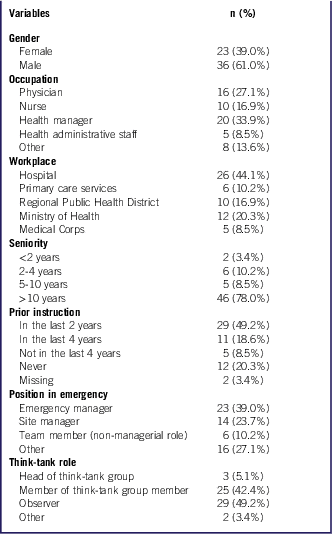
The MOH invited all multi-sector senior and mid-level health care managers from the region’s primary care services, acute-care hospitals, district health bureaus, the military’s Medical Corps, and the national administration of the MOH responsible for the area (n=59), to participate in the think-tanks. See full demographic distribution of the sample in Table 1. The think-tanks comprised a 1-day workshop consisting of the following: (1) presenting the updated situational awareness and overall risk assessment as estimated by the national security authorities; (2) describing existing medical facilities in the region, including their capacities for routine and emergency situations; and (3) 5 stations of “think-tanks,” each focusing on a different topic, as follows: (a) provision of primary care services in the risk zone, including policy for the continuous operation of medical services in community clinics (such as safety and protection of staff and patients, catering for the unique needs of the health care workers, continued provision of vital services [dialysis, chemotherapy, radiotherapy, fertility treatments, laboratory tests], and operation of designated child care centers for children of health care workers), as well as provision of home-care services directly to the needy population (such as ventilated or incapacitated populations or patients in need of distribution of vital pharmaceuticals to their homes); (b) operating hospitals, including report of personnel to place of work despite the potential risk, deployment of facilities that provide ongoing care to employees’ children, providing transportation to and from the hospital, elective procedures (such as diagnostic, cardiac, or cancer surgical procedures), manpower coordination, utilization of unsecure areas, and dealing with a potential need for hospitals’ or patients’ evacuation; (c) casualty evacuation policies, including creation of situational awareness, overcoming transportation constraints, and communication policies; (d) provision of medical services to special-needs populations, risk communication, use of volunteers, and care for self-evacuees that require medical care outside their routine area of residence; and (e) policy for providing health services in an area declared as a “temporary military-closed zone,” including entry of civil health care providers, operation of medical health care facilities, and communication between military and civilian agencies.
Distribution of Studied Sample (n=59)

Senior officials (n=30) were assigned as active members in the think-tanks, to maximize policy-making based on experience. Mid-level personnel (n=29) were appointed as observers, to facilitate their exposure to capacity building and policy-making processes. The participants were divided into 5 groups, each consisting of representatives from the different entities, so as to ensure diversity in experience and scope of operation and to promote a rich discourse. The groups rotated systematically between all the think-tanks, each focusing on a different component that required policy-making.
Discussions in each think-tank lasted 25 minutes. Each think-tank included 2 fixed chairpersons, a rapporteur, participants, and observers. The topics for discussion in each think-tank were pre-prepared by the chairpersons and displayed on the wall throughout the discussion. Each session commenced with a brief explanation of the goals and challenges that necessitate policy or decision-making, followed by a discussion in which each of the participants was requested to provide insights and propose recommendations for policies that should be adopted.
A survey concerning perceived individual and overall emergency preparedness was designed based on a literature review, reviewed for comprehensiveness and content validity by 10 disaster management experts, and pilot tested prior to its use. The survey was filled by all partakers (participants and observers) before (pre-think-tanks; i.e, before the discussions commenced) and following the think-tanks (post-think-tanks; i.e, at the end of the workshop). The survey included 7 demographic questions including participation in prior training programs and role in the workshop. It also included 10 Likert-scale questions for ranking perceptions concerning emergency preparedness, from 1 (completely disagree) to 5 (highly agree). The questions pertained to systemic preparedness (2 questions; Cronbach’s α for pre-post-intervention: 0.697, 0.773, respectively), individual preparedness and role of oneself as well as that of colleagues (capacity to perform roles) perception (4 questions; Cronbach’s α for pre-post-intervention: 0.767, 0.786, respectively), proficiency in risk assessment (2 questions; Cronbach’s α for pre-post-intervention: 0.890, 0.840, respectively), operational continuity (1 question) and whether think-tanks facilitate emergency preparedness (1 question). Though the surveys were filled anonymously, each respondent was requested to mark each questionnaire with the last 4 digits of their social security number, to enable pairing pre-post think-tank responses. The MOH approved the study, based on voluntary participation, informed consent, and anonymity.
Statistical analysis was performed using SPSS Version 22. Paired samples t-test was used to evaluate differences pre-post-think-tanks. Association between categorical and continuous variables was examined with non-parametric tests, that is Mann-Whitney and Kruskal-Wallis with correction for multiple comparisons. Spearman correlation test was used to examine correlations between continuous variables. Indices were generated to reflect the different topics addressed in the questionnaire. Indices’ reliability was assessed using Cronbach’s α test. In all statistical analyses, P-value<0.05 was deemed statistically significant.
RESULTS
Outputs of the think-tanks provided health care leaders with proposed policies for 5 main issues concerning the emerging threats: (1) provision of primary care services; (2) operating hospitals including hospital evacuation, elective procedures, and labor force coordination; (3) casualty evacuation; (4) provision of medical services to special-needs populations; and (5) delivery of medical services in a military-closed zone.
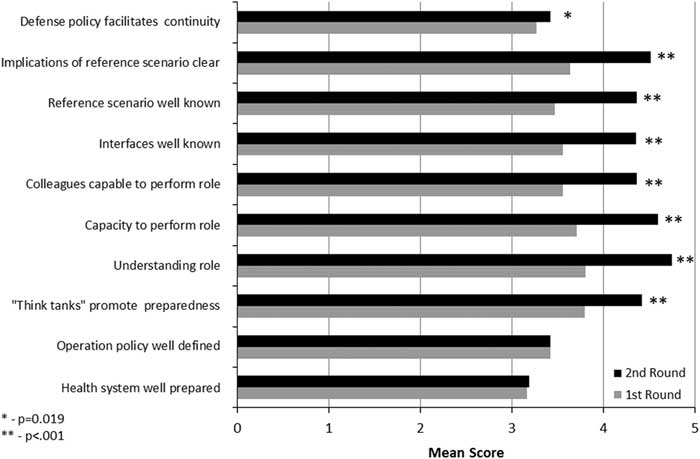
Comparison of perceived emergency preparedness pre-post-think-tanks presented a significant increase in 8 out of 10 elements including knowledge of health care managers concerning their role during emergencies (3.81±0.68 vs 4.75±0.51, respectively; P<0.001); perceived proficiency in performing the role during emergency (3.71±0.67 vs 4.60±0.53, respectively; P<0.001); and perceived proficiency of colleagues in performing their roles during emergency (3.56±0.75 vs 4.37±0.61, respectively; P<0.001). Similar increases were identified in 5 additional elements of the 10 items listed in the questionnaire, with a difference increase of almost 1 point for most items. No increase in perceived systemic emergency preparedness was found (3.17± vs 3.19±0.71, respectively; P>0.05) nor regarding perceived effectiveness of the operation policy (3.42 in both cycles; P>0.05). The perceived emergency preparedness results pre-post the think-tanks are presented in Figure 1.
Perceived Preparedness Pre-Post-Think-Tanks (Paired t-Test; n=59).

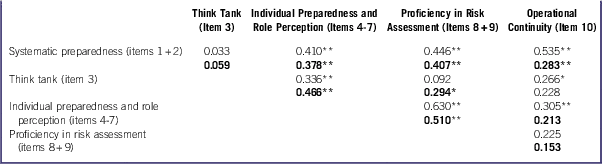
Significant correlations were observed between different indices (Table 2). Most notably, individual preparedness and role perception is positively correlated with all other indices in both pre-post-think-tanks, including systemic preparedness (ρ=0.410 and ρ=0.378; P<0.001, respectively) and proficiency in risk assessment (ρ=0.630 and ρ=0.510; P<0.001, respectively).
Spearman Correlations Between Study Items and Indices—2 RoundsFootnote a

a Pre-intervention on top, post-intervention in bold on bottom; n=59.
*Correlation is significant at the 0.05 level (2-tailed).
**Correlation is significant at the 0.01 level (2-tailed).
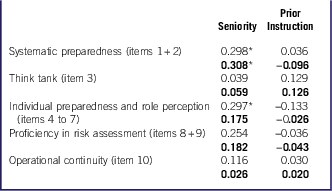
No significant correlations were found between demographic variables and the preparedness perception indices. In particular, no gender-based differences were observed, according to Mann-Whitney test, and no profession, think-tank role, or emergency position-based differences were observed, according to Kruskal-Wallis test. No significant correlations were found between seniority of participants or prior instruction and preparedness perception indices, except between seniority and perception of systematic preparedness, which remained constant in both rounds of questionnaire administration, as can be seen in Table 3.
Spearman Correlations Between Seniority, Prior Instruction and Study Items and Indices—2 roundsFootnote a

a Pre-intervention on top, post-intervention on bottom and bold; n=59.
* Correlation is significant at the 0.05 level (2-tailed).
DISCUSSION
Capacity to manage crises and ensure an effective organizational response is based on plans and procedures that delineate the mechanisms of the responseReference Coetzee, Van Niekerk and Raju 8 , Reference Peleg and Kellermann 9 , Reference Bodas, Siman-Tov, Kreitler and Peleg 11 and the ability of staff members to function effectively and in a timely manner.Reference Adini and Peleg 5 To contribute to the overall emergency preparedness as well as to staff’s confidence in their ability to function according to expectations, an appropriate policy must be developed.Reference Arbon, Ranse and Cusack 13 The plan should limit the need of health care workers to function in variance to their routine environment and positions.Reference Aoyagi, Beck, Dingwall and Nguyen-Van-Tam 15 , Reference Park, Behrouz-Ghayebi and Sury 14 Inadequate policies increase vulnerability to adverse effects,Reference Coetzee, Van Niekerk and Raju 8 , Reference Bodas, Siman-Tov, Kreitler and Peleg 11 negatively impact the staff, and amplify the risk of their being unavailable to report for duty when activated.Reference Arbon, Ranse and Cusack 13 , Reference Aoyagi, Beck, Dingwall and Nguyen-Van-Tam 15
These challenges are even greater when facing emerging threats that may be characterized by elements unfamiliar to the personnel, with consequences that may be unclear.Reference Gunaratna 1 , Reference Liu, Roberts, Petrun Sayers, Ackerman, Smith and Iles 12 Emerging threats disrupt the health care system, create an imbalance between needs and resources, and frequently increase morbidity and mortality. A holistic (all-inclusive, taking into account varied interconnected factors) policy is needed to achieve a “comprehensive vulnerability management” and enable creation and implementation of policies that “attempt to reduce the probability and consequences of disasters.”Reference McEntire 3 Appropriate policies that consider expected and unexpected challenges increase the probability of an effective response and optimize the use of vital resources.Reference Adini, Cohen, Laor and Israeli 6 , Reference Adini, Aharonson-Daniel and Israeli 7
Involvement of field and managerial personnel in the process of policy development contributes to a rapid “adaptation and legitimation of strategies,”Reference Liu, Roberts, Petrun Sayers, Ackerman, Smith and Iles 12 and accordingly to a comprehensive policy.Reference Nohrstedt 10 It makes it possible to consider the perspectives of multi-disciplinary professionals, encourages exchange of information, and facilitates development of more adaptive approaches, thus decreasing risks of adverse consequences.Reference Connolly 2 , Reference Nohrstedt 10
Think-tanks were found to be useful in constructing policies, especially in relation to crises.Reference Pautz 18 They facilitate open discussions, while limiting the time allocated for each speaker, encouraging focus and presentation of recommendations in a concise manner. They expedite adaptation of policies to changing conditions and perspectives, as presented by multi-sector managers.Reference Jarman and Kouzmin 17 They can be highly influential when characterized by independent thinking and lacking self-interest, and when their main lessons learned are easily understood as a result of unambiguous yet authoritative communication.Reference Lingard 19 Consistent with these prior findings, utilization of think-tanks in the present study facilitated the creation of a sound foundation for developing policies concerning the emerging threat of a manmade conflict from extremist groups. Involving multi-sectorial managers in the think-tanks and exposing them to the different facets and challenges of emergency management not only contributed to the construction of holistic policies, but also strengthened mutual influence and broader perspectives.
Comparing perceptions of emergency preparedness among medical managers that participated in think-tanks presented an increase in numerous indices. Involvement in discussing and designing policies concerning the emergent threat resulted in an elevated knowledge of the individual roles of the participants, as well as in perceived competency in performing those tasks. This involvement also contributed to an increased confidence that peer colleagues are capable in performing their roles during crisis. This increased confidence is most significant, as former studies have shown that enhancing perceptions of health care workers concerning self-readiness as well as readiness of colleagues and/or the organization at large for crises, increases commitment to fulfill roles and report to work during such events.Reference Arbon, Ranse and Cusack 13 , Reference Aoyagi, Beck, Dingwall and Nguyen-Van-Tam 15 It also empowers stakeholders to manage predictable and unpredictable multi-casualty events.
Risk assessment is a fundamental element in emergency preparedness since it serves as the basis for preparedness actions such that the response can be planned and structured beforehand. The significant increase in understanding the risk and its implications, as achieved after participating in think-tanks, facilitates the participants’ capacity to consider management alternatives and recommend the most appropriate strategic policies.Reference Prenger-Berninghoff, Cortes and Sprague 4
No significant differences were detected concerning systemic preparedness; the perceived preparedness of the health care system as well as the effectiveness of the operation policy remained constant pre-post participation in the think-tanks. This may suggest that participation in policy-making impacts individual empowerment, including belief in the ability of colleagues, but does not result in an overall confidence that the system is well prepared. Additional actions must be implemented to impact perceptions concerning systemic preparedness.
The lack of correlation between characteristics of the involved participants in the think-tanks and perceived individual or systemic emergency preparedness suggests that investing efforts in involving personnel in policy design can positively impact all members of the health care system.Reference Wong, Stern and Mitchel 16 - Reference Pautz 18 Nonetheless, it should be noted that the personnel involved in the think-tanks included senior and mid-level staff that may not represent populations that are inept in emergency management.
The study’s main limitation is that the impacts of think-tanks were assessed only before and immediately following the workshop. The impact over time should be measured by distributing the survey during additional time frames. Nonetheless, presentation of a single-case study has formerly been reported in the scientific literature for pragmatic reasons and found useful.Reference Pautz 18 In addition, as the differences in pre-post perceived individual emergency preparedness were highly significant, and considering the existing association between perceived preparedness and readiness to report to work during crises, the results hold great merit. Another limitation is that, though the surveys were anonymous, respondents were requested to mark their questionnaires with the last 4 digits of their social security numbers. This may have been a confounder. Two more limitations of the study include: the generalizability of the findings to other countries/regions was not reviewed, and the study did not examine how perception correlates with actual preparedness.
CONCLUSIONS
Health care systems worldwide are required to ensure continuous emergency preparedness for all potential risks. Emerging risks such as social or ideological extremism that threaten neighboring regions necessitate the design of appropriate policies to cope with such events. Think-tanks were proven to be an effective means in designing health policies for emerging threats by involving multi-sector professionals. An important added value to their utilization is the elevated individual perceptions concerning emergency management among the actors involved in think-tanks designated to recommend appropriate policies. This increase in perceived capacities for emergency management has been shown to impact not only self-confidence, but also confidence in the ability of colleagues. These findings should lead to an increase in involvement of both field and managerial officials in the process of policy-making, as a means to empower health care managers and improve interfaces and self-efficacy relevant to preparedness and responsiveness to crises.
Acknowledgments
The authors thank the professionals that participated in the think-tanks for their contribution to both field and scientific emergency preparedness.
Funding
This research did not receive any grant or funding.