Introduction
Autism spectrum disorders (ASD) are lifelong conditions characterized by severe impairments in social interaction and dysfunctional communication, with serious impact on daily life [American Psychiatric Association (APA), 2000]. Although some individuals with ASD show successful adaptation to daily life, many others are at risk for severe deterioration of daily functioning during development (APA, 2000), and some are at risk for very serious psychopathology, such as psychosis, later in life (e.g., Mouridsen, Rich, & Isager, 2008; Stahlberg, Soderstrom, Rastam, & Gillberg, 2004). Results of studies focusing on this risk suggest that specific developmental abnormalities in childhood, such as dysregulation of affective state and primitive anxieties, occur before those children meet the criteria for psychotic disorder or schizophrenia later in life (e.g., Van der Gaag et al., Reference Van der Gaag, Buitelaar, Van den Ban, Bezemer, Njio and Van Engeland1995). In their review, Padgett, Miltsiou, and Tiffin (Reference Padgett, Miltsiou and Tiffin2010) argued that ASD could be a risk factor for psychosis. In a prevalence study on schizophrenia spectrum disorders (SSD) in 241 adults diagnosed with ASD in childhood, up to 7.8% were found to meet criteria for schizophrenia or another psychotic disorder in adulthood (Stahlberg et al., Reference Stahlberg, Soderstrom, Rastam and Gillberg2004). The authors conclude that the risk for psychosis in ASD is clearly higher than in the general population (approximately 1%) (McGrath et al., Reference McGrath, Saha, Welham, El Saadi, MacCauley and Chant2004), and in other developmental disorders (such as ADHD, approximately 5%) (Stahlberg et al., Reference Stahlberg, Soderstrom, Rastam and Gillberg2004). Moreover, Raja and Azzoni (Reference Raja and Azzoni2010) reported that 84.6% of 26 adults with ASD showed psychotic symptoms, and 72.7% had a concurrent diagnosis of schizophrenia. In an earlier study, Volkmar and Cohen (Reference Volkmar and Cohen1991) concluded on the basis of case records of 163 adolescents and adults with autism that the frequency of SSD in ASD is comparable to that in the general population. However, the comparability of their findings to those of more recent studies is restricted, since approximately 50% of their patients were mute. Other studies focussing on the presence of ASD in SSD found that in 25–50% of patients childhood-onset schizophrenia was preceded by and comorbid with ASD (Rapoport, Chavez, Greenstein, Addington, & Gogtay, Reference Rapoport, Chavez, Greenstein, Addington and Gogtay2009; Sporn et al., Reference Sporn, Addington, Gogtay, Ordonez, Gornick, Clasen and Rapoport2004). The link between ASD and SSD symptoms is emphasized by findings of increased prevalence of SSD in parents of children with ASD, suggesting genetic associations (Larsson et al., Reference Larsson, Eaton, Madsen, Vestergaard, Olesen, Agerbo and Mortensen2005; Daniels et al., Reference Daniels, Forssen, Hultman, Cnattingius, Savitz, Feychting and Sparen2008). Therefore, it is considered crucial to identify developmental markers of high vulnerability to SSD in children and adolescents with ASD to (1) understand developmental mechanisms that might lead to severe psychopathology (SSD), and by understanding these mechanisms (2) to be able to identify highly vulnerable individuals early in life and possibly limit their developmental risk by protective interventions.
Although according to DSM-IV-standards ASD and SSD have distinct classification criteria, the similarity of the clinical presentation of the two neurodevelopmental disorders has been a topic of scientific dispute for many decades. Kolvin (Reference Kolvin1971) and Rutter (Reference Rutter1972) argued that ASD and SSD are mutually exclusive categorical diagnoses with distinct developmental pathways. The term autism, however, was coined by Bleuler (Reference Bleuler1911) to characterize social impairments seemingly characteristic of schizophrenia. In addition, Bender (Reference Bender1947) argued that ASD could be an age-specific expression of a developmental disorder characterized by schizotypal symptoms in adulthood. As Padgett et al. (Reference Padgett, Miltsiou and Tiffin2010) argued, a relation between ASD and SSD may be explained by the possibility that ASD predisposes to SSD, they are different expressions of the same disorder, or they are separate but related disorders, due to shared genetic or environmental risk factors. From a clinical perspective, behavioral symptoms are important cues by which the risk for psychosis in ASD is determined. Both disorders share deficits in social behavior, oddness of speech, unusual responsiveness to the environment, and inappropriate affect. A study of the similarities and differences at a phenotypical level may reveal risk factors for SSD in ASD. Recently, Barneveld et al. (Reference Barneveld, Pieterse, De Sonneville, Van Rijn, Lahuis, Van Engeland and Swaab2011) reported that it was specifically attention switching problems in ASD that were associated with identified positive (distorted thought and perception) and negative symptoms (constricted affect and social anxiety), as well as disorganized schizotypal behavior (odd speech and eccentric behavior), suggesting that deficits in cognitive control functions, such as attention regulation, might signal a risk for SSD in ASD.
Regarding neurocognitive mechanisms of vulnerability, it is argued that problems with attention regulation in ASD may indicate reduced abilities to switch to alternative cognitive strategies (Fugard, Stewart, & Stenning Reference Fugard, Stewart and Stenning2011), possibly reflecting mental inflexibility and failures to inhibit inappropriate actions. These executive function (EF) deficits may be associated with rigidity and perseveration in ASD (e.g., Hill, Reference Hill2004a). EF deficits might also explain difficulties in regulating thoughts and feelings (Gioia & Isquith, Reference Gioia and Isquith2004), and so contribute to the risk for SSD (e.g., Solomon, Ozonoff, Carter, & Caplan, Reference Solomon, Ozonoff, Carter and Caplan2008). Therefore, we examined whether or not EF deficits are related to SSD symptomatology in ASD, and sought to identify specific cognitive control deficits as markers of vulnerability to SSD pathology in ASD.
There is extensive literature concerning EF dysfunction for both ASD and SSD. The executive dysfunction theory (Ozonoff, Reference Ozonoff1997) attempts to explain autistic symptomatology, and although the claim that EF is a singular causal factor is controversial and evidence for an unique EF profile in ASD is weak (Kenworthy, Yerys, Anthony, & Wallace, Reference Kenworthy, Yerys, Anthony and Wallace2008), many reviews confirm that EF deficits are found in ASD, including abnormalities in cognitive flexibility, generation of ideas, planning, and working memory (e.g., Hill, Reference Hill2004a, Reference Hill2004b; Kenworthy et al., Reference Kenworthy, Yerys, Anthony and Wallace2008). The investigation of response inhibition in ASD has yielded conflicting results. Meta-analytic studies reported that it is specifically inhibition of prepotent responses that is impaired, whereas other inhibition functions are affected less, such as negative priming and neutral inhibition conditions (e.g., Hill Reference Hill2004a, Reference Hill2004b). Evidently, EF is a broad concept comprising a variety of disparate functions (Miyake et al., Reference Miyake, Friedman, Emerson, Witzki, Howerter and Wager2000), and it is important to consider which specific EF deficits might underlie autistic symptoms. For example, deficits in specific EF domains such as verbal fluency and generation of ideas are associated with communication symptoms in ASD (Dichter, Lam, Turner-Brown, Holtzclaw, & Bodfish, Reference Dichter, Lam, Turner-Brown, Holtzclaw and Bodfish2009). Difficulties in other EF domains, such as semantic fluency, are linked to social interaction problems (Kenworthy, Black, Harrison, Della Rosa, & Wallace, Reference Kenworthy, Black, Harrison, Della Rosa and Wallace2009). Impairments in core EF domains: cognitive flexibility, working memory, and response inhibition are associated with repetitive, stereotyped behavior in ASD (e.g., Hill, Reference Hill2004a; Yerys et al., Reference Yerys, Wallace, Harrison, Celano, Giedd and Kenworthy2009).
EF deficits are also considered core neurocognitive abnormalities regarding SSD (e.g., Nieuwenstein, Aleman, & De Haan, Reference Nieuwenstein, Aleman and De Haan2001), and are suggested as putative endophenotypic markers for schizophrenia (e.g., Eisenberg & Berman, Reference Eisenberg and Berman2010). Meta-analyses relating EF to SSD symptoms indicate that poor EF is related predominantly to negative symptoms (e.g., Dibben, Rice, Laws, & McKenna, Reference Dibben, Rice, Laws and McKenna2009) and to disorganization symptoms (e.g., Nieuwenstein et al., Reference Nieuwenstein, Aleman and De Haan2001). A meta-analysis by Johnson-Selfridge and Zalewski (Reference Johnson-Selfridge and Zalewski2001) reported correlations between poor EF and positive symptomatology, but these findings were not confirmed in other reviews (Dibben et al., Reference Dibben, Rice, Laws and McKenna2009; Nieuwenstein et al., Reference Nieuwenstein, Aleman and De Haan2001; Ventura, Hellemann, Thames, Koellner, & Nuechterlein, Reference Ventura, Hellemann, Thames, Koellner and Nuechterlein2009). To clarify these inconsistencies it would be useful to examine whether or not SSD symptoms are associated with specific EF deficits (Nieuwenstein et al., Reference Nieuwenstein, Aleman and De Haan2001; Vollema & Postma, Reference Vollema and Postma2002). Following Dibben et al. (Reference Dibben, Rice, Laws and McKenna2009), it is argued that negative symptoms should be associated particularly with difficulties in generating ideas, whereas disorganization should be associated with response inhibition problems. In addition, Guillem, Rinaldi, Pampoulova, and Stip (Reference Guillem, Rinaldi, Pampoulova and Stip2008) focused on positive symptomatology and also found complex relations between specific aspects of positive symptoms and discrete EF processes.
There is no known study on the relation between EF functions and both ASD and SSD symptomatology. However, Solomon et al. (Reference Solomon, Ozonoff, Carter and Caplan2008) investigated whether illogical thinking, which refers to schizophrenia-related pragmatic language impairments and unusual verbal behavior, is related to EF in ASD children. They reported relations between response inhibition problems and illogical thinking, suggesting that response inhibition might be a candidate marker of SSD vulnerability in ASD. In our study we also aimed to identify specific cognitive markers for vulnerability to SSD pathology in ASD, especially response inhibition and other core EF domains (i.e., mental flexibility, visuo-motor control, interference control, and perseveration) representing various aspects of cognitive control. This was examined in adolescents with ASD, so that we could identify vulnerability to SSD at an early stage (e.g., Frangou, Reference Frangou2010). Therefore, the focus is on identifying associations between EF deficits and schizotypal symptoms that could already emerge during adolescence as a precursor of the risk for SSD.
Methods
Design
This study is part of a longitudinal study on the cognitive and social-emotional development of patients referred to the Department of Child and Adolescent Psychiatry at the University Medical Centre Utrecht, the Netherlands, between 1998 to 2004. Patients were admitted for a short period for observation and elaborate diagnostic assessment and diagnosed with ASD at childhood. They were re-examined at adolescence during 2007 and 2008 with a mean follow-up period of 6 to 7 years. The study was approved by the medical ethics committee (number 05-319/K), and written informed consent was obtained according to the declaration of Helsinki.
Participants
Twenty-nine adolescents with ASD (10 to 18 years) and 40 typically developing (TD) controls, matched on age and gender, participated in the study. Fifty-five patients diagnosed with ASD at childhood were sent a letter informing them about the aims of the study and asking them to participate. Fifteen adolescents refused participation, leaving 40 adolescents eligible for the study. No differences in gender distribution (p = .070) and age at referral (p = .113) were found between the potential participants and those who refused participation. Reasons for nonparticipation were: no interest or time (47%), a wish not to put too much stress on the adolescent (40%), or parents divorcing (13%).
The participants had to meet the following inclusion criteria. First, a diagnosis of ASD at childhood was required, based on full agreement between two board-certified psychiatrists. Semi-structured DSM-focused interviews, observations, medical records, and structured questionnaires were included in the diagnostic process. During the follow-up period, the ASD diagnoses were validated by the Autism Diagnostic Interview – Revised (ADI-R) (Lord, Rutter, & Le Couteur, Reference Lord, Rutter and Le Couteur1994). A diagnosis of ASD required a score meeting the cutoff criteria on a minimum of two domains, including the ADI-R reciprocal social interaction domain and either the communication or the restricted activities/interests domain (Bölte, Westerwald, Holtmann, Freitag, & Poustka, Reference Bölte, Westerwald, Holtmann, Freitag and Poustka2011). The second inclusion criterion was an IQ of 70 or higher. Eight adolescents were excluded because they failed to meet the ADI cutoff criteria, and three adolescents were excluded because they had an IQ below 70, leaving 29 adolescents with ASD (21 boys, 8 girls) participating. The mean age was 14.72 (SD = 2.1; min = 10.94; max = 18.45). The mean ADI social interaction score was 19.73 (SD = 5.1), for communication 13.97 (SD = 3.6), and for restricted activities/interests 3.86 (SD = 2.7). Seventeen participants (59%) met ADI cutoff criteria on all three domains, 12 adolescents (41%) met criteria on two domains. Although the DSM discourages diagnosing anyone before 18 years with a personality disorder, when a board-certified psychiatrist described the schizotypal symptoms (instability of functioning, affect dysregulation and high levels of anxieties) in the ASD group at time of referral, it was found that 12 participants (41%) would have met the criteria for a schizotypal personality disorder (DSM-IV-TR 301.22), which indicates serious developmental risks in these children.
The TD group consisted of 40 adolescents (32 boys, 8 girls; Age: M = 15.22; SD = 2.5; min = 10.27; max = 18.80), recruited by contacting regular public secondary schools. All individuals had an IQ of 70 or higher and had to be free of problem behavior (i.e., total problem scores must be below the clinical cutoff score of 70 on the Child Behavior Checklist; Achenbach, Reference Achenbach1986). No difference in age (p = .384) and gender distribution (p = .461) was found between the ASD and TD groups.
Measures
Group descriptives
Global IQ was estimated via the Vocabulary and Block Design subtests of the Wechsler Intelligence Scales for Children (WISC-IIINL; Wechsler, Reference Wechsler2002) or Adults (WAIS-IIINL; Wechsler Reference Wechsler2005).
Schizotypal symptoms
SSD symptomatology was appraised using the revised Schizotypal Personality Questionnaire with proven reliability and validity (SPQ; Raine, Reference Raine1991). The SPQ is a 74-item self-report measure modelled on DSM-III-R criteria for schizotypal personality disorder, with high scores being indicative of a diagnosis of schizotypal personality disorder (Raine, Reference Raine1991) and of genetic vulnerability to schizophrenia (Vollema & Postma, Reference Vollema and Postma2002). Score distribution in the general population is normal and, therefore, suitable for correlation analyses with cognitive performance scores. A factor-analytic study conducted in a psychiatric population revealed three dimensions: positive schizotypy (e.g., referential and delusional thinking), negative schizotypy (e.g., constricted affect and social anxiety), and disorganization (odd speech and eccentric behavior) (Vollema & Hoijtink, Reference Vollema and Hoijtink2000). Although a different factor solution was found in a student population (Chmielewski & Watson, Reference Chmielewski and Watson2008), we chose the factor structure that is commonly used in studies assessing the presence of SSD (Vollema & Hoijtink, Reference Vollema and Hoijtink2000).
Autism symptoms
ASD symptomatology was assessed via the Autism-Spectrum Quotient (AQ; Baron-Cohen, Wheelwright, Skinner, Martin, & Clubley, Reference Baron-Cohen, Wheelwright, Skinner, Martin and Clubley2001), a 50-item self-report questionnaire assessing the degree to which an individual may have features of ASD: poor social skills, poor attention switching, exceptional attention to detail, poor communication skills, and poor imagination. Several studies have indicated that the AQ is effective at distinguishing individuals with ASD from TD individuals (e.g., Baron-Cohen et al., Reference Baron-Cohen, Wheelwright, Skinner, Martin and Clubley2001). Score distribution in the general population is normal (Hurst, Mitchell, Kimbrel, Kwapil, & Nelson-Gray, Reference Hurst, Mitchell, Kimbrel, Kwapil and Nelson-Gray2007). Psychometric properties and validity have been established in several studies (e.g., Hurst, Nelson-Gray, Mitchell, & Kwapil, Reference Hurst, Nelson-Gray, Mitchell and Kwapil2007). However, the use of self-reports for ASD patients may involve limitations due to difficulties in self-reflection. Baron-Cohen et al. (Reference Baron-Cohen, Wheelwright, Skinner, Martin and Clubley2001) addressed this issue and found sufficient support for the assumption that high-functioning ASD patients are able to report their own preferences and describe what they find easy or difficult. Therefore, the AQ is evaluated as a valuable instrument for quantifying autistic symptomatology of high-functioning ASD patients, although findings should be interpreted with caution.
Cognitive control measures
The EF processes of response inhibition, mental flexibility, and visuo-motor control under conditions varying in EF demands, were measured by performances on computerized tasks taken from the Amsterdam Neuropsychological Tasks (ANT) (De Sonneville, Reference De Sonneville2005). The ANT is used extensively to examine EF processes in various patient populations, which points to the sensitivity of this assessment battery to deficits in neuropsychological functions (e.g., Slaats-Willemse, De Sonneville, Swaab-Barneveld, & Buitelaar, Reference Slaats-Willemse, De Sonneville, Swaab-Barneveld and Buitelaar2005) and its reliability and validity (e.g., Huijbregts, Swaab-Barneveld, & De Sonneville, Reference Huijbregts, Swaab-Barneveld and De Sonneville2010). In addition, the EF processes of interference control and perseveration were assessed via the Wisconsin Card Sorting Test (WCST; Heaton, Chelune, Talley, Kay, & Curtiss, Reference Heaton, Chelune, Talley, Kay and Curtiss1993).
Response inhibition
Inhibition of a prepotent response was assessed by the ANT subtest “Shifting attentional Set.” A colored square jumps randomly on a bar to the right or left. Depending on the colour of the square, the participant has to execute a compatible (pressing the key in the same direction) or an incompatible response (opposite direction). This test consists of three parts. The first part requires compatible responses (fixed compatible condition), the second part requires incompatible responses (fixed incompatible condition), for which it is imperative to inhibit the prepotent responses of the first part. Response inhibition leads to slower, less stable, and less accurate responses and is evaluated by contrasting parts one and two on speed (mean latency), fluctuation in speed (standard deviation of mean latency), and accuracy (percentage of errors) (e.g., Huijbregts, De Sonneville, Licht, Sergeant, & Van Spronsen, Reference Huijbregts, De Sonneville, Licht, Sergeant and Van Spronsen2002).
Mental flexibility
Mental flexibility was assessed by the same ANT subtest, “Shifting attentional Set.” In the third part the color varies (random condition), requiring mental flexibility by continuously adjusting the response. Flexibility is evaluated by contrasting part one and the compatible condition of part three on speed, fluctuation in speed, and accuracy (e.g., Huijbregts et al, Reference Huijbregts, De Sonneville, Licht, Sergeant and Van Spronsen2002).
Visuo-motor control
Visuo-motor control was assessed by contrasting the performance of two ANT eye-hand coordination tasks, “Tracking” and “Pursuit.” In the tracking task the participant has to draw a circle by moving the cursor in-between two concentric circles, so that planning and execution of automatized movements can be measured. The pursuit task requires the participant to continuously track a target moving randomly across the screen. Because the trajectory is unpredictable, we assessed the concurrent planning and execution of a non-automatized movement requiring continuous adaptation to follow a randomly moving target. This task imposes higher EF demands than the tracking task (Slaats-Willemse et al., Reference Slaats-Willemse, De Sonneville, Swaab-Barneveld and Buitelaar2005). EF-dependent visuo-motor control was assessed by contrasting the performance on the tasks on accuracy (mean distance to the target) and fluctuation in accuracy (standard deviation of the mean distance) (Rommelse et al., Reference Rommelse, Altink, Oosterlaan, Buschgens, Buitelaar, De Sonneville and Sergeant2007).
Interference control and perseveration
Interference control and perseveration were assessed by the computerized version of the WCST (Heaton et al., Reference Heaton, Chelune, Talley, Kay and Curtiss1993), based on a rule-learning paradigm. Interference control was operationalized by the failure to maintain set (i.e., the number of failures to complete a card-sorting set after at least five correct consecutive sorts), as this score reflects the vulnerability to interference with ongoing processing (Andrewes, Reference Andrewes2001). Perseveration was operationalized by contrasting the numbers of perseveration errors (i.e., the participant continues sorting the previous correct category despite negative feedback) and non-perseveration errors (Loring, Lezak, & Howieson, Reference Loring, Lezak and Howieson2004).
Statistical Analyses
Differences between groups on the questionnaires were tested using univariate (total SPQ and AQ) and multivariate (subscales of the SPQ and AQ) analyses of variance (ANOVAs). The degree of relation between schizotypal symptoms (total SPQ) and autistic symptoms (total AQ) was examined within the ASD group by partial correlations, controlling for age (r), (small effect size: r = 0.1–0.23; medium: r = 0.24–0.36; large: r ≥ 0.37) (Cohen, Reference Cohen1992). An exploratory factor analysis was performed on the total sample to determine how SSD and ASD symptoms are related. The AQ and SPQ subscales were entered in a principal component analysis, with oblimin rotation, allowing for some correlation between factors. Response inhibition, mental flexibility, visuo-motor control, and perseveration were operationalized as the contrast between performance on one condition (one task or part of a task) and the performance on another condition. Contrasts were entered as levels of within-subject (WS) factors in GLM repeated-measures ANOVAs. Separate runs were made with speed, flexibility in speed, accuracy, and fluctuations in accuracy on the set-shifting task or the visuo-motor coordination tasks as dependent variables. The Group × WS factor interactions reflect the extent to which differences between groups are condition or task dependent. Differences in interference control were tested by univariate ANOVA. Because of the wide age range and because EF tends to develop progressively during this period, age was used as a covariate in all analyses. To verify whether or not our findings were consistent across age, the ASD and TD groups were (median) split into a young and an older group, and an ANCOVA repeated-measures design was run, with Group (ASD vs. TD) and Age group (young vs. old) as between-subjects (BS) factors and Inhibition as WS factor. As recommended by Dennis et al. (Reference Dennis, Francis, Cirino, Schachar, Barnes and Fletcher2009) IQ was not used as a covariate, because controlling for IQ removes variability in the outcome measure that is related to EF. Alpha was set to 0.05, and partial eta squared (ηp2) was computed to estimate effect sizes (weak effect: ηp2∼0.03; moderate: ηp2∼0.06; large: ηp2 ≥ 0.14) (Stevens, Reference Stevens1986). The degree of relation between the EF tasks and schizotypal and autistic symptoms (SPQ and AQ subscales) was examined within the ASD group by partial correlations controlling for age. We have refrained from executing regression analyses involving all EF measures, as the number of participants is too small to yield a stable solution. To verify the impact of age, bivariate correlation analyses were run separately for the young and old patients. For these correlational analyses, alpha was set to 0.01 to compensate for the effect of multiple testing. When significant correlations were found, group differences on EF tasks were re-analyzed adding total AQ and SPQ scores, respectively, as a covariate to examine the specificity of relations between EF and schizotypal, or EF and autistic symptomatology.
Results
There was a significant difference in global intelligence between the ASD group (M = 94.34; SD = 13.5) and the TD group (M = 111.62; SD = 12.1) (F(1,66) = 29.49; p < .0001; ηp2 = .309). Within the ASD group a significant partial correlation was found between the mean levels of schizotypal and of autistic traits (r = .35; p = .038), with a proportion of explained variance of 12%. This relation did not change substantially when age was not controlled for (r = .44; p = .011). In the factor analysis, three factors were extracted, explaining 83% of the variance. Factor 1 refers to autistic symptoms, with major loadings of the AQ subscales Imagination (.91), Social skills (.91), Communication (.66), and Attention switching (.54), and one additional loading of the SPQ subscale Negative symptoms (.50). Factor 2 refers to schizotypal symptoms, with major loadings of all SPQ subscales: Positive symptoms (.94), Disorganized behavior (.87), and Negative symptoms (.65). A third factor consisted of a major loading of the AQ subscale Attention to details (.99).
Schizotypal Symptoms
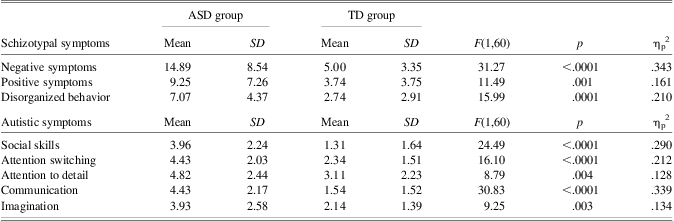
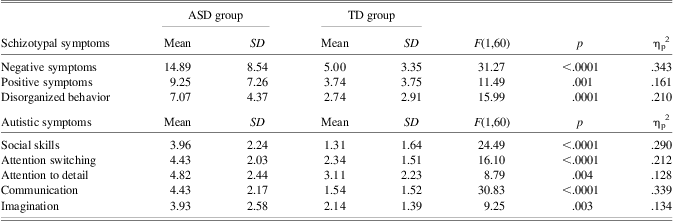
The mean total SPQ score was significantly higher in adolescents with ASD (M = 31.21; SD = 16.8) than in TD adolescents (M = 11.20; SD = 7.7) (F(1.60) = 31.21; p < .0001, ηp2 = .342). The multivariate analysis of the SPQ subscales confirmed this outcome, more schizotypal symptomatology was found in the ASD group than in the TD group (F(3,58) = 11.19; p < .0001; ηp2 = .367), the scores on all SPQ dimensions were significantly higher in adolescents with ASD; with large effect sizes (Table 1). Total SPQ score differences between the young and old ASD patients were not significant (p = .269).
Levels of schizotypal and autistic symptomatology in adolescents with ASD as compared to typically developing adolescents
Autistic Symptoms
The mean total AQ score was significantly higher in the ASD group (M = 21.61; SD = 7.4) than in the TD group (M = 10.49; SD = 5.8) (F(1,60) = 37.08; p < .0001; ηp2 = .382). The multivariate analysis of the AQ subscales confirmed this outcome in that the the adolescents with ASD displayed more autistic symptoms than TD adolescents (F(5,56) = 7.67; p < .0001, ηp2 = .406), significantly higher scores were found in all AQ domains; with moderate to large effect sizes (Table 1). Total AQ score differences between the young and older ASD patients were not significant (p = .195).
Response Inhibition
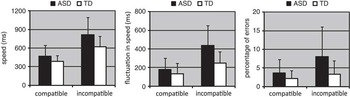
Group interacted with stimulus-response mapping for speed (F(1,60) = 4.33; p = .042; ηp2 = .067), fluctuation in speed (F(1,59) = 5.40; p = .024; ηp2 = .084), and accuracy (F(1,57) = 4.29; p = .043; ηp2 = .070) (Figure 1), which indicates that these differences between ASD and TD adolescents increase under incompatible conditions, reflecting problems in inhibiting prepotent responses in adolescents with ASD. Adding Age (young vs. old) as a second BS factor resulted in a significant Group × Inhibition(speed) interaction (p = .011; ηp2 = .10), signifying that the ASD patients have problems with response inhibition, which confirms the above result. The 2nd-order interaction (Group × Inhibition × Age) is not significant (p = .39), which indicates that the interaction is consistent across age. Similar results were found for fluctuation in speed and accuracy.
Response inhibition: performance in speed (left), fluctuation in speed (middle) and accuracy (right) during the compatible and incompatible condition on the set-shifting task by group (mean and standard deviation).

Mental Flexibility
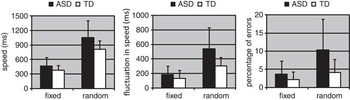
The interaction of stimulus-response mapping with group approached significance for speed (F(1,60) = 3.57; p = .064; ηp2 = .056) and was significant for fluctuation in speed (F(1,59) = 6.39; p = .014; ηp2 = .098), and for accuracy (F(1,57) = 5.64; p = .021; ηp2 = .090) (Figure 2), which indicates that these differences between groups increase under random conditions, demonstrating deficits in mental flexibility in adolescents with ASD.
Mental flexibility: performance in speed (left), fluctuation in speed (middle) and accuracy (right) during the fixed and random condition on the set-shifting task by group (mean and standard deviation).

Visuo-motor Control
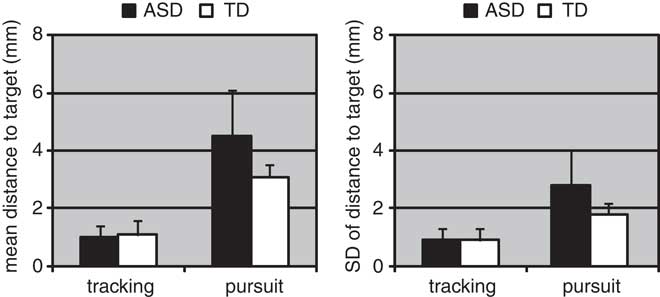
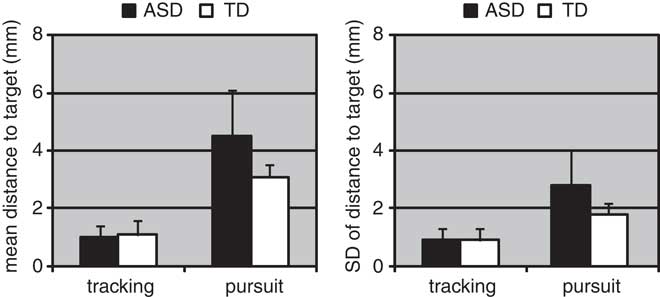
Significant Group × Task interactions were found concerning accuracy (F(1,57) = 15.47; p < .0001; ηp2 = .213) and fluctuation in accuracy F(1,56) = 8.45; p = .005; ηp2 = .131) (Figure 3). Differences in accuracy and fluctuation in accuracy between ASD and TD adolescents were larger on the pursuit task than on tracking task, reflecting the effect of higher EF demands.
Visuo-motor control: performance in accuracy (left) and fluctuation in accuracy (right) on the tracking and pursuit task by group (mean and standard deviation).
Interference Control
A significant group difference for interference control was found (F(1,65) = 6.13; p = .016; ηp2 = .086); adolescents with ASD failed more frequently to maintain set than TD adolescents, suggesting difficulties to control their attention.
Perseveration
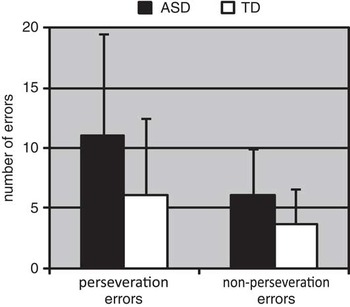
Adolescents in the ASD group made more errors than TD controls (F(2,58) = 3.82; p = .028; ηp2 = .116): not only more perseverative errors (F(1,59) = 5.51; p = .022; ηp2 = .085) but also more non-perseverative errors (F(1,59) = 6.89; p = .011; ηp2 = .105). Perseveration did not interact significantly with group (p = .166) (Figure 4), which indicates that perseveration does not discriminate between groups.
Perseveration: number of perseveration errors in contrast with non-perseveration errors on the Wisconsin Card Sorting Test (WCST) by group (mean and standard deviation).

Correlations of EF Functions with Schizotypal and Autistic Symptoms
Within the ASD group no significant correlations were found between any measure of cognitive control and degree of autistic symptomatology. The same result was found with regard to schizotypal symptoms, with the exception of response inhibition. Significant partial correlations were found between response inhibition (accuracy) and Total SPQ score (r = .58; p = .001) as well as SPQ Positive symptoms (r = .52; p = .003) and Disorganized behavior (r = .68; p < .001), resulting in, respectively, 34%, 27%, and 46% explained variance. The correlation between response inhibition (accuracy) and SPQ Negative symptoms approached significance (r = .35; p = .040). In addition, a significant correlation was found between response inhibition (fluctuation in speed) and Disorganized behavior (r = .47; p = .007), with 22% explained variance. The bivariate correlation analyses, run for the young and older patients separately, resulted in similar outcomes (for example: the correlation between SPQ total score and inhibition (accuracy) was r = .58 in the younger group and r = .51 in the older group). Similar results were found for the other associations, which confirms that these findings are consistent across age. In addition, the results are probably unrelated to an overlap between the AQ and SPQ scores, since the correlations between response inhibition and SPQ scores remained significant after we controlled for the influence of autistic symptoms (e.g., correlation between response inhibition (accuracy) and Total SPQ score, with the Total AQ score as covariate: r = .59; p = .001).
To verify that response inhibition deficits in the ASD sample were related to the presence of schizotypal symptoms, we again ran the repeated measures ANOVA on response inhibition: Group × Inhibition (accuracy) interactions disappeared when using the SPQ total (p = .823), SPQ Positive (p = .425), or Disorganized behavior (p = .787) score as a covariate. The Group × Inhibition (fluctuation in speed) interaction also disappeared when controlling for the SPQ Disorganized behavior score (p = .130).
Discussion
The objective of this study was to examine whether deficits in cognitive control contribute to SSD symptomatology in ASD, and if possible to identify specific vulnerability markers indicating a risk for SSD in adolescents diagnosed with ASD in early childhood. The outcome revealed high levels of schizotypal symptomatology and a substantial level of impaired cognitive control in adolescents with ASD, that is, problems with inhibiting prepotent responses, mental flexibility, visuo-motor control with high EF demands, and difficulties in controlling interference. Only impaired response inhibition in ASD was associated with schizotypal symptoms, whereas we did not find any significant associations between measures of cognitive control and ASD symptomatology. The specificity of this result is emphasized by the finding that, after controlling for schizotypal symptoms, response inhibition does no longer discriminate between groups, suggesting that impaired response inhibition in ASD is mainly associated with the presence of schizotypal symptoms. We, therefore, suggest that impaired response inhibition might be a marker of vulnerability to SSD symptoms developing in ASD.
The presence of schizotypal symptoms co-occurring with ASD symptoms emphasizes the relevance of examining comorbidity in researching ASD. This underscores that inconsistencies in the literature concerning inhibition in ASD can be explained by high numbers of comorbidity factors (Kenworthy et al., Reference Kenworthy, Yerys, Anthony and Wallace2008). Meta-analytic studies on inhibition functions report that inhibition of prepotent responses is specifically impaired in ASD (e.g., Hill, Reference Hill2004a), as we also found in our study. Moreover, our findings suggest that of the EF domain, it is specifically response inhibition deficits in ASD that could indicate high risk for developing SSD symptoms. Others have related inhibition problems to degrees of schizotypal traits in other disorders associated with increased vulnerability to SSD pathology as well (Van Rijn, Aleman, De Sonneville, & Swaab, Reference Van Rijn, Aleman, De Sonneville and Swaab2009).
Regarding the relation between specific EF deficits and various separate dimensions of schizotypy, deficiencies in inhibiting responses were associated with disorganized behavior and positive symptoms, which explains 46% and 27% of variance, respectively. These findings are reflected in the results of the meta-analysis by Dibben et al. (Reference Dibben, Rice, Laws and McKenna2009), in which the failure to inhibit responses was associated with disorganized symptoms. However, where Dibben's results were found in adults with schizophrenia, our findings indicate that impaired response inhibition is related to schizotypal symptomatology within an ASD sample already in adolescence.
Our findings clearly show cognitive control deficits in adolescents with ASD with a relatively high mean IQ, so that replication of these findings for other IQ levels is necessary. However, we found no problems with perseveration, which is inconsistent with other studies. Meta-analyses report that persons with ASD (e.g., Hill, Reference Hill2004a, Reference Hill2004b) and SSD (e.g., Laws, Reference Laws1999) are highly perseverative in their responses on the WCST. Inconsistencies in findings are probably related to differences in how perseveration is operationalized. Most studies report an absolute number of perseveration errors, whereas others, as for instance we also did, report proportional measures (i.e., perseveration errors relative to non-perseveration errors), which represents a more valid operationalization. Consistent with our results, in the meta-analysis by Laws, reviewing WCST analyses in SSD, a medium effect size for the number of perseveration errors was found, but the effect size for the proportion of perseverative errors appeared to be small (Laws, Reference Laws1999).
Although we found high levels of autistic symptomatology and a substantial level of impaired cognitive control within the ASD sample, no significant correlations were found between cognitive control measures and the degree of autistic symptomatology. This is probably due to the small range of scores. An alternative explanation may be that the lack of correlation is related to the limitations of self-report in these ASD patients, so that replication of these findings by other instruments, such as observation scales, is advisable to further validate this finding.
Our results indicate that adolescents with ASD show SSD traits. A relation was found between schizotypal and autistic traits (12% explained variance), suggesting a correspondence in diagnostic criteria between both spectrum disorders. For more detailed discussion see Barneveld et al. (Reference Barneveld, Pieterse, De Sonneville, Van Rijn, Lahuis, Van Engeland and Swaab2011), which reports specific associations between autistic symptoms and negative, disorganized and positive schizotypal symptoms.
An exploratory factor analysis was performed to rule out the possibility that any overlap between SSD and ASD symptoms is a result of two questionnaires measuring the same construct. The AQ and SPQ appeared to differentiate between symptomatology: one factor referred to autistic symptoms and another factor to schizotypal symptoms. Negative symptoms loaded on both factors. This SPQ scale which reflects constricted affect and social anxiety, comprises symptoms that clinically correspond with autistic symptoms (Bleuler, Reference Bleuler1911), in line with studies reporting schizotypal negative symptoms in ASD (Dykens, Volkmar, & Glick, Reference Dykens, Volkmar and Glick1991; Rumsey, Andreasen, & Rapoport, Reference Rumsey, Andreason and Rapoport1986).
Out of concern for the wide age range, younger and older ASD patients’ AQ and SPQ scores were examined and found not to differ significantly from each other. In addition, analyses using age as a second BS factor (young vs. old) and the bivariate correlations per age group were run, and confirmed that the findings were consistent across age.
Several limitations of our study should be mentioned. The information obtained from questionnaires was affected by the limitations inherent in self-report. This specifically applies to young ASD adolescents, who may have difficulties judging their own behavior. In addition, the inclusion of a high-functioning ASD population limits the representativeness of the sample and precludes generalizability to the whole autistic spectrum. Moreover, ascertainment bias possibly influenced results in an unpredictable way (27% refused participation), although no differences on demographics were found between participants and nonparticipants. Furthermore, although high levels of schizotypal symptoms were found in ASD patients, it is impossible to determine whether schizotypal problems are qualitatively equal to those found in SSD patients. Finally, patients with ASD often show symptoms of many other psychiatric disorders besides SSD (e.g., attention deficit/hyperactivity disorder, social anxiety disorder; Simonoff et al., Reference Simonoff, Pickles, Charman, Chandler, Loucas and Baird2008), and EF deficits are related to other neurodevelopmental disorders. Whether response inhibition is specifically associated with schizotypal symptomatology in ASD and not with coexisting symptoms of other psychiatric disorders remains to be investigated.
In conclusion, we found high levels of schizotypal symptomatology in adolescents with ASD and considerable cognitive control deficits. Impaired response inhibition appeared to be strongly associated with positive and disorganized schizotypal symptoms, which clearly suggests that impaired response inhibition is a vulnerability marker for the development of SSD pathology within ASD already during adolescence. We recommend a follow-up study to examine whether these response inhibition problems in ASD are predictors for full-threshold psychotic illness.
Acknowledgment
For this research we have received no specific grant from any funding agency, whether commercial or non-profit sectors. The authors report no conflict of interest.