




No CrossRef data available.
Strategic Calculation and International Socialization: Membership Incentives, Party Constellations, and Sustained Compliance in Central and Eastern Europe
Published online by Cambridge University Press: 18 October 2005
Abstract
This article uses a rationalist approach to explain the international socialization of Central and Eastern Europe to liberal human rights and democracy norms. According to this approach, socialization consists in a process of reinforcement, and its effectiveness depends on the balance between the international and domestic costs and benefits of compliance over an extended period of time. EU and NATO accession conditionality has been a necessary condition of sustained compliance in those countries of Central and Eastern Europe that violated liberal norms initially. The pathways and long-term outcomes of international socialization, however, have varied with the constellations of major parties in the target states. Whereas conditionality has been effective with liberal and mixed party constellations, it has failed to produce compliance in antiliberal regimes. In the empirical part of the article, these propositions are substantiated with data on the development of liberal democracy in Central and Eastern Europe and case studies on Slovakia and Latvia.For useful comments on earlier versions, I thank the participants of the IDNET workshop seminars, especially Jeff Checkel, Matthew Evangelista, Judith Kelley, Thomas Risse, and Marianne van de Steeg. In addition, the anonymous reviewers and the editors of IO made excellent suggestions for improving and clarifying the argument. The research for this article was supported by a grant of the German Research Foundation (DFG), 2000–2002.
Information
- Type
- Research Article
- Information
- Copyright
- © 2005 The IO Foundation and Cambridge University Press
After the end of the Cold War, European regional organizations proclaimed liberal democracy as the new standard of legitimacy for the states of the emerging pan-European international community. These organizations defined the international socialization of the ex-communist Central and East European countries (CEECs) to this standard as a new core task for themselves, and devised a diversified set of instruments—reaching from the provision of expertise to membership conditionality—to promote and support the democratic consolidation of the region.1
See, for example, the 1990 “Charter of Paris for a New Europe” of the Conference on Security and Cooperation in Europe (CSCE), or the “Declaration on Central and Eastern Europe” by the Strasbourg summit of the European Community in December 1989.
Fifteen years later, it is obvious that the results have been highly divergent. Whereas one group of countries, mainly the central European and Baltic countries, quickly and smoothly adopted fundamental liberal norms of state organization and conduct, other CEECs—most notably Belarus and Serbia—have long defied “Westernization.” Still others have displayed inconsistent patterns characterized by stop-and-go processes or fluctuation between progress and reversals. The aim of this article is to explore the causal mechanism and conditions that have produced the uneven outcomes and pathways of democratic international socialization in the CEECs.
My argument is based on a rationalist approach to international socialization. It conceives of socialization as a process of reinforcement that has three major components. First, whereas European regional organizations have used a variety of strategies and instruments, only the high material and political rewards of membership in the European Union (EU) and the North Atlantic Treaty Organization (NATO) have triggered sustained domestic change in those CEECs that initially violated the liberal-democratic community norms. In contrast, normative suasion or social influence alone have not been effective. The accession conditionality of the EU and NATO consists in a positive strategy of reinforcement by reward. Both organizations offer the CEECs support and membership under the condition of conformance with the community norms and rules. If a country does not conform, the EU and NATO withhold the reward but do not engage in coercive enforcement.
Second, the main channel of international reinforcement in the CEECs is intergovernmental, because societies are too weak vis-à-vis the states, and electorates are too volatile, to serve as effective agents of socialization. Under a policy of intergovernmental reinforcement by reward, the outcome depends on the political cost-benefit calculations of governments. The higher the domestic political costs of adaptation to international human rights and democratic norms, the less likely target governments will conform with them. Thus, the high and tangible rewards of EU and NATO membership are only effective in combination with low adaptation costs in the target countries.
Third, the long-term prospects of international socialization not only depend on the incumbent government, but also on the calculations of their major competitors. As a consequence, the most important factor for successful international reinforcement is the constellation of parties. In countries in which all major parties are pro-Western and reform-minded (liberal party constellation), international socialization has been smooth and has produced stable, consolidated democracies. In these countries, the political costs of adaptation were low, and elections have led to an alternation between reform-friendly forces. In contrast, in states dominated by nationalist, populist, and/or authoritarian political forces (antiliberal constellation), international socialization has failed. In these countries, the governments' political costs of adaptation have been higher than the rewards of membership. Finally, countries with a mixed constellation, in which major parties are split between reform-oriented and nationalist-authoritarian parties, show a stop-and-go or up-and-down pattern of norm conformance. Thanks to lock-in effects, however, which led the nationalist-authoritarian parties to adapt to the requirements of Western integration, reinforcement by reward has eventually been successful. What is more, it is in the mixed-constellation countries that European organizations have had the most discernible effect on democratic consolidation.
In sum, the uneven outcomes and pathways of democratic international socialization in the CEECs can be explained by the mechanism of strategic calculation. The relevant conditions for sustained compliance have been the nature of international incentives and domestic political constellations. EU and NATO membership incentives have been effective in countries with liberal or mixed party constellations, but not in authoritarian systems.
The causal links between reinforcement activities, internalization, and sustained compliance are not straightforward in these cases. In most countries with a liberal party constellation, the internalization of a liberal identity and liberal norms preceded sustained compliance, and norm conformance preceded the reinforcement activities of the regional organizations. For the mixed-constellation countries, however, the causal pathway seems to be exactly the reverse: membership conditionality resulted in compliance, and behavioral compliance might eventually give way to internalization. However, because membership conditionality has been in place throughout the entire period of examination, it is currently impossible to tell whether internalization has progressed to the point at which norm-conforming behavior will be assured in the absence of external sanctions.
The design of this article is as follows. In the “theory” section, I develop a rationalist approach to international socialization based on strategic calculation. I describe the reinforcement mechanism and specify the conditions under which it is expected to lead to effective international socialization. In the remainder of the article, I explore the empirical plausibility of these conditions. Following a brief section on “data and methods,” I analyze the correlation between party constellations and conformance patterns and conduct a process-tracing analysis of the international socialization of Slovakia and Latvia. I conclude with a discussion of the prospects of internalization.
Theory: Reinforcement, Party Constellations, and Socialization
In this section, I specify the core mechanism and conditions of international socialization in Central and Eastern Europe. I claim that the generation of sustained compliance in the CEECs has been dependent on a socialization strategy of intergovernmental reinforcement by tangible membership rewards in combination with a liberal or mixed party constellation in the target countries.
Mechanism: Socialization by Reinforcement
I propose a rationalist approach to the study of international socialization based on strategic calculation.2
See Schimmelfennig 2000.
- The actors do not necessarily take the norms and rules of the international community for granted. They generally confront them as external institutional facts that work as a resource of support for norm-conforming behavior and as a constraint that imposes costs on norm-violating behavior. At any rate, their behavior in the socialization process is initially motivated extrinsically by self-defined political preferences. I assume these political preferences to be material and power-oriented. They consist in security and welfare benefits as well as the desire to attain and maintain political power.
- Socialization works through reinforcement.3International organizations reward norm-conforming behavior and punish norm-violating behavior; target states conform with the norms and rules in order to avoid punishment and gain rewards. The relevant rewards and punishments are those that affect the security and welfare of a state and increase the chance of political actors to come to, and stay in, power.
Note that I do not use “reinforcement” as a “mechanical,” nonrational mechanism as described, for example, by Elster 1989, 82–88.
- The actors weigh up the costs and benefits of reinforcement and compliance in light of their goals. Target states conform with international norms if it increases their political utility, and on the condition that the costs of adaptation are smaller than the benefits of external rewards or the costs of external punishment.
- In addition, actors manipulate the norms strategically to avoid or
reduce the costs of socialization. They use and interpret international
norms to justify their self-interested claims, and frame their preferences
and actions as norm-consistent. In other words, they act rhetorically.4
See Schimmelfennig 2001 and 2003, 194–225.
Socialization by reinforcement differs from the alternative mechanism of normative suasion with regard to actor motivation, process, and outcome.5
Risse 2000, 1–9.
Checkel, this volume.
Ibid. See also Johnston 2001.
See Elster 1983; Ikenberry and Kupchan 1990, 291; and Zürn and Checkel, this volume.
Reinforcement mechanisms can be distinguished along three dimensions: first, reinforcement can be based on rewards or punishments; second, it can use tangible (material or political) or intangible (social or symbolic) rewards and punishments; finally, it can proceed through an intergovernmental or a transnational channel.
In intergovernmental reinforcement by tangible rewards, the socialization agency offers the governments of the target states positive incentives, which would improve their security, welfare, or political power and autonomy. The target governments are promised rewards, such as aid or membership, on the condition that they conform with the community norms and rules. If a target government rejects them or fails to comply, the socialization agency simply withholds these rewards but does not pressure the target state into norm-conforming behavior.9
See the discussion of positive sanctions combined with “assurances” not to punish the target actor for noncompliance in Baldwin 1971, 25–27; and Davis 2000, 12.
In contrast, intergovernmental reinforcement by punishment consists in the coercive enforcement of international norms. The socialization agency threatens to punish the socializees in case of noncompliance (beyond merely withholding the rewards). To be effective, reinforcement by punishment requires that the costs of external punishment be higher for the target government than the costs of adaptation. Moreover, the rewards and punishments may be social rather than material (social influence). Such rewards include international recognition, public praise, and invitations to intergovernmental meetings; the corresponding punishments include exclusion, shaming, and shunning.10
Johnston 2001, 499–500. Tangible and social rewards are sometimes hard to distinguish. For instance, membership in international organizations often enhances the status of states and gives them access to material resources at the same time, or social punishments by the international community might deter foreign investment and weaken the domestic power of governments in the future. Here I treat social rewards and punishments as those that are not directly linked to, or combined with, tangible ones by the same actor (socialization agency).
Material and social, positive and negative, reinforcement mechanisms can also be used indirectly, via the transnational channel. In transnational reinforcement, the socialization agency uses rewards and punishments to mobilize groups and corporate actors in the society of the target state to apply pressure on their government to change its policy. Transnational reinforcement is effective if the costs of putting pressure on the government are lower for the societal actors than the expected community rewards, and if they are strong enough to force the government to adapt to the community norms and rules.
Conditions of Effective Socialization I: Membership Incentives
Which of these reinforcement strategies are used in the international socialization of Central and Eastern Europe? Which are most likely to be effective—that is, to produce sustained compliance and, eventually, internalization in the target countries—in light of the theoretical assumptions of the rationalist approach and the empirical conditions of socialization in the region? I argue that, while European regional organizations have pursued all of these strategies in different combinations at various points in time,11
In addition to teaching and persuasion; see Checkel 2001; and Gheciu, this volume.
See also Kelley 2004; and Kubicek 2003.
All European regional organizations use social influence in both its positive and its negative form. These organizations monitor the development of democracy and human rights in the CEECs and regularly assess the state of democratic consolidation in official reports, intergovernmental meetings, and debates of their parliamentary assemblies. By drawing attention to violations of human rights and democratic norms, or by expressing their satisfaction with the consolidation of democracy, European organizations distribute praise and disapproval by the international community. In addition, the graded integration process of most organizations—the differentiated promotion of states to “special guests” (Council of Europe), “partners for peace” (NATO), or “associates” (EU), then to candidates for membership and, finally, to full members—provides a system of status markers and confers different degrees of international legitimacy upon the CEECs.
In contrast, reinforcement by tangible punishments and rewards has been limited to the two organizations capable of providing material incentives and disincentives in the areas of security and welfare: the EU and NATO. Whereas reinforcement by tangible punishments—the use of coercion to stop the violation of community norms and to enforce change—has been the exception, and generally limited to situations of massive “ethnic cleansing” (above all in Bosnia-Herzegovina and Kosovo), both organizations have consistently used reinforcement by tangible rewards to promote human rights and democracy in the CEECs. Both organizations have set the consolidation of democracy and the rule of law, respect for human rights, and minority protection as political conditions for membership and the benefits that come with it: military protection by NATO, full access to the EU's internal market and economic subsidies, and full participation in the decision making of the most powerful organizations of the region. In both organizations, fulfillment of the political conditions has been a necessary, and most important, condition for being admitted to accession negotiations.13
On the enlargement decision-making processes in the EU and NATO, see, for example, Goldgeier 1999; Sedelmeier 2000; and Schimmelfennig 2003.
In light of the theoretical assumptions of the rationalist approach, and leaving aside the exceptional use of coercive punishment by European organizations, I suggest that only intergovernmental reinforcement by tangible rewards has had an effective impact in favor of norm-conforming domestic change in those postcommunist CEECs that initially violated liberal norms, and that, among those rewards, the incentives of EU and NATO membership have been the most effective in promoting international socialization.
The predominance of intergovernmental reinforcement can be attributed to the state-centric domestic structure and the electoral volatility in the CEECs. As a broad rule, the domestic structure of the CEECs is characterized by the weakness of society vis-à-vis the state. This is obvious in the presidential systems of government that prevail in the former Soviet republics, but also applies to the advanced parliamentary democracies of Central Europe. Even here, political parties have been organized top-down, have no or only weak roots in society and social organizations, and depend on the state for their resources. A powerful civil society has failed to emerge despite promising beginnings in the revolutions of 1989. Rather, levels of political participation have declined. This domestic structure gives both governments and parties ample space for discretionary decision making and strongly limits the influence of societal actors on day-to-day policymaking.14
See, for example, Ágh 1998a, 52, 106; Birch 2000, 15–16; Kaldor and Vejvoda 1999, 11, 19–22; Lewis 2001, 546, 556; and Sitter 2001, 75–76, 87.
To be sure, Central and Eastern European governments are generally subject to the most powerful sanctioning mechanism of society: electoral confirmation and defeat. “Electoral democracies” have come into being early in the transition process, and have persisted even though many CEECs have failed to institutionalize consolidated “liberal democracies.”15
Diamond 1996, 23–25.
See the Yugoslav elections in 2000 or the Ukrainian elections in 2004. See Jasiewicz 1998, 166.
It seems, however, that actual voting behavior is more strongly shaped by immediate concerns with personal security and welfare than by concerns about the government's conformance with Western norms. Most often, changes in government have been caused by societal dissatisfaction with the hardships of economic shock therapy, economic mismanagement by the incumbent government, and corruption scandals, and this dissatisfaction has turned against reform-friendly and reform-adverse governments alike.17
See Jasiewicz 1998, 186; and Pravda 2001, 26–27.
This qualification distinguishes my argument from the more positive assessment of transnational reinforcement by Vachudova 2001.
The primacy of tangible rewards follows from the assumption of material and power-oriented political preferences and from the nature of the community norms and rules. In general, adopting the liberal political norms of the European international community means a loss in autonomy and power for the target governments. These governments have to respect the outcome of free and fair elections, the competences of courts and parliaments, the rights of the opposition and national minorities, and the freedom of the media. These political disincentives need to be balanced in kind by incentives such as military protection or economic assistance to improve the security and the welfare of the state—and the reelection prospects of the government.19
See Mattli 1999 for a similar argument on the incentives of nonmember states to join regional integration schemes.
Under a policy of intergovernmental reinforcement by reward, it is up to the target government to decide whether it accepts the costs of adaptation in exchange for the promised benefits. Whatever choice it makes, it will not be punished or coerced by the international organization. For two reasons, I suggest that these decisions will depend on the size of the domestic political costs rather than variation in international rewards. First, the EU and NATO have generally pursued an open and meritocratic policy of enlargement; that is, both organizations have invited all European countries to enter into accession negotiations on the same political preconditions. They have not discriminated against individual nonmember countries because of their strategic, economic, or cultural characteristics. Second, the material incentives of EU and NATO membership are high for all CEECs. CEECs have generally sought protection against a potential Russian threat and the ethnic wars in the region, and they depend on the EU market and investments. Thus if EU and NATO membership incentives are high and accessible to all CEECs, in principle, they can be treated as a constant. It also follows that any explanation of the divergence of reinforcement outcomes must be based on different domestic conditions and costs.
Conditions of Effective Socialization II: Party Constellations
Under the condition of electoral volatility and random election effects, the long-term prospects for socialization will not only depend on the cost-benefit calculations of the government currently in power, but of potential future governments as well. All major parties—that is, all parties that are able to form a government or will be dominant in any feasible coalition government—must therefore make the same basic cost-benefit assessment in favor of norm conformance. In other words, I claim that the effectiveness of international socialization will depend on the party constellations in the target countries.20
To be sure, this variable only qualifies as a proximate cause: the party constellation depends in turn on deeper factors such as ethnic cleavages, political culture, socioeconomic structures, or transition trajectories.
I distinguish three basic types of party constellations: liberal, antiliberal, and mixed.21
See McFaul 2002 for a similar three-way categorization of transition countries and explanation of transition outcomes based on the domestic balance of power between democratic parties and supporters of the ancien régime.
As with the other countries of the region, the CEECs with a liberal party constellation had to go through the economic trough of transformation. Although they pursued different strategies of economic reform (for instance, gradualism in the Czech Republic and shock therapy in Poland), the population has had to suffer from the hardships of economic adjustment sooner or later, and has used the ballot to oust the incumbent parties from government. Moreover, political scandals have taken their toll. Whereas some of these countries have shown a remarkable stability of governments and parties (such as the Czech Republic and Slovenia), in others, governments have been highly fluctuating and short-lived (such as in Poland and the Baltic countries). What distinguishes these countries from the other CEECs, however, is a general orientation of the major parties toward liberal democracy and Western integration. Thus, whenever a government was dismissed or voted out of office, its successors followed the same basic parameters of political change. This not only applies to the parties of the center and the moderate right, but also to the reconstructed postcommunist parties that came to power through democratic elections only a few years after the communist breakdown in Hungary, Lithuania, and Poland.
The expectation for this group of countries is a quick and smooth socialization process resulting in high and stable conformance with Western democratic standards. This is because, given the political programs and predominant legitimation strategies of the major parties, the political benefits of Western integration are high and the costs of adaptation are comparatively low. Under these domestic conditions, however, transformation countries are likely to engage in “anticipatory adaptation” in the first place; that is, they conform with liberal norms even in the absence of external reinforcement.22
Thus, whereas socialization is highly successful, the independent contribution of international institutions to this outcome is limited.The community organizations can have two kinds of impact on countries with a liberal party constellation. First, they reinforce and stabilize existing norm conformance and create a virtuous circle. They reward initial reform steps with material assistance and a strengthening of institutional ties. These rewards strengthen the norm-conforming government domestically, create incentives for further adaptation, and raise its stakes in integration: the costs of deviant behavior become increasingly high. Second, the community organizations may have an impact on compliance with particular rules that are not generally shared by liberal parties. In Central and Eastern Europe, this has mainly been the case with minority protection. It is only in these cases that intergovernmental reinforcement is expected to be a necessary condition of compliance in CEECs with a liberal party constellation. Just as in norm-violating CEECs with less favorable party constellations, however, it is still EU and NATO membership incentives, rather than less tangible rewards, that bring about domestic change.
In the mixed party constellation, there is no elite consensus on liberal-democratic reform and Western integration. Liberal parties or coalitions have been able to come to power in these systems, but did not exclusively shape their postcommunist development. Either superficially reconstructed communist parties initiated (but also slowed down and distorted) democratic transition from above (such as in Romania), or reform-adverse nationalists and populists benefited from the failure of reform-oriented parties to provide for economic recovery or efficient governance. In the former cases, norm conformance should have been slow and weak in the beginning. In the latter case, the level of conformance should have stagnated. In some of these countries (Bulgaria, Croatia, Romania, Slovakia), governmental authority has shifted more than once between the two camps. In these cases, I expect the level of conformance to change in a stop-and-go or up-and-down pattern.
Over time, however, these countries are still likely to be socialized effectively, although not as quickly and smoothly as the ones with a liberal party constellation.23
See McFaul 2002, 241–42.
Finally, in the last group of countries, governments base their legitimacy on antiliberal (nationalist, populist, or communist) ideologies and/or rely on authoritarian practices for the preservation of power. Whereas governments may agree to cosmetic changes or tactical concessions to reap the political benefits of Western rewards, adaptation to liberal norms would undermine the basis of their rule. In these CEECs, socialization has little impact; autocracy, rather than democracy, is consolidated. Under reinforcement by reward, these countries are excluded from the benefits of assistance and membership. In contrast to states with mixed and liberal constellations, the stakes in reform therefore do not grow in countries with antiliberal regimes, and lock-in effects are absent. As a result, the conformance gap between these countries and the rest of the CEECs widens. Only a domestic revolution (such as in Serbia in 2000) can reverse this trend.
In sum, assuming a socialization process characterized by strategic calculation and reinforcement, the following set of hypothetical expectations results from the discussion of domestic and international conditions of international socialization in the transformation countries of Central and Eastern Europe:
1. In norm-violating CEECs, only intergovernmental reinforcement offering the reward of EU and NATO membership can generate sustained compliance with liberal-democratic norms.
Membership conditionality, however, is a necessary, but not a sufficient, condition of compliance.
2. The effects of EU and NATO membership incentives on sustained compliance with liberal-democratic norms will further depend on the party constellation of the target countries.
a. In countries with a liberal party constellation, intergovernmental reinforcement by reward will not only be effective, but also quick and smooth.
b. In countries with a mixed party constellation, intergovernmental reinforcement by reward will also be effective, but will take longer and proceed via stop-and-go or up-and-down processes.
c. In countries with an antiliberal party constellation, intergovernmental reinforcement by reward will not be effective.24
See Table 1 for country-specific predictions based on these hypotheses.
In other words, EU or NATO membership incentives and a liberal or mixed party constellation are both necessary and jointly sufficient conditions for effective intergovernmental reinforcement in norm-violating target countries.
Data and Methods
To explore the empirical plausibility of my theoretical analysis and hypotheses, I proceed in two steps: correlation and process tracing. In the first step, I examine the hypotheses for individual countries in a simple bivariate correlation (between party constellations and compliance with Western liberal norms) based on graphical inspection. In order to capture as much variation as possible and to detect patterns of outcomes, I analyze a large number of CEECs: all ten new NATO members as well as the largest European successor states of the Soviet Union (Belarus, Russia, and Ukraine) and of Yugoslavia (Croatia and Serbia-Montenegro). To measure sustained compliance, I use the Freedom Index, the summary rating provided annually by Freedom House for civil liberties and political rights.25
The Freedom Index combines the ratings for “civil liberties” and “political rights” and ranges from 1 (best) to 7 (worst). See 〈http://www.freedomhouse.org〉. I cross-checked the Freedom House ratings with Polity scores. Generally, correlation between Polity and Freedom House data is high—see Jaggers and Gurr 1995, 474—and the general patterns of scores for the CEECs largely coincide. (However, Ukraine is evaluated significantly better by Polity than by Freedom House; the opposite is true for the Baltic countries.) Moreover, there is less variation in Polity scores over time.
Diamond 1996, 24.
For these reasons, I turn to process-tracing analysis in the second empirical section. It serves a positive and a negative purpose. The positive purpose is to show that the international socialization of CEECs and their outcomes can be plausibly reconstructed as a process of intergovernmental reinforcement by reward, the results of which vary with the political costs of adaptation for the target governments. The negative purpose is to demonstrate that the process and the outcomes cannot be explained either by social influence or by normative suasion. Since process analysis is too resource-intensive for a large number of cases, and its output cannot be condensed as much as that of correlation, I examine only two cases representing different party constellations: Latvia (liberal party constellation) and Slovakia (mixed party constellation). Both cases are useful to analyze the impact of accession conditionality and domestic costs of adaptation, and to show the limits of alternative explanations. In order to obtain a detailed reconstruction of the process, I mainly use sources that provide day-to-day coverage of events: specialized news agencies and press reports.
Party Constellations and Conformance Patterns
In this section, I explore the hypothesized correlation between membership incentives, party constellations, and conformance patterns. Table 1 shows a classification of CEECs according to the independent variable “party constellations” and the expectations on socialization that follow from this classification.27
Note that the classification of CEECs is based on the 1990–2000 evidence.
Party constellations and predicted socialization patterns (1990–2002)

EU and NATO offered the CEECs a general membership perspective in July 1993 (Copenhagen European Council) and January 1994 (Brussels NATO summit), but both organizations only began to select countries for accession talks in 1996 and 1997. Thus if membership incentives were a necessary and sufficient condition of sustained compliance, one should observe a marked improvement in Freedom House ratings in or immediately after this period. However, according to the hypotheses, the effect of external rewards is mediated by party constellations. Thus one should see prior norm conformance in the liberal countries and neither prior nor subsequent conformance in the antiliberal countries. In contrast, membership incentives should matter most in the mixed-constellation countries.
Figure 1 shows the Freedom House ratings for CEECs with a liberal party constellation between 1988 and 2004. The figure has three noticeable features. First, it illustrates a sharp rise in Freedom House ratings between 1988 and 1991. That is, the major improvements in democracy and human rights took place before the offer of EU and NATO membership and, indeed, before any European regional organization embarked on specific support activities for democracy in Central and Eastern Europe.

Liberal party constellations and compliance
Second, many CEECs with a liberal party constellation also reached a high, Western level of conformance—the rating of 1.5 matches that of most Western countries—before the EU and NATO decided to admit CEECs. In 1993, the Czech Republic, Hungary, and Slovenia had a rating of 1.5; Poland and Lithuania were rated only slightly worse with a rating of 2.0. From 1995 onwards, these five countries have usually had a stable rating of 1.5 or better. Obviously, these are cases of domestically driven norm conformance or “self-socialization.” In addition, high and sustained compliance in the absence of external incentives is an indication of internalization. However, this internalization cannot be attributed to specific activities of international institutions. As expected, international organizations appear to have had a stabilizing role at best.
Third, the two countries in this group that needed until 1996–97 to attain a rating of 1.5 were Estonia and Latvia. The reason for this slightly worse performance involved problems with the treatment and the rights of the large Russian-speaking minorities in both Baltic countries. The fact that the attainment of a high level of norm conformance coincided with the preparations of the EU and NATO for the first round of accession negotiations suggests a possible causal link between membership incentives and norm conformance. Moreover, it appears to confirm an independent role for international institutions when specific norms (such as minority protection) are contested among liberal parties (see the case study on Latvia, below).
In contrast, CEECs with antiliberal party constellations (see Figure 2) have generally scored badly throughout the postcommunist period.28
The line for Serbia-Montenegro ends in 1999. After the regime change of 2000, the country switched from “antiliberal” to “mixed.”

Antiliberal party constellations and compliance
Figure 3 shows the development of norm conformance in the countries with a mixed constellation of major political forces. Again, I wish to emphasize three observations. First, as in the case of the liberal-constellation countries, big improvements in democracy and human rights took place between 1988 and 1991 and, thus, in the absence of specific socialization efforts by European regional organizations. In contrast with the liberal-constellation countries, however, these improvements did not attain high, Western levels of norm compliance before membership incentives became effective.

Mixed party constellations and compliance
Second, the performance of mixed-constellation countries follows individual patterns, mostly reflecting changes in government. The up-and-down pattern of norm conformance in Slovakia mirrors the alternation between the populist and authoritarian-style Mečiar governments (1993 and 1994–98) and the reform coalitions of 1994 and since 1998. The ratings for Croatia worsened with the consolidation of the nationalist Tudjman regime at the beginning of the Yugoslav succession wars, and improved markedly after his death and the switch to a liberal coalition in 2000. Romania shows a slow but overall successful, stop-and-go process of compliance. During the first, postcommunist, Iliescu regime (1991–96), compliance improved slowly but the ratings did not get better than 3.5. The reform coalition (1996–2000) achieved a rating of 2.0. Only the Bulgarian case does not provide evidence for the conformance effect of mixed party constellations. According to Freedom House, the ratings were even better during the government of the Socialist Party than under the reformist Union of Democratic Forces between 1997 and 2001.
Finally, Figure 3 shows the expected long-term convergence toward high levels of norm conformance. Since 2000, the ratings for the four countries vary between 1.5 and 2.5, which mirrors the state of compliance in the liberal-constellation countries between 1994 and 1996. The clearest indicator for a lock-in effect of EU and NATO integration is Romania, where the rating of 2.0 was maintained after the return to power of the PDSR and Iliescu in 2000. A similar effect can already be observed for Croatia after the return of the HZS in 2003.
Generally, on graphical inspection, the results of the exploratory correlation analysis broadly corroborate the hypothetical expectations of the effects of party constellations on long-term norm conformance under a policy of intergovernmental reinforcement by reward. They are, however, too vague to demonstrate the impact of EU and NATO membership incentives or to exclude alternative mechanisms of socialization.
Process-Tracing Analysis: The International Socialization of Slovakia and Latvia
I selected Slovakia (under Vladimír Mečiar) and Latvia for the process-tracing analysis because they represent extreme cases in their category of countries and are best suited to demonstrate the causal relevance of intergovernmental reinforcement by rewards and domestic adaptation costs. Among the mixed-constellation countries, Slovakia has been the most likely case of effective socialization. It quickly established institutional ties with the Western organizations and has been a serious candidate for early membership; it has a vibrant and Western-oriented civil society with relatively strong transnational ties. The case study will show, however, that the governmental-power costs of adaptation prevented compliance during the Mečiar government in spite of these favorable conditions.
Latvia is special because it represents a country with a liberal party constellation and a record of sustained noncompliance in the area of minority rights. The case study shows that a liberal party constellation is neither a sufficient condition of automatic compliance nor of effective persuasion or social influence. It demonstrates that even in a socialization-friendly domestic environment, intergovernmental reinforcement by tangible rewards has been a necessary condition of overcoming norm violation. Thus, whereas the Slovak study serves to establish the causal relevance of domestic adaptation costs (under otherwise favorable international and transnational conditions), the Latvian study emphasizes the crucial impact of external incentives (under otherwise favorable domestic conditions).
Slovakia under Mečiar
In September 1994, Mečiar and his party, the HZDS, won the parliamentary elections and formed a coalition with the Slovak National Party (SNS) and the Association of the Workers of Slovakia (ZRS). Immediately after the elections, the coalition embarked on an authoritarian path. Above all, it sought to concentrate political power in the hands of the prime minister: it curbed the rights of the opposition in parliament and harassed its members; it defamed, ignored, and tried to force out of office President Michal Kováč; it ignored decisions by independent courts; and it brought public administration at all levels under the control of its followers. Moreover, it expanded governmental control of the audiovisual media, applied financial pressure on the private media, and restricted the freedom of the press. Finally, it was hostile toward any autonomous rights of the Hungarian minority, which makes up around 12 percent of the population. In sum, the political style of the Mečiar government between 1994–98 is well-characterized as a “tyranny of the majority.”29
See Bútora and Bútorová 1999, 84; and Schneider 1997.
Western policy
In reaction to the authoritarian turn in Slovak politics, Western organizations used a variety of instruments. In line with a policy of reinforcement by reward, EU and NATO held out the carrot of membership but did not threaten to suspend existing agreements on EU association or NATO partnership. This policy was accompanied by an intensive shaming and shunning campaign against the Mečiar government.
Almost immediately after the 1994 elections, the EU began to criticize the political development in Slovakia.30
See Henderson 2002, 88–93; Krause 2003, 66–70; and Malová and Rybář 2003, 104–107.
BBC Summary of World Broadcasts, 30 November 1994, Part 2, Central Europe and the Balkans; EE/2166/A; Financial Times, 9 August 1995, 2.
Agence Europe, 27 October 1995.
In 1996, the Slovak government received increasingly concrete signals that its chances of joining the EU or NATO had diminished sharply. The EU ambassador, at a meeting near Bratislava, said that for Slovakia there still was “much work to be done and in this task there can be no delay.” He added that “it is only through its own efforts in the field of democracy, as in the economy, that Slovakia can hope to join the EU.”33
Quoted according to Goldman 1999, 155. See also Agence Europe, 25 October 1996.
Krause 2003, 68.
Goldman 1999, 166.
See, for example, Bútora and Bútorová 1999, 89–90; and Pridham 1999, 1237.
In sum, the international conditions of effective reinforcement were extremely positive. Both the EU and NATO articulated their conditional promise of accession early, clearly, and consistently. However, domestic cost-benefit calculations frustrated the efforts of the regional organizations.
Target state response
In spite of the unambiguous Western warnings and the high stakes of EU and NATO membership involved, Western policy had no major or lasting impact on the compliance record of the Mečiar government. The most frequent discursive responses were denial and accusations of inconsistency: the Slovak government reproached the West for lacking information or misperceiving the situation in the country, for interfering with its domestic affairs, and for using double standards. Government representatives described the state of democracy in Slovakia as at least as good as in the other Central European countries, or emphasized the positive economic situation. Or they simply blamed the opposition or international media for the “distorted image” of Slovakia abroad.37
See, for instance, Goldman 1999, 159–64; Schneider 1997, 33–34; and RFE/RL Newsline, 13 February 1998.
At the behavioral level, Western criticism did little to change the authoritarian style of the government. Even the single most important success of Western policy, the signing of the Basic Treaty between Slovakia and Hungary, committing Slovakia to the Council of Europe (CE) guidelines for the treatment of national minorities, was compromised and rendered ineffective by domestic measures. Signed by Slovakia at the Stability Pact conference in March 1995, the treaty met with fierce resistance from Mečiar's nationalist coalition partners at home. Slovakia finally ratified the treaty in March 1996, but only after the government had planned several laws to dilute the treaty provisions.38
See, for example, Leff 1997, 250; and Schneider 1997, 20–24.
RFE/RL Newsline, 5 October 1997.
The failure of reinforcement by reward in the Slovak case can be attributed mainly to the preponderance of antiliberal parties and domestic political concerns of power preservation. Both the right-wing nationalist SNS and the left-wing ZRS favored neutralism and close collaboration with Russia, were staunchly anti-Western parties, and welcomed rather than deplored Slovakia's exclusion from EU and NATO membership.40
See Goldman 1999, 153, 157–58; Leff 1997, 243; and Samson 1997, 9.
Mečiar's attitude toward Western integration and conditionality is best described as instrumental. He had allied himself with the SNS and the ZRS in order to return to government in 1994, and because the other parties in parliament refused to enter into a coalition with him, he needed to accommodate their nationalist and anti-Western preferences to remain in power. The primacy of domestic power preservation led to a dualistic policy. Externally, Mečiar and his foreign ministers ceremonially upheld Slovakia's bid to join the Western organizations and rhetorically vowed to fulfill the prerequisites of membership eventually. In its program, the Mečiar government accorded EU and NATO membership the first priority among its foreign policy goals, and when the new prime minister met EP President Klaus Haensch in January 1995, he assured him “that Slovakia would respect all the obligations incumbent upon countries which are applicants for admission to the EU,” in particular with regard to the Hungarian minority and the privatization of the economy.42
Agence Europe, 26 January 1995.
See Agence Europe, 26 February 1997; 28 June 1997; 14 October 1997; and 23 October 1997.
RFE/RL Newsline, 27 May 1997.
Alternative mechanisms
Could one explain the lack of compliance by the Mečiar government otherwise? First, it is true that core conditions for the effectiveness of social learning or social influence (norm resonance and identification with the Western aspiration group) were not particularly favorable. However, this applies mainly to Mečiar's coalition partners, and less to the HZDS or Mečiar himself (who had embraced Slovak nationalism for instrumental reasons and wanted to lead Slovakia into the Western organizations). Thus, the overriding concern with the preservation of domestic power is an indispensable element in explaining why both persuasive appeals and reward-based reinforcement had such a small impact. Even rhetorical entrapment did not work as an opening on the way to behavioral change and internalization.45
Despite comparatively favorable conditions, transnational reinforcement did not prove effective either. First, support for democracy in Slovakia was as strong as in the more consolidated democracies of the Czech Republic, Hungary, and Poland.46
See Stankovsky, Plasser, and Ulram 1998, 80. Some figures were even better than in the Central European neighboring countries. Ibid., 81, 83.
See Kaldor and Vejvoda 1999, 16, 19.
Krause 2003, 78–81.
The case study of Slovakia during the Mečiar government of 1994–98 confirms the postulated mechanisms and conditions of international socialization in Central and Eastern Europe. The process was primarily characterized by accession conditionality and by the self-serving manipulation of international norms (“rhetorical action”) on the part of the Slovak government. However, in spite of the highest external incentives the European international community can offer, the power costs of Slovakia's nationalist-authoritarian government undermined their allure. Despite societal conditions that were highly favorable by regional standards, transnational reinforcement did not have a decisive impact either.
However, the Slovak case does not sufficiently discriminate between alternative socialization mechanisms. Conditions of successful reinforcement by reward were as bad as those of successful social influence or normative suasion; EU and NATO failed as much as the OSCE and the CE to produce compliance. I therefore analyze a second case—the promotion of minority rights in Latvia.
Latvia
Latvia is the Baltic state with the highest proportion of so-called “Russian-speakers.” When it became independent from the Soviet Union in 1991, citizenship of the new state was granted only to the citizens of the interwar Latvian Republic and their descendants. This left 30 percent of the population stateless and deprived of political rights. Moreover, the government set prohibitively high conditions for their naturalization and enacted discriminating laws on the use of the Latvian language, education, and economic rights.
Western policy
Since 1993, the promotion of minority rights in Latvia has been mainly entrusted to Max van der Stoel, the OSCE's HCNM. In his frequent visits and subsequent recommendations to the Latvian government, van der Stoel used a mixture of expert advice, persuasion, and social influence to make Latvia comply with Western demands on minority policy. In order to induce Latvia to amend its laws, van der Stoel referred to Latvia's prior commitments, its international legal obligations, its obligations as a democratic country seeking membership in Western organizations, and to the example of other member countries of the Western community.50
See Zaagman 1999 and the documents cited there.
For instance, in his April 1993 letter to Foreign Minister Georgs Andrejevs, in which he urged Latvia to pass a citizenship law with a naturalization requirement of only five years of residence, van der Stoel justified his suggestions as being “inspired … by the various CSCE [Conference on Security and Cooperation in Europe] documents to which Latvia … has subscribed” and recommended that Latvia should “restrict itself to requirements for citizenship which … would not go beyond those used by most CSCE states.”51
When he responded to the draft citizenship law in December of the same year, he conveyed his “impression that, within the community of CSCE states, the solution of citizenship issues is seen as being closely connected with democratic principles” so that, as a consequence of the denial of political rights to a large part of the population, “the character of the democratic system in Latvia might even be put into question. In this connection I refer to the 1990 CSCE Copenhagen Document which states that the basis of the authority and legitimacy of all governments is the will of the people.”52The CE, the EU, and NATO went beyond persuasion and shaming and linked compliance with membership. In December 1993, the CE stated clearly that Latvia would not be admitted as a member if it did not change the citizenship law according to the HCNM's recommendations. In July 1997, in its Opinions on the applicant countries, the European Commission judged Latvia to fulfill the political criteria for admission in general, but mirrored the concerns of the HCNM by demanding that “Latvia needs to take measures to accelerate naturalisation procedures to enable the Russian-speaking noncitizens to become better integrated into Latvian society.” Finally, in the run-up to NATO's Prague summit of 2002, NATO and U.S. representatives urged Latvia to abolish its language proficiency requirements for people standing in elections. “The NATO nations will be watching very carefully what you do this year in relation to the election laws so that they conform to standards throughout NATO countries and the wider international community,” Secretary General George Robertson said in February 2002 in a speech to Latvia's parliament.53
See NATO Enlargement Daily Brief, 21 February 2002; and “U.S. NATO Team in Latvia,” NATO Enlargement Daily Brief, 26 February 2002.
Target state response
In general, the major demands of the HCNM and his efforts to generate compliance by combining teaching and shaming were not effective alone. Only when they were linked to Latvia's accession to Western organizations did the Latvian government and parliament reluctantly give in. This process repeated itself several times on different issues.
In response to the April 1993 letter of van der Stoel, Foreign Minister Andrejevs argued defensively and evasively. He pointed out that the Supreme Council had no legal mandate to change the body of Latvia's citizenship, so that a new law would have to await the election of a new parliament (the Saeima) in June 1993;54
and in response to the December 1993 letter, he explained that the Latvian government would wait for further recommendations by other international organizations before expressing any views on van der Stoel's suggestions.55 The Latvian parliament initially ignored the HCNM's suggestions altogether. Instead of granting citizenship to all persons with five years of residence in Latvia, the draft law of November 1993 made naturalization dependent on an annual quota to be determined by the government and parliament according to economic and demographic considerations. Although van der Stoel, in response to the quota system, had suggested that it be replaced by a gradual but legally determined naturalization system, the citizenship law of June 1994 modified the draft law only slightly. However, Latvian President Guntis Ulmanis, who had been consulting intensively with representatives of the CE (which had made accession conditional on a change of the law), sent the law back to the Saeima for revision. He justified his veto by citing international repercussions that would spell the danger of Latvia's isolation in Europe and damage its international reputation.56Although the CE does not offer tangible rewards, it is generally seen as an antechamber to the EU and NATO.
See Jubulis 1996.
Yet the implementation of the citizenship law did not meet expectations, because only a minor proportion of those eligible used and successfully completed the naturalization procedures. In his letters of October 1996 and May 1997 to Foreign Minister Valdis Birkavs, van der Stoel therefore made several recommendations to overcome the “stagnation of the naturalization process”: the reduction of naturalization fees, the simplification of the tests required of new citizens, and, above all, the granting of citizenship to stateless children and the abolishment of the naturalization windows.58
The response was again evasive and defensive. Birkavs pointed to “political difficulties” and an “ongoing discussion,” defended Latvian practice as compatible with international law, and declared that a change in the law had to be decided by the Saeima, not the government.59After the European Commission had published its Opinion on Latvia mirroring the HCNM's demands, the Latvian government drew up a package of laws in line with the OSCE recommendations. At the same time, however, the Saeima's working group drafted amendments that, according to van der Stoel, did not “comply in any way with my original Recommendations.”60
In May 1998, the lawmakers approved an amendment that would allow stateless children to become citizens only at the age of sixteen and only if they could prove sufficient knowledge of the Latvian language.61RFE/RL Newsline, 21 May 1998.
RFE/RL Newsline, 2 June 1998.
RFE/RL Newsline, 23 June 1998; and 24 June 1998.
Still, the party of Prime Minister Guntars Krasts (LNNK) called for a referendum. Ahead of the referendum, Western representatives stepped up their efforts to influence the electorate. Van der Stoel assured Latvians, on the one hand, that the amendments were “not dangerous”; on the other hand, he made it clear that the outcome of the referendum would have significant influence on Latvia's international position: U.S. President Bill Clinton had stressed that the amendments were essential for the country's integration into Euro-Atlantic institutions.64
RFE/RL Newsline, 26 August 1998; and 6 September 1998.
RFE/RL Newsline, 23 September 1998; and 29 September 1998.
A further case is the Latvian state language bill. In 1998, the Saeima drafted a law that was criticized by the OSCE and the CE because it not only required the use of the state language in the public sector but also obligated private bodies and enterprises to conduct their activities in Latvian.66
For the CE, see Parliamentary Assembly 1999.
RFE/RL Newsline, 19 April 1999; and 20 April 1999.
Süddeutsche Zeitung, 16 July 1999; RFE/RL Newsline, 7 July 1999; 9 July 1999; 15 July 1999; 1 September 1999; and van der Stoel 1999.
A final case concerns the language proficiency requirements for candidates in local and national elections. Copying the linkage established by van der Stoel, Peter Semneby, the head of the OSCE mission to Latvia, called for an abolition of these requirements that “might prove an obstacle to EU and NATO accession.”69
RFE/RL Newsline, 15 November 2001.
RFE/RL Newsline, 7 December 2001; and 19 December 2001; Nick Coleman, “OSCE Mission Closures Boost EU and NATO Hopes for Estonia and Latvia,” Agence France Presse, 19 December 2001.
It was in the guidelines for closing the OSCE mission [in Latvia], and Latvia just had a case [against the language law] brought before the UN [Human Rights Committee] and another case before the European Court of Human Rights. But the only thing that really pushed the Latvian government to move in this direction was the fact that a number of NATO countries, especially America, said, “You must change this law!”71
Quoted in Mite 2002.
In a parallel move to appease Latvian nationalists, the constitution was amended to strengthen the role of the Latvian language in parliament and local elected bodies.
Just as the in Slovak case, the Latvian case can be explained by the interaction of external incentives and domestic costs. Whereas weak incentives and high domestic costs blocked compliance initially, reduced costs of adaptation together with EU and NATO membership incentives produced norm-conforming behavior in the second half of the 1990s. Initially, the center-right governments that dominated Latvian politics in the 1990s perceived the naturalization of the large non-Latvian population as a grave political threat. In 1990 and 1991, a great majority of the “Russian-speakers” had voted against independence from the Soviet Union. Moreover, they favored parties on the left of the political spectrum. As a result, in a situation in which Russian troops were still stationed on Latvian territory and the Russian foreign policy doctrine put Latvia in its sphere of influence, the Latvian governments feared that large-scale naturalization would threaten Latvian independence and culture and strengthen the influence of Russia and the political left. Finally, the lack of a credible perspective of EU and NATO membership increased the sense of vulnerability. In the second half of the 1990s, however, the EU and NATO not only offered Latvia concrete prospects of accession. But, in addition, Russia had withdrawn its troops, the minority increasingly accepted Latvia as an independent state, and gradual naturalization did not upset the composition of the electorate in favor of the left.72
The process-tracing analysis reveals the crucial importance of membership incentives by Western organizations to turn around—usually at the last moment—the procrastinating behavior and evasive rhetorical action of a widely unconvinced Latvian body politic. Counterfactually speaking, it is safe to conclude that without these Western incentives and deadlines, Latvian laws relating to the treatment of national minorities would not have been changed. At least, the timing of the changes could not be explained otherwise.
Alternative Mechanisms
The conditions of social influence and social learning were more favorable in Latvia than in the Slovak case. Whereas Latvian ethnic nationalism and anti-Russian sentiments represent “ingrained beliefs that are inconsistent with the persuader's message,”73
Checkel 2001, 563.
See Jubulis 1996, 69; Plakans 1997, 285; and Smith et al. 1998, 108.
Yet persuasion and social influence failed to change Latvian policy when domestic political costs were high, and even when domestic costs decreased, they did not trigger compliance unless they were explicitly linked to the membership decisions of Western organizations. On the other hand, the lack of resonance for minority rights among the Latvian parties in government did not prevent behavioral compliance when the cost-benefit calculation was positive. Furthermore, the fact that conditionality had to be used time and again during the past decade to overcome the defiance of Latvian governments and lawmakers, and to bring Latvian legislation in line with Western demands, shows that change has not resulted from persuasion and has not led to internalization or habitualization. Finally, the Latvian case demonstrates that the positive effects of a liberal party constellation on sustained compliance cannot be fully explained as identity-driven behavior. If liberal socializees perceive adapting to individual community norms as costly, there is no compliance without reinforcement and net benefits.
In sum, the Latvian case study confirms that membership incentives and low domestic political costs are both necessary and jointly sufficient conditions of effective reinforcement and behavioral adaptation—even if the rule-breaking country has a liberal party constellation. With a view to discriminating between alternative socialization mechanisms, the case study clearly demonstrates that only intergovernmental reinforcement by rewards—the linking of the HCNM's demands with membership in the Western organizations—produced compliance—even though the conditions of social influence and learning were favorable, and shaming and persuasion were dominant in the initial socialization process conducted by the HCNM.
Conclusion
The international socialization of Central and Eastern Europe is work in progress. At the beginning of the 1990s, European regional community organizations set out to induct the transition countries into their core liberal norms and rules. When and how have their efforts been successful?
In this article, I have made two core arguments. First, whereas European regional organizations have used a wide array of instruments and channels to promote their rules and norms, only intergovernmental reinforcement offering the high and tangible reward of EU and NATO membership had the potential to produce norm-conforming domestic change in norm-violating countries. Second, however, EU and NATO membership incentives only worked in favor of sustained compliance when the domestic costs of adaptation for the target governments were low. This has most clearly been the case in countries in which all major parties are liberal-democratic and oriented toward Western integration (liberal party constellation). But membership incentives have also been effective, thanks to path-dependency, in CEECs with alternating liberal and nationalist-authoritarian governments, although the process has taken longer to succeed. Correspondingly, one can observe high levels of norm conformance in CEECs with a liberal party constellation since the mid-1990s, and after 2000 in those with mixed party constellations. In contrast, the authoritarian systems of Eastern Europe have not been positively affected by EU or NATO membership incentives at all.
The international socialization of Central and Eastern Europe thus provides evidence for socialization by reinforcement based on strategic calculation. Both the relevant processes and their divergent outcomes demonstrate the predominant role of conditional incentives by international organizations and of cost-benefit calculations and rhetorical action by their targets. Compliance with community norms was set as a condition for reaping the political and material benefits of membership in the community organizations, and nonmember governments weighed these benefits against the domestic political costs that adaptation would involve.
Whereas there is rather conclusive and cumulative evidence from a number of recent multicase comparative studies on the causal relevance and effectiveness of membership incentives and domestic constellations in the promotion of democracy and human rights in Central and Eastern Europe,75
the central question in the context of this special issue is whether there is also evidence for internalization. Has the switch from a logic of consequences to one of appropriateness occurred? If so, have international institutions been the relevant promoters of internalization? The findings of this analysis suggest that both questions cannot be answered jointly in the affirmative.On the one hand, the sustained compliance with liberal norms in most of the CEECs with a liberal party constellation is strongly indicative of internalization. These countries have attained high conformance levels ahead of EU or NATO accession conditionality and have maintained them across numerous elections and changes in government. This observation suggests, however, that the contribution of international institutions to internalization has been small. At best, they have helped to reinforce and stabilize a preexisting domestic consensus (which may well have formed by diffuse transnational influences during the Cold War). It is highly probable that these countries would have embarked and continued on the path of democratic consolidation in the absence of any norm promotion by international organizations, be it in the form of persuasion, social influence, or membership incentives.
On the other hand, the reinforcement-driven changes in many other Central and Eastern European candidates for EU and NATO membership provide strong evidence for the causal relevance of international institutions as promoters of norms and rules. The case of minority rights in Latvia shows that this kind of promotion was in some instances even necessary in countries with a liberal party constellation. However, international organizations were most important in the mixed-constellation countries. Membership incentives and progress in European and transatlantic integration led nationalist-authoritarian opposition parties to “rebrand” themselves as pro-Western and to vow conformance with liberal norms. In these cases of clear external impact, however, the switch to internalization is not sufficiently evident yet. First of all, EU and NATO membership conditionality was in place until the end of the period of examination (2003). Thus, it cannot be excluded that norm conformance was driven by external incentives rather than internalization. The Latvian case study suggests that, even in this otherwise well-consolidated democracy, compliance with Western demands for minority rights has been purely instrumental to the very end. Likewise, it is too early to conclude that the nationalist-authoritarian parties of Romania, Slovakia, or Croatia have transformed themselves reliably into liberal parties. Whereas one can safely infer from the evidence that intergovernmental reinforcement has produced major norm-conforming behavioral change in the region, one cannot know, at the time of writing, whether this change has been internalized as a result of cognitive dissonance or habitualization.
The true test comes after EU and NATO accession. Although both organizations will continue to monitor political developments in the new member states, and also possess informal and formal instruments for sanctioning noncompliant behavior,76
The most formal instrument is Article 7 of the Treaty on European Union. It empowers EU institutions to suspend the rights of a member state in case of a serious and persistent breach of the core community norms.
References
REFERENCES
Ágh, Attila.
1998a.
Emerging Democracies in East Central Europe and the Balkans.
Cheltenham, England:
Edward Elgar.
Ágh, Attila.
1998b.
The Politics of Central Europe.
London:
Sage.
Andrejevs, Georgs.
1993.
Latvian Minister of Foreign Affairs' Reply to the OSCE High
Commissioner to the National Minorities of April 18, 1993.
Available at
〈http://www.arts.uwaterloo.ca/MINELRES/osce/counrec.htm〉.
Accessed 22 June 2005.
Andrejevs, Georgs.
1994.
Latvian Minister of Foreign Affairs' Reply to the OSCE High
Commissioner to the National Minorities of January 25, 1994. OSCE Ref.
Com. No. 8.
Available at
〈http://www.arts.uwaterloo.ca/MINELRES/osce/counrec.htm〉.
Accessed 22 June 2005.
Baldwin, David.
1971.
The Power of Positive Sanctions.
World Politics
24 (1):19–38.CrossRefGoogle Scholar
Berglund, Sten,
Thomas Hellén, and
Frank H. Aarebrot, eds.
1998.
The Handbook of Political Change in Eastern Europe.
Cheltenham, England:
Edward Elgar.
Birch, Sarah.
2000.
Elections and Representation in Post-Communist Eastern
Europe. In
Elections in Central and Eastern Europe: The First Wave,
edited by
Hans-Dieter Klingemann,
Ekkehard Mochmann, and
Kenneth Newton,
13–35.
Berlin:
Sigma.
Birkavs, Valdis.
1996.
Latvian Minister of Foreign Affairs' Reply of December 24,
1996, to the OSCE High Commissioner on National Minorities. No.
31/1003-7767.
Available at
〈http://www.arts.uwaterloo.ca/MINELRES/osce/counrec.htm〉.
Accessed 22 June 2005.
Birkavs, Valdis.
1997.
Latvian Minister of Foreign Affairs' Reply of September 11,
1997, to the OSCE High Commissioner on National Minorities. No.
31/666-5680.
Available at
〈http://www.arts.uwaterloo.ca/MINELRES/osce/counrec.htm〉.
Accessed 22 June 2005.
Blondel, Jean, and
Ferdinand Müller-Rommel.
2001.
Cabinets in Eastern Europe.
Basingstoke, England:
Palgrave.
Bútora, Martin, and
Zora Bútorová.
1999.
Slovakia's Democratic Awakening.
Journal of Democracy
10 (1):80–95.CrossRefGoogle Scholar
Checkel, Jeffrey T.
2001.
Why Comply? Social Learning and European Identity Change.
International Organization
55 (3):553–88.CrossRefGoogle Scholar
Davis, James W., Jr.
2000.
Threats and Promises: The Pursuit of International Influence.
Baltimore, Md.:
Johns Hopkins University Press.
Elster, Jon.
1983.
Sour Grapes: Studies in the Subversion of Rationality.
Cambridge:
Cambridge University Press.
Elster, Jon.
1989.
Nuts and Bolts for the Social Sciences.
Cambridge:
Cambridge University Press.
Goldgeier, James M.
1999.
Not Whether But When: The US Decision to Enlarge NATO.
Washington, D.C.:
Brookings Institution.
Goldman, Minton F.
1999.
Slovakia since Independence: A Struggle for Democracy.
Westport, Conn.:
Praeger.
Haggard, Stephan,
Marc A. Levy,
Andrew Moravcsik, and
Kalypso Nicolaidis.
1993.
Integrating the Two Halves of Europe: Theories of Interests,
Bargaining, and Institutions. In
After the Cold War: International Institutions and State Strategies
in Europe, 1989–1991, edited by
Robert O. Keohane,
Joseph S. Nye, and
Stanley Hoffmann,
173–95.
Cambridge, Mass.:
Harvard University Press.
Henderson, Karen.
2002.
Slovakia: The Escape from Invisibility.
London:
Routledge.
Ikenberry, G. John, and
Charles A. Kupchan.
1990.
Socialization and Hegemonic Power.
International Organization
44 (3):283–315.CrossRefGoogle Scholar
Ismayr, Wolfgang, ed.
2002.
Die politischen Systeme Osteuropas.
Opladen, Germany:
Leske and Budrich.
Jaggers, Keith, and
Ted Robert Gurr.
1995.
Tracking Democracy's Third Wave with the Polity III
Data.
Journal of Peace Research
32 (4):469–82.CrossRefGoogle Scholar
Jasiewicz, Krzysztof.
1998.
Elections and Voting Behaviour. In
Developments in Central and East European Politics. Vol. 2,
edited by
Stephen White,
Judy Batt, and
Paul Lewis,
166–87.
Basingstoke, England:
Macmillan.
Johnston, Alastair Iain.
2001.
Treating International Institutions as Social Environments.
International Studies Quarterly
45 (4):487–515.CrossRefGoogle Scholar
Jubulis, Mark A.
1996.
The External Dimension of Democratization in Latvia: The Impact of
European Institutions.
International Relations
13 (3):59–73.CrossRefGoogle Scholar
Kaldor, Mary, and
Ivan Vejvoda.
1999.
Democratization in Central and Eastern European Countries: An
Overview. In
Democratization in Central and Eastern Europe, edited by
Mary Kaldor and
Ivan Vejvoda,
1–24.
London:
Pinter.
Kelley, Judith.
2004.
International Actors on the Domestic Scene: Membership
Conditionality and International Socialization by International
Institutions.
International Organization
58 (3):425–57.CrossRefGoogle Scholar
Knobel, Heiko.
2004.
Latvia.
Unpublished manuscript,
University of Mannheim,
Germany.
Krause, Kevin Deegan.
2003.
The Ambivalent Influence of the European Union on Democratization
in Slovakia. In
The European Union and Democratization, edited by
Paul J. Kubicek,
56–86.
London:
Routledge.
Kubicek, Paul J., ed.
2003.
The European Union and Democratization.
London:
Routledge.
Leff, Carol Skalnik.
1997.
The Czech and Slovak Republics: Nation versus State.
Boulder, Colo.:
Westview.
Lewis, Paul G.
2001.
The “Third Wave” of Democracy in Eastern Europe:
Comparative Perspectives on Party Roles and Political Development.
Party Politics
7 (5):543–65.CrossRefGoogle Scholar
Malová, Darina, and
Marek Rybář.
2003.
The European Union's Policies Towards Slovakia: Carrots and
Sticks of Political Conditionality. In
The Road to the European Union. Vol. 1, The Czech and Slovak
Republics, edited by
Jacques Rupnik and
Jan Zielonka,
98–112.
Manchester, England:
Manchester University Press.
Mattli, Walter.
1999.
The Logic of Regional Integration: Europe and Beyond.
Cambridge:
Cambridge University Press.
McFaul, Michael.
2002.
The Fourth Wave of Democracy and Dictatorship: Noncooperative
Transitions in the Postcommunist World.
World Politics
54 (2):212–44.CrossRefGoogle Scholar
Mite, Valentinas.
2002.
Latvia: Language Laws Amended, but Issue Remains Divisive.
RFE/RL Features, 15 May 2002.
Available at
〈http://www.rferl.org/features/2002/05/15052002082221.asp〉.
Accessed 22 June 2005.
Parliamentary Assembly of the Council of Europe.
1999.
Honouring of Obligations and Commitments by Latvia.
Doc. 8426, 24 May 1999.
Plakans, Andrejs.
1997.
Democratization and Political Participation in Postcommunist
Societies: The Case of Latvia. In
The Consolidation of Democracy in East-Central Europe, edited
by
Karen Dawisha and
Bruce Parrott,
245–89.
Cambridge:
Cambridge University Press.
Pravda, Alex.
2001.
Introduction. In
Democratic Consolidation in Eastern Europe. Vol. 2, International
and Transnational Factors, edited by
Jan Zielonka and
Alex Pravda,
1–27.
Oxford:
Oxford University Press.
Pridham, Geoffrey.
1999.
Complying with the European Union's Democratic Conditionality:
Transnational Party Linkages and Regime Change in Slovakia,
1993–1998.
Europe-Asia Studies
51 (7):1221–44.CrossRefGoogle Scholar
Risse, Thomas.
2000.
“Let's Argue!”: Communicative Action in World
Politics.
International Organization
54 (1):1–39.CrossRefGoogle Scholar
Risse, Thomas, and
Kathryn Sikkink.
1999.
The Socialization of International Human Rights Norms into Domestic
Practices: Introduction. In
The Power of Human Rights: International Norms and Domestic
Change, edited by
Thomas Risse,
Stephen Ropp, and
Kathryn Sikkink,
1–38.
Cambridge:
Cambridge University Press.
Samson, Ivo.
1997.
Die Slowakei zwischen Annäherung an Moskau und Streben nach
Westintegration
(Bericht 2/1997).
Cologne, Germany:
Bundesinstitut für ostwissenschaftliche und internationale
Studien.
Schimmelfennig, Frank.
2000.
International Socialization in the New Europe: Rational Action in an
Institutional Environment.
European Journal of International Relations
6 (1):109–39.CrossRefGoogle Scholar
Schimmelfennig, Frank.
2001.
The Community Trap: Liberal Norms, Rhetorical Action, and the
Eastern Enlargement of the European Union.
International Organization
55 (1):47–80.CrossRefGoogle Scholar
Schimmelfennig, Frank.
2003.
The EU, NATO, and the Integration of Europe: Rules and
Rhetoric.
Cambridge:
Cambridge University Press.
Schimmelfennig, Frank.
Forthcoming.
International Norm Promotion in Eastern Europe: A Qualitative
Comparative Analysis. In
EU Membership and Consolidation of Democracy in East Central
Europe, edited by
Grzegorz Ekiert and
Jan Zielonka.
Baltimore, Md.:
Johns Hopkins University Press.
Schneider, Eleonora.
1997.
Quo vadis, Slowakei? Von der eingeleiteten Demokratie zum
Autoritarismus?
(Bericht 36).
Cologne, Germany:
Bundesinstitut für ostwissenschaftliche und internationale
Studien.
Sedelmeier, Ulrich.
2000.
Eastern Enlargement: Risk, Rationality, and Role-Compliance.
In
The State of the European Union: Risks, Reform, Resistance and
Revival, edited by
Maria Green Cowles and
Michael Smith,
164–85.
Oxford:
Oxford University Press.
Sitter, Nick.
2001.
Beyond Class vs. Nation? Cleavage Structures and Party Competition
in Central Europe.
Central European Political Science Review
2 (3):67–91.Google Scholar
Smith, Graham,
Vivien Law,
Andrew Wilson,
Annette Bohr, and
Edward Allworth.
1998.
Nation-Building in the Post-Soviet Borderlands: The Politics of
National Identities.
Cambridge:
Cambridge University Press.
Stankovsky, Jan,
Fritz Plasser, and
Peter A. Ulram.
1998.
On the Eve of EU Enlargement: Economic Developments and Democratic
Attitudes in East Central Europe.
Schriftenreihe des Zentrums für Angewandte Politikforschung
16.
Vienna:
Signum Verlag.
Vachudova, Milada Anna.
2001.
The Leverage of International Institutions on Democratizing States:
Eastern Europe and the European Union.
RSC Working Paper No. 2001/33.
San Domenico, Italy:
European University Institute (EUI), Robert Schuman Centre of
Advanced Studies (RSCAS).
Van der Stoel, Max.
1993a.
Letter of April 6, 1993, to Georgs Andrejevs, Latvian Minister of
Foreign Affairs.
Ref. No. 238/93/L/Rev.
Available at
〈http://www.arts.uwaterloo.ca/MINELRES/osce/counrec.htm〉.
Accessed 22 June 2005.
Van der Stoel, Max.
1993b.
Letter of December 10, 1993, to Georgs Andrejevs, Latvian Minister
of Foreign Affairs.
Ref. No. 1463/93/L.
Available at
〈http://www.arts.uwaterloo.ca/MINELRES/osce/counrec.htm〉.
Accessed 22 June 2005.
Van der Stoel, Max.
1996.
Letter of October 28, 1996, to Valdis Birkavs, Latvian Minister of
Foreign Affairs.
Ref. No. 1085/96/L.
Available at
〈http://www.arts.uwaterloo.ca/MINELRES/osce/counrec.htm〉.
Accessed 22 June 2005.
Van der Stoel, Max.
1997.
Letter of May 23, 1997 to Valdis Birkavs, Latvian Minister of
Foreign Affairs.
Available at
〈http://www.arts.uwaterloo.ca/MINELRES/osce/counrec.htm〉.
Accessed 22 June 2005.
Van der Stoel, Max.
1998.
On the Proposals of the Working Group Concerning the Amendments to
the Citizenship Law. Letter to Mr. Guntars Krasts, Prime Minister of
Latvia.
Ref. No. 984/98/L.
Available at
〈http://www.osce.org/documents/hcnm/1998/04/2734_en.pdf〉.
Accessed 22 June 2005.
Van der Stoel, Max.
1999.
Statement on Latvian Language Law by OSCE High Commissioner on
National Minorities, 15 July.
Vienna:
OSCE Secretariat, Press and Public Information Section.
Available at 〈http://www.osce.org/press_rel/
1999/07/820-hcnm.html〉. Accessed 3 January 2005.
Zaagman, Rob.
1999.
Conflict Prevention in the Baltic States: The OSCE High Commissioner
on National Minorities in Estonia, Latvia, and Lithuania.
ECMI Monograph 1.
Flensburg, Germany:
European Centre for Minority Issues.
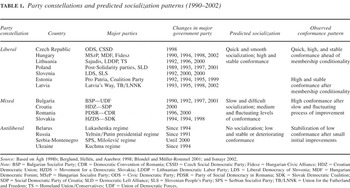
Party constellations and predicted socialization patterns (1990–2002)
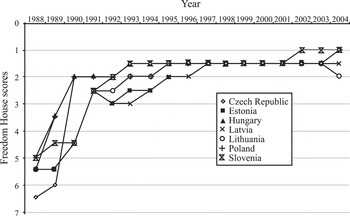
Liberal party constellations and compliance
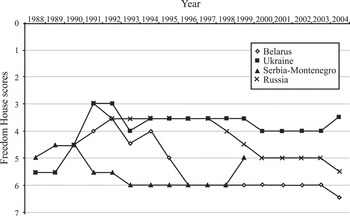
Antiliberal party constellations and compliance
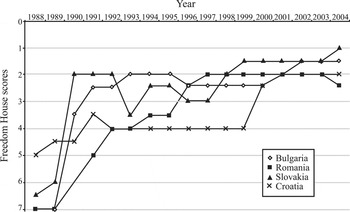
Mixed party constellations and compliance
 You have
Access
- 192
- Cited by