Clostridium difficile is the most commonly reported pathogen causing healthcare-associated infections and a significant cause of morbidity and mortality.Reference Magill, Edwards and Bamberg 1 We observed high rates of hospital-onset C. difficile infection (CDI) among 2 surgical units at our medical center despite focused attention on hand hygiene, adherence to contact precautions, and environmental cleaning. For fiscal year 2013 (July 1, 2012-June 30, 2013), the CDI rate was 14.8 and 27.6 per 10,000 patient-days on the 2 surgical units, respectively, compared with an overall institutional CDI rate of 11.7 per 10,000 patient-days. We conducted a case-control study to identify risk factors for CDI among surgical patients at our institution to direct additional infection prevention strategies.
METHODS
We performed a retrospective, case-control study of 2 surgical units at University of California San Francisco Medical Center from July 1, 2012, through September 30, 2013. Control subjects were matched to case patients using incidence density sampling. Cases of hospital-onset CDI were identified using the National Healthcare Safety Network LabID event module. Hospital-onset CDI was defined as a C. difficile–positive assay for toxin A and/or B detected in stool collected more than 3 days after admission to the healthcare facility.Reference Gase, Haley, Xiong, Van Antwerpen and Stricof 2 C. difficile testing was performed using a 2-step assay with a combination of glutamate dehydrogenase and toxin A/B antigen testing (C. Diff Quik Chek Complete; Techlab) and C. difficile polymerase chain reaction for toxin B (GeneXpert; Cepheid). Only the first positive result obtained from a case patient was included. Two control subjects without any test results positive for C. difficile during the study period were selected for each case. Controls were matched to case patients by calendar year, quarter, surgical unit, and length of stay. Baseline demographic characteristics, comorbidities, surgical procedures, exposures, and outcomes data were collected from electronic medical records. All exposure data were limited to the period between admission and LabID date. Antibiotics given 24 hours or less after surgery were coded as prophylaxis and antibiotics given more than 24 hours after surgery were coded as treatment.
Descriptive statistics were calculated. Comparisons for categorical and continuous variables were performed with the χ2 test and the t test (2-tailed testing, P<.05), respectively. We performed bivariate conditional logistic regression to estimate unadjusted odds ratio and 95% CIs. Variables with P<.2 were entered into a multivariate conditional logistic regression model to identify independent risk factors for CDI. An adjusted odds ratio and 95% CI were calculated to evaluate the strength of each association. All odds ratios are unbiased estimates of relative risk, given that cases were matched to controls using incidence-density sampling. Data analysis was performed using Stata, version 13.0 (StataCorp).
The study was approved by the University of California San Francisco Committee on Human Research.
RESULTS
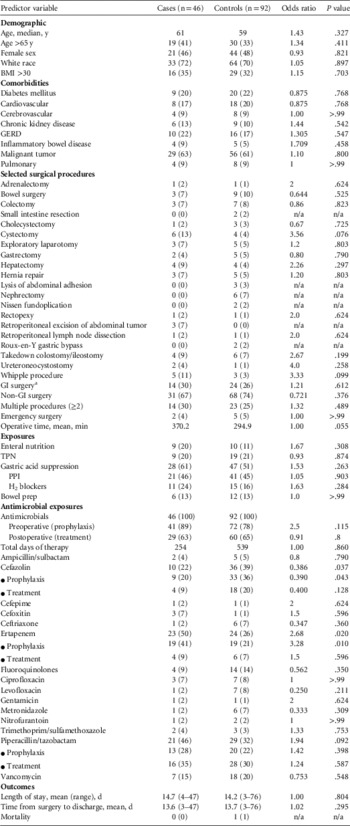
A total of 46 patients were diagnosed with CDI during the study period and were matched to 92 controls. Sixty controls (65%) had suspected CDI and were tested with negative results. Table 1 summarizes the characteristics of case patients and controls and results of bivariate analyses. Cases and controls were well-matched in terms of age, other demographic information, and underlying comorbidities. Cystectomy (13% vs 4%) and Whipple procedures (11% vs 3%) were more common among case patients than controls, although this did not reach statistical significance. There was no difference between risk of CDI among those undergoing gastrointestinal surgery compared with those undergoing nongastrointestinal surgery. The mean operative time was longer among cases compared with controls (370 minutes vs 295 minutes, P=.055). There was no significant difference with respect to other exposures and previously described risk factors for CDI, such as enteral nutrition, gastric acid suppression, or bowel preparation.
Bivariate Analysis of Risk Factors for Clostridium difficile Infection

NOTE. Data are no. (%) unless otherwise specified. BMI, body mass index (calculated as weight in kilograms divided by height in meters squared); GERD, gastroesophageal reflux disease; GI, gastrointestinal; PPI, proton-pump inhibitors; TPN; total parenteral nutrition.
a GI surgery includes the following: colectomy, small intestinal resection, takedown colostomy/ileostomy, gastrectomy, Whipple, Roux-en-Y gastric bypass, Nissen fundoplication.
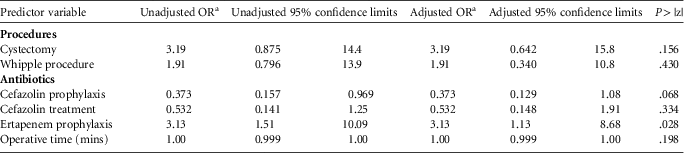
On bivariate analysis, we found that cefazolin prophylaxis was associated with a reduced risk of CDI whereas ertapenem prophylaxis was associated with an increased risk of CDI. On multivariate analysis, ertapenem prophylaxis was associated with an increased risk for CDI, (adjusted OR, 3.13 [95% CI, 1.13–8.68], P=.028) (Table 2). The median (interquartile range) duration of ertapenem use for prophylaxis was 1 (1–1) day of therapy for both cases and controls whereas the median duration of ertapenem use for treatment was 7 (3–10) days of therapy for cases and 3 (1–9) days of therapy for controls. We also observed that ertapenem was used as surgical prophylaxis for a wide range of procedures beyond colorectal surgery, including hepatectomy, cystectomy, Whipple procedure, gastrectomy, hernia repair, adrenalectomy, and other abdominal surgical procedures. Among 23 CDI cases who received ertapenem, 10 (43%) underwent nongastrointestinal surgery.
Multivariate Logistic Regression Analysis of Risk Factors for Clostridium difficile Infection

a Unadjusted and adjusted odds ratios (ORs) were obtained from bivariate and multivariate conditional logistic regression, respectively.
DISCUSSION
In this case-control study, we identified ertapenem used as surgical antimicrobial prophylaxis as an independent risk factor for CDI. These findings are consistent with observations from a randomized clinical trial comparing ertapenem with cefotetan as prophylaxis for colorectal surgery in which a trend toward higher rates of CDI was seen in the ertapenem group (1.7% vs 0.6%; P=.22).Reference Itani, Wilson, Awad, Jensen, Finn and Abramson 3 There was no significant difference in risk of CDI observed among those patients who received ertapenem for treatment of other infections, but we may have had inadequate power to detect a difference owing to the small number of patients treated with ertapenem.
Ertapenem is a broad-spectrum antimicrobial indicated for treatment of community-acquired pneumonia as well as intra-abdominal, skin and soft-tissue, urinary tract, and pelvic infections, and also indicated for surgical prophylaxis for elective colorectal surgery. 4 In our study, we observed the use of ertapenem as prophylaxis for a variety of surgical procedures outside of colorectal surgery, representing a potential opportunity for antimicrobial stewardship intervention. The 2013 American Society of Health-System Pharmacists Guidelines for Antimicrobial Prophylaxis in Surgery state that “routine use of ertapenem for surgical prophylaxis remains controversial due to theoretical concerns regarding increases in resistant organisms and a potential increase in adverse events.”Reference Bratzler, Dellinger and Olsen 5 (p225) Although the guidelines list ertapenem as an option for surgical prophylaxis in colorectal surgery, they favor a single dose of ceftriaxone plus metronidazole over routine use of carbapenems and do not recommend ertapenem as prophylaxis for any other surgical procedure. A metronidazole-containing regimen may have the added advantage of including an agent with activity against C. difficile. The increased risk of CDI observed with ertapenem may potentially be due to its enhanced anaerobic activity, which may have a more disruptive effect on the fecal microbiota, as described with other antibiotics with anaerobic activity, such as gatifloxacin and moxifloxacin.Reference Gaynes, Rimland and Killum 6 , Reference Wenisch, Equiluz-Bruck and Fudel 7 Although piperacillin-tazobactam also maintains anaerobic activity, its capacity to inhibit sporulationReference Garneau, Valiquette and Fortier 8 may explain the absence of an association with CDI in this study as well as its lower risk of CDI compared with other antimicrobial agents.Reference Settle, Wilcox, Fawley, Corrado and Hawkey 9
There are several limitations to our study. First, we were unable to collect information on antibiotic exposure prior to hospitalization. Second, although controls had no history of CDI on the basis of our review of electronic medical records, we could not exclude the possibility that the patient developed CDI at another institution after discharge. Additionally, this study was conducted in a single healthcare system and these findings should be confirmed by other multicenter studies.
Our study suggests that ertapenem use as surgical prophylaxis was associated with an increased risk for CDI in our patient population. Alternative agents should be considered as part of an antimicrobial stewardship strategy aiming to reduce CDI risk among surgical patients, particularly among those undergoing noncolorectal surgery.
ACKNOWLEDGMENTS
Financial support. None reported.
Potential conflicts of interest. All authors report no conflicts of interest relevant to this article.