Implications
This study found that goats in West Africa require supplementation to achieve reasonable levels of productivity but that the highest profitability is not necessarily related to the most intensive supplementation regime. The simulation model for small ruminants was useful for comparing different management options in smallholder goat production systems in West Africa.
Introduction
In the humid tropics of West Africa, goats represent a valuable resource for economic development and livelihood security for the rural population in addition to having major cultural importance. They serve as a source of meat, milk and leather (Odeyinka, 2000; Adebambo et al., Reference Adebambo, Adebambo, Williams, Blott and Urquart2011). Major constraints to small ruminant production in the humid zone have been identified as poor animal health and nutrition (Anaeto et al., Reference Anandan, Ayantunde, Okike, Babayemi, Sosina and Duncan2009; Chah et al., Reference Byerlee, Stevenson and Villoria2013). The nutritional constraint to small ruminant production in the humid zone is not the quantity but the quality of the available forage in terms of its digestibility and CP content. This feed quality constraint may help to explain the common practice of early disposal of some young stock soon after weaning. A higher return would be realized by carrying them through to maturity but shortage of quality feed appears to preclude this strategy (Upton, Reference Steele1988).
Increasing pressure on dwindling feed resources as a result of expansion of crop areas to support the growing food needs of the human population (Byerlee, Reference Whitbread, Robertson, Carberry and Dimes2014) means that feed constraints can only be effectively alleviated through judicious supplementation. Considerable efforts have been focussed on providing supplementation to improve the quality of goats’ feed particularly during the dry season in West Africa (Franzel et al., Reference Yousuf, Belewu, Daramola and Ogundun2014; Adjorlolo et al., Reference Adjorlolo, Timpong-Jones, Boadu and Adogla-Bessa2016) The use of agro-industrial by-products, protein-rich forage legumes, multi-nutrient feed blocks and commercially formulated concentrate have been tested (Asaolu et al., Reference Asaolu, Binuomote, Akinlade, Aderinola and Oyelami2012). However, few studies have addressed the impacts of such interventions on the lifetime productivity of goats and on the profitability of the small ruminant enterprise in the humid tropics of Africa.
Many projects aimed at improving goat productivity through feeding strategies in the humid tropics zone of West Africa reached no firm conclusions simply because there were not enough data to support robust assessments of lifetime productivity (Omeke, Reference Odeyinka1988; Bosman and Ayeni, Reference Bosman and Ayeni1993). For adequate assessment of livestock production systems based on productivity parameters, in-depth monitoring is needed to obtain sufficient reliable data. On-farm livestock studies on small ruminant production systems (farm surveys and on-farm research) often face problems related to experimental design and data analysis (Ayantunde, Reference Ayantunde1994). A simulation modelling approach is helpful to address the above problems and complement experimental approaches through ex ante analysis (Whitbread et al., Reference Upton2010).
A number of lifetime productivity simulation models have been developed as reported by Bosman et al. (Reference Bosman, Ayantunde, Steenstra and Udo1997). These include a sheep management model reported by Benjamin and Mekhon (Reference Benjamin and Mekhon1983) and the Texas A&M Sheep simulation model of Blackburn and Cartwright (1987). LIVSIM (Livestock Simulator) is a simple dynamic model, originally developed for simulating cattle production. The model has been used effectively in the past in cattle systems (Rufino et al., Reference Omeke2009), but not for small ruminants which are the major livestock species reared by smallholder farmers in the humid tropics of West Africa. In this paper we chose to adapt and test the existing LIVSIM model for small ruminants. The LIVSIM model is implemented in open source software, thereby making it accessible not only for use, but also further development. LIVSIM is not highly data demanding, which is an advantage in the data-scarce environment of the West African humid tropics. Another advantage of LIVSIM is that it functions as the livestock module of the NUANCES – FarmSim modelling framework (Giller et al., Reference Flint2011), which allows exploring dynamics of both crop and livestock production at farm level. LIVSIM simulates the performance of individual animals in time according to their genetic potential and feeding, and the interaction between the effect of nutrition and management on production traits. To gain better understanding of the interventions needed for improvement of small ruminant production in the developing world, a dynamic model specifically developed for smallholder systems of Sub-Saharan Africa is required.
The objective of this study was to assess lifetime performance of small ruminants using an adapted version of LIVSIM.Shoat (Livestock Simulator for Sheep and Goat), under different feeding systems in the humid tropics of West Africa, in terms of livestock productivity. An additional goal was to assess the profitability of various feed interventions using a modelling approach. This assessment will serve to guide potential interventions to improve systems productivity for small ruminants in West Africa.
Material and methods
For LIVSIM.Shoat, modifications to the original LIVSIM model were made for the components of lactation, gestation, growth and maintenance requirements, based on the equations presented in Agricultural and Food Research Council (1993). In the reproduction component of this modified model, extra parameters were introduced where necessary to allow for the incidence of multiple births in small ruminants. Details of the model description and parameterization are included in the Supplementary Material S1.
Sensitivity analysis
In order to gain confidence in the outputs of the LIVSIM.Shoat model for West African Dwarf (WAD) goats and to understand the influence of feed quality and BW on livestock productivity, a sensitivity analysis was conducted for feed quality by changing the CP and the metabolizable energy (ME) content of the feed. All other input parameters and variables were kept constant at default values. The test was performed for 50 replicate runs over a period of 10 years with a starting flock size of six (five breeding does and one buck). This flock size is commonly reported for smallholder goat husbandry systems in the tropics (Baah et al., Reference Baah, Tuah, Addah and Tait2012). The feed quality values chosen were as follows:
 $$\hskip-18pt{\rm Low{\minus}quality}\,{\rm feed\,\colon\, }\,{\rm CP\;{\equals}\;6\,\%\,}\,{\rm and}\,{\rm ME\;{\equals}\;4}{\rm .5}\,{\rm MJ\//\\kg}\,{\rm DM}$$
 $$\vskip-18pt{\rm Moderate{\minus}quality}\,{\rm feed\,\colon\,}\,{\rm CP\;{\equals}\;9\,\%\,}\,{\rm and}\,{\rm ME\;{\equals}\;9}{\rm .3MJ/kg}\,{\rm DM}$$
 $$\hskip-8pt{\rm High{\minus}quality}\,{\rm feed\,\colon\,}\,{\rm CP\;{\equals\,}12\,\%\,}\,{\rm and}\,{\rm ME\;{\equals}\;11}{\rm .7}\,{\rm MJ/kg}\,{\rm DM}$$
The values of 6% CP content and 4.5 MJ/kg dry matter (DM) ME content compare well with the feed quality of natural pasture during the dry season in Southwestern Nigeria, which is lower than the recommended ME for maintenance and production in goats (Steele, Reference Rufino, Herrero, Van Wijk, Hemerik, De Ridder and Giller2006). The energy content (9 to 12 MJ/kg DM) and CP content (9% to 12% CP) of both moderate- and high-quality feed represent the range of feed quality for typical household feed supplements (yam peels, cassava peels and maize bran) commonly fed to goats in Southwestern Nigeria and are comparable with ME values recommended for intensive feeding of goats (Flint, Reference Fasae, Adesope and Ojo2005).
A second sensitivity analysis included the effect of changes in potential adult weight on reproductive variables, such as age at first kidding (AFK) and kidding interval, and on weaning weight and weight of kids at 12 months. The default value for potential female adult weight (25 kg) was varied from 15 to 35 kg, which corresponds to a −40% to +40% change. The test was performed for 50 replicate runs over a period of 10 years with starting flock size of six (five breeding does and one buck) using the moderate- and high-quality feeds (as described above) in two separate simulation sets.
Scenario analysis and operational validation
To evaluate the relative impact of different production systems on the productivity of the WAD goats, the effects of different diets were simulated using three scenarios representing the dominant feeding systems of Southwestern Nigeria. Comparison of predicted data with 12 months’ observed data from experiments with these feeding systems allowed for model performance evaluation. The three scenarios were as follows: free grazing, grazing with supplementation and stall feeding with cut-and-carry feeding. The simulation took into account the quality of available grasses which are low during the 4 months (November to February) of the dry season (Amole et al., Reference Amole, Oduguwa, Shittu, Famakinde, Okwelum, Ojo, Dele, Idowu, Ogunlolu and Adebiyi2013), whereas other feed resources were assumed to be constant in quality (Table 1). Based on the assumption that biomass quantity is often not a limiting factor in the humid tropics but quality rapidly declines during the dry season (Olanite et al., Reference Odeyinka and Torimiro2004), feed quantity was supplied in excess in order to eliminate its effect. The simulation used six animals (five mature does in their first parturition and one buck) and 50 replicated runs for 12 months to estimate the output variables for the operational validation and 10 years for the scenario analysis of lifetime productivity of WAD goats. Lifetime productivity variables including BW, age at first and last kidding, weight of kids at weaning and number of kids in productive years for all animals in each scenario were compared. The costs and benefits of each simulated scenario were analysed based on indicative feed input and animal product prices at the time of the analysis from a semi-formal market survey and an assessment of the livestock feed value chain in Southwest Nigeria (Anandan et al., Reference Anaeto, Tayo, Chioma, Ajao and Peters2014).
Quality parameters of different feeds used in the Livestock Simulator for Sheep and Goat model simulations

DM=dry matter; DMD=dry matter digestibility; ME=metabolizable energy; a=proportion of water soluble N in the total N in a feed; b=proportion of potentially degradable N other than water soluble N in the total N of the feed; c=fractional rumen degradation rate per hour of the b fraction of the feed N with time (Agricultural and Food Research Council, 1993).
1 DYNAFEED database International Livestock Research Institute (ILRI), Ajayi et al. (Reference Ajayi, Babayemi and Taiwo2007), Abegunde et al. (Reference Abegunde, Babayemi and Akinsoyinu2011).
2 DYNAFEED database ILRI, Akinfemi et al. (2009), Ifut (Reference Heuzé and Tran1988), Kalio et al. (Reference Hounkonnou, Kossou, Kuyper, Leeuwis, Nederlof, Röling, Sakyi-Dawson, Traoré and van Huis2013), Mako et al. (Reference Kalio, Ayuk and Agwunobi2013).
3 National Research Council (Reference Ngongoni, Mwale, Mapiye, Moyo, Hamudikuwanda and Titterton1981), Ayantunde (Reference Ayantunde1994).
4 Gusha et al. (Reference Gillespie, Ae Kim and Paudel2013).
5 Ajayi et al. (Reference Ajayi, Adeneye and Ajayi2005), Okafor et al. (Reference Okafor, Lakpini and Fayomi2012).
+ Quality and quantity from March to October.
++ Quality and quantity from November to February.
The costs included feeding cost and excluded other costs like purchase of animals, veterinary services and labour because of lack of data on those. The effect of the feeding systems on indicators of productivity was evaluated with one-way ANOVA using Statistical Analysis Systems (Reference Oosting, Udo and Viets1999) using each run as a replicate. The differences between scenarios were tested using the Duncan’s (Reference Dove1955) multiple range tests and deemed to be statistically significant at a probability of 0.95 (P<0.05).
Scenario 1: free grazing system
The major feed resources available in this extensive system are natural pastures, composed mainly of various grasses and legumes, cassava peels and maize bran which are often provided for the animals at different intervals and quantities when available (Fasae et al., Reference Duncan2011). For the purpose of this simulation, Panicum maximum was selected as the sole available forage for the animals due to its dominance in natural pasture in Southwestern Nigeria (Olanite et al., Reference Odeyinka and Torimiro2004). P. maximum was provided daily per animal at 0.7 kg DM but reduced to 0.5 kg DM during the dry season (November to February), whereas cassava peels and maize bran were supplied at 0.3 kg DM daily.
Scenario 2: grazing with supplementation system
In this system, the animals are housed and often released for grazing and to browse forages. The basic feed resource for this simulation was P. maximum provided daily at 0.7 kg DM but reduced to 0.5 kg DM during the dry season (November to February). Supplementary feeds (Gliricidia sepium, cassava peels and maize bran) were offered at 0.3 kg DM daily throughout the year. G. sepium is a protein-rich, highly nutritive and fast-growing perennial leguminous browse plant (Heuzé and Tran, Reference Gimenez and Rodning2015), which is commonly fed to goats in rural villages in Southwestern Nigeria (Odeyinka, 2000). The leaves contain as much as 20% to 30% CP and about 15% crude fibre (Asaolu and Odeyinka, Reference Asaolu and Odeyinka2006).
Scenario 3: cut-and-carry feeding system
The cut-and-carry feeding system consists of zero grazing and provision of feed ad libitum. The feed resources are P. maximum as a cut-and-carry forage with cassava peels and commercially formulated concentrate. In this simulation, P. maximum was provided daily at 0.7 kg DM but reduced to 0.5 kg DM during the dry season (November to February). Both cassava peels and concentrate were offered at 0.3 kg DM.
The free grazing and grazing with supplementation scenarios were compared with data collected on feed-health intervention experiments for improved small ruminant production (Avornyo et al., Reference Avornyo, Ayantunde, Shaibu, Konlan and Karbo2015). In the grazing with supplementation experiment, feed supplements (200 g of mixed rations) were offered after normal grazing. Supplements contained maize (30%), maize bran (28.2%), wheat bran (15%), soyabean (5%), fishmeal (4%), cotton seed (15%), vitamin premix (1%), salt (0.8%) dicalcium phosphate (1%). The cut-and-carry scenario was compared with published data from the Goat Research Project at Ife, Southwestern Nigeria (Chiboka et al., Reference Chah, Obi and Ndofor-Foleng1988). The project confined experimental goats and fed them twice daily ad libitum with P. maximum, G. sepium, Leucaena leucocephala and a concentrate ration of 0.3 kg/day. A second data set used for comparison with this scenario was generated during the on-farm testing of management packages developed by the West Africa Dwarf Goats project in Southwestern Nigeria. The management packages included confinement and feeding with P. maximum, G. sepium and other crop by-products such as cassava peels and maize bran (Bosman and Ayeni, Reference Bosman and Ayeni1993).
Results
Sensitivity analysis
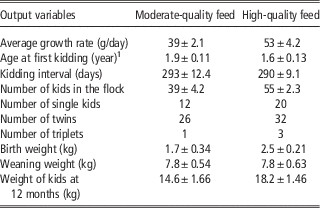
The growth performance of simulated goats was strongly affected by different feed quality regimes, approaching potential BW after a shorter time in the better feed scenarios. In the low-quality feed treatment, feed quality was so poor that it resulted in negative growth rates, and the starting flock quickly dying out. Kids were born at 2 years but all died by the 36th month of the simulation. Because of this, the data generated for this treatment were very limited, precluding a statistical analysis. Consequently these data were not reported further in the results. Average daily growth rates on high-quality feed (53 g/day) were higher than on the moderate-quality feed (39 g/day) (Table 2). For all the reported productivity variables, the moderate-quality feed resulted in poorer productivity than the high-quality feed, except for kidding interval which was almost the same (moderate-quality feed 293 days, high-quality feed 290 days) and weaning weights which were also similar (7.8 kg). Better feed quality resulted in earlier attainment of the weight threshold for reproduction, which explained differences in AFK and kid weight at 1 year of age. Likewise, higher incidence of multiple births was recorded under the good feed regime than under the moderate feed regime (Table 2).
Sensitivity of the Livestock Simulator for Sheep and Goat model output variables to change from moderate- to high-quality feed

1 Starting age (12 months) included values are means (±SE) of 50 replicate runs of 10 years.
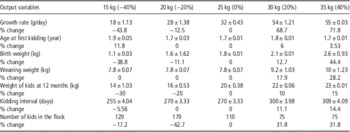
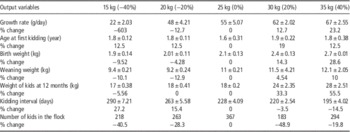
An increase of 20% in potential adult BW resulted in a 6% increase in AFK on moderate feed (Table 3), and a 19% increase of this age on high-quality feed (Table 4). The change in weaning weight was directly proportional to the change in potential adult weight with high-quality feeding. However, weaning weight remained more or less stable with a 20% or larger change in potential adult weight under moderate-quality feeding.
Sensitivity of the Livestock Simulator for Sheep and Goat model output variables to change in the default value (25 kg) for potential adult weight of female West African Dwarf goat from 15 to 35 kg under moderate feed quality

Values are means (±SE) of 50 replicate runs.
Sensitivity of the Livestock Simulator for Sheep and Goat model output variables to change in the default value (25 kg) for potential adult weight of female West African Dwarf goat from 15 to 35 kg under high-quality feed

Values are means (±SE) of 50 replicate runs.
Operational validation
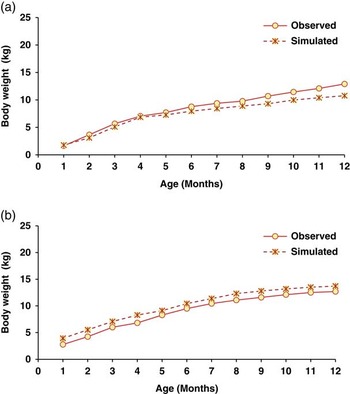
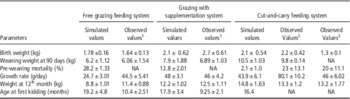
The simulated and observed values of BW of kids in the free grazing system showed a similar pattern (Figure 1), but the observed average daily growth rate of adult goats was higher (45 g/day) than the simulated (25 g/day) (Table 5). As a result, the simulated BW at 12 months was lower than the observed BW at that age (Table 5). The values of most output variables simulated for grazing with supplementation closely matched observed values (Table 5). However, ages at first kidding were higher in the simulated than the observed data in grazing with supplementation. Most of the simulated livestock productivity variables for cut-and-carry feeding fell within the range of observed values except for pre-weaning mortality, which was 2.1% in the simulated data but 20% or 23% in the observed data (Table 5).
The 12-month growth curve of simulated and observed kids under (a) free grazing, (b) grazing with supplementation feeding system.

Simulated values and observed values of goat production performance under free grazing feeding, grazing with supplementation and cut-and-carry feeding systems

NA=Not available.
1 Avornyo et al. (Reference Avornyo, Ayantunde, Shaibu, Konlan and Karbo2015).
2 Chiboka et al.(Reference Chah, Obi and Ndofor-Foleng1988).
3 Bosman and Ayeni (Reference Bosman and Ayeni1993).
Scenario analysis
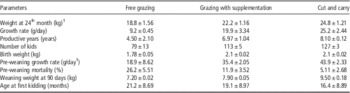
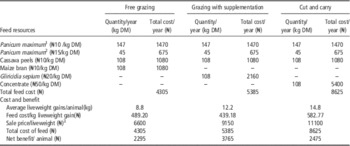
Early BW development and early attainment of potential adult weight were simulated in both supplementation and cut-and-carry regimes. The starting flock under free grazing attained puberty and kidded later (9 months after the start of simulation) than those on grazing with supplementation and cut-and-carry feeding (8 months and 7 months, respectively; Table 6). The simulation results indicated higher (P<0.05) birth weight (2.1 kg) in both the grazing with supplementation and the cut-and-carry feeding systems than in the free grazing system (1.78 kg) (Table 6). The number of kids within the productive years was higher in the cut-and-carry feeding system than in the other systems. Supplementation with concentrate feed and Gliricidia had a significant effect on the weaning weight of kids. Pre-weaning mortality (26%) was highest (P<0.05) in the free grazing feeding system. Pre-weaning growth rate was significantly higher in kids from the cut-and-carry system compared with the grazing plus supplementation system. Similarly, pre-weaning growth rate in kids from the grazing plus supplementation system was significantly higher than that from the free grazing system. Kids’ sexual maturity was delayed under free grazing to up to 21 months. Even though the economic analysis (Table 7) revealed that keeping goats was profitable for all feed options in the simulation, profitability decreased from grazing with supplementation over cut-and-carry with concentrate to free grazing. The highest weight gain was recorded under cut-and-carry feeding system but the grazing with supplementation gave the highest net benefit.
Effect of the three feeding systems on lifetime productivity parameters of the simulated goats

1 Including 10 kg starting weight.
Average cost of feed (per goat) and economic benefit of the three feeding systems in the scenario analysis for 12 months

1 Panicum maximum: 7 months (March to October).
2 Panicum maximum: 5 months (November to February).
3 Prevailing market price (750.00) for 1 kg liveweight West African Dwarf goat at the time of this study (₦197=1$).
Discussion
Model sensitivity and validation
The sensitivity analysis of LIVSIM.Shoat revealed that feed quality and adult BW are important input parameters and showed that there is an interaction between the effect of nutritional quality and BW. Generally, the responses of performance indicators on feed quality underscored the importance of good quality feed for goat productivity. The higher kid weight and incidence of early kidding on high-quality feed as a result of increases in potential adult BW illustrates the interaction between both factors in influencing puberty (Gimenez and Rodning, Reference Giller, Tittonell, Rufino, van Wijk, Zingore, Mapfumo, Adjei-Nsiah, Herrero, Chikowo, Corbeels, Rowe, Baijukya, Mwijage, Smith, Yeboah, van der Burg, Sanogo, Misiko, de Ridder, Karanja, Kaizzi, K’ungu, Mwale, Nwaga, Pacini and Vanlauwe2007). The result re-affirms the fact that genetic potential of animals in a given environment can only be exploited through good feed (Nnadi et al., Reference Mpairwe, Sabiiti, Ummuna, Tegegne and Osuji2007).
The results of our model validation showed that the model simulated the three feed systems reasonably well. Deviations between observed and simulated AFK for free grazing and grazing with supplementation could be attributed to the fact that the age at sexual maturity was set at 12 months in the model which could possibly delay AFK as compared with early mating and uncontrolled breeding practices which are common in the traditional free grazing production system of Sub-Saharan Africa (Dereje et al., Reference Debele, Duguma and Hundessa2015). The observed rate of pre-weaning mortality in the cut-and-carry feed system was higher than the simulated rate. This could be attributed to the fact that various factors other than under-nutrition influence mortality (e.g. injuries, accidents, diseases, predators, etc.) These ‘reducing factors’ are, by nature, very stochastic and location specific, and are therefore not accounted for in the model (Debele et al., Reference Chiejina and Behnke2011). Higher observed than simulated growth rates under free grazing could be related to the nutrients derived from other feedstuffs available to the animals during free grazing, which could have enhanced their growth. The ability of animals to select from an array of feedstuffs when free grazing is indeed known to influence their performance (Dove, Reference Dossa, Rischkowsky, Birner and Wollny1996). In general, deviation of a few simulated values from observed values did not undermine the usefulness of the model in view of the magnitude of variation in reported observed values.
Lifetime productivity
The results of our scenario analysis underscored the importance of supplemental feeding, in providing required nutrients that promote growth and reproductive performance in WAD goats. Simulated daily weight gain of the starting goat flock was the same in both cut-and-carry and the grazing with supplement system and higher than in the free grazing system, in line with the data reported by Yousuf et al. (2007) when grazing WAD goats were supplemented with G. sepium. Our results suggest that it is feasible to increase lifetime productivity of WAD goats through improved nutrition by supplementation with low-cost, farm-generated feed resources (browse legumes, crop by-products). Browse legume inclusion in WAD goats’ diets leads to a higher conception rate, improves kidding interval, early weaning and hence results in improved productivity.
Cost-benefit analysis of the three feeding scenarios based on cost of feeding only indicated that grazing with supplementation is profitable considering the net returns. The results may likely be different if other costs, and in particular labour, are included. Our results show that although the most intensive system resulted in the highest animal performance, the moderately intense system (grazing plus supplementation) produced the most profit based on feed cost alone. In reality, the risk in this improved scenario is still considerable as it involves labour-intensive practices such as regular feeding and cleaning. These activities may be difficult to undertake for farmers whose available labour is primarily used for arable crop production which can bring higher returns (Odeyinka and Torimiro, Reference Nwafor2006). Furthermore, providing a good ration to livestock certainly entails considerable costs for poor livestock keepers and involves some risk in the absence of a reliable marketing system for livestock and livestock products (Lawal-Adebowale, Reference Ifut2012). This could be a major bottleneck for farmers to adopt the practice. Although scientists and extensionists tend to promote the most productive systems, farmers often opt for practices which yield the highest profit or minimize their risks (Gillespie et al., Reference Franzel, Carsan, Lukuyu, Sinja and Wambugu2007; Amankwaha et al., Reference Amankwaha, Klerkx, Oosting, Sakyi-Dawsond, van der Zijppc and Millar2012).
Profit maximization is often not a priority for traditional WAD goat keepers (Nwafor, Reference Nnadi, Kamalua and Onah2004), as goats are used for customary rites and religious purposes, human consumption and socio-economic services (security, gifts and manure for crops) (Chiejina and Behnke, Reference Chiboka, Somade and Montsma2011). Notwithstanding, for any of these purposes, flock size, liveweight and body condition are significantly associated with the value of the animal at any particular time and could significantly improve through the adoption of appropriate feeding management (Dossa et al., Reference Dereje, Mengistu, Getachew and Yoseph2008).
Increased animal-sourced food production and the reduction of environmental impact and poverty are frequent targets set for livestock production in the tropics. Smallholder mixed crop–livestock systems could largely contribute to these targets (Oosting et al., Reference Olanite, Tarawali and Aken’ova2014) if productivity per animal and per unit area can be increased in line with sufficient market incentives. This is unlikely to be achieved in a free grazing system that is characterized by a low nutritional plane, which predisposes goats to diseases, poor growth and development, and high pre-weaning mortality (Belay et al., Reference Belay, Gebru, Godifey, Brhane, Zenebe, Hagos and Teame2014). Although, sustained adoption of improved livestock feeding strategies has been marginal, if appropriate technologies are accompanied by good markets and measures to overcome other barriers, the rate of adoption could increase (Barrett, Reference Barrett2008; Hounkonnou et al., Reference Gusha, Ngongoni and Halimani2012). This is illustrated in recent reports showing a rise in the proportion of farmers adopting grazing with supplementation (Umunna et al., 2014), with subsequent improved goat productivity and socio-economic benefits for rural communities (Chiejina and Behnke, Reference Chiboka, Somade and Montsma2011). Examples illustrate that such increase in adoption is often driven by market opportunities through the increased demand for animal protein (Bernués and Herrero, Reference Bernués and Herrero2008).
Given the demand for additional feed sources, particularly of high quality, identification and exploitation of farm-based feed resources (forage/tree legumes) that require few inputs, and are largely adapted to the climatic conditions of developing countries, would be a positive step towards better resource utilization and reduced feed cost (An, Reference An2004). Cheap farm-based supplementation could be adoptable by smallholders through integration of forage legumes into the existing production system without markedly increasing competition for land and other resources. This could be achieved by promoting incorporation of adaptable, productive and nutritious forage tree legumes with both food and feed value and intercropping of forage legumes with cereals to increase the quality of total fodder available (Mpairwe et al., Reference Mako, Akinwande and Oyegunwa2002; Ngongoni et al., 2007). The current extensive production system where animals are left to range freely limits incentives for adoption of farm-based feed resources but as these systems evolve and intensify such options are likely to become more attractive.
Conclusion
The model simulations in this study provided a detailed characterization of small ruminant production in current smallholder systems in humid West Africa and the potential for improvement using different feeding scenarios. The model captured the effect of diets of different quality on productivity indicators in a realistic way. The simulated results suggest that goats require supplementation with protein and energy sources to promote lifetime productivity through early sexual maturity and higher birth weight. Cheap and locally available feed resources such as browse plants and other feed resources such as crop residues (stovers and vines) and crop by-products (peels, brans and residues from sieving) could provide the required protein and energy to meet the nutritive requirements of the animals and are within farmers’ investment capacity. We conclude that grazing with adequate supplementation using farm-generated feed resources (browse, crop by-products and forage legumes) offers an opportunity for improving smallholder goat production systems in West Africa.
Acknowledgement
This project was completed under the CGIAR research program on integrated systems for the humidtropics. Humidtropics would like to acknowledge the CGIAR Fund Donors, and other donors and investors for their provision of core and project-specific funding.
Supplementary material
To view supplementary material for this article, please visit https://doi.org/10.1017/S1751731116002676