Introduction
Maize (Zea mays L.) grain yield is positively associated with the number of kernels per unit area (Tollenaar et al., Reference Tollenaar, Dwyer and Stewart1992; Andrade et al., Reference Andrade, Vega, Uhart, Cirilo, Cantarero and Valentinuz1999), which is in turn a function of plant density and the number of kernels per spike. Plant density is a key management option for obtaining maximum grain yield (Tang et al., Reference Tang, Ma, Noor, Li, Hou and Zhao2018) as it allows the crop to better utilize the available light, water and fertilizers, although an excess of number of plants per unit area can result in fewer kernels per plant (Tollenaar et al., Reference Tollenaar, Dwyer and Stewart1992; Echarte et al., Reference Echarte, Luque, Andrade, Sadras, Cirilo, Otegui and Vega2000; Sangoi et al., Reference Sangoi, Gracietti, Rampazzo and Bianchetti2002).
The modulation of kernel number by the number of plants per unit area is related to the plant growth rate during the critical period for plant fertility determination, which extends between −227°Cd and +100°Cd from silking (Otegui and Andrade, Reference Otegui, Andrade, Westgate, Boote, Knievel and Kiniry2000), and depends on the amount of radiation available, the fraction intercepted by each plant, and the radiation use efficiency (RUE) during this period, i.e. the plant growth rate (g/plant d). The plant growth rate is more informative than the crop growth rate (g/m2 d) because dry matter partitioning to the reproductive structures and the number of kernels set respond to the amount of resources available to each individual plant (Otegui and Andrade, Reference Otegui, Andrade, Westgate, Boote, Knievel and Kiniry2000).
Plant leaf architecture and plant density affect the fraction of radiation intercepted in this period. Plant leaf architecture is genetically controlled by leaf angle (Maddonni et al., Reference Maddonni, Otegui and Cirilo2001), but some hybrids also benefit from a ‘shade-avoidance’ mechanism, which allows them to modify their leaf orientation to colonize the available space better and intercept more of the radiation available (Maddonni et al., Reference Maddonni, Otegui and Cirilo2001).
The fraction of intercepted radiation during the critical window for kernel setting also depends on row distance (Maddonni et al., Reference Maddonni, Otegui and Cirilo2001). Moreover, the effect of row distance is not independent of plant density (Maddonni et al., Reference Maddonni, Otegui and Cirilo2001) or of genotypic traits such as developmental rate, leaf angle and azimuth angle plasticity in relation to plant density and disposition (Maddonni et al., Reference Maddonni, Otegui and Cirilo2001). Contrasting results on the effect of row distance on light attenuation and grain yield are reported in the literature. Maddonni et al., (Reference Maddonni, Otegui and Cirilo2001) found a positive effect on light attenuation of the more uniform plant distribution deriving from a small row distance, but only when the maximum green leaf area index (GLAI), that is in the critical period for kernel setting, was too low to guarantee complete interception of the available photosynthetically active radiation (PAR). On the other hand, Testa et al. (Reference Testa, Reyneri and Blandino2016) only found a positive effect of a smaller row distance on maize grain yield when considering high plant densities. Maddonni et al. (Reference Maddonni, Cirilo and Otegui2006) did not find a reduction in row distance to improve grain yield when applying the commercial sowing rate (9–10 plants/m2) because of the negative effect of closer rows on RUE during the post-silking period.
Whereas other studies (Gözübenli, Reference Gözübenli2010; Greveniotis et al., Reference Greveniotis, Zotis, Sioki and Ipsilandis2019; Li et al., Reference Li, Zhang, Xie, Hou, Bo, Xue, Wang and Li2021) revealed that narrower rows produced higher grain yield than conventional rows depending on the plant density, other works (Stone et al., Reference Stone, Pearson, Sorensen and Rogers2000; Strieder et al., Reference Strieder, Da Silva, Rambo, Sangoi, Da Silva, Endrigo and Jandrey2008) found inconsistent increases in grain yield with narrow row spacings or any effect on yield associated with plant density. While the changes in yield related to variation in plant distribution are well explained with variations in kernel number, the mechanisms responsible of the increase in kernel number are not clear. Changes in yield have been mainly explained through variation in intercepted radiation, related to leaf architecture (Maddonni et al., Reference Maddonni, Otegui and Cirilo2001) or plant growth rate (Otegui and Andrade, Reference Otegui, Andrade, Westgate, Boote, Knievel and Kiniry2000), but mechanisms other than the quantity of intercepted radiation might explain changes in kernel number (Rajcan and Swanton, Reference Rajcan and Swanton2001).
These contrasting results might, at least in part, be a consequence of the weather conditions in which the maize was grown, and in particular of the radiation available during the critical period for kernel setting (i.e. the period between 227°Cd before silking and 100°Cd after it). The Mediterranean environment is a typical semiarid environment with rainfall concentrated in the cooler part of year, but almost completely absent during the warm season, when maize is grown. In this type of environment, maize is generally grown under irrigated conditions.
The aim of this study was to explore whether, in a Mediterranean environment, a reduction in row distance can have a positive effect on grain yield, and whether this effect depends on plant density when a full-season hybrid is grown without nutrient and water limitations.
Materials and methods
Site and experimental design
Field experiments were conducted for the seasons 2021 and 2022 at the experimental station in Oristano (40° N; 8°E; 15 m a.s.l.) belonging to the University of Sassari, Italy. The soil was a clay-loam with a depth of about 2 m. Soil characteristics were determined from samples collected before fertilization and sowing. The average soil water content in the first 2 m layer on a volumetric basis was 38% at field capacity (−0.02 MPa), and 19% at the permanent wilting point (−1.5 MPa). Mineral soil N amounted to about 50 kg/ha in the 0–2 m soil layer, and the soil organic matter of the first 0.8 m was 1.1%. The local climate is typically Mediterranean, with a long-term average annual rainfall of 575 ± 139 mm, mainly occurring between October and April. The typical maize growing period in this environment is from the end of April to the end of September.
Treatments were a factorial combination of three plant densities – 6, 8 and 10 plants/m2 – and two row spacings – 35 and 70 cm – arranged in a strip-plot design with three blocks. Row spacing was assigned to the columns, and plant density to the rows. Each plot was 21 m long, with 4 rows spaced 70 cm apart, or 6 rows spaced 35 cm apart, depending on the row spacing treatment.
The seed-bed was prepared by chisel-ploughing to a depth of 25 cm, followed by surface cultivations. Sowing was performed with a row planter on 10 May 2021, and 4 May 2022, at a rate higher than the target plant density. The cultivar used was a full-season hybrid (FAO class 700) that was selected to ensure a full light interception at the different plant densities. Emergence was recorded when plantlets were visible on about 70% of the plot surface area. Plots were thinned to the desired plant population when plants had reached the three-leaf stage (V3).
Nitrogenous fertilizer was split into three applications: 128 kg N/ha at sowing, 46 kg N/ha at ten-leaf stage (V10), and 46 kg N/ha at silking. Phosphorous fertilizer was applied at sowing at a rate of 40 kg P/ha. Plots were irrigated by drip irrigation. Weeds, pests and diseases were chemically controlled. The final harvest was conducted mechanically. After harvest, residues were chopped and incorporated into the soil.
Measurements
At V3, 10 successive plants per plot in the central row of the second block were tagged and checked twice a week to record the number of total and ligulated leaves, lamina length (L), maximum lamina width (W) and the number of senesced leaves, i.e. those with half or more of their area yellowed. The phenological stages of flag-leaf ligula appearance, tasselling, silking, end of silking (pollination) and physiological maturity (black layer) were recorded on the 10 tagged plants and verified by inspecting the other two blocks.
Leaf length (L) and width (W) were used to calculate leaf area as 0.75 × L × W, as 0.75 can be considered valid for a wide range of plant densities and independent of changes in L and W (Montgeomery, Reference Montgeomery1911; Maddonni et al., Reference Maddonni, Otegui and Cirilo2001). The sum of the areas of green ligulated leaves plus the final area of the following two leaves (Muchow and Carberry, Reference Muchow and Carberry1989) was used to estimate both leaf area per plant and the GLAI as the plant leaf area × the number of plants per square metre. Senescence was quantified by subtracting the area of senesced leaves from the total green leaf area.
Biomass sampling was carried out at the 12-leaf stage (V12), silking, 15 days after silking, and at physiological maturity (black layer) by cutting 4 plants per plot at the ground level. The spike with its glumes, when present, was separated from the rest of the plant before oven-drying the samples at 80°C for 48 h. All plants produced a single spike only. The dried spikes from the sample at physiological maturity were hand-threshed to obtain the grain weight and to calculate the harvest index (HI), as the ratio of grain weight to total above-ground biomass per plant.
An area of 14 m2 in the central part of each plot was used at the physiological maturity stage to count the number of plants and the number of spikes, and to obtain the number of plants and of spikes per square metre. Spikes were sampled and threshed, and the fresh weight of five samples of 100 grains each per plot recorded. The humidity level of the grains was calculated by subtracting the dry weight of the grains after oven-drying at 80°C for 48 h. Grain yield was calculated on the 14 m2 sample, and grain number per square metre calculated as the ratio between grain yield and grain weight. The number of grains per spike was determined as the ratio between the number of grains per square metre and the number of spikes per square metre. The dry weight of the total above-ground biomass was estimated by dividing the grain yield by HI.
Weather data (maximum and minimum temperature, rainfall, solar radiation and relative air humidity) were recorded by a meteorological station located approximately 300 m from the field.
The SunScan Canopy Analysis System SS1-UM-1.05 (Delta-T Devices, Cambridge, UK) was used to measure the fraction of photosynthetically active radiation intercepted by the canopy (FIPAR) once a week during the central hours of the day (h 12:00 ± 30′) from crop emergence until 100°Cd after flowering. Mean PAR at the soil level was assessed by aligning the probe at right angles to the row direction and parallel to the soil surface at three different points along the plot. At the same time, the Beam Fraction Sensor, as part of the system noted above, monitored the light incident at the canopy surface. The coefficient of extinction of radiation was one of the outputs of this instrument.
The weekly values of FIPAR were measured for each plot and linearly interpolated to obtain daily values. The daily intercepted PAR was then calculated by multiplying these values by the daily values of PAR (calculated as 48% of the solar radiation [Monteith, Reference Monteith1965]) recorded at the meteorological station of the experimental station. The cumulative intercepted PAR (MJ/m2) at each developmental stage was then calculated as the sum of the daily values of intercepted PAR. RUE was obtained by dividing the above-ground biomass produced at each sampling by the cumulative intercepted PAR.
Statistical treatment of data
ANOVA was performed separately for each year accordingly to the strip plot design used and means compared using least significance difference (l.s.d.) tests at P = 0.05 (when the F test indicated the presence of significant differences).
Results
Weather
Except for September, the 2022 season was hotter than the 2021 season, particularly in July when the maximum average daily temperature was 34.6°C vs 32.9°C in 2021, and in August when the minimum average daily temperature reached 19.8°C vs 17.9°C in 2021 (Fig. 1). By contrast, the highest daily maximum temperatures were observed in 2021, with 6 days between July and August registering values above 40°C vs none in 2022. Both years were hotter than the long-term average in terms of both maximum and minimum temperatures. Irradiance was also higher in July and August 2022, by 63 (850 vs 787 MJ/m2 month) and 23 MJ/m2 (705 vs 682 MJ/m2 month), respectively.
Daily solar radiation (upper panel) and maximum and minimum temperatures (lower panel) for 2021 (solid lines) and 2022 (dotted lines), and long-term averages (green solid lines). Downward arrows indicate sowing date; blue upward arrows indicate silking; red upward arrows indicate dented kernel; red squares indicate physiological maturity. Solid arrows are for 2021; empty arrows are for 2022.

Morpho-phenological traits
The earlier sowing date in 2022 (May 4 vs May 10 in the previous season) was accompanied by earlier silking (July 1 vs July 12) and an earlier ‘dented kernel’ stage (August 9 vs August 18). Differences in physiological maturity were much larger, mainly because of a severe red-spider-mite (Tetranychus urticae K.) attack, starting about 3 weeks after silking in 2022.
No differences were observed between treatments in the duration of the major phenological-phases, although plant density promoted significant differences in final leaf number in 2022, when about one leaf less was produced at the lower plant density, and in plant height (in both 2021 and 2022), which was lowest at the lowest plant density (Table 1). Only in 2021 was the final leaf number higher at the narrower row distance (19.8 vs 19.2). The differences in final leaf number were accompanied by coherent differences in the ear leaf. Only one ear was produced by each plant regardless of the treatment.
Final leaf number, ear leaf and plant height in the two years for the different treatments applied

ANOVA results and means (row density means, n = 9; plant density means, n = 6; interaction means, n = 18).
ns, not significant., *, significant at P ≤ 0.05; **, significant at P ≤ 0.01; ***, significant at P ≤ 0.001.
Leaf area development and radiation interception
Differences in plant density led to larger differences in individual leaf area (Fig. 2) than differences in row spacing, the effect of which was almost irrelevant (data not shown).
Single leaf area for the two years (2021 upper panel, 2022 lower panel) and the three plant densities (empty circles, 6 plants/m2; light blue symbols, 8 plants/m2; dark blue symbols, 10 plants/m2). Bars are standard errors of the mean at P ≤ 0.05. Means are calculated for each plant density across the replications (n = 3) of the row distance treatments (n = 2).

Competition due to plant density was apparent from the appearance of the 12th leaf in 2021, when both the 12th and 14th leaves displayed a greater area at 6 plants/m2 compared with the other two densities (ear leaf was the 13th). In 2022, the first 8 leaves were larger for the plant density of 6 plants/m2, and larger than in 2021. Leaf length (Supplemental Fig. S1) was more affected than leaf width by the plant density treatment, and in 2021 leaf length signalled the beginning of competition at a lower leaf number than the total leaf area; specifically, at leaf 10.
Despite the larger and longer leaves, plants grown at the lower density exhibited a lower GLAI starting from about 40 days after sowing (Fig. 3). The period with the largest differences in GLAI between plant densities coincided with the interval ‘anthesis – dented kernels’ in 2021, and with the 20 days after anthesis in 2022, due to the earlier senescence caused in 2022 by the combination of particularly high temperatures and a red spider mite attack. Although earlier than in 2021, senescence in 2022 began well after the end of the critical period for kernel number determination, which extended approximately from the appearance of the 12th leaf to 1 week after silking. Maximum GLAI at the highest plant density (10 plants/m2) was about 8 in 2021, and 9 in 2022, whereas it was 7 and 5.5 at 8 and 6 plants/m2, respectively, in both years. Row distance did not affect GLAI (Supplemental Fig. S2).
Green leaf area index (GLAI) for the two years (2021 upper panel, 2022 lower panel) and the three plant densities (empty circles, 6 plants/m2; light blue symbols, 8 plants/m2; dark blue symbols, 10 plants/m2). Vertical dashed lines indicate the beginning and end of the critical period for kernel number determination (V12 – 100°Cd after silking). The central vertical line signals flowering. Bars are standard error of the means at P ≤ 0.05. Means are calculated for each plant density across the replications (n = 3) of the row distance treatments (n = 2).

The differences in GLAI for the various plant densities did not result in any differences in the plants' capacity to intercept radiation (Supplemental Fig. S3), as the GLAI was high enough in all treatments to guarantee almost complete radiation interception from the appearance of the 12th leaf and for the whole critical period for kernel number determination. This is why the cumulated intercepted PAR in the critical window for kernel number determination was not different across the evaluated plant densities, row spacings, and years, and amounted to an average of 275 MJ/m2 (range 270–282 MJ/m2). The extinction coefficient K, equal to 0.60 in 2021, and 0.55 in 2022, on average, was not affected by the treatments applied (data not shown).
The proportion of GLAI above the ear leaf on the total GLAI was not affected by plant density, although a lower amount of GLAI was present in the leaf stratum above the ear at the lower plant density in both years (Table 2), reflected in a lower fraction of intercepted PAR above the ear at 6 plants/m2.
Green leaf area (GLAI) and the fraction of intercepted PAR (FIPAR) above the ear

ANOVA results and means (row density means, n = 9; plant density means, n = 6; interaction means, n = 18).
ns, not significant, *, significant at P ≤ 0.05; **, significant at P ≤ 0.01; ***, significant at P ≤ 0.001.
Grain number determination and grain yield
The treatment that most affected the traits responsible for grain number determination in the critical period bracketing silking was plant density (Table 3). In both years, the lowest plant density showed the highest amount of intercepted PAR per plant and the lowest RUE. The resulting plant growth rate was highest at the lowest plant density at both row distances in 2022, but only at the 70 cm row distance in 2021.
Photosynthetic active radiation intercepted (IPAR), radiation use efficiency (RUE), plant growth rate for the period V12 – 100°Cd after flowering and number of kernels

All data are expressed on a single plant base. Means and ANOVA results (row density means, n = 9; plant density means, n = 6; interaction means, n = 18).
ns, not significant, *, significant at P ≤ 0.05; **, significant at P ≤ 0.01; ***, significant at P ≤ 0.001.
The higher number of kernels per plant produced at the lowest plant density was likely the output of all these differences; it was 24% higher than the average of the other two plant densities in 2021, and 41% higher in 2022.
The effect of row distance was limited to a higher RUE and plant growth rate at the smaller row distance of 35 cm in 2022, although a higher number of kernels per plant was observed at this row distance in both years.
The average grain yield across all treatments was 38% lower in 2022 compared with 2021. The reason for this is the already mentioned combination of high temperatures and the red spider mite attack in 2022 that caused the kernel weight to decrease by about 28%, but which did not affect grain number, that was even slightly higher in 2022 (4049 kernel number/m2 in 2022 vs 3783 kernel number/m2 in 2021, on average). Due to the lack of any significant interactions between plant density and row spacing (Table 4), only their simple effects will be discussed.
Grain yield and yield components in the two years

ANOVA results and means (row density means, n = 9; plant density means, n = 6; interaction means, n = 18).
ns, not significant, *, significant at P ≤ 0.05; **, significant at P ≤ 0.01; ***, significant at P ≤ 0.001.
Despite the above-discussed effects of plant density on leaf area development and on the traits responsible for kernel number determination in both years, grain yield was only affected by plant density in 2021, when the lower grain yield observed at 6 plants/m2 was associated with a lower grain number per square metre.
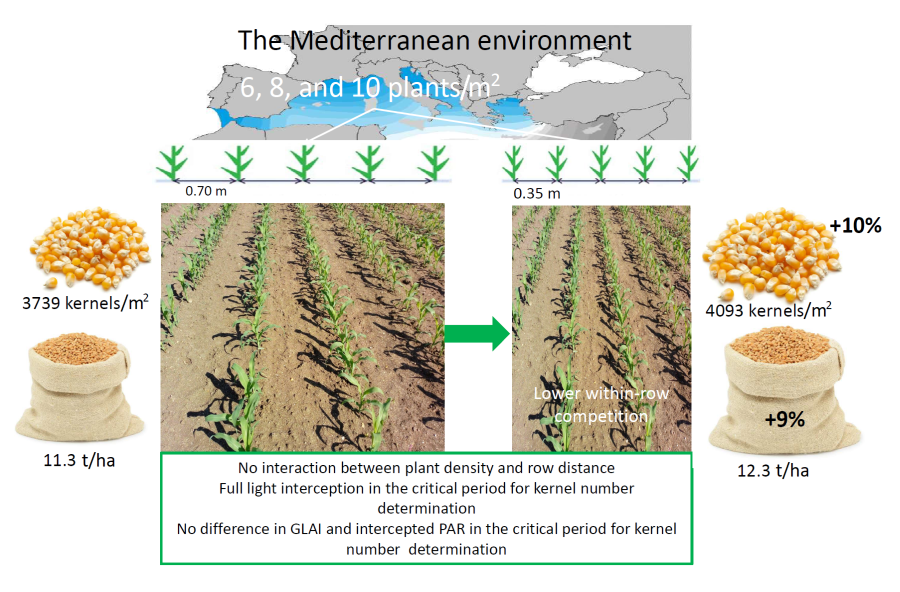
By contrast, an effect of row distance on grain yield was observed in both years despite the lack of any effect of row distance on leaf area development and despite the limited effects of row distance on the traits responsible for grain number determination. Grain yield was greater at the row distance of 35 cm than at 70 cm – 7% higher in 2021 vs 12% higher in 2022 – a difference that is again associated with differences in grain number per square metre, which in 2021 was 9% greater at the smaller row distance and 10% greater in 2022.
Discussion
The variations in grain yield between the different treatments (plant density and row distance) observed in this experiment were due to the variation in kernel number per unit area, a result also obtained in experiments carried out in other locations and with different hybrids (Cirilo and Andrade, Reference Cirilo and Andrade1994b; Otegui et al., Reference Otegui, Andrade and Suero1995; Tollenaar and Dwyer, Reference Tollenaar, Dwyer, Smith and Hamel1999). This is why the smaller row distance resulted in higher grain yields in both years despite the lower value obtained in 2022 originating from the particularly high temperatures and a red spider mite attack. The mite attack reduced leaf area index and imposed a source limitation well after the end of the critical period for kernel number determination, i.e. during grain filling, therefore, affecting grain weight but not grain number. In maize, source limitation occurring during the linear phase of grain filling, imposed by shading (Andrade and Ferreiro, Reference Andrade and Ferreiro1996) or by defoliation (Daynard and Duncan, Reference Daynard and Duncan1969), reduces the duration of grain filling and, therefore, the kernel weight, but not the kernel number.
The positive effect of a reduction in row distance, from the canonical 75 cm, on grain yield has also been observed in other studies (Widdicombe and Thelen, Reference Widdicombe and Thelen2002; Testa et al., Reference Testa, Reyneri and Blandino2016; Bernhard and Below, Reference Bernhard and Below2020). As in our experiment, Widdicombe and Thelen (Reference Widdicombe and Thelen2002) did not observe a significant interaction between plant density and row distance, whereas Testa et al. (Reference Testa, Reyneri and Blandino2016) only observed a positive effect of a reduction in row distance from 75 to 50 cm at the highest density used in their experiment (10.5 plants/m2).
In accordance with the physiological model proposed by Otegui and Andrade (Reference Otegui, Andrade, Westgate, Boote, Knievel and Kiniry2000), the effect of row distance on grain number and grain yield was analysed by looking at the critical period for grain number determination, which in our experiment extended from about the appearance of the 12th leaf to about 1 week after silking, corresponding to 23 days in both years. The recorded values of intercepted PAR in this period were within the range 210–350 MJ/m2 reported by Maddonni et al. (Reference Maddonni, Cirilo and Otegui2006) at lower latitudes (34°33′ S and 33°56′ S) in an experiment that compared different maize hybrids at the same two row widths analysed here and a plant density comparable to this experiment (9 plants/m2). When expressed on a per plant basis, the average intercepted PAR was on average around 36 MJ, in line with the maximum values quoted by Otegui and Andrade (Reference Otegui, Andrade, Westgate, Boote, Knievel and Kiniry2000). Andrade et al. (Reference Andrade, Calvin and Barbieri2002) and Maddonni et al. (Reference Maddonni, Cirilo and Otegui2006) attributed the positive effect of the reduction in row distance on grain yield to the increase in radiation interception during the critical window for kernel setting. This was not the case of our experiment as the intercepted PAR did not vary between treatments since the GLAI was high enough to guarantee an almost complete interception of radiation for the whole period. This high GLAI was also likely responsible for the lack of any effect of row distance on the coefficient of extinction of radiation because it has been demonstrated that the coefficient of extinction of radiation is only affected by plant density and row distance in cases of incomplete light interception (<95%) (Maddonni et al., Reference Maddonni, Otegui and Cirilo2001). Similarly, in studies conducted on silage maize growth, only during the early stages did a narrow row promote faster growth, but this effect did not persist at later stages with a decline of the advantage in radiation interception observed at the initial stages (Fuksa et al., Reference Fuksa, Hrevušová, Szabó and Hakl2023). The apparently high values of RUE observed here are consistent with the data reported by Cirilo and Andrade (Reference Cirilo and Andrade1994a, Reference Cirilo and Andrade1994b) for the best growing conditions of their experiment (4.2 g/MJ), and plant growth rates were consistent with the range reported by Otegui and Andrade (Reference Otegui, Andrade, Westgate, Boote, Knievel and Kiniry2000). Unfortunately, the Otegui and Andrade (Reference Otegui, Andrade, Westgate, Boote, Knievel and Kiniry2000) model cannot explain the higher number of kernels per square metre and per plant observed at the smaller row distance in both years, because only in 2022 were RUE and the plant growth rate higher at the smaller row distance. Moreover, the variation in plant growth rate explored in our experiment was in the range in which ear fertility is hardly affected, i.e. above 4 g per day (Otegui and Andrade, Reference Otegui, Andrade, Westgate, Boote, Knievel and Kiniry2000). This result lets us suppose that processes other than assimilation were also involved in kernel number determination. For example, the red:far red light ratio can be modified by row distance, because reducing the row distance from the canonical 70–75 cm assures a more uniform spatial distribution of plants, thus creating a more homogeneous environment in terms of red:far red light (Maddonni et al., Reference Maddonni, Otegui, Andrieu, Chelle and Casal2002). This could result in less expression of the shade-avoidance syndrome, which, according to Page et al. (Reference Page, Tollenaar, Lee, Lukens and Swanton2010), also includes the setting of fewer kernels per plant. This is particularly true in the case of full-season hybrids, characterized by big plants that are potentially more competitive, and hence favoured by less within-row competition. These results show the importance of inter-row in regulating light quality within a canopy of maize, and confirm the effect of the shade avoidance reaction of plants (Smith and Whitelam, Reference Smith and Whitelam1997) on light distribution and kernel number formation.
As plant density increases, resource allocation at the plant level decreases, and plant-to-plant competition increases, consequently limiting per-plant yield potential. Whether the net result of this compensation mechanism is an increase or a decrease in grain yield depends on genotype × environment interactions and on the resources available (i.e. the ‘yield environment’, Assefa et al., Reference Assefa, Vara Prasad, Carter, Hinds, Bhalla, Schon, Jeschk, Paszkiewicz and Ciampitti2016), although both the meta-analysis reported in Assefa et al. (Reference Assefa, Vara Prasad, Carter, Hinds, Bhalla, Schon, Jeschk, Paszkiewicz and Ciampitti2016) and the general positive trend observed in the USA between maize grain yield and plant densities up to 7.9 plants/m2 over the past 60 years (Bernhard and Below, Reference Bernhard and Below2020) suggest that a greater grain yield should be expected at 8 and 10 plants/m2 rather than at 6 plants/m2. In our experiment, the advantages of less interplant competition on leaf size – leaves were longer and larger at 6 plants/m2 – and on intercepted PAR per plant led to greater ear fertility in both years, although this higher level of ear fertility was only large enough to compensate for the lower number of plants per square metre in the lowest plant density in 2022. In this year, 651 kernels per ear were produced at the lowest plant density (i.e. 41% more than the other two plant densities) vs 557 (24% more than the average of the other two plant densities) in 2021. The greater RUE and higher plant growth rate observed in 2022 in the period of kernel number determination compared with 2021 are the likely reasons behind this difference. Similarly, Li et al. (Reference Li, Zhang, Xie, Hou, Bo, Xue, Wang and Li2021) reported an impact of row spacing on RUE and yield of maize in different canopy densities.
Conclusions
A reduced row distance seems to be a valuable management option for full-season maize hybrids grown in Mediterranean environments in the absence of nitrogen and water limitations. Reducing the row distance seems capable of increasing grain yield via an increase in kernel number per square metre, regardless of plant density and yield level.
Supplementary material
The supplementary material for this article can be found at https://doi.org/10.1017/S0021859624000583.
Acknowledgements
We are grateful to the technicians, Paolo Manca, Paola Fenu and Roberto Leri, and to Federica Mura for their assistance in field management, and to Mariolino Deroma of the Department of Agriculture of the University of Sassari for the laboratory analyses.
Authors’ contributions
SB, RM, FG contributed to the conceptualization, investigation, methodology, writing, review and editing. MCB, FG collected and analysed the data. All authors contributed to interpretation of the results.
Funding statement
The research was funded by the FAR (Fondo di Ateneo della Ricerca 2020) of the University of Sassari.
Competing interests
None.
Ethical standards
Not applicable.