The United Nations Security Council (UNSC) has the sole authority to determine the existence of threats to the peace, breaches of the peace, or acts of aggression. With this authority, the Council can give approval for member states to take appropriate measures to maintain or restore international peace and security, and on numerous occasions it has adopted resolutions to authorize UN member states to use military force, such as in the Korean War and the 1991 Persian Gulf War.Footnote 1
It is widely believed that such an endorsement by the UNSC increases levels of public support for military action over other forms of unilateral or multilateral use of force.Footnote 2 For instance, Grieco et al. conduct a survey experiment which demonstrates that the public support for a hypothetical military action initiated by the United States of America would increase by 43 per cent among American respondents if a UNSC resolution had been passed.Footnote 3 Many researchers argue that the key reason why UNSC approval increases public support is because of the information transmitted by a resolution: UNSC approval for the use of force implies better prospects for successful military actions, and signals to the general public that the states conducting the military action have benign intentions.Footnote 4
Grieco, Gelpi, Reifler and Feaver test the effects of UNSC approval and information transmission by conducting a survey experiment with a hypothetical US intervention in East Timor. However, we still lack comparable survey experiments on how UNSC authorization affects domestic audiences outside the United States or individuals in countries that do not initiate military action. While we have some aggregated evidence on national average support rates that appears to be consistent with the information transmission argument,Footnote 5 no existing studies have examined the effects of UNSC approval at the individual level beyond the United States, and the aggregate level studies so far do not provide much information on how different types of UNSC approval or efforts to seek authorization may affect public support. In this article we provide an experimental approach to test how variation in types of UNSC approval, and the process through which support is obtained or fails, affects support for the use of force among individual respondents in Japan. In our survey experiments we develop hypothetical conditions describing different degrees of UNSC approval and the authorization process in order to observe how these change support for the use of force.
This provides one of the first experiment-based studies of how UNSC resolutions affect public support in countries that are unlikely to provide major contributions to military action. More specifically, we study Japan, which has not initiated any major military actions since 1945, and has only recently committed to any form of military deployment abroad. However, Japan has often been asked to support US military action. Our results provide evidence consistent with the information transmission argument: the Japanese general public appears to be more likely to approve of the use of force by the United States when it has UNSC approval, as this conveys benign intentions and increases expectations that the use of force will lead to positive outcomes. We also show that when the UNSC approves a resolution, the Japanese general public regards US military action as having ‘legal legitimacy’.Footnote 6
Another new contribution of this study is the focus on the process of securing approval. Existing studies have compared cases with and without UNSC endorsement. By contrast, we consider how the endorsement was obtained, and distinguish between the process of successful adoption, failure to get an authorizing resolution passed, and cases where the United States simply ‘gives up’ and bypasses the UNSC altogether. The formal model provided by Chapman indicates that the process of UNSC endorsement could bring important information to the general public, but Chapman does not provide systematic empirical evidence to substantiate his claims.Footnote 7 Our survey experiment includes a variety of stimuli of different conditions of UNSC (non-)authorization. Our expectation is that the foreign domestic audience will perceive subtle differences in the process of UNSC (non-) approval in making decisions about appropriate responses to a crisis situation. We anticipate that multiple negative votes by non-permanent members of the UNSC should not significantly reduce foreign domestic support as long as a resolution is passed. Likewise, the use of force by the United States in cases where the UNSC has failed to pass a resolution due to a veto by one of the other permanent members should be no less likely to be supported by the foreign public than cases with successful UNSC authorization, if the public expects opposition by the non-interventionist major powers such as China and Russia. However, we expect to see a significant decrease in foreign public support when the United States withdraws a draft UNSC resolution authorizing the use of force, as this would suggest the United States has admitted failure and has given up on UN diplomacy.
The remainder of the article is organized as follows. The first section reviews existing research on UNSC approval of the use of force and the information transmission mechanism argument. The second section discusses how different degrees of authorization success and failure shape foreign public support for the use of force. In the third section, we summarize the testable hypotheses on the types of information transmitted by UNSC (non-)approval. The fourth section introduces the two scenarios in our experiment and explains why Japan is an appropriate case for the survey experiment. The fifth section details additional research design issues, and the sixth section presents and discusses the results of the statistical analyses. The final section concludes.
Unsc Approval of The Use of Force and Information Transmission
The information transmission argument has generated a great deal of attention in the growing research on the effect of UNSC approval of the use of force.Footnote 8 This argument at its core claims that the general public prefers a policy to be approved by international organizations (IOs) like the UN because such approval suggests to the international community that the proposed policy is more likely to have a successful outcome. We review three key studies in this area and then highlight areas in need of further research to enhance our knowledge of how UNSC authorization can affect public support for the use of force.
Grieco et al. argue that the UNSC approval process provides the general public with a ‘second opinion’ from the IOs, with the UN and NATO as specific examples.Footnote 9 Their main empirical contribution is an individual (micro-)level analysis to evaluate the information transmission argument through survey experiments. More specifically, approximately 1,000 Americans were asked about their support for a hypothetical US military intervention in East Timor. IO approval led to increased levels of support for the use of force among respondents who value the organization that endorses the policy. The impact of UN/NATO approval was about three times greater for respondents who most value an organization compared with those who value an organization the least. IO approval also increased support among respondents who lacked confidence in the American president. The approval effect was ten times larger among respondents without confidence in the president than among respondents with great confidence. The analysis of Grieco et al. reveals the significance of UNSC approval for the American public and the conditions under which IO approval has an impact. However, their study examines only US respondents and does not test how international audiences react to US military actions with or without UN or IO authorization.Footnote 10 We believe that foreign public reactions to the use of force are as important as American domestic public reactions. With foreign domestic support, the United States can more easily obtain coalition partners for military action, which also affects the levels of funding and the probability of operational success. Moreover, allied states would face more difficulties in providing troops for US missions when faced by strong domestic opposition.
Other studies have focused on international audiences and non-US domestic audiences. Thompson argues that approval by an international organization ‘informs domestic publics abroad that the coercive policy has desirable consequences, thereby increasing the likelihood of international support by minimizing domestic opposition’.Footnote 11 He argues that the benefits of international support are the crucial motivating factor for a US president in seeking multilateral military action over a unilateral approach.Footnote 12 Thompson suggests that formal international organizations play a unique role in international relations because of their independence and ability to act with relative autonomy and neutrality. In particular, their neutrality allows IOs to serve as informative agents to the international community, including powerful states such as the United States. Their institutional rules and procedures for decision making ensure neutrality and prevent domination by individual powerful states. In the UNSC, for example, fifteen members vote on decisions to adopt any non-procedural resolution. At least nine members must vote for a proposal, and all of the five permanent members must concur or at least not use their veto. This ensures that the diverse interests of the member states are reflected in any resolutions adopted by the UNSC and that no single country can dominate the Council.
One weakness in Thompson's research on UNSC information transmission is the highly aggregated nature of the data; there is a lack of direct evidence at the individual level as to whether information is transmitted by a UNSC resolution in the hypothesized manner.Footnote 13 As such, Thompson's empirical research does not allow us to fully evaluate the causal mechanisms at the individual level.
By contrast, Chapman examines how the process of seeking UNSC approval affects public support.Footnote 14 His model distinguishes between conservative and revisionist IOs. Conservative IOs are defined as organizations with a pivotal member which has an ideal point closer to the status quo than the audience, while revisionist IOs have a pivotal member with an ideal point further away from the status quo than the audience. In general, obtaining an outcome closer to the status quo should be less costly. When the United States seeks UNSC endorsement for the use of force, the pivotal members include China and Russia and possibly France, who are likely to have quite different preferences and thus may oppose UNSC authorization. Chapman's formal model has an interesting implication, namely that the general public is more likely to be supportive for an authorized use of force when the pivotal members of IOs are conservative. It is particularly informative to the audience if a critical pivotal member endorses a particular military action.Footnote 15 In a similar vein, Chapman argues that failure to obtain endorsement from conservative IOs is less likely to affect public attitudes towards the use of force because the general public expects those pivotal members to oppose any proposal to change the status quo no matter what. Hence, their ‘expected’ opposition does not convey much new information. Although this argument is highly original and presents interesting implications for endorsement failure, Chapman does not provide a systematic empirical test.
While existing studies have provided a great deal of information regarding how UNSC endorsement can change perceptions of military actions, there are a number of unresolved issues in our understanding of how UNSC or IO endorsement can affect public support for the use of force. We need a more direct method of evaluating whether audiences respond to endorsement in the manner suggested by the information transmission argument, and we need survey experiments beyond the United States for responses on support for US use of force. Additionally, we need an experiment to see how perceptions of legal legitimacy, which has been regarded as the power of UN authorization but rarely tested in micro-level empirical studies, can change foreign public support for American use of force.Footnote 16 Collective legitimacy may be assigned to authorized use of force, and that would be closely related to the extent of support for the proposed military action. It is possible to examine this legal legitimation effect through developing appropriate stimuli and questions in a survey experiment. Finally, as noted by Chapman, a failed resolution can also send information to the audience. Rather than making a dichotomous distinction between UNSC endorsement and a lack thereof, we should study how (un)successful the state was in obtaining UNSC endorsement and how this affects levels of support for military action. Again, by assigning proper stimuli randomly to respondents, we can assess through survey experiments how UNSC approval (non-approval) mobilizes (or undermines) domestic support for the use of force.
Before moving to the research design and details of the experiment, we will now expand on the specific hypotheses to be tested.
The Authorization Process and Foreign Public Support
When a state seeks UNSC authorization for the use of force, the diplomatic process can influence whether the outcome is perceived as a success or failure. Beyond the issue of whether a draft resolution is adopted or not the number of states in support or opposition also conveys information and may influence domestic audiences around the world. In the light of this, we should expect that the specific manner in which UNSC approval succeeds or fails affects the level of public support for military action.
Among successfully endorsed proposals, we would expect to see a clear difference in public support for the use of force between (1) a fully supported authorization (where all the fifteen member states vote in favour) and (2) a narrowly adopted proposal (where up to six states cast negative votes or abstain). Although both of these scenarios entail the adoption of a resolution, the former case implies much stronger support from the international community for military action while the latter implies a divided UNSC in which several members have serious concerns about the military action. In a similar vein, unsuccessful cases differ in how they fail, and this too conveys distinct information to the general public. In particular, a vetoed case should be distinguished from a bypassing case. In the former, an authorizing resolution could not be adopted because at least one major power vetoed the resolution despite a majority of members favouring the resolution. Chapman's model suggests that such an outcome should have higher support, given the majority in favour, as this still conveys information that many countries see the proposed use of force as well intended.Footnote 17 Vetoes by ‘perpetual naysayers’ are unlikely to convey any new information to the general public, and simply confirm existing perceptions. By contrast, when the United States ignores or ‘bypasses’ UNSC diplomacy by not asking the Council to vote on a draft resolution, the process is likely to be perceived as illegitimate, implying that the United States expected strong opposition from Council members. The general public is thus likely to see the military action as a controversial and contested issue, and is therefore less likely to support the use of force.
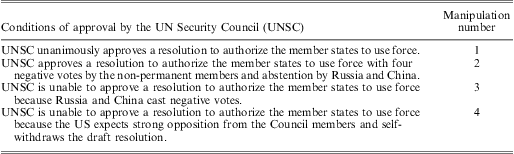
For this study, we focus on four manipulation patterns with respect to the success and failure of UNSC authorization, summarized in Table 1, that we expect to differ notably in terms of degree of public support. The first pattern is formal, unanimous UNSC approval of the use of force. The second is formal UNSC approval of the use of force, with four negative votes from non-permanent members and two abstention votes from permanent members (Russia and China). The third is a failure to obtain formal UNSC approval with two negative votes (vetoes) from permanent members (Russia and China) and thirteen affirmative votes. Finally, the last pattern is failure to obtain formal UNSC approval where the United States withdraws a draft resolution, expecting strong opposition from Council members. The first and last patterns are extreme cases of approval or non-approval, and we expect a large gap in public support between the two. The second and third patterns are mixed and less clear cases.
Four Manipulations

We expect to find the following results in response to the manipulations in the survey experiments. If the process or manner in which a resolution is adopted or rejected matters for public support of military action, we should see the highest support for the first manipulation pattern. The final pattern of ‘giving up’ on the diplomatic process at the UNSC should have significantly lower levels of support since the public receive no positive cues from the process.Footnote 18 By contrast, in the second and third manipulations we expect that the process will convey information to the public that may increase support. In the second case, the foreign domestic audience might respond to the nine affirmative votes in the Council, and the fact that a majority of members support the use of force as evidence that the proposed action brings good results for international society and has some degree of Council legitimacy. Similarly, in the third pattern the public may respond positively to the thirteen states in favour and the fact that the only opposition came from countries considered ‘perpetual naysayers’. More formally, we hypothesize:
Hypothesis 1: Domestic support for the use of force should be highest when the UNSC adopts an authorizing resolution unanimously.
Hypothesis 2: Domestic support for the use of force is higher when there is a majority of positive votes for the draft resolution, even if the authorization is adopted narrowly or vetoed by conservative permanent members.
Hypothesis 3: Domestic support is lowest when the UNSC authorization process is terminated before voting.
Variety of Information Being Transmitted
We now turn to the type of information likely to be perceived by the foreign domestic audience depending on the different conditions of UNSC endorsement or non-endorsement. The information transmission argument suggests that outside domestic audiences evaluate whether a military action (1) is done with good intentions and (2) will have positive consequences for international society. More formally, we hypothesize that:
Hypothesis 4: UNSC authorization of the use of force increases support for military action by conveying information that the proposed action will have positive consequences and is carried out with good intentions.
We already know from existing research that UNSC approval appears to increase support for the use of force.Footnote 19 Our focus here is on evaluating the information transmission mechanism specifically, and to probe how strongly individual respondents perceive a UNSC resolution as informative.
Proponents of the information transmission argument such as Thompson admit that legitimization provides an alternative explanation for the observed increase in foreign support for military actions approved by an international organization. Aside from how approval may signal better prospects for success in military actions, people may perceive the UNSC resolution as evidence that the intervening state is acting in an appropriate and legal manner, complying with the UN Charter, with formal authorization from the United Nations.Footnote 20 We argue that three key features determine how Council approval increases international support for military action.Footnote 21
First, the UNSC is the only organization with the power to judge if there is a threat to international peace and security under the UN Charter (Article 39).Footnote 22 The Council has the power to identify targets for authorized use of force as aggressors and/or threats to international peace. Even if a UNSC resolution does not clearly label anyone as an aggressor, the text of the resolution will suggest who has committed an unlawful act and influence who will be perceived as the aggressor. This means that states using force with UNSC authorization can be assumed to have a ‘just cause’ and act for the ‘right purposes’. Although the use of force is a less desirable outcome than a peaceful solution without the use of force, use of force under UNSC approval may be acceptable to foreign domestic audiences since there is an institutional assurance that the military action is being conducted for the right purposes and just causes.
Hypothesis 5: UNSC authorization for the use of force creates a perception that military action has been taken for a just cause and right purposes.
Secondly, under the UN Charter, the UNSC is recognized as the supreme authority of the United Nations to deal with matters related to peace and security. The UN General Assembly (UNGA) can only make recommendations to member states on what should be done to maintain peace, but the UNSC can order its member states to take action and enforce the restoration of peace and security in international society (Article 25). While the Council is dealing with a dispute or situation, the UNGA cannot make any recommendation unless the Council requests it to (Article 12). In short, the UNSC has a special position in international society, especially with regard to peace and security. UNSC authorization to use force can convey information to outside observers that military action has been authorized under correct and appropriate procedures.Footnote 23 Foreign domestic publics are thus likely to see the UNSC as the sole authority of the United Nations on issues of international peace and security with the capacity to decide upon appropriate measures.
Hypothesis 6: UNSC authorization of the use of force creates a perception that the military action has been approved by the correct and appropriate procedure.
Thirdly, there are high decision costs in the UNSC, given the fact that nine of the fifteen member states must vote in favour of a resolution to authorize the use of force (Article 27), and all the five permanent members must refrain from using their veto. There are usually Council members who are reluctant to approve a military option and insist on seeking further diplomatic solutions. Thus, a state proposing UNSC authorization of the use of force must first seek a diplomatic solution before claiming that peaceful solutions have been exhausted.Footnote 24 The fact that UNSC-approved use of force is seen as a last resort is likely to generate a higher rate of public acceptance. Even if the absolute level of active support from the international audience is muted, it is at least likely to reduce objections to military action.Footnote 25
Hypothesis 7: UNSC authorization of the use of force creates a perception that efforts for a diplomatic solution have been exhausted and that military action is a last resort.
Finally, we consider how perceptions of legality and legitimacy in terms of international law may be engendered by UNSC approval.
Hypothesis 8: UNSC authorization of the use of force creates a perception that the military action is legally legitimate and consistent with international law.
Why a Survey Experiment and Why Japan
We conducted a survey experiment to test how individuals in other states respond to US military actions that have been approved or rejected by the UNSC. A survey experiment allows us to conduct a controlled study where we can ask randomly selected respondents about their support for the use of force under a variety of hypothetical conditions or manipulations on UNSC approval and non-approval.
It would be ideal to conduct such a survey experiment in several states to examine possible cross-national differences, but this would require a significant investment of resources. We believe that Japan provides a useful setting for our experiment for a number of reasons. The literature on the approval of the UNSC, or more generally of IOs, is to a great extent based on the American use of force. We considered foreign domestic reactions to US use of force, and asked respondents whether they supported the proposed US use of force and whether they agreed to the deployment of the Japanese Self-Defence Forces (SDF). In our view, the latter question is a more critical measure of the support for the use of force, since it avoids possible free-riding, where people do not oppose the use of force when it is perceived as costless to them. Thus, to evaluate coalition participation in a US-led multinational force we must conduct a survey experiment in a state with a formal alliance or close relationship with the United States. Japan has had a formal alliance with the United States since 1951, and has recently sent the SDF to Iraq and the Indian Ocean as part of US coalitions.
Given the famous peace constitution and the overall anti-military sentiment in Japan, we can reasonably assume that Japanese citizens will have a lower rate of support for the use of military action as a means of managing international affairs than many other states.Footnote 26 The lower baseline probability for accepting a military option as a solution for an international problem is advantageous for testing the effects of IO approval on the use of force, since this enables us to observe increases in public support for the military action with UNSC approval in a case where individuals are known to be hesitant to endorse the use of force.Footnote 27
Scenarios
We use two scenarios to compare the effects of context information for the baseline support rate.Footnote 28 They differ in terms of the nature of interest at stake for the United States and international society, but since the differences in the benefits at stake should not alter the effect of UNSC approval we expect to observe similar results.
Scenario 1 concerns military action against piracy. Country A in the Middle East is a failed state, which is unable to police piracy in the nearby sea called the Gulf of B. Commercial tankers and ships are increasingly affected by acts of piracy, and the fact that country A is effectively a ‘safe haven’ for the pirates is becoming an international concern. The United States asks the UNSC to adopt a resolution that authorizes the member states to take all necessary measures to stop acts of piracy and restore regional peace and security.
By contrast, Scenario 2 is a military intervention aimed at regime-change in country A in the Middle East. Country A has a dictator and faces a popular movement demanding democratization. The dictator orders the military to repress the protest movement, leading to mass killings. The country is a major oil producer, and the price of crude oil rapidly increases after media reports of mass killing, refugees flooding out of the country, and deteriorating security in the entire region. The United States asks the UNSC to adopt a resolution that authorizes member states to take all necessary measures to stop the mass killing and restore regional peace and security.
For both scenarios, the UNSC decides on the draft resolution proposed by the United States. Each of the four different outcome manipulations in Table 1 is assigned randomly to each respondent. Regardless of its success in obtaining a resolution from the UNSC, respondents are told that the US government initiates multinational military operations against the target country with broad support from the US public.Footnote 29
Design of The Survey Experiments and Key Questions
The survey experiments were carried out over the period 6–10 July 2012 by Nikkei Research Inc.Footnote 30 Their online survey services are highly reliable in preventing multiple registrations by one individual, and have been used in other political science experimental studies.Footnote 31 The survey covers 2,272 individuals between the ages of 20 and 69.Footnote 32
Although Nikkei Research has a nationwide pool of respondents, our survey experiments are not nationally representative since individuals in the sample must have internet access and be voluntarily preregistered with the firm. As such, we cannot claim that the results of this experiment can be directly generalized to the Japanese population at large.Footnote 33 However, the observable differences following the randomly assigned stimuli should still provide a reliable test of how UNSC approval affects support for military action and why.Footnote 34 We measure support in our survey to test Hyptheses 1 to 3 by using the following two questions.Footnote 35 First, we asked respondents:
-
Do you approve of the coalition's military action initiated by the US?
The possible answers to this question are: (1) approve, (2) somewhat approve, (3) somewhat disapprove, (4) disapprove, and (5) do not know.Footnote 36
Secondly, using the same scale of choices, we asked respondents;
-
Do you approve of the Self-Defence Forces (SDF) providing logistical support for the US-led coalition in the Middle East, as requested by the US government?
To test the information transmission argument on the desirable results of using force, we asked the following two questions, testing Hypothesis 4.Footnote 37
-
Do you consider that the use of force would generate a ‘desirable outcome’ for international peace? Footnote 38
-
Do you consider that the use of force was carried out ‘with good intention’?
To test whether legal legitimacy information is transmitted to the Japanese audience by UNSC reaction (Hypotheses 5 to 8 successively), we posed the following four questions:
-
Do you consider that the use of force was initiated for the ‘right purpose’?
-
Do you consider that the use of force was initiated in line with the ‘right procedure’, with approval of the appropriate authority?
-
Do you consider that force was initiated as a ‘last resort’ after exhausting efforts towards a diplomatic solution?
-
Do you consider that the use of force was ‘legally legitimate’ based on international law?
We also asked supplementary questions about gender, income level,Footnote 39 level of education (i.e., whether the respondent has attended college), and age,Footnote 40 which we used to check the random assignment of the manipulations.
Analyses And Results
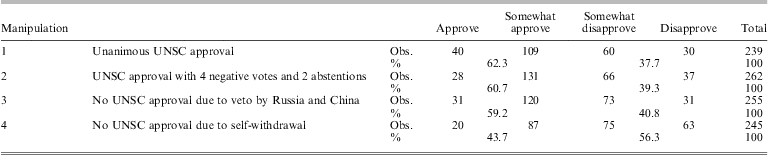
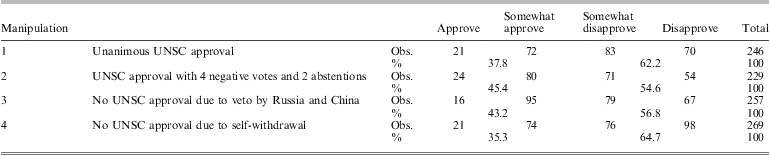
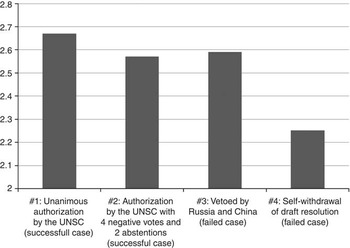
The simple descriptive statistics presented in Tables 2A and 2B allow us to test the first three hypotheses. Consistent with our second hypothesis, we see the most critical difference in public support exists between the third and fourth manipulations. The ANOVA and multiple comparisons (Scheffé's method) confirm that the difference is statistically significant.Footnote 41 The survey respondents distinguish between cases in which the United States withdraws the draft resolution and cases where the UNSC votes. In the latter cases we see more support for the use of force, irrespective of whether the draft resolution is adopted or not. The withdrawal of a resolution undermines support for military action. Our results suggest that failure to secure authorization due to a veto by Russia and China does not affect support for military action.Footnote 42
Support for American Use of Force: Scenario 1 (counter-piracy)

Note: F (3, 997) = 9.93 (p < 0.000); Scheffé (between manipulations 1 and 4) = 0.404, p < 0.000; Scheffé (between manipulations 2 and 4) = 0.311, p < 0.005; Scheffé (between manipulations 3 and 4) = 0.331, p < 0.005.
The percentages are shown in aggregated numbers by Approve and Somewhat approve, and by Somewhat disapprove and Disapprove, respectively.
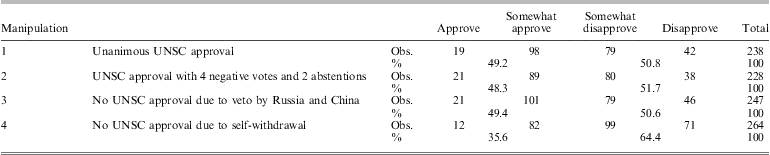
Support for American Use of Force: Scenario 2 (Regime-change)

Note: F (3, 973) = 5.97 (p < 0.000); Scheffé (between manipulations 1 and 4) = 0.262, p < 0.05; Scheffé (between manipulations 2 and 4) = 0.275, p < 0.01; Scheffé (between manipulations 3 and 4) = 0.260, p < 0.05.
The percentages are shown in aggregated numbers by Approve and Somewhat approve, and by Somewhat disapprove and Disapprove, respectively.
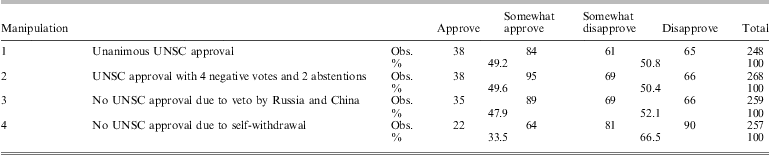
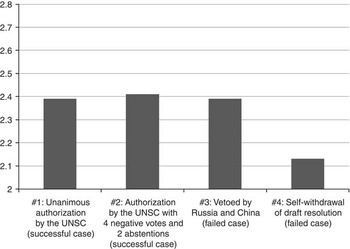
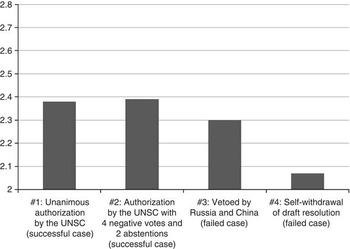
Tables 3A and 3B report public support levels for sending Japanese troops to US-led military actions in the Middle East. We would expect that Japanese respondents would prefer to free-ride on military actions. Surprisingly, however, the respondents are only about 10 per cent less supportive of sending Japanese military forces compared with support for the military action itself. This may be due to our question being limited to a commitment of logistical support rather than combat operations. The effect of UNSC authorization in the regime-change scenario is consistent with our expectations, but the difference is not statistically significant.
Support for Sending Japanese Troops: Scenario 1 (Counter-piracy)

Note: F (3, 1028) = 6.09 (p < 0.000); Scheffé (between manipulations 1 and 4) = 0.313, p < 0.01; Scheffé (between manipulations 2 and 4) = 0.275, p < 0.01; Scheffé (between manipulations 3 and 4) = 0.260, p < 0.05.
The percentages are shown in aggregated numbers by Approve and Somewhat approve, and by Somewhat disapprove and Disapprove, respectively.
Support for Sending Japanese Troops: Scenario 2 (Regime-change)

Note: F (3, 997) = 3.21 (p < 0.05); Scheffé (between manipulations 2 and 4) = 0.256, p < 0.05.
The percentages are shown in aggregated numbers by Approve and Somewhat approve, and by Somewhat disapprove and Disapprove, respectively.
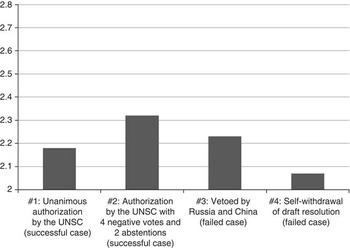
Figures 1 to 4 provide a graphical presentation of the mean support score for the US use of force and Japanese SDF participation under different manipulations. Depending on the scenarios, there are two figures for US use of force support and SDF participation support. In Figure 1, for example, we see a difference in support between the first and fourth manipulations of 0.40, which is statistically significant at the 1 per cent level. The figure makes it clear how Hypothesis 3 is generally supported, since the fourth manipulation (where the US ‘gives up’ on UNSC approval) sees significantly lower support.
Level of support for US use of force in response to success or failure in gaining UNSC approval: Scenario 1 (counter-piracy) Note: The differences between #1 and #4, between #2 and #4 and between #3 and #4 are statistically significant, respectively.

Level of support for US use of force in response to success or failure in gaining UNSC approval: Scenario 2 (regime-change) Note: The differences between #1 and #4, between #2 and #4 and between #3 and #4 are statistically significant, respectively.

Level of support for sending Japanese troops in response to success or failure in gaining UNSC approval: Scenario 1 (counter-piracy) Note: The differences between #1 and #4, between #2 and #4 and between #3 and #4 are statistically significant, respectively.

Level of support for sending Japanese troops in response to success or failure in gaining UNSC approval: Scenario 2 (regime-change) Note: The difference between #2 and #4 is statistically significant.

We now turn to the ANOVA and multiple comparisons for the type of information received by respondents under the different manipulations for success/failure for UNSC authorization used, and report the full tables and figures in the online appendix. Hypothesis 4, involving desirability and intention, and Hypotheses 5 to 8, pertaining to perceptions of legal and procedural legitimacy, are generally supported in our results, although there is variation across the different scenarios. In sum, we see the expected differences with notably lower support in the manipulations where the United States gives up on UNSC approval compared to the other three manipulations. The hypotheses on perceptions of legitimacy and legality, or ‘appropriate procedure’ (Hypothesis 6) and ‘legally legitimate’ (Hypothesis 8), receive robust support (see online appendix Figures 9 to 12). By contrast, the ‘last resort’ perception hypothesis (Hypothesis 7) does not see statistically significant differences among the four manipulations, nor do we see this for the ‘right purpose’ hypothesis (Hypothesis 5).
Information on desirability and intention, as well as legitimacy in terms of legal procedure, are all more likely to be perceived by individuals when the UNSC adopts a resolution. However, a UNSC resolution that fails to pass solely due to Russian or Chinese vetoes undermined the perceived legitimacy. The use of force is considered significantly more legal and legitimate only when the United States successfully obtains UNSC resolutions. Irrespective of how a resolution is adopted, as long as it meets the UN Charter's requirement as a formal decision of the Council, the use of force appears to be perceived as legally legitimate and based on appropriate procedure. By contrast, desirability and intention information appears to be conveyed to audiences both when a resolution is adopted successfully and rejected due to opposition by the conservative veto powers.
Conclusion
Our survey experiment in Japan confirms how different types of success and failure of UNSC approval matter for the level of foreign support for US use of force. Foreign domestic support for US-led use of force is higher under UNSC authorization. Unanimous approval maximizes support, but narrowly-adopted resolutions also increase support and even resolutions vetoed by conservative permanent members increase support, as long as a majority of members vote in favour of the draft resolution. By contrast, UNSC authorization which was terminated before formal voting leads to much lower foreign domestic support for the use of force. The withdrawal of a draft resolution, when the United States ‘gives up’ on UNSC diplomacy, is associated with dramatically lower popular support for the use of force.
We have argued that these differences stem from perceptions of the diplomatic process at the UNSC. A formal resolution that is adopted successfully is perceived as legitimate, irrespective of whether it is adopted narrowly or unanimously. It is indeed unnecessary to gather all of the fifteen votes to generate a perception of legal legitimacy; only nine affirmative votes without the exercise of a veto by the permanent members can make a military action legally legitimate.
Moreover, our survey experiment clearly suggests that the Japanese public seems to respond to subtle differences in UNSC diplomacy regarding authorization of the use of force. A country seeking approval for the use of force should not give up too easily on UNSC approval, especially if it expects vetoes from conservative major powers. A resolution that fails through a veto can send information to the domestic audience that the use of force has good intentions, and is likely to increase public support for military action even if the resolution does not pass. One implication of our findings from Japanese respondents is that military action against Iraq would have been less controversial if the George W. Bush administration had managed to secure more than nine affirmative votes from Council members before March 2003 and let France, China and Russia veto the draft resolution.
Our current study unfortunately does not allow us to consider many other important forms of variants of UNSC (non-)approval. Even among the cases where the United States ‘gives up’ one could imagine important differences between whether the United States abandons or bypasses the UNSC's diplomatic process at the outset or maintains some form of engagement with the UNSC. Future experiments can compare scenarios where a major power ‘gives up’ or ‘bypasses’ the UNSC altogether. As our study is limited to Japan, it would also be helpful to conduct similar experiments in other states to evaluate the generalizability of the finding. We hope that this study inspires follow-up studies on the effects of UNSC authorization on domestic audiences, both in intervening and non-participating countries.