Introduction
Positive assortative mating, that is mate selection based on finding a mate that is phenotypically similar to oneself, has been demonstrated in humans for many different phenotypic traits (Spuhler, Reference Spuhler1982), including manifestations of different psychiatric disorders (Merikangas, Reference Merikangas1982). Most clinical psychiatrists will at some time have encountered, or experienced concerns over, patients who live together with a partner or spouse who also has a psychiatric disease, and over the years there has been considerable interest in studying the extent to which patients form pairs with, or marry, other patients. The question is not trivial for patients who are in their reproductive years, as the risk of psychiatric diseases in the offspring is markedly increased if two parents, as opposed to one parent, suffer from disease, because the total amount of transmitted disease-related genes is increased when both parents are clinically ill (Lieb et al. Reference Lieb, Isensee, Hofler, Pfister and Wittchen2002; Weissman et al. Reference Weissman, Wickramaratne, Nomura, Warner, Verdeli, Pilowsky, Grillon and Bruder2005). This is pertinent both clinically for planning the level of support for patients who live together and plan to have children, and scientifically for conducting epidemiological research or genetic research of psychiatric diseases. Therefore, it is of interest to know the extent to which psychiatric patients assort to living with one another.
Although there is evidence for assortative mating among patients with various psychiatric diseases, the data vary (Heun & Maier, Reference Heun and Maier1993; Waters et al. Reference Waters, Marchenko, Abrams, Smiley and Kalin1983). Many older studies of assortative mating have methodological shortcomings, such as lack of systematic inclusion of patients and control persons, low statistical power, and recall bias in relation to retrospectively collected data.
In the most recent review of the literature, Mathews & Reus (Reference Mathews and Reus2001) found that 12 out of 17 assessed studies reported assortative mating among patients with an affective disorder, but in widely varying degrees. Although there is a history of studying assortative mating in schizophrenia (Zerbin-Rudin & Kendler, Reference Zerbin-Rudin and Kendler1996), few studies have explored the phenomenon in the era of psychiatry where operational criteria have been routinely used for diagnosis. No previous study has presented results of bidirectional longitudinal analyses on cohabitation and psychiatric illnesses within a large population.
Therefore, we have investigated the concordance of psychiatric diagnoses in cohabitating pairs using register data, examining the cohabitation pattern of the entire Danish population over a 13-year period. We conducted analyses of (1) the rates of commencing cohabitation with a cohabitant who had a history of psychiatric disorder, comparing rates for psychiatric patients with rates for individuals without a history of psychiatric disorder, and (2) the rate of receiving a psychiatric diagnosis while cohabitating with an individual with a psychiatric disorder, compared to the rate of receiving a psychiatric diagnosis while cohabitating with an individual without a history of psychiatric disorder. Our a priori hypothesis was that these rate ratios (RRs) would be increased due to assortative cohabitation among psychiatric patients.
Method
Danish register data
Danish population-based registries use a unique personal identification number, the Central Personal Register (CPR) number, which is assigned at birth or upon attaining citizenship to all persons living in Denmark. All registered information about the individual citizen is recorded using this number, and the number ensures that accurate linkage of information between registers can be performed, irrespective of whether the individual citizen changes name or address. Demographic data, including data about citizens' address status, are registered centrally in the governmental agency Statistics Denmark. All deaths, and all emigrations from Denmark, are also registered.
Hospital admissions to psychiatric wards have been recorded in a nationwide register, the Danish Psychiatric Central Register (DPCR), since 1 April 1970, using ICD-8 (WHO, 1974) and later ICD-10 (WHO, 1993) diagnoses for registration (Munk-Jorgensen & Mortensen, Reference Munk-Jorgensen and Mortensen1997). All admissions to Danish hospitals are on record, as it is mandatory for hospitals to report dates of admission and discharge and the discharge diagnoses of all admitted patients. From 1995, out-patient contacts to hospital-affiliated psychiatric services have also been registered.
The study sample
The study population was obtained by linking diagnosis data from the DPCR with data about cohabitation from Statistics Denmark.
The time period studied was from 1 January 1994 to 31 December 2006. Information on the entire adult Danish population was available so that all individuals in Denmark, who were between 18 and 70 years of age at 1 January 1994, were included in the study. Thus, the maximum time under observation for individuals entering the study at 1 January 1994 was 13 years. All individuals who reached the age of 18 during the study period were included in the study from their 18th birthday. All individuals who reached the age of 70 during the study period were censored (i.e. excluded from further participation in the study from this point in time) at their 70th birthday.
In the study population, individuals registered in the DPCR with a psychiatric diagnosis from 1970 and onwards were identified. The group of individuals with a psychiatric diagnosis was divided into subgroups of four major diagnostic categories, according to the main ICD diagnoses given at their first contact with a psychiatric service facility: schizophrenia and related disorders (ICD-10 diagnoses F20–F29.0; ICD-8 diagnoses 295–295.09); bipolar disorder (ICD-10 diagnoses F30–F31.7 and F38.00; ICD-8 diagnoses 296.1–296.3); major depressive disorder (MDD; ICD-10 diagnoses F32–F33.9 and F34.1–F34.9; ICD-8 diagnoses 296.0 and 298.0); other psychiatric disorders (all other ICD diagnoses, for example those denoting substance abuse disorders, anxiety disorders or personality disorders). The data in the Danish hospital registers reflect the diagnostic practice of clinicians in Denmark in the observational period. The diagnostic validity of the psychiatric diagnoses in the DPCR has been compared with ICD-10 research criteria for affective disorder and was correct in approximately 80% of cases, depending on the severity of the disease (Bock et al. Reference Bock, Bukh, Vinberg, Gether and Kessing2009). The diagnostic validity decreases with the number of digits used in the ICD diagnoses (Munk-Jorgensen & Mortensen, Reference Munk-Jorgensen and Mortensen1989; Kessing, Reference Kessing1998), so to achieve high diagnostic validity we grouped the diagnoses into main categories as ‘schizophrenia’ or ‘MDD’, defined by the first three digits of the ICD diagnoses. Schizophrenia, bipolar disorder and MDD were selected because these are major distinctive categories of severe psychiatric disease that can be reliably identified from the registered data. The diagnostic validity of the first diagnosis of other registered psychiatric disorders is less reliable; therefore, these disorders were not studied separately but grouped in the collected category of ‘other psychiatric disorders’.
Using information about address status linked to the individuals' CPR number, all time periods where two individuals of opposite sex were living at the same address were identified. The time periods ranged from the date they were both registered at the same address to the date one of them was registered to be living at another address or, if they remained sharing an address, to the end of the study period. Cases where three or more unrelated individuals were registered as living at the same address were excluded, so as to exclude living arrangements such as group homes or residential care facilities from the analyses. However, in cases where one or more ‘extra’ individuals had been registered at a given address before the age of 18, these were included because the extra individuals were most probably children who had been in the custody of the other cohabitating individuals.
In contemporary Danish society it is common to be living together in unregistered unions without being married. For example, in 1999, 72% of Danish couples were married and 28% were living in unregistered unions (Ottesen, Reference Ottesen2000). Living in an unregistered union was most common among young couples. Therefore, cohabitation status in the form of a shared address, rather than a registered partnership or marital status, was used as the most relevant proxy variable for determining whether two adults were forming a couple.
Statistical analysis
Two different Poisson regression analyses were conducted. Poisson regression models are standard multiple regression models for incidence rates, where numbers of outcome events and person-years at risk are computed and analyzed in subgroups given by covariates, which may be time dependent (Clayton & Hills, Reference Clayton and Hills1993).
In the first analysis the outcome was cohabitation, defined as changing status from living single to moving to the same address as a new cohabitant. In this analysis, individuals were contributing with time at risk in all periods where they were not sharing address with another adult individual. Thus, multiple at-risk periods and multiple events for each individual were allowed in the analysis. The rates of moving to the same address as a cohabitant who had a psychiatric diagnosis were estimated for individuals who themselves had a psychiatric diagnosis and compared with the rates for individuals without a psychiatric diagnosis, resulting in estimated RRs. If diagnosed during the study period, an individual changed exposure status from being without a psychiatric diagnosis to belonging to one of the diagnostic subgroups. In addition, the RR of moving to the same address as a cohabitant with a diagnosis from one of the four diagnostic subgroups was estimated for individuals from each of the diagnostic subgroups.
In the second analysis the outcome was receiving a psychiatric diagnosis. In this analysis, individuals were contributing with time at risk in all periods where they were sharing an address with a cohabitant who either had or did not have a psychiatric diagnosis. All cohabiting individuals were divided into five exposure groups of individuals living together with cohabitants with diagnoses from one of the four psychiatric subgroups or with cohabitants without any psychiatric diagnosis. Because the individuals were considered at risk in all periods where they shared an address with another adult individual, their exposure status could change according to the diagnosis of their cohabitant. If an individual received a psychiatric diagnosis during the study period, the event contributed to the event rate of the exposure group this individual belonged to at the given time, and hereafter the individual was censored.
The rates of receiving a psychiatric diagnosis were compared between individuals whose cohabitant had a psychiatric diagnosis and individuals whose cohabitant did not have a psychiatric diagnosis. In addition, the RRs of receiving a psychiatric diagnosis from one of the four diagnostic subgroups were estimated separately for individuals with cohabitants from each of the four subgroups.
In both analyses all RRs were adjusted for age (divided into 5-year age groups) and we estimated the interaction between diagnostic status and age group (18–29, 30–50 and 50–70 years) in the first analysis, and the interaction between cohabitation status and age group in the second analysis. All analyses were performed separately for men and women. As cohabitation status is only updated once a year in the Danish registers; random dates of commencing and ending cohabitation were drawn from the relevant time intervals.
All analyses were performed with SAS version 9.2 (SAS Institute Inc., USA).
Results
In the first analysis, 2 523 326 individuals (1 241 883 women and 1 281 443 men) were included. A total of 94 761 individuals (3.7%) were censored because of death, 139 168 individuals (5.5%) were censored because of emigration from Denmark, and 195 239 individuals (7.7%) were censored because they reached 70 years of age during the study period.
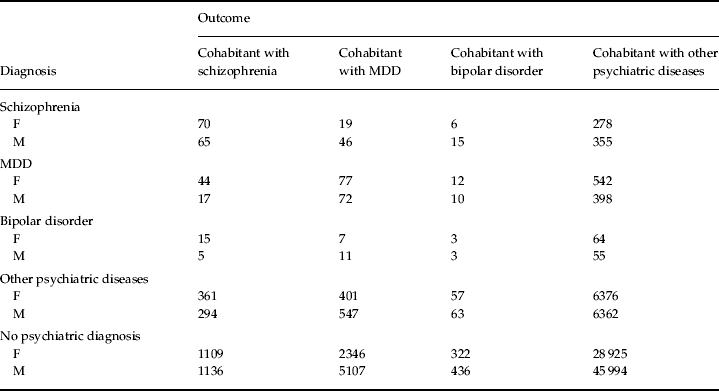
In total, there were 102 025 events where individuals moved together with a cohabitant who had a psychiatric diagnosis. For individuals who had a psychiatric diagnosis (any diagnosis), the overall RR of moving in together with a cohabitant with a psychiatric diagnosis was 1.95 [95% confidence interval (CI) 1.90–2.00] for women and 1.65 (95% CI 1.61–1.69) for men, when compared with individuals without a psychiatric diagnosis. Table 1. shows the number of events occurring in each major diagnostic category.
The number of individuals who changed status to sharing address with a cohabitant with a psychiatric diagnosis, depending on the individuals' own psychiatric diagnostic status
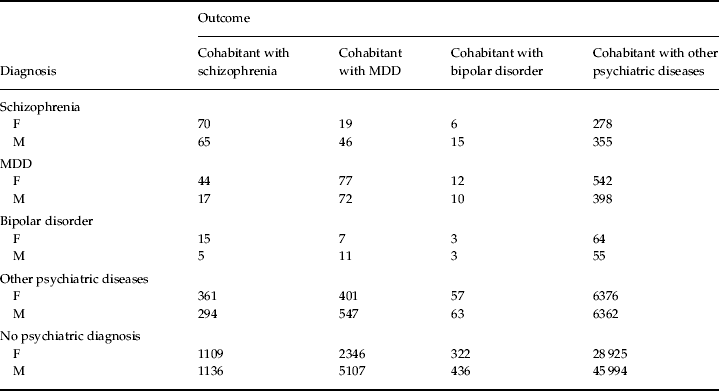
MDD, Major depressive disorder; F, female; M, male.
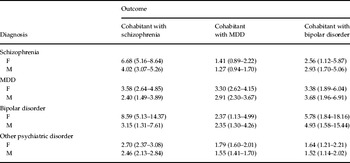
The RRs of commencing cohabitation with a cohabitant with a psychiatric diagnosis according to the individuals' diagnostic status and compared with individuals with no psychiatric diagnosis are presented in Table 2.
Rate ratios (RRs) of commencing cohabitation with a cohabitant with schizophrenia, major depressive disorder (MDD) or bipolar disorder for individuals who have schizophrenia, MDD, bipolar disorder or other psychiatric disorder, compared with individuals without a psychiatric diagnosis

F, female; M, male.
Values given as RR (95% confidence interval).
Psychiatric patients' RR of commencing cohabitation with another psychiatric patient tended to decrease with age; thus, a woman aged <30 years with a psychiatric diagnosis had an RR of 2.46 (95% CI 2.35–2.57) of commencing cohabitation with a man with a psychiatric diagnosis when compared with women of the same age group with no psychiatric diagnosis. Women aged between 30 and 50 years had an RR of 1.85 (95% CI 1.79–1.91) and women aged between 50 and 70 years had an RR of 1.53 (95% CI 1.43–1.63). The corresponding RRs for men were: 2.03 (95% CI 1.94–2.14), 1.63 (95% CI 1.58–1.68) and 1.31 (95% CI 1.24–1.39).
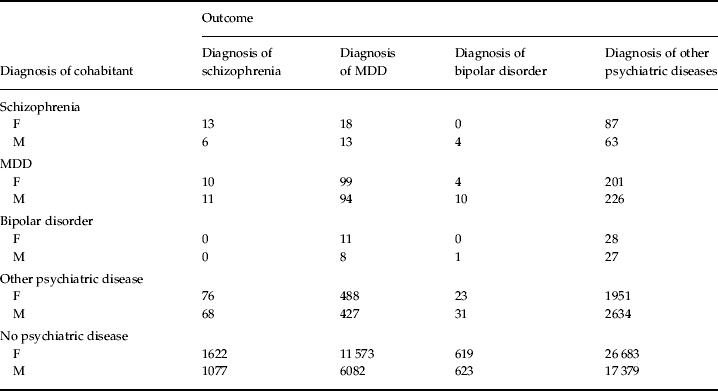
In the second analysis, 3 204 633 individuals (1 602 167 women and 1 602 466 men) were included. A total of 159 929 individuals (5.0%) received a psychiatric diagnosis at some time during the study period, and 72 290 of these individuals (2.3%) were living at the same address as a person of the opposite sex when diagnosed. A total of 98 384 individuals (3.0%) were censored because of death, 72 942 (2.2%) were censored because of emigration from Denmark, and 333 678 (10.4%) were censored because they reached 70 years of age during the study period. Table 3 shows the number of events in each major diagnostic category.
The numbers of cohabitating individuals who received different psychiatric diagnoses, depending on their cohabitant's psychiatric diagnostic status
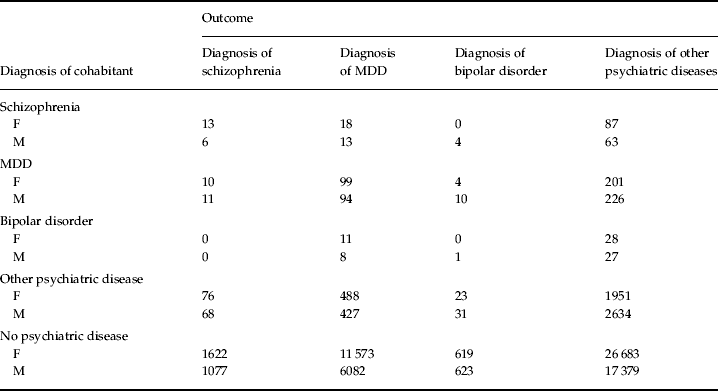
MDD, Major depressive disorder; F, female; M, male.
The overall RR of receiving a psychiatric diagnosis while cohabitating with an individual with a psychiatric diagnosis was 2.40 (95% CI 2.31–2.49) for women and 2.91 (95% CI 2.81–3.01) for men, when compared with individuals of the same sex whose cohabitants did not have a psychiatric diagnosis.
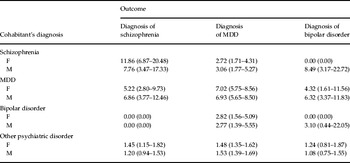
The RRs of individuals' diagnoses according to their cohabitant's diagnostic status and compared with individuals whose cohabitants had no psychiatric diagnoses are presented in Table 4.
Rate ratios (RRs) of receiving a diagnosis of schizophrenia, major depressive disorder (MDD) or bipolar disorder for individuals with cohabitants with schizophrenia, MDD, bipolar disorder or other psychiatric disorder, compared with individuals with cohabitants without a psychiatric diagnosis

F, female; M, male.
Values given as RR (95% confidence interval).
The rates of incident psychiatric diagnoses among those cohabitating with psychiatric patients tended to decrease with age; thus, a woman aged <30 years had a 2.48 (95% CI 2.29–2.68) RR of receiving a psychiatric diagnosis while cohabitating with a diagnosed man, when compared with women of the same age group who were cohabitating with men without a psychiatric diagnosis. Women aged between 30 and 50 years had an RR of 2.46 (95% CI 2.34–2.59) and women aged between 50 and 70 years had an RR of 2.19 (95% CI 2.03–2.36). The corresponding RRs for men were: 4.19 (95% CI 3.85–4.55), 3.22 (95% CI 3.08–3.38) and 2.06 (95% CI 1.93–2.21).
Discussion
We estimated individuals' risk of moving in with a cohabitant with a history of psychiatric disorder depending on whether they themselves had a psychiatric diagnosis, and also estimated the rate of receiving a psychiatric diagnosis among individuals living with a cohabitant with a psychiatric disorder. Both analyses resulted in estimates that suggest a general tendency of cohabitation between psychiatric patients. The study sorts diagnosed individuals into fairly heterogeneous disease category groups but, looking at the two analyses in combination, within these groups there seems to be a tendency for individuals to cohabitate with a partner with the same disorder as themselves as opposed to cohabitating with a partner with any other psychiatric disorder. There is also a tendency for individuals with the severe psychiatric disorders (MDD, bipolar disorder and schizophrenia) to cohabitate with other individuals with severe psychiatric disorders.
Previous studies have hypothesized that spousal concordance for a psychiatric trait or a psychiatric diagnosis could result from the stress of living with an affected spouse, or result from both spouses being exposed to the same stressors at the same time (Galbaud du Fort et al. Reference Galbaud du Fort, Bland, Newman and Boothroyd1998). However, these mechanisms would not explain higher RRs of commencing cohabitation, and although it undoubtedly is often stressful to cohabitate with an individual with a severe mental disorder, we find it biologically implausible that a cohabitant would develop schizophrenia or bipolar disorder as a stress reaction, without having an underlying disposition to develop such a disorder. High RRs for severe psychiatric disorders therefore imply that cohabitation is assorted by the presence of traits or factors associated with these disorders. The register data used in this study only allow for guesses of the causes of the assortment, which could result from a host of different factors, such as individuals' preferred choice of partner, cohabitation due to similar socio-economic circumstances, cohabitation due to finding a cohabitant in a patient setting, and so on.
Looking at the cohabitation pattern of the severe psychiatric disorders separately, the differences between the diagnosed individuals and the background population are fairly substantial (Table 2). Individuals with diagnoses of schizophrenia, MDD or bipolar disorder all had higher rates of pairing with cohabitants with one of these severe disorders than individuals without psychiatric diagnoses, the exception being individuals with schizophrenia who did not have a significantly increased risk of pairing with individuals with a history of MDD. Both men and women with a diagnosis of bipolar disorder had a particularly increased risk of pairing with cohabitants with diagnoses characterized by or associated with psychotic symptoms (i.e. bipolar disorder or schizophrenia). This pattern was also seen among individuals with a diagnosis of schizophrenia; here the RR of pairing with a cohabitant with a history of schizophrenia was most pronounced.
For psychiatric illness arising during cohabitation, the general pattern was that individuals had a high RR of getting a diagnosis of severe psychiatric disorder if their cohabitant had a similar disorder (see Table 4). Among individuals living with cohabitants with MDD, there was a markedly increased rate of all three disease categories, for both sexes. Although there were not enough cases of individuals being diagnosed with bipolar disorder or schizophrenia while living with a cohabitant with bipolar disorder to estimate meaningful event rates, individuals living with a cohabitant with bipolar disorder had an increased rate of being diagnosed with MDD. Individuals who were cohabitating with a partner with schizophrenia had a markedly increased rate of being diagnosed with MDD and an even greater rate of being diagnosed with schizophrenia. Here, women with a cohabitant with schizophrenia seem to be at greatest risk, with an almost 12 times increased rate of schizophrenia when compared with women living with cohabitants without a psychiatric disorder.
Concordance between spouses or cohabitants has previously been studied for traits that are associated with psychopathology such as substance use, for personality traits such as openness and agreeableness (McCrae et al. Reference McCrae, Martin, Hrebickova, Urbanek, Boomsma, Willemsen and Costa2008; Merline et al. Reference Merline, Schulenberg, O'Malley, Bachman and Johnston2008), and for psychiatric conditions such as attention deficit/hyperactivity disorder (ADHD), alcoholism and antisocial personality disorder (Galbaud du Fort et al. Reference Galbaud du Fort, Boothroyd, Bland, Newman and Kakuma2002; Boomsma et al. Reference Boomsma, Saviouk, Hottenga, Distel, De Moor, Vink, Geels, van Beek, Bartels, De Geus and Willemsen2010). In a comprehensive review of the scientific literature published before 1982, it was concluded that concordance between spouses for psychiatric illness had been widely and consistently reported (Merikangas, Reference Merikangas1982). Maes et al. (Reference Maes, Neale, Kendler, Hewitt, Silberg, Foley, Meyer, Rutter, Simonoff, Pickles and Eaves1998), in a study of cohabitation and marriage data from two large twin cohorts, found that there was a moderate degree of mate assortment both within and across psychiatric diagnoses for anxiety disorders, MDD and alcoholism.
There is some evidence for assortative mating among patients with schizophrenia or among individuals within the schizophrenia spectrum (Parnas, Reference Parnas1988; Vaever et al. Reference Vaever, Licht, Moller, Perlt, Jorgensen, Handest and Parnas2005), but the extent of cohabitation or assortative mating among patients with a clinical diagnosis of schizophrenia has not been estimated before. Concordance has been more widely studied among patients with affective disorders. In a review and meta-analysis, Mathews & Reus (Reference Mathews and Reus2001) found that assortative mating occurs in both bipolar disorder and MDD, with an odds ratio of 2.38 (95% CI 1.29–4.40). The largest previous study, a register-based study of individuals from the Finnish general population who were over 40 years of age, showed increased risk of MDD for partners to patients with a psychiatric disorder, and also gender-specific increased risks of substance use disorder and of ‘severe psychiatric disorder’ (Joutsenniemi et al. Reference Joutsenniemi, Moustgaard, Koskinen, Ripatti and Martikainen2011). The highest risk for incidence of own MDD was among persons whose partner also had MDD combined with substance use disorder. Compared to this study, we found RRs of cohabitation among individuals with MDD, bipolar disorder or schizophrenia that were generally higher. A possible explanation for this divergence is that we also included individuals aged from 18 to 40 years in the study, and we found that the tendency to cohabitate with another individual with a psychiatric diagnosis was highest in the youngest age group, even after correcting for a general tendency of increased cohabitation among young adults.
Thus, with regard to MDD and to psychiatric disorder in general, the present study finds RRs of cohabitation that correspond well to the rates of assortative mating that have been reported by other investigators. With regard to schizophrenia and bipolar disorder, diseases that have been less well investigated previously, we find higher RRs of cohabitation than for other psychiatric disorders. It should be kept in mind that we investigated cohabitation between two individuals of opposite sex, with no information about the cohabitants' specific relationships to one another. However, the phenomenon of higher rates of cohabitation in severe psychiatric disorders is important background knowledge for the clinicians managing patients who cohabitate with spouses/partners, as there may be an increased risk of the partner being unable to support the patient in a way the clinician would ideally hope for. Similarly, psychiatric health professionals providing care, or counsel, for patients and spouses with childbearing potential should be aware of an increased risk of severe psychiatric disorder in both potential parents. In psychiatric research, family studies on schizophrenia, bipolar disorder and MDD should include data on both parents, as assortative mating increases the likelihood of both parents being affected by a major psychiatric disorder. Awareness of assortative mating is important for researchers who design and implement studies of the genetic and environmental factors determining psychiatric disorders of possible multifactorial origins, and here it is pertinent to know that the phenomenon may be most pronounced in the most severe psychiatric disorders.
Limitations of the study
We were interested in determining whether psychiatric patients frequently form pairs with other psychiatric patients. Although we used two unrelated individuals of opposite sex sharing the same address as proxy for this, obviously cohabitating individuals are not necessarily romantically involved. If the proportion between the cohabitants who are married, or are living in a marriage-like relationship, and cohabitants who are sharing address for other reasons is similar in the groups of affected and unaffected individuals, the actual percentages of how many cohabitants are romantically involved become less important, as the percentages balance each other in the RR analysis. However, it is conceivable that affected individuals have a greater tendency to cohabitate outside of romantic relationships; for example, they may cohabitate because of socio-economic factors or because they feel more vulnerable and in need of interpersonal support than unaffected individuals. Therefore, the high rates of assortative cohabitating cannot be used as a direct measure of assortative mating, but only to suggest that assortative mating is increased in these patient populations.
It is possible that surveillance bias may influence the results. Individuals cohabitating with psychiatric patients may be more prone to be detected by the psychiatric services in contact with their cohabitants, or may be more prone to seek psychiatric care similar to their cohabitants, than individuals with unaffected cohabitants.
Only patients who have been diagnosed at psychiatric hospitals, or out-patients diagnosed at hospital-affiliated psychiatric services, were identified in the study. As no private psychiatric hospitals exist in Denmark, the nationwide registration of the severe mental disorders schizophrenia and bipolar disorder is almost complete. It is estimated that approximately 10% of patients with MDD get into contact with the psychiatric hospital service (Thielen et al. Reference Thielen, Nygaard, Andersen, Rugulies, Heinesen, Bech, Bultmann and Diderichsen2009). However, most cases with mild to moderate MDD and most ‘other psychiatric disorders’, such as substance abuse disorders, anxiety disorders or personality disorders, are diagnosed and treated by general practitioners or specialists in psychiatry working in private practice, and the diagnoses are therefore not registered in the DPCR (Mors et al. Reference Mors, Perto and Mortensen2011). Thus, the study observes and compares relatively infrequent events occurring in the most severe ends of the disease spectrums, as patients must be referred to hospitals or hospital-affiliated facilities and must pass the symptom thresholds for receiving a clinical diagnosis to be included in the registers.
Strengths of the study
The unique strength of this study is that it follows all adults between 18 and 70 years of age in an entire national population for an unprecedented observational period of up to 13 years. As the first study of its kind, we present the results of bidirectional longitudinal analyses on cohabitation and psychiatric disorders within the same population, which increases the validity of the overall findings. Data were collected as part of a routine Danish civil and health-care survey, independent of the researchers, thus avoiding recall or selection bias in studying cohabitation.
Conclusions
This nationwide study adds to the existing knowledge about assortative mating, showing that cohabitation among individuals with clinically diagnosed psychiatric disorders is increased, particularly among those with diagnoses of schizophrenia or affective disorders. Thus, clinicians should be observant of cohabitants to patients when providing care in general, and specifically so when counseling in relation to decisions about pregnancy, as assortative cohabitation among individuals with severe psychiatric disorders may present a risk of increased genetic loading and increased psychosocial burden on the offspring.
Furthermore, attention to the possibility of increased rates of assortative mating at the most severe end of the disease spectrum is important for researchers who design and implement studies of the genetic and environmental factors determining psychiatric disorders.
Acknowledgments
This study was supported by funding from the Lundbeck Foundation.
Declaration of Interest
L.V.K. has been a consultant for Bristol-Myers Squibb, Eli Lilly, Lundbeck, AstraZeneca, Pfizer, Wyeth, Servier, and Janssen-Cilag.