Purging disorder (PD) is an other specified feeding or eating disorder characterized by recurrent purging behaviors (e.g. self-induced vomiting, laxative misuse, diuretic misuse) in the absence of recurrent binge-eating episodes (American Psychiatric Association, 2013; Keel & Striegel-Moore, Reference Keel and Striegel-Moore2009). Individuals with PD do not meet criteria for anorexia nervosa because their weight is not ‘significantly low,’ and they do not meet criteria for bulimia nervosa because they do not consume ‘definitely large’ amounts of food. PD is associated with clinically significant impairment and distress (Smith, Crowther, & Lavender, Reference Smith, Crowther and Lavender2017), including increased risk for medical complications (Forney, Buchman-Schmitt, Keel, & Frank, Reference Forney, Buchman-Schmitt, Keel and Frank2016), suicidality (Smith et al., Reference Smith, Crowther and Lavender2017), and mortality (Koch, Quadflieg, & Fichter, Reference Koch, Quadflieg and Fichter2013). In cross-sectional comparisons, PD is distinct from bulimia nervosa on biological and psychological factors linked to binge-eating episodes (Dossat, Bodell, Williams, Eckel, & Keel, Reference Dossat, Bodell, Williams, Eckel and Keel2015; Keel, Haedt, & Edler, Reference Keel, Haedt and Edler2005; Keel, Wolfe, Liddle, Young, & Jimerson, Reference Keel, Wolfe, Liddle, Young and Jimerson2007) while differences from anorexia nervosa have been studied less (Smith et al., Reference Smith, Crowther and Lavender2017). PD has a prevalence comparable to other eating disorders, affecting up to 6% of girls and women in their lifetime (Glazer et al., Reference Glazer, Sonneville, Micali, Swanson, Crosby, Horton and Field2019; Stice, Marti, & Rhode, Reference Stice, Marti and Rhode2013). Given its relatively recent introduction to the literature (Keel et al., Reference Keel, Haedt and Edler2005), little is known about the outcome of PD.
Literature has begun to describe the natural outcome of PD (Allen et al., Reference Allen, Byrne, Oddy and Crosby2013; Allen, Byrne, Oddy, & Crosby, Reference Allen, Byrne, Oddy and Crosby2013; Keel et al., Reference Keel, Haedt and Edler2005; Knoph et al., Reference Knoph, Von Holle, Zerwas, Torgersen, Tambs, Stoltenberg and Reichborn-Kjennerud2013; Stice et al., Reference Stice, Marti and Rhode2013; Watson et al., Reference Watson, Holle, Hamer, Berg, Torgersen, Magnus and Bulik2013). Remission rates have ranged from less than 10% at 6-month follow-up (Keel et al., Reference Keel, Haedt and Edler2005) to almost two-thirds at 5-year follow-up (Allen et al., Reference Allen, Byrne, Oddy and Crosby2013), with one study reporting 100% remission over a 2-year period (Stice et al., Reference Stice, Marti and Rhode2013). This literature has been limited by small samples (n = 17–37) (Allen et al., Reference Allen, Byrne, Oddy and Crosby2013; Keel et al., Reference Keel, Haedt and Edler2005; Stice et al., Reference Stice, Marti and Rhode2013), short duration of follow-up (Keel et al., Reference Keel, Haedt and Edler2005), inclusion of only pregnant women (Knoph et al., Reference Knoph, Von Holle, Zerwas, Torgersen, Tambs, Stoltenberg and Reichborn-Kjennerud2013; Watson et al., Reference Watson, Holle, Hamer, Berg, Torgersen, Magnus and Bulik2013), and a limited age range (Allen et al., Reference Allen, Byrne, Oddy and Crosby2013; Stice et al., Reference Stice, Marti and Rhode2013). These latter two limitations are particularly problematic, as parenthood is associated with decreased symptomatology (von Soest & Wichstrøm, Reference von Soest and Wichstrøm2008) and the peak age of onset is around 20 (Allen et al., Reference Allen, Byrne, Oddy and Crosby2013; Stice et al., Reference Stice, Marti and Rhode2013). The longest duration of follow-up in the literature comes from adults in a tertiary care sample and found that over 40% were remitted at 5-year follow-up (Koch et al., Reference Koch, Quadflieg and Fichter2013). Despite a growing literature examining the outcome of PD, the long-term outcome associated with PD remains unknown.
The current study sought to describe the long-term outcome of PD in a well-characterized, community-based sample of women. Analyses examined three outcomes: the presence of a DSM-5 eating disorder, presence of full recovery (Bardone-Cone et al., Reference Bardone-Cone, Harney, Maldonado, Lawson, Robinson, Smith and Tosh2010), and change on a well-established continuous measure of eating pathology severity. Analyses also described changes in psychopathology and comorbidity. Indicators of severity (i.e. illness duration, purging frequency, weight and shape concerns, loss of control eating frequency) and indicators of comorbidity (i.e. depressive and anxiety symptoms, comorbid mood, anxiety, and substance use disorders) were tested as predictors of outcome.
Methods
Procedure
Women (n = 84) from three previous community-based studies (Keel et al., Reference Keel, Eckel, Hildebrandt, Haedt-Matt, Appelbaum and Jimerson2018, Reference Keel, Haedt and Edler2005, Reference Keel, Wolfe, Liddle, Young and Jimerson2007) were invited to participate in a follow-up study. Although the aims and specific recruitment criteria of the three parent studies varied, all studies utilized a standard set of diagnostic interviews and questionnaires. Women were invited to participate at follow-up if they met research criteria for PD (Keel & Striegel-Moore, Reference Keel and Striegel-Moore2009) at baseline. All participants were required to have a BMI ⩾18.5 kg/m2 and purge at least once per week, on average, in the 12 weeks prior to the baseline interview. At baseline, participants identified as White (84.3%; n = 70), Asian or Pacific Islander (7.2%; n = 6), African-American/Black (4.8%; n = 4), and Hispanic (3.6%; n = 3). A minority reported a lifetime history of anorexia nervosa (14.3%; n = 12) and binge-eating disorder (1.2%; n = 1) at baseline; none reported a lifetime history of bulimia nervosa due to parent study eligibility requirements.
TLO Online Investigative Systems was used to locate participants and confirm that participants were living. Participants were invited to participate by letter, which described the study and included information on how to participate. Participants received up to four additional letters, and women who did not respond were contacted by another means (i.e. telephone, text, or e-mail). Participants were contacted in five waves beginning in October 2014 to increase mean duration of follow-up and minimize differences in duration of follow-up across study cohorts. Data collection ended in December 2017. Initially, participants were offered $25 for the interview and $10 for questionnaires. To increase participation, compensation was increased to $35 for the interview and $15 for questionnaires in August 2015. As another strategy to increase participation, a brief 20-min version of the interview was offered for $15 compensation to establish an eating disorder status at follow-up. All interviews were completed by doctoral students and supervised by the senior author (PKK). All participants provided informed consent prior to participation in follow-up assessments, following procedures approved by the local IRB. The authors assert that all procedures contributing to this work comply with the ethical standards of the relevant national and institutional committees on human experimentation and with the Helsinki Declaration of 1975, as revised in 2008.
Assessments
Eating Disorder Examination (EDE)
The EDE version 12.0 (Cooper & Fairburn, Reference Cooper and Fairburn1987) was administered at baseline to confirm PD diagnosis and at follow-up to determine eating disorder outcomes. The EDE produces a Global score and assesses eating disorder behaviors. The EDE distinguishes between ‘objective’ bulimic episodes, which correspond to DSM-5 binge eating, and ‘subjective’ bulimic episodes, characterized by a sense of loss of control while eating an amount of food that is not large. Baseline frequency of purging, frequency of loss of control eating episodes, and Global EDE score were used as measures of eating severity. At follow-up, the EDE was used to assess behavioral episodes (e.g. purging) over the prior 12 weeks and overall severity. Only diagnostic items were administered to participants who completed the short interview (n = 6). Internal consistency for the Global score was good (α = 0.79 at baseline; α = 0.89 at follow-up) and interrater reliability for diagnosis was excellent (κ range: 0.91 to 1.0 at baseline; κ = 1.00 at follow-up).
Eating Disorder Examination Questionnaire (EDE-Q)
The EDE-Q is a questionnaire version of the EDE and was administered at follow-up as another means for assessing eating disorder status and severity (Fairburn & Beglin, Reference Fairburn and Beglin1994). The scale produces a Global score (α = 0.94) and four subscales: Restraint (α = 0.90), Eating Concerns (α = 0.86), Shape Concerns (α = 0.94), and Weight Concerns (α = 0.87). EDE-Q subscale scores were used in determining recovery status.
Outcome Definitions Three outcome definitions were tested: the presence of a DSM-5 eating disorder, the presence of full recovery (Bardone-Cone et al., Reference Bardone-Cone, Harney, Maldonado, Lawson, Robinson, Smith and Tosh2010), and the EDE Global score. An eating disorder was rated as present if a participant met DSM-5 criteria for an eating disorder [i.e. anorexia nervosa, bulimia nervosa, binge-eating disorder, PD, or other specified feeding or eating disorder (OSFED)] on the EDE. The minimum behavioral frequency criterion for DSM-5 OSFED was engaging in at least 12 behavioral episodes (e.g. objective or subjective binge-eating, self-induced vomiting, laxative misuse, diuretic misuse, fasting, excessive exercise) over the previous 12 weeks. The definition of full recovery was derived using the definition of Bardone-Cone et al. (Reference Bardone-Cone, Harney, Maldonado, Lawson, Robinson, Smith and Tosh2010). To be categorized as recovered, participants had to be free of objective binge-eating, self-induced vomiting, laxative misuse, diuretic misuse, and fasting over the prior 12 weeks on the EDE and report EDE-Q scores within one standard deviation of age-based norms (Mond, Hay, Rodgers, & Owen, Reference Mond, Hay, Rodgers and Owen2006). The EDE Global score served as the continuous measure of eating pathology severity at follow-up.
Structured Clinical Interview for DSM-IV (SCID)
The SCID-IV (First, Spitzer, Gibbon, & Williams, Reference First, Spitzer, Gibbon and Williams1995) assessed lifetime mood, anxiety, and substance use disorders at baseline. Illness duration was calculated using the baseline eating disorders module. At follow-up, the SCID overview assessed demographic and lifetime treatment history information. The SCID was modified for DSM-5 and used to assess current mood and substance use disorders at follow-up. Interrater reliability for diagnosis was excellent for mood and substance use disorders (κ = 1) and good for anxiety disorders (κ range = 0.76 to 1).
Body Mass Index (BMI)
At baseline, participant height and weight were objectively measured with a wall-mounted ruler and digital scale without shoes in light, indoor clothing. At follow-up, participant height and weight were measured through self-report. Self-reported height and weight have an acceptable agreement with objective measurement when the objective measurement is not feasible (Bowman & DeLucia, Reference Bowman and DeLucia1992). BMI was calculated in kg/m2.
Body Shape Questionnaire (BSQ)
The BSQ (Cooper, Taylor, Cooper, & Fairburn, Reference Cooper, Taylor, Cooper and Fairburn1987) assessed the severity of weight and shape concerns. Previous work supports its test-retest reliability and associations with body image assessments (Rosen, Jones, Ramirez, & Waxman, Reference Rosen, Jones, Ramirez and Waxman1996). Internal consistency was excellent at baseline (α = 0.95) and follow-up (α = 0.98).
Three Factor Eating Questionnaire (TFEQ)
The TFEQ's three subscales (Cognitive Restraint, Disinhibition around Food, and Hunger) (Stunkard & Messick, Reference Stunkard and Messick1985) were administered to characterize eating pathology. Internal consistencies at baseline and follow-up were good (Restraint α = 0.86 and 0.89; Disinhibition α = 0.79 and 0.86; Hunger α = 0.84 and 0.80).
Beck Depression Inventory (BDI)
The BDI (Beck, Ward, Mendelson, Mock, & Erbaugh, Reference Beck, Ward, Mendelson, Mock and Erbaugh1961) assessed depressive symptoms. Previous work supports the test-retest reliability and concurrent validity with other depression assessments (Beck, Steer, & Carbin, Reference Beck, Steer and Carbin1988). Internal consistency was good at baseline (α = 0.89). The BDI-II (Beck, Steer, & Brown, Reference Beck, Steer and Brown1996) was used in place of the original BDI at follow-up. The internal consistency was excellent (α = 0.93).
State Trait Anxiety Inventory (STAI)
The State and Trait subscales from the STAI (Speilberger, Gorusch, Lushene, Vagg & Jacobs, Reference Speilberger, Gorusch, Lushene, Vagg and Jacobs1983) assessed current anxiety symptoms. Previous work supports the STAI's test-retest reliability (Keel et al., Reference Keel, Wolfe, Liddle, Young and Jimerson2007). Internal consistency was excellent at baseline and follow-up for State (α = 0.93 and 0.96) and Trait (α = 0.91 and 0.94) subscales.
World Health Organization Quality of Life-BREF (WHOQoL-BREF)
The WHOQoL-BREF is a 26-item version of the WHOQoL (The WHOQoL Group, 1998) that assesses quality of life in four domains. It was administered only at follow-up. Internal consistency was good (α range = 0.82 to 0.85).
Clinical Impairment Assessment (CIA)
The CIA was administered at follow-up to assess impairment due to eating pathology over the past 28 days (Bohn et al., Reference Bohn, Doll, Cooper, O'Connor, Palmer and Fairburn2008). The scale has good test-retest reliability and is associated with clinician impairment ratings (Bohn et al., Reference Bohn, Doll, Cooper, O'Connor, Palmer and Fairburn2008). Internal consistency was excellent (α = 0.96).
Analytic strategy
To understand if attrition was biased, those who participated were compared to those who did not participate for any reason (e.g. declined, unable to locate).
Posited predictors of outcome, baseline EDE Global scores, and duration of follow-up were standardized for analyses. Missing data needed for inferential statistics were multiply imputed 40 times using the package ‘mice’ in R (van Buuren, Reference van Buuren2019). Data were imputed for the following baseline variables: STAI [State (n = 1/84) and Trait (n = 2/84)], duration of illness (n = 5/84), and lifetime substance use disorders (n = 2/84). Data were imputed for the following variables at follow-up: WHOQoL-BREF (n = 30/84), EDE (n = 35/84) and EDE-Q (n = 30/84) Global scores, EDE (n = 28/84) and EDE-Q (n = 31/84) eating disorder status, full recovery status (n = 28/84), purging frequency (n = 28/84), current mood (n = 37/84) or substance use disorder (n = 34/84), CIA (n = 31/84), BSQ (n = 30/84), TFEQ (n = 31/84), BDI (n = 31/84), and STAI (n = 31/84). In addition to study variables, baseline age, duration of follow-up, and follow-up WHOQol-BREF scores were used as covariates in multiple imputation procedures. Baseline lifetime history of anorexia nervosa and lifetime history of treatment at follow-up were used in the imputation of outcome. Because 52% (n = 29/56) denied any purging behaviors in the 3 months prior to follow-up interview, purging frequency was imputed with a zero-inflated negative binominal distribution using the package ‘countimp’ (Kleinke, Reference Kleinke2019). Due to problems with model convergence, only baseline purging frequency, BDI, state anxiety, lifetime substance use, and duration of follow-up were used to impute follow-up purging frequency. The pattern of results was largely the same using listwise deletion.Footnote 1Footnote † Missing data were not imputed for demographic information that was not used in inferential statistics including DSM-5 eating disorder diagnosis, parental status, and marital status at follow-up.
Paired t tests were used to evaluate the change in study variables over time using the ‘mi.t.test’ procedure in R (Kohl, Reference Kohl2019). Pooled χ2 tests were used to evaluate if DSM-5 eating disorder or recovery status was associated with comorbidity at follow-up using the ‘micombine.chisquare’ procedure in R (Robitzsch, Grund, & Henke, Reference Robitzsch, Grund and Henke2019). Logistic regression tested predictors of follow-up eating disorder and recovery status (van Buuren, Reference van Buuren2019), adjusting for duration of follow-up (Keel & Mitchell, Reference Keel and Mitchell1997). Multiple linear regression analyses tested predictors of follow-up EDE Global scores (van Buuren, Reference van Buuren2019), adjusting for baseline EDE Global scores and duration of follow-up. All statistical tests were two-tailed. The α level was set at 0.05 given the descriptive nature of this study.
Results
Participation and demographics
No deaths were found at follow-up. Over 95% of participants responded to recruitment materials (n = 80); of these women, 73% (n = 58) participated, reflecting 69% of the total target sample. Fifty-three women completed both an interview and questionnaire assessments, three women completed an interview only, and two women completed questionnaire assessments only. Women participated at a mean (s.d.) of 10.24 (3.81) years (range = 2.51–15.47 years; median = 11.26 years) after baseline.
Participation rates did not vary by parent study (p = 0.57), baseline recruitment site (p = 0.18), or race/ethnicity (p = 0.40). Women who were older at baseline were significantly more likely to participate at follow-up (t (72.59) = 3.42, p = 0.001, d = 0.66). Participation rates were not associated with baseline EDE Global scores (p = 0.68) or posited predictors of outcome (p's ⩾ 0.09).
Among those who completed a follow-up interview (n = 56), participants had a mean (s.d.) age of 34.05 (8.22) years (range: 22–54 years). Their mean self-reported BMI was in the normal range [M(s.d.) = 23.27(3.47)], with none in the underweight range, 21.4% in the overweight range (n = 12/56), and 3.6% in the obese range (n = 2/56). Participants were 85.7% White (n = 48/56), 7.1% Asian or Pacific Islander (n = 4/56), 5.4% African American/Black (n = 3/56), and 1.8% identified as more than one race (n = 1/56). Additionally, 3.6% identified as Hispanic (n = 2/56). Approximately half were married or living with a partner (53.6%; n = 30/56) and approximately half had children (47.3%; n = 26/55). The majority had a post-secondary degree (85.2%; n = 46/54). One woman reported being unable to work and receiving government assistance (1.9%). Three-quarters (74.5%; n = 41/55) reported a lifetime history of mental health treatment, and 36.0% (n = 18/50) were receiving mental health treatment at follow-up.
Outcome
At follow-up, 57.6% (pooled n = 48.4/84) met DSM-5 criteria for an eating disorder and 29.5% (pooled n = 24.8/84) were fully recovered. Women with a DSM-5 eating disorder at follow-up reported significantly greater eating disorder-related impairment compared to women without an eating disorder (t (51.15) = 3.16¸ p = .003, d = 0.64) and those fully recovered reported less impairment at the level of significance (t (23.8) = −2.06, p = 0.05, d = 0.51). Lifetime mental health treatment was not associated with outcome (DSM-5 eating disorder OR = 0.99, p = 0.98; Recovery OR = 1.55, p = 0.60; Global EDE t (31.04) = 0.37, p = 0.72, d = 0.08). Similarly, a baseline history of anorexia nervosa was not associated with outcome (DSM-5 eating disorder OR = 1.09, p = 0.92; Recovery OR = 4.83, p = 0.10; Global EDE estimate = −0.34, p = 0.56). For those with DSM-5 diagnoses at follow-up (n = 35/56 who completed interviews), diagnoses were PD (28.6%; n = 10/35), bulimia nervosa (11.4%; n = 4/35), and OSFED (60.0%; n = 21/35). None of the women met criteria for anorexia nervosa or binge-eating disorder at follow-up. Among those with OSFED, the modal presentation was recurrent non-purging compensatory behaviors with or without subjective binge-eating episodes (52.4%; n = 11/21). Other presentations were as follows: subthreshold bulimia nervosa (19.0%; n = 4/21), recurrent subjective binge-eating episodes (14.3%; n = 3/21), subthreshold PD (9.5%; n = 2/21), and binge-eating disorder without associated features (4.8%; n = 1/21). Almost half (43.9%; pooled n = 36.9/84) reported purging over the 12 weeks prior to interview.
Approximately a quarter of women met criteria for a current mood disorder (Pooled Estimate = 26.5%; n = 22.3/84) and approximately a quarter met criteria for a substance use disorder (Pooled Estimate = 28.0%; n = 23.5/84) at follow-up. Meeting criteria for a mood disorder at follow-up was not associated with eating disorder status (F (1,177.41) = 1.19, p = 0.28) or recovery status (F (1,226.2) = 0.47, p = 0.49), nor was meeting criteria for a mood disorder associated with EDE Global scores (t (12.96) = 1.27, p = 0.23). The pattern of results was the same for current substance use disorders (F (1,239.62) = 1.81, p = 0.18; F (1,1036.32) = 0.16, p = 0.69; t (16.58) = 0.90, p = 0.38).
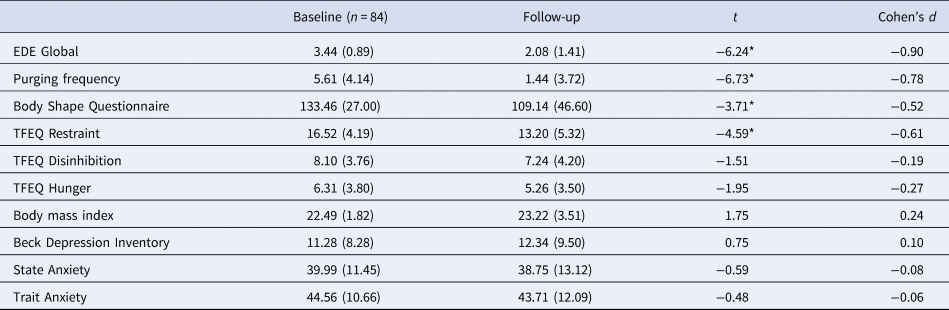
Table 1 displays descriptive variables at baseline and follow-up. Women reported significant decreases in eating pathology, purging frequency, severity of weight and shape concerns, and cognitive restraint from baseline to follow-up (p's ⩽ 0.001). They did not report statistically significant decreases in disinhibition, hunger, depressive symptoms, state anxiety, or trait anxiety (p's ⩾ 0.06). BMI demonstrated a small increase over follow-up that did not reach statistical significance (p = 0.09). Relative to norms for women aged 30–39 (Hawthorne, Herrman, & Murphy, Reference Hawthorne, Herrman and Murphy2006), women with a history of PD had significantly impaired quality of life in the physical (M(s.d.) = 75.30(18.26), t (55.45) = −2.51, p = 0.02, d = −0.31), psychological (M(s.d.) = 62.20(19.18), t (53.58) = −5.45, p < 0.001, d = −0.71), and social (M(s.d.) = 66.82(28.98), t (50.24) = −2.52, p = 0.01, d = −0.32) domains at follow-up. Quality of life was not significantly impaired in the environmental domain (M(s.d.) = 76.69(19.59), t (55.58) = 1.54, p = 0.13, d = 0.20).
Changes in eating disorder and psychopathology variables across naturalistic follow-up women with purging disorder

EDE, Eating Disorder Examination; TFEQ, Three Factor Eating Questionnaire.
Note: Values represent pooled estimates from multiple imputation analyses.
*p < 0.001.
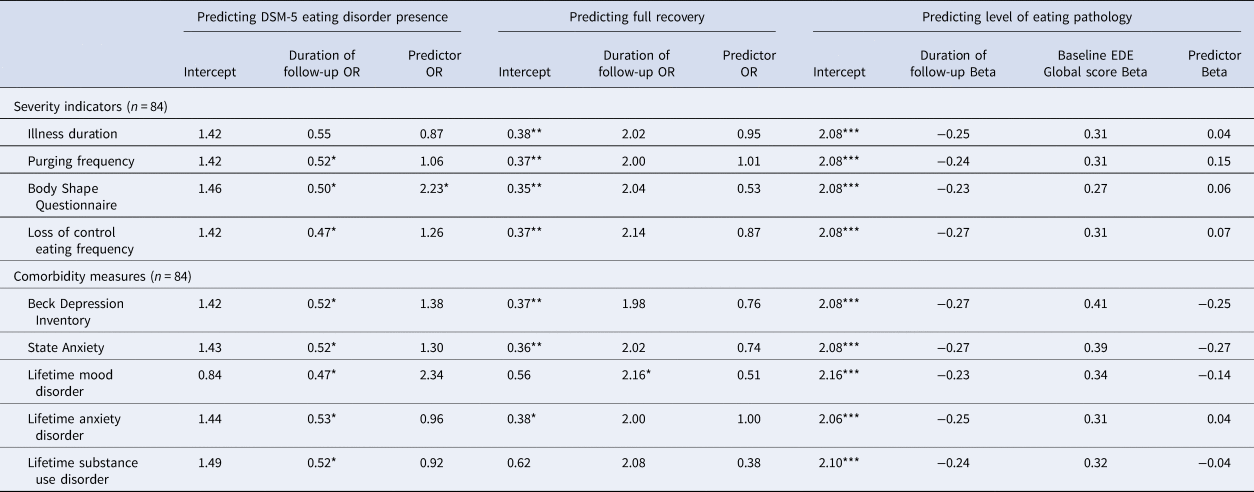
Table 2 displays parameter estimates from models testing predictors of outcome. More severe weight and shape concerns at baseline predicted a greater likelihood of a DSM-5 eating disorder diagnosis at follow-up, adjusting for duration of follow-up (p = 0.03). Other baseline severity indicators including illness duration (p = 0.60), purging frequency (p = 0.84), and loss of control eating frequency (p = 0.51) did not predict the presence of an eating disorder, adjusting for duration of follow-up. None of the severity indicators predicted recovery (p's ⩾ 0.07). Similarly, none of the severity indicators predicted EDE Global scores at follow-up (p's ⩾ 0.44).
Pooled logistic and multiple regression models testing predictors of eating disorder outcome and level of eating pathology at long-term follow-up in purging disorder

OR, odds ratio; EDE, Eating Disorder Examination.
*p < 0.05; **p < 0.01; ***p < 0.001.
Baseline measures of comorbidity, including depressive symptoms (p = 0.28), state anxiety (p = 0.36), lifetime mood disorders (p = 0.16), lifetime anxiety disorders (p = 0.94), and lifetime substance use disorders (p = 0.88), were not significantly associated with the presence of an eating disorder at follow-up. Similarly, these variables neither predicted recovery (p's ⩾ 0.17), nor did these variables predict EDE Global scores at follow-up (p's ⩾ 0.20).
Discussion
The current study represents the first long-term, prospective follow-up of the natural outcome of PD. Available records indicated that all participants were living at follow-up, and over 95% were successfully located. A majority of those sought participated, and there was minimal evidence of biased participation. Results suggest PD exhibits a chronic course, with most women meeting criteria for a DSM-5 eating disorder at follow-up. More severe weight and shape concerns predicted a greater likelihood of having an eating disorder at follow-up. Approximately 30% of women were fully recovered from their eating disorder. However, no variables predicted recovery status or the continuous measure of outcome.
No deaths were observed in this study, in contrast to findings suggesting elevated mortality in PD (Koch et al., Reference Koch, Quadflieg and Fichter2013). This may reflect severity differences in study populations, as the current study drew from the community whereas Koch and colleagues studied individuals receiving specialized inpatient eating disorder treatment. In addition, participants recruited for two of the studies were required to be free of medical conditions or treatment that might influence weight or appetite, which may have resulted in a somewhat healthier sample. More follow-up studies of PD are needed to understand if the disorder is associated with elevated mortality, as evidence for elevated mortality for other eating disorders, such as bulimia nervosa, did not emerge until larger studies and meta-analysis were undertaken (Arcelus, Mitchell, Wales, & Nielsen, Reference Arcelus, Mitchell, Wales and Nielsen2011; Crow et al., Reference Crow, Peterson, Swanson, Raymond, Specker, Eckert and Mitchell2009). Given the negative consequences associated with purging behaviors (Forney et al., Reference Forney, Buchman-Schmitt, Keel and Frank2016) and poor physical quality of life reported in this sample, medical monitoring of this population is recommended.
Although women reported a clinically meaningful decrease in eating pathology, less than half were free from an eating disorder at follow-up and less than 30% were fully recovered. Over twice as many women with baseline PD met criteria for PD than for bulimia nervosa at follow-up, consistent with epidemiological data (Glazer et al., Reference Glazer, Sonneville, Micali, Swanson, Crosby, Horton and Field2019), and none met criteria for anorexia nervosa or binge-eating disorder. Most women met criteria for OSFED, transitioning from purging behaviors to non-purging compensatory behaviors that may be more socially acceptable (i.e. excessive exercise, fasting). These results provide evidence that some women with PD exhibit diagnostic stability, while others exhibit changes in symptom presentation, consistent with findings from a 5-year follow-up of a tertiary care sample of PD (Koch et al., Reference Koch, Quadflieg and Fichter2013) and other eating disorder diagnoses (Eddy et al., Reference Eddy, Swanson, Crosby, Franko, Engel and Herzog2010). More frequent follow-ups with comparisons to other eating disorders are needed to better understand if PD represents a unique illness presentation or is a stage of binge/purge-related eating disorders more broadly. Taken together, results reinforce the clinical significance of PD. Indeed, women reported diminished quality of life in the physical, psychological, and social domains, and three-quarters of participants had sought mental health treatment in their lifetime.
Significant improvements in eating pathology were observed for purging frequency, weight and shape concerns, and cognitive restraint. In contrast, women did not report statistically significant decreases in disinhibition and hunger. At baseline, disinhibition and hunger in PD fell between that of non-eating disordered controls and women with bulimia nervosa (Keel et al., Reference Keel, Eckel, Hildebrandt, Haedt-Matt, Appelbaum and Jimerson2018, Reference Keel, Haedt and Edler2005, Reference Keel, Wolfe, Liddle, Young and Jimerson2007). If loss of control eating is less elevated for PD than other features of eating pathology, the lack of improvement may reflect a somewhat restricted range on this feature. Indeed, effect sizes compared to non-eating disordered controls at baseline were larger for weight and shape concerns (d = 4.17) and restraint (d = 3.90) relative to disinhibition around food (d = 1.71) and hunger (d = 0.94) (Keel et al., Reference Keel, Eckel, Hildebrandt, Haedt-Matt, Appelbaum and Jimerson2018, Reference Keel, Haedt and Edler2005, Reference Keel, Wolfe, Liddle, Young and Jimerson2007).
Lifetime mental health treatment was not associated with any outcome measure. This may reflect limited sensitivity in the assessment of lifetime mental health treatment. In particular, the current study did not systematically assess for eating disorder treatment. It is possible that some participants sought mental health treatment for comorbid conditions and did not disclose their eating disorder to their providers. Alternately, existing treatments may not have been effective in addressing their symptoms, given some evidence from that cognitive-behavioral therapy may be more successful for those who experience binge-eating episodes (Waller et al., Reference Waller, Gray, Hinrichsen, Mountford, Lawson and Patient2014). More systematic work is needed to evaluate appropriate treatments for PD.
There were no meaningful changes in depressive and anxiety symptoms over follow-up, and rates of current mood and substance use disorders were not associated with follow-up eating pathology. This contrasts with findings that comorbidity is associated with poor outcome in other eating disorders (Bardone-Cone et al., Reference Bardone-Cone, Harney, Maldonado, Lawson, Robinson, Smith and Tosh2010; Löwe et al., Reference Löwe, Zipfel, Buchholz, Dupont, Reas and Herzog2001). Although a subset of the current sample comes from a study that excluded participants based on the presence of a current mood or substance use disorder (Keel et al., Reference Keel, Eckel, Hildebrandt, Haedt-Matt, Appelbaum and Jimerson2018), the pattern of results remained the same when those participants were excluded from analyses. This lack of association requires additional investigation, as meeting criteria for a current mood disorder was associated with worse outcome using listwise deletion in the full sample.
Greater weight and shape concerns predicted a greater likelihood of continuing to have a DSM-5 eating disorder at follow-up. This finding reinforces transdiagnostic eating disorder conceptualizations that emphasize weight and shape concerns as the central feature (Fairburn et al., Reference Fairburn, Cooper, Doll, O'Connor, Bohn, Hawker and Palmer2009). No other baseline variables significantly predicted outcome in PD. The current study failed to replicate findings that depressive symptoms predict outcome (Koch et al., Reference Koch, Quadflieg and Fichter2013), perhaps due to differences in sample severity. Contrary to prior work (Eddy et al., Reference Eddy, Dorer, Franko, Tahilani, Thompson-Brenner and Herzog2007), a history of anorexia nervosa was not associated with outcome. This likely reflects changes in recruitment criteria across parent studies. In the most recent parent study, participants were excluded based on a history of anorexia nervosa (Keel et al., Reference Keel, Eckel, Hildebrandt, Haedt-Matt, Appelbaum and Jimerson2018). Thus, a history of lifetime anorexia nervosa was confounded with the duration of follow-up in this sample (OR = 3.27, p = 0.02). Null findings also may reflect the length of follow-up, as the duration of follow-up is a potent predictor of outcome (Keel & Mitchell, Reference Keel and Mitchell1997) and explained significant variance in eating disorder status (OR = 0.84, p = 0.04). Posited predictors of outcome were drawn from work on other eating disorders (Fichter, Quadflieg, & Hedlund, Reference Fichter, Quadflieg and Hedlund2006; Helverskov et al., Reference Helverskov, Clausen, Mors, Frydenberg, Thomsen and Rokkedal2010; Keel, Mitchell, Miller, Davis, & Crow, Reference Keel, Mitchell, Miller, Davis and Crow1999; Keski-Rahkonen et al., Reference Keski-Rahkonen, Raevuori, Bulik, Hoek, Rissanen and Kaprio2014; Koch et al., Reference Koch, Quadflieg and Fichter2013) that may not extend to PD. The original studies in which women participated provided some evidence of unique disruptions in satiety in PD (Keel et al., Reference Keel, Eckel, Hildebrandt, Haedt-Matt, Appelbaum and Jimerson2018); however, the number of participants was too small to permit adequately powered analyses of whether these disruptions predicted outcome. Future work using machine learning approaches in larger samples may be valuable in generating hypotheses about additional predictors of outcome.
This study benefited from a high ascertainment rate, assessments with strong psychometric properties, a well-characterized sample, and high interrater reliability. Comparisons of baseline data do not suggest biased responding, and multiple imputation attenuated effects of missing data. The two-wave design prohibits an examination of course, short-term predictors of course, and the description of more frequent or fluid changes in the course such as patterns of remission, cross-over, and relapse. Given the female sample, results may not generalize to males with PD. Variability in the duration of follow-up and differences in recruitment criteria of the baseline studies may have limited power to find significant predictors of outcome. Finally, this study did not assess for eating disorder-focused treatment, and its naturalistic design precludes evaluation of possible treatment effects.
The current study represents the first to prospectively assess the long-term outcome of PD in a community-based sample. The low recovery rates and continued evidence of impairment reinforce the clinical significance of the syndrome even among those drawn from the community. More work is needed to answer questions about mortality, medical morbidity, and the role of comorbidity in predicting prognosis given findings from patients drawn from an inpatient treatment setting (Koch et al., Reference Koch, Quadflieg and Fichter2013). Evidence that weight and shape concerns predicted likelihood of a DSM-5 eating disorder suggest that transdiagnostic cognitive-behavioral therapy for eating disorders may be well-suited for treating PD, consistent with findings from its application in samples that have included patients with PD (Fairburn et al., Reference Fairburn, Cooper, Doll, O'Connor, Bohn, Hawker and Palmer2009). However, studies with multiple, short-duration follow-ups are needed to better identify eating-disorder specific and transdiagnostic maintenance factors in order to adapt or develop empirically supported treatments for this population.
Acknowledgements
This research was supported by National Institute of Mental Health (K.J.F. F31-MH105082), (P.K.K. R01-MH61836), (P.K.K. R01-MH111263) (P.K.K. R03-MH61320). Additional financial support came from the American Psychological Association Dissertation Research Award (K.J.F.), the Florida State University Dissertation Research Award (K.J.F.), the American Psychological Foundation/COGDOP Graduate Research Scholarship (K.J.F.), and Experiment.com crowdfunding (K.J.F.; doi: 10.18258/3354)
Previous presentation
Portions of this work were presented at the annual meeting of the Eating Disorders Research Society in New York, NY, 27–29 October 2016, at the International Conference on Eating Disorders in San Francisco, 5–7 May 2016, the International Conference on Eating Disorders, Prague, Czech Republic, 8–10 June 2017, and the International Conference on Eating Disorders, New York, NY, 14–16 March 2019.
Disclosures
Pamela Keel receives royalties from Oxford University Press. Ross Crosby is a paid statistical consultant for Health Outcomes Solutions, Winter Park, Florida.