


The average birth weight of twins is typically around the 10th percentile of singletons (Hiersch et al., Reference Hiersch, Okby, Freeman, Rosen, Nevo, Barrett and Melamed2020; Melamed et al., Reference Melamed, Yogev and Glezerman2009). Monochorionic (MC) twins generally weigh less than dichorionic (DC) twins, largely due to placental vascular anastomoses and related complications (Sathasivam et al., Reference Sathasivam, Selliah, Sivalingarajah, Mayorathan and Munasinghe2023; Souza et al., Reference Souza, Brizot, Biancolin, Schultz, de Carvalho, Francisco and Zugaib2017). Birth-weight studies show greater similarity in dichorionic monozygotic twins (DCMZ) than in monochorionic monozygotic twins (MCMZ), likely reflecting competition for nutrients in shared placentas (Hur & Shin, Reference Hur and Shin2008). The effect of chorionicity on body size, however, decreases with age (Loos et al., Reference Loos, Derom, Derom and Vlietinck2001).
Genetic influences on anthropometric measures outweigh environmental ones, as demonstrated in adoption (Sørensen et al., Reference Sørensen, Holst and Stunkard1992) and twin studies (Silventoinen et al., Reference Silventoinen, Bartels, Posthuma, Estourgie-van Burk, Willemsen, van Beijsterveldt and Boomsma2007; Wilson, Reference Wilson1976). These effects are smaller in the first year of life — likely due to prenatal variation and birth-weight discordance in monozygotic (MZ) twins—but increase with age, with MZ pairs converging and dizygotic (DZ) pairs diverging from 6 to 11 years (Buckler & Green, Reference Buckler and Green2008; Ooki & Asaka, Reference Ooki and Asaka1993; Silventoinen et al., Reference Silventoinen, Bartels, Posthuma, Estourgie-van Burk, Willemsen, van Beijsterveldt and Boomsma2007).
Longitudinal studies show that twins tend to lag behind singletons in growth. UK data on 2- to 9-year-olds indicated that twins were slightly shorter and significantly lighter than singletons, with boys — especially MZ boys — most affected (Buckler & Green, Reference Buckler and Green2008). In the US, appropriate-for-gestational-age twins displayed similar catch-up growth to singletons by ages 7–9, whereas small-for-gestational-age twins remained smaller (Gleason et al., Reference Gleason, Yeung, Sundaram, Putnick, Mendola, Bell, Polinski, Robinson and Grantz2023). In monochorionic pairs with discordant birth weight, the growth-restricted twin continued to show modest but significant deficits in height, weight, and head circumference into adolescence (Groene et al., Reference Groene, Gremmen, van Zwet, Roest, Haak, van Klink, Lopriore, Heijmans and de Bruin2023).
Understanding the growth patterns of twins, with or without intrauterine growth restriction, and according to zygosity and chorionicity, is essential for parental counseling during pregnancy and for postnatal clinical follow-up. Recognizing that twins may maintain lower growth scores than singletons up to adolescence has direct implications for pediatric monitoring, interpretation of growth charts, and the definition of nutritional and health interventions. Therefore, identifying this pattern is clinically relevant to distinguish physiological variations in twin growth from situations that warrant pathological investigation. As most longitudinal studies have not jointly considered zygosity and chorionicity, the present study addresses this gap by examining twin weight at birth and weight and height at school age with respect to both variables.
Methods
Of the 736 mothers who delivered at Hospital das Clínicas da Faculdade de Medicina da Universidade de São Paulo (HC-FMUSP) between 2007 and 2017 without health complications, 118 were successfully contacted and agreed to participate. Of these, 24 cases had incomplete data and were excluded, resulting in a final sample of 94 mothers who had received antenatal care at the Twin Obstetric Clinic in the Departamento de Obstetrícia e Ginecologia do HC-FMUSP and their 188 healthy twin children (94 twin pairs; M = 9.13 years; SD = 2.16). Information on chorionicity, gestational age, date of birth, and birth weight was obtained from obstetric and birth records. The study included DC and MCDC twins without chorionicity-related complications or malformations. This was a convenience sample, and no formal sample size calculation or power analysis was performed, as the study was exploratory and descriptive. Measurements were obtained at two time points: at birth in the neonatology unit, and at school age, when trained research assistants from the Instituto de Psicologia da USP collected weight and height data with children wearing light clothing and no shoes, following standardized procedures.
This study is part of a larger collaborative and interdisciplinary project on twin development conducted by the Painel USP de Gêmeos [USP Twin Panel] Research Group, which includes researchers from medicine, dentistry, and psychology. The present analysis was part of a longitudinal investigation on physical and behavioral development of twins born at Hospital das Clínicas, Faculdade de Medicina, Universidade de São Paulo (HC-FMUSP). Birth weight and height data were compared with the children’s growth charts from the US Centers for Disease Control and Prevention (CDC, 2000). Z scores were calculated using the following formula:
z = (Observed value − Reference value)/Reference SD.
Because z scores standardize weight and height relative to a population of the same age and sex, they allow comparisons across different ages while accounting for expected growth at each developmental stage. As no standard growth curves for twins at school age were available, singleton growth charts were used for both birth weight and school-age weight and height comparisons. Chorionicity was determined during antenatal care in the first-trimester ultrasound and confirmed by pathological examination of the placenta after birth. Zygosity was determined by DNA analysis in same-sex twin pairs.
The project was approved by the Human Research Ethics Committee of the HC-FMUSP (CAEE 80819717.0.3001.0068).
Statistical Analysis
Statistical analyses were performed by two of the authors (LAC and CMP) using the R programming language (https://www.r-project.org). Variables were summarized as means/medians or proportions, according to chorionicity, zygosity, gestational age, and sex. The Shapiro–Wilk test was used to verify the normality of continuous variables, complemented by visual inspection of histograms and Q–Q plots. Generalized linear mixed models (GLMMs) were fitted with z scores of weight (at birth and at school age) and height (at school age) as response variables, and chorionicity, zygosity, gestational age in weeks (IGP), and sex as fixed effects, with twin pair specified as a random effect. A significance level of .05 was adopted for all analyses, such that p < .05 was considered statistically significant when rejecting the null hypothesis.
Results
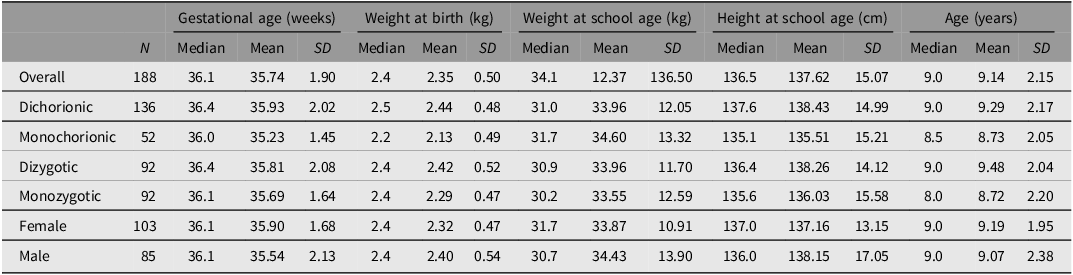
In the total sample of 188 twins, the mean gestational age at birth was 35.7 ± 1.9 weeks, and the mean birth weight was 2.4 ± 0.5 kg. At the school-age evaluation, the mean age was 9.1 ± 2.2 years, the mean weight was 34.3 ± 12.4 kg, and the mean height was 137.6 ± 15.1 cm. Our population is mostly a low risk as overall only 17.52% presented birth-weight discordance > 20% (17/97: 8 DC and 9 MC). The details of the cohort regarding gestational age at birth, birth weight, age at school evaluation and weight at school evaluation according to chorionicity and zigozity are presented in Table 1.
Descriptive statistics for gestational age, birth weight, school-age weight and school-age height by chorionicity, zygosity, and sex

Note: kg, kilograms; cm, centimeters; N, number of cases; SD, standard deviation.
Distribution of Twin z-Score Weights at Birth and at School Age
Weight z-score distributions shows that, at birth, the mean was –2.05 ± 1.32 with a left-skewed distribution, indicating low birth weight. At school age, the mean was 0.43 ± 0.99, with a more symmetrical distribution around the mean.
Figure 1 shows scatter plots of weight z scores at birth and at school age. Each point represents an individual. The plots are stratified by chorionicity (Figure 1a) and sex (Figure 1b). Horizontal and vertical dashed lines, representing a mean z score of zero and the 5th percentile, divide the plots into four quadrants. Individuals with a birth weight z score below the horizontal line were underweight at birth, while those above the line were above the reference mean. Similarly, individuals to the left of the vertical line had lower-than-expected school-age weights, whereas those to the right had higher weights than expected.
Comparison of weight z scores at birth and at school age in twins by chorionicity.
Note: DC, dichorionic, MCDA, monochorionic.

Comparison of weight z scores at birth and at school age in twins by sex.
In both figures, left panel: scatterplot of z scores at birth versus school age, with dashed lines marking reference values (0 = population mean). Right panel: comparison of birth and school-age percentiles, where the diagonal indicates equal rank across time; points above the diagonal reflect improved relative weight position at school age, and points below reflect decline.

Overall, there was a significant difference in the proportions of twins with weight z scores below the median at birth compared with school age (98.4% vs. 32.2% respectively; McNemar’s χ2 = 118.01, df = 1, p = .033). At birth, 99.0% of female and 97.6% of male newborns had weight z scores below the median; these proportions decreased at school age to 28.6% and 29.6% for female and male children respectively. There was a significant difference in the dispersion of weight z scores at birth between MC and DC twins (2.10 vs. 1.74; Fligner-Killeen χ2 = 4.58, df = 1, p < .05), as well as a significant difference in dispersion at school age (0.98 vs. 1.54; Fligner-Killeen χ2 = 3.89, df = 1, p < .05). Overall, 67.4% of the twins showed improvement in their weight development, and 0.0% deteriorated (McNemar’s χ2 = 83.012, df = 1, p < .001).
As expected, gestational age had a significant positive effect on weight z scores at birth (β = 0.58, p < .001). No other predictors, including chorionicity, zygosity, sex, or their interactions, were statistically significant at birth or at school age. Similarly, for height z scores at school age, no predictors were found statistically significant at school age.
Analysis of Differences Between Twin-Pair Weight z Scores at Birth and School Age
The four density plots in Figure 2 illustrate the distribution of weight differences between twin pairs, categorized by chorionicity and zygosity, at birth and at school age. This analysis examined how chorionicity and zygosity influence twin-pair weight differences over time. At birth, MC twins displayed a wider distribution with higher densities at larger weight differences compared with DC twins, indicating that MC twins tend to have greater birth-weight differences (top left plot). By school age, distributions for MC and DC twins converge, with fewer large differences and more comparable distributions (top right plot). Regarding zygosity, at birth, both MZ and DZ twins showed concentrated distributions with small weight differences, reflecting similarity in birth weight (bottom left plot). At school age, MZ twins exhibited fewer large weight differences than DZ twins (bottom right plot), consistent with the generalized linear model results, which indicated that MZ twins have, on average, about 0.41 times the weight difference at school age compared with DZ twins.
Density plots of the distribution of weight differences (percentage and absolute) between twin pairs, categorized by chorionicity and zygosity, at birth and at school age.

A Welch two-sample t test showed a significant difference in mean birth weight between the groups DCMZ and MCMZ (t = –4.67, p < .001), with DCMZ twins having a higher mean birth weight (M = 2.5 kg, SD = 0.3) than MCMZ twins (M = 2.1 kg, SD = 0.1). Gestational age was positively associated with birth weight in both groups, and, as expected, DCMZ twins tended to have slightly longer gestations and higher birth weights, whereas MCMZ twins were more frequently observed at lower birth weights and shorter gestational lengths.
A multiple linear regression model was used to determine whether the lower birth weights in MCMZ twins were attributable to chorionicity or gestational age. The model accounted for 45% of the variance in birth weight (R 2 = .45) and was statistically significant (F = 30.24, p < .001). After controlling for gestational age, chorionicity was a significant predictor of birth weight, with a negative coefficient (β = −0.21, p = .020). This indicates that, on average, MCMZ twins weighed 0.21 kg less than DCMZ twins, independent of gestational age.
At school age, a Wilcoxon rank-sum test showed no significant difference in weight z-scores between MCMZ and DCMZ twins (W = 805, p = .321). However, when school age was segmented into three groups, a temporal trend emerged. Figure 3 shows boxplots of weight z scores by chorionicity (DCMZ and MCMZ) across ages ≤7, 8–10, and ≥11 years. In the youngest group (≤7), MCMZ twins had greater variability and lower median z-scores compared with DCMZ twins. These differences diminished with age, suggesting that the effect of chorionicity on weight attenuates over time.
Boxplot of the distribution of weight z scores by chorionicity (DCMZ and MCMZ) across different age groups (≤ 7, 8–10, and 11+).
Note: DCMZ, Dichorionic monozygotic; MCMZ, Monochorionic monozygotic.

Analysis of Differences Between Twin-Pair Height z Scores at School Age
Using a Gaussian generalized linear model (GLM) with a log link applied to the positive within-pair height difference at school age, and including sex concordance, zygosity, and chorionicity as predictors, we found that MZ twins tended to be more similar in height than DZ twins. The MZ coefficient (β = −0.544, p = .060) corresponds to approximately 42% smaller height differences on average (exp(−0.544) ≈ 0.58). Chorionicity and sex were not significant predictors. Model fit was modest, suggesting that zygosity is the primary contributor to between-twin similarity in height at school age.
Figure 4 shows a clear zygosity effect: MZ pairs (dashed) are tightly concentrated near zero difference with much lighter tails, whereas DZ pairs (solid) display broader distributions and heavier right tails — that is, larger within-pair height gaps. This pattern holds both for absolute height differences and for height z-score differences, indicating that the result is not explained by age or sex standardization. For chorionicity, MC twins (dashed) tend to cluster closer to zero with a slightly thinner tail than DC twins (solid), but the overlap is substantial.
Density plots of the distribution of height differences (percentage) between twin pairs, categorized by chorionicity and zygosity at school age.

Normality was not rejected within groups (Shapiro–Wilk: DCMZ p = .077; MCMZ p = .384), so a parametric comparison is appropriate. The Welch t test comparing height z scores between MCMZ and DCMZ twins showed no evidence of a mean difference (t = −0.864, df = 80.47, two-sided p = .390; mean MCMZ = 0.697, DCMZ = 0.935). Results indicate that DCMZ and MCMZ twins do not differ in height (z score) at school age.
Figure 5 shows that, across age groups, height Z-score distributions show an early heterogeneity for MCMZ that fades with age: at ≤7 years both DCMZ and MCMZ center around normal-to-above-average height, but MCMZ display greater variability with a lower tail; at 8–10 years a transient divergence emerges, with MCMZ showing a lower median and wider spread than DCMZ; by 11+ years the groups converge, with similar medians near the upper range and only minor differences in spread — consistent with catch-up and a diminishing influence of chorionicity over time.
Boxplot of the distribution of height z scores by chorionicity (DCMZ and MCMZ) across different age groups (≤ 6, 7-10, and 11+).
Note: DCMZ, Dichorionic monozygotic; MCMZ, Monochorionic monozygotic.

Discussion
The main findings of this study, which analyzed weight in 188 healthy twin pairs at birth and at school age, were as follows: (1) twins are born with low birth weight but show catch-up growth by school age; (2) MC twins have larger intertwin weight differences at birth compared with DC pairs, but these differences are attenuated by school age; (3) among MZ twins, those from MC pregnancies have significantly lower birth weight than those from DC pregnancies, although this difference disappears at school age; and (4) MZ and DZ pairs show comparable intertwin weight differences at birth, but by school age, DZ pairs display significantly larger differences — both in weight and in height — compared with MZ pairs.
Recent studies with large cohorts (Groene et al., Reference Groene, Gremmen, van Zwet, Roest, Haak, van Klink, Lopriore, Heijmans and de Bruin2023) have shown that twins born with appropriate birth weight tend to reach weight levels comparable to singletons during childhood, whereas those with intrauterine growth restriction exhibit persistent deficits. In line with these findings, our study demonstrated that twins experienced catch-up growth, attaining weights and heights comparable to singletons by school age. It is noteworthy that our sample excluded twins with intrauterine growth restriction, which may account for the absence of persistent weight differences observed in our results.
However, few studies have specifically examined weight catch-up in relation to chorionicity. In our study, MC twins showed greater intertwin weight discrepancies at birth compared with DC twins, but these differences diminished by school age as weight and height distributions became more comparable. A similar pattern was observed among MZ pairs: although DCMZ twins had higher birth weights and longer gestations than MCMZ twins, no significant differences in weight z scores or height z scores were detected at school age. Across age groups, MCMZ twins ≤7 years exhibited greater variability and lower median weight and height z scores, whereas in older age groups these differences were less pronounced.
A recent study of MC twins with selective fetal growth restriction reported that the restricted twin maintained a moderate but significant weight deficit not only in weight but also in height and head circumference compared with their co-twin, persisting up to 17 years of age (Groene et al., Reference Groene, Gremmen, van Zwet, Roest, Haak, van Klink, Lopriore, Heijmans and de Bruin2023). In our study, chorionicity was the most relevant factor associated with birth-weight differences, consistent with the hypothesis that MC twins, who share a single placenta, may experience increased competition for nutrients, leading to greater discordance. However, in the present study involving mostly twins with normal birth weight, we did not observe these differences in either weight or height at school, suggesting that the influence of chorionicity on postnatal growth diminishes over time. The convergence in both weight and height distributions supports the idea that postnatal environmental factors and developmental processes may attenuate early-life disparities associated with chorionicity.
With respect to zygosity, previous studies have shown that MZ twins become progressively more similar in both weight and height over time, whereas DZ twins demonstrate decreasing concordance by around eight years of age (Wilson, Reference Wilson1976). Our findings are consistent with these observations, supporting the interpretation that MZ twins grow more alike in weight and height as over time, while DZ twins retain greater differences, likely reflecting their genetic dissimilarity. In our sample, zygosity was not a significant factor in birth-weight differences but became significant by school age, indicating an increasing influence over time, with MZ twins showing greater similarity than DZ twins. The absence of a zygosity effect at birth may be explained by the high proportion of DCMZ twins in our sample, as these pregnancies are less affected by the vascular imbalances typically seen in MCMZ pregnancies.
In a study following the growth of twins between the ages of 2 and 9 years, it was found that birth-weight discordance had little influence on postnatal growth, except in MZ twins with discordance greater than 20% (Buckler & Green, Reference Buckler and Green2008). Very low birth weight (<1.95 kg) had a more negative impact on long-term growth than the degree of discordance itself. In our study, weight differences at birth were more strongly associated with chorionicity (MC vs. DC and MCMZ vs. DCMZ) than with zygosity. However, these differences did not persist, and by school age, only zygosity remained significant for both weight and height, with DZ twins showing less similarity than to MZ twins. Our findings also did not suggest an association between birth weight and catch-up growth in either weight or height at school age, likely because our sample consisted almost exclusively of twins born appropriate for gestational age.
These results may help guide counseling for parents of twins born with expected birth weight. The clinical relevance of this study lies in showing that, although twins are generally born lighter than singletons, they typically achieve expected weight and height by school age. While chorionicity can be a stressor during the fetal period, it did not affect postnatal catch-up in weight or height among twins born appropriate for gestational age without growth restriction. Instead, zygosity emerged as the main factor associated with residual differences at school age, with MZ twins showing greater similarity in both growth indicators than DZ twins.
Although a recent study demonstrated that MZ twins with discordant prenatal growth maintain a modest but significant weight difference up to 17 years of age (Groene et al., Reference Groene, Gremmen, van Zwet, Roest, Haak, van Klink, Lopriore, Heijmans and de Bruin2023), other conditions inherent to monochorionicity, such as growth after laser therapy for twin-to-twin transfusion syndrome (TTTS) and fetal growth restriction, also warrant investigation. Examining these cases could clarify whether postnatal catch-up growth differs between twins with TTTS who undergo laser therapy and those with selective fetal growth restriction managed expectantly.
The main strength of this study is the inclusion of both chorionicity and zygosity in the analysis, as chorionicity is widely recognized as a key determinant of outcomes in twin pregnancies. Another important strength is that the study was conducted in a Brazilian public health referral hospital, with a population representative of the socioeconomic conditions of the broader community. This enhances the relevance of the findings by showing that twins achieve catch-up growth even in less favorable economic contexts. A limitation of this study is that our sample included only a small number of cases with severe selective fetal growth restriction, and TTTS was an exclusion criterion. This limitation prevented the assessment of outcomes in more complex monochorionic pregnancies. Another factor that may have influenced the analyses is that MC twins are always MZ, whereas DC twins can be either MZ or DZ. This overlap between zygosity and chorionicity may affect the estimation of their individual effects in the models. In conclusion, twins born with adequate weight generally achieve catch-up growth comparable to singletons by school age. At birth, MC twin pairs show greater differences in birth weight than DC pairs, but these differences diminish by school age. MZ pairs become more similar in growth over time, whereas DZ twins become more dissimilar.
Data availability statement
The data that support the findings of this study are available from the corresponding author upon reasonable request.
Acknowledgments
We are grateful to the twin pairs and their families for their participation in this study and to the Painel USP de Gêmeos [USP Twin Panel] Research Group for their support.
CRediT authorship contribution statement
Luis A. Correia: Methodology, Software, Formal analysis, Data curation, Visualization, Writing – review & editing. Tania K. Lucci: Conceptualization, Methodology, Investigation, Visualization, Writing – review & editing. Lucas A. Moura: Methodology, Resources, Investigation, Visualization. Claudia M. Peixoto: Methodology, Formal analysis, Validation, Writing – review & editing. Maria de L. Brizot: Methodology, Resources, Investigation, Writing – review & editing. Mario H. B. Carvalho: Methodology, Resources, Investigation, Data curation. Vera L. Krebs: Methodology, Resources, Investigation, Data curation. Mariana A. Carvalho: Methodology, Resources, Investigation, Writing – review & editing. Julia F. Gomes: Methodology, Resources, Project administration, Investigation. Rafael R. Albuquerque: Methodology, Resources, Project administration, Investigation. Timon Lebaron-Kherif: Methodology, Resources, Project administration, Investigation. Isabella F. Ferreira: Methodology, Resources, Project administration, Investigation. Giovana H. Arissi: Methodology, Resources, Project administration, Investigation. Lilian C. Luchesi: Methodology, Resources, Project administration, Investigation. Ricardo Prist: Supervision, Funding acquisition, Project administration, Data curation, Writing – review & editing. Emma Otta: Writing – review & editing, Writing – original draft, Funding acquisition, Conceptualization.
Funding
This study was supported through a FAPESP São Paulo Research Foundation Grant (22/02107-6 to EO and MLB) as well as National Council for Scientific and Technological Development Grant (303805/2021-8 to EO). The authors have no conflicts of interest to disclose.
Ethical statement
The authors assert that all procedures contributing to this work comply with the ethical standards of the relevant national and institutional committees on human experimentation and with the Helsinki Declaration of 1975, as revised in 2008.