Implications
Short rotation coppice (SRC) with willow can improve free-range use: chickens provided with SRC go farther from the house and were outside for a greater proportion of time than when provided with artificial shelter (AS). Such use of the range can have beneficial effects on animal welfare and on the reduction of point pollution. In addition, wood chips made from SRC can be used as a source of heat or energy or as litter. Depending on economic and logistical feasibility, SRC could thus be suitable vegetation in free-range areas for chickens.
Introduction
Free-range use in broiler chickens is often limited, with only 5% to 11% of birds being outside at any given time (Dawkins et al., Reference Dawkins, Cook, Whittingham, Mansell and Harper2003; Jones et al., Reference Jones, Feber, Hemery, Cook, James, Lamberth and Dawkins2007; Rodriguez-Aurrekoetxea et al., Reference Rodriguez-Aurrekoetxea, Leone and Estevez2014). If the chickens would go outside more often and distribute themselves over the field more evenly as opposed to staying close to the house, their welfare could benefit in several ways. They would have more opportunities to perform highly motivated natural behaviours; more foraging opportunities may be available farther from the house due to more (edible) vegetation, and better distribution over the range would give them more space for dust bathing and other behaviours. Better distribution over the range could prevent point pollution close to the house, and such decreased stocking density may also lead to lower nematode infection levels (Sherwin et al., Reference Sherwin, Nasr, Gale, Petek, Stafford, Turp and Coles2013).
A more optimal use of the free-range area could be accomplished by providing appropriate shelter (Dawkins et al., Reference Dawkins, Cook, Whittingham, Mansell and Harper2003; Dal Bosco et al., Reference Dal Bosco, Mugnai, Rosati, Paoletti, Caporali and Castellini2014). The preference of broiler chickens for different shelter types, however, remains unclear. One previous study showed that when birds had the choice, they preferred areas with vertical panels over grassland (Stadig et al., Reference Stadig, Ampe, De Smet and Tuyttens2014), but when comparing groups with panels to groups with grassland, no differences in free-range use were observed (Rodriguez-Aurrekoetxea et al., Reference Rodriguez-Aurrekoetxea, Leone and Estevez2014). Perhaps the panels in the latter study did not cover a large enough part of the free-range area to have a profound impact, or they did not have the desired characteristics (e.g. protection against solar radiation or aerial predators). Studies comparing free-range use of chickens with different shelter types indicate that those with access to trees spend considerably more time outside in comparison with access to grassland or AS, but the actual preference of the chickens could not be tested in these setups (Dal Bosco et al., Reference Dal Bosco, Mugnai, Rosati, Paoletti, Caporali and Castellini2014; Stadig et al., Reference Stadig, Rodenburg, Ampe, Reubens and Tuyttenssubmitted). Only one observational study testing the preference for shelter type showed that birds preferred trees over grassland when these were located at a similar distance from the house (Dawkins et al., Reference Dawkins, Cook, Whittingham, Mansell and Harper2003). SRC with willows could be an interesting type of vegetation suitable for free-range areas for chickens. SRC with willow is planted at very high density (15 000 trees/ha), can be harvested every 3 years, and the wood chips can be used for heat or energy production or as litter. The dense vegetation may be attractive to the birds as it can provide protection against adverse weather conditions and aerial predators, and the alleged increase in biodiversity (Sage, Reference Sage1998; Baum et al., Reference Baum, Weih, Busch, Kroiher and Bolte2009) may increase foraging behaviour.
Another factor that might play a role in free-range use is fearfulness. Studies with laying hens have shown that decreased fearfulness is linked to increased free-range use (Grigor et al., Reference Grigor, Hughes and Appleby1995; Hartcher et al., Reference Hartcher, Hemsworth, Hickey, Cronin, Wilkinson and Singh2016). In addition, it has been shown that early environmental enrichment (coloured drawings on the wall, brightly coloured manipulable objects) can reduce fearfulness in laying hen chicks (Jones and Waddington, Reference Jones and Waddington1992). However, this has not yet been studied in broiler chickens. Stadig et al. (Reference Stadig, Rodenburg, Ampe, Reubens and Tuyttenssubmitted) found some relations between fearfulness of slow-growing broilers at group level as measured by a tonic immobility (TI) test (test of fearfulness (Jones, Reference Jones and Faure1986)) and free-range use (a shorter pre-outdoor-access TI duration was associated with more chickens >5 m from the house, and the percentage of animals needing more than one induction to induce TI was higher for chickens from groups that used the free-range area more). However, these findings were not conclusive, perhaps due to little variation between the groups, as there was no treatment aimed at reducing or augmenting fearfulness. In addition, the interactive effects of early environmental enrichment and fearfulness on free-range use have not yet been studied within a single experiment.
In addition to shelter and fearfulness, weather conditions are also known to influence free-range use. It has been found that in temperate climates rainfall (Stadig et al., Reference Stadig, Rodenburg, Ampe, Reubens and Tuyttenssubmitted), high wind speeds (Stadig et al., Reference Stadig, Rodenburg, Ampe, Reubens and Tuyttenssubmitted) and high solar radiation (Dawkins et al., Reference Dawkins, Cook, Whittingham, Mansell and Harper2003; Stadig et al., Reference Stadig, Rodenburg, Ampe, Reubens and Tuyttenssubmitted) have a negative impact on the number of birds outside, whereas an increase in temperature has a positive effect (Dawkins et al., Reference Dawkins, Cook, Whittingham, Mansell and Harper2003; Rodriguez-Aurrekoetxea et al., Reference Rodriguez-Aurrekoetxea, Leone and Estevez2014; Stadig et al., Reference Stadig, Rodenburg, Ampe, Reubens and Tuyttenssubmitted). However, the impact of these weather conditions may differ depending on shelter type: for example, artificial roofs may protect better against solar radiation, whereas SRC may provide better protection against strong wind.
The aims of this study were to test the following hypotheses: (1) that early environmental enrichment would decrease fearfulness and thereby increase free-range use, (2) that chickens would prefer SRC over grassland with AS, (3) that enrichment would lead to more foraging behaviour (because this was stimulated by the enrichment), (4) that behaviours would differ between shelter types and distance from the house (e.g. more sitting behaviour in the SRC because it provides a better sense of safety than AS, and more foraging behaviour far from the house due to more vegetation), and (5) that rainfall, strong winds and strong solar radiation would be related with a decrease in free-range use, but that these aspects would mainly affect the number of chickens in AS because SRC provides better protection.
Material and methods
Animals and housing
From March to October 2015, three production rounds were completed. Each round included 440 slow-growing mixed-sex broiler chickens (Sasso T451). The Sasso hybrid was chosen because it is the most common hybrid in organic broiler production in Belgium, where organic broilers are the predominant type of broilers that get free-range access (Tuyttens et al., Reference Tuyttens, Vanhonacker and Verbeke2014). The chickens were housed indoors from day 0 until day 25, in four groups of 110 birds (6 m2/pen; two pens with males and two with females). They received feed and water ad libitum (starter week 0 to 3, grower week 4 to 7, finisher week 8 to 10). Half of the four groups (i.e. one male and one female group) received environmental enrichment until day 25; the other two did not. The enrichment consisted of a hay bale (replaced twice per week), white strings (on the floor, attached to the walls and hanging from the ceiling), daily provision of grain which was not put in the feeders but distributed over the litter (wood shavings) and live mealworms (ca. 200 gram/group per day). These enrichments were chosen to encourage exploration and foraging behaviour.
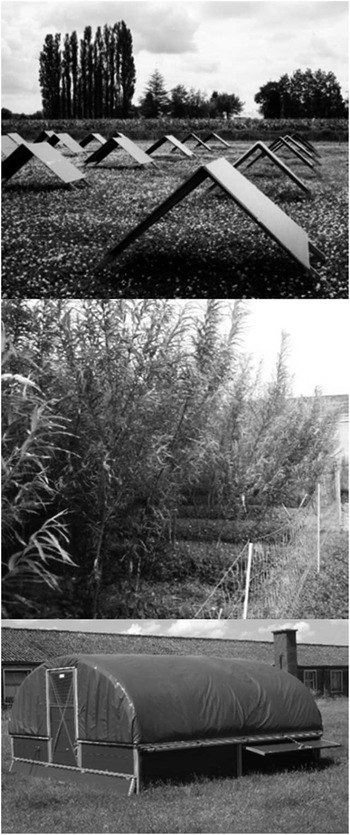
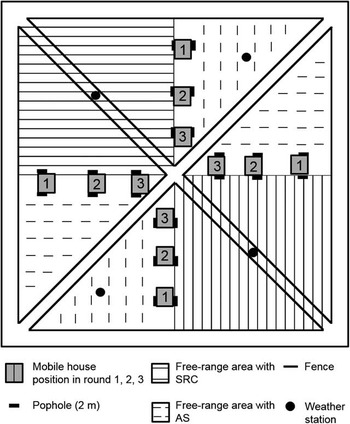
At day 25, chickens were moved to four mobile houses (McGregor Polytunnels Ltd, Ropley, UK; Figure 1). Males and females were mixed upon moving to achieve a male : female ratio of 50 : 50 in each group. Birds from enriched groups were placed together, as were birds from unenriched groups. The mobile houses were located on a 100×100 m field (Figure 2) and were repositioned along the AS/SRC boundary in between rounds to increase use of the entire free-range area and minimise point pollution. They measured 4.1×4.25 m and their floors were covered with wood shavings. Each house contained two bell drinkers and two feeders. They were isolated with fibreglass and ventilated naturally through openings in the two doors. From day 28 onwards, birds were given free-range access every day from the morning (between 0700 and 0900 h) until sunset. They had access to a field (1600 m²), half of which was grassland with ASs (21 wooden A-frames; L×W: 2.5×1.25 m; height at the centre: 1.5 m; Figure 1) and the other half was SRC (Figure 1) planted with willow clones (Tora (Salix schwerinii), Klara ((Salix burjatica×Salix viminalis)×S. burjatica) and Tordis (S. schwerinii×S. viminalis)). The trees had been planted in the spring of 2013 at high density (15 000 trees/ha) in accordance with common practice (75 cm between single rows, 150 cm between double rows, 60 cm between trees in each row). During the periods in which the chickens had outdoor access, the trees had leaves (although they only started to grow at the time that the first round went outside) and were on average 4.32 m tall. At day 70, all birds were weighed in groups (males and females separately). At day 72, all chickens were commercially slaughtered and processed. All animal procedures were approved by the Ethics Committee of the Institute for Agricultural and Fisheries Research (ILVO, Merelbeke, Belgium).
Above: free-range area with wooden A-frames. Middle: free-range area with short rotation coppice with willow. Below: mobile house.

Top view of the experimental site (100×100 m (outer edges)). SRC=short rotation coppice with willow; AS=grassland with artificial shelter.

Fearfulness
At day 23, a TI test was performed on 25 randomly selected chickens per group. This is the reason why the chickens were initially housed in single-sex groups; we wanted to have equal numbers of males and females for the TI tests (because some aspects of the TI test may differ between sexes (Jones and Faure, Reference Jones1981)), and at day 23 it was not yet possible to differentiate between sexes based on, for example, comb size and colour. During this test, the chicken was placed on its back in a U-shaped crib, restrained for 15 s and then released. If the chicken righted itself within 10 s, another induction was done, with a maximum of three inductions. If the induction was successful, the duration until righting and the number of inductions were recorded. Maximum duration of the test was 5 min; in this case the bird was allocated a duration of 300 s.
Free-range use and behaviour
Free-range use was recorded by visual observations during 15 days in round 1, 21 days in round 2 and 18 days in round 3, starting on day 28 and ending on day 63. The observations were always done at 0900, 1300 and 1700 h. The number of animals outdoors was counted once per hour, and for every chicken that was outdoors it was recorded which part of the field (AS or SRC) it was on and how far it was away from the house (0 to 2, 2 to 5, >5 m). In addition, in rounds 2 and 3, the behaviour of each chicken at that moment was scored: the possibilities were standing, walking, running, sitting/lying, preening, dust bathing, foraging/eating and social behaviour (interaction with other birds). When scoring, preening, dust bathing, foraging/eating and social behaviour had priority over standing, walking, running and sitting/lying. The scoring of the behaviour was done according to the birds’ location: first the birds within 0 to 2 m from the house were scored, then those within 2 to 5 m and finally those >5 m from the house. Running was rarely observed and therefore, for the analysis walking and running were grouped together as ‘locomotion’. Preening, dust bathing and social behaviour were also rare, and were grouped together as ‘other’ behaviours.
Weather conditions
In total four weather stations were placed on the field: two in AS (they did not fit underneath the A-frames and were therefore placed in the open next to a frame) and two in SRC (Figure 2). The weather stations were equipped with a thermometer and humidity meter (CS215; Campbell Scientific, Logan, UT, USA), a precipitation meter (ARG100 Tipping Bucket; Campbell Scientific), a pyranometer (CS300; Apogee Instruments, Logan, UT, USA), a wind speed meter (03002 Wind Sentry Set; R.M. Young, Traverse City, MI, USA) and a data logger (CR200; Campbell Scientific). They made recordings every 15 min of the following five parameters: temperature (°C), relative humidity (%), solar radiation (kW/m2), rainfall (mm/15 min) and wind speed (m/s). For the analysis, the average of the values recorded by all four weather stations was used from the point in time closest to the observation time.
Data analysis
Statistical analyses were performed in SAS 9.4 (SAS Institute, Cary, NC, USA). Data are presented as least squares (LS) means±standard errors unless stated otherwise. Continuous variables were considered sufficiently normally distributed based on the graphical evaluation (histogram and QQ plot) of the residuals. Statistical significance was evaluated at P<0.05. Non-significant factors were removed from the final models. In case of post hoc pairwise comparisons, the Tukey–Kramer adjustment for multiple comparisons was used at a total significance level of 0.05. The effect of enrichment on TI duration and number of inductions was tested using a generalised linear mixed regression model. TI duration was log-transformed. Fixed factors were enrichment (yes/no) and BW (per sex). Pen within production round was included as random effect.
Data on free-range use and behaviour were analysed using a GLM Poisson regression model, with a first-order autoregressive covariance structure to correct for multiple observations over time within the same house. Early enrichment (yes v. no), shelter type (AS v. SRC), distance from the house (<2, 2 to 5, >5 m), time of day (0900, 1300 or 1700 h), age, rainfall, temperature, wind speed, relative humidity, solar radiation and their relevant interactions were included in the model for free-range use (% chickens outside; log-transformed) as fixed factors, but removed again if not significant. In the model for behaviours (expressed as percentage of the birds outside performing that behaviour) fixed factors were early enrichment, shelter type, distance from the house, time of day, age and their relevant interactions.
Data are shown as back-transformed LS means and their back-transformed confidence intervals (CI).
Results
Production
The average mortality per round was 2.5±0.3% (mean±SD). The average weight of male birds at day 70 was 3.0±0.2 kg, that of females was 2.3±0.2 kg.
Fearfulness
In 300 TI tests, TI could not be induced in 13 chickens, and 16 chickens reached the maximum duration of 300 s. Enrichment had no effect on fearfulness as measured by the TI duration (t 286=−0.57; P=0.571). TI duration was, however, related to the weight of the bird, with a longer duration in heavier birds, both in males (t 142=−1.29; P=0.023) and in females (t 143=6.41; P=0.012). For example, a male bird in an enriched group weighing 300 g (minimum recorded weight) would have on average a TI duration of 22 s, compared with 88 s for a bird weighing 780 g (maximum recorded weight).
Free-range use
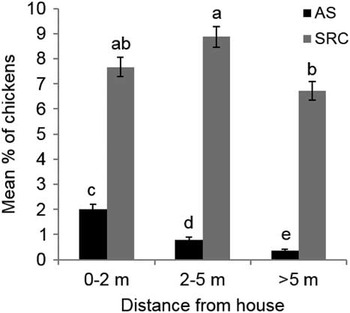
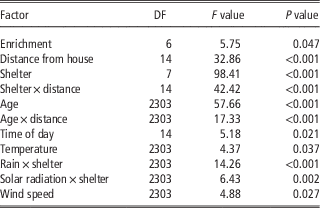
On average, 27.1% (95% CI: 24.8 to 29.7) of the birds were observed outside at any given moment of observation. Table 1 gives an overview of all factors that were related to the number of birds outside. Although enrichment did not affect birds’ fearfulness, it did have a small, positive effect on the number of birds outside as compared with the groups without enrichment (0.4% more birds outside, t 6=−2.49; P=0.047). At all distances from the house, a markedly higher number of birds were observed in SRC compared with AS (all P<0.001; Figure 3). In AS more birds were within 0 to 2 m than within 2 to 5 m (t 14=−5.92; P<0.001) or >5 m (t 14=8.01; P<0.001) from the house, and more birds tended to be within 2 to 5 m than >5 m (t 14=3.07; P=0.072; Figure 3). In SRC, the percentage of birds within 0 to 2 m of the house did not differ from that within 2 to 5 m (t 14=2.43; P=0.211) or >5 m (t 14=2.04; P=0.368) from the house, but the percentage within 2 to 5 m was higher than that at >5 m (t 14=4.04; P=0.012; Figure 3).
Percentage of broiler chickens outside in grassland with artificial shelter (AS) and short rotation coppice with willow (SRC), according to their distance from the house. Bars without a common superscript differ significantly (P<0.05).

Factors related to the number of broiler chickens outside at a given moment of observation

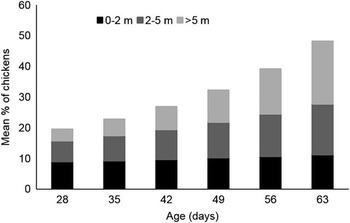
Free-range use increased with age of the chickens. This effect was more pronounced in areas farther from the house (F 2303=17.33; P=0.002; Figure 4). For example, the mean percentages of birds at 0 to 2, 2 to 5 and >5 m, respectively, were 8.5% (95% CI: 6.8 to 10.7), 6.9% (95% CI: 5.5 to 8.7) and 3.9% (95% CI: 3.0 to 5.2) at day 28, and 11.6% (95% CI: 8.6 to 15.7), 16.4% (95% CI: 12.5 to 21.7) and 19.9% (95% CI: 15.0 to 26.5) at day 63. The mean percentage of birds outside was related to time of day (raw means±SD: 32.1±17.1% in the morning v. 22.6±16.5% in the afternoon; F 14=5.18; P=0.021) with birds outside at midday (25.7±17.6%) being intermediate and not different from that observed either in the morning or afternoon.
Mean percentage of broiler chickens outside at different ages, per distance from the house (0 to 2, 2 to 5, >5 m).

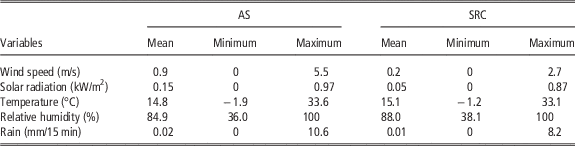
Weather conditions had an effect on free-range use (for an overview of the weather conditions during the experiment see Table 2). Free-range use increased with temperature (F 2303=4.37; P=0.037), and decreased with wind speed (F 2303=4.88; P=0.027). In AS, rainfall and decreasing solar radiation were related to more birds outside, whereas the opposite was true in SRC (F 2303=14.26; P<0.001 and F 2303=6.43; P=0.002). For example, at a temperature of 15°C, 23.6% (95% CI: 21.2 to 28.9) of the birds would be outside, whereas at 30°C, this would be 33.5% (95% CI: 25.2 to 44.5). In AS, when it was not raining a mean percentage of 3.0% (95% CI: 2.3 to 3.7) of the birds was outside, as compared with 5.5% (95% CI: 4.0 to 10.6) when it was raining. For SRC, this was 24.8% (95% CI: 23.6 to 27.8) when it did not rain v. 11.9% (95% CI: 8.1 to 16.8) when it rained. In AS, at a radiation of 0.1 kW/m2 mean percentage of birds outside was 3.7% (95% CI: 2.8 to 5.1), v. 2.3% (95% CI: 1.5 to 3.2) at 0.4 kW/m2. In SRC, this was 21.9% (95% CI: 19.0 to 25.1) at 0.1 kW/m2 and 25.9% (95% CI: 21.6 to 31.0) at 0.4 kW/m2.
Mean, minimum and maximum values of all recorded weather variables per shelter type

AS=grassland with artificial shelter; SRC=short rotation coppice.
Free-range behaviour
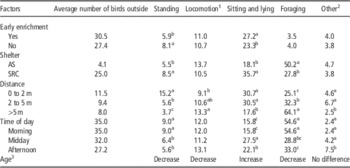
Occurrence of several behaviours was related to shelter type, distance from the house, time of day and the age of the birds (Table 3). Occurrence of the behaviours was expressed as the percentage of the total number of birds that were outside. We chose not to use absolute numbers in order to avoid confounding effects of factors such as shelter type: the fact that birds preferred the SRC would mean the chance any behaviour was more common in the SRC would be higher than in the AS. On the other hand, using percentages can give a distorted picture of the absolute occurrence of these behaviours. Therefore, when interpreting these results, one should keep in mind that the number of birds in AS was considerably lower than in SRC.
Factors affecting the occurrence of behaviours of broiler chickens in the free-range area at a given moment of observation (% of total number of birds outside)

AS=grassland with artificial shelter; SRC=short rotation coppice with willow.
a,b,cMeans per factor within a column without a common superscript differ significantly (P<0.05).
1 Locomotion includes walking and running.
2 Other includes dust bathing, preening and social behaviour.
3 Indicates whether behaviours increased or decreased with age.
Table 3 gives an overview of the factors affecting behaviours that the birds performed in the free-range area. In groups that had received early environmental enrichment, a lower percentage of the birds was standing (F 1197=30.89; P<0.001) and a higher percentage was sitting (F 6=6.00; P=0.050) as compared with the groups without enrichment. The estimated percentage of outside birds observed standing was higher in SRC than in AS (F 1197=24.22; P<0.001), decreased with distance from the house (F 1197=179.73; P<0.001), decreased with age (F 1197=34.29; P<0.001) and was higher in the morning than later on the day (F 1197=24.22; P<0.001). Locomotion (walking+running) did not differ between shelter type or time of day, but occurred more often in birds furthest from the house (F 14=3.86; P=0.046) and decreased with age (F 1194=24.69; P<0.001). A higher percentage of birds in SRC were sitting when compared with those in AS (F 7=42.08; P<0.001). Sitting occurred less in birds furthest from the house (F 14=46.99; P<0.001), was observed more often at midday than in the morning or afternoon (F 14=24.35; P<0.001), and increased with age (F 1191=126.44; P<0.001). Foraging was performed by a higher percentage of birds in AS compared with SRC (F 7=52.41; P<0.001), by birds farther from the house (F 14=100.48; P<0.001), and in the morning as compared with midday and afternoon (F 14=42.87; P<0.001), and decreased with age (F 1191=42.43; P<0.001). Dust bathing, preening and social behaviour (grouped as ‘other’ behaviours) were not affected by shelter type or age, but occurred relatively more often close to the house (F 14=11.71; P=0.001), and later in the day (F 14=14.38; P<0.001).
Discussion
In this study, we aimed to reduce fearfulness by providing birds with environmental enrichment at an early age. However, enrichment had no effect on fearfulness as measured by a TI test. TI duration was positively correlated with BW. Perhaps it was physically more difficult for heavier birds to right themselves. At this young age (day 23), and therefore low weight, that may not yet seem to play a role, but Bizeray et al. (Reference Bizeray, Leterrier, Constantin, Picard and Faure2000) already found differences in chickens’ activity related to BW from day 15 onwards. Early life enrichment did have a small positive effect on the mean number of chickens outside, so perhaps it influenced the birds in another way than via fearfulness. Nevertheless, this effect was small and its relevance can be questioned. Enrichment did not affect the distance (0 to 2, 2 to 5 or >5 m) the chickens ranged from the house or the shelter type they preferred. The period of enrichment provision was possibly too short (4 weeks), although Jones and Waddington (Reference Jones and Waddington1992) did find an effect of providing enrichment (manipulable, brightly coloured objects) to layer chicks from days 0 to 20 on fearfulness as measured by TI, open field, novel object and emergence tests. Alternatively, the enrichment was insufficient (either in quantity or quality) to have a strong effect. The enrichment did influence standing (shown less) and sitting (shown more). The differences in standing and sitting are not in accordance with other studies on early environmental enrichment: Jones and Waddington (Reference Jones and Waddington1992) found that chicks from enriched pens pecked more at the environment, but found no other differences in home-pen behaviour, and Jones (Reference Jones1982) observed less immobility in an open field test in chicks from enriched pens. The reason for the differences in standing and sitting behaviour in this study remains unclear, but the effect sizes were small and may not be relevant.
Free-range use was overall higher than in other studies with broiler chickens (Dawkins et al., Reference Dawkins, Cook, Whittingham, Mansell and Harper2003; Jones et al., Reference Jones, Feber, Hemery, Cook, James, Lamberth and Dawkins2007; Rodriguez-Aurrekoetxea et al., Reference Rodriguez-Aurrekoetxea, Leone and Estevez2014). The reason for this is unclear, but could be related for instance with a smaller group size (Hegelund et al., Reference Hegelund, Sørensen, Kjær and Kristensen2005), a different breed (Nielsen et al., Reference Nielsen, Thomsen, Sørensen and Young2003) or a better free-range design (Dawkins et al., Reference Dawkins, Cook, Whittingham, Mansell and Harper2003). Many factors had an effect on how chickens used the free-range area. The chickens showed a clear preference for SRC over AS. There are several possible explanations for this: the SRC’s dense vegetation likely provided a greater sense of safety (it was anecdotally observed that more chickens went inside the house when an airplane or large bird flew over the field if they were in AS compared with SRC), the SRC provided protection against adverse weather conditions (average wind speed and solar radiation were lower in SRC than in open areas in AS), and an increased biodiversity in the SRC is likely to have provided an attractive foraging environment (not measured in this study). Regarding the weather conditions, the number of birds in SRC indeed increased with increasing solar radiation, whereas the number of birds in AS decreased, indicating that SRC provided more shade than AS. However, when it rained the number of birds in SRC decreased, whereas the number in AS increased. The increase of birds in AS was numerically very small, and the absolute number in SRC was always higher, indicating that AS did not provide sufficient protection against rain. Regardless of shelter type, free-range use decreased with decreasing temperatures and increasing wind speeds. This indicates that AS and SRC provided similar protection against these factors, in accordance with findings of Stadig et al. (Reference Stadig, Rodenburg, Ampe, Reubens and Tuyttenssubmitted), Dawkins et al. (Reference Dawkins, Cook, Whittingham, Mansell and Harper2003) and Rodriguez-Aurrekoetxea et al. (Reference Rodriguez-Aurrekoetxea, Leone and Estevez2014).
Shelter type not only affected the distribution of birds over the range, but also the behaviours the birds performed. A higher percentage of the chickens in AS foraged as compared with SRC, but the number of birds in SRC was considerably higher than in AS, so the absolute number of birds foraging was actually higher in SRC than in AS. This could be because foraging is a highly motivated behaviour in chickens (Weeks and Nicol, Reference Weeks and Nicol2006) and therefore occurs frequently regardless of the environment, but it could also indicate that the vegetation in SRC was more attractive for foraging. In SRC both standing and sitting were proportionately more common than in AS. A possible explanation is that birds felt safer in SRC, and were therefore more likely to sit down, which could have caused them to be less mobile and therefore more susceptible to predators. The roots of the trees could also be suitable dust bathing spots, after which the chickens remain sitting at that spot. Dal Bosco et al. (Reference Dal Bosco, Mugnai, Rosati, Paoletti, Caporali and Castellini2014) also found differences in behaviours between birds on pasture v. with tall grass v. with olive trees, such as more lying down in pasture and more locomotion under the trees. However, they always observed the same number of birds per shelter type, and the absence of the confounding effect of total number of birds outside could account for differences with our study. Rodriguez-Aurrekoetxea et al. (Reference Rodriguez-Aurrekoetxea, Leone and Estevez2015) found no effect of shelter (panels) in the free-range area on behaviour, possibly due to their light weight, which may have made them unstable and therefore not attractive enough (Rodriguez-Aurrekoetxea et al., Reference Rodriguez-Aurrekoetxea, Leone and Estevez2015), or perhaps there were not enough shelters placed outdoors (nine 0.5×0.5 m panels for 1300 birds).
Chickens preferred the areas closer to the house over those farther away, especially in AS, which is in accordance with findings of Mirabito and Lubac (Reference Mirabito and Lubac2001) and Dawkins et al. (Reference Dawkins, Cook, Whittingham, Mansell and Harper2003). However, in SRC there was no difference between 0 to 2 and 2 to 5 m from the house. Perhaps this was because the chickens had to cross a small patch of grassland (1 m) in front of the house to reach the willows, giving them more incentive to go farther from the house, or because SRC was more suitable to encourage the birds to range farther from the house. The chickens were more often observed to be standing or sitting close to the house as compared with farther away. This could be due to an increased feeling of safety when closer to the house, or because there was no need to range farther from the house to sit down, whereas for foraging, it was necessary to traverse greater distances to access suitable foraging places.
Free-range use was highest in the morning, which corresponds with findings of Dawkins et al. (Reference Dawkins, Cook, Whittingham, Mansell and Harper2003) and Jones et al. (Reference Jones, Feber, Hemery, Cook, James, Lamberth and Dawkins2007). These studies, however, also found an increase in free-range use again in the late afternoon/early evening. In our study this was not observed; perhaps the observations in the afternoon were still too early (2 to 5 h before sunset) to observe an increase in free-range use at the end of the day. Behaviours were also affected by time of day: sitting was most often observed at midday, whereas more active behaviours such as standing and foraging were observed most in the morning. This suggests that at the times that the most birds are outside, they are also most active.
Free-range use increased with age, and this effect was more pronounced at distances farther from the house. The finding that free-range use increased with age corresponds with findings of Mirabito and Lubac (Reference Mirabito and Lubac2001) and Rodriguez-Aurrekoetxea et al. (Reference Rodriguez-Aurrekoetxea, Leone and Estevez2014), and could indicate that chickens may need time to get used to free-range access. The observation that older birds ventured farther from the house could be because (edible) vegetation near the house became depleted over time, because they learned it was safe to go farther, or because they were less prone to predation due to their larger body size. Age was also related with the behaviours the birds showed outside, with sitting being observed more often over time, and standing, locomotion and foraging less. This could be due to the increasing weight of the birds, which made them less mobile (Bokkers and Koene, Reference Bokkers and Koene2003). Rodriguez-Aurrekoetxea et al. (Reference Rodriguez-Aurrekoetxea, Leone and Estevez2015) found no effect of age on slow-growing broilers’ behaviour, but they only used females in their experiment, which are less heavy at slaughter age, so weight would have less influence on their activity.
In conclusion, early environmental enrichment had no effect on birds’ fearfulness and no profound effect on free-range use. Birds showed a strong preference of SRC over AS in the free-range area, and they also ranged farther from the house in SRC, indicating that this shelter type was more suitable, for example, because of protection against adverse weather conditions. Exactly which characteristics of SRC caused this difference needs further investigation. Chickens showed other behaviours in SRC than in AS, such as relatively more sitting and lying. This study’s results indicate that SRC with willow is a more appropriate shelter type for slow-growing broiler chickens than A-frames.
Acknowledgements
The authors thank T. Decroos, M. Van Haver, S. Chahid, C. Girard, L. Jacobs and S. de Graaf for their help with practical work, the animal caretakers of ILVO for their care for the animals, and A. De Vliegher and the technical team of G. De Smet for installation and maintenance of the SRC plots. They also thank M. Levenson for proofreading and English language correction. This research was funded by a PhD grant of the Agency for Innovation by Science and Technology (IWT).