Implications
Poultry mortality during pre-slaughter transportation is a major animal welfare and economic concern that can be influenced by several species-specific factors, such as gender and genetic line. The knowledge of these factors is important to provide targets for improving poultry welfare and reducing economic loss associated with pre-slaughter transportation. Particularly, increasing the number of birds per crate does not seem to protect turkeys from cold stress, but rather leads to increased mortality.
Introduction
During loading and transportation to the slaughterhouse, several factors can affect poultry welfare. As reported by the European Food Safety Authority (EFSA) (2004 and 2011), these factors can cause behavioural stress due to movement restriction (Wichman et al., Reference Wichman, Norring, Pastell, Algers, Pösö, Valros, Saloniemi and Hänninen2010), injuries associated with handling and loading operations, thermal discomfort, as well as feed and water restriction due to conventional slaughtering procedures (Terlouw et al., Reference Terlouw, Arnould, Auperin, Berri, Le Bihan-Duval, Deiss, Lefèvre, Lensink and Mounier2008). Moreover, vibration, sudden acceleration and deceleration of the transport vehicle and noise may also represent challenging conditions (Nicol and Scott, Reference Nicol and Scott1990; Randall et al., Reference Randall, Streader and Meehan1993; Mitchell and Kettlewell, Reference Mitchell and Kettlewell1998).
An increase in pre-slaughter mortality (dead-on-arrival, DOA) can reflect the level of welfare impairment and has been associated with some of the above mentioned factors, such as travel distance and specific meteorological conditions (Petracci et al., Reference Petracci, Bianchi, Cavani, Gaspari and Lavazza2006; Vecerek et al., Reference Vecerek, Grbalova, Voslarova, Janackova and Malena2006; Chauvin et al., Reference Chauvin, Hillion, Balaine, Michel, Peraste, Petetin, Lupo and Le Bouquin2011; Weeks et al., Reference Weeks, Brown, Richards, Wilkins and Knowles2012). The average pre-slaughter mortality for turkeys has been reported to range from 0.27% in Czech Republic (Voslářová et al., Reference Voslářová, Janáčková, Rubešová, Kozak, Bedáňová, Steinhauser and Večerek2007a) to 0.38% in Italy (Petracci et al., Reference Petracci, Bianchi, Cavani, Gaspari and Lavazza2006), whereas pre-slaughter mortality for end of lay hens has been reported to range from 0.27% in the UK (Weeks et al., Reference Weeks, Brown, Richards, Wilkins and Knowles2012) to 1.22% in Italy (Petracci et al., Reference Petracci, Bianchi, Cavani, Gaspari and Lavazza2006). In Italy, end of lay hens can be subject to longer journeys compared with broilers and turkeys, as relatively fewer slaughterhouses processing this type of poultry are available (Petracci et al., Reference Petracci, Bianchi, Cavani, Gaspari and Lavazza2006). These birds are slaughtered at the end of their egg-production cycle, that is at a low economic value, which may reduce the care taken in handling (Grandin, Reference Grandin2007). Moreover, due to relative inactivity within cage system and breeding for a high rate of laying, they are likely to suffer from a variety of skeletal problems resulting in increased bone fragility and susceptibility to fracture (Whitehead and Fleming, Reference Whitehead and Fleming2000; Lay et al., Reference Lay, Fulton, Hester, Karcher, Kjaer, Mench, Mullens, Newberry, Nicol, O’Sullivan and Porter2011).
In a previous Italian study, DOA was found to dramatically increase in summer both for turkeys and hens compared with other seasons (Petracci et al., Reference Petracci, Bianchi, Cavani, Gaspari and Lavazza2006). The summer increase in mortality in turkeys was confirmed by a Czech study (Machovcova et al., Reference Machovcova, Vecerek, Voslarova, Malena, Conte, Bedanova and Vecerkova2017), whereas a Czech and a British study found an increased risk for hens in winter (Voslářová et al., Reference Voslářová, Janáčková, Vitula, Kozak and Vecerek2007b; Richards et al., Reference Richards, Wilkins, Weeks, Knowles and Brown2012). At present, the potential effect of other factors, such as gender, genetic line and stocking density has not been studied in depth.
The Council Regulation (EC) 1/2005 establishes a minimum floor area for poultry in containers based on their live weight. However, this Regulation also states that space requirements may vary depending not only on the weight and size of the birds, but also on their physical conditions, weather and transport duration. In Italy, integrated poultry companies may adjust the stocking density, often believing that reducing the floor allowance during wintertime may provide better protection from cold temperatures. However, some authors have suggested that under simulated cold temperatures (i.e. −15°C) broilers may benefit from a space allowance (i.e. around twofold more than the minimum required by EC Reg. 1/2005) which enables them to adjust their position within the drawer based upon the temperature distribution in the crate (Strawford et al., Reference Strawford, Watts, Crowe, Classen and Shand2011).
Previous studies have indicated travel distance as a major risk factor for increased DOA in turkeys (Machovcova et al., Reference Machovcova, Vecerek, Voslarova, Malena, Conte, Bedanova and Vecerkova2017) and end of lay hens (Weeks et al., Reference Weeks, Brown, Richards, Wilkins and Knowles2012). Factors such as on-farm mortality and catching system have also been identified as risk factors for broilers in France, with mechanical loading being associated with higher mortality than manual loading (Chauvin et al., Reference Chauvin, Hillion, Balaine, Michel, Peraste, Petetin, Lupo and Le Bouquin2011). In the UK, on-farm mortality rate and housing system have been reported to be risk factors for DOA in end of lay hens (Weeks et al., Reference Weeks, Brown, Richards, Wilkins and Knowles2012).
Dead-on-arrival represents a welfare indicator but also an economic loss in itself; therefore its reduction would be beneficial to the interests of both consumers and producers. This study aims at identifying potential risk factors for increased DOA in turkeys and end of lay hens, considering variables such as the genetic line, gender, density in the crates, environmental temperature during transportation and travel duration.
Material and methods
Data collection
Historical slaughtering data were obtained from the archives of three of the largest slaughtering plants in northern Italy, two of which processed fattening turkeys and the third one end of lay hens. These abattoirs slaughter about 15 000 loads (i.e. animals loaded on a vehicle consisted of a truck plus a trailer) per year, mostly originating from northern Italy (turkey plants) or from the whole country (hen plant).
The documentation of all turkey loads (n=41 452) transported from the 1 January 2009 to the 31 December 2011 was provided by the production company. The average size of the loads was 837 birds (95% confidence interval (CI) 832 to 842), for a total of 34 696 388 birds slaughtered in the period of reference. Further information available included: location of origin, date and hour of departure and arrival (travel duration was subsequently calculated), number of animals, number of crates, stocking density, genetic line, gender, age, average weight and DOA. The genetic lines were anonymised and coded as A, G, H, I and N.
The laying hens loads (n=3241) included in the analyses were transported between the 1 January 2010 and the 31 December 2012; as for the turkey data, the documentation was provided by the production company. Loads contained an average of 6775 birds (95% CI 6733 to 6815), totalling to 21 788 124 birds slaughtered during the study period. For each load the information available included: location, date and hour of departure and arrival (travel duration was subsequently calculated), number of animals, number of crates, stocking density, genetic line (brown-feathered line v. white-feathered line), age, average weight, and DOA. No information was available regarding either stocking density in the transport crates or the housing system. This study was approved by the IZSVe Ethical Committee (CE.IZSVE.18/2013).
Collection and processing of meteorological data
Minimum, maximum and average environmental temperatures were acquired from the European Climate Assessment and Dataset project (ECA&D, Royal Netherlands Meteorological Institute, De Bilt, the Netherlands) as spatial raster data sets for each pathway. The GRASS-GIS software was used to obtain summary values (minimum, maximum and mean) for the minimum, maximum and average temperatures per each day of transportation.
For further analyses, we considered the mean values of: (i) the minimum temperature when the travel occurred between 2300 and 0600 h in the following day; (ii) the maximum temperature when the travel occurred between 1100 and 1600 h in the same day; (iii) the average temperature when the travel occurred during the remaining part of the day. This choice was made to reduce bias potentially generated by using the daily average temperature for the whole travel, assigning the most likely temperature to each part of the day.
As for end of lay hens, journeys were characterised by longer distances, from southern to northern regions, and markedly varying environmental temperatures along the route. Therefore, as it was not possible to assign a single value reliably indicating the temperature during the whole transportation, we classified the temperatures during journeys by the seasonal period (i.e. spring, summer, autumn, winter).
Statistical analysis
Dead-on-arrival was expressed as the percentage of dead birds in each load at the moment of hanging on the slaughter line.
The stocking density for turkeys was classified into three categories according to data distribution and percentage deviation from the density limits defined in the EC Regulation 1/2005 (i.e. 105 cm2/kg for birds heavier than 5 kg, corresponding to 95 kg/m2): ‘low’ stocking density if lower than the EC Regulation 1/2005 limits (percentage deviation from the maximum limit ⩽−7%, that is, a median difference of 10 kg/m2); ‘fair’ density within the provided limits (percentage deviation>−7% and⩽0%, median difference of 3 kg/m2); and ‘high’ stocking densities when greater than the EC Regulation 1/2005 limits (percentage difference>0%, median difference of 1 kg/m2). The travel duration was classified as shorter than 30 min, between 30 min and 1 h, longer than 1 h. Temperature categories were: ⩽2°C; >2°C and ⩽12°C; >12°C and <26°C; and⩾26°C.
An explorative analysis was performed to investigate DOA distribution and its relation to the different parameters, including their interactions. Given the high skewness of DOA distribution, the effect of the parameters on DOA was assessed using a quantile regression analysis targeting the median (Koenker and Hallock, Reference Koenker and Hallock2001). The parameters considered in the quantile regression were: sex, genetic line, travel duration (expressed in minutes) and environmental temperature. Considering the large sample size, in order to perform a robustness/sensitivity analysis, the model was re-run on random subsets of the data, which confirmed the factors with the greatest effects on DOA (Supplementary Table S1). As the different distributions of stocking density among the temperature categories were highlighted during the explorative analysis (reported in Table 1), the effect of stocking density on DOA was assessed using a quantile regression analysis stratified by temperature. Because the stratification by stocking density and temperature considerably reduced the size of some of the categories, the model was applied only to the following categories: (i) ⩽2°C, (ii) >2°C and ⩽12°C. As for end of lay hens the quantile regression analysis included only breed, travel duration (expressed in hours) and season of travel as predictors. Results were expressed as β-coefficients and corresponding 95% CI and P-values. All statistical analyses were performed using STATA v. 12.1 (Stata Corporation, College Station, TX, USA).
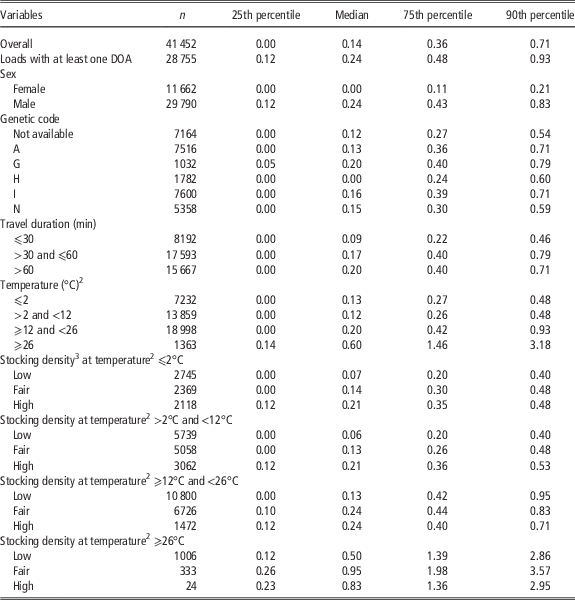
Descriptive statistics of dead-on-arrival (DOA)Footnote 1 in 41 452 turkey loads

1 Percentage of load DOA.
2 Summary values (minimum, maximum and mean) of local environmental temperatures per day of transportation were acquired and the most likely value was assigned to each journey on the basis of the time of occurrence (min: 2300 to 0600 h; max: 1100 to 1600 h; average: remaining part of the day).
3 The stocking density was classified as low (lower than EC Regulation 1/2005 limits; percentage deviation from the maximum limit: ⩽−7%), fair (within the legal limits; percentage deviation: >−7% and ⩽0%), high (greater than the EC Regulation 1/2005 limits; percentage difference: >0%).
Results
Turkeys
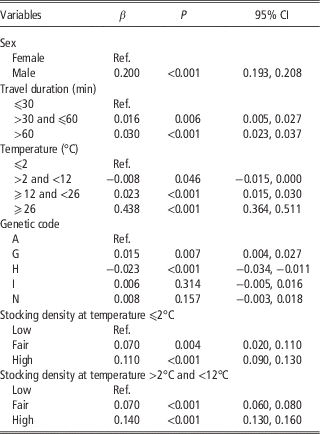
The descriptive statistics and results from the quantile regression analysis for turkeys are given in Tables 1 and 2, respectively. Females were 9.04 kg average live weight (SD: 1.09) and 108 days average age (SD: 9); males were 19.35 kg average live weight (SD: 1.59) and 142 days average age (SD: 6). The seasonal variations of ambient temperatures (minimum, mean and maximum values) are presented as Supplementary Table S2.
Associations between slaughtering variables and dead-on-arrival (DOA)Footnote 1 in turkeys

CI, confidence interval.
Results of the quantile regression models are expressed as regression coefficients (β) with the 95% CI and P-value.
1 Percentage of load DOA.
Table 1 shows the DOA distribution stratified by categories of stocking densities and temperatures. Higher stocking densities did not protect turkeys from cold stress when considering temperature ⩽2°C; on the contrary, a significant increase of DOA was observed (P<0.001) (Table 2). Male turkeys showed an overall higher DOA than female (β=0.200, P<0.001); birds belonging to genetic line H had lower values of DOA than genetic line A, whereas genetic line G had higher values (Table 2). As for the extrinsic factors, travel duration and temperature were significantly associated with the variation of DOA (Table 2). In particular DOA increased when temperatures were >12°C (β=0.023, P<0.001), with a maximum increment above 26°C (β=0.438, P<0.001). Journeys longer than 60 min showed higher DOA when compared with shorter journeys (β=0.030, P<0.001). A table showing DOA stratified by temperature and sex has been included as Supplementary Table S3.
End of lay hens
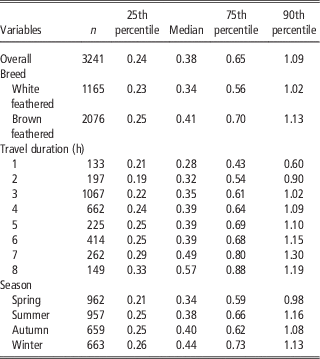
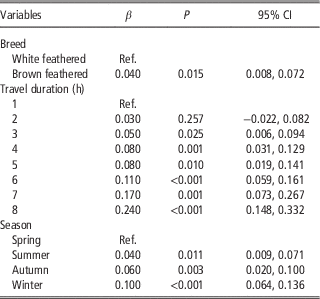
The descriptive statistics and results from the quantile regression analysis for end of lay hens are given in Tables 3 and 4, respectively. White-feathered hens were 1.63 kg of average live weight (SD: 0.13), whereas brown-feathered hens were 1.99 kg of average live weight (SD: 0.13). The seasonal variations of ambient temperatures (minimum, mean and maximum values) are presented as Supplementary Table S2.
Descriptive statistics of dead-on-arrival (DOA)Footnote 1 of 3241 loads of end of lay hens

1 Percentage of load DOA.
Associations between slaughtering variables and dead-on-arrival (DOA)Footnote 1 in end of lay hens

CI, confidence interval.
Results of the quantile regression models are expressed as regression coefficients (β) with the 95% CI and P-value.
1 Percentage of load DOA.
Results of the quantile regression (Table 4) show a positive association of DOA with journey duration, which remained constant between 4 and 6 h and presented a peak at 8 h (median: 0.57%). Brown-feathered hens had a higher DOA than white-feathered birds. An increased DOA was detected in the winter period (P<0.001) compared with spring. Less marked increments of DOA in summer (P=0.011) and autumn (P=0.003) were also observed compared with spring.
Discussion
Previous studies on DOA in turkey and hen loads have usually considered the mean values when making comparisons and inferences (Petracci et al., Reference Petracci, Bianchi, Cavani, Gaspari and Lavazza2006; Weeks et al., Reference Weeks, Brown, Richards, Wilkins and Knowles2012). Yet, our study showed a marked difference between mean and median DOA values, which is caused by the large amount of loads with no or just few dead birds at arrival, leading to the strong positive skewness of the distribution of DOA values observed here. Due to this skewed distribution, we considered the median rather than the mean to be the statistical measure that best described the central tendency in our data.
In turkeys, journeys shorter than 30 min showed the lowest DOA risk. In end of lay hens, a similar effect was observed for journeys shorter than 2 h. This is in accordance with Weeks et al. (Reference Weeks, Brown, Richards, Wilkins and Knowles2012), although these authors considered the spatial distance from the abattoir instead of the travel duration. Travel distance and duration are expected to be strongly associated; however as evidenced by Warriss et al. (Reference Warriss, Bevis and Brown1990) in the UK, road journeys may be subject to unpredictable delays which could potentially lead to longer durations than would be expected by the spatial distance.
In turkeys, DOA was significantly higher in males than in females and in some specific genetic lines. Although this information has never been reported in previous studies that focussed on DOA, it has been previously found that a 12-h transport stress led to different stress responses (i.e. increased corticosterone level, immune reactivity and stress-related behaviours) in three turkey lines; in the same study it was also observed that the stress response was greater in males than in females (Huff et al., Reference Huff, Huff, Rath, Donoghue, Anthony and Nestor2007). In particular, the small-bodied line had little behavioural response and were immediately active after transportation, whereas the birds in both large-bodied lines were debilitated and reluctant to move, eat or drink for several hours. The authors suggested that the genetic selection for fast growth could be associated with a lower capacity to cope with environmental stressors, and especially in males (Huff et al., Reference Huff, Huff, Rath, Donoghue, Anthony and Nestor2007).
Similarly, breed has an effect on DOA in hens, with brown-feathered hens showing a 20% higher DOA risk than white-feathered. A major breeding company fact-sheet reports a higher robustness in white lines compared with brown ones (Hyline, 2017). However, we had no information regarding the housing system in brown and white hens included in the analysis. Therefore, an interaction breed×housing system cannot be completely excluded, given that Weeks et al. (Reference Weeks, Brown, Richards, Wilkins and Knowles2012) reported a higher DOA in non-cage systems, probably due to bad plumage conditions.
Temperatures higher than 26°C were found to considerably increase DOA in turkeys (i.e. median DOA of 5.95%) and was the factor with the greatest effect on the DOA for this species, as also observed for broilers (Vecerek et al., Reference Vecerek, Grbalova, Voslarova, Janackova and Malena2006; Chauvin et al., Reference Chauvin, Hillion, Balaine, Michel, Peraste, Petetin, Lupo and Le Bouquin2011). In winter, we observed an increase in stocking density. According to EFSA (2004), in conditions of hot weather, it is important to reduce the stocking density in the crates to allow better ventilation, reduce metabolic heat and humidity, whereas no study supports the increase in stocking density as a strategy to better shelter animals from cold air. Rather, we found that high stocking density in winter conditions (⩽2°C) was associated with increased DOA. This is in accordance with the study of Strawford et al. (Reference Strawford, Watts, Crowe, Classen and Shand2011) on broilers under a condition of simulated cold weather transportation. These authors found that low densities likely allowed birds to move away from cold draughts and to huddle in warmer areas of the crate.
In contrast to that observed in turkeys, in end of lay hens, presumably cold stress during winter or perhaps reduced ventilation during winter had a greater effect on DOA than during the other seasons. This is in accordance with Weeks et al. (Reference Weeks, Brown, Richards, Wilkins and Knowles2012) in the UK and with Voslářová et at. (Reference Voslářová, Janáčková, Vitula, Kozak and Vecerek2007b) in the Czech Republic, although weather conditions in these countries may differ substantially. In our study, the average DOA in end of lay hens was higher than the one reported by Weeks et al. (Reference Weeks, Brown, Richards, Wilkins and Knowles2012) (i.e. median 0.38% v. 0.15%), although this was lower than the mortality reported in Italy in 2006 using a database of comparable size (i.e. DOA=1.2%; median not provided; Petracci et al., Reference Petracci, Bianchi, Cavani, Gaspari and Lavazza2006). The latter could be related to a greater attention paid by the official authorities on the EU Regulation in force, as animal welfare during transportation has become a priority in the last few years, both in terms of official inspections and public concern (Gavinelli et al., Reference Gavinelli, Ferrara and Simonin2008).
In Italy, fewer egg farmers than turkey farmers are within the same vertical integration system, and fewer slaughtering plants are available (source: National Data Registry). This difference can explain the average longer travel duration to which hens are subjected. We evidenced that a travel duration longer than 2 h significantly increases DOA, whereas a duration of 8 h is associated with a twofold increase in DOA in comparison to a duration shorter than 2 h. Therefore, journeys shorter than 8 h should be recommended.
In conclusion, our study provides new insights into pre-slaughter poultry welfare. A number of previously unexplored risk factors for mortality during pre-slaughter transportation have been identified. These risk factors have a different effect on turkeys and end of lay hens. This information can be used by integrated poultry companies in planning pre-slaughter transportation, accounting for the species-specific needs and the proper application of the EC Regulation 1/2005. Particularly, our results show that a decrease of stocking density during cold weather can reduce mortality in turkeys. Our results also emphasise the benefit in reducing journeys for laying hens to <8 h. Nevertheless, some parts of the Regulation do not provide detailed requirements for all circumstances (e.g. ‘space requirements may vary depending not only on the weight and size of the birds but also on their physical conditions, weather and transport duration’) and further research is needed.
Acknowledgements
This study was funded by the Italian Ministry of Health, Rome, Italy (Project RC IZSVe 07/12; B28C13000410001).
Supplementary material
To view supplementary material for this article, please visit https://doi.org/10.1017/S1751731117000970