Introduction
Public health concern about the significance of zoonosis in endemic tropical countries is increasing because of rising human–animal contact caused by poverty, ignorance and poor levels of hygiene (Malgor et al., Reference Malgor, Oku, Gallardo and Yarzabal1996; Jamshidi et al., Reference Jamshidi, Meshgi and Toghani2002). Human–dog contact is of particular relevance because, as the first domesticated animal, dogs have partnered and lived with humans for several thousands of years, providing companionship and essential services in the areas of sporting, herding, security and crime control, hunting, working, religion and income generation (Urquhart et al., Reference Urquhart, Armour, Duncan, Dunn and Jennings2003).
In addition, domestic dogs (Canis familiaris) are associated with many potentially zoonotic organisms, and play vital roles in the zoonotic transmission of the diseases they cause (Urquhart et al., Reference Urquhart, Armour, Duncan, Dunn and Jennings2003). Several studies in different parts of the world reveal that diseases of zoonotic importance transmitted by dogs include, but are not limited to, gastrointestinal helminthiasis (e.g. trematodes, cestodes and nematodes), rabies, toxoplasmosis, leishmaniasis, larva migrans and myiasis (Kornbalt & Schantz, Reference Kornbalt and Schantz1980; Craig & Macpherson, Reference Craig, Macpherson, Macpherson, Meslin and Wandeler2000). These studies suggest that transmission of dog diseases is exacerbated by several factors, including dog age, conditions of care and feeding patterns.
In Nigeria, as in many other tropical African communities, dogs roam the streets untended, scavenging waste dumps, decaying food materials and faecal matter. They contract zoonotic infections and pollute the environment with helminth eggs and larvae, protozoan cysts and other infective agents in the process (Sowemimo & Asaolu, Reference Sowemimo and Asaolu2008). In most rural and urban resource-limited communities, children play outdoors and adults walk the streets bare-foot, picking up infections from contaminated soils (Chiejine & Ekwe, Reference Chiejine and Ekwe1986; Minaar & Krecek, Reference Minaar and Krecek2001).
A recent investigation in south-western Nigeria revealed that sustainable control of zoonotic diseases of canine origin requires adequate and useful information on the local and regional distribution of appropriate environmental risk factors (Sowemimo & Asaolu, Reference Sowemimo and Asaolu2008). This information is, however, scarce in Nigeria, especially data on the intensity of infection, which have not been collected by most epidemiological studies of canine zoonosis in south-eastern Nigeria (Ugochukwu & Ejimadu, Reference Ugochukwu and Ejimadu1985; Anene et al., Reference Anene, Nnaji and Chime1996; Onyenwe & Ikpegbu, Reference Onyenwe and Ikpegbu2004). Besides, the studies carried out in specified communities provided information of very limited relevance to regional-level control programmes. In contrast, we present here data from two markets, Obollo-Afor and Ekwulobia, in south-eastern Nigeria, located over 100 km apart. Obollo-Afor market, located within the northern fringes of the region, attracts patronage from communities in Enugu State, while communities in Anambra State patronize Ekwulobia in the southern fringe. It is hoped that the findings of such a composite setting will provide reliable information for planning effective and sustainable control of zoonotic diseases in Nigeria and other nations with a similar veterinary disease burden.
Materials and methods
Study area
Obollo-Afor is located about 50 km north of Enugu, the capital of Enugu State, Nigeria, latitude 6°55′N and longitude 7°31′E, while Ekwulobia is located about 65 km south of Enugu, on latitude 6°05′N and longitude 7°01′E. The mean temperatures in Obollo Afor and Ekwulobia are similar, being hottest in the month of February, at about 87.16°F (30.64°C), while the lowest temperatures occur in the month of November, reaching 60.54°F (15.86°C). Also, both places share similar tropical relative humidity, with a mean annual range between 40 and 80% (Ayoade, Reference Ayoade, Barbour, Oguntoyinbo, Onyemelukwe and Nwafor1982). The daily and annual peaks occur very early in the morning and during the rainy season, respectively.
The two places are peri-urban communities, each with a large daily market. The markets are about 105 km away from each other and are patronized by distinctly separate communities with minimal prospects of mixes. Each has a dog section where dogs of varying sizes and ages are bought and sold.
Collection and processing of samples
Sampling in each market was carried out once every month for 17 months (June 2007–December 2008). All dogs encountered on each sampling day were sampled with the informed consent of the owner, who also provided information about the community where the dog was reared, age of the dog and care patterns, including healthcare and feeding. Dog age was determined on the spot using the dentition method, and classified as pup ( < 6 months), sub-adult (6–24 months) and adult (>24 months).
Stool samples were collected from each dog through a direct rectal swab using a long forceps. A 3–5 g sub-sample of each faecal sample was kept in a well-labelled specimen bottle, preserved in 10% aqueous formaldehyde and returned to the Parasitology Laboratory of the University of Nigeria, Nsukka, for analysis of presence and number of helminth eggs, using the Kato–Katz method (WHO, 1994) and observation under a binocular microscope at × 100 magnification. Observed helminth ova in 41.7 mg of sieved stool were identified using known structural and morphometric features (Bowman, Reference Bowman1999), and multiplied by a factor of 24 to convert to eggs/g of faeces (Katz et al., 1994). Kato–Katz is the method adopted by the World Health Organization (WHO, 1993) for quantitative and qualitative diagnosis of intestinal infections caused by helminths. For personal protection, personnel handling the faecal specimens wore disposable hand gloves.
Data analysis
Differences in parasite prevalence between subgroups were determined using the chi-square tests from the Contingency tables. Student t-test was used to assess differences in mean egg counts between dichotomous variables, and one-way analysis of variance (one-way ANOVA) for variables with more than two levels. All analyses were performed using SPSS for Windows, version 16 (SPSS Inc., Chicago, Illinois, USA).
Results
Helminth species and levels of infection
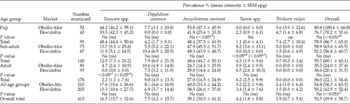
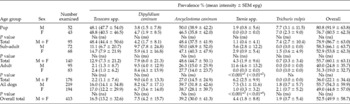
Five gastrointestinal helminth parasites, namely Toxocara spp., Dipylidium caninum, Ancylostoma caninum, Taenia spp. and Trichuris vulpis were recorded in this study (tables 1 and 2). Of the 413 dogs examined, 217 (52.5%) were infected with at least one parasite. Overall, mean faecal egg intensity was 49.9 ± 58.7 eggs/g faeces (epg).
The prevalence and intensity of intestinal helminth parasites relative to the age of dogs from markets in south-eastern Nigeria.

*1χ2 = 4.48, df = 1; *2F = 4.36, df = 1.176; *3F = 6.71, df = 1.93; *4χ2 = 5.75, df = 1; *5F = 4.98, df = 1.138; *6F = 5.66, df = 1.93; *7F = 5.79, df = 1.411.
Ns and ns, not significant.
The prevalence and intensity of intestinal helminth parasites relative to the age and gender of dogs from markets in south-eastern Nigeria.

*1χ2 = 10.24, df = 1; *2F = 10.64, df = 1.176; *3χ2 = 9.72, df = 1; *4, F = 10.2, df = 1.411. M, Male; F, female; Ns and ns, not significant.
Table 1 presents the distribution of infection in relation to dog age and market of examination. Of the 210 dogs examined at Obollo-Afor market, 115 (54.8%) were infected while 102 (50.2%) of 203 dogs examined at Ekwulobia market were infected with at least one parasite. Overall faecal egg intensity of infection was 56.7 ± 63.5 epg at Obollo-Afor and 42.9 ± 52.4 epg at Ekwulobia. Thus, while the prevalence of infection was comparable, intensity varied significantly between the markets. Within each market, both prevalence and intensity were significantly (P < 0.001) age-dependent, decreasing from peak values in the pups to lowest levels in adult dogs. Between the markets, however, prevalence and intensity of all parasites combined were age-independent, except that intensity was significantly higher (P < 0.05) among pups in Obollo-Afor (100.4 ± 66.0 epg) than among those in Ekwulobia (70.2 ± 55.6 epg). In terms of individual parasite infection patterns, A. caninum (24.7–53.8%) and Toxocara spp. (4.7–53.5%), recovered from all age groups in Obollo-Afor and Ekwulobia, were the most common infections, while T. vulpis (0.7–9.6%), which infected only the pups and sub-adult dogs, was the least common.
The age and gender distribution of prevalence and intensity showed that all five parasite species occurred in every age group, apart from the absence of Taenia spp. in female pups and adults, and Trichuris vulpis in sub-adult males, and adult male and female dogs (table 2). Overall, prevalence and intensity of infection among male and female dogs were highest in the pups and least in adults, but within each age bracket both prevalence and intensity were comparable between male and female dogs. With reference to infection patterns of parasites, prevalence and intensity of each of the parasites encountered were comparable between male and female dogs within each age bracket, except Taenia spp., which were significantly higher (P < 0.001) among male adults because infection was absent in female adults.
Single and multiple infections
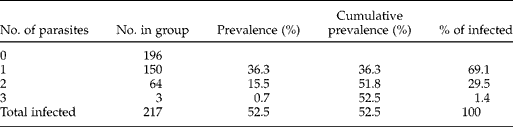
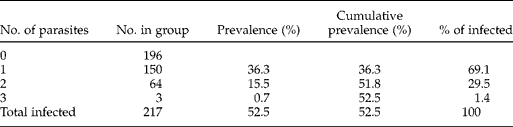
The distribution pattern of zero, single and multiple infections of the various helminth parasites is presented in table 3. Single infection accounted for 69.1% of total infections, double infection 29.5% and triple infections 1.4%. The most important single infection was A. caninum, which accounted for 102 (68.0%) of 150 single infections observed, while T. vulpis, found in only one dog (0.67%), was the least important. The rate of various double-infection combinations ranged from 48.4% (31 of 64 cases) of Toxocara spp./A. caninum to a single case (1.6%) of D. caninum/T. vulpis and Toxocara spp./Taenia spp. combinations. The three cases of triple infections obtained were Toxocara spp./D. caninum/A. caninum, Toxocara spp./A. caninum/Taenia spp. and Toxocara spp./Taenia spp./T. vulpis. Thus Toxocara was a common factor in triple-combination infections. There were no cases of combination infections involving four or five parasites. Statistical analysis revealed that distribution of multiple infections in the area did not vary significantly by age, sex or market of examination.
Patterns of multiple infections of intestinal helminth parasites from 413 stray dogs from markets in south-eastern Nigeria.
Discussion
The results of this study have revealed five common gastrointestinal parasites (namely Toxocara spp., Dipylidium caninum, Ancylostoma caninum, Taenia sp. and Trichuris vulpis) infecting dogs in Obollo-Afo and Ekwulobia markets in south-eastern Nigeria. These are zoonotic parasites and the diseases they cause are now classified by the World Health Organization (WHO, 2003) among the neglected tropical diseases (NTD) ravaging African countries including Madagascar, Mauritius, Kenya, Democratic Republic of Congo and Nigeria (Kimani, Reference Kimani2009). The comparable prevalence and intensity of the diseases in the two markets separated by over 100 km raises two vital epidemiological points. First, it suggests that the diseases and risk factors driving them are widely distributed in south-eastern Nigeria. Second, it also points to a high risk of infection in human populations since the diseases are zoonotic. According to Anene et al. (Reference Anene, Nnaji and Chime1996) this risk is exacerbated by the high rate of interaction between stray dogs and human populations in south-eastern Nigeria.
The overall prevalence of 52.5% recorded by this study suggests that every other dog seen in south-eastern Nigeria is infected with at least one gastrointestinal parasite. This rate is in agreement with previous findings falling within the prevalence ranges of 24.1–68.5% and 24.7–77.4% reported in the south-east (Anene et al., Reference Anene, Nnaji and Chime1996; Onyenwe & Ikpegbu, Reference Onyenwe and Ikpegbu2004) and south-west (Olufemi & Bobade, Reference Olufemi and Bobade1979; Sowemimo, Reference Sowemimo2007, Reference Sowemimo2009; Sowemimo & Asaolu, Reference Sowemimo and Asaolu2008), respectively. Analyses of these studies revealed prevalence and intensity of infection patterns that are three times lower in dogs surveyed at veterinary clinics than stray dogs surveyed at the community level. That is, stray dogs are three times more susceptible to infection than kennelled dogs. Sowemimo & Asaolu (Reference Sowemimo and Asaolu2008) reported that most dogs in the treatment centres were exotic breeds (mostly Alsatian) and attributed the lower than average prevalence and intensity of gastrointestinal infections among them to adequate care in terms of feeding and proper medical attention, especially regular deworming.
In contrast, most stray dogs surveyed at the community level are free-range local breeds (mainly African shepherd). They receive only limited care from their resource-limited owners, who generally are ignorant, uneducated and unable to provide the daily needs of domestic pets (Ezeokoli, Reference Ezeokoli1984; Minaar & Krecek, Reference Minaar and Krecek2001). Consequently, stray dogs are constantly exposed to risk factors of disease transmission as they roam the streets scavenging and polluting the environment with faecal matter, much of which contains infective ova or larvae of zoonotic helminth parasites. Besides, several other studies have suggested that, in addition, local-breed dogs are genetically more predisposed to gastrointestinal parasites than exotic dogs (Baba et al., Reference Baba, Ogunkoya and Ezeokoli1983; Ugochukwu & Ejimadu, Reference Ugochukwu and Ejimadu1985). These findings are clear indications of the serious public health challenges attributable to stray dogs in Nigeria and many other Third World nations where dog control laws are either non-existent or loosely enforced due to negligence by government agencies. Appropriate control laws and stricter enforcement are therefore inevitable components of any control initiatives in endemic societies. In addition, health education to raise public awareness about the dangers of untended dogs is strongly advocated.
The most prevalent gastrointestinal helminth parasites encountered in this survey were A. caninum (39.2%) and Toxocara spp. (16.5%). Ogunkoya et al. (Reference Ogunkoya, Useh and Esievo2006) and Ramirez-Barrios et al. (Reference Ramirez-Barrios, Barboza-Mena, Munoz, Angulo-Cubillan, Henandez, Gonzalez and Escalona2004) reported comparable levels in Zaria, Nigeria and Zulia, Venezuela, and emphasized the pathogenic significance of these zoonotic parasites. For instance, ancylostomiasis causes cutaneous larva migrans (CLM) or creeping eruption, dermal bumps and blisters, scabies and allergic skin rashes (Malgor et al., Reference Malgor, Oku, Gallardo and Yarzabal1996) while toxocariasis is a leading cause of visceral larva migrans (VLM), ocular larva migrans (OLM), skin rash, wheezing, chronic intestinal bleeding, abdominal pain and diarrhoea in children, and enteric fevers (Gawor et al., Reference Gawor, Borecka, Zarnowska, Marczynska and Dobosz2008). These underscore the public health implications of these infections and the need for urgent community-wide control programmes.
The observed age-dependent infection pattern is consistent with previous reports in different parts of the world, including southern Spain (Martinez-Moreno et al., Reference Martinez-Moreno, Hernandez, Lopez-Cobos, Becerra, Acosta and Martinez-Moreno2007), Turkey (Senlik et al., Reference Senlik, Cirak and Karabacak2006) and Nigeria (Ogunkoya et al., Reference Ogunkoya, Useh and Esievo2006; Sowemimo & Asaolu, Reference Sowemimo and Asaolu2008). Although this study did not investigate predisposing risk factors for age-dependent infection patterns, other studies in similar environmental settings attributed similar patterns to protective immunity and an uneven exposure to risk factors (Hagan, Reference Hagan1992).
The finding that infection patterns were both single and multiple, and that the rate of single infection is higher than either the double or triple infections, is typical of helminth infections of small animals (Panadey et al., Reference Panadey, Dakkak and Elmamoune1987; Martinez-Moreno et al., Reference Martinez-Moreno, Hernandez, Lopez-Cobos, Becerra, Acosta and Martinez-Moreno2007). Explanations for multiple infections of veterinary animals are varied. Schmidt & Roberts (Reference Schmidt and Roberts1989) suggested that two or more parasites would occur in one host only if they are not in competition or if they have divergent physiological needs. While this study did not investigate these factors, it is important to note the observed high rate of Toxocara spp./A. caninum combinations and the low rates of their separate combinations with other species. That is, what drives Toxocara spp. and A. caninum combination affinity and why are they refractory to other species? Answers to these questions are essential for adequate understanding of the epidemiology and control of these diseases.
The present study also found that while many dogs were not infected in spite of equal exposure to risk factors in the areas, most of the infected carried a moderate infection and only a few carried heavy infections. This well-known concept in parasite infra-population dispersion plays very vital roles in the design and implementation of control programmes. According to Schmidt & Roberts (Reference Schmidt and Roberts1989), parasite infra-populations are rarely randomly distributed; rather they are over-dispersed, with only a few hosts harbouring most of the infections in a community. Ofoezie (Reference Ofoezie2002) posited that selective and targeted control programmes should adopt this concept to isolate individuals carrying most infections in endemic communities. Our study, for instance, found that isolating and treating about 25% of most infected dogs in the study area at least 6 monthly (pups, expectant bitches and those with litters more frequently) for several years will reduce morbidity by over 70%. This approach is very cost effective and is strongly recommended for control programmes in Nigeria and other tropical areas currently experiencing an upsurge in zoonotic infections.