


Introduction
The mean life expectancy in developed countries is between 70 and 86 years of age, with the Japanese being the longest-lived nationality (PRB, 2006). Biologically speaking, this is rather remarkable because our bodies have a “use by date” of about 45 years. As a species, we are meant to have carried out most of our key biological functions by the time we reach 50 (reproduction, child rearing, Kirkwood and Rose, Reference Kirkwood and Rose1993). By this age our body's self-repair mechanisms become less efficient and we become more susceptible to the diseases and features associated with the ageing process (Kirkwood and Wolff, Reference Kirkwood and Wolff1995). Putting this in perspective, in Britain approximately 24.4 million people (40.5% population, www.statistics.gov.uk) are living beyond their life-time warranties of 45 years. Thus, from a biological perspective, it may appear that therapists working with older adults are treating the “frail and the befuddled”. However, this is far from the case, with the “well-being paradox” demonstrating that personal satisfaction increases with age (Staudinger, Reference Staudinger2000; Diener, Suh, Lucas and Smith, Reference Diener, Suh, Lucas and Smith1999). Diener et al. suggest that maintenance of well-being demonstrates the ability of many older people to adapt positively to a whole range of conditions (loss, ill-health). Despite these general levels of personal satisfaction, as a society we tend to view old age negatively (Harper, Reference Harper, Jacoby, Oppenheimer, Dening and Thomas2008). It is often seen as a period of decline across a range of physical, intellectual and social domains. “Old age” is a relatively new phenomenon – up until the 18th century we did not have the notion of an ageing society because the majority of people did not live beyond 50 years of age. Hence, an ageing society is a modern phenomenon that we are struggling to deal with (Harper, Reference Harper, Jacoby, Oppenheimer, Dening and Thomas2008). The UK government has finally acknowledged the tensions created by having an ageing society, and responded by appointing a Parliamentary Under Secretary of State for Care Services (Ivan Lewis, MP). His job is to help coordinate the health, social, and financial needs of older people and their carers. This paper will focus on the health care aspect of Lewis's remit, and particularly on mental health.
Therapy adaptations for older people
A number of texts have been written on how to adapt therapies for older people (Dick, Gallagher-Thompson and Thompson, Reference Dick, Gallagher-Thompson, Thompson and Woods1996; Glantz, Reference Glantz, Freeman, Beutler and Arkowitz1989; Zalaquett and Stens, Reference Zalaquett and Stens2006; Zarit and Knight, Reference Zarit and Knight1996). Such guides generally suggest using slower paced approaches, shorter sessions, a more concrete communication style, repeated presentation of key materials/concepts. They also often advise that therapists should employ strategies to support people's sensory impairment and memory deficits (tape recordings, bibliotherapy, cue cards and pictures), and encourage the assistance of families and advocates in the treatment programmes (Teri and Gallagher-Thompson, Reference Teri and Gallagher-Thompson1991). Laidlaw, Thompson, Dick-Siskin and Gallagher-Thompson (Reference Laidlaw, Thompson, Dick-Siskin and Gallagher-Thompson2003) stress the importance of spending time socializing the patient into the therapeutic model, and consider it helpful to use an educative approach initially.
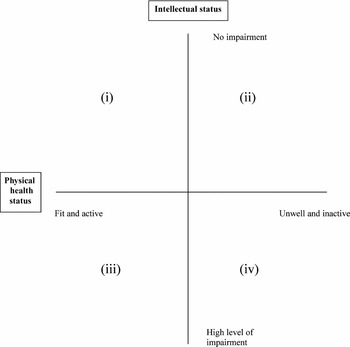
Despite broadly acknowledging the helpfulness of some of these suggestions, care must be taken not to over-generalize their relevance, because of the heterogeneity within this group. The group is composed of a number of different cohorts, within an age range of 65 to 100+. To stop ourselves from becoming too generic in our advice about adapting therapies, a simple framework is provided to capture some of the diversity in the population (see Figure 1). Figure 1 provides a representation of older people's status via two intersecting continua, and is used below to provide more specific guidance regarding therapeutic requirements.
Framework for clarifying patients’ overall health status

The “physical health” dimension describes a person's status along a continuum of fitness and health. The “intellectual” dimension describes a person's cognitive status. This line is closely linked with age, because many of the dementia and vascular problems are associated with the ageing brain. Through the dimensions described in Figure 1, it is possible to provide specific advice about how to work with the patients populating each quadrant. It is relevant to note that patients can move between the quadrants rapidly, as physical illness can impact on intellectual status (e.g. delirium) and vice versa. It is also worth noting that the therapeutic goals sought for the various populations will differ between quadrants. For example, for some people the goals will be to receive relief from their depression, while others may require the teaching of mnemonic strategies to help them remember to take their medication.
The quadrants
The patients occupying the top left quadrant require little adaptation from standard treatments. This is the group that have generally been well researched in the psychotherapy literature (Hepple, Wilkinson and Pearce, Reference Hepple, Wilkinson, Pearce, Hepple, Pearce and Wilkinson2002; Kneebone, Reference Kneebone2006; Mackin and Arean, Reference Mackin and Arean2005; Scogin, Welsh, Hamson, Stump and Coates, Reference Scogin, Welsh, Hamson, Stump and Coates2005). Evidence suggests that this population can not only benefit from psychotherapy (Hartman-Stein, Reference Hartman-Stein2005; Pinquart and Sorensen, Reference Pinquart and Sorensen2001; Zalaquett and Stens, Reference Zalaquett and Stens2006), but in some situations may show better outcomes than their younger counterparts (Walker and Clarke, Reference Walker and Clarke2001). The reasons for such positive findings are complex, but it is clear that those older people experiencing non-chronic mental health conditions often demonstrate effective coping strategies, particularly those that have shown resilience in the past. With specific relevance to the treatment of depression of patients in this quadrant, the systematic reviews (Mackin and Arean, Reference Mackin and Arean2005; Scogin et al., Reference Scogin, Welsh, Hamson, Stump and Coates2005; Zalaquett and Stens, Reference Zalaquett and Stens2006) advocate using a stepped-care approach, suggesting that the brief and simpler treatments should be offered prior to any of the more intensive and invasive approaches in cases of mild to moderate depression. Thus for mild to moderate depression, self-help programmes, problem-solving/brief therapies, reminiscence and life review therapies are suggested (Bohlmeijer, Smit and Cuipers, Reference Bohlmeijer, Smit and Cuipers2003). For the more severe presentations, CBT, interpersonal therapy (IPT; Hinrichsen and Clougherty, Reference Hinrichsen and Clougherty2006) and family and group therapies (Qualls, Reference Qualls1999) are recommended, usually in conjunction with the appropriate pharmacological treatments. Psychodynamic therapy (Garner, Reference Garner, Jacoby, Oppenheimer, Dening and Thomas2008) is suggested for the complex comorbid conditions that may present along with the depression.
The top right square is made up of diverse groups of people, many with multiple diseases and disorders (cancer, arthritis, mild stroke). The nature of the therapeutic adaptations will depend on the physical difficulties being experienced, and these difficulties need to be factored into one's formulation. In many cases the therapeutic work involves treating the anxieties stemming from fears associated with the conditions (Wilkinson, Reference Wilkinson, Jacoby, Oppenheimer, Dening and Thomas2008). This work typically involves distinguishing the anxiety component from the physical symptoms, acknowledging the roles that fears are playing (e.g. physiological arousal, anticipatory fear, safety seeking behaviours, avoidance). Then via education, behaviour experimentation, de-catastrophization techniques and thought re-evaluation methods, the person is helped to tackle the affective component of her difficulties. Examples of such approaches are seen in the literature on stroke (Lincoln and Flannaghan, Reference Lincoln and Flannaghan2003) and cancer care (Moorey and Greer, Reference Moorey and Greer2002) and conditions such as Parkinson's disease (Cole and Vaughan, Reference Cole and Vaughan2005).
The two bottom quadrants consist of people with moderate to severe dementia. A great deal of literature has been written on how to improve the well-being of these patients but, as NICE (2006) Guidelines and Cochrane Reports inform us (James and Fossey, Reference James, Fossey and Jacoby2008), the evidence base for many of the treatments is poor.
The patients populating the bottom left hand quadrant have cognitive impairment, but remain relatively fit and active. There are a number of empirical studies demonstrating the use of psychotherapy for affective disorders with this group (Heason, Reference Heason2005), but many of the papers use case study formats (Bird, Alexopoulos and Adamowicz, Reference Bird, Alexopoulos and Adamowicz1995). Hence, the evidence base remains largely at the anecdotal level. In this quadrant one also sees patients displaying challenging behaviours (aggression, disinhibition, vocalizing, agitation, smearing, repetitive behaviours). Over recent years a number of effective formulation-led approaches have been used with these presentations (CBT – Fossey et al., Reference Fossey, Ballard, Juszczak, James, Alder, Jacoby and Howard2006; Teri and Gallagher-Thompson, Reference Teri and Gallagher-Thompson1991; Wood-Mitchell, Mackenzie, Stephenson and James, Reference Wood-Mitchell, Mackenzie, Stephenson and James2007; Behavioural – Cohen-Mansfield, Werner, Culpepper and Barkley, Reference Cohen-Mansfield, Werner, Culpepper and Barkley1997; Spira and Edelstein, Reference Spira and Edelstein2006). In developing treatments with these patients, although one is using formulations to understand the problematic behaviours and emotions, the actual interventions used are often simple behavioural and environmental manipulations. The agents of change in this work are frequently the carers and staff, and thus much of the therapeutic work is done with them (i.e. changing staff attitudes and belief systems, using modelling and role play techniques to reinforce effective staff-patient interactions - Beck, Ortigara, Mercer and Shue, Reference Beck, Ortigara, Mercer and Shue1999; Moniz-Cook et al., Reference Moniz-Cook, Agar, Silver, Woods, Wang, Elston and Win1998).
At the less severe end of the 4th quadrant (iv) are those who are frail, have a moderate dementia and are living at home. They may be maintained at home by home-care services and/or telecare services that can support them to live independently (Orpwood and Chadd, Reference Orpwood and Chadd2007). With advances in computing and telecommunications, patients can be monitored, their safety maintained, and medication dispensed via an internet link. Thus patients can be assisted to stay in their homes for as long as possible. The internet can also be used to deliver cognitive stimulation therapy (CST) packages. CST is a therapy consisting of intellectual games designed to slow down cognitive deterioration (Spector et al., Reference Spector, Thorgrimsen, Woods, Royan, Davies, Butterworth and Orrell2003). In the UK, those in the very bottom right hand corner of the figure are often receiving care in Elderly Severely Mentally Ill settings, either in the NHS or increasingly within the private sector. Standard forms of psychotherapeutic work for this group are often limited (reality orientation, reminiscence, validation therapy, Livingston, Johnston, Katona, Paton and Lyketsos, Reference Livingston, Johnston, Katona, Paton and Lyketsos2005; James and Fossey, Reference James, Fossey and Jacoby2008; Verkaik, van Weert and Francke, Reference Verkaik, van Weert and Francke2005), and in some situations may be restricted to the use of activities (music, sensory stimulation, aromatherapy, Ballard, O'Brien, Reichelt and Perry, Reference Ballard, O'Brien, Reichelt and Perry2002) in order to provide stimulation and to relieve boredom.
What we can learn from working with older adults
Having described the interplay of physical and cognitive health in older adult patient groups, the second half of the paper examines the use of standard psychotherapeutic practices. In this section, details are presented of the author's experiences of working with the elderly to see how these experiences can help inform the treatment of younger populations. Two areas are addressed: (i) therapeutic competence, particularly in the face of cognitive deficits, and (ii) core belief work. In relation to competence, it is argued that the information processing difficulties apparent in people with affective disorders mirror closely the deficits observed in those with mild/moderate cognitive impairment (James, Reichelt, Carlsonn and McAnaney, Reference James, Reichelt, Carlsonn and McAnaney2008). Therefore adaptations for the latter are also relevant to the treatment of depression and anxiety in working age adults. In the subsequent section, the concept of core beliefs is explored, suggesting that core beliefs should not be exclusively viewed as the products of childhood, nor should they always be seen as dysfunctional.
Therapeutic competence, and overcoming cognitive deficits
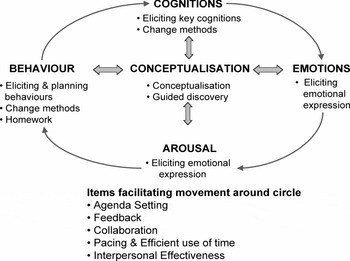
In a previous role, the present author was involved in the development of competence scales for assessing the delivery of cognitive behaviour therapy. The product of this work was the Cognitive Therapy Scale – Revised (CTS-R; Blackburn, James, Milne and Reichelt, Reference Blackburn, James, Milne and Reichelt2001). The CTS-R provides therapists with comprehensive feedback on how well they are performing the structural and process features of CBT. As designers of the scale we were mindful of the common information processing deficits experienced by people with affective disorders, and thus developed items within the scale that addressed the attentional, concentration, memory, and executive problems as well as interpersonal features. The items of the scale are presented in Figure 2, which also outlines the conceptual model underpinning the CTS-R.
The relationship between the CTS-R items and the Cognitive Cycle, with the process/generic items below the cycle

The items that form the circle represent the familiar “hot-cross bun” conceptualization. All of these items need to be addressed when performing CBT, and thus they may be regarded as CBT specific features. Note that the conceptualization item, at the centre of the cycle, helps integrate the therapy, providing coherence. The non-specific items may be regarded as process items ensuring that the therapy flows smoothly; these are described as generic features. A detailed description of all the items is provided in the CTS-R manual (James, Blackburn and Reichelt, Reference James, Blackburn and Reichelt2001).
Since its development, this scale has been used in the teaching of trainee therapists working with many patients - young and old, with and without cognitive impairment. Over time, raters of the scale noted that they often gave similar advice to their trainees after watching video recordings of the therapy, irrespective of whether the trainees’ patients had presented with cognitive impairment or not. This was particularly true with respect to the process/generic features of the CTS-R. For example, typically raters noted that inexperienced therapists failed to provide sufficient structure and feedback for their patients and frequently outpaced them. Indeed, it was evident that often the patients were observed to be struggling to keep pace with the content of the sessions, and were reacting rather than truly engaging in teamwork. Initially, the similarities in the errors made by the trainees with respect to the patient groups seemed rather surprising. Yet, on consideration, it became apparent that the reason for similar issues arising was a reflection that patients with severe depression and anxiety present with cognitive deficits comparable to those seen in cases of dementia. This view has been confirmed in a number of studies that have shown that those experiencing severe depression have similar intellectual profiles to those with moderate dementia (Braff and Beck, Reference Braff and Beck1974; Cassens, Wolfe and Zola, Reference Cassens, Wolfe and Zola1990). Both groups of patients suffer from memory and frontal lobe deficits, with difficulties in problem solving and sustaining attention.
With this in mind, a list of therapeutic strategies is presented below to be employed when working with older people with cognitive deficits (e.g. poor attention and concentration), resulting from the presence of either an affective disorder or a dementia. Thus many of the strategies outlined have relevance to those working with patients with severe affective disorders, irrespective of their age.
Poor concentration and attention. This difficulty can be ameliorated by reducing the complexity of the therapeutic material, shortening sessions, and only covering a few topics within a session. It is also important to use feedback often, and to frequently check the patient's understanding of the material covered. The session should be paced according to the patient's needs, with the use of therapeutic breaks as appropriate.
Poor memory. The therapist should ensure that information is provided in a paced manner in order to prevent overloading of the patient's working memory and executive functioning (i.e. limited information processing capacity). Further, any novel information needs repeating often to help consolidate material and facilitate encoding. It is also important to support the patient to recall positive events and coping strategies from the past, owing to the affective memory biases making them less accessible.
Poor problem solving. To lessen the impact of this deficit it is advisable to reduce problems into component parts in order to simplify them. Indeed, until the patient can engage in a more collaborative approach, she may need a great deal of guidance. Once a potential solution to the problem has been devised it is advisable to operationalize the goal into a behavioural experiment, as this often serves to re-energize problem solving skills.
Slowed information processing speed. The therapy must be structured and sequenced well, making good use of agenda and goal-setting techniques. When information is sought, it will need to be scaffolded to increase the patient's chance of responding appropriately. Scaffolding involves providing contextual information to help cue an appropriate response (James, Milne and Morse, Reference James, Milne and Morse2008). For example, when asking the patient about her relationship with her deceased father, the therapist would ask a number of questions to aid recall and cue the patient to recall the period of time for which information was sought (e.g. either about their relationship during her childhood, or her later role as his carer).
Guilt. Depressive processing is likely to be biased towards negative retrieval, and may also lead to dysfunctional re-interpretations of past events. For example, a woman might be critical of herself for divorcing her husband, and fail to acknowledge the extent of her former husband's abuse occurring at the time. Hence it is important to assist older people's memories by re-contextualizing events from the past. It is relevant to note that the broader issue of guilt and its relationship to shame is discussed more fully in Gilbert (Reference Gilbert2005).
Physical health issues. A decline in physical health is a common feature of old age. Many people, including medical professionals, directly associate low affect with a physical cause. Such views often lead to difficulties in socializing patients to conceptualizations that involve a psychological perspective (Gatz et al., Reference Gatz, Fiske, Fox, Kaskie, Kasi-Godley, McCallum and Loebach Wetherell1998). Conceptual models from physical health can be helpful in assisting the patient to appreciate that psychological interpretations may play some role in the depression, even if only in a maintenance role (Mayou, Bass and Sharpe, Reference Mayou, Bass and Sharpe1995).
Interpersonal difficulties. Life transitions (retirement, taking on a carer role), ill health and deaths of significant others may disrupt the person's interpersonal life. In addition, sensory difficulties (hearing, sight) and mobility problems may prevent the patient from utilising support networks (Hinrichsen and Clougherty, Reference Hinrichsen and Clougherty2006). It is important to assess the potential impact of these factors, and to problem-solve possible solutions. Therapists need to be aware of potential transference issues (therapist perceived as surrogate son). If evident, such issues need to be addressed in therapy rather than avoided.
Over-elaborated conceptualizations. Due to older people's long histories, it is often tempting to undertake grand assessments of the person's past. This can be problematic, particularly if such data are unlikely to be used in the intervention (Charlesworth and Reichelt, Reference Charlesworth and Reichelt2004). For example, if the intervention is likely to be a “surface” behavioural strategy, a detailed assessment may be inappropriate and perhaps unethical. The therapist also needs to always take care to include only the details he requires when constructing the conceptualization. “Kitchen-sink” formulations should certainly be avoided (i.e. conceptualizations that are over-inclusive). Indeed, if the formulation becomes too comprehensive, it is likely to prove unwieldy and one may not be able to socialize the patient to the model. Where appropriate, one should develop positive formulations, highlighting patients’ strengths and abilities (child rearing skills, jobs – James, Kendell and Reichelt, Reference James, Kendell and Reichelt1999). This is in contrast to the diathesis-stress model (i.e. d-s model – the notion of an underlying belief formed in childhood that lies dormant as a memory until activated by a salient trigger), which stresses the role of dysfunctional core beliefs and thus can be perceived negatively by the patient.
In summary, adaptations adopted to accommodate information processing deficits, due to mild cognitive impairment apparent in the elderly, can be equally relevant to psychotherapy for younger populations presenting with affective disorders.
Core belief work
In addition to the information processing perspective presented above, working with older adults has informed my view on the nature of core beliefs, and their super-ordinate concept of the “schema” (James, Reference James2003; James, Reichelt, Freeston and Barton, Reference James, Reichelt, Freeston and Barton2007). In terms of the notion of the core belief, it is argued that we often spend too much time focusing on beliefs formed in early childhood. Indeed, it seems self-evident that people's “sense of self” changes over time, and thus what is considered to be core and fundamental also alters (see Erikson's stages of development, Reference Erikson1975). This perspective suggests that core beliefs can be formed throughout the person's life. So if the person lives into old age, she will have developed - and subsequently disregarded - a number of beliefs that have influenced her greatly in the past. Clearly, there will be some cases were people will have been so traumatized by their early years that they will be influenced by these events throughout their lives (e.g. people with personality disorders), but for many people this is not the case. It is relevant to note, if we dispute the notion that the core beliefs formed in childhood are pre-eminent, it follows that we must also doubt the validity of the d-s model. A critical review of the d-s model, in terms of its validity, ethical stance and negative bias, is provided by James et al. (Reference James, Kendell and Reichelt1999).
Reconceptualization of schema
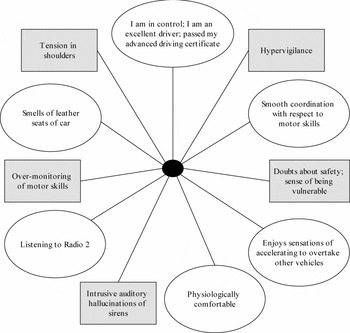
Finally, working with the elderly has helped therapists specializing in the area to appreciate the nature of core beliefs and the fact that they can be distinguished from schemas (James et al., Reference James, Reichelt, Freeston and Barton2007). In this perspective, schemas are viewed as a group of conscious and unconscious memories that are united and stored together, recording a function or an experience from the past. This view is consistent with the original notion of schema in the psychological literature expounded in the 1930s by Bartlett (Reference Bartlett1932). For example, once someone has learned to drive a car, the various components of the driving skill fuse together to provide the ability to drive (coordinated control of wheel, clutch and brake). The various sub-skills used in driving (hand, foot, eye and head movement coordination) are the elements of the schema. These are then stored in memory as a unit, as clearly we do not need to learn to drive every time we use a car. Thus when we get into a car, the experience is triggered and the schema is activated again, allowing us to drive efficiently without too much conscious monitoring. Now in addition to the physical skills of driving, people will have other sensory experiences associated with their driving. Some people may feel powerful behind the wheel, others may experience bodily tension (Figure 3). However, this stored representation may change. For example, if someone experiences a road traffic accident (RTA), they may start to associate anxiety, a sense of pain, recollection of sirens, with their existing driving schema. In some circumstances the anxiety and other sensory features may become intimately associated with the driving schema, leading to a chronic fear of driving. As one can see in Figure 3, an updated stored representation of driving is now associated with panic and fear.
Schemas associated with driving pre and post RTA. The circles represent the original driving schema. Since the RTA, new features – represented in the boxes – are triggered when the person gets behind the ‘wheel of the car’. The anxiety related features now dominate the memory representation associated with driving, producing PTSD

Using this broader multi-sensory definition, one would suggest that treatment for the RTA should address all aspects of the memory/schema within the therapy (NATS, sensory features, sounds, smells) not merely the cognitive elements. Thus one might deal with the siren by playing soothing music to the person while she is driving, using imagery work to disrupt visual aspects of the memory. Indeed, the goal of therapy would be to disrupt the “new” representation and revise it in such a way that the driving schema no longer has fearful components associated with it. Some of the components that need to be disrupted are cognitive, but others are sensory features of other domains (auditory, visual, olfactory). Hence by addressing the schema in such a comprehensive way, triggering the traumatic memory will be less likely, thus providing better relapse prevention and outcomes. Over recent years the relevance of this retro-perspective perspective of schema has been outlined in relation to depression and treatment of personality disorder (James, Reference James2003).
Conclusion
This paper stressed the importance of appropriate adaptations to therapy by clearly defining the nature of the problem, rather than assuming a cohesive older adult population. To this end, a simple two dimensional model was provided to help specify presentations and treatment approaches. This paper further suggested that features routinely explored by those specializing in older adult work (e.g. information processing processes and biases), are relevant to younger people's conceptualizations. For example, in the current paper the information processing deficits apparent in depression are equated to those observed in dementia. Thus while most therapists would consciously adapt their approaches if confronted with someone with dementia (using a slow considered pace, lots of repetition, shorter sessions), it is questionable whether they would do so to the same extent for someone with depression. Hence it was argued that treatment of affective disorders in working age adults can benefit from utilising adaptations usually employed with older adults. The final section of the paper reviewed the notion of schema. Owing to recent work on the concept from an elderly perspective (James et al., Reference James, Reichelt, Freeston and Barton2007, James, Reference James, Laidlaw and Knight2008), a major reconceptualisation of the concept was suggested which has implications for therapy in general.



Comments
No Comments have been published for this article.