Introduction
The notion of “national monument” in the Ottoman Empire emerged at the turn of the twentieth century, and coincides with the rise of nationalist consciousness. The appropriation of the Ottoman Empire’s own past as heritage was instrumental in the production of an Ottoman national identity, through the reframing of Islam, and Islamic monuments and artifacts, as an attribute of the Ottoman nation.Footnote 1 The Commission for the Preservation of Antiquities was established in 1917 as a supervisory body for the preservation of antiquities in the imperial capital, İstanbul.Footnote 2 After the foundation of the Turkish Republic, the nascent republic represented itself as a new nation-state rather than the continuation of the Ottoman Empire, detaching itself from its imperial and religious past. Consequently, Ottoman heritage was reintegrated into the nationalist narrative as documents of Turkish culture, devoid of not only their Islamic, but also any multi-religious or multiethnic connotations.Footnote 3 The Republican authorities kept the Commission for the Preservation of Antiquities to perform its duty as a supervisory body responsible for the preservation of monuments in İstanbul.Footnote 4 Although the capital was moved to Ankara, İstanbul sustained its privileged status as the former capital of the Ottoman Empire, at least as far as Turkish preservation policies were concerned. Championed by the Preservation Commission, the preservation works initiated around the 1940s for the 500th anniversary celebrations of Constantinople’s Ottoman conquest for 1953 proved to be a convenient framework for the reconceptualization of Ottoman monuments as Republican national monuments.
While the celebrations had only been embraced by relatively few religious groups after the quincentenary anniversary in 1953, they have become a political manifestation of Islamic hegemony in recent years. After the Justice and Development Party came to power in 2002, the government adopted neo-Ottomanist urban policies highlighting mainly the Ottoman period of the city. Hoping to stimulate nostalgia for a “glorious” Ottoman past,Footnote 5 neo-Ottomanist urban policies aimed to create an idealized Ottoman identity for the city through not only restorations, but also the celebration of the Ottoman conquest of Constantinople. Unlike the quincentenary anniversary, however, more recent celebrations have had an Islamic turn, narrating the Islamic importance of the conquest as Muhammed’s prophecy.Footnote 6 At present, the celebrations begin with a public performance of a “conquest prayer” during the early hours of the anniversary in front of the Hagia Sophia Museum—regarded as the symbol of the conquest—calling for its opening as a functioning mosque. In this way, the memory of the Ottoman conquest has become the lived reality of the present and a useful tool for the construction of an Ottoman-Islamic identity for the city.Footnote 7 Manifesting the struggle for ascendancy among neo-Ottomanist and Republican ideologies, the Ottoman conquest of Constantinople has become part of the present-day politics in Turkey.Footnote 8
The paper first introduces the Commission for the Preservation of Antiquities, and its role in the institutionalization of historic preservation. The second part concentrates on how the imperial and religious connotations of Ottoman heritage were remembered and reframed as national monuments in relation to the Ottoman conquest during the preparations for the quincentenary anniversary of Constantinople’s conquest. By highlighting the conflicts, contestations, and negotiations of the Preservation Commission with various actors, the paper discusses how approaches to İstanbul’s diverse heritage are manifestations of changing conceptualizations of national identity.
Commission for the Preservation of Antiquities: its formation and role during the late Ottoman and early Republican periods
The Ottoman Empire’s acknowledgment of its own architectural past as historic monuments has its origins in the search for a binding identity for the multi-religious and multiethnic fabric of the empire, under the umbrella of Ottomanism,Footnote 9 to attain an ideal of equality and unity of its citizens parallel to the Tanzimat reforms.Footnote 10 Ahmet Ersoy evaluates the “Fundamentals of Ottoman Architecture” (“Usul-u Mimari-i Osmani”), published for the 1873 Vienna Exposition, in this context. Considered as the earliest publication on art history in the empire, Ersoy links this attempt to the representation of the notion of a shared Ottoman identity, by expressing a collective vision of Ottoman history and architecture.Footnote 11 This shared notion of Ottoman identity, however, did not last long. The more democratic spirit of late Tanzimat was interrupted after Sultan Abdulhamid II reinstated his authority and foregrounded Islamism as the new binding identity for the empire.Footnote 12 It was in this context that the last antiquities regulation of the Ottoman Empire was enacted in 1906, recognizing Islamic artifacts and buildings that were part of Ottoman urban life as antiquities for the first time.Footnote 13 This regulation defined antiquities as “artistic, scientific, literary and religious products of any civilization that had formerly inhabited Ottoman territories.”Footnote 14 While the recognition of the concept of “monument” and “antiquity” that was part of the Ottoman urban life can be interpreted as an attempt to institutionalize the preservation of historic monuments, the regulation did not clearly define a mechanism for this task.Footnote 15
Following the 1908 Young Turk Revolution, the Committee of Union and Progress—the political party of the Young Turks—began to dominate the political sphere. As the way of holding the Ottoman Empire together, the Committee emphasized the notion of a Turkish nation merged with Islam, replacing the discourse of shared Ottoman identity.Footnote 16 The abundance of “Turkishness” in public discourse by the Committee of Union and Progress influenced the architectural practice with the adoption of Ottoman Revivalism as a rather uniform national style, and a growing interest in Islamic monuments as symbols of a shared Turkish identity.Footnote 17 The Ministry of Imperial Foundation (Evkaf Nezareti) was critical in not only disseminating the national style as a centralized government institution but also in the restoration of historic monuments defined by 1906 Antiquities Regulation.Footnote 18
Along with the rise of nationalist discourse, the search into the origins and collective history of Ottoman architecture eventually led to the notion of a “national monument” in the Ottoman Empire at the turn of the twentieth century. The way in which Islamic monuments were now recognized as expressions of Turkish civilization can be seen in a contemporaneous article of Kemaleddin Bey, a well-known Ottoman Revivalist architect who was appointed as the head of the Construction and Repairs Department of the Ministry of Imperial Foundations (Evkaf Nezareti İnşaat ve Tamirat Heyet-i Fenniyesi) in 1909:
They are established as historical evidence and the immortal imprints of Turkish civilization … They are of crucial importance and sacred to the nation … Efforts to protect these works, the required permanent work, will allow us to establish the antiquity of our nation and our existence as a civilization.Footnote 19
While Islamic monuments had already been recognized as antiquities by the 1906 regulation, a legal framework for their preservation could only be achieved with the enactment of the Regulation for the Preservation of Monuments (Muhafaza-i Abidat Hakkında Nizamname) in 1912. The regulation recognized any historic “place or work” regardless of their period as antiquities, in accordance with the 1906 regulation. Although it clearly declared that monuments could not be destroyed or vandalized on any grounds, the regulation also stated that if demolishment was necessary, it should first be examined by a commission of experts.Footnote 20 In order to execute this regulation, the Imperial Museum Directorate decided to establish a commission for İstanbul. The Commission for the Preservation of Antiquities was formed in 1917 and was responsible for the implementation of the 1912 Preservation Regulation, the inventory and registration of historic monuments, and the supervision of restoration works in İstanbul.Footnote 21 In the early years of its establishment, the commission was mainly occupied with the registration of historic monuments, especially during urban regularizations and road improvements.Footnote 22
The early decades of the Turkish Republic was a period during which the discourse of “Turkishness” was widely adopted for the homogenization of the multiethnic and multi-religious Ottoman past and for the construction of a collective national identity.Footnote 23 Sibel Bozdoğan describes this as a paradigm shift since it reframed Ottoman architecture by establishing a Turkic genealogy distinguishing it from Byzantine as well as other kinds of Islamic architecture.Footnote 24 There were also attempts by the Ministry of Culture to reappropriate past civilizations as imprints of Turkish culture, portraying the Hittite, Roman, Byzantine, or Ottoman past as different periods of Turkish history.Footnote 25 Hence, unlike the Ottoman conceptualization of the national monument as belonging to the recent past, the Republican conceptualization broadened this timeframe considerably in a manner to appropriate pre-Ottoman past as part of the national past.
For İstanbul, the Republican authorities decided that the Preservation Commission should continue as a supervisory commission within the body of İstanbul Antiquities Museum for any intervention conducted by public authorities or individuals related to historic monuments or antiquities in İstanbul. The commission was also responsible for the inventory and registration of the antiquities and artifacts mentioned in the 1906 Antiquities Regulation, effective until 1973, as well as historic places in İstanbul.Footnote 26 Accordingly, the city, while no longer the capital, acquired a rather “privileged status” due to the scale and plurality of historic monuments it housed.
In the early years of the republic, the Preservation Commission initiated a city-wide inventory and registration of historic monuments to provide a basis for the İstanbul masterplan, initiated in 1936 by the French architect and urbanist Henri Prost. By 1941, the commission had listed 797 monuments, giving priority to those proposed by Prost along the main arteries (Figure 1). The commission categorized historic monuments into seven groups: mosques, madrasas, fountains, tombs, khans, baths, and Byzantine monuments.Footnote 27
Inventory sheet of the Column of Arcadius, 1936 (Commission for the Preservation of Antiquities Archive (CPOAA))

The 1940s was an important turning point for historic preservation in İstanbul and for the appropriation of its historic monuments as “national heritage.”Footnote 28 Inspired by the earlier celebrations organized by the Committee of Union and Progress, the Turkish authorities decided to celebrate the quincentenary anniversary of İstanbul’s Ottoman conquest for 1953.Footnote 29 The preparations for the celebrations, starting in 1939, quickly brought the Ottoman conquest to the forefront of the public imagination and dominated the way in which national identity was strengthened through historic monuments. While the Ottoman past was regarded as another historical period of Turkish civilization, distant in the collective memory of the citizens, from the 1940s onwards this imperial and Islamic past became integrated with the nationalist present.Footnote 30 This integration was part of a larger shift in politics, marking a departure from the foundational ideology of the Republic of Turkey. The rise of Turkish nationalism, in strong association with Islam in the context of World War II, coincided with the rise of the conservative Democrat Party.Footnote 31 The Democrat Party’s domination of politics from 1950 onwards, when it came to power, resulted in the continuation of the nationalist discourse.Footnote 32
İstanbul was the hot spot of conservation debates, providing an important milieu with its iconic monuments from the late-Roman, Byzantine, and Ottoman periods. Considering the scale and range of historic monuments and sites, it had been and still is one of the most intense points of interaction and friction between local and central actors in Turkey as well as international policymakers. The following section discusses the role of the Preservation Commission in the appropriation of İstanbul’s multifaceted heritage as national heritage by pointing out its exchanges, contestations, and negotiations between myriad actors and institutions, all of which had tried to assert their own mindsets, centered around the preparations for the 500th anniversary of the Ottoman conquest of Constantinople.
The 500th anniversary of the Ottoman conquest of Constantinople as a framework for the reconceptualization of national monuments
At the beginning of the 1940s, several state institutions, including the Ministry of Education and the Turkish Historical Society, began to discuss how to celebrate the quincentenary anniversary, which was supported by the then President İsmet İnönü.Footnote 33 While the Turkish Historical Society established a special board, soon a national committee, including representatives from the Ministry of Education and İstanbul Municipality, was established under the chairpersonship of Minister of Education Hasan Ali Yücel.Footnote 34 The committee anticipated conferences and publications on İstanbul and Mehmed the Conqueror, an international İstanbul Exhibition, and even applied to host the 1952 Olympic Games in İstanbul.Footnote 35
Based on this general vision, the İstanbul Municipality put great emphasis on urban development of the city for 1953. Henri Prost, who had already prepared the master plan for İstanbul, began to work on a ten-year urban development plan to integrate the proposals of the committee.Footnote 36 Prost suggested the rearrangement of the Bayrampaşa district outside the Byzantine land walls as an Olympic park. He also designed an “International Exposition” area for 1953, comprising an open-air exhibition of fine arts and small industries, emulating nineteenth-century international exhibitions. The location for this exhibition was identified as Yenikapı region, the southern section of the historic peninsula.Footnote 37 The plan proposed the erection of Mehmed II’s statue commemorating the conquest at the intersection of two new arteries dividing the peninsula, in front of the new Municipality Building. Prost suggested the rearrangement of Sultanahmet Square as the Republican Square with the erection of a Republican statue.Footnote 38
In 1941, Hamit Zübeyir Koşay, the director of antiquities and museums, organized a meeting with the Preservation Commission to discuss restoration projects to be conducted within the scope of the celebrations. Koşay’s suggestions included the erection of the statue of Mehmed II in Topkapı region where he first entered Constantinople, the refurbishment of the fifteenth-century Tiled Pavilion as Fatih (as the Mehmed the Conqueror is called in Turkish) Museum, and research into historic monuments from the era of Mehmed II for publication.Footnote 39
After this meeting, the Preservation Commission prepared their own detailed program of studies as part of the quincentenary anniversary celebrations in 1941. This program involved an inventory and restoration program for all historic monuments associated with Mehmed II. The commission anticipated the restoration of the Topkapı Palace Complex and the surrounding Imperial Walls (Sur-u Sultani), Fatih Mosque Complex, Yedikule Fortress, and Rumelian Castle (outside the historic peninsula), as well as the mosques, fountains, and burial areas from the reign of Sultan Mehmed II. Along with designating the most suitable site for Mehmed II’s statue within the Topkapı region, the Preservation Commission suggested researching the route where he had said to have carried his ships over land on sleds so that this route could be incorporated into the celebrations. The commission also suggested identifying and accentuating the buildings of the Topkapı Palace Complex dating from Mehmed II’s reign.Footnote 40 For the Tiled Pavilion, the commission required a thorough research before taking any decision or action, since it was the first building of the Imperial Museum, officially opened in 1880.Footnote 41 According to Efdalettin Tekiner, a member of the Preservation Commission, returning the building to the time of Mehmed II by transferring the objects on display would be criticized by museologists.Footnote 42
The Preservation Commission sought advice from Ahmet Hamit Ongunsu, the then dean of İstanbul University’s Faculty of Letters, about the anniversary program. Along with establishing an archive documenting İstanbul’s history, the main topic was the restoration of historic monuments. According to Ongunsu, the restoration works were to be regarded as a “nationwide duty” since İstanbul was the “most significant national masterpiece of the Turks.”Footnote 43 Consequently, the focus of the inventory works of the Preservation Commission shifted mainly to historic monuments from Mehmed II’s reign. By 1949, the commission had finalized a detailed inventory of both surviving and demolished monuments constructed during the reign of Mehmed II as well as the reused Byzantine monuments.Footnote 44 Priority was given to the restoration of monuments associated with Mehmed II.
Preparing Topkapı Palace complex for celebrations
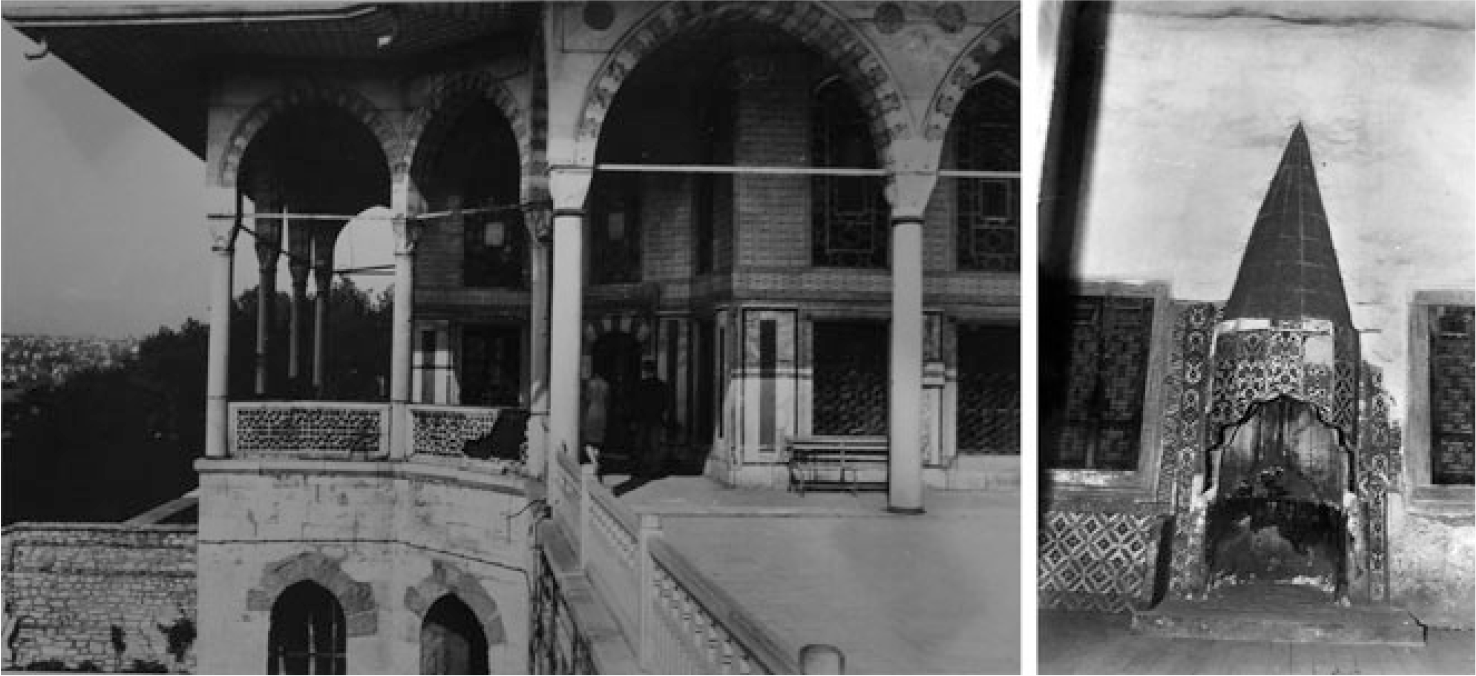
Regarded as the most significant piece of civic architecture under Mehmed II, Topkapı Palace was the main focus of restoration works for the celebrations.Footnote 45 Although the palace was opened to the public as a museum as early as 1924, substantial restoration works could only begin in 1939. In line with the spirit of the celebrations, the aim of these works was “to recover the palace of Mehmed the Conqueror and saving it from additions stuck on during the period of decline” as noted by the museum’s director Tahsin Öz.Footnote 46 During the restoration works between 1939 and 1942, significant buildings of the complex were demolished after being identified as later additions, such as the nineteenth-century ranges for cooks and stewards. Moreover, rococo ornamentation was changed into sixteenth-century architectural elements in the Harem section and wall paintings on the Babüssaade and Arabacılar gates were covered over with plaster (Figure 2).Footnote 47
Baghdad Kiosk and the chamberlain’s room in the Harem, 1950s (İstanbul IV Regional Conservation Council Archives)

A critical report by the Preservation Commission, however, suggests that the museum directorate was reluctant to consult with them about the restoration works, even though the commission was the supervisory body for any restoration work in İstanbul. According to the commission, the restoration works did not consider the authentic character of Topkapı Palace, often excessively reconstructing the former components, while later period additions with architectural value were demolished.Footnote 48 Since that regarded Topkapı Palace as the representative of “Turkish art, Turkish history and the Turkish nation,” the Preservation Commission argued that interventions should preserve the historic traces and unique qualities of the building.Footnote 49
In fact, the Commission for the Preservation of Antiquities had already prepared a report for the preservation of Topkapı Palace in 1915, the same year in which it was established.Footnote 50 Recognizing the palace as a unique example of civic architecture accumulated over time, the commission clearly stated their opposition to any approach seeking to demolish later additions to the building.Footnote 51 A year later, the Council of Ministers passed the Regulation on the Preservation of Topkapı Palace based on this report. Despite this regulation and their clearly defined responsibilities, the Preservation Commission was still kept out of the restorations at Topkapı Palace.Footnote 52 Accordingly, Hasan Ali Yücel, the minister of education, personally intervened and guaranteed the involvement of the commission.Footnote 53 Despite their limited involvement in the following years, there were several critiques about the retrospective restorations not only targeting Tahsin Öz but also the Preservation Commission.Footnote 54 The Topkapı Palace Museum Directorate, however, continued restorations without consulting the commission until 1944.
Just before the beginning of the restoration works in the Tiled Pavilion, the Preservation Commission notified the Ministry of Education and requested their involvement as a supervisory body, giving the example of previous restorations by the museum directorate that damaged the “authentic quality” and “identity” of Topkapı Palace Complex. Topkapı Museum Directorate, however, established a separate commission and continued interventions aiming to turn Tiled Pavilion into Fatih Museum for the celebrations.Footnote 55
In an interview, Tahsin Öz was asked whether they were cooperating with the Preservation Commission for the restoration works both in Topkapı Palace and the Tiled Pavilion. Öz replied that the commission was in fact an advisory board and that they had not conducted any implementation, whereas the Topkapı Palace Museum Directorate restored the seashore residence of Grand Vizier Amcazade Hüseyin Paşa, and now the Tiled Pavilion. He compared the criticism against the museum directorate to the accusation of an uninformed individual, whom he had met in a gathering, stating that the Turkish-period buildings were demolished to reconstruct the Byzantine palaces in Topkapı Palace Complex.Footnote 56
While these controversial restorations were ongoing, Sedat Çetintaş, the head of the Architectural Survey Bureau of Ministry of Education, put forward a more provocative suggestion in a newspaper article titled “We Should Demolish the Building Threatening Topkapı Palace.” Pointing out the timber buildings posing great danger, Çetintaş proposed the demolishment of İstanbul Archaeology Museums Building—the first purpose-built museum of the Ottoman Empire—on the grounds that it had a timber roof and flooring. In addition to its fire threat to Topkapı Palace Complex, he also claimed that the building:
is not like the Post Office or Vakıfhans [both in Ottoman Revivalist style] greeting Turkish architecture and respecting Turkish civilization. It was rather surprisingly a Greek imitation, which appears across the Tiled Pavilion … In any case, however, this surprising incident of aesthetic contrast ruins the conscience of the present and future generation who has national consciousness.Footnote 57
Çetintaş also suggested utilizing the Palace of İbrahim Paşa, a sixteenth-century palace associated with the grand vizier of Süleyman the Magnificent (r. 1520–1566) at the edge of the ancient Hippodrome, for the museum’s collection after the demolishment of the Archaeology Museum. He added that the demolishment of the building and the transfer of its collection to İbrahim Paşa Palace would be a pleasant act for the 500th anniversary celebrations.Footnote 58 While Çetintaş’s suggestion was fortunately not taken into consideration, the Palace of İbrahim Paşa became another focus of debate during the preparations for celebrations.
Remaking the palace of İbrahim Paşa as a “National monument”
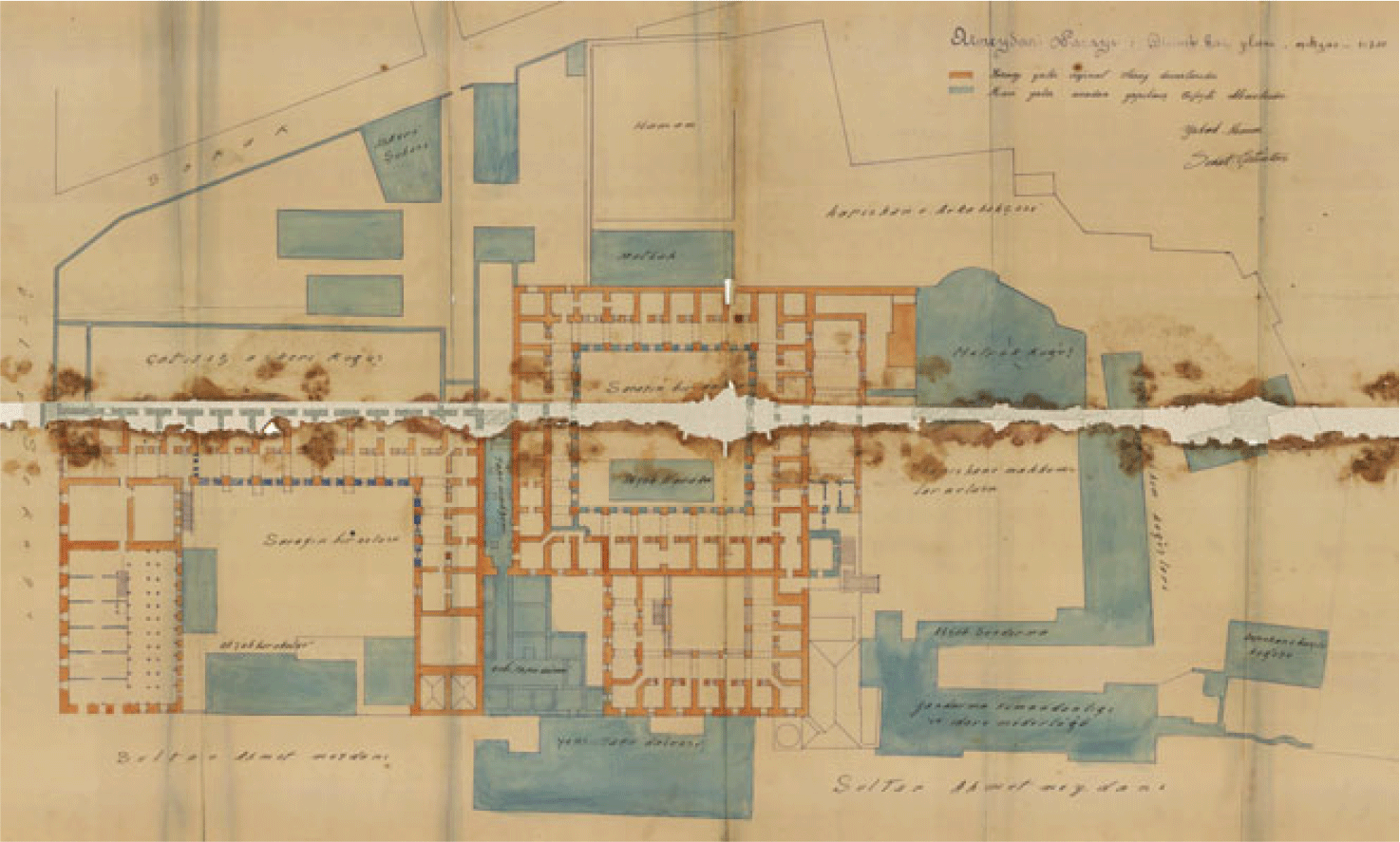
In line with the preparations for the celebrations, Hamit Zübeyir Koşay, the director of antiquities and museums, suggested establishing a city-museum for İstanbul, inspired by the Historical Museum in Vienna. Efdalettin Tekiner, a member of the Preservation Commission, suggested the Palace of İbrahim Paşa, which had already been the focus of preservation debates after the Republican authorities decided to construct a Palace of Justice building at the edge of the Hippodrome in 1937.Footnote 59 Once the location of the new Palace of Justice was finalized, Sedat Çetintaş began his architectural survey. With the contribution of the Turkish Historical Society, Çetintaş identified the sixteenth-century building, surrounded by the nineteenth-century General Prison and its related buildings, as the palace belonging to İbrahim Paşa. Çetintaş announced his discovery as “the birth of a grandiose Turkish palace that came out from the dark clouds of ignorance into the Turkish history and the Turkish world in the Republican period” (Figure 3).Footnote 60
Measured drawing of the İbrahim Paşa Palace by Sedat Çetintaş in 1939 (CPOAA)
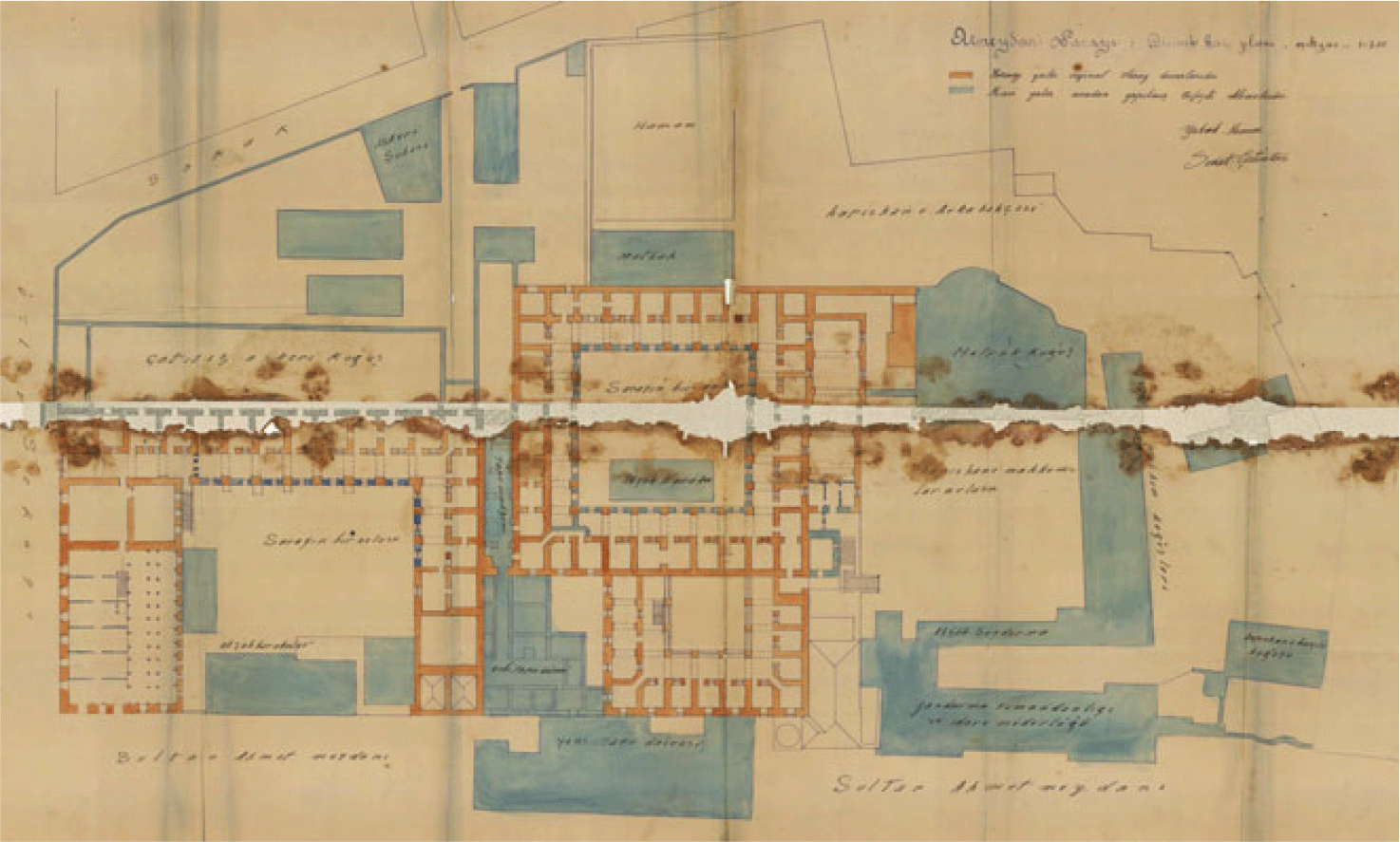
Consequently, the Preservation Commission listed the Palace of İbrahim Paşa and the adjacent imperial band building (mehterhane) to prevent damage during construction of the Palace of Justice and recommended reusing the palace as a museum or archive.Footnote 61 Considering the significance of the building, the Turkish Historical Society required that the new Palace of Justice be built in a different location, and that the İbrahim Paşa Palace, as “the unique example of Turkish residential architecture,” should be converted into a museum.Footnote 62 Subsequently, Prime Minister İsmet İnönü demanded the removal of later additions to the palace to reveal its original facades.Footnote 63 Discussions of the palace’s destruction to make way for the new Palace of Justice building caught the attention of lawyers. A former judicial inspector sent an open letter to the Cumhuriyet newspaper titled “İbrahim Paşa Palace should not be Demolished.”Footnote 64
Uninformed of the registration of the İbrahim Paşa Palace, the İstanbul Municipality this time asked the Preservation Commission whether the buildings that Henri Prost suggested demolishing for his Republican Square project for the Hippodrome were important.Footnote 65 The commission replied with a report pointing out the significance of the sixteenth-century palace and required its preservation.Footnote 66
Despite its registration by the Preservation Commission, the palace was the subject of further demolishment in the following years. In line with the earlier decision of the Prime Minister İsmet İnönü, the attorney general (who was responsible for the new Palace of Justice’s construction) initiated demolitions around the palace. However, the Mehterhane Building and the palace’s stables, which had already been listed for preservation, began to be demolished.Footnote 67 Upon being informed of the demolitions, the Preservation Commission intervened immediately to stop the destruction.Footnote 68 To legitimize these demolitions, the attorney general argued that these buildings had been restored by “the Armenian master builder Krikor,” and therefore could not be considered historic monuments.Footnote 69 By claiming that the architect was Armenian, the attorney general tried to remove a building’s status as a national monument by arguing it was associated with an ethic minority in the Ottoman Empire. In doing so, he was most probably appealing to the “Turkification” policies of the government, which can be regarded as systematic attempts to impose Turkish identity as a hegemonic identity.Footnote 70
The Preservation Commission did not take this argument seriously because Krikor Balyan (1764–1831) had been a highly regarded chief imperial architect of the Ottoman Empire.Footnote 71 Hamit Ongunsu criticized the suggestions of the attorney general as “ignorance and charlatanism that should be strangled by means of scientific investigations and publications.”Footnote 72 Since most of the parts restored by Krikor Balyan had already been destroyed, the minister of education, Hasan Ali Yücel, avoided further debate by claiming that the Mehterhane Building and the İbrahim Paşa Palace were in fact two separate buildings, and that only the palace should be preserved as “a significant Turkish monument.”Footnote 73 Accordingly, Prime Minister Refik Saydam eventually decreed that the Palace of İbrahim Paşa should be preserved.Footnote 74
A similar discussion was generated for the preservation of Süleyman Ağa Mosque in Baltalimanı. Although the Directorate of Foundations had begun the restoration of Süleyman Ağa Mosque, Hamit Zübeyir Koşay, the director of antiquities, objected to this restoration claiming in a meeting related to the celebrations that Süleyman Ağa, the navarch of Mehmed II, was “a devshirme and Bulgar in origin.”Footnote 75 In trying to garner support for the building’s demolishment, Koşay, like the attorney general, tried to appeal to the Turkification policies of the government. Fortunately, the restoration works had already been started and Koşay’s objection was not taken into consideration by the Preservation Commission.
Although the fourth courtyard and the stables of the İbrahim Paşa Palace had already been listed for preservation as early as 1938, both were sacrificed to build the Palace of Justice, which was opened on the day of the 500th anniversary of İstanbul’s Conquest in 1953. While the palace at least was saved from demolishment, its restoration was not on the agenda of the celebrations due to the priority given to monuments associated with Mehmed II and because of budgetary constraints.Footnote 76 The amount spent on the construction of the Palace of Justice instead of restoring the dilapidated İbrahim Paşa Palace gained widespread media coverage. One of the articles, entitled “The Building Costs Four Million: New Palace of Justice,” ironically wished state authorities had demolished İbrahim Paşa Palace rather than leaving it as “evidence of disrespect to history.”Footnote 77
Discussions on Henri Prost’s Sultanahmet Archaeological Park
The preparations for the celebration for the 500th anniversary of İstanbul’s Ottoman conquest affected the destiny of Sultanahmet district, at the tip of the historic peninsula. When Henri Prost began his masterplan studies, Topkapı Palace and Hagia Sophia had already been functioning as museums, and significant remains from the Great Palace had been unearthed by archaeological excavations.Footnote 78 Influenced profoundly by his personal interest in Byzantine Constantinople, Prost identified the eastern tip of the historic peninsula—comprising Hagia Sophia, the Hippodrome, and the Great Palace remains—as an “archaeological park.” Prost proposed excavating the area around Hagia Sophia, exposing the Great Palace ruins, and integrating them into terraced gardens.Footnote 79 The reason behind his Archaeological Park Project was explained by Prost as “all of Sarayburnu and the buildings that dominate it deserve the approach adopted by the Turkish Republic for Hagia Sophia when they claimed that it belongs to humanity and separated it from religion.”Footnote 80
Although Prost’s masterplan was approved by the İstanbul Municipality in 1939, the realization of his Archaeological Park Project was by no means simple. While permission would not be given to new constructions in the area, it was expected that the municipality would expropriate all the buildings within the Sultanahmet district within five years.Footnote 81 Almost ten years after the approval of the project, the İstanbul Municipality sent correspondence to the Preservation Commission, explaining the problems they had been facing in implementing the proposal, which they regarded as the “state’s responsibility.” These included high expropriation costs and their obligation to permit new constructions on privately owned lands, which were causing significant damage to the archaeological heritage of the district.Footnote 82
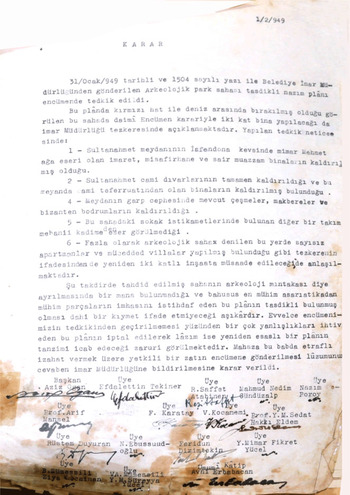
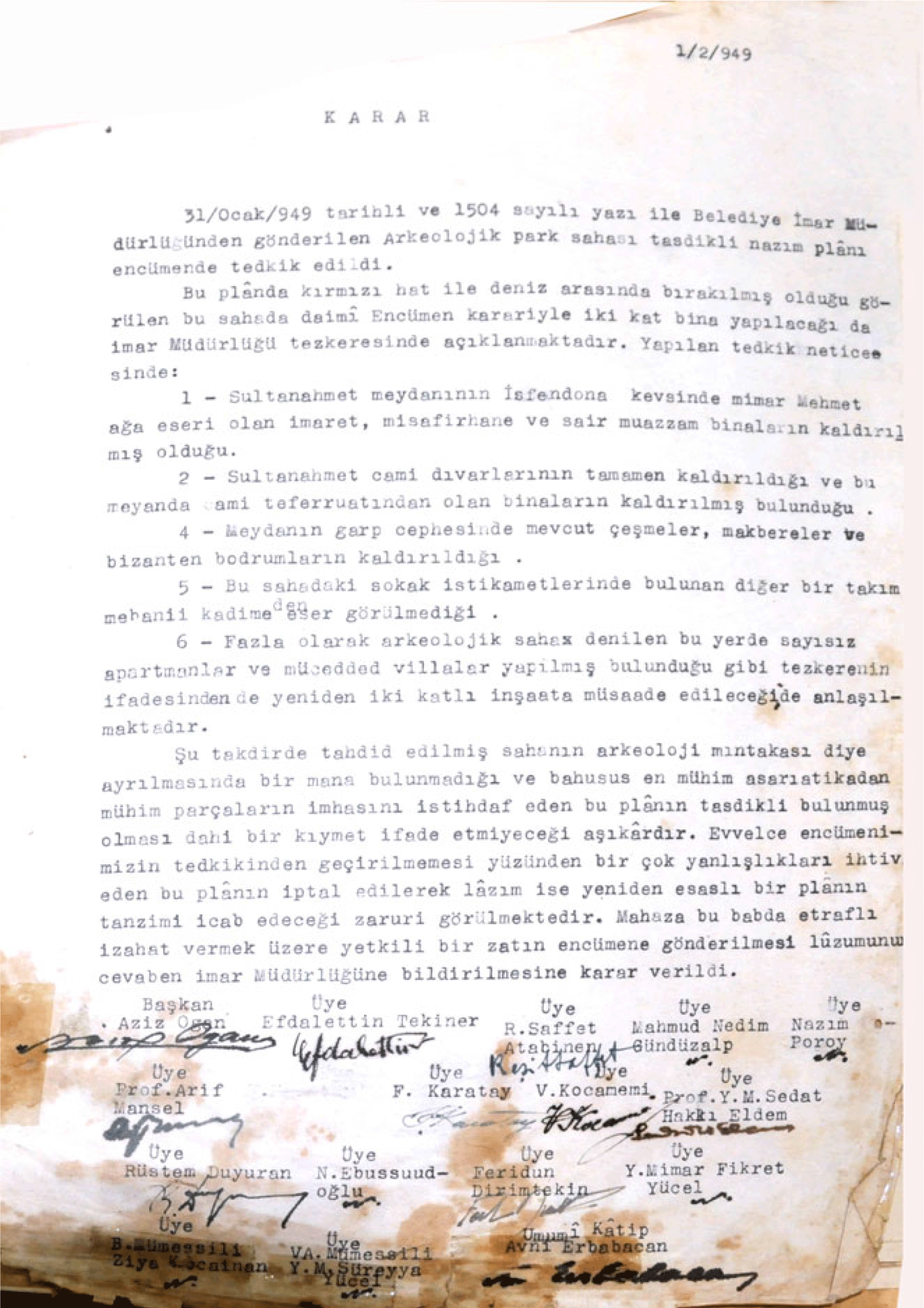
It is surprising that the commission had not been informed about the details of Prost’s Archaeological Park Project for almost ten years due to the lack of an organized institutional framework.Footnote 83 After receiving the project details from İstanbul Municipality, the commission evaluated the archaeological park proposal in terms of its approach to the preservation of historic monuments. First, it failed to consider certain important monuments of the seventeenth-century Sultanahmet Mosque complex, such as the public kitchen, hospice on the Hippodrome’s Sphendone, Sultanahmet Imperial Lodge, primary school (sıbyan mektebi), and arasta (covered bazaar). Second, there were many privately owned residential buildings within the area, and it would be impossible to prevent new constructions on those plots since expropriations of this scale would be very costly. Based on these reservations, the commission rejected Prost’s archaeological park proposal on the grounds that it would pave the way for the destruction of significant monuments.Footnote 84 A later correspondence revealed that the Preservation Commission simply continued treating the archaeological park proposal as merely a “rumor” with no actual legal basis (Figure 4).Footnote 85
1949 decision of the Preservation Commission regarding Henri Prost’s archaeological park proposal (CPOAA)
In a presentation at the Beaux-Arts Academy in Paris, Henri Prost had already addressed the difficulties in enacting his Archaeological Park Project as early as 1947. Acknowledging the priority given by the Turkish government to historic monuments constructed after the Ottoman conquest of the city, Prost sought the international support of archaeologists conducting research in İstanbul.Footnote 86 Supported by Albert Gabriel from the French Institute of İstanbul, Prost began his struggle to realize his Archaeological Park Project, drawing international publicity and convincing UNESCO to support the project. The renowned Byzantine scholar Andre Grabar sent a letter to President İsmet İnönü, calling for a special committee composed of Turkish and international scholars to contact UNESCO services and provide support for the Sultanahmet Archaeological Park.Footnote 87 Minister of Education Hasan Tahsin Banguoğlu responded to Grabar’s letter by saying that the Sultanahmet district had already been identified as an “archaeological park” in Prost’s masterplan, and the Turkish government was ready to collaborate to conserve antiquities and to create the “archaeological park.”Footnote 88 After Prost and Gabriel found support from Byzantine scholars like Andre Grabar and Paul Lemerle, as well as the Turkish government, UNESCO eventually agreed to provide the necessary scientific and financial support in 1950.Footnote 89
Parallel to this struggle, the committee that was responsible for the coordination of different state institutions for the quincentenary anniversary announced their new program since there had not been any considerable progress by 1949. The committee identified the Fatih Mosque Complex, Topkapı Palace and the Imperial Walls, the Tiled Pavilion, the Rumelian and Anatolian Castles outside the historic peninsula, and the gates of the Byzantine land walls associated with the conquest as some of the monuments to be given priority for restoration.Footnote 90 The committee also demanded the restoration of Byzantine monuments refunctioned during the reign of Mehmed II, including Hagia Sophia, Hagia Irene, Kariye Mosque (Chora Church), and İmrahor Mosque (Monastery of Stoudios). Along with the Ministry of Education budget, the committee sought to utilize international funds such as the UNESCO budget allocated for the Archaeological Park Project, Fulbright funds, and Marshall Aid funds for the restoration of reused Byzantine monuments.Footnote 91
While planning to use state funds for the monuments given priority for the celebrations, the committee desired to use the UNESCO fund to restore key monuments associated with the conquest rather than pursuing Prost’s archaeological park, which shifted the narrative of “İstanbul’s Ottoman conquest” and mainly highlighted the late-Roman and Byzantine periods of the city. In a UNESCO meeting in Paris, Reşit Saffet Atabinen, a member of the İstanbul Preservation Commission, clearly expressed the desire of the Turkish government by stating that for the “Turkish people,” “Turkish monuments” were the priority.Footnote 92 Since it was now evident that the Turkish government did not support Prost’s archaeological park as it was, UNESCO cut their involvement in the project.Footnote 93
Concluding remarks
Despite high expectations, the celebrations for the 500th anniversary of İstanbul’s Ottoman conquest proved less than spectacular. On May 29, 1953, the day of the conquest, the ceremony started outside the land walls at the spot where Hasan of Uluabat, a legendary martyr, had supposedly placed the Ottoman flag on the walls of Constantinople. After placing a Turkish flag at the same spot, celebrations continued at the tomb of Mehmed II—in Fatih Mosque Complex—with a parade of military cadets. The celebrations ended with the opening ceremony of the refurbished Tiled Pavilion, housing new objects associated with Mehmed II.Footnote 94 The columnist Sedat Simavi, with a touch of humor, described the ceremony as: “instead of galleys we trailed sandals and made Janissaries with fake moustaches and Ottoman marine soldier imitators and called this the quincentenary anniversary.”Footnote 95
Even though the actual ceremony was more modest than anticipated, the preparations for the celebrations were a benchmark for historic preservation in İstanbul. From its announcement in 1939 until its realization in 1953, the celebration program dominated inventory and restoration works in the city. The preservation works almost entirely concentrated on monuments associated with Mehmed II, including the reused Byzantine monuments. Topkapı Palace underwent extensive restoration aiming to turn it into its original state built by Mehmed II. The Palace of İbrahim Paşa was the focus of heated debates regarding the “Turkishness” of the additions to the monument. Similarly, Turkish authorities sought ways to use the UNESCO budget, reserved for Prost’s archaeological park, to restore key monuments associated with Mehmed II.Footnote 96
Although different actors had different agendas in relation to İstanbul’s diverse heritage, the celebrations provided a unified narrative of “İstanbul’s conquest” for discussions of the importance and priorities of historic preservation. In the loosely organized institutional framework of historic preservation, the appropriation of İstanbul’s multifaceted heritage as national heritage was highly selective and mostly inconsistent.Footnote 97 While Ottoman heritage was embraced as the imprint of Turkish culture, the focus was on historic monuments mainly from the fifteenth and sixteenth centuries, regarded as the glorious centuries of the Ottoman Empire, overlooking the later periods.Footnote 98 Given the fact that the roles of different state institutions were not clearly identified, these inconsistencies became more apparent in the debates over the multi-religious and multiethnic character of both the Ottoman heritage and Byzantine heritage. For the case of İbrahim Paşa Palace, there was even ethnic nationalism mobilized by the representatives of state authorities that were extraneous in historic preservation.
Nevertheless, the preparation for celebrations reconceptualized historic monuments as national monuments, as reminders of the Ottoman conquest of İstanbul. Similarly, the Byzantine heritage was integrated into these narratives of conquest. Contrary to earlier attempts to incorporate the Byzantine past into the official Turkish historiography as a period of “enduring Turkish culture,” Byzantine heritage began to be perceived as the “conquered heritage.”Footnote 99 While the 500th anniversary celebrations mainly focused on the monuments associated with Mehmed II, the İstanbul Preservation Commission ensured the inclusion of reused Byzantine monuments into the inventory works, thus contributing to their survival. For Topkapı Palace and the Tiled Pavilion, the commission embraced these monuments as evidence of the Ottoman Empire’s history, valuing their entire lifespan. After being informed of Prost’s archaeological park proposal, which would mainly highlight the Byzantine period by not only disregarding significant Ottoman monuments but also the urban fabric, the Commission expressed their reservations about the project. Thus, the commission provided a balance between pro-Byzantine or pro-Ottoman leanings in historic preservation. More importantly, the commission not only played a significant role in reframing İstanbul’s diverse heritage as national monuments, but also provided a way to remember the city’s imperial and religious associations.
In a context where the authority of İstanbul’s Preservation Commission was loosely defined, the commission tried to be involved, sometimes by pushing its limits, in different aspects of historic İstanbul’s preservation ranging from inventory, identification of restoration principles and strategies for their implementation as well as urban-planning decisions. Throughout its long history, the Commission for the Preservation of Antiquities played a central role in the institutionalization of historic preservation. Despite the fact that the idea of the “national monument” emerged as early as the beginning of the twentieth century, İstanbul’s multifaceted heritage was always a site of contestation due to the changing conceptualizations of national identity in the Republican period. Therefore, the Preservation Commission was instrumental in the reappropriation of the multilayered, multiethnic, and multi-religious past as national past, with a legitimizing narrative of the Ottoman conquest.
The experiences of the Preservation Commission in the appropriation of İstanbul’s multifaceted heritage in a complex institutional framework with multiple actors paved the way for a new act, which established the High Council of Immovable Antiquities and Monuments (Gayrimenkul Eski Eserler ve Anıtlar Yüksek Kurulu) in 1951. Completely autonomous, the High Council indeed emerged as the only decision-making body above central and local authorities with regard to historic preservation in Turkey, and became responsible for determining the principles in relation to preservation, maintenance, repair, and restoration of historic monuments, as well as pursuing their implementation and offering scholarly opinion on any controversies.Footnote 100 Nevertheless, the Commission for the Preservation of Antiquities continued to serve as a local agency assisting the High Council, and only abolished itself in 1978.Footnote 101 With the establishment of the High Council, İstanbul lost its “privileged status” for historic preservation as the old capital of the Ottoman Empire, and was integrated into a centralized decision-making system.