Liverpool and Manchester have come to typify twentieth-century urban decay. Writing in 1982, economic historian Sheila Marriner suggested that Liverpool was ‘synonymous with vandalism, with high crime rates, with social deprivation in the form of bad housing, with obsolete schools, polluted air and a polluted river, with chronic unemployment, run-down dock systems and large areas of industrial dereliction.’Footnote 1 Similarly, Manchester's image ‘is invariably gloomy’ as ‘twentieth-century changes have created a sense that the city and its people have been deserted and abandoned’.Footnote 2 In particular, Liverpool and Manchester's demise is strongly associated with their experiences between the two world wars. The lasting influence of contemporary left-wing commentators, especially George Orwell and Walter Greenwood,Footnote 3 and autobiographical writers such as Pat O'Mara and Helen Forrester,Footnote 4 caused northern England to be stereotyped as a place of deprivation and poverty in comparison to the prosperous south.Footnote 5 Economic historians have reinforced notions of a geographical divide, stressing higher unemployment rates in the north and its inability to recover from the economic depression of 1929–31.Footnote 6 Both cities’ pasts are however being reassessed following recent regeneration and economic growthFootnote 7 and this article seeks to develop recent scholarship and undermines stereotypical understandings of interwar Liverpool and Manchester, challenging perceptions of urban decay.Footnote 8
Narratives of the decay of northern England's industrial cities have usually been associated with accounts of the decline of local government. Historians have typically viewed 1914 as a turning point in the dramatic demise of civic power.Footnote 9 Robert Morris, for instance, suggests that the powerful municipal culture of the late nineteenth and early twentieth-centuries relied on ‘the integration of local political, economic and social elites and the local identity and ownership of capital’. By the 1920s and 1930s however, ‘key institutional structures which had supported all this began to be diminished, undermined and replaced … The towns were abandoned by their elite.’Footnote 10 Yet, Richard Trainor has drawn attention to J. B. Priestley's assertion in 1934 that England was ‘the country of local government’.Footnote 11 By highlighting the involvement of the middle classes more generally, rather than the industrial elite, Trainor suggests that ‘perceptions of decline in the 1920s and 1930s have been exaggerated’.Footnote 12
This article does not deny that there was a north–south divide in terms of unemployment and economic growth, but argues that a focus on poverty and on the relative decline of the power of local government in comparison to its Victorian heyday has overshadowed the level of dynamism and innovation shown by local rulers in Liverpool and Manchester between the two world wars. Although interwar local government was marked by a greater involvement of the middle class more generally, here attention is drawn to the enduring contribution and leadership of titled politicians and academic intellectuals. The article incorporates a broad range of material, including the history of transport,Footnote 13 housing,Footnote 14 planning,Footnote 15 urban government,Footnote 16 and civic pride,Footnote 17 with recent cultural histories of the cityFootnote 18 to illustrate the scale and ambition of local government in Liverpool and Manchester, triggered by economic and political instability after the First World War. The study also develops scholarship on the Liverpool School of Architecture and, in particular, on the contribution made by the Liverpool-based architect Sir Charles Reilly, to show Liverpool was at the forefront of developments in urban planning and civic design.Footnote 19 Together, this approach reveals a dynamic urban culture too often eclipsed in accounts of the ‘hungry thirties’.Footnote 20
The years after 1918 were turbulent. Liverpool, in particular, experienced a tumultuous transition to peace: despite waves of racially motivated riots in several port cities in 1919, including Cardiff and London, which targeted black seamen and were provoked by concerns about unemployment and miscegenation, Liverpool saw the worst of the violence and with murderous results.Footnote 21 In the same year, the city witnessed the most extensive police strikes in comparison to the rest of England: more than half of Liverpool and Birkenhead's and three-quarters of the Bootle police forces went on strike (compared to 10 per cent of forces in London), provoking considerable unrest and looting.Footnote 22 Meanwhile, the advent of mass democracy prompted considerable debates about the nature of the electorate.Footnote 23 Although the impact of mass suffrage on national politics has attracted scholarly attention, especially regarding the implications for political marketing,Footnote 24 the impact on local politics remains notably under-researched.Footnote 25 Thus, this article draws attention to the way investment in urban redevelopment was extensively marketed to local citizens in Liverpool and Manchester in the form of publicity material and civic celebrations.Footnote 26 Their strategy reflected the desire of municipal leaders in both cities to involve inhabitants in local government, appealing to the classless (and, to some extent, genderless) citizen. As case studies, Liverpool and Manchester show that, as a result of economic and political turbulence, local government moved towards a more demotic and inclusive civic culture. Policies focused on large-scale and grandiose projects, such as the Mersey Tunnel and Wythenshawe municipal housing estate, that boosted both employment opportunities and the morale of the local population. The symbolic impact of these schemes – including those that remained incomplete by 1939, such as housing reform – was profound.
I
National levels of unemployment peaked in 1932, when 22.7 per cent of the workforce was out of work.Footnote 27 Regional rates varied, from 8 per cent in London and the south-east to 22 per cent in Wales and northern England.Footnote 28 In Liverpool, unemployment rates hit 33 per cent in 1932.Footnote 29 Dudley Baines has stressed Merseyside's inability to diversify its economy after 1929 as its port lost an annual average of 1 per cent of trade per annum to other British ports between 1919 and 1939.Footnote 30 The greatest problem was, however, the erratic nature of trade, rather than straightforward decline: for example, the percentage of Britain's raw rubber imports handled by Liverpool fluctuated between 5 per cent and 35 per cent over this period.Footnote 31 Liverpool was never officially designated a depressed area and suffered less than other northern towns and citiesFootnote 32 and its interwar economy was therefore characterized by instability, rather than simple decline, which shaped how urban redevelopment was marketed to inhabitants.
Lancashire's famous cotton industry collapsed irrecoverably during the 1920s and, by 1939, cloth exports amounted to only one fifth of their 1913 levels.Footnote 33 Mill towns throughout the region were severely affected, such as Blackburn, where the cotton industry had accounted for 60 per cent of employment but had an unemployment rate of 46.8 per cent in 1931.Footnote 34 By contrast, the city of Manchester was better equipped to cope with the cotton industry's collapse and overall levels of unemployment never reached the national rate.Footnote 35 It was also a period of striking innovation and commercial diversification. Manchester's Ship Canal (completed in 1894) became particularly important in developing and diversifying trade between the wars. Trafford Park attracted significant investment and was home to over 200 American firms by 1933, whilst a municipal airport opened in 1929.Footnote 36 The economic context explains why Manchester's urban transformation was presented in a way that highlighted its diverse economy and portrayed a break from the city's Victorian image of ‘Cottonopolis’.
Alongside economic turmoil, the decades following the First World War were characterized by political change with the advent of mass suffrage. The Conservatives remained the majority party in municipal elections in both Liverpool and Manchester throughout the interwar period, but lost some seats following a rise in support for Labour,Footnote 37 largely mirroring national trends.Footnote 38 The dramatic decline of the Liberal party at a national level was not reflected in Liverpool and Manchester, suggesting stronger continuities in support at a municipal level.Footnote 39 Both cities had significant Catholic populations, but religion was more politicized in Liverpool, as shown by historians such as Phillip Waller and John Belchem.Footnote 40 Nevertheless, the commonalities between both cities should also be stressed and the approach to citizens was notably similar, despite Liverpool's stronger sectarian influence.
Liverpool's and Manchester's urban transformation and the way redevelopment was marketed to local inhabitants can be seen as part of a broader scheme by the Conservative party to engage with the new mass electorate. Municipal publications were released regularly in both cities,Footnote 41 and were central to the way local government publicized and marketed urban redevelopment. The link between urban planning and promoting citizenship in the age of mass suffrage is noteworthy: in 1925, Manchester's Town Planning Special Committee was instructed to prepare a general survey of the city's needs because ‘the publication of a survey as suggested should do much to assist the municipal government and the Citizens in general to visualise living and other conditions within the city and to create a greater sense of citizenship’.Footnote 42 The approach of both corporations reveals similarities to marketing tactics adopted by the national Conservative party, as studied by Ross McKibbin, David Jarvis, and Jon Lawrence, in response to anxieties about mass suffrage in the early 1920s.Footnote 43
Alongside the influence of the Conservative party, Manchester's key figure was Lord Earnest Simon who donated land at Wythenshawe to the city of Manchester.Footnote 44 An ardent socialist, Simon was politically active at both a national and local level and was particularly interested in improving housing for the working classes. Simon also campaigned for a more comprehensive approach to town planning with greater state involvement and advocated the municipalization of urban land.Footnote 45 Alderman Sir Percy Woodhouse was also central in establishing a Civic Committee in Manchester in 1930 to ‘take advantage of any and every opportunity arising to retain existing industries in Manchester and to seek the introduction of new industries’.Footnote 46 Manchester was notable for appointing a city architect, Henry Price, in 1902, who retired in 1932 and was replaced by George Noel Hill, charged with overseeing all municipal building projects and advising on planning and civic design.
Sir Charles Reilly, architectural expert and Emeritus Professor at the University of Liverpool, was instrumental in driving redevelopment in Liverpool and, to a certain degree, also in Manchester.Footnote 47 Reilly's own architectural work was limited and, impressed with what he witnessed in East Coast America just before the First World War, he became devoted to promoting the role of architecture in British society and, on his return, Reilly became a prolific journalist.Footnote 48 Reilly's architectural critiques of Liverpool and Manchester, published in the early 1920s, can be seen as landmarks in the emergence of a greater interest in planning and urban redevelopment in both cities.Footnote 49 Reilly was highly effective in developing the professionalization of town planning through the University of Liverpool's School of Architecture, which established the Town Planning Review, and he convinced Lord Lever to finance the first-ever professorship in planning in 1912. Reilly's friend, Patrick Abercrombie, holder of the chair from 1915 to 1935, was also important in developing the discipline and together they pursued a holistic approach to regional planning.Footnote 50 John Brodie, city engineer from 1898, provided a direct link between the corporation and the university, after a special lectureship was created for him in engineering. Brodie's achievements were striking: he was one of the first to suggest an electric tram system for Liverpool, designed the Mersey Tunnel, put forward the scheme for building the East Lancashire Road, led experimental use of pre-fabricated housing, assisted in the planning of New Delhi, and, his proudest achievement, invented the nets used in football matches.Footnote 51
Within the Conservative party in Liverpool, the role of Sir Archibald Salvidge (chairman from 1892 to 1928) was fundamental in shaping the party's approach to local politics. ‘King of Liverpool’, Salvidge fashioned a deliberate ‘Tory democrat’ image for the Conservatives in reaction to Labour's first parliamentary seat in Liverpool in 1923.Footnote 52 Salvidge remained concerned about the rise of Labour and the implications of universal suffrage on local politics. Following the municipal elections in May 1926, Salvidge lamented the loss of three key districts and ‘urged councillors, in their own interests, to give more time and attention to the affairs of the respective Wards to meet the ceaseless propaganda of their opponents’.Footnote 53 Yet such concerns were not limited to the Conservative party. In the preface to Simon's 1926 publication, A city council from within, for example, the political psychologist and educationalist, Graham Wallas, explained that the book was aimed at younger members of the Labour party and warned that the ‘inevitable transference of power from the middle to the working classes in our English cities might be so directed as to be disastrous in some cases to administrative efficiency’.Footnote 54 Salvidge and Wallas thus exposed the tensions and anxieties both between and within the Labour and Conservative parties on a local level over the issue of mass suffrage.
The corporations were able to finance their ambitious programmes of urban transformation and accompanying propaganda campaigns because their rateable incomes and loans from central government increased (above inflation) between the two world wars, as did profits from public transport and amenities such as electricity and gas. Liverpool Corporation had a total income of £5,366,155 in 1924 (£2,753,508 from rates), rising to £9,400,589 by 1935 (£4,367,220 from rates).Footnote 55 Manchester Corporation's income also rose substantially, from £4,947,920 in 1924 (£2,872,912 from rates), to £8,621,477 in 1935 (£4,623,801 from rates),Footnote 56 partly because rates nearly doubled between 1915 and 1922.Footnote 57 Both corporations invested heavily in their respective cities. For example, Manchester Corporation consistently invested far more money in libraries and art galleries (£126,864 in 1935), than on maternity and child welfare (£83,732 in 1935). There were also revealing distinctions in how each corporation spent their income. Manchester Corporation spent significantly more money on streets: £450,528 in 1926, compared to Liverpool's expenditure of £229,027. By contrast, Liverpool's civic leaders invested more in policing, perhaps by way of response to the 1919 police strike, and in 1927, Liverpool Corporation spent £799,562 on policing, in comparison to Manchester's £484,745.Footnote 58
II
Housing was a national priority after the First World War ended and significant steps were taken to demolish inadequate dwellings and to construct state-subsidized replacements.Footnote 59 As Liverpool and Manchester were home to some of the poorest housing in the country in 1918, it is unsurprising that both corporations embraced housing reform.Footnote 60 In Liverpool, much of the work was undertaken by Sir Lancelot Keay, City architect and director of housing from 1925 until 1948. 140,000 people (15 per cent of its population) were re-housed by the corporation between the wars, in 33,355 purpose-built suburban houses.Footnote 61 In 1934, the Social Survey of Merseyside reported that 96 per cent of corporation houses built after 1919 were in the suburbs.Footnote 62
Progress made in housing reform was striking, yet incomplete: in July 1928, the Housing Committee abandoned a plan to clear congested areas near the city centre in favour of supplying cheap houses nearby to relieve the acute shortage of affordable accommodation.Footnote 63 Scotland Road, the area between the port area and the city centre, was home to a large Irish-Catholic population and epitomized ‘squalid Liverpool’ to late Victorian health reformers.Footnote 64 It remained a site of great poverty and unemployment interwar and was not subject to major clearance until the 1950s. The alienation felt by those who were rehoused to the suburbs due to the lack of community and social amenities is well documented.Footnote 65 Although Liverpool Corporation included the provision of shops, such businesses struggled financially and newly emerging chain stores such as Woolworths were denied permission to open in the new estates.Footnote 66
Although this process of housing reform was varied in Liverpool, municipal leaders publicized their progress to encourage confidence in the city's economy. ‘Nowhere has the appalling post-war problem of house shortage been more bravely and successfully tackled’, announced Lord Mayor Thomas Dowd in 1924.
It would have been impossible for the city to undertake works of such magnitude as this if its financial stability were not impregnable. But happily, Liverpool's financial credit is high – so high, indeed, that on more than one occasion it has been able to borrow money in the open market more cheaply than the Imperial Government itself.Footnote 67
These sentiments were repeated in 1931, when Lord Mayor Edwin Thompson also turned to the changing urban environment to express optimism in the city's commercial future. ‘Evidence of this faith in the future meets us at every hand on both sides of the river’, he declared, ‘it is to be read in … the vast development of our suburbs; in the contemplated attacks on our slum areas; in our new arterial roads and town and regional planning schemes’.Footnote 68 Municipal leaders acknowledged that Liverpool's programme of housing reform was incomplete, but claimed it was ‘progressing step by step, thanks to enlightened civic management and courageous private enterprise … Liverpool, believing in its own future, is equipping itself for the good times ahead, and at the same time lengthening her lead over all rivals, both as a city and as a port.’Footnote 69 There was thus a clear attempt to promote the city's progress within a broader narrative of optimism concerning the city's economy.
In Manchester, 21,859 new suburban council houses were built by 1933.Footnote 70 Manchester's famous Wythenshawe Estate provided suburban homes specifically for the working classes:Footnote 71 40,000 inhabitants occupied 8,145 homes in Wythenshawe by 1939, which was nearly half way towards the corporation's goal of 100,000 people.Footnote 72 Simon claimed that there were no cellar dwellings remaining in Manchester by 1938 and whereas there had been 10,000 back-to-back houses prior to 1918, there were, by then, less than 40: ‘Really bad slums, which are still common in other cities, do not exist in Manchester.’Footnote 73
For Brian Rodgers, historian of urban planning and design, Manchester Corporation's interwar investment in housing represented ‘the last grand gesture of that supreme self-confidence that was bred in Victorian Manchester’.Footnote 74 Yet municipal publicity material presented the new suburbs as symbols of a clear break with the city's Victorian past. A brochure, published in 1938 to celebrate the corporation's centenary anniversary, encouraged citizens to recognize the improvement in the city's housing stock. During the Victorian years,
slums were crowded, and street after street of cheap little houses was rushed up, often without foundations, and with walls half a brick in thickness, crowded together to make the builder's profit out of a piece of land as high as possible … we are now in the city of today, as clean and as healthy as the town we have just described was dirty and horrifying.Footnote 75
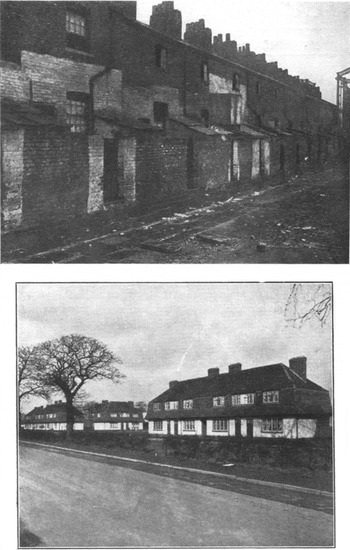
Figure 1 shows how the corporation directly contrasted housing from the mid-nineteenth century and the 1930s. Indeed, corporation publicity material consistently presented a negative image of Victorian Manchester, particularly following the collapse of the cotton industry.Footnote 76 The Manchester City News also compared the Victorian slums with the new suburbs in an article entitled ‘Hulme Vs Wilbraham Estate’. ‘Instead of dreary, depressing long rows of houses opening onto the street front … and backing onto narrow, dirty passages’, the article claimed, ‘we have … houses into which the sunlight can penetrate … with good gardens and plenty of space.’Footnote 77 Manchester's inhabitants were encouraged to see the new suburbs as a symbol of change and were presented as a tangible example of the city's broader development.
‘Houses – Old and New’. Source: Manchester City Council, Centenary celebration of Manchester's incorporation, May 2–7 1938 (Manchester, 1938), p. 84.

Representations of housing reform in Manchester masked a darker reality, however. In 1930, the pressure on housing was acute and Manchester Corporation decided to delay the clearance of Hulme until rehousing was available to its inhabitants.Footnote 78 There were 10,000 people waiting for corporation housing in 1931Footnote 79 and a report in 1932 found 30,000 houses in Manchester needed clearing. Since that was impossible, the report recommended that a target of 15,000 by 1938 was more realistic.Footnote 80 Under pressure, Manchester Corporation modified its plans for housing reform. In 1932, a report for the corporation on the Hulme Clearance Area was undertaken by the Manchester, Salford, and Counties Property Owner's Association, which claimed there were no back-to-back houses in Hulme, that each had a private yard, all but nine had water carrier systems, and at 4.43 persons per house ‘cannot be taken as serious overcrowding’.Footnote 81 The report suggested that the Wythenshawe Estate was an impractical alternative location for Hulme residents because of travelling expenses and that 75 per cent had already refused to move to the Platt Lane Estate, which was much closer. Clearing the area, recommended the report, would merely increase overcrowding in the surrounding areas.Footnote 82 In response, the architect's report suggested that a better alternative was the destruction of half the houses in Hulme, whilst its plans show that the aim was to create as many open spaces as possible, by reducing density to twenty-five houses an acre with a focus on reconditioning surviving houses.Footnote 83 Corporation propaganda was careful to ensure that older types of housing that did survive, such as that in Hulme, were overshadowed by the grandiosity of the Wythenshawe Estate, which was a striking and ambitious project, but did not represent the reality of all housing in Manchester by the mid-1930s.
III
Impressive transport networks were established in both cities. By as early as 1924, trams in Liverpool covered Allerton, Woolton, and Walton on the city outskirts and, during the morning and evening peak hours, 300 cars entered and left the Pierhead.Footnote 84 By 1939, Liverpool Corporation claimed that its public transport system carried 282,045,776 passengers and covered 24,620,064 miles each year.Footnote 85 Public transport expansion ensured that large numbers of people congregated in two key areas of the city, notably the Pierhead and St George's Hall. The Pierhead became the ‘the transport hub of the city’ and ‘a bustling interchange between ships and trains, ferries and trams’.Footnote 86 From there, the ‘majority of routes radiate in fanlike formation’ and an estimated 4,000 trams visited the Pierhead each day.Footnote 87
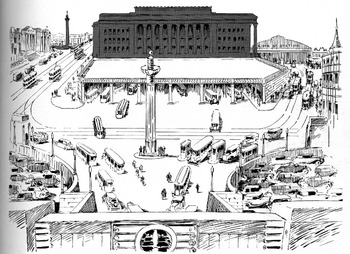
The enhanced role of St George's Hall as a tram terminal in the 1930s cemented its position as Liverpool's civic centre. As Figure 2 shows, the expansion of Liverpool's public transport shaped representations of St George's Hall, which had become the main terminus by 1935. The picture depicts how planners understood the impact of the Mersey Tunnel (completed in 1934) as they envisioned St George's Hall to be the centre of all forms of transport. By presenting an image of a coherent and ordered transport system around Liverpool's grandest and most impressive building, a sense of grandeur is evoked. Liverpool's other impressive Victorian buildings are featured alongside St George's Hall, including the Walker Art Gallery and Lime Street Station. Planners in Liverpool appropriated symbols of Victorian civic pride to nurture a sense of continuity. The foundation stone of St George's Hall was laid to commemorate Queen Victoria's coronation, although the building was not actually completed until 1854.Footnote 88 The site was specifically chosen because it was situated above the city and adjoined Lime Street Station (built in 1836 and rebuilt in 1850 and 1871) and expressed ‘the pride and confidence of the thriving town’.Footnote 89 By placing St George's Hall at the centre of the city's public transport network, attention was drawn to Liverpool's strong history of commercial success, to inspire confidence in its future.
‘A vision of the future of Kingsway’. Source: Liverpolitan, Jan. 1935, p. 15.

The Mersey Tunnel, connecting Liverpool and Birkenhead, was championed by Salvidge as a strategy to deal with unemployment problems and to improve infrastructure. Salvidge was awarded the Freedom of Liverpool for his success in obtaining 50 per cent funding from central government with the passing of the Mersey Tunnel Act in 1925.Footnote 90 Designed by Brodie, the tunnel was inspired by the Holland Tunnel, connecting New Jersey and Manhattan under the Hudson Rover, which had been begun in 1920 and completed seven years later.Footnote 91 The Mersey Tunnel was formally opened by King George IV on 18 July 1934 and during the ceremony, ‘Liverpool looked to history to seek confidence in its future’, which reflected a broader celebration of the city's past in municipal publicity material.Footnote 92 The chairman of the Mersey Tunnel Committee described the Tunnel as ‘a mighty piece of engineering, the tunnel will rank as one of the wonders of the world, as well as a monument to the civic enterprise of the city of Liverpool and the borough of Birkenhead’.Footnote 93 In a similar fashion to the corporation's investment in housing, the Tunnel was presented in the local press as a symbol of confidence in the city's economy: ‘What, indeed, is the great new Merseyside Road Tunnel but an act of faith unmatched probably in all of Europe?’ asked the lord mayor in 1931.Footnote 94
Investment in public transport was also important to Manchester's redevelopment. Manchester's buses carried 6.9 million passengers in 1925, increasing to 20.2 million in 1929, and by 1938, at least one tram passed through the main shopping street in the city centre, Market Street, every twenty-four seconds.Footnote 95 Again, there was a link between improving transport and alleviating unemployment in the area: in 1929, a Report of Works for the Unemployed Special Committee proposed a comprehensive programme of road works in Manchester over a period of five years, with 60 per cent of the cost expected from central government.Footnote 96 Municipal publicity material consistently presented developments in Manchester's public transport as a symbol of the city's progress. Manchester's Commercial Yearbook of 1925 declared ‘transport is vital to a modern city’ and offered statistics to ‘enable every citizen to study our great municipal enterprise’.Footnote 97 Public transport was one of the main attractions in Manchester's Civic Week of 1926, when the Electricity and Tram Departments collaborated to produce ‘a very brilliant spectacle’: a tram covered in electric light, with ‘3,000 lamps of 30 watts each, which will require nearly 13 electrical horsepower to light. The whole car is to flame, not with a steady illumination, but with a ripple which should get the best out of the red, white and green.’ One side spelt ‘1901 Still the Best’ and the other, ‘1926 Stood the Test’, in lights to emphasize a sense of progression.Footnote 98
In the 1930s, municipal publicity material continued to stress progress made in the city's public transport in comparison to the Victorian years. In 1935, the corporation asked its citizens to contrast the ‘early motor buses’, which ‘were a somewhat doubtful proposition from the point of view of reliability and were anything but quiet and smooth’, with Manchester's newer system of operating ‘motor buses parallel with and supplementary to the tramway services, each type of vehicle functioning to the best of its ability’.Footnote 99 The article further claimed that ‘Manchester has always been a pioneer in transport.’Footnote 100 Public transport was also an important aspect of the centenary celebrations of Manchester's incorporation in 1938 and the Manchester Guardian's article, ‘From horse bus to motor bus’, contrasted Manchester's first omnibus of 1824, ‘a relatively exclusive conveyance’ and ‘narrow and cramped’ with the sophisticated and comfortable public transport available in 1938.Footnote 101
IV
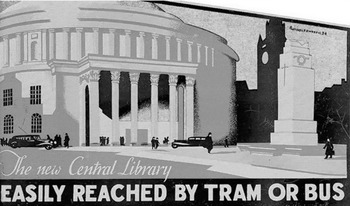
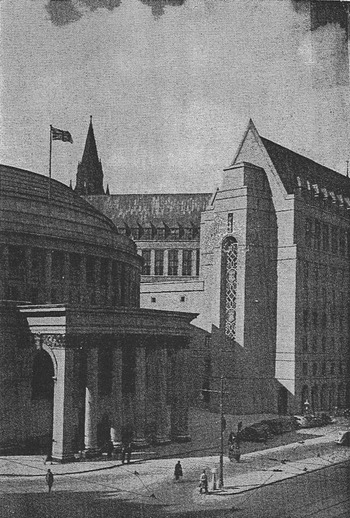
Whereas representations of public transport expansion in Liverpool drew greater attention to the city's existing architecture, investment in public transport changed Manchester's urban environment and defined a clearer ‘Civic Centre’. The tram system terminated in Piccadilly and many ran past the rear of the Victorian Town Hall (completed 1877). ‘The routes extend from the districts beyond the City on all sides and pass through the centre of the City, thus affording the opportunity of transferring from one route to another’, described one public transport handbook in 1928.Footnote 102 The area behind the Victorian Town Hall (St Peter's Square) became the focus of civic culture with the building of Manchester Central Library (1934) and the Town Hall Extension (1938). The impact of public transport expansion was fundamental to this shift. Indeed, Figure 3 suggests municipal investment in the Library and public transport went hand in hand.Footnote 103
‘The new Central Library. Easily reached by tram or bus’, 1934. Source: Manchester Central Library 1934.

The area where the new library and Town Hall Extension were built was the focus of a new interest in planning and development from the early 1920s. In 1924, the area, then known as ‘Jackson's Row’ and covering 1,618 square yards, was described as the ‘heart of the city’ and ‘an exceptional site’. A report commissioned by the corporation suggested that the area should not be left vacant but warned against piecemeal allocation and recommended that a representative ‘should be appointed and charged with the duty of immediately preparing comprehensive schemes for the utilisation en bloc of these extensive and important sites’.Footnote 104 Led by Reilly, criticisms of Manchester's city centre were particularly common from the early 1920s and focused on the lack of comprehensive planning and disappointing architecture.Footnote 105 The new approach to the city centre was also influenced by America: the town clerk's report from a regional planning conference held in New York City in 1925 reveals that the redevelopment of Manchester was to ‘be properly regulated in conformity with a pre-determined plan of development’, in response to broader American trends.Footnote 106
In 1925, the Town Hall Committee – originally set up to oversee the care of all monuments and statues owned by the corporation – decided that a new library was in ‘urgent need’, alongside an extension to the Town Hall.Footnote 107 By 1931, however, the committee (now called Town Hall Extension Committee) reported that the Unemployed Grants Committee no longer considered grants towards town hall schemes and the plans for Jackson Row were postponed for two years.Footnote 108 Manchester Central Library was finally completed and opened by George V on 17 July 1934. Costing almost £600,000, the library accommodated one million volumes and seated over 300 readers in the Great Hall, which made it second in size only to the British Library's reading room.Footnote 109 Manchester Corporation presented the library within a rhetoric of populist civic culture: in 1938, municipal publicity material claimed the building was ‘used by all classes in the community’.Footnote 110 Again, the corporation presented the library as a sign of the city's progression and suggested a ‘story of pioneer experimental work’.Footnote 111
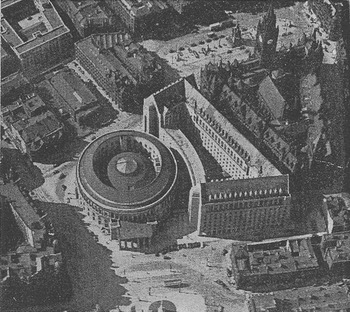
Adjacent to the library, the Town Hall Extension was opened in 1938 as part of the centenary celebrations of Manchester's incorporation. Costing £750,000, the extension included a new council chamber, Gas and Electricity Departments with their own showrooms, cinemas, and demonstration rooms,Footnote 112 and a 200 foot ‘Rates Hall’, where people paid their taxes. Manchester Corporation claimed the extension was ‘the absolute property of the Citizens’,Footnote 113 which was ‘designed with a view to the convenience of the public’ and providing ‘the seat from which the city's municipal affairs are directed, and is the centre of much of the social life of the community’.Footnote 114 These buildings are noteworthy not only because they reflected ambition not normally associated with northern England in the 1930s, but also because of the inclusive and demotic civic culture fostered by Manchester Corporation. As Figures 4 and 5 show, these new buildings were not just considered to be the ‘Civic Centre’ of the city, but also represented ‘Modern Manchester’, from which the Victorian Town Hall was noticeably marginalized.
Manchester's ‘Civic Centre’. Source: Manchester Corporation, How Manchester is managed: a record of municipal activities (Manchester, 1938), p. 16.

‘Modern Manchester’. Source: Manchester Corporation, How Manchester is managed: a record of municipal activities (Manchester, 1938), inside cover.

Municipal leaders’ investment in civic architecture reflected renewed concern about the city centres in the second half of the interwar period, following key developments in housing reform and public transport: in 1929, for instance, the city architect, Henry Price, claimed demolition in the centre had already begun and the ‘general appearance is fast changing’.Footnote 115 The corporation's new strategy paved the way for a new form of commercial architecture to emerge in the city centre that rejected Manchester's Gothic heritage.Footnote 116 Whereas Manchester's Victorian architecture was associated with the cotton trade, the most notable buildings of the interwar period reinforced the portrayal of a commercially diverse and cosmopolitan city. The Ship Canal Building (1926), the first in the new architectural style, was much taller than any other buildings in the city and required an act of parliament to overrule pre-existing regulations on building height and was intended to be ‘the focal point of a comprehensive development of the area’.Footnote 117 The period also reflected a continuation of Manchester Corporation's collaboration with private enterprise to enhance the city's architecture.Footnote 118 Other important buildings emerged in the 1930s and included Lee House, Great Bridgewater Street (1931), Sunlight House, Quay Street (1932), then the city's tallest commercial building, Kendal Milne's, Deansgate (1938), and Edwin Lutyens's Midland Bank on King Street (1935). The light Portland stone of Manchester's interwar commercial architecture represented a clear break from darker Victorian architecture of sandstone and terracotta.
The new architecture was celebrated in municipal publicity material and the local press. The Ship Canal building was ‘a sign the city was progressing’Footnote 119 and a central attraction of Manchester's Civic Week, when it was decorated with lights to provide an important aspect of evening entertainment. As the Daily Dispatch reported, this seemed to have a dramatic impact:
By far the most interesting building by the night glares was the latest skyscraper – the new offices of the Manchester Ship Canal Company. The contractors had just removed the scaffolding from the building in time for the celebrations, and the clean bold lines stood out in all their classic boldness.Footnote 120
Significantly, municipal leaders chose to floodlight the Ship Canal building and the Refuge Insurance building (completed 1910), rather than better-known Victorian buildings such as the Town Hall or Trade Hall. Between 1926 and 1937, the Manchester Guardian's semi-regular feature titled ‘A new building for Manchester’, celebrated the city's new architecture.Footnote 121 In 1927, the mayor praised Manchester's ‘recent improvement in its buildings’, suggesting ‘it was good architects now studied not only the framework of a building but the work that was to be carried in it … newspapers and especially the “Manchester Guardian” were doing great service by showing that there was something in architecture than mere building’.Footnote 122 The new buildings were consistently marketed in the press to emphasize the diversity and strength of Manchester's economy: Rylands Building was described as ‘another symbol of Manchester's enterprise’ in 1930Footnote 123 and the new Kendal Milne department store was considered a ‘modern building … one of the largest in the country’.Footnote 124 There was a far more celebratory attitude to architecture in Manchester's local press from the late 1920s onwards.
Liverpool did not aim to alter the city centre dramatically and did not make any significant investment in civic architecture. Liverpool was home to spectacular Georgian and Victorian buildings, such as St George's Hall and, in addition, the Pierhead buildings were completed in 1916. Comprising the Royal Liver Building (completed 1911), Cunard Building (1916), and Port of Liverpool Building (1907), they were not immediately popular but became celebrated and admired.Footnote 125 In contrast to Manchester, there was, therefore, a desire to improve Liverpool's existing urban fabric. Liverpool Corporation continued its pre-war town planning strategy that focused on developing a garden suburb estate and building the Queen's Drive, a six and a halfmile long circumferential boulevard around the city that was begun in 1904 and completed in 1927. The boulevard was part of Brodie's wider municipal vision for Liverpool and shared similar influences to Daniel Burnham and Edward Bennett's 1909 plan for Chicago. Brodie saw the ‘planned city in terms of municipal development in preference to the piecemeal approach of the Garden Suburb’.Footnote 126
Architects, civic leaders, and the local press all sought to consolidate links between Liverpool and New York City, a successful port and a place of glamour and amusement, to inspire confidence in Liverpool's economic future.Footnote 127 William Lever became interested in American architecture at the end of the nineteenth century, opening offices in New York City and Philadelphia in 1895 and was responsible for Reilly's first visit to the East Coast in 1909. Reilly was very impressed: ‘Ordinary American citizens … even knew the names of the architects of their chief buildings. It was very different to the outlook of the ordinary Manchester or Liverpool citizen about his town to which I was not accustomed.’Footnote 128 The experience inspired Reilly to send up to six architectural students to New York a year, until the Wall Street Crash in 1929, whilst he also imported American architectural periodicals to the University of Liverpool's library. Reilly's most famous student was Herbert Rowse, who visited America at the same time as Reilly, but stayed longer.Footnote 129 Rowse's experience of America heavily shaped the style of buildings that emerged in Liverpool during the 1930s, which ‘would not be out of place in New York or Montreal’.Footnote 130
New York's influence on architecture in Liverpool is clear from 1930, when a flurry of neo-classical and, later, modernist buildings were completed. They included India Buildings (1930), Martins Bank (1932), Philharmonic Hall (1939), and George's Dock Ventilation and Control Station (1932), which were all designed by Rowse.Footnote 131 Again, changes to Liverpool's urban environment were marketed to citizens in a way that encouraged optimism and faith in the city's economy. As early as 1924, Reilly claimed,
Liverpool, like New York, is soaring skyward. In all parts of the city splendid new buildings, such as the Adelphi Hotel, reflect the influence of the best modern American architecture. The face of some leading shipping streets is thus being gradually transformed, and the city's business houses bear witness in stone to the stability of their trade.Footnote 132
Keen to maintain links with New York, the lord mayor of Liverpool visited the lord mayor of New York City in 1931 and described Liverpool to his New York counterpart as the ‘most American of English cities’, and claimed Liverpool would also build skyscrapers.Footnote 133
V
It is, inevitably, difficult to know how far citizens accepted the images presented by municipal leaders of Liverpool's and Manchester's redevelopment. There was considerable debate in both cities about the place and form of their First World War cenotaphs, which exposes the corporations’ considerable sensitivity to public opinion. There was also a rare moment of contrast, since sectarian tensions were more evident in Liverpool's quest for a cenotaph than in Manchester.Footnote 134 Local politicians were criticized in both citiesFootnote 135 and, in particular, there were complaints about the cost of civic celebrations: ‘a large number of citizens are much opposed to such a scheme at the present time’, complained one correspondent to the Manchester Evening News, ‘who's footing the bills? If it is coming out of the public purse the sooner a protest meeting is held the better.’Footnote 136 Civic celebrations nevertheless attracted large crowds and were evidently popular in both cities; around a million people were said to have attended Manchester Civic Week in 1926 and 50,000 people a day visited Liverpool's first Civic Week in 1924.Footnote 137 Municipal leaders were certainly confident about their impact: Manchester's lord mayor claimed that ‘Civic Week has justified itself from every possible point of view, and has realised the highest expectations.’Footnote 138 Similarly, the success of Liverpool's first Civic Week caused the Post and Mercury to claim, ‘the high peak of civic patriotism was reached today’.Footnote 139 Although it is harder to ascertain how far the crowds accepted the new images they saw, the attempts of municipal leaders in Liverpool and Manchester to engage with the citizens lends weight to the suggestion that there was a greater interest in ‘the people’ and that community was the ‘buzz word’ of the interwar period.Footnote 140
Faced with a turbulent economic and political climate, municipal leaders turned to the city. Liverpool's and Manchester's unemployment figures told one story, but the cities themselves were portrayed to say something different to the local citizen. Nor were they the only northern industrial cities to invest in the urban environment: other examples of ambitious civic buildings include Sheffield City Hall (1929–32) and Leeds Civic Hall (1931–3). Civic Weeks were also hosted by Salford, Cardiff, Hull, Bristol, and Derby, and Lesley Whitworth's research on Coventry suggests such ambition was not limited to cities in crisis.Footnote 141 Further research is needed on interwar urban transformation to understand the motivations and ambitions of local politicians and planners in more detail. Nevertheless, the connections explored here between town planning and an inclusive approach to citizenship in the age of mass suffrage should not be ignored. The role of Liverpool University and the pioneering influence of Charles Reilly, especially in encouraging the local press to promote new buildings and in cultivating close links with East Coast America, must also be emphasized. The article has highlighted the innovative work of local politicians, architects, planners, and engineers in both cities, but suggests that Liverpool was at the forefront in developing strategies of civic design and urban redevelopment.
Finally, this article also supports Michael Saler's research on visual modernism, which suggests that northern England attempted to maintain its independence and autonomy against the increasing power of London between the two world wars.Footnote 142 The ambition demonstrated by municipal leaders in interwar Britain, however, signalled the final period of independence for local government. Nationalization of gas, electricity, transport, and health, alongside the advent of the Second World War and the Labour victory of 1945, all contributed to the growth of central government.Footnote 143 For Liverpool and Manchester, the shift in power was to prove disastrous and the following decades were characterized by significant population loss and dramatic economic decline.Footnote 144 Their post-1945 experience has overshadowed the relative strength and ambition of municipal power in Liverpool and Manchester between the two world wars, when, despite higher levels of unemployment and poverty than in southern England, both cities were indeed ‘soaring skyward’.Footnote 145