Women now receive political science degrees in record numbers, but female representation among political science faculty still lags behind that of many other disciplines. Only 26% of the 13,000 political science professors in the United States today are women (Sedowski and Brintall Reference Sedowski and Brintall2007). According to our recent survey of international relations faculty in the United States—the 2006 Teaching, Research, and International Politics (TRIP) Survey—women comprise an even smaller proportion of IR scholars: 77% of the IR faculty respondents are men, while only 23% are women.Footnote 1 Even more than their counterparts in the wider field of political science, women in IR tend to be more junior and less likely to hold tenure than their male colleagues. Women comprise a minority at every level of the profession, but they are most scarce at the full professor level: Only 17% of political science professors and 14% of IR professors are women (Maliniak et al. Reference Maliniak, Oakes, Peterson and Tierney2007c; Sedowski and Brintall Reference Sedowski and Brintall2007).
Women may be underrepresented in the profession and trail their male colleagues because they see the world differently; they may see the world differently because of their minority status within the discipline; or the causal arrow may run in both directions. Many feminist scholars contend that gender subordination explains significant differences in worldview between men and women. Other scholars suggest that the content of women's scholarship contributes to their marginalization within the profession: Female political scientists adopt methods and choose topics that are not considered to be the best or most rigorous types of research by the editors of leading journals.Footnote 2 As a result, “women's publishing opportunities may be restricted, or ghettoized, to specific and gendered domains” (Mathews and Anderson Reference Mathews and Anderson2001).
Regardless of the cause, the 2006 TRIP survey reveals important dissimilarities between men and women in their status in the profession, approaches to teaching and scholarship, and views on the discipline. In addition to highlighting women's minority status within the profession, and particularly within its upper ranks, our survey of IR faculty indicates that women research and teach different topics and in noticeably different ways than do their male counterparts. Women are more likely to study transnational actors, international organizations, and nongovernmental organizations, while men are more likely to study U.S. foreign policy and international security. Women study sub-Saharan Africa and Latin America; men focus on the United States and Europe. Women are more likely to describe themselves as constructivists who focus on the role of ideas and identities as explanations of world politics, while men are more likely than women to be realists who assume an anarchic international system and focus on the effects of military capabilities held by states.
To a significant extent, women are still second-class citizens within the IR profession, and their research and teaching differ in important ways from that of male IR scholars. At the same time, however, our survey reveals important similarities between men and women. Men and women graduate from many of the same Ph.D. programs. Both male and female IR specialists overwhelmingly describe their research as positivist and qualitative, although women employ qualitative methods slightly more often and are less likely than men to describe their research as positivist. Large percentages of both men and women also report subscribing to liberal IR theory.
In short, while women's research and teaching tend to focus more heavily on topics and regions outside the mainstream of the field and use nontraditional theoretical tools, male and female IR scholars also have much in common. Some apparent differences, moreover, are better explained by age or life experiences than by differences in gender. In the following pages, we paint a picture of women in IR at this particular moment in the history of the discipline. Although our data do not enable us to explain every divergence, throughout the essay we turn to existing literature to speculate on some of the reasons for the patterns we observe. The data used to discern these patterns are drawn from the 2006 TRIP survey of 1,112 IR faculty throughout the United States. For the survey, we attempted to identify and survey all faculty members in four-year colleges and universities in the United States who do research in the subfield of international relations or who teach courses on international relations. Of those identified, 41% ultimately responded to our 83-question survey on teaching, research, the discipline, and foreign policy. In the following, we highlight some of those patterns in professional status, scholarship, and teaching.
Women and the Profession
Women occupy a different place within the profession than do their male colleagues, beginning with their education and continuing throughout their careers. Women are more likely than men to have attended and then teach at a liberal arts college. They favor different Ph.D. programs. Women IR faculty members tend to be younger and more junior than the men in the profession, and their work is less recognized and valued by the discipline as a whole.
Harvard leads the list for undergraduate training of both men and women, but the similarities end there. Forty-eight percent of women received their B.A.s from American Ph.D.-granting institutions, compared with 61% of men who received B.A.s at similar institutions. More women received their B.A.s at liberal arts colleges (20%), Master's-granting institutions (12%), and foreign universities (17%). A smaller percentage of men got degrees from each of those categories (16%, 9%, and 11%, respectively).
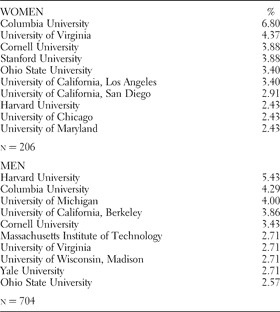
Where do women get their Ph.D.s? They attend many of the same institutions as their male colleagues, but in different numbers. Five percent of men but only 2% of women received their Ph.D.s at Harvard, the top-ranked program in our survey.Footnote 3 As the list in Table 1 shows, female IR scholars are more likely to have attended Columbia, Virginia, Cornell, Stanford, Ohio State, University of California-Los Angeles, University of California-San Diego, Chicago, or Maryland, while male colleagues are more likely to have attended Harvard, Michigan, Berkeley, Massachusetts Institute of Technology (MIT), Wisconsin, or Yale.
Ph.D.-granting institution of IR faculty by gender

Source: 2006 Teaching, Research, and International Politics (TRIP) Survey.
Gender differences persist as women move through the profession. The average female IR scholar is almost four years younger and received her Ph.D. five years later than her male colleagues. This reflects the higher percentages of women at the assistant and associate professor ranks compared to men. Of the women who participated in the survey, 41% are assistant professors, compared to only 27% of the men. Fifty-three percent of women hold tenure, compared to 62% of their male colleagues. Thirty-three percent of female respondents were associate professors, compared to 25% of men. This means that strikingly few women have reached the top of the profession—only 20% of women are full professors, compared to 37% of men, and women comprise only 14% of all full professors of IR.
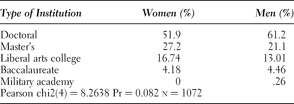
As a group, women do not have the same status within the profession as their male colleagues. First, they are less likely to teach at research universities. More women IR scholars (48%) than men (39%) teach at liberal arts colleges or universities without political science Ph.D. programs (see Table 2).
Job placement by gender
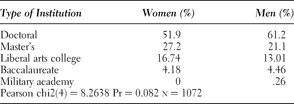
Source: 2006 Teaching, Research, and International Politics (TRIP) Survey.
This finding is somewhat at odds with results for the field of political science as a whole. The 2001–2 American Political Science Association (APSA) Survey of Departments found that 30.1% of female political scientists in the United States are employed in B.A. political science programs, 25.8% in Master's departments, and 44.1% in Ph.D. programs (Van Assendelft et al. Reference Van Assendelft, Gunther-Canada, Dolan, Palmer and Michele2003).
Second, scholarship by women is generally not as well recognized as that of male IR scholars. Only two women—J. Ann Tickner (21) and Kathryn Sikkink (25)—make the list of the top 25 scholars whose work has had the greatest impact on the field of IR in the last 20 years.Footnote 4 This list also reveals other interesting gender differences. Female respondents were less likely than men to include leading realist scholars, such as Kenneth Waltz (−8%), John Mearsheimer (–4%), and Hans Morgenthau (−4%), or influential formal modelers, such as James Fearon (−7%) and Bruce Bueno de Mesquita (−5%). They were more likely than their male colleagues to value the contributions of female scholars, including J. Ann Tickner (+8%), Cynthia Enloe (+3%), and Martha Finnemore (+3%).
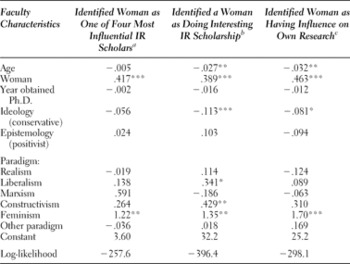
The differences are more striking when one compares rankings of scholars whose work is considered “the most interesting.” Of the top 10 scholars identified by women as producing the most interesting research in recent years, five are women. In the list of the top 10 scholars whose work is most interesting to male scholars, in contrast, there was only one woman. Martha Finnemore was the only female scholar to be ranked in the top 10 by both male and female scholars, but fully 10% more women than men included her in their list, making her their top choice.Footnote 5 It is possible that these results could be explained simply by differences in paradigmatic focus and methodology. As Table 3 shows, however, even after controlling for age and paradigm, gender is a significant predictor of whether a respondent finds the work of women scholars interesting and influential in his or her own research.
Faculty identification of women as most interesting and influential international relations scholars

* ≤ .10; ** ≤ .05; *** ≤ .01; n = 867
Source: 2006 Teaching, Research, and International Politics (TRIP) Survey.
a What factors explain whether a respondent identified a woman as being one of the “four scholars who have had the greatest impact on the field of IR over the past 20 years”?
b What factors explain whether a respondent identified a woman as being one of the scholars who “has been doing the most interesting work in international relations in recent years”?
c What factors influence whether a respondent identifies a woman as having “had the most profound impact” on their own research and the way they think about IR?
These results appear to mirror findings from the wider discipline of political science. Natalie Masuoka, Bernard Grofman, and Scott Feld find that women are significantly underrepresented on the list of the 400 most frequently cited political scientists, relative to their representation in the profession (Reference Masuoka, Bernard and Scott2007).Footnote 6
Why do women IR scholars appear to lag behind their male colleagues in rank and recognition? The research that we have conducted to date cannot answer this question definitively, but existing literature provides a wealth of potential explanations. One oft-cited reason is the differential effects on men and women of family responsibilities. Women are more likely than men to interrupt their careers to raise children, and they are more likely to become primary caregivers for children (Dinauer and Ondeck Reference Dinauer and Ondeck1999; Long Reference Long1990; McElrath Reference McElrath1992; Schneider Reference Schneider1998). Women who have children as graduate students may be more likely to drop out of school, take longer to complete their studies, fail to get a job or succeed at a job than are men who have children while they are still in school.Footnote 7 This hypothesis is supported by Viki Hesli and Barbara Burrell's finding that women have higher rates of attrition than do their male colleagues (Hesli and Burrell Reference Hesli and Burrell1995; see also Hesli, Fink, and Duffy Reference Hesli, Fink and Duffy2003b, Reference Hesli, Fink and Duffy2006).Footnote 8
A number of other explanations have been offered. One reason women lag behind men in terms of promotion and tenure may be differences in productivity. Women are more likely to hold the ranks of assistant and associate professor, according to this argument, because they produce fewer publications on average than their male counterparts (Blackburn and Lawrence Reference Blackburn and Lawrence1995; Creamer Reference Creamer1998; Dinauer and Ondeck Reference Dinauer and Ondeck1999; Roland and Fontanesi-Seime Reference Roland and Fontanesi-Seime1996; Sandler Reference Sandler1991; Sarkees and McGlen Reference Sarkees and McGlen1992; Schneider Reference Schneider1998). Although the differences are narrower than they once were, men still outpublish women in political science journals by a ratio of two to one (Converse and Converse Reference Converse and Converse1971; McElrath Reference McElrath1992; Roland and Fontanesi-Seime Reference Roland and Fontanesi-Seime1996). This gap persists even when controlling for reputation of Ph.D.-granting institution, rank, institutional type, professional age, and marital status (Creamer Reference Creamer1998; Dinauer and Ondeck Reference Dinauer and Ondeck1999; Schneider Reference Schneider1998). This difference may be in international relations than in other subfields of political science. Cheryl Young finds that between 1983 and 1994, women were less likely to publish in journals that focused on international relations (they were largely absent, for instance, from the Journal of Conflict Resolution) than in journals that focus on political institutions (like Legislative Studies Quarterly) (Young Reference Young1995). In Marijke Breuning, Joseph Bredehoft, and Eugene Walton's study of articles published in three top-tier IR journals, women were the first authors of 20.2% of articles published, although they make up 31.8% of International Studies Association members (Reference Breuning, Bredehoft and Walton2005).
Our own research provides mixed evidence for the argument that women publish less than men. We supplement our faculty survey data with a new database of all international relations articles published in the top 12 peer-reviewed IR and political science journals from 1980 to 2007.Footnote 9 Over the time period from 1980 to 2007, female IR scholars comprise only 14% of the author pool. However, if we limit our analysis to articles published from 2004 to 2007, a time period that corresponds more closely to our survey, then females make up 19% of the author pool—closer to the 23% of IR faculty who are women. While the most recent time period is relatively short, these data suggest that the gender gap in publishing may be shrinking. At the same time, however, women are more likely than men to coauthor articles. From 1980 to 2007, men published 87% of the single-authored articles appearing in these journals, while women authored only 13% of the articles. In the most recent years, 2004–7, the gap narrowed, however: 79% of single-authored articles were published by men and 21% by women.
Women are significantly more likely than their male colleagues to collaborate in their research, and they are disproportionately likely to coauthor with men, rather than with other women. They are considerably less likely, however, to be listed as the first author on these articles: 17% of second or subsequent authors are women, but women comprise only 13% of first authors.Footnote 10
Some analysts argue that the gender gap in publishing is the result not of differences in productivity but of differences among male and female political scientists in ambition, reputation, and merit.Footnote 11 Others argue that women care more about advising, administrative work, and departmental committees than research (Committee on the Status of Women 1992; Sandler Reference Sandler1991; Sarkees and McGlen Reference Sarkees and McGlen1992). Women also are more likely (65.8%) to devote eight or more hours per week to class preparation than are men (59.1%) (Boyd Reference Boyd2001).Footnote 12 Some of this may be explained by the fact that fewer women teach at Ph.D.-granting institutions, and faculty at research institutions may spend less time preparing for class than faculty at baccalaureate- or master's-granting institutions. Nevertheless, higher percentages of men (41%) than women (33%) who were on the job market in 1996 said that scholarship was the most important attribute in getting a job, and higher percentages of women (42%) than men (32%) said that teaching was the most important requirement (Mann Reference Mann1998).
Another explanation may be isolation or discrimination. In this view, women are more likely to be excluded from social networks in departments dominated by men, to receive less institutional support, and to suffer from subtle or even overt discrimination (Anonymous and Anonymous 1999).Footnote 13 Hesli and Burrell find that many more women than men moved jobs because of hostility among faculty members or superiors and that they found the work climate to be “chilly” (Reference Hesli and Burrell1995). There are fewer professional networks for women or opportunities for mentoring relationships (Creamer Reference Creamer1998; Hesli, Fink, and Duffy Reference Hesli, Fink and Duffy2003a; Lewis Reference Lewis1975; Monroe Reference Monroe2002, Reference Monroe2003). One piece of evidence for this claim may be the lower percentages of women who publish in edited volumes, since professional contacts are a key part of participating in these volumes. Indeed, edited volumes on international politics had among the lowest percentage of female authors—only 14%—even though 26% of IR scholars in APSA are women, according to Lanethea Mathews and Kristi Anderson (Reference Mathews and Anderson2001).
Another observable implication of the social network hypothesis is that women should have fewer opportunities to coauthor than men, all else being equal, and that when they do coauthor, they should be less likely to coauthor with men. However, our analysis of 2,806 journal articles in the 12 leading peer-reviewed IR journals over the past 28 years demonstrates that women are not isolated academically and are actually more likely than men to coauthor articles. In fact, women are more likely to publish a coauthored article (285) than a single-authored article (249). Men, on the other hand, are much more likely to publish single-authored articles (1,657) than coauthored pieces (796). If gendered social networks are as insidious as these scholars suggest, then women should be expected to have more difficulty engaging in collaborative opportunities to publish. Of course, it is possible that women are simply coauthoring with other women and continue to be excluded from gendered social networks. To test this claim we calculated the probability that a coauthored article with two authors would have two females, two males, or a male and female coauthor. If left to random chance, one would expect 3% of articles to be coauthored by two women, 69% by two men, and 28% by a female and a male coauthor.Footnote 14 The social network hypothesis suggests that the actual count of male-female collaboration should be lower and that male-male should be higher than random chance suggests. The evidence suggests exactly the opposite. Men are disproportionately likely to coauthor with women (32% rather than 28%), and men are less likely to coauthor with each other (65% rather than 69%).Footnote 15 So, while female faculty members may be excluded from golf and departmental poker games, there is little evidence that they are excluded from collaborative research projects that culminate in published articles. In political science, peer-reviewed journal articles (not edited volumes) are the coin of the realm when it comes to tenure and promotion.
A final explanation for the gender gap in publishing highlights the content of the research. Female political scientists may focus their research on topics—such as racial politics, politics of sexuality, gender politics—considered marginal in the field, and as a result their work may not be as highly valued (Committee on the Status of Women in the Profession 2001). For example, Meredith Reid Sarkees and Nancy McGlen find that relatively few articles on women and politics are published in leading political science journals (Reference Sarkees and McGlen1992). And when they do publish, they are less likely to be cited by male colleagues (Simeone Reference Simeone1986). The anonymous authors of “Tenure in a Chilly Climate” posit that departments are hostile to comparative, feminist, and/or nonquantitative work (Anonymous and Anonymous 1999). Steve Smith reports a similar hostility to feminist scholarship in international relations (Reference Smith, Zalewski and Parpart1998). Finally, well-qualified women may struggle due to what Kristen Renwick Monroe terms the “Ginger Rogers syndrome,” that is, the “internalization of differential standards for men and women” (2002, 238). Women still feel that they need to do more than their male colleagues to get ahead.
Given the documented gender gap in tenure and promotion, it is surprising to find that while women are clustered at the bottom of the career pyramid, those women who do advance appear to do so somewhat more quickly than their male colleagues. Women at the rank of assistant professor received their Ph.D., on average, one year earlier than men at the same rank, but female full professors received their Ph.D.s almost two years later than men at the same rank (although they are the same age, on average).
Why do those women who make it to the top seem to advance more quickly than their male colleagues? At least two hypotheses leap to mind. First, because it may be more difficult for women to advance through the profession—whether because of family obligations, discrimination, or personal choice—those female scholars who are promoted may be especially able. In short, they may advance more rapidly due to their merit and ambition. Alternatively, the speed with which women advance may be explained by the fact that senior faculty and administrators recognize gender disparities and actively seek to close the gender gap by hurrying talented female scholars through the promotion process. That is, administrators who recognize an asymmetric situation may put a thumb on the scale in tenure and promotion decisions in favor of female tenure candidates.
The Female International Relations Scholar
Although women scholars' research overlaps with men's in many ways, this research tends to focus around different regions and substantive issues. Female scholars also use different methodological and theoretical tools in their efforts to understand the world of international politics. In general, women appear more open to nontraditional topics and approaches than male faculty and more likely to employ qualitative methods than quantitative tools or formal models. In addition to their heavier focus on constructivism and their greater proclivity to adopt postpositivist epistemologies, female scholars believe that their research has more practical applications than do men.
Women study substantively different issue areas. Higher percentages of female than male faculty study international organization (+6%), international political economy (+3%), international law (+2%), the environment (+2%) and human rights (+1%). Higher percentages of men, in contrast, study U.S. foreign policy (+13%), international security (+6%), IR theory (+2%), and comparative foreign policy (+1%). These findings are consistent with evidence from the broader field of political science. The APSA divisions with the lowest female representation include international security and arms control, international collaboration, foreign policy, conflict processes, and international history and politics (Gruberg Reference Gruberg2007). Indeed, fewer women are found in the field of IR than in American and comparative politics (Sedowski and Brintall Reference Sedowski and Brintall2007).
When asked about their regional focus, higher percentages of women respondents than their male colleagues on the TRIP survey reported that they studied transnational actors, international organizations, and nongovernmental organizations (+8%) and used cross-national data (+3%). Higher percentages of female scholars also study sub-Saharan Africa (+4%) and Latin America (+3%). Higher percentages of male IR scholars, in contrast, study the United States (+8%), Canada and Western Europe (+6%), and Oceania (+4%). These differences become more marked when we compare absolute numbers: In our sample, 10 times more men than women (90 versus 9) report that their primary area of study is the United States. That is, 10.5% of men but only 3.5% of women in our sample report that they study the United States. The differences between men and women in the regional focus of their research may be explained in part by differences in substantive areas of study. It is not surprising, given their greater interest in international security and American foreign policy, that male scholars in higher numbers study the regions in which most of the traditional great powers are located.
In addition to their different substantive foci, female IR scholars choose different theoretical tools to study international phenomena. In the field of IR, realism and liberalism remain the two predominant theoretical paradigms. In the 2006 survey, 25% of IR scholars identified themselves as realists and 31% said they were liberals, but a third school—constructivism—is gaining adherents rapidly. In our 2004 survey, 15% of scholars self-identified as constructivists; two years later, the number jumped to 19%. A slightly different picture emerges when one breaks down these results by gender. A considerably larger percentage of women (29%) than men (16%) said they were constructivists. Indeed, constructivism was the most preferred paradigm for women, followed by liberalism (27%). This suggests that the growth of constructivism in the discipline may be driven in part by an increasing number of female scholars who study IR.Footnote 16 In contrast, only 14% of women said they were realists, compared to 28% of men. Indeed, for men, realism is the second most favored paradigm (28%) after liberalism (33%). Another striking, though not terribly surprising, finding here is that while 6% of women said they were primarily committed to feminism as the paradigm guiding their research, less than 1% of men described their work as feminist.
These results suggest a greater tendency among women to employ nontraditional paradigms in their research—paradigms that arose in part as a reaction to the dominance of realism and liberalism. This tendency may be explained, as Ann Tickner contends, by the fact that women's status in society helps them to see women's (and other minorities') marginality in scholarship (Tickner Reference Tickner2001). Laura Sjoberg and Caron Gentry similarly argue that women's experiences teach them that autonomy is relational or constrained by social relationships (Reference Sjoberg and Gentry2007). Sjoberg notes that
Realism and Liberalism both to some degree hold a “social contract” view of obligation, where individuals and states rationally negotiate their situations and freely choose among policy options. Constructivism sees more intersubjectivity. This is likely to reflect a difference in men's and women's lives—where men's choices are more likely to be experienced as completely or almost completely free, whereas women will have obligations … which they did not choose and cannot escape without taking some sort of constrained action. In other words, men may be more likely to be realists and women more likely to be constructivists because those theories reflect how they experience the world. (Email Correspondence with Laura Sjoberg, 12 May Reference Sjoberg and Gentry2007.)
Regardless of the explanation, women IR scholars are more likely to adopt nontraditional approaches to the study of their subject.
Women scholars' marginal status in the profession and preference for nonmainstream theories also may influence their reading of the IR literature. Indeed, women think that higher percentages of the literature are devoted to realist and liberal scholarship than do men. When asked to estimate how much of the IR literature is devoted to each paradigm today, higher percentages of women (53%) than men (48%) said that between half and three-quarters of the literature focuses on realism and liberalism. At the same time, female IR scholars believe that constructivism and feminism are having a significant impact on the field. Ten percent more women than men indicated that between one-quarter and one-half of the research in the field of IR now focuses on constructivist research. Similarly, women estimate that a higher percentage of the literature is devoted to feminism than do men. Female IR scholars, in short, report a belief that higher percentages of the literature are devoted to liberalism and realism, on the one hand, and feminism and constructivism, on the other. Men are more likely to describe a larger percentage of the literature as nonparadigmatic. Women's views on this issue may be explained by their minority or “outsider” status in the profession. Women tend to be more familiar than their male counterparts with, and more open to, nontraditional approaches, including feminism and constructivism, and to see these approaches reflected in the IR literature. At the same time, however, women also know that such approaches remain marginalized within the discipline and tend to describe the literature as more heavily dominated by mainstream approaches than do their male colleagues.
Like their male colleagues, female IR scholars in the United States are overwhelmingly positivist. Sixty-five percent describe themselves as positivists, compared with 70% of respondents overall. There are higher percentages of women (21%) than men (12%), however, who identify themselves as postpositivists. This result is likely explained by women's support for feminism and constructivism, many of the proponents of which are deeply skeptical of positivism as an approach to international relations.
Considerable consensus also exists among men and women about their choice of methodological tools. A slightly higher percentage of women (72%) than men (68%) identify qualitative analysis as their primary methodological approach, and a slightly higher percentage of men (22%) than women (19%) identify quantitative analysis as their primary methodology. These findings are consistent with Marijke Breuning, Joseph Bredehoft, and Eugene Walton's study, which finds that articles in top-tier IR journals whose first author is female use qualitative methods 56.3% of the time, while only 47.5% of the articles with male first authors use qualitative methods (Reference Breuning, Bredehoft and Walton2005). Articles by female authors use quantitative and mathematical approaches 43.7% of the time, while 52.5% of articles by men employ these approaches (Ibid. 2005).
The largest gap between male and female IR scholars in terms of methodology is in the use of formal modeling. Less than 1% of women use formal models as their primary method and only 4% use them as a secondary method. Alternatively, 13% of male scholars use formal models in their research, though like their female counterparts, most male scholars describe it as a secondary method. In absolute numbers the difference appears even more striking. Of the 122 people in the sample who indicated that formal modeling was either their primary or secondary methodology, only 12 were women.
Female IR scholars may see a closer link between IR research and IR practice than their male counterparts. A slightly higher percentage of male (14%) than female (11%) IR scholars say that they have an immediate policy application in mind when conducting their research, but a higher percentage of men also say that they conduct research for the sake of knowledge and do not think about its immediate policy relevance. The vast majority of women say that they produce both basic and applied research. Despite the infrequency with which they use quantitative analysis in their own research, moreover, female IR scholars are quite positive about the usefulness of this research to policymakers. A surprising 75% of female respondents said that quantitative research was “very useful” or “somewhat useful” to policymakers. Men, who are more likely to use quantitative methods in their own research, were actually more skeptical about its utility for policy practitioners: Only 56% described studies using quantitative methods as “very useful” or “somewhat useful” to foreign policy decision makers.Footnote 17
In general, women judge the practical utility of all types of IR research —including theoretical models, historical and contemporary case studies, and policy analysis—more favorably than do men. One possible explanation for this result is that women are less likely than men to have experience working in the policy world. Fewer female IR scholars have worked or consulted for the United States or foreign governments, international organizations, nongovernmental organizations, or think tanks. Fifty-two percent of women and 65% of men are paid for such work outside of the academy. The gap is narrower for unpaid work: 61% of women work in an unpaid capacity for one of these entities, compared to 67% of men. Fifteen percent of women work for the U.S. government in a paid capacity versus 19% of men, and 6% fewer women work for interest groups in either a paid or unpaid capacity. At the same time, similar percentages of women and men are paid for work done for nongovernmental organizations—and more women (25%) than men (16.8%) work for these organizations in an unpaid capacity.
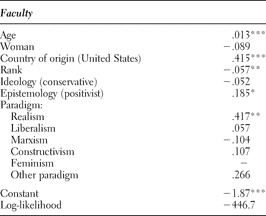
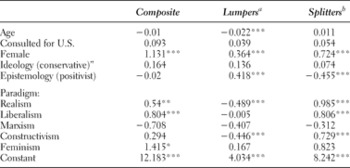
Gender alone cannot explain different levels of policy work among IR faculty. Other than whether a respondent is born in the United States, the single most important determinant of whether an IR scholar consults for the U.S. government is whether he/she is a realist. Since women are less likely than their male counterparts to subscribe to realism, they also are less likely to consult for the government (see Table 4).
Characteristics of faculty consultants for U.S. government (paid or unpaid)

According to Stephen Krasner, who has worked in the White House National Security Council and as director of policy planning at the State Department, “Almost none of the research we do in political science has much of an effect on policy makers. They don't have time to read the stuff we write and they would ignore most of it if they did have the time. It does happen occasionally, but it is just very rare.”Footnote 18 To the extent that Krasner is correct, one might expect that those who have worked for the U.S. government—regardless of gender—would be more skeptical about the usefulness to policymakers of all types of academic research. We find, however, that consulting experience has no effect on whether IR scholars believe that political science research is useful to policymakers. Instead, when asked about six different types of research (theoretical models, quantitative studies, area studies, historical case studies, contemporary case studies, and policy analysis), women IR experts are more likely than men to judge their utility for policymakers favorably. As column one of Table 5 illustrates, the gender variable is positive and statistically significant, even controlling for age, paradigm, epistemology, consulting experience, and political ideology. Finally, realist and liberal IR scholars appear to believe that all types of IR research are useful for making policy, while positivists are, perhaps surprisingly, more skeptical of the utility of this research than are non- or postpositivists.
Utility of political science approaches to policymakers

* ≤ .10; ** ≤ .05; *** ≤ .01; n = 858
Source: 2006 Teaching, Research, and International Politics (TRIP) Survey.
Notes: For this question, respondents were asked, “How useful are the following kinds of political science research to policymakers?” and then were asked to choose from “Very useful,” “Somewhat useful,” “Not very useful,” and “Not useful at all.” We assigned these the number values of 3, 2, 1, 0, respectively. The Composite column is the result of an OLS model with the dependent variable as the sum of all choices for all six categories of research. Lumpers is calculated similarly, with the dependent variable only the sum of “Theoretical models” and “Quantitative studies.” Splitters is calculated with the dependent variable as the sum of “Area studies,” “Historical case studies,” “Contemporary case studies,” and “Policy analysis.”
a Scholars who focus on similarities among phenomena to produce generalizable theory.
b Scholars who focus on differences among phenomena to produce case-specific explanations.
Some interesting differences emerge when we divide types of IR research into two groups: “lumpers” and “splitters.” These terms, first used by the historian J. H. Hexter, describe the debate between scholars who tend to look for similarities among phenomena and seek to produce generalizable theory (which he termed the “lumpers”) and those who emphasize difference (the “splitters”) (Hexler Reference Hexler1975). Columns two and three illustrate how scholars' views differ depending on the type of research, specifically whether the research uses theoretical models and quantitative methods (these authors are generally “lumpers”) or historical/contemporary case studies, area studies, and policy analysis (these authors are more likely to be “splitters”).
Again, experience in government does not seem to make scholars more skeptical about the usefulness of academic research for government—the variable is not statistically significant in any of the models we estimated.Footnote 19 However, realists, liberals, and constructivists value methods, such as historical case studies, that emphasize nuance and difference, and judge lumping methods, like theoretical models, as less useful for policymakers. In contrast, having a positivist epistemology has a strong, positive effect on IR scholars' attitudes toward lumping methods, and a negative effect for splitting methods; both are significant. Thus, while they appeared to be skeptical of the usefulness of all types of research in the composite model, by disaggregating the dependent variable, we can see that positivists are simply more skeptical of some types of approaches (namely, qualitative methods). Perhaps the most striking result is that gender is the only variable that is positive and significant for both categories of research: The evidence clearly suggests that female IR scholars view all types of research as more useful to policymakers than do their male colleagues.
The Female International Relations Teacher
Do women teach differently than men? More specifically, do students who take Introduction to International Relations with a woman get a different view of the field than if they took the same course with a male scholar? The answer, at least in part, is yes. Not surprisingly, many of the differences in women's research on IR translate into differences in teaching about the subject.
Women's greater use of constructivism and feminism in their research is reflected in the amount of time they devote to each theoretical paradigm in the classroom. When teaching an introductory course on IR, women spend more class time than do men on feminism and constructivism and slightly less on realism.Footnote 20 Fully half of female IR scholars devote between 6% and 25% of their introductory course to discussing constructivist arguments, while a little over one-third of male IR scholars discuss this paradigm to the same extent. The divergence is even greater in the case of feminism: More than one-third of women report spending between 6% and 25% of the class discussing feminism, whereas only one-sixth of men spend a similar amount of time on the paradigm.
It is interesting to note that women also give more class time to Marxism than do men—even though women and men are equally unlikely to identify themselves as Marxists (3% and 2%, respectively). Half of women spend between 6% and 25% of the class discussing Marxism, while only one-third of men spend the same amount of time introducing students to Marxist ideas. Women, in short, spend more time discussing theoretical alternatives to realism and liberalism, even those to which they personally do not subscribe.
The observed divergences in substantive and regional focus also manifest in the classroom. Higher percentages of women than men teach international organization (+15%), human rights (7%), global development (6%), and environmental politics (6%). Although women made up only 23% of the sample, 40% of the respondents who said they teach courses on human rights were women; 34% of the respondents who teach global development were women; and 33% of the respondents who teach international organization were women. Significantly higher percentages of men teach U.S. foreign policy (17%), international security (10%), and IR theory (6%).Footnote 21 Differences in regional focus between male and female faculty are limited, however. Somewhat more women than men report devoting significant time in their introductory classes to Latin America (2%) and sub-Saharan Africa (2%), and slightly fewer women than men devote significant attention to the former Soviet Union or Eastern Europe (–2%). Otherwise, the classes are remarkably similar in their regional foci.
Women's faith in the policy relevance of IR research does not appear to translate into a greater emphasis in the classroom on the “practice” of international relations. Higher percentages of men than women report that the purpose of their introductory classes is to “help students become informed participants in debates about foreign policy and international politics,” rather than to introduce them to the academic debates in the discipline. Higher percentages of women than men said both matter, but women spent more time familiarizing students with the scholarly discipline of IR. Once we control for age, however, the role of gender drops out. Younger scholars fresh out of their graduate training focus their teaching more on the scholarly debates and less on preparing students to become informed participants in policy debates about international politics and foreign policy.
Conclusion
Our primary goal in this essay is not to explain perceived differences between men and women in IR but to begin documenting them. The TRIP survey, the most extensive and systematic survey to date of IR scholars in the United States, provides an unprecedented ability to track views on teaching, research, and the discipline.Footnote 22 Originally conducted in 2004 and repeated in 2006, the survey will be conducted every two years and thus will provide researchers the opportunity to monitor changes in attitudes over time. These data will provide an important window into the role of women in the profession, as well as similarities and differences among men and women in their views on teaching, research, and the discipline.
This essay presents a snapshot view of those issues, which, we hope, will provide some grist for the mill of critics and commentators, as well as a baseline for future studies on these issues. The 2006 TRIP survey of IR faculty reveals a profession in which women comprise a minority at every rank and especially at the level of full professor. Women are more likely than their male colleagues to teach in B.A. than Ph.D. programs, and their work is less likely to be recognized as interesting and important by their mostly male colleagues. They are more likely than men to identify themselves as constructivists, feminists, and postpositivists, and they are less likely than men to use quantitative or formal methods. Despite these significant differences, women scholars of IR also reflect substantial similarities to their male colleagues. Both men and women's work tends to be highly qualitative and positivist, and both subscribe to liberalism in large percentages. Future iterations of the survey will allow us to determine whether these similarities grow as women's representation in the profession grows.