Introduction
Acetyl-CoA carboxylase (ACCase)–resistant rice technology (Provisia™) was first evaluated for its potential use in rice-producing states in the midsouthern United States in 2014 (Lancaster et al. Reference Lancaster, Norsworthy and Scott2018). The Provisia technology allows POST applications of quizalofop, which blocks fatty acids synthesis through ACCase inhibition (Anonymous 2017). Quizalofop was first registered for use in soybean [Glycine max (L.) Merr] in the late 1980s, followed by registration in cotton (Gossypium hirsutum L.) in the early 1990s (Shaner Reference Shaner2014). Quizalofop controls non-ACCase-resistant red rice [Oryza sativa (L.) Lombardy], as well as volunteer conventional rice, hybrid rice, IR rice types; and other common annual and perennial grasses such as barnyardgrass [Echinochloa crus-galli (L.) P. Beauv.] (Anonymous 2017). However, quizalofop does not control sedges or broadleaf weeds.
Florpyrauxifen-benzyl is a POST herbicide developed by Corteva Agrisciences for control of broadleaf, grass, and sedge weeds, and it is a member of the synthetic auxin herbicide family, the arylpicolinates (Epp et al. Reference Epp, Alexander, Balko, Buysse, Brewster, Bryan, Daeuble, Fields, Gast, Green, Irvine, Lo, Lowe, Renga, Richburg, Ruiz, Satchivi, Schmitzer, Siddall, Webster, Weimer, Whiteker and Yerkes2016). Herbicides classified as synthetic auxins mimic the naturally occurring plant hormone indole-3-acetic acid. Synthetic auxins are commonly used to control dicot weed species in grass crops (Grossmann Reference Grossmann2010); however, florpyrauxifen-benzyl also controls some monocot weeds (Epp et al. Reference Epp, Alexander, Balko, Buysse, Brewster, Bryan, Daeuble, Fields, Gast, Green, Irvine, Lo, Lowe, Renga, Richburg, Ruiz, Satchivi, Schmitzer, Siddall, Webster, Weimer, Whiteker and Yerkes2016). Therefore, florpyrauxifen-benzyl could be utilized as a management option for monocot and dicot weed species resistant to acetolactate synthase inhibitors, photosystem II inhibitors, and quinclorac.
Rice cultivars can vary in tolerance to herbicides (Ampong-Nyarko and De-Datta Reference Ampong-Nyarko and De-Datta1991). Variability in cultivar tolerance has been documented based on differences in cultivar growth rate, growth stage, morphology, and physiology (Ampong-Nyarko and De-Datta Reference Ampong-Nyarko and De-Datta1991; Bond and Walker Reference Bond and Walker2011; Griffin and Baker Reference Griffin and Baker1990; Zhang and Webster Reference Zhang and Webster2002; Zhang et al. Reference Zhang, Webster and Leon2005). Previous research has indicated that long-grain cultivars exhibit greater herbicide tolerance than medium-grain or hybrid cultivars (Bond and Walker Reference Bond and Walker2011, Reference Bond and Walker2012; Bond et al. Reference Bond, Walker, Webster, Buehring and Harrell2007; Scherder et al. Reference Scherder, Talbert and Clark2004; Willingham et al. Reference Willingham, McCaulet, Senseman, Chandler, Richburg, Lassiter and Mann2008; Zhang and Webster Reference Zhang and Webster2002; Zhang et al. Reference Zhang, Webster, Blouin and Linscombe2004). ‘Jodon’ was injured 13% when data were pooled over triclopyr rates, growth stages, and years; however, ‘Bengal’, ‘Cypress’, and ‘Kaybonnet’ were injured 8% (Jordan et al. Reference Jordan, Sanders, Linscombe and Williams1998). Bond and Walker (Reference Bond and Walker2012) reported variable tolerance among rice cultivars to postflood quinclorac applications, with rough rice yields of the inbred ‘Cheniere’ and the hybrid ‘XL723’ reduced more than that of the inbred cultivar ‘Bowman’.
Florpyrauxifen-benzyl and quizalofop were available for POST applications to rice in 2018 (Anonymous 2017, 2018b). Previous research in Mississippi has demonstrated that rice cultivars respond differently to florpyrauxifen-benzyl (Corban et al. Reference Corban, Bond, Golden, Sanders, Lawrence and Edwards2018). Additionally, little is known about the response of ACCase-resistant rice cultivars and advanced lines to POST herbicides. Therefore, research was conducted to evaluate growth and yield of two IR rice cultivars and six ACCase-resistant rice cultivars and advanced lines following POST applications of florpyrauxifen-benzyl.
Materials and Methods
A field study was conducted at the Mississippi State University Delta Research and Extension Center in Stoneville, MS, in 2017 (33.44°N, 90.90°W) and 2018 (33.44°N, 90.90°W) to characterize the response of ACCase-resistant rice cultivars and advanced lines to POST applications of florpyrauxifen-benzyl. Soil both years was a Commerce silty clay loam (Fine-silty, mixed, superactive, nonacid, thermic Fluvaquentic Endoaquepts) with a pH of 7.1 and an organic matter content of approximately 1.7%. Clomazone (Command 3 ME, 498 g ai ha–1; FMC Corp., Philadelphia, PA) plus saflufenacil (Sharpen 2.85 SC, 4.5 g ai ha–1; BASF Crop Protection, Research Triangle Park, NC) was applied PRE each year for residual weed control. Bispyribac-sodium (Regiment 80 WP, 28 g ai ha–1; Valent U.S.A. Corp., Walnut Creek, CA) plus halosulfuron (Permit 75 DF, 12 g ai ha–1; Gowan Co., Yuma, AZ) plus a proprietary blend of methylated seed oil/organosilicon/urea-ammonium nitrate (MSO/OSL/UAN) (Dyne-A-Pak, proprietary blend of polyalkyleneoxide-modified polydimethylsiloxane, nonionic emulsifiers, methylated vegetable oils, and nitrogen fertilizer solution; Helena Chemical Co., Collierville, TN) at 1% (v/v) was applied to rice in the two- to three-leaf (EPOST) growth stage to maintain experimental sites weed-free.
Rice was drill-seeded on May 9, 2017, and May 2, 2018, to a depth of 2 cm using a small-plot grain drill (Great Plains 1520; Great Plains Manufacturing, Inc., Salina, KS). Inbred rice cultivars were seeded at 356 seeds m–2 each site-year; however, because of heterosis, CLXL 745 was seeded at 161 seeds m–2, as recommended by the manufacturer (Anonymous 2018a). Plots consisted of eight rows of rice spaced 20 cm apart and 4.6 m in length and were flooded to an approximate depth of 6 to 10 cm when rice reached the one- to two-tiller stage and within 5 d of treatment application. Treated plots were bordered on either end by a 1.5-m fallow alley. Nitrogen fertilizer was applied at 168 kg ha–1 as urea (46-0-0) immediately prior to flood establishment (Norman et al. Reference Norman, Slaton and Roberts2013). Rice was managed throughout the growing season utilizing local guidelines to optimize yield (Buehring Reference Buehring2008).
Treatments were arranged as a two-factor factorial within a randomized complete block design and four replications. Factor A was rice cultivar and consisted of IR rice cultivars CL163 and CLXL 745, and ACCase-resistant rice cultivars PVL01, PVL013, PVL024-B, PVL038, PVL080, and PVL081. Factor B was florpyrauxifen-benzyl application rates of 0 (nontreated control for each cultivar) and 58 g ai ha–1 applied to rice in the four-leaf to one-tiller (LPOST) growth stage. Applications of florpyrauxifen-benzl were made at twice the labeled rate to evaluate herbicide tolerance and included the addition of methylated seed oil (MSO with Leci-Tech, 100% methylated vegetable oil; Loveland Products, Greeley, CO) at 0.83% (v/v) (Anonymous 2018b).
Visible estimates of aboveground rice injury were recorded 3, 7, 14, 21, and 28 d after treatment (DAT) on a scale of 0 to 100%, where 0 indicated no visible effect of herbicide treatment and 100% indicated complete plant death. Plant heights were determined at maturity by measuring from the soil surface to the uppermost extended leaf and calculating the mean height of five randomly selected plants in each plot. The number of days to 50% heading was recorded as an indication of rice maturity by calculating the time from seedling emergence until 50% of rice plants in an individual plot had visible panicles. Rice was harvested with a small-plot combine (Wintersteiger Delta; Wintersteiger, Inc., Salt Lake City, UT) at a moisture content of approximately 20% and subsamples were collected for milling. Whole and total milled rice yields were determined from cleaned 120-g subsamples of rough rice using the procedure outlined by Adair et al. (Reference Adair, Bollich, Bowman, Jodon, Johnston, Webb and Atkins1972). Rough rice was mechanically hulled, milled in a Grainman No. 2 miller (Grain Machinery Manufacturing Corp., Miami, FL) for 30 s, and size-separated with a No. 12, 4.76-mm screen. Whole and total milled rice yield were calculated as a mass fraction of the original 120-g sample of rough rice. Final rough rice grain yield was adjusted to 12% moisture content.
Because of inherent differences in plant height, maturity, and yield potential among the rice cultivars, data for number of days to 50% heading, height, and rice yield (rough, whole, and total milled rice) were converted to a percentage of the control (florpyrauxifen-benzyl at 0 g ha–1) for the respective cultivar in each replication. Percentage of control data were calculated by dividing data from the treated plot by that in the control plot in each replication of the same cultivar and multiplying by 100.
Arcsine transformations of the square roots of visible injury estimates were performed to improve homogeneity of variances. The transformation did not improve homogeneity of variance based on visual inspection of plotted residuals; therefore, nontransformed data were used in analyses. Data from control plots for each cultivar were deleted prior to analysis of rice injury estimates to stabilize variance. Nontransformed data were subjected to the Mixed Procedure (Statistical software Release 9.3, SAS Institute Inc., Cary, NC) with year and replication (nested within year) as random-effect parameters (Blouin et al. Reference Blouin, Webster and Bond2011). Type III statistics were used to test the fixed effect of rice cultivar. Least square means were calculated, and mean separation (P ≤ 0.05) was produced using PDMIX800, which is a macro from SAS for converting mean separation output to letter groupings (Saxton Reference Saxton1998).
Results and Discussion
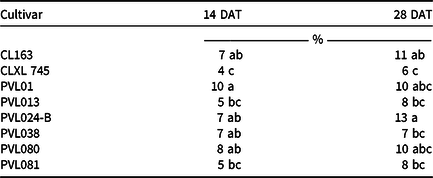
Injury symptoms appeared as minor stunting, swelling near the base, and leaf twirling. No differences in injury were detected at 3, 7, and 21 DAT. At 14 DAT, injury to PVL01 was 5% to 6% greater than for CLXL 745, PVL013, and PVL081; however, injury was ≤10% 14 DAT for all cultivars (Table 1). By 28 DAT, florpyrauxifen-benzyl injury to CL163 and PVL024-B was 11% to 13%, and this injury was greater than that of CLXL 745.
Visible estimations of injury 14 and 28 d after treatment (DAT) for eight rice cultivars treated with florpyrauxifen-benzyl at 58 g ai ha–1 at Stoneville, MS, in 2017 and 2018. a

a Data were pooled over two experiments. Means within a column followed by the same letter are not different at P ≤ 0.05.
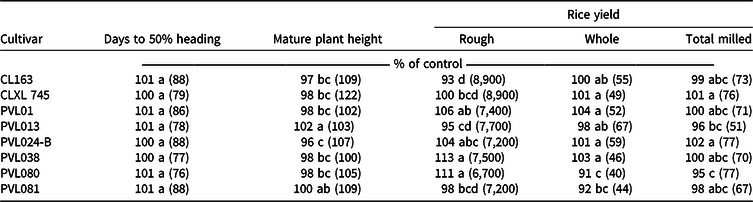
No differences in maturity (number of days to 50% heading) were detected among the cultivars (Table 2). Although mature plant heights for the other cultivars except PVL081 were less than that for PVL013 (102% of the control), mature plant heights for all cultivars were ≥96% of the control. Therefore, differences in plant height were of little consequence even though they were statistically significant.
Days to 50% heading, mature plant height, and rough, whole, and total milled rice yield for eight rice cultivars treated with florpyrauxifen-benzyl at 58 g ai ha–1 at Stoneville, MS, in 2017 and 2018. a–c

a Data were pooled over two experiments. Means within a column followed by the same letter are not different at P ≤ 0.05.
b Percentage of control data were calculated by dividing data from the treated plot by that in the control plot of the same cultivar and multiplying by 100.
c Numbers in parentheses represent days to 50% heading (days after emergence), mature plant height (cm), rough rice yield (kg ha–1), whole milled rice yield (%), and total milled rice yield (%) for each cultivar.
Rough rice yield was ≥100% of the control for all cultivars except PVL081, PVL013, and CL163 (Table 2). Florpyrauxifen-benzyl application reduced rough rice yield of CL163 more than PVL01, PVL024-B, PVL038, and PVL080. Even though differences in rough rice yields were detected, rough rice yields for all cultivars were ≥93% of the control. An explanation for some cultivars producing rough rice yield ≥100% of the control was not apparent from the data collected in the current study. Additional investigation into the response of the rice plant following application of florpyrauxifen-benzyl is warranted. Whole milled rice yield for PVL080 and PVL081 were 91% and 92% of the control, respectively, and less than the other cultivars. Although differences were detected, total milled rice yield was ≥95% of the controls for all cultivars.
Previous research has reported different results for rice cultivar tolerance to herbicides. Glufosinate applications to glufosinate-resistant cultivars delayed maturity 7 to 15 d for medium-grain and only 3 to 5 d for long-grain cultivars (Lanclos et al. Reference Lanclos, Webster, Zhang and Linscombe2003). In the current study, florpyrauxifen-benzyl applications did not delay maturity for any of the cultivars evaluated. Scherder et al. (Reference Scherder, Talbert and Clark2004) evaluated 14 commercial long- and medium-grain cultivars and 4 experimental cultivar lines, and observed that the experimental ‘RU961096’ was less tolerant to clomazone than other cultivars. Additionally, hybrid cultivars were reported to be less tolerant to preflood applications of saflufenacil and postflood applications of imazamox and quinclorac (Bond and Walker Reference Bond and Walker2011, Reference Bond and Walker2012; Montgomery et al. Reference Montgomery, Bond, Golden, Gore, Edwards, Eubank and Walker2014). Days to 50% heading, mature plant height, and rice yield (rough, whole, and total milled rice) were ≥98% of the control for CLXL 745 following florpyrauxifen-benzyl (Table 2), indicating that the hybrid cultivar was tolerant. Based on visible-injury estimations, the experimental PVL024-B was the least tolerant cultivar 28 DAT (Table 1). Differences among parent lines may explain differential tolerance between inbred and hybrid cultivars or commercial cultivars and experimental lines. Despite observed injury, yields (rough, whole milled, and total milled) were all ≥91% of the control for all cultivars.
Zhang and Webster (Reference Zhang and Webster2002) and Zhang et al. (Reference Zhang, Webster, Blouin and Linscombe2004) reported that differences in herbicide tolerance among rice cultivars were more easily distinguished when twice the registered rate of the herbicide was used for screening tolerance. In IR rice, Bond and Walker (Reference Bond and Walker2011) observed that CLXL 745 was less tolerant than other hybrid cultivars to imazamox at two times the labeled use rate, and even labeled rates of imazamox reduced rough rice yield of CLXL 745. Corban et al. (Reference Corban, Bond, Golden, Sanders, Lawrence and Edwards2018) reported that two applications of florpyrauxifen-benzyl at twice the labeled rate injured CL163 and CLXL 745 more than other cultivars 14 and 28 d after LPOST application. Current labeling only allows application of florpyrauxifen-benzyl at 29 g ha–1. However, in commercial fields, irregularities in herbicide application such as overlapping sprays could occur that would make the florpyrauxifen-benzyl rate from this research possible under some commercial field situations. Additionally, Corban et al. (Reference Corban, Bond, Golden, Sanders, Lawrence and Edwards2018) reported that rice maturity (number of days to 50% heading) was delayed 2 to 3 d for CL163 and CLXL745 following applications of florpyrauxifen-benzyl at 58 g ha–1. Although differences in rice injury and agronomic parameters were observed in the current study, no patterns in response were detected that would confirm one cultivar as being consistently more sensitive to florpyrauxifen-benzyl among the cultivars evaluated.
The current research demonstrates that florpyrauxifen-benzyl can safely be applied POST to rice cultivars grown in Mississippi as well as ACCase-resistant cultivars that are currently under development. Screenings for tolerance as new cultivars are commercialized should continue to monitor for potential damage with florpyrauxifen-benzyl.
Acknowledgments
This publication is a contribution of the Mississippi Agricultural and Forestry Experiment Station. Material is based on work supported by the National Institute of Food and Agriculture, U.S. Department of Agriculture, Hatch project under accession number 199080. The authors would like to thank the Mississippi Rice Promotion Board for partially funding this research. We thank personnel at the Mississippi State University Delta Research and Extension Center for their assistance. No conflicts of interest have been declared.