


Equity in health care financing has been an important research topic since the early 1990s and was recognised by the World Health Organisation (WHO) as a relevant dimension for the evaluation of health system performance more than a decade ago (WHO, 2000). There is broad consensus on the normative assumption that health care payments should be linked to capacity to pay with use related to need, and that all households should be protected against catastrophic financial loss related to ill health. Still, Smith (Reference Smith2013) argues that it has taken a surprisingly long time for the importance of financial protection against the consequences of ill health to be properly recognised.
Two main approaches have been used to assess equity in health care financing. One is based on progressivity indices and evaluates the impact of health payments on income distribution. If these payments lead to inequality in income distribution, to the advantage of the better off (worse off), then they are characterised as regressive (progressive). If the distribution of income is exactly the same before and after health payments then contributions to the health system are proportional. The other approach focusses more on catastrophic health expenditure (CHE), i.e., expenditure so high that it might mean that people have to cut down on basic necessities such as clothing or education. Moreover, it can push individuals and families into a cycle of health and poverty, where lower income exposes them to poorer living conditions, which in turn adversely affects their health, leading to more health care expenses (Wagstaff, Reference Wagstaff2002). CHE is more likely in low and middle income countries, which tend to lack prepayment mechanisms (such as tax or health insurance) for risk pooling. Nonetheless, catastrophic expenditure might also be found in other countries due to out-of-pocket payments (OOP). Empirical data show that CHE remains low in countries where OOP represent <15–20% of total national health expenditure and where general government health spending is >5–6% of gross domestic product (GDP) (WHO, 2010). This agrees with a study for the European region that found a negative correlation between the weight of government health spending (in relation to GDP) and the weight of OOP in total health expenditure (WHO, 2009). In this study, Portugal presented the highest share of OOP in total health expenditure within the group where government health spending was between 7 and 8% of GDP. Given the risk thresholds for CHE mentioned above, Portugal falls in the high risk group according to the first criterion (i.e. in 2010, OOP accounted for 26% of total health expenditure); however, according to the second criterion, Portugal should have a low risk of CHE (government health care spending in 2010 corresponded to 7% of GDP) (WHO, 2013).
There are few studies focussing on health care financing in Portugal. An early study (Wagstaff and van Doorslaer, Reference Wagstaff and van Doorslaer1992) based on data from the Portuguese Family Income and Expenditure Survey 1980/1981 concluded that OOP were regressive (Kakwani index value −0.149), while overall payments tended to progressivity (Kakwani index value 0.063). Later, using data from the Family Budget Survey 1989/1990, Wagstaff et al. (Reference Wagstaff, van Doorslaer and van der Burg1999) presented evidence showing that if all forms of financing were taken into account, the system was slightly regressive (index value −0.0445) with direct payments being regressive (index value −0.2424). Two other studies calculated progressivity indices for OOP using the Household Budget Survey 2000 (Simões et al., Reference Simões, Barros and Pereira2007) and the National Health Survey 2005/2006 (Quintal and Venceslau, Reference Quintal and Venceslau2011). Both found that payments were particularly regressive in the case of medicines (index values of −0.328 and −0.4325, respectively). The latter study also found that the regressivity of OOP increased after considering reimbursements. In terms of catastrophic expenditure, a large study (covering 59 countries) concluded that 2.71% of Portuguese households incurred catastrophic expenditure (data drawn from Household Budget Survey 1995) (Xu et al., Reference Xu2003). This study included 19 of the current 28 EU Member States. Among these, Portugal (after Latvia with a prevalence of 2.75) had the second highest percentage of families with CHE, followed by Greece with 2.17%. More recently Kronenberg and Barros (Reference Kronenberg and Barros2014) used data from the Household Budget Surveys 2000 and 2005 and found that the percentage had risen to 7% and then fell to 5%.
Given the persistence of a high share of OOP in total health care expenditure in Portugal, our study aims to update the evidence by exploring the most recent Household Budget Survey (2010/2011). The specific objectives are to identify the proportion of households with CHE in Portugal and the household factors associated with this outcome and also to analyse the composition of OOP by expenditure quintiles and calculate progressivity indices for OOP and private health insurance.
Overview of the Portuguese health care system
The Portuguese National Health Service (SNS) was established in 1979. It is mainly funded through taxation (taxes account for around 90% of all public health expenditure). But currently the Portuguese health care system has three overlapping financing systems: the SNS which covers all residents in the country – it is universal, comprehensive and almost free at the point of use (in accordance with the Portuguese Constitution, Article 64); the health subsystems – occupational insurance systems financed by employee and employer contributions; and private health insurance. It is estimated that 10% of the population take out voluntary health insurance (Thomson et al., Reference Thomson, Foubister and Mossialos2009). Overall, a considerable proportion of the population enjoys double coverage (estimated at between 20 and 25%), either through subsystems or through voluntary health insurance. Because there is rationing at several points in the SNS, generating namely waiting lists for consultations and surgery, one of the benefits from double coverage is to overcome these access barriers (Barros et al., Reference Barros, Cristóvão and Gomes2011).
The breakdown of total health expenditure by main sources of financing shows that in 2010 general government health spending accounted for 65.8%, OOP 26% and private insurance 4.3% (WHO, 2013). In terms of general taxation, and according to Organisation for Economic Co-operation and Development (OECD) data, there has been a shift towards indirect taxes in several countries, including Portugal. It is reckoned that 60% of total taxation in Portugal derives from indirect taxes (Thomson et al., Reference Thomson, Foubister and Mossialos2009). This trend raises some equity concerns as indirect taxes are usually set at a single rate and their effect is therefore regressive, and also because they do not tax savings, which tends to benefit richer people.
Some aspects related to care provision help to explain the weight of OOP in Portugal. Health care services are provided by a mix of public and private providers. Even after the establishment of the SNS, the private sector remains a significant provider of health care services in Portugal. Theoretically, no services are explicitly excluded from SNS coverage. However, regarding dental care the public sector is residual. Since 2008, specific groups of the population are entitled to dental vouchers [pregnant women, elderly, children aged from 3 to 16 years old with particular emphasis at the ages of 7, 10, 13 and 16 years old, and patients with human immunodeficiency virus (Barros et al., Reference Barros, Cristóvão and Gomes2011; Kravuitz et al., Reference Kravitz, Bullock, Cowpe and Barnes2014)]. But despite the implementation of the Portuguese Public Oral Health Programme, it has been estimated that >90% of dental consultations take place in the private sector (Barros et al., Reference Barros, Cristóvão and Gomes2011). Also, ~60% of specialist appointments are in the private sector (Thomson et al., Reference Thomson, Foubister and Mossialos2009). Private providers further operate in the area of diagnostic, rehabilitation and psychiatric care services. The role of the private sector results from both SNS shortages (with long waiting times) and a tradition, from before the creation of the SNS, of direct access to physicians’ private offices (Barros et al., Reference Barros, Cristóvão and Gomes2011).
Regarding hospitals, of the 231 hospitals in Portugal in 2010, 129 were publicly owned, 50 were privately owned and not-for-profit, while only 52 were private for-profit. The majority (73%) of all beds were in publicly owned hospitals (Barros et al., Reference Barros, Machado and Simões2013).
User charges and co-payments play an important role in the access to a wide range of services. Co-payments in the public sector are usually set at a fixed amount for a given service (consultations, emergency visits, diagnostic tests and home visits) and there is no ceiling on total co-payments. In 2007, co-payments were also introduced for hospital admissions; however, their economic insignificance led to their removal in 2009 (Barros et al., Reference Barros, Cristóvão and Gomes2011). Following the financial rescue plan for Portugal, in 2011, a Memorandum of Understanding (MoU) was signed by the Portuguese Government, the European Commission, the European Central Bank and the International Monetary Fund (European Central Bank, European Commission and International Monetary Fund, 2011). Among other policy measures in the health sector, the MoU required the update of user charges. The level of user charges thus increased significantly from January 2012, though exemptions from them were also extended. According to Barros (Reference Barros2012), exemptions are expected to cover about 70% of the population, up from 45 to 50% prior to the reform. Co-payments were explicitly recognised in the legislation (Decree-Law 113/2011 – 29 November) as a mechanism to moderate demand and rationalise the use of scarce resources rather than as a relevant source of revenue.
As in most OECD countries, one of the main spending items for out-of-pocket expenditure in Portugal is medicines. Although there are cost sharing schemes, private spending is substantial. In 2010, public outpatient pharmaceutical expenditure as a percentage of total pharmaceutical expenditure was 62% in Portugal, similar to the EU average (60%), but lower than public spending in countries such as Spain (72%), Germany (76%) and United Kingdom (90%) (Carone et al., Reference Carone, Schwierz and Xavier2012). In the meantime, the MoU defined the reduction in overall expenditure on pharmaceuticals as an objective. The legislation on medicine co-payments is complex but roughly speaking there are four co-payment groups: A – 10%; B – 31%; C – 63%; and D – 85% (Decree-Law 48-A/2010 – 13 May). These groups are defined according to therapeutic classification and their composition is frequently updated (last update: Ordinance 195-D/2015 – 30 June). There are some exceptions to the general regime of co-payments: the co-payment in group A might be reduced to 5%; in group B to 16%; in group C to 48%; and in group D to 70%. Exceptions are related to the beneficiaries (retired individuals whose pensions do not exceed a specified ceiling) and pathologies/groups of users.
After the financial assistance to Portugal, medicines were reclassified to reduce the number in the lowest co-payment category (group A above) (Carone et al., Reference Carone, Schwierz and Xavier2012). In fact, significant increases in user co-payments had already been put in place in 2006 and 2007 to reverse the growth in pharmaceutical expense (Tribunal de Contas, 2011). Portuguese households have therefore experienced a continuous increase in co-payments, though policy measures to reduce the price of medicines may have tempered its impact on household spending to some extent. Changes were introduced in the formation of prices in 2011 (Decree-Law 112/2011 – 29 November) and since 2012 the Ministry of Health has intensified the negotiations with the Portuguese pharmaceutical industry (represented by Apifarma) – agreements have been achieved for all fiscal years with a view to controlling public spending on medicines (they were signed in May 2012; September 2013; June 2014; and November 2014 – in this case regarding 2015 expenditure). The agreements set the total reduction in euros that had to occur in each year, which led to the reduction of prices of medicines both in ambulatory and hospital care.
Methods
Data are taken from the 2010/2011 wave of the Portuguese Household Budget Survey. This survey contains data from a representative stratified clustered sample of private dwellings with main residence in the national territory and is carried out by Portuguese National Institute of Statistics (INE). The database used in this study includes 9489 households. Data were collected on the mainland and islands (Azores and Madeira) between March 2010 and February 2011. This was the first time the Portuguese Household Budget Survey used electronic recording for the collection of daily consumption of goods and services (INE, 2012).
The main idea underlying the approach to catastrophic payments is that health payments might disrupt the material living standards of households. As noted by O’Donnell et al. (Reference O’Donnell, van Doorslaer, Wagstaff and Lindelow2008), ideally, longitudinal data would be used to estimate the extent to which living standards are seriously disrupted by the purchase of medical care in response to illness shocks. However, often only cross-section data are available. Consequently, a popular approach has been to define medical spending as catastrophic if it exceeds a particular fraction of the household’s resources in a given period, usually one year. The implementation of this approach thus requires the specification of that fraction and the selection of a measure of household resources. Income, expenditure or consumption could be used for the latter (O’Donnell et al., Reference O’Donnell, van Doorslaer, Wagstaff and Lindelow2008). Expenditure is the money spent by households and consumption includes the consumption value of long-term assets (such as a house) and the time spent in home production. Expenditure and consumption are usually used interchangeably and they do not differ considerably (Arsenijevic et al., Reference Arsenijevic, Pavlova and Groot2013), but income might significantly diverge from expenditure and consumption. Some households can achieve a higher consumption level than their income allows by mobilising additional resources (e.g. borrowing money and/or selling assets). In less developed countries estimates for expenditure are more reliable than estimates for income (because there is often a large informal economy); therefore, it might be better to use data on consumption/expenditure instead of income. Moreover, there is an argument for using expenditure instead of current income for developed countries, because expenditure is less prone to short-term fluctuations and therefore better approximates ability to pay. On the other hand, consumption might be artificially increased (e.g. when using average rents to value houses outside expensive cities); therefore, higher consumption level might not represent higher ability to pay. Regarding the threshold at which the absorption of household resources by spending on health care is deemed to cause a severe disruption to living standards this is a matter of judgement. It is essentially arbitrary and can vary from 5 to 40% of total income/consumption (Arsenijevic et al., Reference Arsenijevic, Pavlova and Groot2013).
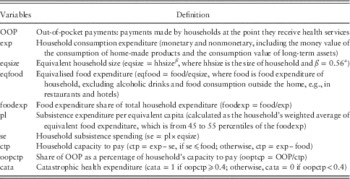
This paper adopts the methodology proposed by WHO researchers (Xu et al., Reference Xu2003; Xu, Reference Xu, Evans, Carrin and Aguilar-Rivera2005) and followed by several authors (e.g. Xu et al., Reference Xu, Evans, Carrin, Aguilar, Musgrove and Evans2006; Yardim et al., Reference Yardim, Cilingiroglu and Yardim2010; Lara and Gómez, Reference Lakhdar, Cauchie, Vaillant and Wolff2011). Hence, a household is said to have incurred catastrophic expenditure if its OOP health care payments are equal to, or higher than, 40% of its capacity to pay. Capacity to pay corresponds to a household’s nonsubsistence spending. Subsistence spending (which is regarded as nondiscretionary) is the amount each household is expected to spend on food taking into account its equivalent size and the amount spent by the household on the sample median food share of total expenditure [to minimise measurement error, Xu (Reference Xu, Evans, Carrin and Aguilar-Rivera2005) proposes a calculation based on the average food expenditure of households whose food expenditure share is in the 45–55 percentile range]. This study uses the WHO definition of CHE but following the suggestion of Xu (Reference Xu, Evans, Carrin and Aguilar-Rivera2005), adopted also in other studies (Arsenijevic et al., Reference Arsenijevic, Pavlova and Groot2013; Kronenberg and Barros, Reference Kronenberg and Barros2014; Narci et al., Reference Narci, Sahin and Yildirim2015), a sensitivity analysis is carried out testing the thresholds of 10, 20 and 30%. Table 1 provides information on the definition and construction of variables used to calculate CHE [this table essentially replicates the details in Xu (Reference Xu, Evans, Carrin and Aguilar-Rivera2005)].
Definition and construction of variables used to calculate (the presence of) catastrophic health expenditure

Source: Adapted from Xu (Reference Xu, Evans, Carrin and Aguilar-Rivera2005).
a The value of β (0.56) is suggested by Xu (Reference Xu, Evans, Carrin and Aguilar-Rivera2005) (estimated from studies based on 59 countries’ household survey data).
Factors associated with CHE were identified using multiple logistic regression analysis. In this part of the analysis the objective is to identify characteristics associated with the presence or absence of catastrophic spending in a household, not the actual amount paid for health services. Therefore, the dependent variable (‘cata’ in Table 1) corresponds to a dummy with the value 1 if the household has catastrophic expenditure. When OOP are required, households with elderly, handicapped or chronically ill members are generally more likely to be faced with catastrophic health spending than others, both because they usually have a greater need for health services and because they lack financial resources (Xu et al., Reference Xu, Evans, Kawabata, Zeramdini, Klavus and Murray2005). The evidence (Lara and Gómez, Reference Lakhdar, Cauchie, Vaillant and Wolff2011; Arsenijevic et al., Reference Arsenijevic, Pavlova and Groot2013; Gupta and William, Reference Gupta and William2013; Narci et al., Reference Narci, Sahin and Yildirim2015) has also shown that other characteristics such as household size, head of household’s educational level and employment status, health care utilisation and living in a rural/urban area affect the possibility of incurring in catastrophic health spending. Therefore, the independent variables considered in this study were region of residence (region of the country and urban vs rural area), composition of household (including elderly members, children, single parents, large households – five or more members). For the head of household we considered the variables such as gender, age, level of education and employment status. The Portuguese Household Budget Survey does not collect/contain information about the health status of household members as well as information about health care utilisation (INE, 2012). In Portugal, this information is collected by the National Health Survey (latest available dates from 2005/2006). So we took as a proxy for handicap the employment status of the head of household ‘permanent incapacity for work’. To account for any household member having disability/illness we further considered two dummies with the value ‘1’ if the household reported income from disability pensions and from subsidies related to illness. Because tobacco has been associated with chronic diseases such as cardiovascular diseases, cancer and chronic respiratory disease (WHO, 2002), smoking was considered as a proxy for chronic conditions/health care utilisation and a dummy was included which took the value ‘1’ if the household reported spending on tobacco. Physical activity on the other hand has significant benefits for health by reducing the risk of cardiovascular diseases, diabetes, colon and breast cancer, and depression (WHO, 2015). Thus, another dummy was included in the study which took the value ‘1’ if the household reported spending on items related to practising sport. Finally, we included the household’s monetary income in the set of covariates.
To quantify the degree of socio-economic-related inequity in the distribution of OOP and private health insurance, the Kakwani index was calculated (comparing the distribution of payments with the distribution of the living standards measured in this case by total consumption expenditure). If health care payments are proportional to capacity to pay, the Kakwani index is 0; if payments are regressive (progressive) then the index is negative (positive), thus indicating a disproportionate concentration of payments among the poor (rich). The Kakwani index was estimated by means of the convenient regression method (Kakwani et al., Reference Kakwani, Wagstaff and van Doorslaer1997; O’Donnell et al., Reference O’Donnell, van Doorslaer, Wagstaff and Lindelow2008). The ordinary least squares estimate of β in the following equation is the Kakwani index:
 $$2\sigma _{R}^{2} \left[ {{{OOP_{h} } \over \eta }{\minus}{{exp_{h} } \over \mu }} \right]{\equals}\alpha {\plus}\beta R_{h} {\plus}u_{h} ,$$
where OOP h corresponds to health payments for household h and η its mean, exp h represents ability to pay of household h and μ its mean (see Table 1 for definition of OOP and exp), R h the household fractional rank in the total expenditure distribution and σ 2 R the sample variance of the fractional rank.
Results
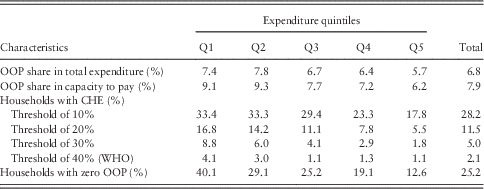
The latest evidence suggests that 2.1% of Portuguese households incurred catastrophic health payments in 2010 (WHO definition). This percentage more than duplicates if the threshold of 30% is considered. For the threshold of 20 (10)% the prevalence of CHE rises to 11.5 (28)%. As shown in Table 2, and irrespective of the threshold, CHE occurred in all expenditure quintiles but its prevalence decreases as we move from the first to the fifth quintile. Using the threshold of 30% (instead of 40) makes a significant difference in the third quintile where the prevalence of CHE almost quadruples.
Distribution of some household characteristics across expenditure quintiles

OOP=out-of-pocket payments; CHE=catastrophic health expenditure; WHO=World Health Organisation.
On average, a quarter of families reported zero OOP but values differ across expenditure quintiles (Table 2). In terms of regions, the prevalence of CHE varies from 1.3% in Algarve to 3.2% in Azores. The North and Lisbon have similar figures (1.8 and 1.9%, respectively), followed by the Centre (2.1%), Madeira (2.3%) and Alentejo (2.7%).
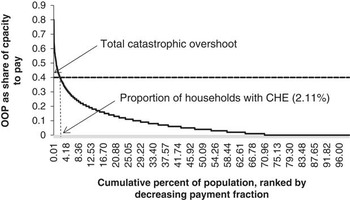
Figure 1 provides additional information showing the catastrophic overshoot (O’Donnell et al., Reference O’Donnell, van Doorslaer, Wagstaff and Lindelow2008), i.e., the degree by which payments (as a proportion of capacity to pay) exceed the threshold that defines CHE. The average overshoot is 9.6% (its maximum value is 40%), meaning that for those households with CHE the OOP correspond on average to 50% of their capacity to pay.
Level and intensity of catastrophic health expenditure (CHE). OOP=out-of-pocket payments

Poor households, i.e., those whose total expenditure is lower than their subsistence spending (Xu, Reference Xu, Evans, Carrin and Aguilar-Rivera2005) are residual (20 households). Considering total expenditure net of OOP, the total number of poor households increases by 12. Thus, based on the evidence, OOP did not cause significant impoverishment in Portuguese households in 2010.
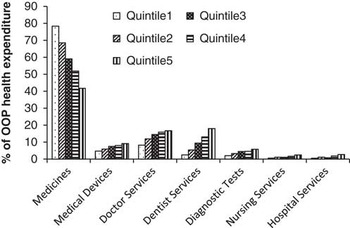
Analysing the composition of OOP, the conclusion is that on average most of the health spending is on medicines (58.4%), followed by doctors (13.8%), dentists (10.4%), medical devices (7.3%), hospital services and nursing (both with 1.5%). There are however some differences in the composition of OOP across expenditure quintiles as shown by Figure 2. The most striking differences occur for medicines and dental services. The share of medicines starts with nearly 80% in the first quintile and falls across all quintiles to reach 42% in the fifth quintile. Contrarily, the share of dentists starts with only 2.5% in the first quintile and reaches 18% in the last quintile (in the fifth quintile the share of dentist services is even higher than the share of doctor services). For the other types of expenditure, except for hospital and nursing services, there is a clear increase in their share across expenditure quintiles, though the gradient is less pronounced than in the case of dentist services. There are two miscellaneous categories of expenditure in the database, which together correspond on average to 3% of total health care expenditure, ranging from 2.7% in the second quintile to 3.4% in the fifth quintile – values for these miscellaneous categories were not included in Figure 2 (meaning that the sums do not correspond to 100%).
Share of different types of expenditure in total out-of-pocket payments (OOP) by expenditure quintiles

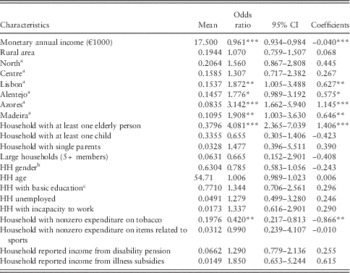
Table 3 presents the main results for the analysis of the association between CHE and characteristics of households. The column with the variables’ means provides some information on the sample composition. A considerable percentage (38%) of households has at least one member aged 65 or over. Regarding the household head, most (63%) are male and the average age is 54.7 years. It is noticeable that 77% of household heads did not complete any level of education higher than basic education. Only a minority (5%) were unemployed in 2010/2011. In 19.7% of cases spending on tobacco was reported and 6% of households reported disability pensions.
Factors associated with catastrophic expenditure

CI=confidence interval; HH=head of household.
Nagelkerke R 2=0.134; Hosmer–Lemeshow test: p=0.992.
a Algarve is the reference category.
b Female is the reference category.
c Secondary/higher education is the reference category.
*p<0.1; **p<0.05; ***p<0.01.
Looking at the association between household characteristics and the risk of CHE (coefficients and odds ratio – the ratio of the odds of an event occurring in one group compared with the odds of that event occurring in another group), as expected, higher household income lowers the risk of CHE, and this effect is statistically significant. For an increase of 1000 euros in annual income the risk diminishes 4%. The coefficient for rural area is positive and the odds ratio suggests that the risk of CHE is 7% higher in rural areas compared with urban areas; however, there is no statistical significance, meaning that we cannot confidently conclude that the risk varies according to the households’ living area. Given that the lowest percentage of families with CHE was in Algarve (the reference category), it is understandable that all regions in Table 3 have positive coefficients, which are statistically significant in three cases. The odds ratio is largest for the Azores (the region with the highest percentage of families incurring CHE). The risk of catastrophic payments in this region is three times the risk in Algarve. In Azores the average figure for OOP (1,151 euros) is close to the national average (1,169 euros) but the average capacity to pay is only 13,854 euros, which is below the national average of 16,484 euros. The opposite occurs in Algarve; here, the average OOP amount (995 euros) is below the national average while the average capacity to pay (17,462 euros) is above the national average. In Lisbon, for instance, the average OOP amount (1,256 euros) is above the national average but so is the average capacity to pay (20,370 euros). Table 3 also shows a very important result regarding the impact of having elderly members in the household. Households with at least one old person (65 or over) are four times more likely to incur CHE than households without elderly members (this represents an increase in the risk of CHE of 300%). Families with at least one child and large families face a lower risk of CHE (in both cases the risk decreases about 35%). But households with single parents face a greater risk of CHE (risk increases by 47%). Still, none of the last three effects are statistically significant. In terms of the characteristics of the head of household, age does not affect the risk of CHE (odds ratio of 1), while being male reduces the risk of CHE by 22% (but this effect is not statistically significant; thus, based on the evidence it is not possible to conclude with confidence that the gender of the head of household influences the risk of CHE). Being unemployed, less educated and unable to work due to permanent incapacity have the positive expected sign as these factors represent lower capacity to generate income and greater need for health care. But again the coefficients are not statistically significant. For households reporting spending on tobacco the risk of CHE decreases >50% and the coefficients are statistically significant. Physical exercise (as measured by the proxy expenditures on sports items) has no impact on the risk of CHE (odds ratio of 0.99; not significant). Finally, proxies for disabled and ill family members have the expected (positive) sign, increasing the risk of CHE by 29 and 85%, respectively, though none is statistically significant.
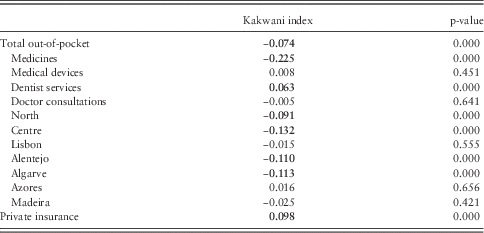
Table 4 presents the results for the progressivity analysis (only indices for the main expenditure categories are shown). As expected, the index is negative for direct payments and particularly so for medicines. Table 4 further shows that payments for dental services are progressive and the respective index is statistically significant. Payments for doctor’s appointments and medical devices are regressive and progressive, respectively; however, the hypothesis of equitable financing (proportional payments) cannot be disregarded as the indices are not statistically different from 0.
Progressivity indices

Bold values are significant at the 0.001 level.
In terms of regions, except for the Azores, all indices are negative but only four are statistically significant. For the cases of Lisbon, Azores and Madeira it is not possible to confidently conclude that payments are not proportional to capacity to pay.
Discussion
Our results suggest that the Portuguese households face a considerable risk of CHE and the percentage of families with CHE is actually higher than expected. Based on Xu et al. (Reference Xu, Evans, Kadama, Nabyonga, Ogwal, Nabukhonzo and Aguilar2007), for countries where the share of OOP in total health expenditure is between 20 and 30%, the percentage of households with CHE (WHO definition) is <1.5, meaning that 2.1% is too high even considering the relative importance of OOP in Portugal. Compared with other (developed) European countries Portugal has an unacceptable level of CHE. For instance, the percentage of households with CHE in United Kingdom is 0.04%, in Spain it is 0.48% and in France it is 0.99% (WHO, 2010). Despite being a high income country, Portugal’s CHE is on the same level as many low, and low-middle, income countries (WHO, 2010).
Naturally, some caution is required when making comparisons because in low income countries families that cannot afford health care are excluded from the analysis. Thus, a low CHE might simply mean that individuals are not getting the care they need. Indeed, this is a limitation of the CHE approach; it identifies only the households that incur catastrophic medical expenditure and ignores those that cannot meet these expenses and so forgo treatment. Households might suffer a greater welfare loss through the subsequent deterioration of health than those incurring catastrophic payments. It has been acknowledged that the catastrophic consequences of illness shocks might be more important for household living standards because of loss of earnings (O’Donnell et al., Reference O’Donnell, van Doorslaer, Wagstaff and Lindelow2008).
The analysis of zero OOP raises similar issues. A quarter of households reported no OOP, with 40% of families in the lowest expenditure quintile presenting zero OOP. From the standpoint of finance this is a positive result, but given the shortcomings of the SNS and the role of the private sector in the provision of some services such as dental care, specialist consultations, diagnostic, rehabilitation and psychiatric care this might be a sign that poorer individuals are not receiving the care they need. Although analyses of equity in financing are relevant on their own, the other side of the coin of a positive result in these analyses might be inequity in health care delivery. Devaux and Looper (Reference Devaux and Looper2012), exploring macro-level relationships between health services use and the financing of health systems, found a negative relationship between inequity in doctor visits and the share of public health expenditure and a positive relationship between inequity in specialist visits and the degree of private provision of care. Moreover, the authors report a positive relationship between inequity in specialist (dental) visits and the share of OOP in total specialist (dental) expenditure. This evidence supports the concerns expressed above about possible unmet needs.
Our results indicate that CHE occurred in high income households too; however, expenditure for richer households might represent more expensive, but not necessarily more effective, care. Indeed, a further limitation of the catastrophic analysis is that it assumes that all payments are completely nondiscretionary. Nonetheless, this might not be the case, e.g., spending stemming from personal preferences plus spending which does not represent effective care, like paying for an expensive private room in a public hospital, should not raise equity concerns.
Regarding the analysis of risk factors, some but not all results are as expected. The impact of income obtained in this study is very similar to that obtained by Kronenberg and Barros (Reference Kronenberg and Barros2014) for Portugal with 2005 data (odds ratio of 0.95) and 2000 data (odds ratio of 0.92). The effect is statistically significant and seems to be stable over time, though its magnitude is rather small compared with the other variables. Living in rural areas is expected to increase the risk of CHE because health care services tend to be concentrated in urban areas; thus, individuals from rural areas are expected to spend more to use these services, nonetheless, coefficients are not statistically significant. A possible explanation is that information collected on OOP does not include travel and accommodation expenses incurred when using health services; consequently, the data might not fully reflect differences in health-related expenditure between households living in rural and urban areas.
If the head of household is unemployed the risk of CHE increases 28% but this effect is not statistically significant. In this case, it might be that households are protected against this adverse event by the health care system and social insurance.
Concerning the effects of the variables related with the composition of households, the idea is that more children represent more inactive individuals depending on parents (earners); however, our results showed a decreased risk of CHE (though not significant). A possible justification for this result is that children are less sick and benefit from financial protection (exempt from user charges in SNS and, unlike in the case of specialist care, public provision is predominant in primary care – primary care services are responsible for maternal and child health).
In terms of having handicapped or chronically ill members in the household, in some cases, we obtained odds ratios >1 but not statistically significant (incapacity to work, disability pension, illness subsidies). In the case of tobacco consumption and based on the positive link between tobacco and chronic diseases, the result obtained is not as expected – households with smokers seem to face a lower risk of CHE than households without smokers. The effect of tobacco is not only statistically significant but it is also a relevant result in terms of magnitude (reduction in risk of almost 60%).
In the former case, the proxies used in this study might be insufficient to account for the presence of handicapped or chronically ill members in households. Thus, future research should look into the impact of chronic conditions and disability on households’ resources. A new health survey is due in the next two years; it might be used to investigate this issue (though results would not be fully comparable as the health survey does not collect information on total expenditure and spending on food). On the other hand, it might be that chronic patients are safeguarded against catastrophic payments via access to primary care services (responsible for managing long-term conditions). In 2011, Portugal actually performed quite well in terms of avoidable hospital admissions (asthma, diabetes and chronic obstructive pulmonary disease in adults) (OECD, 2014a). This might be a sign that chronic patients are getting the care they need, at a low cost, in primary care services (the co-payment for a doctor visit was 2.25 euros in 2011; augmented to 5 euros in 2012).
Concerning tobacco, the results might be influenced by the fact that usually there is a gap between smoking and health deterioration and people might quit smoking when they become ill. Or, the decision to smoke might be endogenous to financial conditions, meaning that richer individuals are more likely to smoke. Still, existing evidence is not conclusive. Although some results suggest that income elasticity of demand for cigarettes is positive (Lakhdar et al., Reference Lara and Gómez2012), including estimates for Portugal (Nguyen et al., Reference Nguyen, Rosenqvist and Pekurinen2012), sensitivity to income remains weak and there is also evidence that additional income is associated with an increase in adult smoking cessation (Kenkel, Reference Kenkel2015). Even for the case of health status, results are mixed: e.g., Adda and Lechene (Reference Adda and Lechene2013) concluded that individuals with poorer health are more likely to smoke and smoke even more, while Aristei and Pieroni (Reference Aristei and Pieroni2009) found that chronic conditions affect smoking decisions increasing the probability of quitting.
The largest effect found in the current study concerns the impact of having at least one elderly person in the household. This is a result that deserves further attention namely because the elderly criterion is not in the list of exemptions to user charges [see Barros (Reference Barros2012) for this list]. Also, considering that the elderly are usually the greatest consumers of medicines and given the high share of medicines in total health expenditure observed in poorer households, existing rules for medicine co-payments might be failing to protect families with elderly members.
The analysis by regions showed differences, with the risk of CHE being significantly higher in Azores; however, results for the Kakwani index revealed a different picture. Algarve has the lowest percentage of families with CHE but the respective Kakwani index is negative and statistically significant, while Azores has the highest prevalence of CHE but the respective Kakwani index is positive and not statistically significant. These results suggest that the two approaches (catastrophic payments and progressivity analysis) are complementary. In the case of payment exemptions, these effects are indeed plausible, i.e., the poorest might be protected against financial losses but after a given threshold payments do not conform to ability to pay. Therefore, it is possible to have a low risk of catastrophic expenditure and considerable regressivity of payments. It would not be surprising if the increase in user charges and extension of exemptions, which occurred in Portugal after the MoU led to similar results (i.e. more people do not pay but those who are not exempt have to pay relatively more). Regarding the archipelagos of Madeira and Azores we should nonetheless note that some differences might eventually be explained by insular specificities and characteristics of regional health care systems. It is not within the scope of this study to explore these specificities but in future work the regional health systems and health and demographic indicators might be scrutinised and greater attention paid to regional health policy.
The analysis of progressivity of payments suggests that regressivity has decreased compared with 2000 (Simões et al., Reference Simões, Barros and Pereira2007); it seems that some improvement has occurred in equity in financing in a decade. Expenditure on medicines continues to be quite regressive, though the Kakwani index calculated here is 10 points below the Kakwani index for medicines in 2000 (−0.225 and −0.328, respectively). This result too suggests an improvement in the sense that existing inequity has decreased. Up-to-date results for equity in health care finance for developed countries are very scarce, but in a recent study, Baji et al. (Reference Baji, Pavlova, Gulácsi and Groot2012) calculated Kakwani indices for medicines, medical devices and informal payments for Hungary. The authors report a Kakwani index for medicines (−0.23) that is actually very similar to our results. Differently from us, they also found that payments for medical devices are highly regressive in Hungary (−0.24). Our result further show that payments for private health insurance are progressive and the respective index is statistically significant. This result could be expected because in general only the better off take out voluntary health insurance.
Although inequities in health care financing persist at a high level in Portugal they seem to have decreased over time. Nonetheless, after the data used in this study was collected there were several changes in Portugal, due to the economic and financial crisis and the subsequent international financial assistance. In terms of pharmaceutical expenditure, two opposite movements took place (increase in co-payments and decrease in prices); thus, we cannot confidently conclude that the situation either improved or worsened. Also, successive wage and pension cuts have been implemented since 2011 and this is expected to affect households’ ability to pay. Other policy measures adopted in the meantime include changes in the unemployment insurance system (e.g. reduction in the maximum duration of unemployment benefits), changes in taxation including increases in personal tax, property tax, VAT and excise duties. Wage cuts and tax increases were relatively higher for higher incomes but Portugal still is one of the most unequal countries in Europe and income inequalities have remained high and constant – the value of the Gini index in 2013 (0.345) was the same as in 2011 (Pordata, 2015).
The Portuguese Observatory on Health Systems (OPSS) has to some extent monitored the impact of the crisis on individuals. According to the 2014 Report, 145,766 individuals are not able to pay their mortgage (OPSS, 2014). This might be a sign that households’ capacity to pay has been seriously affected. Recently published evidence shows worrying signs about the impact of the economic crisis and of the consolidation measures on the most vulnerable groups of society: the number of families receiving the Social Integration Income fell by some 30% between early 2010 and July 2013 and the number of people living in households without any income from work has risen by 20% or more since the onset of the crisis (OECD, 2014b); between 2012 and 2013, Portugal had the largest rate of increase in the at-risk-of-poverty or social exclusion rate in the EU-28 and since the implementation of major cuts, Portugal has reduced by 30% its spending on support for families with children and one-third of beneficiaries have lost access to child benefits (Caritas Europa, 2015); the rate of increase in child poverty was also marked between 2012 and 2013 (Caritas Europa, 2015). According to OECD (2014b), social transfers (unemployment, social assistance, disability and family benefits) have been the focus of by far the greatest number of consolidation measures since 2011, followed by health care and old age pensions. An overview of the impact of the global financial crisis on health spending (Morgan and Astolfi, Reference Morgan and Astolfi2015) shows that health spending has slowed markedly or fallen in many OECD countries after years of continuous growth. In Portugal, public health spending dropped 8% in 2011 and continued to experience a contraction after 2012; additionally, increases in the private sector share of health spending has been observed. Based on the evidence these movements positively affect the risk of CHE.
The simultaneous cuts in social transfers and health care as well as the increase in the private sector share are strong reasons to keep monitoring equity in health care finance and the impact of health expenditure on households’ finances. Direct payments not only can put individuals’ health at risk but also violate the principle of solidarity between the sick and the healthy, or between the rich and the poor, and also make it impossible to spread costs over the life cycle: paying contributions when one is young and healthy and drawing on them in the event of illness later in life (WHO, 2010).
Conclusions
Based on the current study, equity in health care financing seems to have improved in a decade, from 2000 to 2010, but recent evidence about the impact of the economic crisis and consolidation measures on health spending and households’ income indicates that there might be an overturn in this result. Authorities should pay special attention to households with elderly people, finding ways to protect them from disproportionate health expenditure particularly via pharmaceutical expenditure. But our results also show some positive aspects, namely the protection of families with chronically ill members and children. However, the lack of nursing personnel and the scarcity of general practitioners in primary care services might put at risk these achievements, with severe consequences both to families and the health system (e.g. if chronic patients are not properly assisted). Finally, our results show a very low share of dentist services in total health expenditure of poorer families. Combining this result with the almost inexistent public provision of dental care we conclude that inequalities in health care utilisation should be quite large. Authorities should therefore give some priority to oral health in the planning of health care services. Portugal remains one of the most unequal countries in Europe; the SNS thus must be as much inclusive as possible to mitigate the impact of income and social inequalities on health.
Acknowledgements
The authors wish to thank two anonymous referees for their very helpful comments and suggestions to improve the original version of the paper. The usual disclaimer applies.