Introduction
Suicide is a serious mental health problem and often associated with many psychiatric diseases. Although many guidelines have been developed to prevent suicide, the number of suicide deaths is projected to increase over the next decade (Kwon et al., Reference Kwon, Chun and Cho2009). The elderly have the highest suicide rates in most countries (Shah, Reference Shah2010), and men aged over 75 years have the highest rate of suicide among any age group (McIntosh, Reference McIntosh1992). Furthermore, older people who have survived an attempted suicide have a high mortality rate from both natural causes and completed suicide (Hepple and Quinton, Reference Hepple and Quinton1997). Given that life expectancy is increasing rapidly (Yang et al., Reference Yang, Khang, Harper, Davey Smith, Leon and Lynch2010), suicide in the elderly is an important public health concern that poses major challenges for prevention strategies.
Elderly suicide attempters have different characteristics compared to young suicide attempters. The ratio of suicide attempts to suicide completion is estimated to range between 8:1 and 20:1 in the whole population, whereas that for the elderly is estimated to be 4:1 (Szanto et al., Reference Szanto, Gildengers, Mulsant, Brown, Alexopoulos and Reynolds2002). This ratio means that the elderly make more serious suicide attempts using more lethal methods (Conwell and Thompson, Reference Conwell, Thompson and 2008). In addition, older adults were more likely to avoid intervention, take precautions against recovery, and were less likely to communicate their suicide intent (Conwell et al., Reference Conwell, Duberstein, Cox, Herrmann, Forbes and Caine1998). Elderly patients who are at risk for suicide may be more difficult to identify than younger patients.
The issue of gender should also be considered. In general, suicide attempts are more lethal in men than women and this sex difference is more pronounced in old age (Dombrovski et al., Reference Dombrovski, Szanto, Duberstein, Conner, Houck and Conwell2008). Salib and Green (Reference Salib and Green2003) reported that elderly male suicide attempters were less likely to have been known to psychiatric services and were less likely to report a history of previous attempted suicide compared to elderly women with suicide attempts. These gender differences have serious consequences for elderly men, who have the highest suicide rate.
The elderly have usually been exposed to difficult and chronic psychosocial stressors. According to “loss theory”, aging is a natural process of life which is filled with continual loss such as loss of social role, loss of friends, loss of health and loss of life aims (Li et al., Reference Li, Xiao and Xiao2009). These series of losses can trigger a psychological crisis. In the elderly, physical illnesses and loss of social support are associated with a subjective decrease in well-being and self-esteem, and these psychosocial stressors are not only aggravating factors of previous psychiatric symptoms but also independent risk factors for psychiatric illness (Conwell and Thompson, Reference Conwell, Thompson and 2008).
These observations emphasize the importance of careful monitoring and treatment of suicidal seniors. The aim of the present investigation was to explore the characteristics of the elderly suicide attempters in Korea. Since self-poisoning is the commonest method of suicide in the elderly (Tadros and Salib, Reference Tadros and Salib2000) and many self-poisoning patients were admitted to University Hospital in Korea, we evaluated suicide attempters with self-poisoning in emergency rooms for two years. We hypothesized that the elderly would have different psychosocial stressors and lethality of an index suicide attempt compared to young suicide attempters.
Methods
Cases
Data were obtained from a retrospective medical and psychiatric chart review of patients who were admitted to the emergency room in Uijeongbu St. Mary's Hospital, the Catholic University of Korea from 1 January 2008 to 31 December 2009. Patients were eligible if they (1) took the drug or household products (excluding detergents) with suicidal intent, and (2) they agreed to be interviewed by a psychiatrist in the emergency ward. The data of patients who took a drug overdose but denied suicide intention were excluded.
Demographic variables such as age, sex, marriage status, medical illness and psychiatric history were evaluated. Psychiatric evaluation and diagnosis were carried out by trained psychiatrists according to the DSM-IV criteria (American Psychiatric Association, 1994). We assessed the patients in the emergency room using a systematic tool called the Brief Emergency Room Suicide Risk Assessment (BESRA), which was constructed by the authors (see Appendix A, published as supplementary material online attached to the electronic version of this paper at http://www.journals.cambridge.org/ipg). The BESRA consists of domains concerning demographic factors, clinical diagnosis, the patient's psychiatric resources and detailed information about the present suicide attempt including method, planned or impulsive attempt, the reason, and risk/rescue-rating scores. The BESRA was developed to help clinicians make rapid and accurate decisions in the emergency room. Thus, this tool includes assessments of established suicidal risk factors and available resources and risk/rescue-rating scales that have reliability and validity (Misson et al., Reference Misson2010). Risk/rescue-rating scales assess the lethality of a suicide attempt, defined as the probability of inflicting irreversible damage. This scale consists of ten items: five items describe risk factors (method used, impaired consciousness, toxicity, reversibility and treatment required) and five describe rescue factors (location, person initiating rescue, probability of discovery, accessibility to rescue, and delay until discovery) (Weisman and Worden, Reference Weisman and Worden1972). Higher risk rating scores indicate more lethal suicide attempts, and higher rescue rating scores mean less serious and more rescueable suicide attempts. This study was approved by the institutional review board and individual consent was obtained.
Statistical analysis
The χ2 test was used for comparing frequencies and proportions of the two groups' demographic variables, reasons for suicide attempt, impulsivity and medical severity of an index suicide attempt. Risk/rescue-rating scores were compared using t tests. A probability (p) value of less than 0.05 was considered to be significant. All statistical analyses were performed using the Statistical Analysis System software package (Version 6.0) (SAS Institute, Cary, NC, 1999).
Results
A total of 468 patients with self-poisoning visited thr emergency room in the Uijeongbu St. Mary's hospital from 1 January 2008 through 31 December 2009. Of these, 51 patients (10.9%) refused the psychiatric interview; 25 patients (5.3%) died in the emergency room before psychiatric evaluation or could not undergo the psychiatric interview due to a serious medical condition; and four patients (0.9%) were excluded from this analysis due to incomplete information. Accordingly, 388 patients (129 male, 259 female) were included. To examine the characteristics of the elderly suicide attempters, we divided the patients into two groups: the elderly group (over 65 years old) and the under-65 group (less than 65 years old). In Korea, the age of 65 is traditionally considered the beginning of the senior years, when workers become eligible to retire at this age and receive social security benefits. The number of suicide attempters in the elderly group was 57, and their mean age was 73.5 ± 7.5 years old.
Table 1 shows the demographic data, underlying medical illnesses, previous psychiatric history and numbers of previous suicide attempts. As expected, the elderly patients had more underlying medical illnesses than the under-65 group had (p<0.001). The male-to-female ratio was significantly different between the two groups (p = 0.004): in the elderly group it was nearly 1:1, but about 1:2 in the under-65 group.
Demographic and clinical variables of suicide attempters comparing the elderly (aged over 65) with the under-65 group

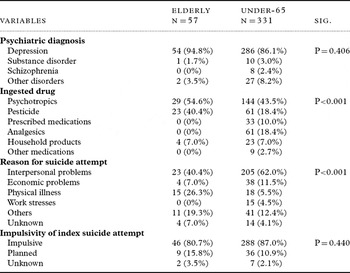
The details of an index suicide attempt are shown in Table 2. Depression was the most common psychiatric diagnosis in both groups. Other psychiatric diagnoses were substance use disorder, schizophrenia, adjustment disorder and so on. Psychotropics were the most commonly ingested drugs for suicide among all age groups, but other drugs used for suicide attempt were significantly different between two groups (p<0.001). Using Tukey's post hoc analysis, we confirmed that the elderly patients ingested more pesticides and less prescribed medications and analgesics compared to younger people. Interpersonal problems were the leading cause of suicide attempts in both groups. Two-hundred-and-five patients (61.9%) of the under-65 group and 23 elderly patients (40.4%) reported interpersonal problems to be the precipitating psychosocial stressor of an index suicide attempt. However, more elderly patients reported physical illness as a reason for a suicide attempt compared to the under-65 group (p<0.001).
Suicide and clinical characteristics of suicide attempters aged over 65 and less than 65 years

The elderly suicide attempters had higher scores on the risk-rating scale (p < 0.001) and lower scores on the rescue-rating scale (p = 0.014) than the under-65 group patients (Table 3). The elderly patients made more serious suicide attempts (p = 0.003), showed more impaired consciousness (p < 0.001) and needed more intensive treatment (p = 0.003) as a result of an index suicide attempt. Furthermore, the elderly patients had less communication about their suicide attempts (p = 0.003).
Risk/rescue rating scales of suicide attempters aged over 65 and less than 65 years

Discussion
The present study aimed to investigate differences in the psychosocial risk factors and clinical characteristics of an index suicide attempt between the elderly and younger suicide attempters by interviewing 388 suicide attempters admitted to the emergency room for self-poisoning in Korea. The main results were: (1) elderly suicide attempters had different psychosocial stressors, such as physical illness; (2) elderly suicide attempters had more serious suicidal attempts, which may exacerbate their physical vulnerability; and (3) elderly suicide attempters included more males than the under-65 group.
In previous studies, predictors of suicide attempts in the elderly were mental disorders, recent bereavement, intractable pain, chronic illness, hopelessness, dependency on others, and despair (De Leo and Spathonis, Reference De Leo and Spathonis2003; Zanni and Wick, Reference Zanni and Wick2010). As expected, the present study showed that the elderly suicide attempters had three times more medical comorbidities than the under-65 group. Medical illness, pain and physical disability were one of the most important risk factors of suicide in the elderly (Ilgen et al., Reference Ilgen, Zivin, McCammon and Valenstein2008). Even after controlling for psychiatric diseases such as depression, anxiety disorders and substance use disorders, the presence of any physical illness and chronic pain was associated with increased risk of suicidal thoughts and attempts (Ratcliffe et al., Reference Ratcliffe, Enns, Belik and Sareen2008). Similarly chronic illness and pain were the second reason of suicide attempt in the present research. Although interpersonal problems were a leading cause of suicide attempts in both age groups, physical illness explained more suicide attempts in the elderly group.
However, in previous research, triggers of suicide attempts appear to be different in the elderly and the younger and middle-age groups. Economic hardship and physical illnesses were more common stressors than interpersonal problem in the elderly group (Duberstein et al., Reference Duberstein, Conwell, Conner, Eberly and Caine2004). This discrepancy can be explained by multiple meanings of the term “interpersonal problem” which can include many different situations. In the under-65 group, interpersonal problems usually mean everyday conflict with others or difficulty with personal relations (Shiner et al., Reference Shiner, Scourfield, Fincham and Langer2009). By contrast, in the elderly group, interpersonal problems might imply a breakdown in the social network, isolation and loneliness. Furthermore, in Korean society, the elderly population has often endured much suffering during the processes of rapid industrialization and urbanization, the rapid spread of individualism and the breakdown of traditional family structure. These changes have tended to limit elderly people's ability to maintain wide social relationships (Wu et al., Reference Wu, Sun, Sun, Tao and Cui2010).
It is noteworthy that the elderly group made more lethal suicide attempts than the under-65 group. The elderly patients had higher risk-rating scores and lower rescue-rating scores in the present study irrespective of sex differences in both age groups. That is, old males had higher risk-rating scores compared to young males (p = 0.009), old females had higher risk-rating scores compared to young females (p = 0.001). Higher risk-rating scores were associated with more violent suicidal attempts, and lower rescue-rating scores were characterized by less communication and more precautions against discovery (Misson et al., Reference Misson2010). Although our study was limited to suicide attempters by self-poisoning, the elderly patients ingested more lethal drugs, especially pesticide. In general, the elderly tend to make suicide attempts using violent methods such as hanging and jumping (Chen et al., Reference Chen2009). Our finding that the elderly made more lethal attempts than the under-65 age group is in line with previous studies. Further research, including examination of other means of suicide such as hanging or jumping, may strengthen this result. It is also apparent that ingestion of pesticides as a means of suicide is closely related to rural areas (Lee et al., Reference Lee, Cha, Park, Kong, Yi and Son2009). Most of the elderly live in rural areas in Korea, and their easy access to pesticides is an important factor explaining higher lethal suicide attempts in late life (Shin et al., Reference Shin, Suh, Rhee, Sung and Kim2004). Strong regulation and control of pesticides will reduce the number of suicide deaths.
Another interesting finding of the present study can be found in the gender ratio. In the under-65 group, the male-to-female ratio was about 1:2, but the sex ratio was nearly 1:1 in the elderly group. This difference may be explained by the difference in patterns of coping with aging, which often calls for lifestyle changes and acceptance of changed social and familial situations. Men are more likely to describe themselves as independent and achievement-oriented whereas women describe themselves as sociable, moral, dependent and less assertive (Pinquart and Sorensen, Reference Pinquart and Sorensen2001). Especially in traditional Korean culture, men were educated to pursue career success and wealth. On the contrary, women tend to value personal relationships and sacrifice for the family. Old women may have greater access to resources of subjective well-being, such as relations with children, friends and community. According to the stress buffer model (Penninx et al., Reference Penninx, van Tilburg, Deeg, Kriegsman, Boeke and van Eijk1997), coping resources – including mastery, self-efficacy and social support – mediate the impacts of stressors on health and coping processes (Penninx et al., Reference Penninx, Van Tilburg, Boeke, Deeg, Kriegsman and van Eijk1998). Therefore, old men may have more difficulty in adapting to new circumstances, and this failure to adapt may lead to increasing frequencies of suicide attempts. However, the present study did not support the gender differences on marriage status, suicide reason and severity of an index suicide attempt in the elderly group. Further research to investigate the gender differences in suicide risk factors and protecting resources may be needed.
Several limitations of the study need to be acknowledged. First, the present study included only self-poisoning cases and all subjects were included in a university hospital setting. In other research, those who died by self-poisoning were more often female, older, unmarried, unemployed, and living alone (Hunt et al., Reference Hunt2010). In addition, 17% of the suicide attempters refused or could not have a psychiatric interview. Suicide is a cultural taboo in Korea; families prefer to consider the suicide of their relative as accidental death or the result of physical illness (Kim et al., Reference Kim, Jung-Choi, Jun and Kawachi2010), which is an obstacle to suicidal research as well as to psychiatric assessment and treatment. Thus caution must be applied in generalizing the results of the present study. Secondly, the present research did not assess the protective factors against suicide in the elderly. These include religiousness, harmonious marriage, social support and a sense of belonging (McLaren and Challis, Reference McLaren and Challis2009). Future research investigating the role of protective factors such as reasons for living, religion and systems of support may be worthwhile.
Conclusion
The results of the present study have implications for interventions offered to patients who have made suicide attempts. Later life is a period of increased risk for suicide, and many different psychosocial factors are associated with suicide compared to younger people. In particular, old men with depression, chronic physical illness and interpersonal problems, including social withdrawal and loneliness, are at high risk of suicide. Thus, cautious management and psychiatric follow-up will be needed.
Description of authors' roles
Yoo-ra Kim designed the study, collected the data and wrote the paper. Kyoung Ho Choi and Youngmin Oh assisted with designing the study and collected the data. Hae-Kook Lee, Yong-Sil Kweon, Chung Tai Lee and Kyoung-Uk Lee supervised the data collection and wrote the paper.
Acknowledgments
This study was supported by a grant from the Korean Health 21 R & D Project, Ministry of Health and Welfare, Republic of Korea (A050047). We particularly wish to thank medical student Jae-Ha Kim, who helped construct BESRA.