Introduction
Numerous insects transmit many important diseases to humans, imposing a burden on human development. Mosquitoes are a major group of insects comprising 3500 species, of which approximately 10% act as disease-transmitting vectors. Taxonomists have described 550 species of Culex, most of them from tropical and subtropical regions. Some species are important as vectors of bancroftian filariasis, since Culex is an effective insect host for the larval development of the filarial parasite Wuchereria bancrofti (Karlekar et al., Reference Karlekar, Deshpande and Andrew2013) and arboviral diseases, such as Japanese encephalitis. Culex is known as the common house mosquito because of the presence of its breeding sites near the vicinity of human dwellings. Amongst them, Culex quinquefasciatus is common in tropical countries (including India) and is found in large numbers in drains, pits and other water bodies. Culex quinquefasciatus is found in high densities throughout the year, because it has a high degree of adaptability in its preference for the practical completion of its life cycle, i.e. breeding sites, host specificity and high reproductive potential (Sirivanakarn, Reference Sirivanakarn1976; Forattini et al., Reference Forattini, Kakitani, Massad and Marucci1993).
Lymphatic filariasis affects 119 million people in 73 countries; India accounts for 40% of the global prevalence of infection. Approximately 420 million people in India reside in endemic areas and 48.11 million are infected (Ramaiah et al., Reference Ramaiah, Das, Michael and Guyatt2000). Filariasis is endemic in 17 States and six Union Territories of India, putting about 553 million people at risk of infection (Sabesan et al., Reference Sabesan, Vanamail, Raju and Jambulingam2010).
The preferred method of choice to control these diseases is vector control. One can implement vector control through environmental management (by decreasing the potential breeding sites) or by insecticide-based control methods (using chemicals with ovicidal, larvicidal, adulticidal, irritant, repellent or deterrent activities). Following the discovery of dichlorodiphenyltrichloroethane, the most widespread method of vector control has been the use of chemical insecticides, but indiscriminate use of chemical compounds on both medically important vector species and agriculturally important pest species has led to the development of resistance among them. Anonymous (2010) defined insecticide resistance as “a heritable change in the sensitivity of a pest population that is reflected in the repeated failure of a product to achieve the expected level of control when used according to the label recommendation for that pest species”. Insecticide resistance is the ability of an insect to withstand the effects of an insecticide by becoming resistant to its toxic effects using natural selection and mutations (Davidson, Reference Davidson1957).
Four main modes of resistance are reduced penetration of insecticides, metabolic detoxification, target site resistance, and behavioural avoidance to insecticide. Metabolic detoxification makes use of the diversity of enzyme systems to degrade the chemical compounds taken into the body deliberately (e.g., as food materials) or accidentally (e.g., as insecticide molecules). Amongst the enzyme diversities used for degrading insecticides into non-toxic compounds is carboxylesterase (or esterase), which is a collective term for the enzymes that hydrolyse carboxylic esters. Classification of these enzymes is difficult, because of their overlapping substrate specificity (Heymann and Jakoby, Reference Heymann, Jakoby and Jakoby1980). However, the esterase classification of Aldridge (Reference Aldridge1953) is recognized. In mosquitoes, carboxylesterases confer primary resistance to organophosphates (Hemingway and Karunaratne, Reference Hemingway and Karunaratne1998), since organophosphates are esters of phosphoric acid, so can be hydrolysed by carboxylesterases. Carboxylesterases also confer secondary resistance to carbamates (Peiris and Hemingway, Reference Peiris and Hemingway1993). As a result of a higher level of activity of metabolic detoxification enzymes, which can be due to quantitative or qualitative increase (differential expression of insecticide metabolizing genes), we observe resistance in mosquitoes and other insects.
For Culex mosquitoes, esterases are classified based on the combined criteria of their preference for hydrolysing the synthetic esters α- and β-naphthyl acetate and electrophoretic mobility (Georghiou et al., Reference Georghiou, Pasteur and Hawley1980; Raymond et al., Reference Raymond, Callaghan, Fort and Pasteur1991). Thus, the esterases that hydrolyse α and β-naphthyl esters were called A and B esterases, respectively (Hemingway and Karunaratne, Reference Hemingway and Karunaratne1998). Esterases are classified based on their preference for the substrate naphthyl acetate (α or β) and their electrophoretic mobility.
Studies have suggested that the use of insecticides in agriculture has contributed to the selection of resistance in mosquitoes, thus threatening the efficacy of vector control programmes (Diabate et al., Reference Diabate, Baldet, Chandre, Akoobeto, Guiguemdé, Darriet, Brengues, Guillet, Hemingway, Small and Hougard2002; Chouaïbou et al., Reference Chouaïbou, Etang, Brévault, Nwane, Hinzoumbé, Mimpfoundi and Simard2008; Yadouleton et al., Reference Yadouleton, Asidi, Djouaka, Braïma, Agossou and Akogbeto2009, Reference Yadouleton, Martin, Padonou, Chandre, Asidi, Djogbenou, Dabiré, Aïkpon, Boko, Glitho and Akogbeto2011). Indeed, most insecticides used in agriculture belong to the same chemical classes and have similar targets and modes of action as those used for vector control (Khambay and Jewess, Reference Khambay, Jewess, Gilbert and Gill2010). In the districts of sub-Himalayan West Bengal, tea is the main plantation crop cultivated in vast areas. Different agrochemicals (insecticides) are routinely sprayed to protect the crop against insect herbivores. The insecticides are carried away during rain and accumulate in nearby drainages that are the breeding habitats of mosquitoes.
In this present context, the current study aims to observe the variability of carboxylesterase isozymes expression in different life stages of Culex mosquitoes, to understand levels of insecticide susceptibility that may be used in integrated mosquito management (IMM) for efficient vector control in the districts of sub-Himalayan West Bengal.
Materials and methods
Chemicals
Deltamethrin (≥98%), lambda-cyhalothrin (≥98%), chlorpyrifos (≥98%), bovine serum albumin (BSA), α-naphthyl acetate (α-NA), β-naphthyl acetate (β-NA), α-naphthol, β-naphthol, Fast Blue BB salt, acrylamide, bis-acrylamide, tris-glycine, TEMED (N,N,N’,N’-Tetramethylethylenediamine), and ammonium persulphate were purchased from Sigma-Aldrich, Mumbai. Homogenization buffer, solutions of α-NA and β-NA (30 µmol/L), and the staining solutions for gels were prepared fresh prior to use.
Field collection
Field populations of C. quinquefasciatus were collected as adults (with the help of sweep net) or as larvae and pupae (by collecting water containing them).
Maintenance of the stock population
Larvae were kept in a plastic container (10x10x30 cm3) containing yeast powder as a nutrition source. The adults were fed with 5% sucrose solution soaked in cotton balls. Adults were maintained at 25–30 °C and 75–80% relative humidity. Adults were treated with cold shock to immobilize them prior to homogenization. The homogenates were freshly prepared before their quantitative and qualitative estimations.
Enzyme extraction
Single adult and single fourth instar larvae of C. quinquefasciatus were homogenized in 200 µl (for quantitative assay of enzyme) and 80 µl (for isozyme analysis through polyacrylamide gel electrophoresis (PAGE)) ice cold 0.1 M sodium phosphate buffer (pH 7.2) and centrifuged at 12,000g for 20 min at 4 °C in a high speed refrigerated centrifuge (Sigma 3K30) (Raymond et al., Reference Raymond, Fournier, Bride, Cuany, Berge, Magnin and Pasteur1986). The resultant post mitochondrial supernatants were stored at −20 °C to be used as enzyme source.
General esterase activity (α-esterase and β-esterase)
General esterase activity was measured using α-naphthyl acetate (α-NA) and β-naphthyl acetate (β-NA) as substrate according to the method of van Asperen (Reference van Asperen1962) with minor modifications for using in a microplate reader (Opsys MR, DYNEX Technologies). Twenty microlitres of supernatant were dispensed in each well of the microplate in duplicate. Two hundred microlitres of freshly prepared 30 µM α-NA were added to each well for the reaction to occur. The reaction was stopped after 15 min by adding 50 µl of staining solution prepared fresh by mixing two parts 0.1% Fast Blue BB salt with five parts of 5% sodium dodecyl sulphate. The plate was left for 15 min to equilibrate, and absorbance was recorded at 590 nm. The change in absorbance was converted to end product (α-naphthol and β-naphthol) using the standard curve of α-naphthol and β-naphthol (0.05–1.00 µM). Blanks were set at the same time using a reaction mixture without protein extracts (enzyme source).
Protein quantification
Enzyme activities were corrected for protein concentration. The total protein content of the homogenate was determined by colorimetric method (Lowry et al., Reference Lowry, Rosebrough, Farr and Randall1951) using BSA as the standard.
Electrophoretic analysis of α- and β-esterases
Electrophoresis of C. quinquefasciatus populations, i.e., field-collected populations in larval, pupal or adult forms, was carried out in 8% polyacrylamide gels using equal amount of protein in 0.1 M Tris-glycine (pH 8.3) at 120 V for 3–4 h at 4 °C. The gels were then soaked for 30 min in 50 mL 0.1 M sodium phosphate, pH 6.2 at room temperature. Esterase activity was visualized by placing the gels for 1 h in a staining solution prepared with 50 mL of sodium phosphate solution, 15 mg of β-napthyl acetate, 20 mg of α-napthyl acetate, 60 mg of Fast Blue RR salt, and 5 mL of acetone (Johnson et al., Reference Johnson, Kanapi, Richardson, Wheeler and Stone1966; Steiner and Johnson, Reference Steiner and Johnson1973; de Carvalho et al., Reference de Carvalho, Marques, Lapenta and Machado2003). Esterase isozymes were designated as EST I, II, III, IV, V, VI, VII, VIII, IX, X, XI, XII, XIII, XIV, and XV respectively based on mobility from anode to cathode. The Rm (relative mobility) values of esterase isozyme bands were determined according to the standard method.
Larval bioassay
Larval bioassays were carried according to the methods proposed by WHO (WHO, 1981). Technical grade insecticides, i.e., chlorpyrifos, deltamethrin and lambda-cyhalothrin were diluted in 1 mL of suitable solvent (ethanol for organophosphate and acetone for synthetic pyrethroids) to obtain a specified stock concentration, from which a variety of dilutions were prepared and checked for mortalities between 2% and 98%. Six to seven concentrations of all the three insecticides were tested along with a control (without insecticide but with the solvent) in triplicate, with 20–25 late third instar larvae per replicate. Larval mortality was determined after 24 h of exposure.
Adult bioassay
Adult bioassays were also performed following WHO guidelines (WHO, 2006). Different concentrations of insecticides were prepared in suitable solvent from the stock solution and insecticide-impregnated papers were prepared (Karunaratne and Hemingway, Reference Karunaratne and Hemingway2001) for a range of concentration of insecticide for each insecticide. Mosquitoes were exposed to different concentrations of insecticides for 1 h, then transferred to retention tubes containing cotton balls soaked in 10% glucose solution and mortality rates recorded 24 h after exposure. No insecticide controls (solvent only) were also done using similar experimental procedures. The dosage (ppm) range was pre-determined to yield mortality rates between 0% and 99%. The tested doses varied for different insecticides with three replicates per dose and 20–25 females per replicate.
Statistical analysis
Comparisons of data on enzyme activities among different populations of C. quinquefasciatus were done by one way analysis of variance (ANOVA) using GraphPad Instat (GraphPad Software Inc., USA) and SPSS 16.0 (SPSS Inc., Chicago, USA). In the bioassays, control mortalities were never found above 5%, so no calculation of corrected mortality was needed. LC50 and LC90 were estimated at 95% confidence interval by putting log dose against probit in SPSS 16.0 software.
Results
Enzyme quantification
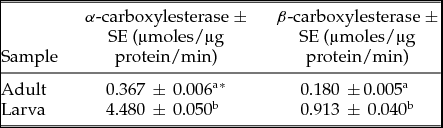
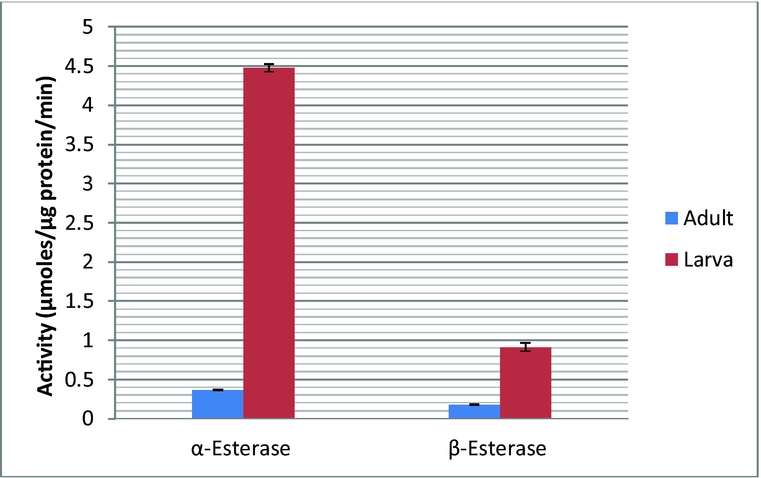
The α and β carboxylesterase enzyme activity varied significantly between adult and larval C. quinquefasciatus (Table 1). For α-carboxyesterase, adults showed 0.367 ± 0.006 µmoles/µg protein/min while larvae showed about 12.2-fold higher level of activity (4.480 ± 0.050 µmoles/µg protein/min). For β-carboxylesterase, the level of activity was 0.180 ± 0.005 µmoles/µg protein/min in adults, which is about 5-fold less (Fig. 1) than that found in larvae (0.913 ± 0.040 µmoles/µg protein/min) (Table 1).
α- and β-carboxylesterase enzyme activity in adult and larval Culex quinquefasciatus

* Within columns, means followed by the same letter do not differ significantly (P = 0.001) in Tukey's multiple comparison test (HSDa).
Activity of α- and β-carboxylesterase enzymes in adult and larva of Culex quinquefasciatus.

Electrophoretic analysis of esterase enzymes in different stages of metamorphosis
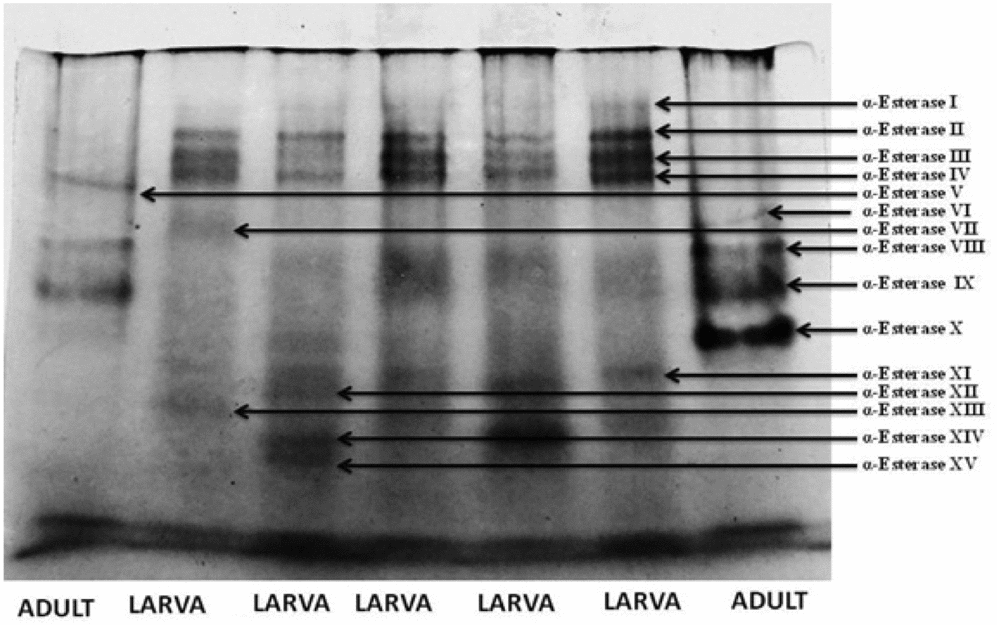
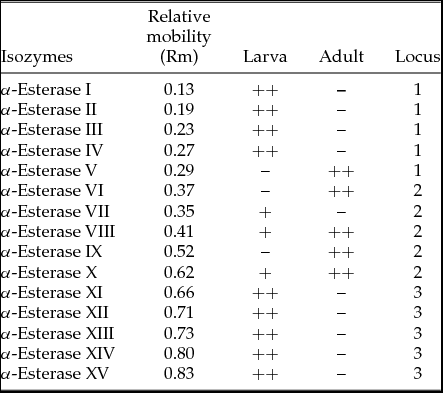
In total, 15 different bands were present in different life stages of mosquito hydrolyzing α-napthyl acetate as the substrate, and were, therefore, identified as α-carboxylesterase. Of these, 10 were expressed exclusively in the larva while three isozymes specific to adults were found. Two isozymes shared their expression in both adult and larval forms (Fig. 2). The Rm values ranged from as low as 0.125 to as high as 0.83 (Table 2).
Electrophoretic analysis of α-carboxylesterase in larva and adult of Culex quinquefasciatus.

Different α-carboxylesterase isozymes with their relative expression pattern in larva and adult of Culex quinquefasciatus

++ represents high and + represents low expression of isozymes, whereas – represents no expression of isozymes.
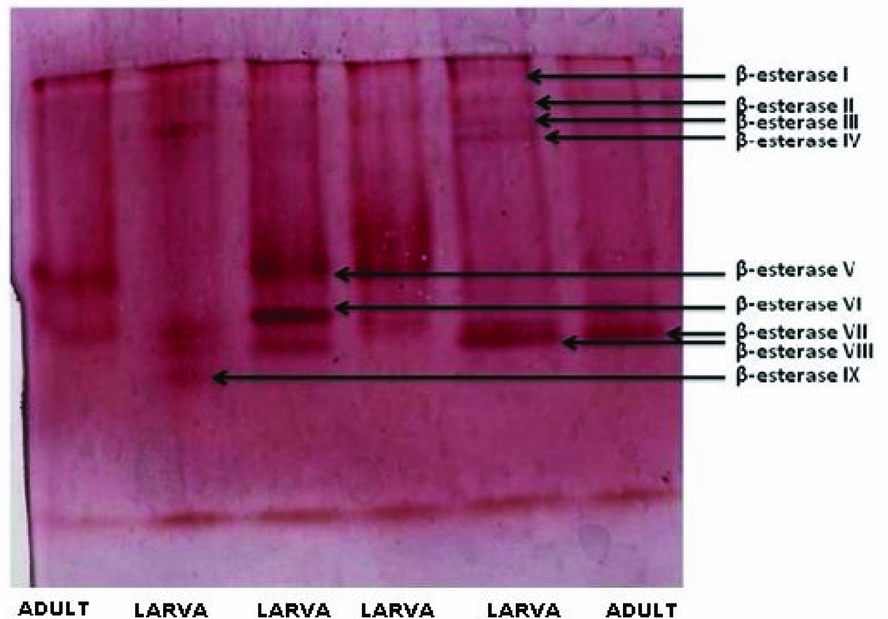
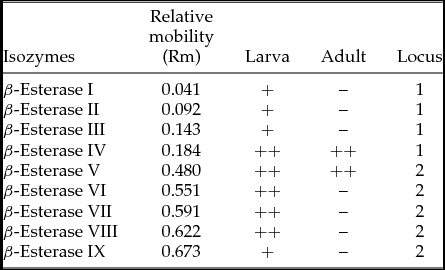
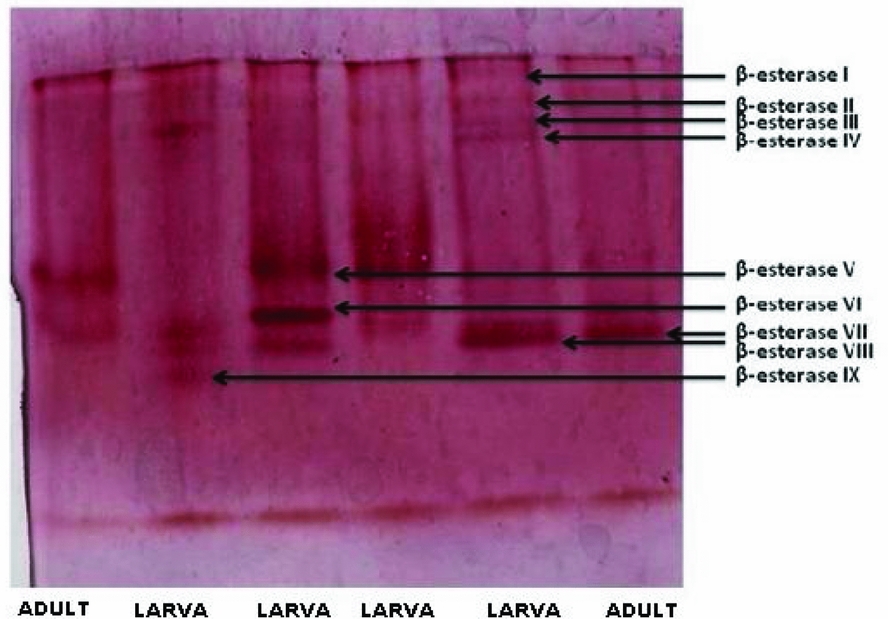
In case of β esterase, the results show remarkable differences in the expression of esterase isozymes in larvae, pupae and adults. Altogether, nine distinct bands were found on the gel, of which seven bands were limited to larvae only while the remaining two were found to be present in both the larvae and adults (Fig. 3). Adults showed absence of any adult-specific band. The Rm values ranged from 0.041 to 0.673 (Table 3).
Electrophoretic analysis of β-carboxylesterase in larva and adult of Culex quinquefasciatus.
Different β-carboxylesterase isozymes with their relative expression pattern in larva and adult of Culex quinquefasciatus

++ and + represents high and low expression of isozymes respectively. – represents no expression of isozymes.
Adult and larval bioassays
Adults were found to be more susceptible compared to larval forms against chlorpyrifos with LC50 and LC90 values of 0.006 ppm and 0.0015 ppm, respectively. The LC90 value of adults is about 10-fold lower than the LC90 value of larvae (Table 4), but in the case of synthetic pyrethroids, the reverse scenario was observed. For deltamethrin, the LC90 value of larvae is 0.097 ppm which is ≈7.43 times lower than that of adults. Similar results were observed against lambda-cyhalothrin where adults possess ≈ 5.05 times higher value of LC90 than larval forms (Table 4).
Adult and larval bioassay of Culex quinquefasciatus against insecticides

1 ppm: parts per million; 2LC50: lethal concentration 50; 3LC90: lethal concentration 90; r: correlation coefficient; χ2: chi square value.
Discussion
Several vector-borne diseases transmitted mainly by mosquitoes, cause significant mortality and morbidity in several countries, including India. Researchers have extensively studied the mechanisms involved in insecticide resistance in mosquitoes over the past decade. A variety of genetic modifications, such as transcriptional changes, changes in gene amplification and point mutations in coding regions that allow increased rates of insecticide detoxification (metabolic detoxification), or reduce the sensitivity of target proteins (target site insensitivity), typically characterize insecticide resistance (Raymond et al., Reference Raymond, Chevillon, Guillemaud, Lenormand and Pasteur1998; Scott, Reference Scott1999; Hemingway et al., Reference Hemingway, Field and Vontas2002). The transcriptional regulation of gene expression is a primary means by which insects adapt to a changing environment. Li et al. (Reference Li, Guo, Zhang, Dong, Xing, Yan, Wang, Zhang and Zhao2016) describe differential expression of more than 100 genes in C. pipiens pallens and C. p. quinquefasciatus in response to insecticide exposure. In this context, esterases seem to hold a prime role, because of the numerous reports of studies indicating its role in insecticide resistance. The esterases involved in insecticide resistance may fail to show elevated expression (quantitative) and appear to be qualitatively different from the susceptible enzymes (Hemingway, Reference Hemingway1982, Reference Hemingway1983). Throughout the metamorphosis process, the whole mosquito body is reshaped asynchronously as the insect transforms from an aquatic animal to a terrestrial being. These changes are brought about by the changes in the gene expression patterns, thereby changes in protein (enzyme) expression (Koutsos et al., Reference Koutsos, Blass, Meister, Schmidt, MacCallum, Soares, Collins, Benes, Zdobnov, Kafatos and Christophides2007).
From the results of quantitative estimation of carboxylesterase, a significant difference between the activity of carboxylesterase in larva and adult is evident. In larvae, the carboxylesterase enzymes were more expressed both quantitatively and qualitatively compared to adults. Several other enzymes have also been shown to follow a similar trend in Drosophila sp., such as alcohol dehydrogenase, lactate dehydrogenase and malate dehydrogenase, which have higher quantitative levels during larval stages than the adults (Avise and McDonald, Reference Avise and McDonald1976).
In the current study, we observed three gene loci for α- and two for β-carboxylesterase among the different life stages of C. quinquefasciatus. However, in case of α-carboxylesterase, only locus 2 was expressed in adults, whereas all the loci were expressed in larvae. Moreover, the highly expressed locus in case of adults was found to exhibit the lowest expression in larvae. Similarly, for β-carboxylesterase, all the loci were found to be expressed in case of larval forms, but only the second locus was expressed in the adults. Differences in carboxylesterase synthesis between stages are probably because of the regulatory mechanisms acting in agreement with the requirements of a variable number of processes in which carboxylesterase are involved (Lima-Catelani et al., Reference Lima-Catelani, Ceron and Bicudo2004). In the current study, one group of carboxylesterases (locus) is found to be predominantly expressed in adults, and all the other loci of carboxylesterase isozymes are seen to be switched off after the emergence of the adult, as well as at the time of pupation. Differences in carboxylesterase patterns through developmental stages reflect the regulation of translation during development (Lima-Catelani et al., Reference Lima-Catelani, Ceron and Bicudo2004). Brady and Richmond (Reference Brady and Richmond1990) have observed a similar trend of stage-specific expression of carboxylesterase bands or isozymes in Drosophila spp. The total number of esterase bands present varies from species to species and also among developmental stages (Lima-Catelani et al., Reference Lima-Catelani, Ceron and Bicudo2004).
In the current study, locus 2 of α-carboxylesterase is present in every stage of the mosquito (α-Est VII–VIII, α-Est X in larva and α-Est V–VI, α-Est VIII–X in adults), as shown by strong, densely stained bands on gels, denoting constant and high expression during development, as well as in adult stage. This group of isozymes seems to be expressed during the entire development and considered to be involved in many vital physiological roles (mainly produced by housekeeping genes) related to its presence throughout the development (Lima-Catelani et al., Reference Lima-Catelani, Ceron and Bicudo2004). Different levels of carboxylesterase band activity (band thickness and staining intensity) reflect that the esterase, which remains active throughout, is also under regulation and the levels undergo extreme fluctuations during development (Lima-Catelani et al., Reference Lima-Catelani, Ceron and Bicudo2004). Here, α-Est VIII, α-Est X and β-Est V were found to be expressed throughout development. Dos Santos et al. (Reference dos Santos, Contel and Kerr1985) have reported such presence of carboxylesterase throughout development in Anopheles darlingi, and Vedbrat and Whit (Reference Vedbrat and Whitt1975) have reported the same in An. albimanus. In the present study, robust α-Est X and β-Est VII bands on PAGE were found for adult mosquitoes, indicating that these isozymes may have some role in the maintenance of low-level juvenile hormones (JH) in adults (dos Santos et al., Reference dos Santos, Contel and Kerr1985). Differences in expression of carboxylesterase in different developmental stages may be due to the regulation of transcription and translation during development.
Researchers have observed the highest expression of carboxylesterase isozymes in the larval stage. They have also observed all the three loci for α- and two for β-carboxylesterase expressed in the larval group, and also polymorphisms within the locus. In insects, carboxylesterase takes part in various biological processes, such as regulation of JH (de Kort and Granger, Reference de Kort and Granger1981; Shanmugavelu et al., Reference Shanmugavelu, Baytan, Chesnut and Bonning2000), digestion (Kapin and Ahmad, Reference Kapin and Ahmad1980; Jones and Brancoft, Reference Jones and Brancoft1986), reproduction (Richmond et al., Reference Richmond, Gilbert, Sheehan, Gromko and Butterworth1980; Mane et al., Reference Mane, Tompkins and Richmond1983), and insecticide resistance (Motoyama and Dauterman, Reference Motoyama and Dauterman1974; Fournier et al., Reference Fournier, Mutero, Pralavorio and Bride1993; Siegfried and Ono, Reference Siegfried and Ono1993; Karunaratne and Hemingway, Reference Karunaratne and Hemingway1996; Perez-Mendoza et al., Reference Perez-Mendoza, Fabrick, Zhu and Baker2000). However, these processes do not function throughout the development of an insect; instead, some functions are switched on and off, depending upon the developmental stage and physiological conditions of the organisms. Higher expression of carboxylesterase isozyme in larvae may be due to higher requirements in larval stages than in the other stages, because of the high level of food ingestion, JH metabolism, and developmental processes (e.g., high mitotic index). However, the carboxylesterase enzymes in this last stage are probably involved mainly with reproduction, digestion, and nervous system physiology (Lima-Catelani et al., Reference Lima-Catelani, Ceron and Bicudo2004). Juvenile hormone esterases (JHEs) have been reported to hydrolyse ester-containing substrates such as α-naphthyl acetate (used in our study for quantitative and qualitative assays) (Kamita et al., Reference Kamita, Hinton, Wheelock, Wogulis, Wilson, Wolf, Stok, Hock and Hammock2003) at a significantly higher rate (Kamita and Hammock, Reference Kamita and Hammock2010) bringing the possibility that quantitative and qualitative assays in this study measured a significant activity of these esterases. Several JHE have been shown to be highly expressed during the larval–pupal transitions (Yang et al., Reference Yang, Xu, Shang, Dou and Wang2016). The Aedes aegypti genome has three carboxylesterases genes, of which one has been shown to be coding for JHE and this activity has been reported to increase gradually during the last instar, with the activity reaching its peak just before pupation (Yang et al., Reference Yang, Xu, Shang, Dou and Wang2016). JHEs may have some role in the degradation of organophosphorus insecticides as done by other members of the carboxylesterase family. In mosquitoes belonging to Anopheles and Aedes genera, microarray experiments have shown that genes coding for JHE and other secreted carboxylesterase were up-regulated in insecticide-resistant populations (Montella et al., Reference Montella, Schama and Valle2012), thereby implicating their role in insecticide detoxification. The results of larval and adult bioassay have indicated the higher resistance of the larval forms against organophosphate chlorpyrifos than adults. The principal mechanism of organophosphorus insecticide resistance in mosquitoes remains the metabolic detoxification pathway, involving the elevation of one or more carboxylesterases (Hemingway and Karunaratne, Reference Hemingway and Karunaratne1998). Georghhiou et al. (Reference Georghiou, Pasteur and Hawley1980) have shown linkage relationship between organophosphate resistance and carboxylesterase in C. quinquefasciatus. The underlying mechanism is the amplification of the structural genes. Insecticide group mainly used for mosquito larvae control is the organophosphate. Also, adults were found to be less susceptible than larval forms against synthetic pyrethroids, which are broken down to non-toxic units by the activity of more than one detoxifying enzyme, including mixed function oxidases (MFOs), glutathione-S-transferases (and to some extent by the carboxylesterases) (Alvares et al., Reference Alvarez, Ponce, Oviedo, Lopez and Flores2013). Resistance to pyrethroids, e.g. deltamethrin has been many times associated with function of MFOs (cytochrome P450) alone (Bouvier et al., Reference Bouvier, Boivin, Beslay and Sauphanor2002) or with the coordinated activity of these two enzyme groups (Rodriguez et al., Reference Rodríguez, Bisset, Armas and Ramos2005; Alvares et al., Reference Alvarez, Ponce, Oviedo, Lopez and Flores2013; Dusfour et al., Reference Dusfour, Zorrilla, Guidez, Issaly, Girod, Guillaumot, Robello and Strode2015). The lower susceptibility of adults against synthetic pyrethroids as compared to larval forms may be because of the higher activity of other such enzymes in adult stages of mosquito.
Li et al. (Reference Li, Guo, Zhang, Dong, Xing, Yan, Wang, Zhang and Zhao2016) have also hypothesized that in Culex mosquitoes, many gene expression patterns have undergone alteration for selection acting in nature. Saavedra-Rodriguez et al. (Reference Saavedra-Rodriguez, Strode, Flores, Garcia-Luna, Reyes-Solis, Ranson, Hemingway and Black2014) have noted that, in response to single generation of selection by temephos in Aedes aegypti, three carboxylesterases genes and one JHE were found to be over-expressed. Experiments targeting the over-expression of enzymes through different life stages of mosquitoes under insecticide selection pressure may provide a detailed insight into the mechanisms governing insecticide resistance.
Since differential expression of genes occurs in different life stages of mosquito, researchers should target the IMM strategy to a specific life stage for the efficient management of mosquito vectors. Different developmental stages require different management strategies for control of variability in susceptibility to insecticides and expression of insecticide detoxifying enzymes. Since most mosquito species are harmful during the adult stage, targeting the larval stages for mosquito control may seem like a good approach for efficient mosquito management.
Acknowledgements
The authors are thankful to the Head of the Department of Zoology, University of North Bengal for providing laboratory space and allowing us to work in a common instrumentation facility. The authors also express their sincere thanks to the Computer Centre, University of North Bengal for providing uninterrupted LAN connection for smooth consultation throughout the work. The first author sincerely acknowledges the University Grants Commission (UGC), New Delhi for sanctioning the Junior Research Fellowship through award letter Sr. no. 2121430414, Ref no.: 21/12/2014 (ii) EU-V, Dated 03/06/2015.