Recent empirical work in the study of political sophistication has found that voters’ knowledge of politics is not just a function of their individual characteristics; it also depends on the supply of information from their environment (the ‘information environment’) (Prior Reference Prior2005; Jerit, Barabas and Bolsen Reference Jerit, Barabas and Bolsen2006; Jerit Reference Jerit2009; Barabas and Jerit Reference Barabas and Jerit2009; Hutchings Reference Hutchings2003). A key finding from this literature is that different groups of citizens learn at different rates about politics, depending on the information that is available to them from the media. Yet this literature does not address the question of how the information environment may be shaped by institutional factors. This article aims to fill this void. It first explains why characteristics of media systems—in particular freedom from government interference—comprise an important ingredient of the information environment. It then analyzes whether variation in government interference in the media sector impacts the political sophistication of electorates as a whole and/or particular groups of voters. To this end, it examines citizen knowledge across 23 elections in 20 countries using the first wave of the Comparative Study of Electoral Systems (CSES) dataset and national-level data on the media from Freedom House. It finds that media freedom has a positive effect on political sophistication for electorates as a whole. Using cross-level interactions analysis, it also finds that this effect is larger for better-educated individuals than for individuals with less education.
The article proceeds as follows. In the following section I briefly survey the literature on political knowledge in both political science and economics. I then present my hypotheses and discuss the data and results. I finish with some concluding remarks.
Theoretical Background
The study of citizens’ political knowledge has long been a prominent branch of the public opinion literature in political science. This makes sense, since it is only through knowledge of the workings of politics that electorates can hold their representatives accountable (Snyder and Strömberg 2010). But then what exactly explains an individual's political knowledge? Answers to this seemingly straightforward question vary considerably over time. Early work emphasizes voters’ individual characteristics, such as their education, income and political interest. These studies tend to be rather pessimistic about the average voter's potential to learn about politics. For example, The American Voter (Campbell et al., Reference Campbell, Converse, Miller and Stokes1960) argues that a majority of voters hold ‘non-attitudes’ that are unconstrained by ideological content. Most of their voters do not care about issues—their vote is informed only by identification with the party they have been exposed to by their families. Recent behavioral research is more optimistic about voters’ potential knowledgeability, which is supported by a range of arguments. Achen (Reference Achen1975), for example, argues that the measures used in The American Voter are flawed, and systematically underestimate voters’ cognitive capacities and information levels. Page and Shapiro (Reference Page and Shapiro1992) find that, even though individual citizens may not be very politically knowledgeable, the public at large is still capable of rationally responding to policy since individual-level noise tends to be cancelled out in the aggregate.Footnote 1 And a sizable literature on ‘low-information rationality’ (Lupia Reference Lupia1994) argues that voters may not need very much information to vote as if they were well informed.
The advent of more sophisticated multilevel modeling techniques in political science has inspired a neo-institutional approach that models political knowledge as a function of both individual characteristics and institutional factors. Most prominently, Jerit and colleagues (Jerit, Barabas and Bolsen Reference Jerit, Barabas and Bolsen2006; Jerit Reference Jerit2009; Barabas and Jerit Reference Barabas and Jerit2009) find that the volume (and type) of newspaper reporting moderates the (widely established) impact of socio-economic status in explaining political information: an increase in the volume of newspaper reporting yields an increase in information differences between highly and poorly educated voters. Their approach opens the door to understanding political sophistication not just as a capability or cognitive trait (as in the earlier behavioral studies) but also as a choice. This point of view echoes that of Gordon and Segura (Reference Gordon and Segura1997), who conceive of some configurations of political institutions as intrinsically more conducive to political learning because they make high-quality political information cheaper to obtain. In their study of the effect of party systems, electoral systems and legislative institutions on voter information, these authors reason that “if the party system, the electoral system, and legislative institutions of a polity affect the availability, clarity and usefulness of political information, they will also account for some of the cross-national variance in any individual-level measure of sophistication” (1997, 126). In a comparison of the 12 pre-1995 countries of the European Union, Gordon and Segura find that factors such as the competitiveness of electoral systems and the effective number of parties that make up party systems have significant positive effects on average mass sophistication.
Following this line of reasoning, variation in mass media institutions should also have an effect on political learning. After all, many citizens learn about politics through the mass media. Yet despite the media's importance to voter sophistication for representative democracies, much public opinion research in political science—both theoretical and empirical—has not systematically studied the mass media. Almost by assumption, the mass media are treated as “a conveyor belt that passively transports elite views—particularly the views of the most powerful elites—to the public” (Baum and Potter Reference Baum and Potter2008, 40). This contrasts with the more systematic study of the mass media within the field of ‘media economics’ (Prat and Strömberg Reference Prat and Strömberg2011). With respect to political knowledge, this literature has produced some interesting results. Leeson (Reference Leeson2008) studies media freedom from government control and political knowledge in 13 Central and Eastern European countries. He finds that “falling from the highest level of media freedom in the sample to the lowest is associated with a 42 percent increase in political ignorance” (160). Prat and Strömberg (Reference Prat and Strömberg2005) find that the introduction of commercial television in Sweden increased the average political knowledge of the electorate as a whole. In addition, voter knowledge is found to have positive downstream policy effects. For example, Snyder and Strömberg (2010) find that politicians are more responsive to the wishes of knowledgeable voters. Djankov et al. (Reference Djankov, McLiesh, Nenova and Shleifer2003) find that private media ownership (in contrast to state-owned media) is associated with improved social outcomes (citizens’ health, wealth and life span).
Hypotheses
In line with the institutional approach to voter learning in the aforementioned studies, the main argument of this article is that the institutional characteristics of media systems can be conducive to voter learning. A seminal paper in media economics (Besley and Prat Reference Besley and Prat2006) finds that as the number of independent media outlets increases, government capture of the media is less likely to occur. That is, if a media market is becoming more diverse, it becomes more difficult for political elites to constrain the supply of political information to voters. From this perspective, it makes sense to think of media freedom (as well as increased competition among media outlets) as conducive to voter information, simply because the ‘information environment’ is more heterogeneous and less constrained. Thus the first main hypothesis is:
Media Freedom Hypothesis: Individuals who live in media systems that are more free from government interference are, on average, more knowledgeable about politics than individuals in media systems that are less free.
The Media Freedom Hypothesis is in line with the findings in Leeson (Reference Leeson2008). The current article improves on that study in at least three different ways. It first expands the sample of countries from 13 Central and Eastern European countries to over 20 countries on five different continents.Footnote 2 Secondly, it uses a more satisfying measure of voter knowledge (which is discussed in the next section). Thirdly, my multilevel modeling approach allows me to test cross-level interactions among types of voters and their institutional surroundings. The estimated multilevel models in this article include individual-level variables that have been named “the usual suspects” (Prior Reference Prior2005; Jerit, Barabas and Bolsen Reference Jerit, Barabas and Bolsen2006; Jerit Reference Jerit2009; Barabas and Jerit Reference Barabas and Jerit2009) of behavioral models of voter knowledge: education, income, etc. As noted, Jerit and colleagues find that the information environment has a moderating effect on these factors’ impact on knowledge. Extending their findings to a cross-national context, I expect that education and media freedom interact in their effect on political knowledge: increased media freedom corresponds to greater choice among media outlets, but individuals with more education are in a better position than voters with less education to learn from this increasingly diverse information environment. This leads me to the second main hypothesis:
Education Hypothesis: In a comparison of countries and citizens, the marginal effect of education level on political knowledge is larger in free media systems than it is in media systems that are less free.
Data And Measurement
Data
Data for this research come from a number of sources. Individual- and country-level political data are from the first module of the CSES, a cross-national research program of over 50 national election studies. Its first module contains data on elections during the period 1996–2001. Information on media freedom in those countries is from Freedom House, a US-based nongovernmental organization that conducts and publishes annual reports on democracy, political freedom and human rights. Political and media control variables are from UNESCO's Institute for Statistics, the World Bank,Footnote 3 Golder (Reference Golder2005) and Baek (Reference Baek2009).
Dependent Variable: Voter Knowledge
Voter knowledge can be thought of and measured in many different ways, ranging from the abstract to the more concrete. Each measure comes with its own strengths and weaknesses. For example, a more concrete measure would simply tally voters’ ability to correctly answer a set of political knowledge questions. Yet this type of measure is difficult to compare across countries. That is, what is considered concrete political information in Country A is often different from concrete political information in Country B.
To be able to compare voter information across countries, a more abstract measure is required that (1) applies to all countries involved and (2) is of central importance to voters in the electoral process. Gordon and Segura (Reference Gordon and Segura1997) have developed a measure with both of these qualities; they conceptualize voter information as voters’ ability to correctly locate parties’ ideological preferences. After all, in order for voters to keep their representatives accountable, they must know the politicians’ policy preferences. And the better they are at this, the more information they must have. More concretely, Gordon and Segura measure voter knowledge as the average sum of the absolute distances between a respondent's placement of a polity's political parties on a one-dimensional ideological scale and their mean placements by all other respondents.Footnote 4
This article uses a similar approach, measuring knowledge as the absolute distance between an individual's perception of the largest party's ideological location and the mean perception of the electorate at large. That is, political knowledge is measured as  $$$|{{L}_{ij}}{\rm{ - }}{{\bar{L}}_j}|$$$
, where Lij is individual i's perception of the ideological location L of party j and
 $$${{\bar{L}}_j}$$$
is the electorate's perception of the ideological position L of party j on a 10-point ideological scale.Footnote 5 This measure is constructed using CSES data (Sapiro and Shively Reference Sapiro and Shively2003). To make the results more intuitive, the knowledge variable is inverted so that larger scores correspond to higher levels of knowledge. The variable is logged and recoded so that it fits a normal distribution and varies between 0 and 1.Footnote 6
Independent Variables
The main independent variable in this article is Freedom House's annual media freedom measure, which is a substantive and continuous measure that scores countries based on government interference in their media sectors. It is scaled from 0 (most free) to 100 (least free) and is constructed from 23 items that are subdivided into three equally weighted subcategories: legal environment, political environment and economic environment.
The legal environment subcategory encompasses “an examination of both the laws and regulations that could influence media content and the government's inclination to use these laws and legal institutions to restrict the media's ability to operate.”Footnote 7 In principle, this subcategory assesses the extent to which a country's legal framework guarantees freedom of expression, and the independence of the judiciary and media regulatory bodies. It consists of eight individual items on which countries are scored from 0 to 30.
The political environment subcategory denotes the degree of political control over the content of the media (seven items, scored between 0 and 40 points). This subcategory assesses “the editorial independence of both state-owned and privately owned media; access to information and sources; official censorship and self-censorship; the vibrancy of the media and the diversity of news available within each country; the ability of both foreign and local reporters to cover the news freely and without harassment; and the intimidation of journalists by the state or other actors.”Footnote 8
The economic environment subcategory (eight items, 0 to 30 points) includes “the structure of media ownership; transparency and concentration of ownership; the costs of establishing media as well as of production and distribution; the selective withholding of advertising or subsidies by the state or other actors; the impact of corruption and bribery on content; and the extent to which the economic situation in a country impacts the development and sustainability of the media.”Footnote 9 In other words, it measures the economic cost of establishing a media outlet in a country.
The scores on this Media Freedom variable have been inverted and re-scaled so that a 0 denotes the country in the sample with the most media interference (Belarus in 2001) and 1 denotes the country with the least media interference (Norway in 1997).Footnote 10 For each country I used the media freedom score for the year in which the election took place.
Furthermore, I control for a number of media system variables. The Herfindahl Index measures media market competitiveness (Hirschman Reference Hirschman1964). Theoretically, a Herfindahl index ranges from 0 to 1, where 0 denotes a perfectly competitive industry and 1 denotes a monopoly. The index H is calculated as follows:  $$$H\, = \,\mathop{\sum}\sidelimits_{i\, = \,{\rm{1}}}^N \,s_{i}^{{\rm{2}}} $$$
, where si is the market share of firm i in the market, and N is the number of firms. The models in this article include indices for both the television and newspaper industries. Both indices were calculated using data from Djankov et al. (Reference Djankov, McLiesh, Nenova and Shleifer2003) on countries’ five largest newspapers and television channels in terms of market share. Public Broadcasting Percentage measures the audience share of public broadcasting channels as the percentage of total audience size of the five largest television stations (Baek Reference Baek2009). Newspaper Demand is the number of daily newspaper subscribers per capita in the population, with daily newspapers referring to publications that appear at least four times a week. This variable is from UNESCO's Institute for Statistics. To control for economic conditions, I also include GDP Per Capita as measured by the World Bank.Footnote 11
In addition to these media system variables, the models in this article also include a number of political control variables as well as individual-level variables. Their measurement is discussed in the Appendix.
Analysis And Results
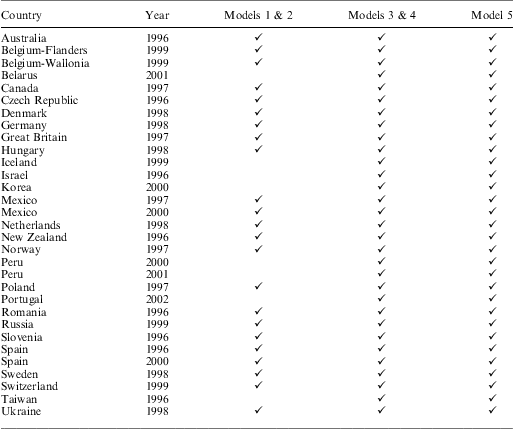
The statistical models I estimate in this article require much from the data. In order to extend the robustness of the statistical results to as many elections as possible, I estimated both a completely specified model (with controls for political, economic and media factors) on 28,450 individuals in 23 elections and nested models (with political and economic controls alone) on 37,077 individuals in 31 elections. Table 1 lists the elections that are under study in all of the estimated models. The difference in the number of observations at the country level stems from the availability of country-level media variables. With media data missing for eight elections, the number of individual observations changes as well.
Elections Under Study

Descriptive Statistics
Figure 1 depicts the raw, linear relationship between voter knowledge and media freedom, averaged across countries. It clearly displays the positive correlation between both variables: on average, voters tend to be more knowledgeable about politics as a country's media system becomes more free.Footnote 12
Media Freedom and voter knowledge (averaged across countries)
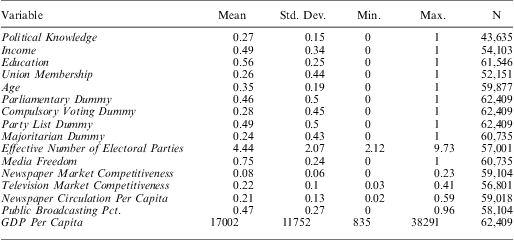
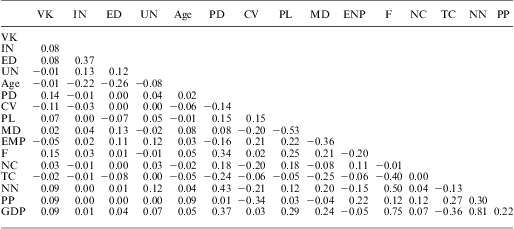
Tables 2 and 3 display the summary statistics for all variables in the model. Table 2 demonstrates that the Herfindahl index for the newspaper market does not vary all that much. That is, almost all countries in the dataset are characterized by highly competitive newspaper markets. This may obscure a potential effect of market competitiveness on voter knowledge. Bivariate correlations among all variables are listed in Table 2. The correlation between Media Freedom and Newspaper Circulation Per Capita is positive and high (r=0.50). Thus an increase in media freedom is associated with a higher number of daily newspaper subscribers per capita. Furthermore, I should note that both Media Freedom (r=0.75) and Newspaper Circulation Per Capita (r=0.81) correlate very strongly with a country's income as measured by GDP Per Capita. To account for this correlation in the analysis that follows, I will present model results with and without GDP Per Capita included as an independent variable. If Media Freedom is to have an effect on voter knowledge that is independent of a country's income, the size and significance of its regression estimates should be unaffected by including the latter variable in the models.
Summary Statistics
Correlations
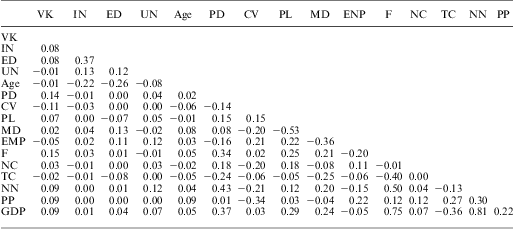
Note: VK = Voter Knowledge; IN = Income; ED = Education; UN = Union Membership; PD = Parliamentary Dummy; CV = Compulsory Voting Dummy; PL = Party List Dummy; MD = Majoritarian Dummy; ENP = Effective Number of Legislative Parties; F = Freedom of the Press Score; NC = Newspaper Market Competitiveness; TC = Television Market Competitiveness; NN = Newspaper Circulation; PP = Public Broadcasting Pct.; GDP = GDP per capita.
Diagnostics
A citizen's political knowledge can be modeled as a function of both individual- and country-level covariates using many types of statistical models, each of which makes its own assumptions about the data-generating process. For example, a pooled ordinary least square (OLS) model takes all (individual-level) observations to be drawn from the same general population. That is, an OLS model implicitly assumes that there is no country-level component to individual-level errors. Yet when I estimate the country-level intraclass correlation coefficient (ρ=0.065), significant and considerable unobserved heterogeneity is revealed, which strongly indicates that the individual observations are clustered within countries.Footnote 13 This finding implies that a random intercept model is to be preferred over a pooled OLS regression model, since there is significant variation across countries; under such conditions, complete pooling leads to biased standard errors and incorrect hypothesis tests (Rabe-Hesketh and Skrondal Reference Rabe-Hesketh and Skrondal2008). More substantively, these diagnostics also indicate that there is interesting cross-national variation in voter knowledge to explore.
Results
The Media Freedom Hypothesis holds that individuals who live in media systems that are more free from government interference are, on average, more knowledgeable about politics than individuals in media systems that are less free.
The random-intercept model for the Political Knowledge of voter i in country j that is employed to address this hypothesis is:
 $${ {\rm{Voter}}\,{\rm{Knowledg}}{{{\rm{e}}}_{ij}} & \, = \,{{\beta }_{0j}}\, + \,{{\beta }_{{\rm{1}}j}}\times {\rm{Educatio}}{{{\rm{n}}}_{ij}}\, + \,\mathop{\sum}{\beta \times {\rm{Controls}}\,{\rm{(Individual}} {\hbox-} {\rm{Level)}}} {}\, + \,{{{\epsilon}}_{ij}} \cr {{\beta }_{0j}} & \, = \,\gamma 00\, + \,{{\gamma }_{{\rm{0}}1}}\times {\rm{Media}}\,{\rm{Freedo}}{{{\rm{m}}}_j}\, + \,\mathop{\sum}{\gamma \times {\rm{Controls}}\,{\rm{(Country}} {\hbox-} {\rm{Level)}}} \, + \,{{\zeta }_{{\rm{0}}j}} \cr}$$
Thus the intercept  $$${{\beta }_{0j}}$$$
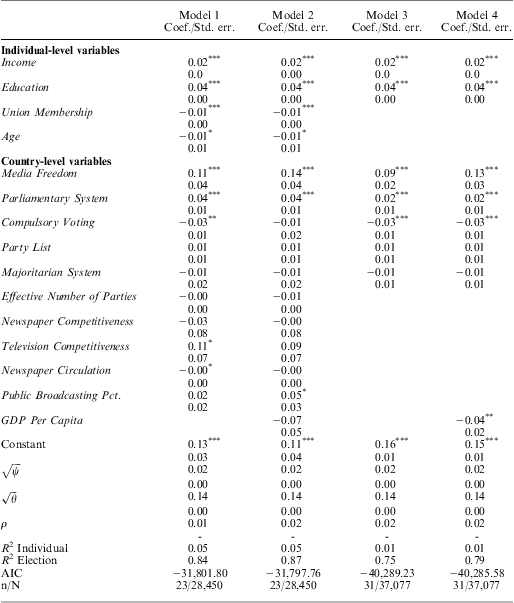
is allowed to vary across countries as a function of country-level covariates. Technically, random-effects estimators are the weighted average of between- and within-country estimates (and thus incorporate information from both). To test the Media Freedom Hypothesis, I have estimated four random intercept models (see Table 4).
Voter Knowledge: Random Intercept Models
* p < 0.05; ** p < 0.01; *** p < 0.001 (two sided).
Models 1 and 2 are fully specified models (with political and media controls and political, media and economic controls, respectively) on individuals in 23 elections, whereas Models 3 and 4 are nested models (with only political and economic controls) of individuals in 31 elections. The estimated effect of Media Freedom is significant, in the hypothesized direction, and of similar size in all models: all else equal, voters are about 10 percentage points ( $$${{\gamma }_{{\rm{01}}}}\, = \,{\rm{0}}{\rm{.11}}$$$
in Model 1,
 $$${{\gamma }_{{\rm{01}}}}\, = \,{\rm{0}}{\rm{.14}}$$$
in Model 2,
 $$${{\gamma }_{{\rm{01}}}}\, = \,{\rm{0}}{\rm{.09}}$$$
in Model 3 and
 $$${{\gamma }_{{\rm{01}}}}\, = \,{\rm{0}}{\rm{.13}}$$$
in Model 4) more knowledgeable when media are most free (Norway in 1997) than when media are least free (Belarus in 2001). This difference thus varies between one-half and one complete standard deviation in aggregate political knowledge. I should also note that the effect of Media Freedom on average voter knowledge is independent of economic conditions as measured by GDP Per Capita, despite the strong correlation between both variables: including GDP Per Capita in Models 2 and 4 does not alter the size or significance of the regression estimates for Media Freedom.Footnote 14
At the individual level, both income and education positively affect Political Knowledge: better-educated individuals with a larger income tend to be more knowledgeable about politics than their lower-earning, less-educated counterparts ( $$$\beta \, = \,{\rm{0}}{\rm{.02}}$$$
and
 $$$\beta \, = \,{\rm{0}}{\rm{.04}}$$$
, respectively). This expected effect of the ‘usual suspects’ of behavioral studies supports the validity of the voter knowledge measure employed in this study. Furthermore, union members are slightly less knowledgeable about politics than non-members (
 $$$\beta \, = \,{\rm{ - 0}}{\rm{.01}}$$$
), whereas the oldest senior citizens are slightly less well informed than those who just turned 18 (
 $$$\beta \, = \,{\rm{ - 0}}{\rm{.01}}$$$
).
With regards to political institutions, the model demonstrates that citizens in parliamentary democracies tend to be better informed than citizens in mixed or presidential democracies. This finding is possibly explained by the important role of parties in parliamentary democracies. After all, in such democracies the executive needs majority support from the legislature to remain in power. Compulsory voting laws seem to negatively impact voter sophistication ( $$$\gamma \, = \,{\rm{ - 0}}{\rm{.03}}$$$
), although this effect seems sensitive to model specification and is not very robust. Furthermore, as television markets become more competitive, this has a positive and sizable effect on Political Knowledge (
 $$$\gamma \, = \,{\rm{0}}{\rm{.11}}$$$
), but this marginally significant effect disappears with the inclusion of GDP Per Capita. In contrast, the competitiveness of newspaper markets does not seem to have any effect on voter knowledge, but this is possibly explained by the lack of variability in newspaper markets in the dataset (see Table 2).
All in all, the results from the random-intercept model strongly support the Media Freedom Hypothesis: Media Freedom and Political Knowledge are positively related. Yet aggregating across electorates may obscure interesting variations. For example, political and media institutions may differentially affect knowledge across different groups of individuals. This idea is in line with the work of Jerit and colleagues (Jerit, Barabas and Bolsen Reference Jerit, Barabas and Bolsen2006; Jerit Reference Jerit2009; Barabas and Jerit Reference Barabas and Jerit2009), who find that the volume and type of newspaper reporting moderates the (widely established) impact of socio-economic status in explaining political information: an increase in the volume of newspaper reporting coincides with an increase in information between highly and poorly educated citizens.
An extension of these findings to a cross-national setting is summarized in the Education Hypothesis, which posits that in a comparison of countries and citizens, the marginal effect of education level on political knowledge is larger in media systems that are more free from government interference. To investigate evidence for the Education Hypothesis, I have estimated a random coefficient model in which the slope parameter for the within-country variation of the Education variableFootnote 15 is modeled as a function of Media Freedom (Gelman and Hill Reference Gelman and Hill2007; Rabe-Hesketh and Skrondal Reference Rabe-Hesketh and Skrondal2008).Footnote 16 The random intercept, random coefficient model for Political Knowledge of individual i in country j that is employed to test this hypothesis is:
 $${ {\rm{Voter}}\;{\rm{Knowledg}}{{{\rm{e}}}_{{\rm{ij}}}}&#x0026; = {{\beta }_{0j}}{} + {}{{\beta }_{1j}}\times {\rm{Educatio}}{{{\rm{n}}}_{{\rm{ij}}}} + \mathop{\sum}\beta \times {\rm{Level}} - 1\;{\rm{Controls}}\, + {{ \in }_{ij}}{} \cr {{\beta }_{0j}} &#x0026; = {}\gamma 00 + {{\gamma }_{01}}{\rm{Media}}\;{\rm{Freedo}}{{{\rm{m}}}_{\rm{j}}} + \mathop{\sum}\gamma \times \,{\rm{Controls}} + {{\zeta }_{0j}}{} \cr {{\beta }_{1j}} &#x0026; = \gamma 10 + \gamma 11\times {\rm{Media}}\;{\rm{Freedo}}{{{\rm{m}}}_{\rm{j}}} + {{\zeta }_{1j}} \cr}$$
This model allows both the intercept  $$${{\beta }_{0j}}$$$
and the slope for Education
 $$${{\beta }_{1j}}$$$
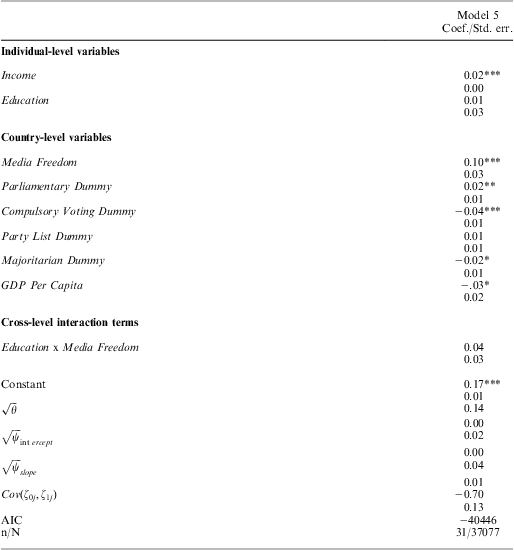
to vary across countries as a function of country-level covariates and Media Freedom, respectively. The model results are presented in Table 5. The first thing to notice is that Income (
 $$$\beta \, = \,{\rm{0}}{\rm{.02}}$$$
), Compulsory Voting (
 $$$\gamma \, = \,{\rm{ - 0}}{\rm{.04}}$$$
) and Parliamentary Dummies (
 $$$\gamma \, = \,{\rm{0}}{\rm{.02}}$$$
) are similar to their estimates in the random intercept model, and that the majoritarian dummy (
 $$$\gamma \, = \,{\rm{ - 0}}{\rm{.02}}$$$
) now is marginally significant. Yet in contrast to the random intercept model, the estimate for the effect of Education on Political Knowledge (
 $$${{\gamma }_{{\rm{10}}}}\, = \,{\rm{0}}{\rm{.01}}$$$
), rather than denoting a marginal effect, now denotes a specific conditional effect of education. More precisely, it denotes the effect of Education on Political Knowledge for individuals living in Belarus. Across all countries j, the conditional effects of Education on Political Knowledge (
 $$${{\beta }_{{\rm{1}}j}}$$$
) are estimated as the sum of fixed components (the fixed effects of Education and Media Freedom) as well as the estimated random effect of Education. More generally, and in contrast to random intercept models or pooled OLS models, the varying coefficient for Education denotes conditional effects rather than a marginal effect.
Random Intercept, Random Coefficient Model With Cross-Level Interactions
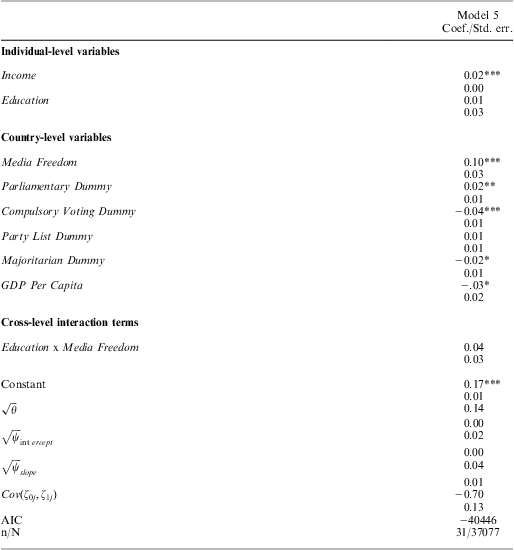
* p < 0.05; ** p < 0.01; *** p < 0.001 (two sided).
Figure 2 displays the estimated conditional effects (and their 95 percent confidence intervals) for all countries, sorted from lowest (Belarus in 2001) to highest (Norway in 2007) Media Freedom. Although the conditional effects do not neatly line up in order, they do follow a clear pattern: as Media Freedom increases, so does the effect of Education on Political Knowledge. Further evidence of this comes from the displayed least squares regression line ( $$$\beta \, = \,{\rm{0}}{\rm{.07}}$$$
, se=0.02, p<0.00) of the conditional effects of Education on Media Freedom. The plot paints an interesting picture of varying conditional effects, in which Education ranges from having no effect on political knowledge (for example, in Belarus, Russia, Mexico and Taiwan) to having significant positive effects. To illustrate, in New Zealand a university-educated individual is about 11 percentage points more knowledgeable about politics than a counterpart with only a secondary school education. And in Norway and Switzerland, education alone moves an individual about half a standard deviation up the political knowledge distribution.
Conditional effects of Education across elections and countries Note: each dot represents the estimated conditional effect of education on individual countries (the black lines represent their 95 percent confidence intervals). The countries are sorted from lowest (Belarus 2001) to highest (Norway 1997) Media Freedom. The red line denotes the least squares regression line of the conditional effects on the Media Freedom variable (its 95 percent confidence interval is shown in gray). The figure shows that, all else equal, as mass media becomes more free from government interference, Education has a stronger effect on Political Knowledge.
To further visualize the interactive Education Hypothesis, I have separately estimated the conditional effect of Education on voter knowledge in less free media systems (Media Freedom ≤ 0.5) and more free media systems (Media Freedom > 0.5). The results of these estimations are displayed in Figure 3. This figure first shows that voters in countries with unrestricted media are predicted to be more politically knowledgeable than their counterparts in countries in which the media are less free, regardless of their education level.Footnote 17 In addition, it demonstrates that the marginal effect of Education on voter sophistication is larger for voters in free media systems than for their counterparts in less free media systems. That is, the predicted marginal effect of Education is much larger for voters in free media systems than it is for voters in relatively unfree media systems, as evidenced by the steeper slope for these voters. This finding lends strong support to the Education Hypothesis: all else equal, education is a better predictor of political knowledge when media are more free than when media are less free.
Education and Voter Knowledge in countries that are low and high in Media Freedom Note: the lines denote fitted Political Knowledge for individual voters with different levels of education within countries that are high (> 0.5) and low (≤ 0.5) in Media Freedom. The shading denotes 95 percent confidence intervals around those predicted values (these are small because they are estimated at the individual level).
Conclusion
The statistical models estimated in this article find evidence for the Media Freedom Hypothesis and the Education Hypothesis: voters who live in media systems that are more free from government interference are, on average, more knowledgeable about politics than voters in media systems that are less free, and the conditional effect of education is more pronounced in free media systems than in less free media systems. These findings are likely the result of the increased supply of political information in free media systems, as evidenced by the strong positive correlation between Media Freedom and Newspaper Circulation Per Capita (see Table 3). In free media systems, individual outlets are less likely to be “captured” by the government, which leads to a more heterogenuous and less constrained information environment, which in turn positively affects the political knowledge of the electorate as a whole, and of well-educated individuals in particular. These media effects are independent of a country's economic state and level of democracy.
These findings illustrate that voter knowledge is not just a function of individual characteristics; it also depends on the institutional environment. That is, individual characteristics such as education, income and political interest interact with the institutional environment to explain voter knowledge. In the American context, these types of (media) contingencies have been studied extensively by Jerit and Barabas and colleagues (Jerit, Barabas and Bolsen Reference Jerit, Barabas and Bolsen2006; Jerit, Reference Jerit2009; Barabas and Jerit, Reference Barabas and Jerit2009), and this article has shown that this finding also applies to a cross-national setting.
Appendix
Country-Level Political Variables and Individual-Level Variables
Gordon and Segura (Reference Gordon and Segura1997) find that party systems, electoral systems and legislative institutions positively affect voter information if they make high-quality political information cheaper to obtain. To account for their findings, this article includes the following control variables:
Country-level political variables
• Parliamentary System is a dummy variable coded as 1 if a country had a parliamentary system in 2000, and 0 otherwise (i.e., presidential or mixed). This variable is taken from Golder (Reference Golder2005).
• Compulsory Voting is a dummy variable coded as 1 if a country has compulsory voting laws, and 0 otherwise. This variable is taken from CSES (2003), and its inclusion is intended to capture the possibility that if a country has mandatory voting, this may affect voters’ willingness to learn about parties.
• Party List is a dummy variable coded as 1 if a country has party lists, and 0 otherwise. This variable is taken from CSES (2003), and it is included in order to capture party strength. In electoral systems in which parties are strong, individuals are expected to be more knowledgeable about parties’ ideologies.
Individual-level variables
• Education is measured on a scale from 1 (no education) to 8 (university undergraduate degree completed). To facilitate interpretation, the variable has been recoded to range from 0 to 1.
• Income is measured on a scale from 1 (lowest household income quintile) to 5 (highest household income quintile) and has been recoded to range from 0 to 1.
• Age (measured in years) has been recoded to range from 0 to 1.
• Union Membership is a dummy variable coded as 1 if a respondent is a member of a union, and 0 otherwise.