Introduction
Bilateral myringotomy with placement of ventilating tubes is a very common procedure worldwide. In New Zealand, the rates for bilateral myringotomy and tube placement are comparable to those in the UK and USA, at approximately 3–7 per 1000 children, making it one of the most common surgical procedures across all ages. Previous studies suggest that up to 76 per cent of children will require analgesia following bilateral myringotomy and tube placement.Reference Tobias, Lowe, Hersey, Rasmussen and Werkhaven1 Consequently, a number of analgesic agents have been studied for bilateral myringotomy and tube placement surgery. These include: oral paracetamol (acetaminophen), oral and intramuscular non-steroidal anti-inflammatory drugs, oral codeine, topical lidocaine, topical phenol, transnasal butorphanol, and intranasal fentanyl.Reference Tobias, Lowe, Hersey, Rasmussen and Werkhaven1–Reference Rampersad, Jimenez, Bradford, Seidel and Lynn11
Assessing pain in children is often complicated by the phenomenon of emergence agitation following induction with inhaled anaesthetic agents, especially in pre-verbal and pre-school aged children.Reference Beyer, McGrath and Berde12, Reference Finkel, Cohen, Hannallah, Patel, Kim and Hummer13 Recent studies have provided a better understanding of emergence agitation, as well as suggesting proven techniques to reduce its occurrence and hence its confusion with pain.Reference Kuratani and Oi14 Surprisingly, none of these preventative techniques have been applied in previous studies addressing pain after bilateral myringotomy and tube placement surgery. This begs the question: could some observations of this pain in patients be attributable to emergence agitation? Furthermore, additional confounding factors, such as the use of an intravenous (IV) cannula, airway adjuncts, and inadvertent canal wall or middle-ear trauma during bilateral myringotomy and tube placement, may also influence post-operative pain and they too have yet to be addressed.
Some studies have assumed that bilateral myringotomy and tube placement is painful, and have focused on which analgesic agent is most effective, without the use of a placebo. Pain is subjective, and instead of asking the question ‘is bilateral myringotomy and tube placement painful?’, we ask ‘is routine pre-emptive analgesia necessary in children undergoing bilateral myringotomy and tube placement?’.
A double-blinded, randomised, placebo-controlled study was conducted to compare the benefit of pre-emptive analgesia (paracetamol and ibuprofen) versus placebo. We also addressed emergence agitation as a confounding factor, and assessed the influence of airway adjuncts, IV cannula placement and inadvertent surgical trauma, towards pain.
Materials and methods
Trial design
The double-blinded, randomised, placebo-controlled trial was registered with the World Health Organization (trial number: 364389) and the Australian New Zealand Clinical Trials Registry (ACTRN12613000692730). Ethical approval was attained from the Lakes District Health Board Ethics Committee and the New Zealand National Ethics Committee. The authors assert that all procedures contributing to this work comply with the ethical standards of the relevant national and institutional guidelines on human experimentation (as named above) and with the Helsinki Declaration of 1975, as revised in 2008.
Participants
Fifty-nine children undergoing elective bilateral myringotomy and tube placement surgery at Rotorua Public Hospital were consecutively screened for inclusion. Inclusion criteria were: age of 3–15 years, American Society of Anesthesiologists physical status classification I or II, and written informed consent from parents (or legal guardians). Exclusion criteria were: intellectual disability or significant developmental delay; evidence of acute otitis media at the time of surgery; experiencing pain prior to bilateral myringotomy and tube placement; undergoing concurrent procedures such as tonsillectomy; having IV induction or endotracheal intubation; allergy to paracetamol, ibuprofen or morphine elixir; and long-term ventilation tube (T-tube) insertion.
Interventions
Children were randomised into one of two groups; an analgesia group or a placebo group. The analgesia group received liquid paracetamol (20 mg/kg Panadol®) plus ibuprofen (10 mg/kg FenPaed; AFT Pharmaceuticals, Auckland, New Zealand). The hospital pharmacy combined both medications to form a thick orange coloured and flavoured liquid, which was administered to the children via a syringe. The placebo group received a similar weight-based volume of thickened orange coloured and flavoured liquid (thickened orange juice, level 2; Flavour Creations, Brisbane, Australia), also via a syringe. Both analgesic and placebo liquids were kept in identical brown bottles with clearly marked labels indicating a weight-based dosing guideline.
All children underwent sevoflurane gas induction with intranasal fentanyl (2 mcg/kg).
Anaesthetists were encouraged to bag-mask ventilate only, in order to minimise throat pain. The use of an airway adjunct (oropharyngeal airway or laryngeal mask airway) or precautionary IV cannula was not compromised if required. A timer was started when intranasal fentanyl was administered. No additional intra-operative analgesic was used. During the operation, the surgeon was asked whether any evidence of infection was found and whether any inadvertent trauma occurred, as this would exclude the child from the study. After surgery, children were transitioned through the post-anaesthetic care unit and subsequently to the day-stay unit to recover.
Outcome measures
At 90 minutes after the administration of intranasal fentanyl, children were asked to score their pain out of 10 using the validated Wong-Baker Faces® Pain Rating Scale.15 The parent or guardian recorded this score. If at any stage prior to 90 minutes the child was observed to be in or complained of pain, the parent or guardian was asked to obtain a pain score and determine the site of pain from the child. If the pain score was less than 5, conservative measures were used and the pain was re-scored after 15 minutes. Only ear pain was included in the final pain score analysis. If the pain score was 5 or more, rescue analgesic was given. The analgesia group, who had already received simple analgesics, received morphine elixir (0.2 mg/kg) for rescue analgesia. The placebo group, who had previously received no analgesic, received paracetamol (20 mg/kg) followed by ibuprofen 10 mg/kg if pain persisted at 15 minutes. At 90 minutes, all children with no pain or resolving pain were sent home if they met standard local discharge criteria. The use of an airway adjunct, IV cannula and presence of inadvertent ear trauma were recorded.
The presence, or absence, of emergence agitation was determined by use of the highly sensitive and specific Watcha scale.Reference Watcha, Ramirez-Ruiz, White, Jones, Lagueruela and Terkonda2
Randomisation
This was achieved using random sequence generation. It involved permuted-block randomisation, with a block size of 4.
Group allocation concealment
Sequentially numbered brown envelopes containing the necessary study documents were stored in a secure location on hospital grounds to which only the investigators had access. The brown envelopes were removed by the investigators and handed directly to operating theatre staff on the day of surgery. The day-stay nurse would open the brown envelope and remove the document that identified if the child was to receive analgesics or placebo. Once given, this sheet was sealed in a small white envelope and placed back in the brown envelope to ensure everyone else was blinded. This concealed sheet also had information for the administration of appropriate rescue analgesics, if required.
Blinding
The patient, parent or guardian, anaesthetist, surgeon, and post-anaesthetic care unit nurses were blinded to the study group. Only the day-stay nurse who delivered medication to the child was not blinded. The latter had no further participation in the study and care of the subjects. Once the child received their liquid, the group allocation sheet was concealed in the white envelope. This was stored inside the large brown envelope, and was only reopened by a post-anaesthetic care unit or a different day-stay nurse if rescue analgesia was required. The type and dose of rescue analgesics were clearly documented on this sheet. The closed envelopes were reopened by the research team for data analysis once all bilateral myringotomy and tube placement procedures had been completed.
Statistical methods
A sample size analysis had determined that 20–22 children in each group would achieve over 80 per cent power to detect a pain score difference of at least 4 points on the Wong-Baker Faces Pain Rating Scale. The estimated variance used to calculate the sample size was extrapolated from a prior pilot study of 20 children's post-grommet pain scores. SPSS® statistics software (version 22) was employed to record and analyse the data. The Kolmogorov–Smirnov test suggested that our samples were skewed (non-parametric data) in both groups.
The null hypothesis was that there was no difference in the median pain scores at 90 minutes between the analgesia and placebo groups. The difference between the median of the highest pain scores obtained at or prior to 90 minutes was also analysed with the Mann–Whitney U test. This manuscript adheres to the Enhancing the Quality and Transparency of Health Research (‘EQUATOR’) guidelines.
Results
Participant flow and recruitment
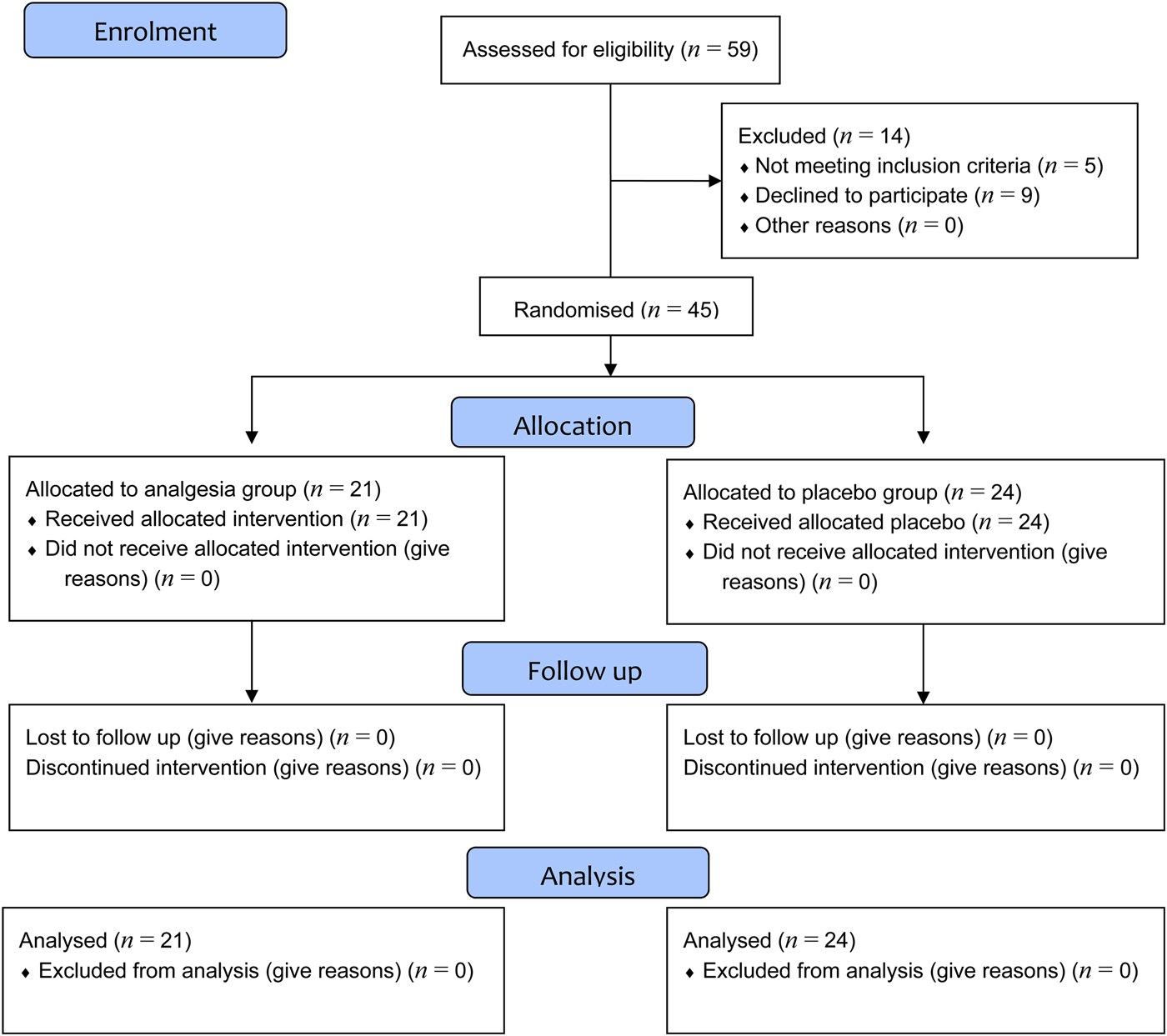
Fifty-nine children from ENT clinics at our district hospital between 8 October 2013 and 31 July 2014 were screened for eligibility. Fourteen children were excluded, resulting in an inclusion rate of 76 per cent (45 children) (Figure 1).
Consolidated Standards of Reporting Trials (‘CONSORT’) flow diagram.

Baseline data
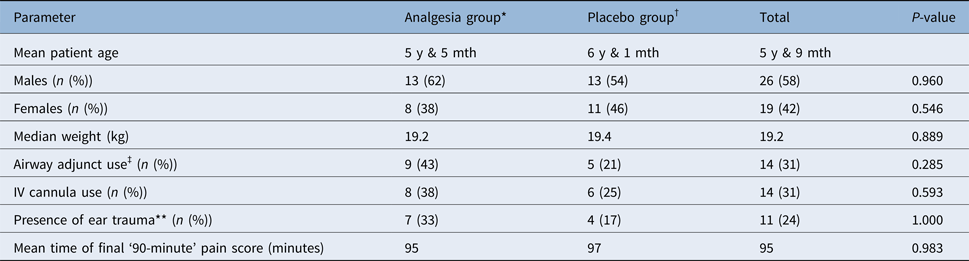
Both study populations were reasonably matched, and there were no statistically significant differences with respect to gender, weight, age, use of airway adjunct, use of IV cannula, inadvertent trauma or time at which the final ‘90-minute’ pain score was recorded (Table 1).
Demographic and clinical data

*n = 21; †n = 24. ‡Either an oropharyngeal or laryngeal mask airway was placed, for reasons decided by the anaesthetist. **Intravenous cannula placed at the discretion of the anaesthetist. Y = years; mth = months; IV = intravenous
Numbers analysed
Of the 45 children included in the study, 21 were in the analgesia group and 24 were in the placebo group.
Outcomes and estimation
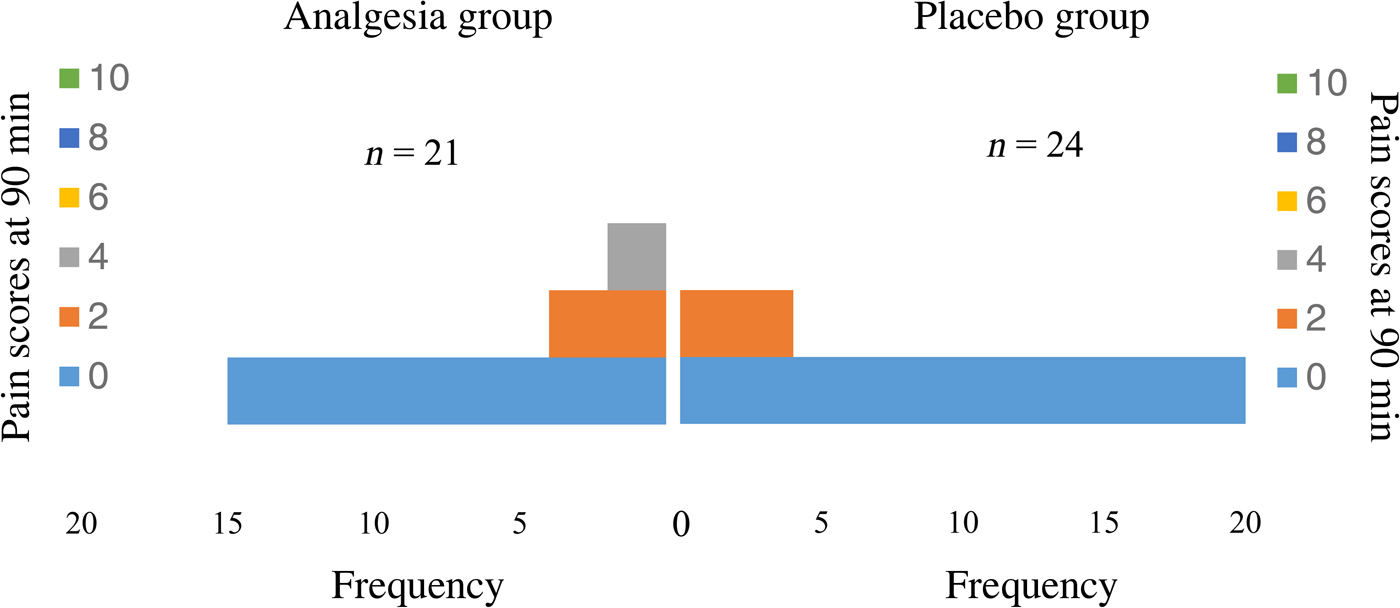
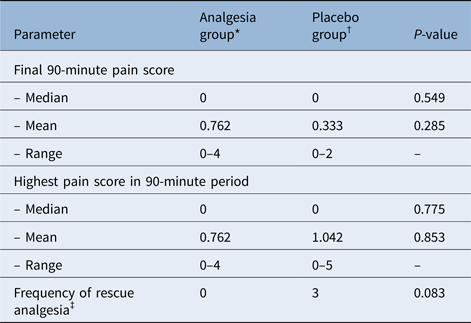
The difference in the median pain scores at 90 minutes following bilateral myringotomy and tube placement surgery was not statistically significant between the analgesia and placebo groups (p = 0.549) (Table 2 and Figure 2). The highest median pain score recorded within the 90-minute period was also not statistically different between the two groups (Table 2). In total, 28.6 per cent of children in the analgesia group and 29.2 per cent in the placebo group had pain scores greater than zero.
Distribution of the final 90-minute pain scores for each group. Frequency relates to the number of children, with the corresponding pain score. Min = minutes

Pain scores and frequency of rescue analgesia required

*n = 21; †n = 24. ‡Rescue analgesia was required if the pain score reported was greater than 5. For the placebo group, the rescue analgesic was paracetamol (20 mg/kg) with or without ibuprofen (10 mg/kg); for the analgesia group, it was morphine elixir (0.3 mg/kg).
No children in the analgesia group required rescue analgesics, as their pain scores were less than 5 out of 10, compared with 3 out of 24 children (12.5 per cent) in the placebo group. These three cases in the placebo group had maximal pain scores of 5 out of 10; they received paracetamol only, and the subsequent final 90-minute pain score was 0, 0 and 2, respectively. Consequently, the frequency of rescue analgesics administered did not reach statistical significance between the two groups.
The distribution frequencies for the pain scores of both groups appeared skewed; the Kolmogorov–Smirnov test had been used to verify this.
Ancillary analyses
The frequency of cases where the surgeon reported inadvertent minor ear canal trauma was similar in each group (total of 24 per cent (11 out of 45)). The median pain scores in these cases were not significantly different to cases where inadvertent trauma did not occur. Similarly, the frequency of cases that received an airway adjunct or IV cannula was similar in each group. The median pain scores in these cases were not significantly different to cases where an airway adjunct or IV cannula were not used.
Although not a specific outcome measure of this study, no child exhibited symptoms consistent with a diagnosis of emergence agitation (corresponding with a score of greater than 3 on the Watcha scale).Reference Watcha, Ramirez-Ruiz, White, Jones, Lagueruela and Terkonda2, Reference Bajwa, Costi and Cyna16 The median Watcha score was 1, and the highest scores of 2 were from two patients in the analgesia group. There was no reported post-operative nausea or vomiting.
Discussion
Generalisability and interpretation
Research to identify an effective pre-operative analgesic agent for bilateral myringotomy and tube placement surgery has led to conflicting results. Paracetamol and ibuprofen have been reported as being no more effective than placebo in children undergoing myringotomy.Reference Bennie, Boehringer, McMahon, Allen and Dierdorf5 Another study found similar results with paracetamol, but demonstrated lower pain scores and frequency of rescue analgesia with ketorolac, compared with a placebo.Reference Watcha, Ramirez-Ruiz, White, Jones, Lagueruela and Terkonda2 Codeine combined with paracetamol is suggested to lower pain scores and the frequency of rescue analgesic use more than paracetamol alone.Reference Tobias, Lowe, Hersey, Rasmussen and Werkhaven1 However, Pappas et al. showed no difference in pain scores when paracetamol was used alone or when codeine was combined with paracetamol, but did show lower pain scores with transnasal butorphanol and oral ketorolac.Reference Pappas, Fluder, Creech, Hotaling and Park9 Importantly, subsequent research has shown that the use of codeine in infants and children is now discouraged.Reference Heintze and Fuchs17 There was also no difference found in pain scores between rectal paracetamol, intramuscular ketorolac and intranasal fentanyl.Reference Rampersad, Jimenez, Bradford, Seidel and Lynn11
Topical agents have also been studied. Topical lidocaine has been suggested to be as effective as paracetamol.Reference Bhananker, Azavedo, MacCormick and Splinter10 Topical tetracaine was retrospectively shown by Hoffman and Li to provide adequate analgesia in 93 per cent of children following bilateral myringotomy and tube placement surgery.Reference Hoffman and Li4 However, Orobell et al. reported increased pain scores following bilateral myringotomy and tube placement surgery when topical phenol was used.Reference Orobello, Park, Wetzel, Belcher and Naclerio3 Derkay et al. also found no difference in the efficacy of pre-operative topical lidocaine and antibiotic in combination with either oral paracetamol alone, paracetamol with codeine, ibuprofen, or placebo.Reference Derkay, Wadsworth, Darrow, Strasnick, Thompson and O'Master7
The conflicting outcomes in these earlier studies may be attributed to confounding factors such as the lack of understanding and recognition of emergence agitation, and the lack of standardisation of anaesthetic and surgical techniques. Some studies did not use a placebo as a control when comparing the efficacy of analgesic agents.Reference Tobias, Lowe, Hersey, Rasmussen and Werkhaven1, Reference Hoffman and Li4, Reference Pappas, Fluder, Creech, Hotaling and Park9–Reference Rampersad, Jimenez, Bradford, Seidel and Lynn11 This was likely based on the assumption that bilateral myringotomy and tube placement surgery is painful and requires some form of analgesia. Our institutional experience and a previously conducted pilot study of 20 children suggested that most children who underwent bilateral myringotomy and tube placement did not require analgesia for this procedure. This suggests that uncomplicated bilateral myringotomy and tube placement surgery is not a significantly painful procedure for most children.
In this study, the analgesia group received a combination of paracetamol (20 mg/kg) and ibuprofen (10 mg/kg) for the following reasons. Watcha et al.Reference Watcha, Ramirez-Ruiz, White, Jones, Lagueruela and Terkonda2 and Pappas et al.Reference Pappas, Fluder, Creech, Hotaling and Park9 suggest that paracetamol was not effective when used at a relatively low dose of 10 mg/kg. However, pre-operative doses of up to 40 mg/kg in children have been previously used and have not resulted in toxicity.Reference Bolton, Bridge and Montgomery8 A single dose of paracetamol or ibuprofen have both been shown to be superior to placebo for analgesia in children undergoing other procedures.Reference Perrott, Piira, Goodenough and Champion18 Furthermore, a 2013 Cochrane review in adolescents and adults showed that combining these agents provides significantly better analgesia than paracetamol or ibuprofen alone.Reference Derry, Derry and Moore19 We were therefore confident that if bilateral myringotomy and tube placement surgery resulted in pain post-operatively, then a combination of paracetamol and ibuprofen would be significantly superior to placebo in providing post-operative analgesia.
Bilateral myringotomy and tube placement surgery is a quick procedure; therefore, a volatile anaesthetic based agent, with gas induction and bag-mask ventilation, is favoured. Sevoflurane is the most widely used volatile induction agent in children because of its favourable pharmacokinetic and pharmacodynamic properties.Reference Kuratani and Oi14, Reference Galinkin, Fazi, Romulo, Chiavicci, Kurth and Shah20 Unfortunately, volatile agents are associated with an increased risk of emergence agitation, which can occur in up to 67 per cent of patients undergoing bilateral myringotomy and tube placement surgery.Reference Finkel, Cohen, Hannallah, Patel, Kim and Hummer13 Emergence agitation is characterised by a variety of presentations that can be misinterpreted, and subsequently treated, as pain. These include crying, moaning, excitation, agitation, restlessness, disorientation and incoherence.Reference Bennie, Boehringer, McMahon, Allen and Dierdorf5, Reference Beyer, McGrath and Berde12, Reference Wells and Rasch21, Reference Cohen, Hannallah and Hummer22 Voepel-Lewis et al. showed that additional pharmacological intervention was required in 52 per cent of children with emergence agitation, and this resulted in a prolonged post-anaesthetic care unit stay.Reference Voepel-Lewis, Malviya and Tait23 Emergence agitation is reported to last up to 45 minutes and can occur independently of pain.Reference Voepel-Lewis, Malviya and Tait23
Numerous studies have been conducted using different pre-medications, in an attempt to reduce the incidence of emergence agitation. A number of studies investigating analgesic agents in bilateral myringotomy and tube placement surgery have used midazolam pre-medication.Reference Tobias, Lowe, Hersey, Rasmussen and Werkhaven1, Reference Pappas, Fluder, Creech, Hotaling and Park9–Reference Rampersad, Jimenez, Bradford, Seidel and Lynn11 However, a meta-analysis of studies showed that midazolam or 5-HT3 inhibitors do not protect against emergence agitation.Reference Dahmani, Stanyl, Brasher, Lejeune, Bruneau and Wood24 In fact, one study suggested that using midazolam as a pre-medication in children undergoing bilateral myringotomy and tube placement results in worse outcome measures.Reference Dewhirst, Fedel, Raman, Rice, Barry and Jatana25 Interpreting pain post-operatively in these studies could have been challenging and may have potentially confounded the results. Therefore, a key step in our study was to take precautions to reduce emergence agitation.
Propofol (depending on timing), ketamine, alpha-2 receptor agonists, and intranasal or IV fentanyl have been shown to have a preventative effect on the occurrence of emergence agitation. Fentanyl is the most widely studied agent in reducing emergence agitation, and has the advantage of being administered IV or intranasally. A recent meta-analysis showed strong evidence that IV or intranasal fentanyl significantly reduced the incidence of emergence agitation.Reference Shi, Xiao, Xiong, Zhou, Yang and Huang26 Cravero et al. showed that IV fentanyl (1 mcg/kg) administered during sevoflurane anaesthesia reduced the incidence of emergence agitation from 56 per cent to 12 per cent in children undergoing magnetic resonance imaging under anaesthesia. This was independent of analgesic effects, as no surgery or procedure was undertaken.Reference Cravero, Beach, Thyr and Whalen27 Another study in children undergoing adenoidectomy showed that 2.5 mcg/kg intranasal fentanyl provided the mean effective dose to reduce emergence agitation.Reference Cohen, Hannallah and Hummer22
The intranasal route is favourable over the IV route as it avoids cannulation-related anxiety, stress and pain (a potential confounder when assessing pain). The variation in dose per kilogram of fentanyl being used in different studies appears to be related to the route of administration. This is in keeping with the pharmacokinetic properties of fentanyl: the intranasal route has a bioavailability of 71 per cent, versus 100 per cent when given IV. In most studies using intranasal fentanyl, the standard dose was 2 mcg/kg; in studies using IV fentanyl, the dose was 1–2 mcg/kg. Lower intranasal fentanyl doses have not been shown to be as effective in reducing emergence agitation.Reference Finkel, Cohen, Hannallah, Patel, Kim and Hummer13, Reference Rampersad, Jimenez, Bradford, Seidel and Lynn28 A study by Finkel et al. directly compared intranasal fentanyl 1 mcg/kg to 2 mcg/kg, and showed that the agitation score at the time patients were reunited with their parents was significantly reduced in the 2 mcg/kg group.Reference Finkel, Cohen, Hannallah, Patel, Kim and Hummer13 In their study, the 2 mcg/kg group had slightly higher rates of post-operative nausea and vomiting; however, this finding was not statistically significant. Previous studies have acknowledged that more research is needed to verify this phenomenon.Reference Shi, Xiao, Xiong, Zhou, Yang and Huang26
No children in this study experienced post-operative nausea and vomiting. This result may have been different had the sample size been larger. However, we believe that post-operative nausea and vomiting is a fairly rare side effect at this low dose, and one which can be easily remedied with post-operative nausea and vomiting risk reduction strategies. Suitable anti-emetics can also be used to treat children with post-operative nausea and vomiting, and therefore this is not considered a reason to avoid intranasal fentanyl.
Studies using intranasal fentanyl have also shown that the time to discharge from hospital is unchanged, and there is no increase in the oxygen requirements in the post-anaesthetic care unit or increase in the incidence of hypoventilation.Reference Galinkin, Fazi, Romulo, Chiavicci, Kurth and Shah20, Reference Shi, Xiao, Xiong, Zhou, Yang and Huang26
As a result of these findings, combining intranasal fentanyl with gas induction anaesthesia in children undergoing bilateral myringotomy and tube placement surgery is now considered common practice in many hospitals. This combination was used as a standard technique in this study to minimise emergence agitation.
This study used a standardised anaesthesia protocol, which included sevoflurane (with oxygen) gas induction with intranasal fentanyl (2 mcg/kg). The dose of 2 mcg/kg was used to optimise the effect of fentanyl in reducing emergence agitation, as explained above. It was appreciated that analgesic effects can be expected at this dose.Reference Finkel, Cohen, Hannallah, Patel, Kim and Hummer13 However, the duration of action of a single dose of intranasal fentanyl has been shown to be only 58 minutes in adults.Reference Foster, Upton, Christrup and Popper29, Reference Christrup, Foster, Popper, Troen and Upton30 Other studies have similarly shown the duration of action in adults as being approximately 1 hour.Reference Finkel, Cohen, Hannallah, Patel, Kim and Hummer13, Reference Panagiotou and Mystakidou31 The elimination half-life of fentanyl reduces with younger age. This is as a result of an increased clearance of fentanyl, with rates 1.7 times faster in infants and children compared with adults. Additionally, the steady state volume of distribution of fentanyl is also much greater in infants and children, which results in a lower blood concentration after bolus administration.Reference Cote, Lerman and Anderson32 The duration of effect is also directly related to intranasal fentanyl dose, with smaller doses resulting in a shorter duration.Reference Christrup, Foster, Popper, Troen and Upton30 The net effect then is that the duration of action will be significantly shorter in infants and children, and well below 90 minutes. This is applicable to this study, as a relatively low fentanyl dose was used (2 mcg/kg, with an average dose of 39 mcg/kg).
Gourlay et al. demonstrated that the minimum effect concentration in adults for analgesia with fentanyl following abdominal surgery is 0.63 ng/ml.Reference Gourlay, Kowalski, Plummer, Cousins and Armstrong33 Galinkin et al. showed that after intranasal fentanyl administration (2 mcg/kg) in children, levels were 0.80 ng/ml at 10 ± 4 minutes and 0.64 ng/ml at 34 ± 9 minutes.Reference Galinkin, Fazi, Romulo, Chiavicci, Kurth and Shah20 This again demonstrates that the duration of action is less than 1 hour and confirms the shorter duration of action of fentanyl in children at the dose administered in this study. Based on these pharmacokinetic qualities, a 90-minute end point was used to ensure that the analgesic effects of fentanyl would not influence the final pain scores, thus avoiding a potentially confounding bias.
Bilateral myringotomy and tube placement surgery is usually a quick day-case procedure. This study used a 90-minute pain score prior to discharge, to ensure that any analgesic effect of fentanyl had dissipated and to reflect current local practice guidelines of observing children following surgery. It is appreciated that some institutions discharge children before 90 minutes, with average time to discharge in other studies recorded as 72, 70 and 61.2 minutes.Reference Watcha, Ramirez-Ruiz, White, Jones, Lagueruela and Terkonda2, Reference Pappas, Fluder, Creech, Hotaling and Park9, Reference Bhananker, Azavedo, MacCormick and Splinter10 The results from this study support this practice as long as the children meet standard discharge criteria. Local recommendations are for observation 20 minutes post-intranasal fentanyl administration. Therefore, routine intranasal fentanyl administration does not require prolonged post-operative observation periods prior to discharge.
Pain scores prior to 90 minutes were not routinely assessed, unless the child was thought to be in pain or complained of pain. This was to simulate normal post-operative practice in the post-anaesthetic care unit and the day-stay unit. Subsequent pain scores at home were not studied as it was felt that if the child was pain-free at discharge, then there was no reason these children would experience any further pain in the next 24 hours. This is supported by Pappas et al., who showed that the need for subsequent analgesia in the first 24 hours following bilateral myringotomy and tube placement surgery was uncommon, and did not differ among the paracetamol, codeine, butorphanol or ketorolac groups.Reference Pappas, Fluder, Creech, Hotaling and Park9
Pain scores were determined using the Wong-Baker Faces Pain Rating Scale, which is one of the most common and more reliable pain assessment tools utilising a faces scale for self-assessment of pain intensity in children aged over three years.15, 34 In this study, it was the parent or guardian who documented the pain score, as indicated by their child. In addition to the patient, surgeon and anaesthetist, the parent or guardian was also blinded to the study group of the child. As mentioned, accurately assessing a child's pain can be complex. The main reasons for utilising the parent or guardian are that they are deemed more likely to know the behaviour of their child, and can communicate more effectively with them and provide clear instructions, compared with a complete stranger.
Previous studies have used a score of greater than 5 as the level to qualify for rescue analgesia.Reference Bhananker, Azavedo, MacCormick and Splinter10, Reference Finkel, Cohen, Hannallah, Patel, Kim and Hummer13 We arbitrarily set a pain score of 5 or more to qualify for receipt of rescue analgesics, as the facial expression associated with a pain score of 4 appears comfortable on the Wong-Baker Faces Pain Rating Scale. For the same reason, we chose a clinical difference of 4 pain scores when determining the sample size of our study.
In total, three children in the placebo group qualified for rescue analgesia (the highest score was 5 out of 10), compared with no children in the analgesia group (the highest score was 4 out of 10). This difference was not statistically significant (p = 0.083). Had this study used higher pain scores for children to qualify for rescue analgesia, as previous studies have done, then the results would have reflected that no children required rescue analgesia and the difference would have been statistically less significant. All three children required only paracetamol (20 mg/kg) as the rescue analgesic; the subsequent reported pain score at 90 minutes was minimal or non-existent (scores of 0, 0 and 2, respectively).
This study attempted to control for a number of other factors that could affect the interpretation of post-operative pain. Firstly, the average age of children in this study is higher than in other studies, where the average patient ages are often less than three years.Reference Watcha, Ramirez-Ruiz, White, Jones, Lagueruela and Terkonda2, Reference Pappas, Fluder, Creech, Hotaling and Park9 Pain interpretation and differentiation from emergence agitation in pre-verbal and pre-school children can be difficult.Reference Beyer, McGrath and Berde12, Reference Finkel, Cohen, Hannallah, Patel, Kim and Hummer13 Pain rating scales are also shown to become more reliable as children get older.34 Therefore, it is appreciable that older children will be able to more accurately characterise and differentiate their pain, resulting in more reliable pain scores.
Secondly, most studies did not report the source of pain in their pain score analysis. Children can experience post-operative pain for a number of reasons, such as an IV cannula, throat pain, blood pressure cuff pain. As this study was researching whether bilateral myringotomy and tube placement surgery causes ear pain, children were asked specifically to locate the site of pain. Only scores from ear pain were included in the final pain score analysis.
Thirdly, in order to reduce the incidence of pain, anaesthesia with a bag-mask technique was preferred. The use of airway adjuncts and an IV cannula was at the discretion of the anaesthetist. Haupert et al. found that precautionary IV access in children undergoing myringotomy under gas induction anaesthesia provided no additional benefit, and resulted in increased analgesic use, more time in hospital and lower parental satisfaction.Reference Haupert, Pascual, Mohan, Bartecka-Skrzypek and Zestos35 It is not known from the article whether the site of pain was distinguished; therefore, pain from these sources could still potentially be misinterpreted as ear pain in young children. Only 31 per cent of children in the current study had either an airway adjunct or IV cannula, and this was similar in both groups. Furthermore, the median pain scores in these children were not higher than the pain scores recorded in children who did not receive an airway adjunct or IV cannula.
Fourthly, the operation technique was uniformly standardised by the three consultant otolaryngologists in the department. A small incision was made at the antero-inferior quadrant of the tympanic membrane with a single use, malleable and slim myringotomy knife. Medium-term ventilatory tubes (e.g. collar button grommets) were inserted in all the studied patients. Long-term ventilatory tubes (T-tubes) are rarely inserted in children because of an increased risk of post-operative perforation; such cases were not therefore included in the study.
Finally, an attempt was made to determine whether inadvertent ear trauma during bilateral myringotomy and tube placement surgery affected post-operative pain. This was recorded by the surgeon performing the bilateral myringotomy and tube placement surgery, and was defined as inadvertent trauma or bleeding to the ear canal or middle ear. This was a subjective recording by the three surgeons involved in the study, and no differentiation was made regarding the degree of trauma present or the number of ears affected. Inadvertent trauma was present in a total of 24 per cent of cases (11 out of 45), with minor bruising or self-limited bleeding of the canal wall, and was statistically similar in both groups. The mean and median pain scores in these cases were not significantly different to cases where ear trauma did not occur.
Limitations
A small single-centre study with three experienced consultant otolaryngologists and eight consultant anaesthetists may have resulted in better standardisation of techniques. It is therefore uncertain whether the results can be replicated in other larger centres, with variable experience and standardisation in their practices.
Most of the aforementioned studies researching analgesia in bilateral myringotomy and tube placement surgery were performed more than 10 years ago. There is paucity of information regarding the surgical instruments or techniques used. Our results may reflect the use of up-to-date refined instruments, although our small sample study was unable to verify this.
The Wong-Baker Faces Pain Rating Scale is not validated for distinguishing between emergence agitation and pain. The most consistent features in emergence agitation are: the absence of eye contact, inconsolable crying, lack of awareness of surroundings, lack of recurrence once it has subsided and the time course (it almost always occurs early and resolves within 15 minutes). A child experiencing true emergence agitation would be unlikely to provide a controlled verbal indication of their pain, which was not the case with any child in this study. The early onset and resolution of emergence agitation also meant it was unlikely to have affected pain scores at 90 minutes, which was our primary outcome measure.
• Bilateral myringotomy and tube placement is a commonly performed paediatric ENT procedure
• Studies suggest that up to 76 per cent of children require analgesia, but many of these studies did not include a placebo group
• No other study has controlled for emergence agitation or other confounders of perceived pain after this procedure
• Pre-operative analgesia was compared to placebo in children undergoing bilateral myringotomy and tube placement surgery
• Evidence suggests that pre-operative analgesics should not be routinely administered prior to this surgery
• In the minority of children who experience post-operative pain, a simple analgesic (e.g. paracetamol) is adequate
At the time of conducting this study, there were over 16 emergence agitation scales, of which 3 (the Paediatric Anaesthesia Emergence Delirium (‘PAED’), Watcha and Cravero scales) have been shown to be consistent in detecting the presence of emergence agitation. The Watcha scale was chosen for this study, as, in its current form, it has the highest overall sensitivity and specificity, and is the most practical tool to use and assess emergence agitation in the post-anaesthetic care unit.Reference Bajwa, Costi and Cyna16 The Paediatric Anaesthesia Emergence Delirium score is perhaps a more thorough tool, encompassing many more variables; however, its clinical utility is limited in a busy post-anaesthetic care unit setting, and as such it is more useful as a research tool for assessing emergence agitation, which was not the main focus of this study.
Conclusion
This study demonstrates that routine pre-operative analgesics (paracetamol and ibuprofen) prior to bilateral myringotomy and tube placement surgery in children (aged 3–15 years) do not produce a significant benefit in terms of reducing post-operative ear pain scores in the early post-operative period, when compared with placebo. Most children in both groups did not experience post-operative pain, and in those who did, the pain experienced was only mild. This study adjusted for emergence agitation, which may have introduced bias to previous studies. The research team do not claim that bilateral myringotomy and tube placement surgery, with medium-term ventilatory tubes, is not a painful procedure, as pain is subjective and complex. However, the team conclude that pre-operative analgesics should not be administered routinely. In the minority of children who appear to have significant post-operative pain, a simple analgesic (e.g. paracetamol) would be adequate.
Acknowledgements
The research team would like to acknowledge: the anaesthetic and ENT departments, day-stay and post-anaesthetic care units, and operating theatre staff who assisted with documentation and patients, and the families who participated in the study.
Competing interests
None declared.