


Introduction
Methicillin-sensitive and methicillin-resistant Staphylococcus aureus (MSSA, MRSA) are major contributors to infections in neonatal intensive care unit (NICU) patients and are the primary pathogens responsible for central line-associated bloodstream infections. 1 Nasal colonization typically precedes infection and can be detected by routine screening tests. Reference Akinboyo, Zangwill, Berg, Cantey, Huizinga and Milstone2–Reference Balamohan, Beachy, Kohn and Rubin5 To prevent progression from colonization to infection, the topical antibiotic mupirocin is commonly used as a decolonizing agent. Reference Nelson, Shaw and Gross6,Reference Kotloff, Shirley and Creech7 Consequently, the emergence of mupirocin resistance, mediated by mutations in the ileS gene or the presence of the plasmid-encoded mupA gene, is a concern. Reference Patel, Gorwitz and Jernigan8 Assessing the prevalence of mupirocin resistance within a population is critical for determining the efficacy of decolonization strategies. The primary objective of this project was to determine the prevalence of S. aureus mupirocin resistance in a NICU population to inform decolonization regimen decisions. Upon reviewing the mupirocin susceptibility results, a secondary objective was added to investigate strain-relatedness of MRSA isolates with high-level resistance.
Methods
Project setting and sample collection
This project took place in an 86-bed, level IV NICU at Cincinnati Children’s Hospital Medical Center in Cincinnati, OH. Patient rooms were single occupancy with several double occupancy rooms available only for siblings. Per routine protocol, NICU patients were screened on admission and weekly thereafter from the nares using the molecular BD MAX™ StaphSR assay (BD Diagnostic System, Sparks, MD). Weekly screening was discontinued for MRSA-positive patients and contact isolation precautions were initiated. MSSA-positive patients continued to undergo weekly screening and contact precautions were not required per institutional policy. The decolonization protocol for first-time positive patients consisted of applying mupirocin to each nostril twice daily for five days.
Sample processing and testing methods
Sample swabs from positive BD MAX™ eluates were plated onto 5% sheep blood agar (Remel, Inc., Lenexa, KS) following routine culturing methods, and S. aureus identification was confirmed by Matrix-Assisted Laser Desorption Ionization-Time of Flight mass spectrometry (bioMérieux, Leone, France). Mupirocin minimum inhibitory concentration (MIC) testing was performed using E-test (bioMérieux, Leone, France) strips with a range of 0.064 to 1,024 μg/ml. In the absence of Clinical Laboratory Standard Index mupirocin breakpoints, isolates with MICs ≥6 ug/ml were considered resistant and MICs ≥512 μg/ml as highly resistant based on E-test methodology and previously published data. 9,Reference Labrecque, Shah, Fergus and Parry10
MRSA isolates with mupirocin MICs ≥1,024 μg/ml along with one blood culture isolate from a colonized patient whose screening isolate was unrecoverable and geotemporally linked to healthcare-acquired MRSA colonization cases were processed for genetic relatedness. Bacterial DNA extraction was performed using the Ultraclean Microbial DNA Isolation kit (Qiagen, Germantown, MD). Sequencing libraries were prepared using the Nextera XT DNA Library Preparation Kit (Illumina, San Diego, CA), and whole genome sequencing was performed to obtain 150-base paired-end reads to a depth of approximately 5 million reads per sample. Single-nucleotide polymorphism (SNP) distances from representative reference genomes were determined using Snippy. Reference Seemann11 A pairwise SNP matrix was generated and a phylogenetic tree constructed using FastTree. Reference Price, Dehal and Arkin12 Strain pairs with fewer than 20 SNPs were considered highly related. Reference Bowers, Driebe and Albrecht13 Analysis for the presence of mupA consisted of isoleucyl-tRNA ligase gene alignment with mean sequencing depth of 6,787 × coverage. MOB-suite was used to identify, reconstruct and type plasmid sequences. Reference Robertson and Nash14
The epidemiological investigation included electronic medical record (EMR) review of patient demographics, MRSA-positive screening date, birth hospital, and geotemporal data (admission date and NICU locations). Fisher’s Exact two-tailed test was used to perform statistical calculations with a significance level of P < .05.
This project was conducted as an infection prevention and control quality study to evaluate the effectiveness of an active mupirocin decolonization protocol and did not require Institutional Review Board approval.
Results
From January 2023 to April 2024, 1,153 NICU patients were screened for S. aureus with 414 positive tests (310 MSSA, 104 MRSA). In total, 104 S. aureus isolates (75 MSSA, 29 MRSA) were available for testing. Of these isolates, 102 were confirmed as S. aureus (one S. hemolyticus, one S. saprophyticus). Most isolates (n = 89, 87%) fell into the mupirocin MIC range of 0.064–0.5 μg/ml. The remaining 13 S. aureus isolates demonstrated varying levels of mupirocin resistance with an MIC range of 6 ug/ml to ≥1,024 μg/ml (Figure 1). These data indicated an overall mupirocin resistance rate of 13%. However, when stratified by MSSA (n = 73) and MRSA (n = 29), the resistance rates were 3% and 38% respectively. Nine MRSA and two MSSA isolates exhibited high-level resistance at ≥1,024 μg/ml. When comparing the frequency of high-level mupirocin resistance between MRSA and MSSA isolates, MRSA demonstrated a significantly higher proportion of resistant isolates than MSSA (31% vs 2.7% P = .0001).
Distribution of methicillin-sensitive S. aureus (MSSA) and methicillin-resistant S. aureus (MRSA) mupirocin minimum inhibitory concentrations (MICs).

The genetic relatedness analysis revealed that all 10 MRSA isolates tested (nine from nares, one from blood) were the same strain with <12 SNP differences (Figure 2). All isolates were USA300, ST8 (CC8), spa t024, SSCmecA IVa, agr group I, ACME type I and PVL negative. Plasmid analysis demonstrated multiple plasmid clusters detected per sample (1–5 plasmids each), all of which were classified as non-mobilizable. The mupA sequences were 100% identical across all 10 samples, consistent with a horizontal transmission cluster.
(A) Phylogenetic tree of methicillin-resistant S. aureus (MRSA) strains with high-level mupirocin resistance and control isolates. (B) Network graph showing the single nucleotide polymorphism differences on the connecting lines between patient MRSA isolates.

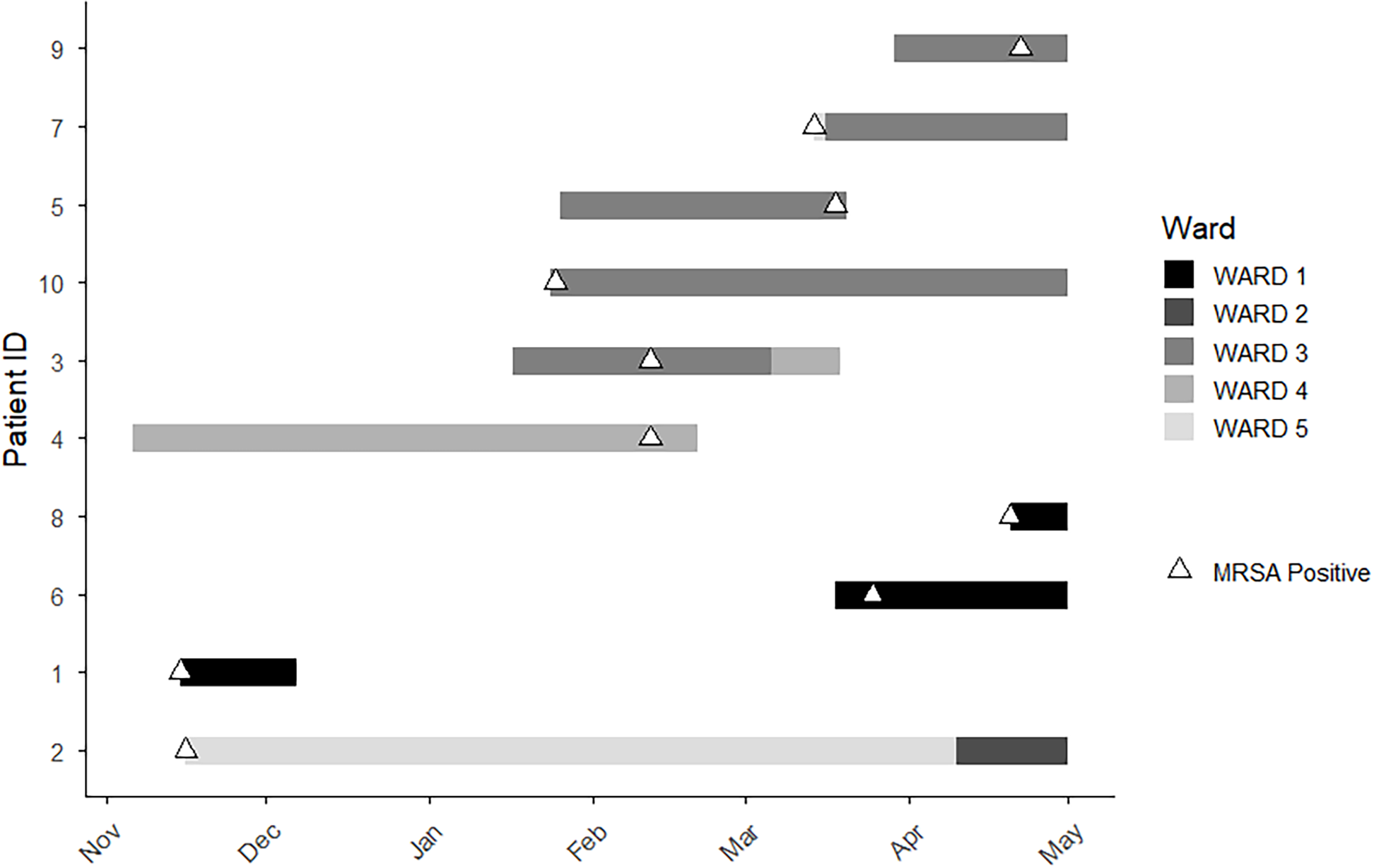
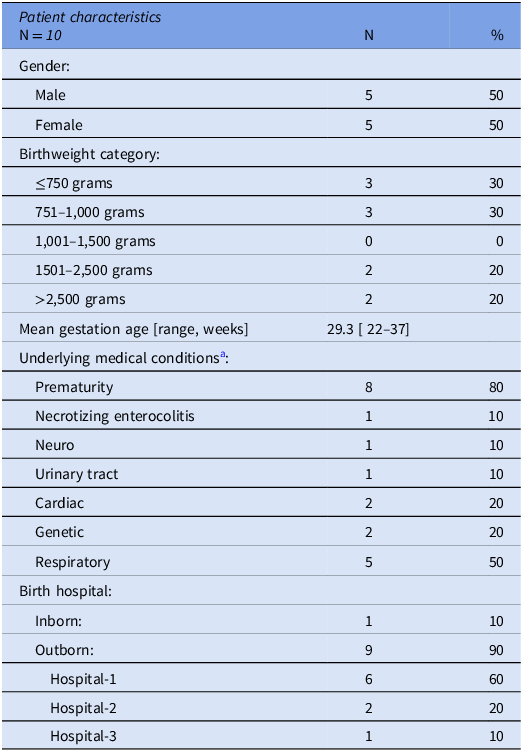
Demographics of patients with related MRSA strains are summarized in Table 1. The epidemiological investigation revealed that five patients screened MRSA positive on admission (pt1, pt2, pt7, pt8, pt10), all transferring from the same birth hospital (Hospital-1). The remaining five patients were MRSA screen negative on admission. For three patients (pt3, pt5, pt9), a geotemporal link with MRSA-positive patients was identified (Figure 3). Pt6 also transferred from Hospital-1 but screened negative twice before testing positive in our NICU at 10 days old. Pt4 was inborn, and although they overlapped temporally, a geospatial link could not be established with the other cluster patients or with MRSA-positive patients whose isolates were not recovered from the screening test. Per institutional practice, contact precautions were not initiated unless a patient was known to be colonized at admission or positive screening results had been released and reviewed. Hospital-1 did not screen NICU patients for MRSA, so colonization was determined upon admission to our facility via screening. Pt1 and Pt2 had a gap of 1 day between admission, testing and implementation of contact precautions. Pt6 and Pt8 were isolated on the same day as their positive screen. Pt7 was known to be MRSA colonized on admission but was not placed into contact isolation for 14 days.
Geotemporal map of patients with related methicillin-resistant S. aureus (MRSA) strains November 2023–May 2024.

Demographics of patients with related methicillin-resistant S. aureus (MRSA) strains

Table 1. Long description
The table presents patient characteristics for a sample size of 10 patients. It includes columns for the number of patients (N) and the percentage (%). The table is divided into several sections: Gender, Birthweight category, Mean gestation age, Underlying medical conditions, and Birth hospital. Gender is split equally with 5 males and 5 females. Birthweight categories include ≤750 grams (3 patients), 751–1,000 grams (3 patients), 1,001–1,500 grams (0 patients), 1,501–2,500 grams (2 patients), and >2,500 grams (2 patients). The mean gestation age is 29.3 weeks with a range of 22–37 weeks. Underlying medical conditions include Prematurity (8 patients), Necrotizing enterocolitis (1 patient), Neuro (1 patient), Urinary tract (1 patient), Cardiac (2 patients), Genetic (2 patients), and Respiratory (5 patients). Birth hospitals are categorized as Inborn (1 patient) and Outborn (9 patients), with Outborn further divided into Hospital-1 (6 patients), Hospital-2 (2 patients), and Hospital-3 (1 patient).
a Patients may have more than one underlying medical condition.
Discussion
We identified MRSA isolates that were highly resistant to mupirocin, contained the mupA gene and were confirmed to be the same strain. Although our overall S. aureus mupirocin resistance rate of 13% falls below the recommended action threshold of 20%, 38% of MRSA isolates demonstrated resistance, which indicates that re-evaluation of our current MRSA mupirocin decolonization protocol is indicated. Reference Labrecque, Shah, Fergus and Parry10 However, the clinical impact of elevated mupirocin MICs remains controversial as many commercial topical mupirocin preparations of 2% (20,000 mcg/mL) may be able to overcome “low-level” resistance (MIC < 256 μg/mL) reported in S. aureus strains. Reference Hetem and Bonten15 The limited available data suggests that MIC ≥512 μg/mL, however, seen in S. aureus strains with the mupA gene may still survive mupirocin application. Reference Sader, Mendes and Streit16 Therefore, MRSA mupirocin MICs would assist with predicting decolonization success. Although rapid molecular tests are available for MRSA identification, mupirocin E-test and disk diffusion methods are not routinely used in clinical laboratories, limiting real-time mupirocin resistance testing. Weekly screening of MRSA-positive patients after mupirocin treatment could help identify continued colonization and potential resistance; however, a commercial molecular assay targeting the mupA gene would provide a more practical and economically feasible approach.
Results from the epidemiologic investigation suggest that MRSA acquisition in our NICU occurred via horizontal transmission, even in the setting of single patient rooms and contact precautions. As discontinuation of contact precautions for MRSA is becoming more widespread in healthcare settings, continuation of these practices in NICUs is still nationally recommended particularly when implemented as part of a prevention bundle in this high-risk population. Reference Sader, Mendes and Streit16 Here, we identified gaps in the timing of contact precaution implementation which could have contributed to horizontal transmission of MRSA to other patients. Continued emphasis on prevention of MRSA transmission in NICUs is prudent particularly in the presence of highly resistant strains.
Lastly, with the Centers for Disease Control and other national organizations recommending mupirocin use for MRSA-colonized ICU patients, emergence and dissemination of resistant strains should be expected. 17–21 Our experience suggests that simplified mupirocin resistance testing and interpretation standards should be a priority for clinical microbiology laboratories, antimicrobial stewardship programs, and clinical teams to make informed decisions about the role of mupirocin in S. aureus decolonization protocols. Yet despite the availability of alternative decolonization agents such as chlorhexidine gluconate, ethyl alcohol and povidone-iodine nasal products for adults, none are approved for neonatal patients across all age groups. 9,22,Reference Chapman, Aucott and Milstone23 This gap underscores the urgent need to validate additional products for infants, especially as mupirocin-resistant strains emerge.
Limitations
This project was performed at a single site and may not be generalizable to all healthcare populations. As this project relied on convenience samples, we were unable to perform testing on all isolates from patients who screened S. aureus positive if the samples from the molecular testing eluate did not grow in culture. Contact tracing was limited by the data that could be extracted from retrospective review of the EMR and in one case was not sufficient to identify the patient-to-patient route of transmission.
Acknowledgements
Special thanks to the Cincinnati Children’s Hospital Medical Center Department of Infectious Disease Testing Laboratory.
Financial support
None reported.



 Open access

