



Attention-deficit hyperactivity disorder (ADHD) is increasingly diagnosed and treated among women of childbearing age.Reference Baker and Freeman1,Reference Freeman2 In Norway, ADHD medication use during pregnancy doubled from 2.5 to 5.5 users per 1000 pregnancies between 2010 and 2019.Reference Cohen, Srinivas, Furu, Cesta, Reutfors and Karlstad3 Stimulants are the first-line treatment because of their proven efficacy in managing ADHD symptoms.Reference Cortese, Holtmann, Banaschewski, Buitelaar, Coghill and Danckaerts4–Reference Mészáros, Czobor, Bálint, Komlósi, Simon and Bitter6 Miscarriage is a common adverse pregnancy outcome, with risk factors including advanced maternal age, stress and psychiatric disorders.Reference Magnus, Wilcox, Morken, Weinberg and Håberg7–Reference Qu, Wu, Zhu, Barry, Ding and Baio9 A large, register-based study on pregnancies in Norway found an elevated risk of miscarriage among women with ADHD, suggesting that ADHD may independently contribute to miscarriage risk.Reference Magnus, Havdahl, Morken, Wensaas, Wilcox and Håberg8 Two older Danish studies suggested ADHD medication use as a potential risk factor for miscarriage; however, they had few exposed pregnancies and are potentially limited by confounding by indication, as they compared against the general population.Reference Haervig, Mortensen, Hansen and Strandberg-Larsen10,Reference Bro, Kjaersgaard, Parner, Sorensen, Olsen and Bech11 Further, the older study data (1997–2010) did not include lisdexamfetamine. Critical gaps remain in understanding the independent effects of ADHD medication use on miscarriage risk. In this study, we utilised national, register-based data from Norway to investigate whether ADHD medication use was associated with an increased risk of miscarriage among pregnant women with ADHD. Importantly, we were able to link nationwide data from the birth registry, with additional registers containing data from primary care and specialist care, to identify miscarriages by using a previously developed algorithm.Reference Magnus, Wilcox, Morken, Weinberg and Håberg7,Reference Magnus, Havdahl, Morken, Wensaas, Wilcox and Håberg8,Reference Magnus, Morken, Wensaas, Wilcox and Håberg12 This approach addresses an important gap in previous research by providing a comprehensive assessment of miscarriage risk.
Objectives
To determine if ADHD medication use in pregnancy is associated with an increased risk of miscarriage compared with no ADHD medication use, among pregnant women with ADHD.
Method
Study design
This was a case–control study conducted using nationwide register-based data on pregnancies in Norway.
Data sources
Data were obtained from the Medical Birth Registry of Norway (MBRN), containing information on pregnancies ending after 12 weeks of gestation (early pregnancy losses, live and stillbirths); the Norwegian Patient Registry (NPR), containing diagnoses and procedural data from in-patient and out-patient specialist care; the Norwegian Control and Payment of Health Reimbursements Database (KUHR), containing data on diagnoses and procedures for patients treated in primary care; and the Norwegian Prescription Database (NorPD), containing information on dispensed medications.Reference Laugesen, Ludvigsson, Schmidt, Gissler, Valdimarsdottir and Lunde13 Data on residency status were from Statistics Norway.
Study population
The study population included pregnancies conceived between 2009 and 2019 in Norway among women aged 12–55 years with ADHD. ADHD was defined based on a diagnosis from specialist care (ICD-10 code F90) or primary care (International Classification of Primary Care, Second Edition (ICPC-2) code P81) any time before estimated date of conception. Pregnancies were identified through data from the MBRN, NPR and KUHR. Exclusions were applied for pregnancies with gestational duration beyond 44 weeks, without continuous residency status in Norway for at least one calendar year (1 January of both the year of miscarriage/live birth and the year before conception).
Pregnancy algorithm and gestational age estimation
Pregnancies ending after 12 completed weeks of gestation were identified from the MBRN. Date of conception (DOC) was estimated as 14 days after the first day of the last menstrual period (LMP), calculated by subtracting the gestational age at delivery in days, confirmed by ultrasound in nearly all pregnancies, from the date of delivery. Information from the NPR and KUHR was used to capture additional pregnancies that could not be identified through the MBRN. We adapted a previously developed pregnancy algorithm to identify unique pregnancy registrations.Reference Magnus, Wilcox, Morken, Weinberg and Håberg7,Reference Magnus, Havdahl, Morken, Wensaas, Wilcox and Håberg8,Reference Magnus, Morken, Wensaas, Wilcox and Håberg12 Briefly, the steps involved include (a) excluding NPR and KUHR registrations within a predefined time window, to avoid duplicate records; (b) prioritising specialist care over primary care registrations and (c) excluding invalid records within an ongoing or shortly following an MBRN-registered pregnancy. Gestational age at miscarriage nor LMP were available for miscarriages identified in primary and specialist care registers. Therefore, we assigned a gestational age of 9+1 weeks (64 days) based on the mean gestational age in prior studies and an empirical investigation that used interrupted time-series analysis.Reference Wilcox, Treloar and Sandler14–Reference Cohen, Selmer, Furu and Karlstad17 The rationale and algorithm used to estimate gestational age are described elsewhere.Reference Srinivas and Cohen18
Cases
A case was a miscarriage, defined as a foetal death before 20 weeks of gestation. Miscarriages were ascertained from the specialist care and primary care registers by using ICD-10 (O01, O02, O03) and ICPC-2 codes (W82). Ectopic pregnancies were excluded from this definition. A small number of additional miscarriages between 12 and 19 weeks were ascertained from the MBRN. Pregnancy losses after 20 weeks of gestation were categorised as stillbirths. The first date of diagnosis of a miscarriage was defined as the index date of a case.
Controls
A control was a pregnancy that ended as a live birth, identified from the MBRN. For each case, we selected up to four controls matched on the same conception year (i.e. ±180 days) and maternal age at conception (±3 years). For each control, the index date was defined as the gestational day corresponding to the estimated gestational age at pregnancy end in the matched case, to ensure comparability in pregnancy duration. Stillbirths were excluded as potential controls, as they may have been associated with a variety of underlying conditions, such as genetic abnormalities, infections, placental complications or other maternal health issues, which could confound the relationship between ADHD medication use and miscarriage.Reference Silver, Varner, Reddy, Goldenberg, Pinar and Conway19,Reference Reinebrant, Leisher, Coory, Henry, Wojcieszek and Gardener20
Induced abortions were not included as cases or controls in this study because their underlying mechanisms and contributing factors might differ substantially from those of miscarriages and live births. Induced abortions in Norway are primarily influenced by psychosocial or other personal factors,Reference Broen, Moum, Bödtker and Ekeberg21 and including them as cases could confound the analysis by mixing outcomes with different biological mechanisms. Including them as controls might introduce bias if exposure to ADHD medications influences the decision to terminate the pregnancy. By restricting the study to miscarriages as cases and live births as controls, we tried to better isolate the association between ADHD medication use and miscarriage risk.
Exposure
Exposure to ADHD medication was defined as having filled at least one prescription for any ADHD medication from the estimated DOC to the day before the end of pregnancy for the cases, with the same exposure period for the matched controls (Fig. 1). The ADHD medications included in this study as per the Anatomical Therapeutic Chemical classification codes were amphetamine (N06BA01), dexamphetamine (N06BA02), methylphenidate (N06BA04), atomoxetine (N06BA09), lisdexamfetamine (N06BA12) and guanfacine (C02AC02). The main exposure of interest was any ADHD medication use. Secondary exposures of interest were individual ADHD drugs, except guanfacine, as it was rarely used in this population. Additionally, we defined ADHD medication use based on two or more prescription fills.
Study design, matching and exposure assessment based on medication use in pregnancy. ADHD, attention-deficit hyperactivity disorder; DOC, date of conception; LMP, last menstrual period.

Furthermore, we defined exposure to ADHD medication in secondary analyses based on total defined daily doses (DDDs) dispensed during the exposure window as a proxy for dose, which is not available in the NorPD. This is helpful in exploring a potential dose–response relationship because total DDDs account for cumulative medication dose and can serve as a proxy for duration and intensity of medication use. However, actual daily intake is unknown, and prescription fills may not reflect consumption.
Covariates
Potential confounders of the relationship between ADHD medication use and miscarriage included maternal age at conception, maternal country of birth and educational attainment, diabetes, hypertension, epilepsy, psychiatric comorbidities, psychotropic co-medication, and known and suspected teratogens (see exact definitions in Supplementary Fig. 1 and Supplementary Table 1 available at https://doi.org/10.1192/bjp.2025.10467). In the absence of a severity measure for ADHD, other psychotropic medication use was considered as a proxy.
Statistical analysis
Baseline characteristics of cases and controls were described to assess group differences. Conditional logistic regression was used to estimate crude and adjusted odds ratios (aOR) with 95% confidence intervals for the association between any ADHD medication use and miscarriage risk. Additional analyses were conducted with exposure to ADHD medication and monotherapies defined based on two or more prescription fills (Supplementary Table 6).
Adjusted analyses accounted for potential confounders, including psychiatric disorders, psychotropic medication use and known or suspected teratogenic drugs. Missing data on education and birth country were handled by using multiple imputation with ten imputed data-sets. To assess the potential impact of unmeasured confounding, E-values were calculated. The E-value represents the minimum strength of association that an unmeasured confounder would need to have with both the exposure and the outcome to fully explain away the observed association, after accounting for measured confounders.Reference VanderWeele and Ding22
Sensitivity analyses were conducted by varying the assumed gestational age for miscarriages by ±7 days to evaluate the robustness of the results (Supplementary Tables 2 and 3). Overestimating or underestimating the mean gestational age affects the classification of exposure and is expected to predictably bias the results away and toward the null, respectively. Therefore, these analyses were performed to assess whether our main gestational age assumption (64 days for most miscarriages, representing the expected mean gestational age) was reasonable, and if the observed changes aligned with expectations.
In secondary analyses, exposure was defined based on total DDDs of any ADHD medication use and individual drugs (Supplementary Table 4). To address skewness and outliers in the data, extreme DDD values were replaced with the 99th percentile. The DDDs were then categorised into tertiles (Supplementary Table 5) to improve the interpretability of the associations between ADHD medication use and miscarriage risk, as assessed with conditional logistic regression models. The reference group was those with no ADHD medication use.
All analyses were performed with Stata SE version 18 for Windows (StataCorp, College Station, TX, USA; www.stata.com).
Results
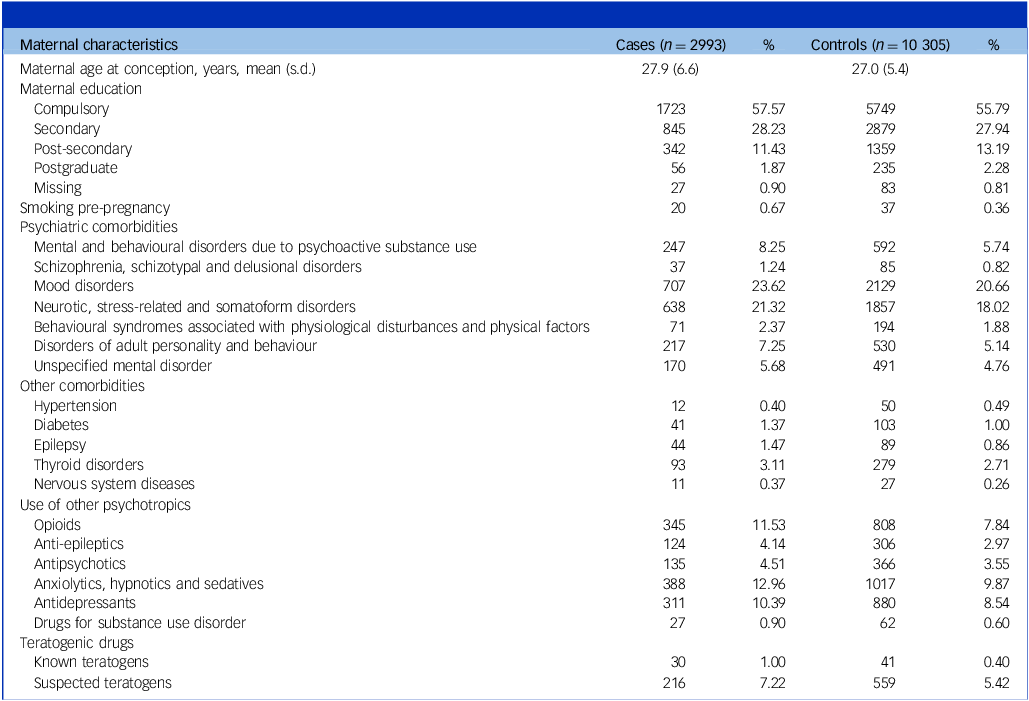
There were 2993 (22.5%) cases matched with 10 305 controls (77.5%). Of 13 298 pregnancies, 1389 (10.5%) were exposed to any ADHD medication in pregnancy. Cases were more likely to have psychiatric comorbidities such as mood disorders (23.6 v. 20.7%); neurotic, stress-related and somatoform disorders (21.3 v. 18.0%); and disorders of adult personality and behaviour (7.3 v. 5.1%), compared with controls (Table 1). Cases were more likely to use psychotropic medications such as opioids (11.5 v. 7.8%); anxiolytics, hypnotics and sedatives (13.0 v. 9.9%); and antidepressants (10.4 v. 8.5%), and had an increased likelihood of using known (1.0 v. 0.4%) and suspected (7.2 v. 5.4%) teratogens, compared with controls. Although cases and controls were matched on maternal age at conception, cases were on average 0.9 years older than controls, and age was adjusted for in the regression models.
Baseline maternal characteristics of cases and controls (N = 13 298)

Table 1 Long description
A table comparing maternal characteristics between cases (n = 2993) and controls (n = 10305). The table has 25 rows and 6 columns. Column headers are Maternal characteristics, Cases (n = 2993), %, Controls (n = 10305), %. Row labels include Maternal age at conception, Maternal education, Smoking pre-pregnancy, Psychiatric comorbidities, Other comorbidities, Use of other psychotropics, and Teratogenic drugs. Notable trends include higher percentages of psychiatric comorbidities and use of psychotropic medications in cases compared to controls. For example, mood disorders are present in 23.62% of cases versus 20.66% of controls, and neurotic, stress-related and somatoform disorders are present in 21.32% of cases versus 18.02% of controls. Cases also show higher use of opioids (11.53% vs. 7.84%), anxiolytics, hypnotics and sedatives (13% vs. 9.87%), and antidepressants (10.39% vs. 8.54%).
Other psychotropics were used 90 days before conception until conception. See Supplementary Table 1 for definition of covariates.
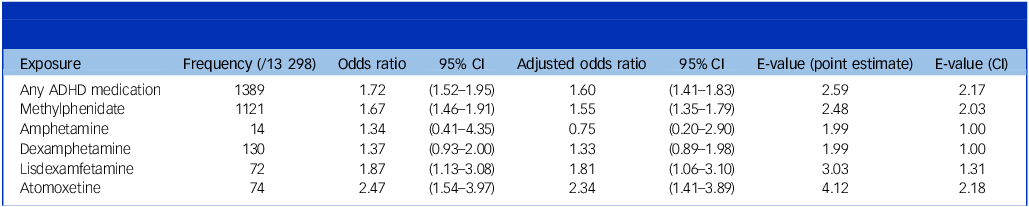
Pregnancies exposed to ADHD medication had an increased odds of miscarriage with a crude odds ratio of 1.72 (95% CI 1.52–1.95). After adjusting for potential confounders, the aOR was slightly attenuated to 1.60 (95% CI 1.41–1.83). We evaluated the potential impact of unmeasured confounding using the E-value, and found that an unmeasured confounder would need to have a strong association (≥2.59) with both ADHD medication use and miscarriage to explain away the observed association. Among individual drugs, adjusted analyses revealed associations between miscarriage and exposure to methylphenidate (aOR 1.55, 95% CI 1.35–1.79), lisdexamfetamine (aOR 1.81, 95% CI 1.06–3.10) and atomoxetine (aOR 2.34, 95% CI 1.41–3.89). Similar to any ADHD medication use, unmeasured confounders would need a strong association with both individual ADHD drugs and miscarriage to explain away these observed associations (Table 2). Sensitivity analyses with alternate gestational age assumptions yielded consistent results, with changes in the expected direction under the assumption that the correct mean of gestational age was used. The aOR was slightly lower for 57 days (aOR 1.45, 95% CI 1.27–1.66) and slightly higher for 71 days (aOR 1.69, 95% CI 1.49–1.93) (Supplementary Tables 2 and 3).
Association between attention-deficit hyperactivity disorder medication exposure and risk of miscarriage: crude and adjusted odds ratios, 95% confidence intervals and E-values

Table 2 Long description
A table with 7 rows and 8 columns comparing the odds ratios, confidence intervals, and E-values for various ADHD medications and their association with miscarriage. The columns are labeled Exposure, Frequency (/13 298), Odds ratio, 95% CI, Adjusted odds ratio, 95% CI, E-value (point estimate), and E-value (CI). The rows list different ADHD medications and their corresponding values. Row 1: Any ADHD medication, 1389, 1.72, (1.52-1.95), 1.60, (1.41-1.83), 2.59, 2.17. Row 2: Methylphenidate, 1121, 1.67, (1.46-1.91), 1.55, (1.35-1.79), 2.48, 2.03. Row 3: Amphetamine, 14, 1.34, (0.41-4.35), 0.75, (0.20-2.90), 1.99, 1.00. Row 4: Dexamfetamine, 130, 1.37, (0.93-2.00), 1.33, (0.89-1.98), 1.99, 1.00. Row 5: Lisdexamfetamine, 72, 1.87, (1.13-3.08), 1.81, (1.06-3.10), 3.03, 1.31. Row 6: Atomoxetine, 74, 2.47, (1.54-3.97), 2.34, (1.41-3.89), 4.12, 2.18.
E-value (CI) represents the minimum strength of association an unmeasured confounder would need with both the exposure and the outcome to explain away the observed confidence interval limit, after accounting for measured confounders. ADHD, attention-deficit hyperactivity disorder.
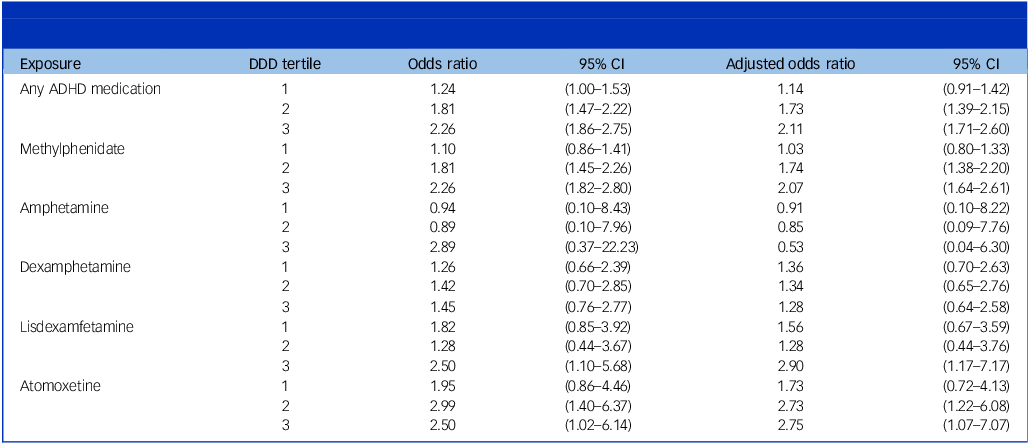
We observed a potential dose–response relationship according to the amount of DDDs dispensed in the exposure window. Compared with no ADHD medication use, the odds ratios increased across tertiles of exposure, from 1.14 (95% CI 0.91–1.42) in the first tertile to 1.73 (95% CI 1.39–2.15) in the second, and 2.11 (95% CI 1.71–2.60) in the third (Table 3). Similar patterns were observed for the individual medications methylphenidate, lisdexamfetamine and atomoxetine.
Association between attention-deficit hyperactivity disorder medication exposure categorised by tertiles of total defined daily doses and risk of miscarriage

Table 3 Long description
A table with six columns and ten rows, including a header row. The columns are labeled Exposure, DDD tertile, Odds ratio, 95% CI, Adjusted odds ratio, and 95% CI. The rows compare different ADHD medications and their exposure levels. The medications listed are Any ADHD medication, Methylphenidate, Amphetamine, Dexamphetamine, Lisdexamfetamine, and Atomoxetine. Each medication has three tertiles of DDD (defined daily doses) with corresponding odds ratios and confidence intervals. Notable trends include increasing odds ratios with higher DDD tertiles for most medications, indicating a potential dose-response relationship.
DDD, defined daily dose; ADHD, attention-deficit hyperactivity disorder.
Discussion
In this population-based, case–control study, we found that ADHD medication use during pregnancy was associated with a higher likelihood of miscarriage after adjusting for key confounders, including maternal age, psychiatric comorbidities, psychotropic medication use and teratogenic drug exposure. Although maternal age was matched between cases and controls, it was additionally adjusted for in regression models because of its strong association with miscarriage risk.Reference Magnus, Wilcox, Morken, Weinberg and Håberg7 Methylphenidate, lisdexamfetamine and atomoxetine were each independently associated with increased miscarriage risk. With medication exposure based on total DDDs, we observed that women in the highest tertile of dispensed ADHD medication demonstrated the strongest associations with miscarriage, supporting a potential dose-dependent effect, particularly for methylphenidate and atomoxetine, suggesting that both drug type and exposure level may influence risk. Although the 95% confidence intervals for the point estimates of some subgroup analyses, especially with lisdexamfetamine, were compatible with null effects, the effect sizes were directionally consistent with our main results. The differing mechanisms of stimulant and non-stimulant medications complicate identification of a clear biological pathway linking ADHD medication use with miscarriage. Stimulant medications increase sympathetic nervous system activity, leading to elevated maternal heart rate and blood pressure. These drugs cause vasoconstriction, including of uterine vessels, which may reduce uteroplacental perfusion and impair placental angiogenesis during critical developmental windows.Reference Nanda, Janga, Sambe, Yasir, Man and Gogikar23,Reference Cohen, Hernandez-Diaz, Bateman, Park, Desai and Gray24 In non-pregnant populations, hypertension and tachycardia have been documented as side-effects of psychostimulant use,Reference Vitiello25 and observational studies have previously linked stimulant use in pregnancy to increased rates of preeclampsia, placental abruption and preterm birth, which are complications thought to arise from vascular dysregulation.Reference Cohen, Hernandez-Diaz, Bateman, Park, Desai and Gray24,Reference Camacho, Zoega, Gomes, Schaffer, Henry and Pearson26,Reference Srinivas, Karlstad, Stigum, Furu, Cesta and Reutfors27 As early placental development and adequate uteroplacental perfusion are essential for pregnancy maintenance, such vascular effects may plausibly contribute to an increased risk of miscarriage. Furthermore, chronic hypertension has been associated with higher miscarriage risk,Reference Al Khalaf, O’Reilly, Barrett, Leite, Pawley and McCarthy28 supporting a potential link between stimulant-induced hypertensive effects and miscarriage. Our findings highlight the need for careful evaluation of ADHD medication use before and during early pregnancy, with a focus on dose and timing of medication exposure.
Our results align with previous research examining ADHD, ADHD medication use and miscarriage risk. A Norwegian register-based study identified an elevated risk of miscarriage among women with ADHD (odds ratio 1.27, 95% CI 1.21–1.33), but did not investigate the effects of ADHD medication use.Reference Magnus, Havdahl, Morken, Wensaas, Wilcox and Håberg8 By restricting the study population to women with ADHD, we aimed to clarify whether the observed risk was a result of the condition itself or its treatment. A Danish study of over one million pregnancies (1998–2010) found that ADHD medication-exposed pregnancies had a higher likelihood of miscarriage (odds ratio 2.07, 95% CI 1.51–2.84). Specifically, among women with an ADHD diagnosis (N = 505), miscarriages were more frequent in pregnancies exposed to ADHD medications compared with unexposed pregnancies (odds ratio 1.69, 95% CI 0.79–3.61). A case-crossover analysis within the same study suggested no increased risk when comparing exposed and unexposed pregnancies of the same women (odds ratio 1.30, 95% CI 0.69–2.47).Reference Haervig, Mortensen, Hansen and Strandberg-Larsen10 Another Danish study found that compared with women unexposed to methylphenidate or atomoxetine and without an ADHD diagnosis, those using these medications had a 55% higher risk of miscarriage (adjusted relative risk 1.55 95% CI 1.03–2.36), whereas untreated ADHD was associated with a similar risk increase (adjusted relative risk 1.56, 95% CI 1.11–2.20), raising the possibility of confounding by indication.Reference Bro, Kjaersgaard, Parner, Sorensen, Olsen and Bech11
Our study utilised nationwide register data from Norway, providing a large, representative sample of pregnancies and enhancing the generalisability of our findings. By including all pregnancies in contact with healthcare services, we identified a comprehensive set of miscarriage cases and examined individual ADHD medications prescribed during pregnancy. Our study focused on early pregnancy loss because of the differences in pathophysiology, clinical presentation and timing of potential exposures compared with later losses. Stillbirths were not included to maintain analytical clarity and to minimise confounding from distinct aetiologies associated with late pregnancy loss. Further research is needed to clarify the potential effects of ADHD medication use on stillbirth. A case–control design was chosen because gestational age data for miscarriages were unavailable, making it difficult to establish the timing of exposure relative to pregnancy start. In a cohort study, exposure is typically defined before the outcome occurs, potentially introducing immortal time bias.Reference Ukah, Aibibula, Platt, Dayan, Reynier and Filion29 This could overestimate exposure time for live births compared with miscarriages. The case–control design minimised this bias by matching cases and controls on key factors, including maternal age at conception and year of conception, ensuring comparability between groups. Although a cohort study could have been conducted using time-varying exposure definitions (e.g. treatment episodes), it would require additional assumptions about drug use patterns and timing.
To assess the robustness of our findings to alternative exposure definitions, we conducted additional analyses with a stricter exposure definition based on two or more prescription fills during the exposure window. The point estimates were generally higher. However, although this approach may increase specificity of the exposure, it resulted in smaller sample sizes and wider confidence intervals, reflecting instability and imprecise estimates, particularly for ADHD monotherapies.
Despite its strengths, our study has several limitations. A key limitation is the lack of recorded gestational age for miscarriages, leading to potential exposure misclassification. We addressed this by using a data-driven approach to estimate the mean gestational age (64 days) and conducted sensitivity analyses (64±7 days). Although misclassification remains in the gestational age for individual pregnancies, we aimed to minimise differential exposure misclassification. Sensitivity analyses with alternative shorter and longer gestational age assumptions showed expected variability in results toward and away from the null, indicating that our assumed mean was reasonable, and the remaining misclassification could bias results toward the null. Notably, only 0.5% of cases were identified from the MBRN, where gestational age may have been recorded, and the remaining relied on the estimated mean.
Another limitation is the reliance on prescription fill data, which may not reflect actual medication use. Misclassification could have occurred if ADHD medications were dispensed but not used. This misclassification is likely non-differential for cases and controls, biasing results toward the null. Although we used DDDs to categorise exposure levels in secondary analyses, the absence of information on actual drug consumption and prescribed dose limits the precision of dose–response assessments. The use of DDDs was intended to stratify the population in low, medium and high use based on estimated exposure, rather than to quantify the precise dose. However, it remains an imperfect proxy for actual drug use, as it does not capture individual variation in adherence, prescribed dose variations or potential discontinuation during pregnancy. Additionally, higher DDDs may reflect greater ADHD severity rather than just increased medication use, making it difficult to disentangle medication effects from underlying disease severity. However, we believe it is reasonable to assume that those in the highest tertile used more medication than those in the lowest tertile.
Odds ratios may overestimate relative risks because miscarriage is a common outcome in our population. Thus, although our findings reflect associations, caution is needed when interpreting the magnitude of effect. In our analysis, we have adjusted for pre-existing diagnosed hypertension, identified using diagnostic codes captured in primary or secondary care registers in the year before conception. This variable was included as a confounder, based on the rationale that chronic hypertension may influence both the likelihood of being prescribed stimulant medications and the risk of pregnancy loss. However, gestational hypertensive disorders, which may develop after conception, may represent intermediate variables on the causal pathway between ADHD medication use and miscarriage. Because we lack data on blood pressure measurements or heart rate during pregnancy, we were unable to evaluate this potential mediation pathway directly. Future studies with access to prospectively collected clinical data will be essential to assess whether cardiovascular effects mediate the relationship between ADHD medication use and early pregnancy outcomes. Finally, we could not fully adjust for smoking status, which is incompletely captured in the data. Although smoking is captured in the MBRN, miscarriages also came from specialist and primary care registers, where smoking status was unavailable. Unmeasured factors, including disease severity, stress and personal behaviours such as smoking, alcohol or substance use, nutrition and medication adherence, could have contributed to the observed associations. These factors can influence miscarriage risk and may be more prevalent among individuals who use ADHD medication versus those who do not, potentially confounding the results. We did not adjust for parity or history of previous miscarriage, as these variables may act as proxies for underlying maternal risk factors already accounted for in our models, and adjusting for them might introduce bias through overadjustment.Reference Weinberg30 Cohabitation status was not included in our models because of inconsistent data capture for cases and controls, as it was only available in the MBRN. However, the calculated E-values indicate that an unmeasured confounder would need to be strongly associated with both ADHD medication use and miscarriage to fully explain the observed associations.
In conclusion, our study suggests that ADHD medication use during pregnancy is associated with an increased risk of miscarriage, particularly with methylphenidate, the most commonly used ADHD medication in Norway. Elevated risks were also observed with lisdexamfetamine and atomoxetine, highlighting the need for further research on underlying mechanisms. Strengths include the use of comprehensive register-based data and analysis of individual ADHD medications. However, potential exposure misclassification, possible overestimation of exposure, confounding by disease severity and the inability to fully assess dose–response relationships should be considered when interpreting these results. In particular, we assume that filled prescriptions reflect actual use, which may not fully capture real-world adherence. Future studies with precise data on gestational age, medication adherence and actual drug doses are needed to confirm and expand upon these findings.
Supplementary material
The supplementary material is available online at https://doi.org/10.1192/bjp.2025.10467
Data availability
The data underlying this study are derived from Norwegian national registry sources, including the Medical Birth Registry of Norway, the Norwegian Patient Registry, the Norwegian Control and Payment of Health Reimbursements Database and the Norwegian Prescription Database. Because of data protection regulations, these data cannot be publicly shared. However, access may be granted upon reasonable request, subject to ethical approvals and permissions from the relevant data custodians.
Author contributions
C.S. and J.M.C. had full access to the data and take responsibility for its integrity and the accuracy of data analysis. Concept and design: J.M.C., C.S. Acquisition, analysis, or interpretation of data: C.S., Ø.K., H.S., K.F., C.E.C., J.R., V.H., J.A.H. and J.M.C. Drafting of the manuscript: C.S. Critical revision of the manuscript for important intellectual content: C.S., Ø.K., H.S., K.F., C.E.C., J.R., V.H., J.A.H. and J.M.C. Statistical analyses: V.H., C.S. Administrative, technical, or material support: J.M.C., K.F. Supervision: J.M.C.
Funding
This research was funded by the Research Council of Norway (project numbers 301977 awarded to J.M.C. and 273366 awarded to K.F.) and through its Centres of Excellence funding scheme (project number 262700).
Declaration of interest
J.M.C., Ø.K. and K.F. report participation in research projects funded by pharmaceutical companies, all regulator mandated phase 4 studies, all with funds paid to their institution (no personal fees) and with no relation to the work reported in this paper. C.E.C. and J.R. report participation in research projects funded by pharmaceutical companies, all with funds paid to the institution where they are employed (no personal fees) and with no relation to the work reported in this paper. C.S., H.S., V.H. and J.A.H. declare no conflicts of interest.
Ethical standards
The authors assert that all procedures contributing to this work comply with the ethical standards of the relevant national and institutional committees on human experimentation and with the Helsinki Declaration of 1975, as revised in 2013. All procedures involving human patients were approved by the Regional Committee for Medical and Health Research Ethics of Norway (South-East A; approval number 2017/2546). This study used pseudonymised data from national health registries in Norway. In accordance with the Norwegian Health Register Act (Helseregisterloven), individual informed consent is not required for register-based research.





eLetters
No eLetters have been published for this article.