A study of street music in nineteenth-century London provides a useful starting point to consider the ways in which street music functioned and the social and cultural values ascribed to it. By many accounts, London was the city with seemingly the most street music in the nineteenth century, though future research on other cities, in addition to the essays presented in this special issue, is needed to corroborate this assumption.Footnote 1 We find that despite a good supply of historical material, some of it is biased and unreliable and, over time, has been misread or used selectively by scholars to portray a fairly one-sided view of street music culture. In contemporary and current literature, street music is often used as a barometer by which attitudes to class, morality and demography are read, but these lines of inquiry only take us so far, especially when extreme views such as ‘many a child has been killed by street music’ are cited.Footnote 2 A new history is required. Often missing in accounts of street music in London are the voices of the musicians themselves and the kind of music they played. An obsession with the noise (nuisance) of street music and musicians has, I argue, given rise to a historiography of street music that overlooks some of the rich ethnography undertaken in the period. In fact, some of the earlier, though ad hoc, ethnography is rarely invoked in modern scholarship, though the work of Aimée Boutin on Joseph Mainzer is an excellent exception.Footnote 3 It is thus time for the history and historiography of street music to be examined afresh, especially in London, and for the principal and primary sources to be re-read critically.
Narratives about street music in London in the nineteenth century are largely dependent upon three principal sources: Charles Dickens (newspaper articles and short stories), Charles Babbage (an autobiography) and Henry Mayhew (a large-scale ethnography).Footnote 4 Scholarship has been largely preoccupied by what they had to say about noise and public nuisance. Moreover, musicological research – barring a few notable exceptions – resists looking at, or listening in between the lines of, various genres of writing to unscramble what these writers assume about social issues such as class and music. A close examination of sources is needed, focusing for instance on the vocabulary that writers employ to describe noise (as in the case of Dickens), the taxonomy or organizational structure of street musicians (in the case of Babbage) and the significant work of ethnographers (in addition to the work of Henry Mayhew) who relied on illustrations and interviews to construct their narratives about street culture in general and street music in particular. I also argue that a study of cries – embodied sound, rather than disembodied sound or purely instrumental music – ought to be made, because the prohibition of street cries under the Police Act of 1839 gradually rendered many of them extinct by the 1920s and objects of scholarly study in the newly fashioned discipline of ethnomusicology. (See Bruce Johnson’s article at the end of this special issue for more on the gradual extinction of street music.) Despite the passing of legislation to regulate street music, the law was not as harsh as it was for cries, and street music continued to thrive, unlike street cries, which largely died out. The way scholars have used ethnologies in formulating histories of cries provides a contrast to the way narratives around the sound of music in the streets of London in the nineteenth century have been formed.
J.T. Lightwood’s Charles Dickens and Music was published in 1912 and was the first large-scale study of Dickens’s interest in music.Footnote 5 Lightwood supposed that Dickens’s interest in music was a ‘reflection of his character’, but this point was under-developed: Lightwood simply noting Dickens’s lack of interest in what today is known largely by classical or art music.Footnote 6 Lightwood went on to claim ‘but as much as he loved music, Dickens could never bear the least sound or noise while he was studying or writing, and he even waged a fierce war against church bells and itinerant musicians’.Footnote 7 In a review of the book, an unnamed critic wrote that
we get quite an early Victorian atmosphere in reading of the popular songs of that epoch as chronicled by Dickens, and it may be added that these musical references are of the highest historical interest – reflecting as they do, the general condition of ordinary musical life in England during the middle of the last century.Footnote 8
Despite the many errors in the provenance and authorship that Dickens ascribed to these songs, they were not the only musical items of historical interest. He referred to a number of less well-known instruments such as the serpent and Kent Bugle and the use of marrow bones and cleavers by musical coachmen and butchers’ apprentices (known as rough music); there are also widespread references to other instruments, such as the guitar, trombone and the organ.Footnote 9 These were the instruments of the upper classes. The instruments of the lower classes were the barrel organ, drum, bagpipes, bassoon and triangle ‘ so beloved of the street musicians’.Footnote 10
Years later, in the 1950s, scholars were concerned with reading Dickens’s interest in music rather more deeply. Charles Cudworth, for instance, published an article that examined Dickens’s use of music in relation to social status in the nineteenth century.Footnote 11 Cudworth writes that the clarinet was depicted by Dickens to have been associated with ‘a very inferior position in the social, if not in the musical scale’ and gives an example of Uncle Fred from Little Dorrit who played the clarinet in a theatre orchestra.Footnote 12 On the other hand, stringed instruments were regarded as ‘genteel’ and the harp as ‘ultra-genteel’, but the piano (like the harpsichord) was held in lower regard by Dickens who wrote ‘many snide references to pianists’ for example in Dombey & Son.Footnote 13
Cudworth’s article gives us a fuller picture of Dickens’s interest in and connection with music. Dickens learned the violin and piano ‘with little success’ but made a better go of the accordion. Fanny, his sister, studied at the Royal Academy of Music, and his father-in-law was George Hogarth, author of many books on music and, as Cudworth explains, a regular audience member of concerts at the home of his fiancée.Footnote 14 Dickens also wrote a libretto for John Hullah’s The Village Coquettes and had a deep interest in, and wide knowledge of, popular songs and ballads. Dickens did not appear to have a very wide knowledge of art music and ‘apparently was not a chamber music enthusiast’.Footnote 15
Given Dickens’s interest in music it is odd that he disparaged it so greatly, if early scholarship in this area is to be believed. Dickens may have abhorred the noise that interrupted his concentration while at work, but did sounds generated by music goad him into searching for silence, as Lightwood suggested? There are doubts to the veracity of this claim and they come from two sources, the first from Dickens’s travel diaries, the second from two excerpts from his Sketches by Boz (1836).
To give insight into Dickens’s musical taste, Cudworth cited the following passage from Dickens’s travel diaries in Italy, where Dickens attended a church festival in Genoa:
The organ played away lustily, and a full band did the like; while a conductor, in a little gallery opposite the band, hammered away on the desk before him, with a scroll, and a tenor, without any voice, sang. The band played one way, the organ played another, the singer went a third, and the unfortunate conductor banged and banged, and flourished his scroll on some principle of his own, apparently well satisfied with the whole performance. I never did hear such a discordant din.
Cudworth has noted the satirical tone of this excerpt, but there is more to be gleaned from it than its tone alone. Words such as ‘lustily’, ‘hammered’ and ‘banged’ suggest an energetic performance. The phrase beginning ‘I never did’ is a well-known linguistic construct that is used for the sole purpose of exaggerating a point and by ending the excerpt with an alliteration, ‘Discordant din’, this is hardly the words of a writer resolutely distressed by sound or music.
Dickens’s use of language in relation to the street in Sketches by Boz (1836) shows up a similar interest in sound and noise rather than ambivalence or criticism. Sketches by Boz, Illustrative of Every-day Life and Every-day People is a collection of articles written by Dickens in periodicals between 1833 and 1836. There are 56 sketches arranged in four parts: ‘Our parish’, ‘Scenes’, ‘Characters’, and ‘Tales’. The book ends with three further sketches on young gentlemen, young couples and ‘The Mudfog and other sketches’.
According to some, Sketches by Boz comprises satirical essays and show Dickens as ‘a master of pictorial description’.Footnote 16 The emphasis on the pictorial is obvious given the sub-title of the book, but it can be argued that the essays are not satirical, especially those that deal with the street in the ‘Scenes’ part of the book. The first two essays in this section are ‘The Streets – Morning’ and ‘The Streets – Night’.
A close reading of these two sketches shows that Dickens is far from perturbed by noise. In the first sketch he writes warmly of ‘the noiseless streets’ and the ‘stillness of death over the streets’.Footnote 17 But Dickens does not write about the ‘silence’ of the street, because the street is far from silent, even in the hours before dawn, and he does not seem to mind. He does not demand it. Dickens observes, or creates, a character who is heard ‘roaring out the burden of the drinking song’ and notes the sounds of shop shutters coming down, the setting up of tables, the sound of footsteps and the sound of the Covent Garden market ‘thronged with carts’.Footnote 18 Furthermore:
Men are shouting, carts backing, horses neighing, boys fighting, basket women talking, piemen expatiating on the excellence of their new pastry, and donkeys braying. These and a hundred other sounds form a compound discordant enough to a Londoner’s ears, and remarkably disagreeable to those of country gentlemen who are sleeping at Hummums for the first time.Footnote 19
Dickens further writes of the gathering of crowds, the ‘sweeping and watering of the street’, cabs that ‘rattle briskly’ and shops filled with ‘servants and children’, who are presumably making some sort of sound.Footnote 20 He continues: ‘The streets are thronged with a vast concourse of people, gay and shabby, rich and poor, idle and industrious’.Footnote 21
In the second sketch, ‘The Streets – Night’, Dickens makes a comparison between the relative loudness of noise in the suburbs opposed to the noise of central London, implying the sound of the muffin boy who ‘rings his way down the street’ is nothing in comparison to the hubbub of the Covent Garden market, even when the muffin boy ‘screams out’ ‘Muffins!”.Footnote 22 Even in the evening, no matter the time, there is no silence. There are people who ‘slam doors’; there is the sound of a sailor’s hornpipe, the ‘clicking of pattens’, ‘rustling of umbrellas’, ‘melancholy tinkling’ of bells and much singing and ‘shouting and rushing about’ of patrons exiting theatres as late as one a.m.Footnote 23
Whether Dickens is writing satirically or autobiographically or in character is beside the point. The street for him in fiction is not a site of silence; it might be ‘discordant’ to him, as Lightwood writes, but it is not ‘disagreeable’ to his private writer’s mind and is not portrayed this way to his reading public. For one thing, Dickens’s prose is alive with sound.
Dickens was to write again on the subject of street music, this time as a signatory to a letter to Michael T. Bass MP, who was preparing an amendment to the Act for increasing the presence of police ‘in and near the metropolis’ to go before the House of Commons. Bass’s submission on the proposed amendment ran to 120 pages and consisted not of detailed legal argument or jurisprudence rhetoric but some 200 letters sent to him – or solicited by him – from people, some of them famous, in the case of Dickens, that supported the proposed bill, which would regulate the movement of street musicians and the sounds they made. Most of the correspondents complained bitterly about the noise made from street musicians, many of whom struck up their bands before eight in the morning, while others were still going up to eleven at night.Footnote 24 Others complained about the din made by multiple performers standing side-by-side competing with one another.Footnote 25 Other letters complained of the difficulty of running a household, with servants having to interrupt their work to go out onto the street and to ask musicians to move along (some letters articulated the reticence of servants to do this, in one case fearing for their safety) and the awkwardness of neighbourly relations if when a band or musician move, they merely moved next door thereby infuriating the neighbours, especially if the musicians had been paid or bribed to move.Footnote 26
The impetus for Bass’s bill came from Charles Babbage. In the same year that Bass’s bill was tabled, 1864, Babbage had written a volume of memoirs, Passages from the Life of a Philosopher, in which chapter 25 was entitled ‘Street Nuisances’. The chapter begins with a grumpy observation:
During the last ten years, the amount of street music has so greatly increased that it has now become a positive nuisance to the very considerable portion of the inhabitants of London. It robs the industrious man of his time; it annoys the musical man by its intolerable badness; it irritates the invalid; deprives the patient, who at great inconvenience has visited London for the best medical advice, of that repose which, under such circumstances, is essential for his recovery, and it destroys the time and the energies of all the intellectual classes of society by its continual interruptions of their pursuits.Footnote 27
Babbage considered himself an ‘industrious man’ and estimated that the cacophony made by street musicians had so distracted him he had lost 25 per cent of his working time.Footnote 28 From July 8 1860 to May 1 1861, Babbage kept a record of the disturbances to his working day by street music and submitted them to Bass, who reproduced the list in his proposed Bill.Footnote 29 The list shows that Babbage experienced 65 interruptions in 90 days but he added that ‘many others during that time were not recorded’.Footnote 30 In 1860 and 1861, wrote Babbage, £103.12 5d had been spent on costs ‘in endeavouring to protect my time from interruption by organs’.Footnote 31
It would be no exaggeration to say that Babbage was obsessed by the proliferation of street musicians and the noise they made, and the dispute with the street musicians turned ugly. Dead cats ‘and other offensive material’ were ‘thrown down my area’, wrote Babbage; windows were also broken and ‘occasional blows from stones projected by unseen hands’.Footnote 32
Apart from the disruption to his working day, Babbage also reported on the degree to which the noise from street musicians impeded the recovery of the sick. Babbage’s rubbery use of statistics to argue this point may suggest a man paranoid and suffering hypochondria:
It has been found, upon undoubted authority, by returns from benefit societies, that in London, about 4.72 persons per cent are constantly ill. This approximation may be fairly assumed as the nearest yet attained for the population of London. It follows, therefore, that about forty-seven out of every thousand inhabitants are always ill. The number of persons per house varies in different parts. In my own district it averages ten to each house; in a neighbouring district the average is thirteen per house.
In Manchester Street, which faces my own residence, there are fifty-six houses. This, allowing the above average of ill-health, will show that about twenty-six persons are usually ill in that street. Now the annoyance from street music is by no means confined to the performers in the street in which the house is situated. In my own case, there are portions of five other streets in which street music constantly interrupts me and my pursuits. If the portions of these five streets are considered to be only equal in population to that of Manchester Street, it will appear that upwards of fifty people who are ill, are constantly disturbed by the same noises which so frequently interrupt my own pursuits.
The misery inflicted upon those who are really ill is far greater than that which arises from the mere destruction of time, however valuable.Footnote 33
While Babbage turned on the street musicians, some of his neighbours turned on him. He wrote that after he had secured ‘two or three’ convictions against street musicians his neighbours printed placards abusing him of resorting to the law ‘against the destroyers of my time’.Footnote 34 The placards were posted in shops ‘from Edgware Road to Tottenham Court Road. Some of them attempted verse and thought it poetry; though the only part really imaginative was their prose statements’.Footnote 35
Charles Dickens’s letter, signed on behalf of 27 ‘professors and practitioners of one or other of the arts and sciences’, pledged full support to Babbage’s complaints and Bass’s proposed bill:
To M.T. Bass, Esq., M.P.
Sir
Your undersigned correspondents are desirous to offer you their hearty thanks for your introduction into the House of Commons of a Bill for the Suppression of Street Music; and they beg to assure you that, in the various ways open to them, they will, out of Parliament, do their utmost to support you in your endeavor to abolish that intolerable nuisance.
Your correspondents are, all, professors and practitioners of one or other of the arts or sciences. In their devotion to their pursuits – tending to the peace and comfort of mankind – they are daily interrupted, harassed, worried, wearied, driven nearly mad, by street musicians. They are even made especial objects of persecution by brazen performers, beaters of drums, grinders of organs, bangers of banjos, clashers of cymbals, worriers of fiddles, and bellowers of ballads; for no sooner does it become known to those producers of horrible sounds that any of your correspondents have particular need of quiet in their own houses, than the said houses are beleaguered by discordant hosts seeking to be bought off.
Your correspondents represent to you that these pecuniary speculations in the misery they endure are far more destructive to their spirits than their pockets; and that some of them, not absolutely tied to London by their avocations, have actually fled into the country for refuge from this unmerited persecution – which is none the less grievous or hard to bear, because it is absurd.
Your grateful correspondents take the liberty to suggest to you that, although a Parliamentary debate undoubtedly requires great delicacy in the handling, their avocations require at least as much, and that it would highly conduce towards the success of your proposed enactment, if you prevail on its opponents to consent to state their objections to it, assailed on all sides by the frightful noises in despite of which your correspondents have to gain their bread.
(Signed) Charles Dickens
Alfred Tennyson
John Everett Millais
Francis Grant
John Forster, Palace Gate House, Kensington
J.R. Herbert
John Leech, 6, The Terrace Kensington
W. Holman Hunt, Campden Hill
Wilkie Collins
J.E. Horsley, High Row, Kensington
W.P. Firth, 7, Pembridge Villas
F. Seymour Haden, 62, Sloane Street
R. Doyle
T. Carlyle, 3, Cheyne, Chelsea
Alfred Wigan, Little Campden House
W. Boxall, 14, Welbeck Street
George Jones
Alfred Elmore, 1, St. Alban’s Road
Thomas Faed, Sussex Villa, Campden Hill
John Phillips, 1, South Villas, Campden Hill
Thomas Creswick
James Sant
E.M. Barry
J.H. Robinson
S. Cousins
L. Stocks
W.C. Dobson
Thomas Woolner.
The avoidance of the first person voice in this letter suggests that Dickens may not have agreed with the view of those he was representing. The letter itself might even been construed as an act of performance. Its use of alliteration, such as ‘worried, wearied’ and the repetition of words in close succession starting with the letter ‘b’ – brazen (used twice), bangers, banjos and bellowers – adds a layer of dramatic affect. The depiction that Dickens drew was that the noise generated by street musicians stood in the way of the advancement of letters and creative culture. Street music and musicians upset this privileged class but at least they had country properties to which they could flee from such ‘intolerable’, ‘horrible’, ‘grievous’ and ‘frightful’ persecution.
The letter is a catalogue of grievances held by self-described important people. It is, to a point, a measure of people’s reaction to noise and of the effect it has on the emotional, psychological and physiological wellbeing of those on whose behalf Charles Dickens was writing. It stands as an historical record of such personal angst. Missing from the list is Charles Babbage. Given his preoccupation with noise, his name is strikingly absent.
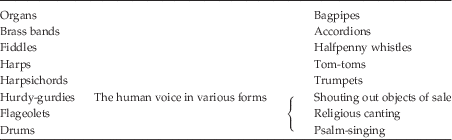
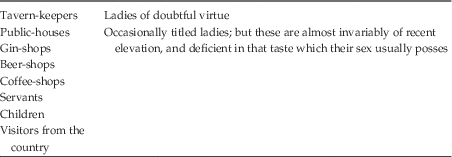
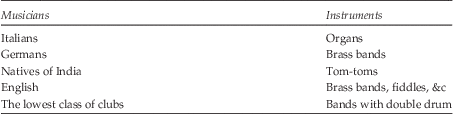
Babbage’s personal accounts of street music are useful in an ethnographic context. His list of interruptions by noise over a three-month period in 1861 is of course subjective, but it is a unique record even if, by his own admission, the data are incomplete and therefore not a full account. In addition to this personal record keeping he provided taxonomies of street music in three tables in his memoir that provide lists of ‘instruments of torture’, ‘Encouragers of street music’ and ‘Musical performers’.Footnote 36
Although not produced by a musical instrument, and not readily defined as street music, the cry formed part of the soundscape of London streets and came under severe criticism by three respondents in Bass’s Bill. One Alfred Wigan described the street criers as a ‘nuisance’, writing that ‘I am invited every morning, before seven, to buy watercresses, and all through the day I am offered vegetables of all kinds, fish, strawberries, door-mats, muffins, flowers, hand-boxes, chairs to mend, ornaments for the fire-stove’ and sarcastically asked, given the abolition of cries in 1839, ‘What are the abolished cries’?Footnote 37
Cries were the object of Babbage’s derision, as seen in Table 1, and unlike other forms of street noise or sound it came under the radar of historians and ethnologists in the nineteenth and early twentieth centuries. Babbage’s ethnography was an early start but the work of Charles Hindley and later Lucy Broadwood and her team of ethnographers had something quite different in mind: a more scholarly approach to capturing some noises from the street, not as a means to shut down noise, but to capture it, in notation, for posterity.
Instruments of torture permitted by the Government to be in daily and nightly use in the streets of London

The first attempted large-scale history of street cries, A History of the Cries of London, was written by Charles Hindley and published in 1881.Footnote 38 It was limited to a printing of 500 copies and was illustrated with woodcuts by Thomas and John Berwick (and their pupils), who had attained a considerable reputation in London for the work. The book was dedicated to Horatio Noble Pym Esquire, ‘a patron of literature’ but he was also a solicitor and book collector.
A History of the Cries of London was a serious work of history – a history with a method, which by 1880 was still something of a novelty in some quarters in Britain. Hagiographical biography, verbose and self-indulgent travelogues and flouncy and self-righteous journalism, which had characterized much historical writing in the early to mid-nineteenth century, was countered by the rise of interest in historical method which required authorial accountability, rational judgement, a carefully cultivated writing style and a regard for social and cultural context in addition to facts.Footnote 39
Hindley’s book was couched in this new spirit of historical writing that relied on primary sources. From the outset, he declared that the idea for the book was not, in fact, his own: Rev. Thomas Hugo, who, amongst other things, had compiled a book of the Berwick Brothers woodcuts, had first suggested it.Footnote 40 Hindley went out of his way to verify that the idea was not his, reproducing copies of letters confirming the fact and reproducing the title page of Hugo’s book in order to avoid the appearance of appropriating Hugo’s idea. Then Hindley declared his method: ‘I have availed myself of all existing authorities within reach, and therefore, to prevent the necessity of continued reference here state, that I have drawn largely from Charles Knight’s History of London’.Footnote 41 Hindley then goes on to list about a dozen other references he consulted including Henry Mayhew’s London Labour and the London Poor, an article from Fraser’s Magazine and Hill’s History of Little Britain in addition to ‘various other sources [that were] suitable for my purpose’.Footnote 42 Hindley then provided another list of particular people from whom he had solicited advice. But Hindley’s history was also personal: he occasionally offered his own views and recounted his own experience of street cries, which will be discussed below.
Hindley’s book had two main sections, to do with ancient and modern cries, though this separation is not always strictly delineated. The book comprised description and observation: it is a document that earnestly encouraged the preservation of street cries and deplored the fate of lost and extinct cries. The woodcut illustrations usually denoted just one person. They were sometimes drawn with an open mouth (denoting the vocalization of a street cry); other times they were fairly benign and expressionless.
A significant part of Hindley’s project was concerned with observing changes in street cries. For example he noted the change in expression from cries of ‘Hot sheep’s feet’ to (cold) ‘sheep trotters’ and the ascendancy of the word ‘great’ over ‘new’ in fish cries; and he discussed extinct cries such as those by the water-carrier, though he pointed out that the water-carrier still existed in Paris and Madrid.Footnote 43 Also documented were the absence of horn criers, who were banished from the street by the Police Act of 1837, along with a whole range of ‘uncommon noises, which did something to relieve the monotony of the once endless roar of the tread of feet and the rush of wheels’.Footnote 44
A History of the Cries of London is also a useful document because of its listing of the variations or numbers of cries by particular criers. For example, Hindley listed some 36 cries of the common crier as well as 36 cries each of the bellman and the rat-catcher but pointed out that despite this large number of variants ‘our series of cries is still extremely incomplete’.Footnote 45 Hindley also concentrated on aspects of noise and wrote that the loudest were fish wives, orange women, chimneysweepers and costermongers, the last of whom he described as one who ‘bawls so loud’.Footnote 46 He also lamented the decline of particular criers by itinerants and noted that the wonderful variety of cries of London was slowly vanishing.
About halfway through the book Hindley reflected on the purpose of his history and its implications. He speculated that striving for a ‘most advanced civilization’ was causing the street to be quiet; this quest for such civilization was a result of legislation prohibiting the loudest cries.Footnote 47 Hindley noted that street trades would become a thing of the past and would be forgotten, and summed up these issues writing that ‘The history of cries is a history of social changes’.Footnote 48
Another shift in the documentation of London street cries came in 1919, 38 years after Hindley’s book was published. In four articles published in the Journal of the Folk Song Society, Lucy Broadwood and her team of ethnographers published a series of transcriptions and analytical studies on the subject. Broadwood belonged to the Folk Song Society that spent years collecting English folk tunes and transcribing them for publication and posterity. Broadwood was the only member of this society to lead a study on London street cries.
The first article published by Broadwood sets the historical scene, and she mentions, quotes from, and criticizes Hindley’s work, finding it confusing but tantalizing, though she does not elaborate.Footnote 49 Clearly, the subject whetted her appetite, and she felt more work needed to be done. The article made comparisons and noted differences between a composition on street cries by Orlando Gibbons from the sixteenth century, a manuscript in the British library and a journal kept by a fellow contemporary ethnographer, Juliet Williams.
In the second article, Lucy Broadwood and A.G. Gilchrest published transcriptions of site-specific street cries they notated during fieldwork.Footnote 50 The first, a chair-mender’s cry, was ‘Sung by a man in Wimbledon, some years ago, and noted at the time’.Footnote 51 The study noted that when Broadwood repeated the cry in a fête at Belgrave Square it was recognized ‘by an old gyspy woman, a professional chair-mender, engaged at the fête’.Footnote 52 When compared to other cries, Broadwood found it similar to an old dance tune. Other cries documented and transcribed in this article were taken from Brighton and Birmingham.
The third article was a comparative study of street calls in Bologna and Paris, and observed they were similar to a London milk-cry and an unnamed Scottish cry.Footnote 53 Variations of such cries were noted and published, and the final paragraph attempts an explanation of the French–Scottish connection by briefly outlining the ways in which French words ‘were handed down in Scotland in domestic and colloquial use’.Footnote 54 It was concluded that street cries travelled in a similar manner.
The final article, with Juliet Williams, was a longer piece that examined the cries of hawkers in Chelsea.Footnote 55 She noted the style of crying, the pitch and key in which they were sung and variations noted between February 1915 and 28 May 1918. She also compared cries by the same man, in different locations, and transcribed the differences. She went so far as to describe its musicality, writing that
His voice is very true, ringing and musical, and his rhythm excellent, so that it is easy enough to take down the notes of his cry. He has sung exactly in the key of A flat every time that I have tested his pitch.Footnote 56
In a moment of frustration, Williams bought a broom from a street seller in the hope of engaging him in conversation to discern the words he was using in his cry. Williams managed only to annoy the man and he would not tell her the words he was ‘crying’.Footnote 57
The only visual illustrations in the articles are musical transcriptions. The musical examples shoehorn irregular pitches, rhythms and intonations onto the Western musical stave. This notation cannot possibly illustrate microtones, glissandos or elisions, the use of high, middle or low voice, the use of grunting or falsetto (if used for projection of the voice) or the changes in speed, manipulation of rhythm, rubato, and much else besides. And we have to take the authors’ word for it that the transcriptions are accurate and that Juliet Williams’s perfect pitch was, well, perfect.Footnote 58
To a point, Broadwood and her colleagues were interested in social history (of sorts) but their approach was more anthropological and comparative musicology (as it was termed at the time) given its reliance on ethnography. Their reliance on insider–outsider ethnography and observer–participant interaction were to become the staple of studies in ethnomusicology. But can more be said about the implications of ethnography and the way street music is heard or represented by visual and aural cues in transcriptions?
In City of Noise: Sound and Nineteenth-Century Paris, Aimée Boutin argues her book ‘adopts a sensory approach’ arguing ‘for an aural rather than visual conception of modernity’ explaining that she is interested in the new field of ‘sensory studies’.Footnote 59 She suggests that ‘visual studies privilege the eye over other senses, and, accordingly, see the nineteenth century as a period in which the supremacy of the visual was entrenched’.Footnote 60 And Hendy concurs:
We surely need to question almost every assumption that has been made … about the supposed triumph of visual sensibility as time passes, and about the constant relegation of aural culture; that hearing is less important now than it has been in the past, that listening is a passive activity, that seeing something provides better proof than hearing something, that what happened in the West also happened in the East. A social history of sound and listening suggests otherwise.Footnote 61
As musical transcriptions show, they are both aural and visual cues. Two modes of thinking or imagination take place when the transcriptions are ‘read’: they are simultaneously visual and aural maps. The aural–visual divide is therefore neither a neat nor a possible historiography.
These examples drawn upon for this article – short stories by Dickens, Babbage’s attempts to rid the streets of roving musicians and transcriptions of Lucy Broadwood and her ethnographers – are all quite different responses to capturing noise, or sound, in the nineteenth-century London street. The narrative techniques used vary and elicit images in the mind’s eye – and ear. Through the use of alliteration (in the case of Dickens) and anger, frustration and vengeance (in the case of Babbage) noise, or music, might be said to have become a performance (of sorts) for both these writers. But is their documentation true, authentic, reliable? Are they trustworthy ear-witnesses to a soundscape we no longer hear? Ethnographers such as Broadwood were ear- and eye-witnesses and their realizations of the nineteenth-century London street and environs relied on both an aural and visual narrative to document music and sound in the street. Although we are left with extensive documentation about the noise or sound of nineteenth-century London musical life they must be read sceptically, our ears (and eyes) at the ready for hearing and seeing history a little differently.
Encouragers of Street Music

Musical Performers