Error Self-Regulation
As the article title attests, humans are fallible and make errors. Sometimes errors have no consequence, and can even be a source of amusement. However, errors can be more serious when they cause social embarrassment, are expensive to fix and pose a risk to safety (e.g., burning your hand while cooking). Following TBI, people make errors more frequently on everyday tasks and are less likely to recognise and self-correct their errors (Hart, Giovanetti, Montgomery, Schwartz, Reference Hart, Giovanetti, Montgomery and Schwartz1998). This can reduce their safety, autonomy and productivity. Consequently, problems with error self-regulation can be a key reason why people with TBI are unable to return to work or live independently (Ownsworth et al., Reference Ownsworth, Fleming, Strong, Radel, Chan and Clare2007; Tate & Broe, Reference Tate and Broe1999).
Brain Regions Supporting Error Self-Regulation
Errors occur because of a breakdown in or failure of basic and higher-order cognitive processes such as attention, memory and executive function. For example, loss of arousal and alertness during task performance may result in errors (O’Keefe, Dockree, Moloney, Carton & Robertson, Reference O’Keefe, Moloney, Carton and Robertson2007). Further, prospective memory problems may lead to a failure to perform an action at the right time will result in errors such as not paying a bill or returning a library book by the due date. Larson, Kaufman, Schmalfuss and Perlstein (Reference Larson, Kaufman, Schmalfuss and Perlstein2007) proposed that ‘impairments of this type belong to a constellation of deficits in cognitive control – the ability to orchestrate thought and action in accord with internal goals’ (p. 961).
TBI typically leads to diverse cognitive and behavioural deficits that produce difficulties on everyday tasks, such as forgetting instructions, becoming distracted and acting impulsively. The capacity to accurately reflect on, monitor and regulate one's own actions is important in post-injury adjustment to enable individuals to recognise and compensate for the frequent problems that arise in daily situations due to the effects of TBI. However, brain injury typically damages the prefrontal cortex and connecting pathways which support ‘metacognition’ or the capacity to monitor and regulate one's own behaviour (Cicerone & Tupper, Reference Cicerone, Tupper, Tupper and Cicerone1991; Ham et al., Reference Ham, Bonnelle, Hellyer, Sagar, Robertson, Leech and Sharp2014).
Researchers have distinguished between performance monitoring (evaluative) and regulative control components of error self-regulation (Kerns et al., Reference Kerns, Cohen, MacDonald, Cho, Stenger and Carter2004; Larson et al., Reference Larson, Kaufman, Schmalfuss and Perlstein2007). Mediated by the anterior cingulate cortex (ACC), the evaluative component monitors for the presence of errors (or response conflict) during performance, which signals the need for top-down control processes to avoid or correct an error (Larson et al., Reference Larson, Kaufman, Schmalfuss and Perlstein2007). Behavioural indicators of ‘online’ awareness include pausing mid-action, verbalisations (e.g., ‘oops’, swearing), non-verbal exclamations, facial expressions (e.g., grimace), head shaking and hand gestures (Hart et al., Reference Hart, Giovanetti, Montgomery and Schwartz1998). The ACC is part of an inter-connected neural circuitry involved in self-monitoring, motivation and emotion regulation during task performance (Bush, Luu, & Posner, Reference Bush, Luu and Posner2000). Hence, people's emotional state and motivation is likely to both influence, and be influenced by their awareness of errors, which in turn affects self-beliefs about the ability to perform a task competently (Toglia & Kirk, Reference Toglia and Kirk2000).
It makes sense that by being aware of an error people are more likely to self-correct. Although this has generally been supported by research, Hart and colleagues (Reference Hart, Giovanetti, Montgomery and Schwartz1998) found that people with brain injury sometimes showed awareness of errors on naturalistic tasks through their behaviour (e.g., pausing mid-action or making comments) without making self-corrections. Similarly, in an electrophysiological study of cognitive control, Larson, Clayson and Farrer (Reference Larson, Clayson and Farrer2012) reported that participants with mild TBI demonstrated intact error monitoring but were less likely to make appropriate adaptations or adjustments for errors than controls.
The regulative component of error self-regulation refers to the implementation of top-down control to enable error correction or other performance adjustments to avert an error. Such functions are supported by the dorsolateral prefrontal cortex (DLPFC) (Kerns et al., Reference Kerns, Cohen, MacDonald, Cho, Stenger and Carter2004; Larson et al., Reference Larson, Kaufman, Schmalfuss and Perlstein2007). Overall, error self-regulation is best understood as a dynamic process mediated by interacting but dissociable components. ACC mediated evaluative processes monitor for and recognise errors and signal the DLPFC when top-down support is needed to correct or adjust performance (Larson et al., Reference Larson, Kaufman, Schmalfuss and Perlstein2007).
Assessment of Error Self-Regulation
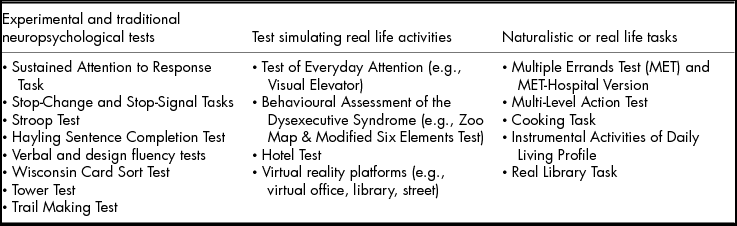
Three main approaches are used to assess error self-regulation in clinical practice and research. As exemplified in Table 1, these include experimental tasks and traditional neuropsychological tests, tests stimulating real life activities and naturalistic or real life tasks. Commonly used in research investigating the neural basis of attention and error self-regulation, the Sustained Attention to Response Task (SART: Robertson, Manly, Andrade, & Baddeley, Reference Robertson, Manly, Andrade and Baddeley1997) is a Go/No-Go continuous performance task that measures sustained attention and provides behavioural indices of off-task mind-wandering and response inhibition. Other standardised neuropsychological tests listed in Table 1 have indices that reflect errors related to rule following, perseveration and response suppression or the ability to inhibit an automatic response.
Approaches Used to Assess Error Self-Regulation in Clinical Practice and Research

Tests designed to simulate real life tasks (e.g., Behavioural Assessment of Dysexecutive Syndrome; Wilson, Alderman, Burgess, Emslie, & Evans, Reference Wilson, Alderman, Burgess, Emslie and Evans1996) aim to provide more ecologically sensitive assessment of cognitive abilities while maintaining practical utility (e.g., feasible administration time and application in different settings). More recently, virtual reality platforms have been developed, such as the Jansari assessment of Executive Function (JEF©; Jansari et al., Reference Jansari, Devlin, Agnew, Akeeson, Murphy and Leadbetter2014) and Virtual Library Test (Renison, Ponsford, Testa, Richardson, & Brownfield, Reference Renison, Ponsford, Testa, Richardson and Brownfield2012), which assess multiple components of executive functioning (e.g., planning, prioritisation and multi-tasking) in a virtual environment that resembles everyday contexts.
Tests conducted in naturalistic settings aim to better capture participants’ real life cognitive capacity and strategy use, such as the Multiple Errands Test (MET; Shallice & Burgess, Reference Shallice and Burgess1991) and Real Library Task (Renison et al., Reference Renison, Ponsford, Testa, Richardson and Brownfield2012). The MET requires participants to perform errands in a real shopping centre according to set rules. A potential limitation of such assessments is that these can be time consuming, expensive and difficult to replicate or standardise across different settings. Designed for a hospital setting, the MET-Hospital version helps to address some of these issues (Knight, Alderman, & Burgess, Reference Knight, Alderman and Burgess2002). Similarly, the Cooking Task (Chevignard et al., Reference Chevignard, Taillefer, Picq, Poncet, Noulhiane and Pradat-Diehl2008) was developed for administration in a hospital occupational therapy kitchen. In this task, participants are asked to bake a chocolate cake and cook an omelette for two people. They are given a book with the cake recipe and all the utensils and ingredients they need (including distracter items). Participants are asked to leave the kitchen the way they found it and are told to act as if they are alone when completing the task. The Cooking Task provides an in-depth assessment of error behaviour and has a comprehensive (albeit time consuming) scoring protocol. In our own research (Ownsworth, et al., Reference Ownsworth, Fleming, Tate, Shum, Griffin, Schmidt and Chevignard2013), omission errors and dangerous behaviours on the Cooking Task were found to be more sensitive indicators of people's capacity to work and their independence and care and supervision needs than standard tests of executive functioning. Examples of chocolate cakes completed by people with severe TBI with good error self-regulation (pictured on the left) and poor error self-regulation (pictured on the right) are displayed in Figure 1.
Chocolate cakes made by people with severe traumatic brain injury during the Cooking Task (Chevignard et al., Reference Chevignard, Taillefer, Picq, Poncet, Noulhiane and Pradat-Diehl2008).
Functional Significance of Error Self-Regulation Impairments
Studies employing many of the aforementioned measures have consistently demonstrated that people with brain injury experience error self-regulation impairments. In research by Ham et al. (Reference Ham, Bonnelle, Hellyer, Sagar, Robertson, Leech and Sharp2014), individuals with TBI with reduced fronto-parietal functional connectivity were found to display impaired self-awareness and error monitoring (Ham et al., Reference Ham, Bonnelle, Hellyer, Sagar, Robertson, Leech and Sharp2014). Impairments in behaviour regulation, response inhibition and error awareness have been reported in studies investigating the effects of brain injury on attention and executive functioning (Dimoska-Di Marco, McDonald, Kelly, Tate, & Johnstone, Reference Dimoska-Di Marco, McDonald, Kelly, Tate and Johnstone2011; O’Keefe et al., Reference O’Keefe, Moloney, Carton and Robertson2007; Rochat, Beni, Annoni, Vuadens, & Van der Linden, Reference Rochat, Beni, Annoni, Vuadens and Van der Linden2013). People with brain injury have also been found to make more errors on real life tasks and show less awareness of errors than controls (Chevignard et al., Reference Chevignard, Taillefer, Picq, Poncet, Noulhiane and Pradat-Diehl2008; Hart et al., Reference Hart, Giovanetti, Montgomery and Schwartz1998). Furthermore, research supports that impaired error self-regulation is related to greater functional difficulties in daily life (O’Keefe et al., Reference O’Keefe, Moloney, Carton and Robertson2007; Ownsworth et al., Reference Ownsworth, Fleming, Strong, Radel, Chan and Clare2007). In our research (Ownsworth et al., Reference Ownsworth, Fleming, Strong, Radel, Chan and Clare2007), we used cluster analysis to identify four awareness typologies (poor self-awareness, high defensiveness, high symptom reporting, good self-awareness) and compared functional outcomes. The ‘poor self-awareness’ group was characterised by reduced self-awareness and impaired error self-regulation. This group had significantly lower independent living skills, interpersonal functioning and vocational capacity than the good self-awareness group. Such findings underscored the need to evaluate rehabilitation programs targeting metacognitive skills.
Metacognitive Rehabilitation
Over the last few decades, the evidence supporting the efficacy of error-based learning or metacognitive approaches in rehabilitation has advanced considerably (Tate et al., Reference Tate, Kennedy, Ponsford, Douglas, Velikonja, Bayley and Stergiou-Kita2014). Cicerone and Tupper (Reference Cicerone, Tupper, Tupper and Cicerone1991) were early advocates of metacognitive skills training and described the ‘noetic’ model of cognitive remediation as a top-down approach that aims to enhance individuals’ capacity for self-awareness and self-regulation (see also Katz, Fleming, Keren, Lightbody, & Hartman-Maeir, Reference Katz, Fleming, Keren, Lightbody and Hartman-Maeir2002; Toglia & Kirk, Reference Toglia and Kirk2000). The noetic model contrasts with the process and functional models which are bottom-up approaches with either an internal focus on restitution of discrete neuro-cognitive skills (process model) or external focus on compensation based on task-specific learning (functional model). Guided by the noetic model, metacognitive skills training teaches people internal strategies to self-monitor and regulate their own behaviour. Such training may be incorporated into broader rehabilitation programs through components such as psychoeducation, feedback, experiential learning, performance self-predictions and post-task self-reflection.
Feedback interventions involve a rehabilitation professional describing the person's performance on relevant tests or functional tasks. This may be done verbally (i.e., oral or written feedback) or using audio-visual recordings of task performance (Schmidt, Lannin, Fleming and Ownsworth, Reference Schmidt, Lannin, Fleming and Ownsworth2011). Alternatively, peer feedback may be used in the context of group therapy (Ownsworth, Fleming, Shum, Kuipers & Strong, Reference Ownsworth, Fleming, Shum, Kuipers and Strong2008). A systematic review of feedback interventions by Schmidt et al. (Reference Schmidt, Lannin, Fleming and Ownsworth2011) appraised the evidence from 12 intervention studies, including three randomised controlled trials (RCTs), and concluded that feedback interventions produced ‘modest improvements’ in self-awareness. However, most studies did not examine error self-regulation skills. Following this review, Schmidt, Fleming, Ownsworth and Lannin (Reference Schmidt, Fleming, Ownsworth and Lannin2013; Reference Schmidt, Fleming, Ownsworth and Lannin2015) conducted a RCT to compare the efficacy of experiential, verbal and video plus verbal feedback interventions. Our results indicated that combining video and verbal feedback was most effective for improving both self-awareness and error self-regulation and maintaining these gains over time. In line with these findings, metacognitive skills training has been recommended as a practice standard for treating impairments in executive functioning (Cicerone et al., Reference Cicerone, Langenbahn, Braden, Malec, Kalmar, Fraas and Ashman2011). In the INCOG recommendations for executive function and self-awareness, Tate et al. (Reference Tate, Kennedy, Ponsford, Douglas, Velikonja, Bayley and Stergiou-Kita2014) concluded that there is substantial support for the use of feedback to treat awareness deficits.
Research Underway: Do people with severe TBI benefit from making errors?
Traditionally, rehabilitation trials focus on increasing or decreasing target behaviours within a specific training context (e.g., following the steps to pay a bill). A leading view in the neuropsychological rehabilitation literature is that people with severe cognitive impairment learn new skills more effectively when errors are avoided during training, using the ‘bottom-up’ approach of errorless learning (Evans et al., Reference Evans, Wilson, Schuri, Andrade, Baddeley, Bruna and Taussik2000), as compared to having people guess and the therapist correcting their error responses (i.e., errorful learning). People with amnesia tend to remember their incorrect responses better than corrections to errors and, due their greater reliance upon implicit memory, are prone to making habitual errors (Evans et al., Reference Evans, Wilson, Schuri, Andrade, Baddeley, Bruna and Taussik2000). Errorless learning is a recommended method for teaching specific information and task-specific procedures to people with severe memory impairment (Cicerone et al., Reference Cicerone, Langenbahn, Braden, Malec, Kalmar, Fraas and Ashman2011). However, as cautioned by Cicerone et al. ‘the presence of severe executive dysfunction may limit effectiveness of this form of memory rehabilitation’ (p. 524). A key limitation of errorless learning is that the discrete skills taught during training typically do not generalise beyond the specific training context (Evans et al., Reference Evans, Wilson, Schuri, Andrade, Baddeley, Bruna and Taussik2000).
In contrast to errorless learning, the ‘top-down’ approach of error-based learning provides structured opportunities for people to become aware of and self-correct their errors through graded prompts from the therapist. Error-based learning teaches people to stop, check and modify their actions, and to flexibly apply these internal steps to self-regulation as needed in daily situations. To date, trials have only compared error-based learning (systematic feedback) to control conditions such as a wait list or behavioural practice with therapist corrected errors (Schmidt et al., Reference Schmidt, Lannin, Fleming and Ownsworth2011). It is unknown whether error-based learning is more effective than errorless learning for facilitating generalisation of skills beyond the training context.
To address this knowledge gap, we are conducting a multi-site RCT funded by the National Health and Medical Research Council to determine whether people with severe TBI benefit from making errors (Ownsworth et al., Reference Ownsworth, Fleming, Tate, Shum, Griffin, Schmidt and Chevignard2013). Specifically, the trial is comparing the efficacy of error-based learning and errorless learning for improving error self-regulation skills and self-awareness. Psychosocial functioning is being assessed at six-months post-intervention to examine whether improvement in error self-regulation skills is related to better long-term outcomes (i.e., occupational and interpersonal functioning, independence and supervision needs). Due to the focus on internal self-regulation skills, error-based learning is expected to facilitate greater generalisation of error self-regulation skills to non-trained tasks. Similarly, because error-based learning provides structured opportunities for people to make errors, reflect on these and consider their functional significance, error-based learning is considered more likely than errorless learning to improve self-awareness of deficits.
Participants are eligible for the study if they are aged 18–65 years, have had a severe TBI, and display dysexecutive impairments that restrict their activities of daily living. Both the error-based learning and errorless learning interventions entail 8 × 2 hour therapy sessions that involve teaching people: (1) how to prepare a multi-step stir fry (sessions 1–4); and (2) how to perform a goal-directed multi-step activity (sessions 5–8) in the home or community. The contrasting aims and techniques of error-based learning and errorless learning are outlined in the protocol paper (see Ownsworth et al., Reference Ownsworth, Fleming, Tate, Shum, Griffin, Schmidt and Chevignard2013). The outcome measures assess generalisation of error self-regulation skills on a task similar to training (i.e., near transfer: Cooking Task), and tasks distinct from or unrelated to training (i.e., far transfer: Zoo Map Test, Hayling Sentence Completion Test). Recruitment for the trial commenced in July 2013 and will continue until May 2016, with the six-month post-intervention follow-up assessments completed by December 2016.
Conclusion
Impairments in error self-regulation after TBI pose major risks to safety and lower people's independence and productivity. There are different approaches to assessing error self-regulation which vary in the extent to which tasks and stimuli resemble real life. Evidence supporting the efficacy of rehabilitation interventions for improving self-awareness and self-regulation skills has amassed over the past decade. A trial is currently underway which seeks to determine whether it is more beneficial for people with severe TBI to make errors and become aware of their errors as they learn, or to prevent people from making errors (Ownsworth et al., Reference Ownsworth, Fleming, Tate, Shum, Griffin, Schmidt and Chevignard2013). This research will help to clarify the role of errors in task learning and generalisation. Error-based learning techniques could be broadly applied to enhance task learning and generalisation in TBI rehabilitation (e.g., safety in physical therapy, retraining social communication skills). This metacognitive approach also has promising applications to other populations with serious neuro-cognitive impairments (e.g., stroke and schizophrenia).