Introduction
Tenecteplase is a recombinant tissue-type plasminogen activator that elicits its effects by converting plasminogen to plasmin, degrading fibrin in blood clots.Reference Huynh, Birkhead and Huber1,Reference Thiebaut, Gauberti and Ali2 Developed via modifications to three amino acid sites of another plasminogen activator, alteplase, tenecteplase has the benefits of increased fibrin specificity, greater resistance to plasminogen activator inhibitor PAI-1, and a longer plasma half-life.3 With the additional advantage of a decreased risk of major bleeding, tenecteplase is an effective treatment for acute myocardial infarction (AMI) and pulmonary embolism (PE).Reference Guillermin, Yan, Perrier and Marti4
Fibrinolytic therapy as a method of reducing mortality of myocardial infarction (MI) is considerably more effective when the time between symptom onset and commencement of treatment is minimalized.Reference Boersma, Maas, Deckers and Simoons5 In large metropolitan centers with multiple specialized cardiac catheterization emergency facilities, thrombolysis is initiated in the hospital setting. However, in areas with long transit times (eg, rural settings), initiating treatment prior to hospital arrival through advanced or intensive care paramedic specialist intervention is believed to reduce both the time to treatment and total mortality, resulting in improved patient outcomes compared to those first treated in hospital.Reference Myers6-Reference Welsh, Travers, Senaratne, Williams and Armstrong9
While non-protein drugs can be affected by thermolysis (eg, diazepam and lorazepam – benzodiazepines used for prehospital seizure treatment), protein drug molecules (including tenecteplase, insulin, and various monoclonal antibodies [mAbs]) have a structural complexity that predisposes them to physical and chemical degradation via environmental and solution conditions during manufacturing, storage, shipment, and patient administration.Reference Gottwald, Akers and Liu10-Reference Cui, Cui, Chen, Li and Guan14 Maintaining the overall structural configuration is essential in ensuring a therapeutic protein’s stability, efficacy, safety, and immunogenicity, with only minor structural changes potentially resulting in major negative impacts.Reference Kommanaboyina and Rhodes15 For example, disruption of the high order structure that results in decreases in both protein monomer and single chain protein can affect a drug’s selectivity, potentially reducing efficacy and inducing adverse side effects.3,Reference Lentz, Joyce and Lam16 Any structural alterations are sometimes only identified during long-term or accelerated storage involving deviations to the surrounding environment (eg, temperature fluctuations).Reference Alsenaidy, Jain, Kim, Middaugh and Volkin13
To limit accelerated thermal degradation of medications, it is suggested they are stored at controlled room temperature unless otherwise indicated.Reference Stein17 Specifically, the manufacturers of Metalyse, a brand of tenecteplase marketed by Boehringer Ingelheim Pty Limited (North Ryde, NSW, Australia), recommend the lyophilized form be stored below 30.0°C (86.0°F). Several studies have demonstrated the difficulty associated with ensuring proper storage of pharmaceuticals in emergency service vehicles (ESVs), particularly in areas that experience extreme temperatures.Reference Brown, Krumperman and Fullagar18 This is even more challenging in rural areas, where limited access to temperature-controlled storage facilities could potentially result in prolonged subjection to less-than-ideal conditions. In a regional city in Queensland, Australia, a preliminary investigation found that the mean temperature inside a drug bag stored in an ESV parked outside during the summer months was 35.5°C (95.9°F), with a maximum of 44.9°C (112.8°F) reached (unpublished findings). These temperatures far exceed those suggested for tenecteplase storage. While the stability thresholds provided by pharmaceutical manufacturers are minimums,Reference Brown, Krumperman and Fullagar18 the extent to which these thresholds can be exceeded for each specific pharmaceutical transported in ESVs is not fully understood. The result of this potential decrease in efficacy of tenecteplase due to field transportation and delivery has resulted in some variable clinical outcomes, with potential incomplete clot thrombolysis and resolution of altered electrocardiogram traces reported by advanced care paramedics and an emergency treating cardiologist (2017; personal communication).
As manufacturers recommend tenecteplase be used immediately following reconstitution due to concerns with possible microbiological growth (or otherwise stored at 2.0°C-8.0°C [35.6°F-46.4°F] for no longer than 24 hours), it is transported and stored in its lyophilized form. Despite the relevance to paramedics and clinicians, studies investigating the impact of storing tenecteplase at high temperatures prior to reconstitution are limited. Therefore, the aim of the present investigation was to determine how the stability and efficacy of lyophilized tenecteplase was affected after being stored for eight hours at temperatures exceeding those suggested by its manufacturers. The environmental conditions examined in this study simulated those experienced by ESVs during summer months in a regional city in Queensland, Australia, but are directly applicable to similar use and climates encountered world-wide.
Methods
Tenecteplase (Metalyse), containing 50mg active ingredient, 522mg arginine, phosphoric acid adjusted to pH 7.3, and 4.0mg polysorbate-20, was obtained from the Queensland Department of Health Central Pharmacy (Richlands, Queensland, Australia) and stored at 4°C (39.2°F) until study commencement. L-arginine free base, 1,2-propanediol, sodium phosphate, sodium dodecyl sulfate (SDS), urea, and dithiothreitol (DTT) were purchased from Astral Scientific Pty Ltd (Taren Point, New South Wales, Australia). Polysorbate-20 and Tris were purchased from Chem-Supply Pty Ltd (Port Adelaide, Southern Australia, Australia). Milli-Q water was prepared by an ultrapure water system (Merck Millipore; Bayswater, Victoria, Australia).
Heat Treatment
Duplicate vials containing 50mg lyophilized tenecteplase, protected from light in their original packaging, were stored at either 4.0°C, 35.5°C (average temperature reached inside a paramedic drug bag stored in an emergency vehicle during summer, as determined previously by the authors; results unpublished), or 44.9°C (maximum temperature reached within a drug bag stored in an emergency vehicle, also determined previously by the authors; results unpublished) for eight hours. Following treatment, each vial was reconstituted with water for injection that was packaged with the drug to a final concentration of 5mg/mL, as per product preparation instructions. Aliquots were removed from each vial and used in subsequent assays, as previously described by Semba, et al and Lentz, Joyce, and Lam,Reference Lentz, Joyce and Lam16,Reference Semba, Weck, Razavi, Tuomi and Patapoff19 to determine tenecteplase stability and efficacy.
Assays
Optical Clarity and pH
Solutions were visually inspected against a white and black background for any obvious precipitate formation. pH was determined using a Eutech Instruments pH 700 meter (Thermo Fisher Scientific; Singapore).
Concentration
Aliquots were diluted 50-fold in a buffer containing 300mM arginine phosphate and 0.04% polysorbate-20, pH 7.3, and assayed using a Genesys 10S UV-Vis spectrometer (Thermo Scientific; Madison, Wisconsin USA) at 280nm. Absorbance at 320nm was recorded to correct for light scattering. Concentration was calculated using the Beer-Lambert equation with an extinction coefficient of 1.9mL/mg/cm (absorptivity of tenecteplase at 280nm), as follows:
 $${\rm{Conc}}{\rm{.\;}}\left( {{\rm{mg/mL}}} \right){\rm{\; = \;}}{{{\rm{abs}}{\rm{.\;@\;280\;nm\, - \,abs}}{\rm{.\;@\;320\;nm}}} \over {{\rm{1}}{\rm{.9}}}}$$
Protein Monomer
Samples (25μg tenecteplase) were analyzed using size exclusion chromatography on a Tosoh Bioscience TSKgel G3000SWxl column (300x7.8mm; 5µm) (Minato-ku; Tokyo, Japan) employed on an Agilent Technologies 1200 series high-performance liquid chromatography system (HPLC; Melbourne, Victoria, Australia) with diode-array detection (DAD) at 280nm. The mobile phase consisted of 200mM arginine free base, 150mM Tris, and 5% 1,2-propanediol, pH 7.0, at a flow rate of 1.0mL/min. The percent monomer in each sample was calculated as follows:
 $${\rm{\% \;monomer\; = \;}}{{{\rm{monomer\;peak\;area}}} \over {{\rm{total\;protein\;peak\;area}}}}{\rm{\; \times \;100}}$$
Single Chain Protein
Aliquots were diluted in a buffer of 8M urea solution and 200mM sodium phosphate, pH 6.8, and reduced for three to five minutes with 20mM DTT solution (final concentration) at 37.0°C (98.6°F). Analysis of samples (12.5μg tenecteplase) was performed on a Tosoh Bioscience TSKgel G3000SWxl size exclusion column (300x7.8mm; 5µm) employed on an Agilent Technologies 1200 series HPLC with DAD at 214nm. The mobile phase contained 200mM sodium phosphate and 0.1% SDS, pH 6.8, at a flow rate of 1.0mL/min. The percent single chain was calculated as follows:
 $${\rm{\% \;single\;chain\; = \;}}{{{\rm{first\;main\;peak\;area}}} \over {{\rm{sum\;of\;1st\;and\;2nd\;peak\;areas}}}}{\rm{\; \times \;100}}$$
Clot Weight
This assessment was based on a method proposed by Prasad, et al.Reference Prasad, Kashyap, Deopujari, Purohit, Taori and Daginawala20 Briefly, healthy human venous blood was transferred to pre-weighed microcentrifuge tubes and incubated at 37.0°C for 45 minutes to allow for clot formation. Following serum removal, clots were weighed using a Mettler Toledo AB204-S balance (Greifensee, Switzerland). Aliquots of 100μL treated tenecteplase (ie, those samples exposed to various temperatures) were added to the clots, with water used as a negative control. After further incubation at 37.0°C for 90 minutes, excess fluid was removed and retained, and the tubes weighed once more to compare to initial clot weight.
Fibrin Degradation Product
The serum from all samples collected before and after treatment was analyzed for the presence of D-dimer using the INNOVANCE D-Dimer immunoturbidimetric assay on a Sysmex CA-560 Coagulation Analyzer (Siemens Healthcare Pty Ltd; Bayswater, Victoria, Australia).
Statistical Analysis
Statistical analysis was performed on all data using ANOVA, with Student’s t test applied when significance (P < .05) was identified (Prism version 4.02; GraphPad Software; San Diego, California USA).
Results
Optical Clarity and pH
Tenecteplase stored at 4.0°C reconstituted easily, however, there was some difficulty experienced with fully reconstituting vials stored at 35.5°C and 44.9°C. Particulate matter was temporarily observed in these solutions following diluent addition, indicating the drug had not completely dissolved. Full reconstitution had visually occurred by the time analyses were conducted.
The pH of reconstituted solutions was found to be similar for all temperatures tested (Table 1).
Biochemical Properties of Lyophilized Tenecteplase Stored for Eight Hours at 4.0°C, 35.5°C, or 44.9°C (n = 2)

Concentration
Tenecteplase concentration was not significantly different between temperature treatments after eight hours (Table 1). There was a difference of 0.01mg/mL (10.8%) between 4.0°C and 35.5°C vials and 0.02mg/mL (20.0%) between 4.0°C and 44.9°C vials.
Protein Monomer
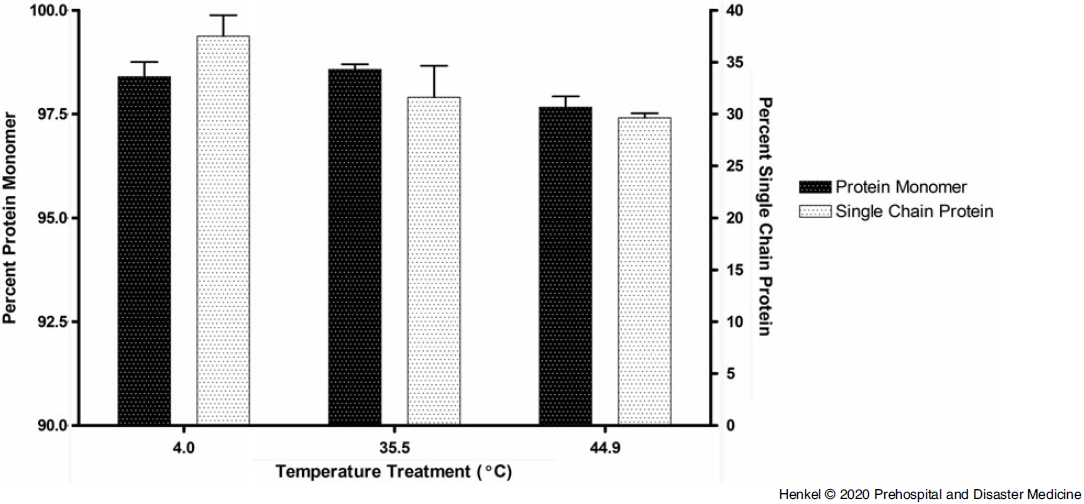
Minimal loss of protein monomer was observed in lyophilized tenecteplase stored at 4.0°C and 35.5°C with an average of 98.4% (95% CI, 97.9-98.9) and 98.6% (95% CI, 98.4-98.7) protein monomer detected after eight hours, respectively. There was a greater decrease in protein monomer for vials stored at 44.9°C, averaging 97.7% (95% CI, 97.3-98.0) after eight hours (Figure 1).
Percent Protein Monomer and Single-Chain Protein Remaining in Tenecteplase Samples Subjected to Temperatures of 4.0°C, 35.5°C, and 44.9°C for a Period of Eight Hours.

Single Chain Protein
As storage temperature increased, the amount of single chain protein detected decreased. Vials stored at 4.0°C contained an average of 37.5% (95% CI, 34.7-40.3) of the single chain form after eight hours, while this percentage averaged 31.6% (95% CI, 27.4-35.8) and 29.7% (95% CI, 29.1-30.3) in solutions stored at 35.5°C and 44.9°C, respectively (Figure 1).
Clot Weight
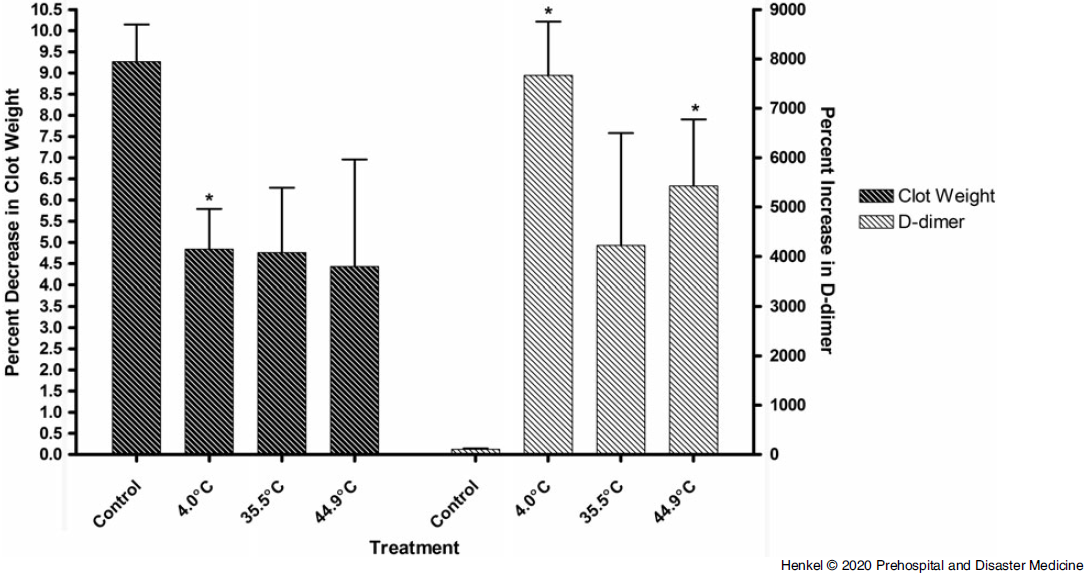
All tenecteplase solutions were found to elicit some clot lytic activity following eight hours of temperature exposure. Interestingly, the control (water-treated) solutions showed more variance in clot weight than those treated with tenecteplase with an average decrease of 0.0267g (95% CI, 0.0207-0.0326) or 9.3%. Tenecteplase stored at 4.0°C and 35.5°C caused a similar reduction in clot weight with an average decrease of 0.0130g, or 4.8% (95% CI, 0.0101-0.0159) and 4.8% (95% CI, 0.00648-0.0196), respectively. Solutions stored at 44.9°C produced the smallest decrease in clot weight compared to all other treatments, averaging a decrease of 0.0115g (95% CI, 0.00288-0.0201) or 4.4% (Figure 2).
Differences in Weight and Detected Fibrin Degradation Product (D-dimer) of Human Blood Clots Before versus After Incubation with Water (Control) or Solutions of Tenecteplase Subjected to Temperatures of 4.0°C, 35.5°C, and 44.9°C for a Period of Eight Hours.

Fibrin Degradation Product
For all samples analyzed, D-dimer levels increased following water/thrombolytic treatment compared to initial levels. However, this change was considerably less for control samples (an average increase of 0.50mg/L Fibrinogen Equivalent Units [FEU] (95% CI, 0.45-0.54) or 109.1%) compared to those treated with tenecteplase. Samples stored at 4.0°C had the greatest elevation in D-dimer, increasing an average of 34.55mg/L FEU (95% CI, 34.46-34.63) or 7668.0%, followed by samples stored at 44.9°C (average increase of 27.75mg/L FEU (95% CI, 14.60-40.90) or 5429.0%); these increases were significantly greater than that observed with control samples (P <.04). The amount of D-dimer in samples stored at 35.5°C was the least of all tenecteplase solutions, increasing an average of 23.87mg/L FEU (95% CI, 3.20-44.53) or 4222.0% following treatment (Figure 2).
Discussion
This investigation explored the effect of storing lyophilized tenecteplase at temperatures exceeding those suggested by manufacturers over an eight-hour period. A number of factors, as previously described, were evaluated to assess the drug’s stability and efficacy following heat treatment with the temperatures chosen simulating those that occur in ESVs in a regional city in Queensland, Australia.Reference Lentz, Joyce and Lam16,Reference Semba, Weck, Razavi, Tuomi and Patapoff19,Reference Prasad, Kashyap, Deopujari, Purohit, Taori and Daginawala20 A unique aspect of this study was that tenecteplase was stored in its original, lyophilized form; similar studies typically store the drug in its reconstituted form. Lyophilization, or the freezing and drying of products, is a technique commonly used to increase the physical and chemical stability of labile therapeutic proteins by hindering degradation reactions.Reference Kasper and Friess21 Exploring tenecteplase stability in its lyophilized form was deemed an important inclusion in this study because of its applicability to real-world emergency situations.
When stored at 35.5°C or 44.9°C for eight hours, tenecteplase concentration was not significantly affected. While this investigation was conducted over one continuous eight-hour period to represent an extreme situation, it is likely that the drugs would be subjected to shorter (eg, two or three hours), more frequent cycles of refrigeration and reheating. The accumulated effects of this could result in continued degradation of the product. It is also important to highlight the temporary reduction in solubility of the drugs stored at the higher temperatures compared to those stored under refrigeration, as this presents potential complications for emergency medical personnel in the field. In situations where a patient requires emergency treatment, a solution may not be given adequate time to dissolve fully. This could lead to a reduction in the lysis capacity of the drug through decreased concentration or deactivation of the effective constituent, or could result in precipitation of harmful chemical entities.Reference Jo, Shin and Lee22 Because of the importance of ensuring no particulates are present in the reconstituted solution, it is suggested that, regardless of solution stability once fully reconstituted, prolonged exposure of lyophilized tenecteplase to high temperatures should be avoided.
Other indications of drug instability were observed. The amount of single chain protein present decreased as storage temperature increased, and the greatest loss in protein monomer was found in solutions stored at the highest temperature. Loss of protein monomer indicates fragmentation of the protein and possible disruption of its high order structure, potentially increasing susceptibility to aggregation and subsequent antibody-mediated adverse immune responses.Reference Lentz, Joyce and Lam16,Reference Semba, Weck, Razavi, Tuomi and Patapoff19,Reference Rosenberg23 The conversion of tenecteplase from its one-chain to two-chain form occurs as a result of proteolytic cleavage or hydrolytic clipping at Arg 275-Ile 276 on contact with plasmin.Reference Lentz, Joyce and Lam16,Reference Rijken24,Reference Jiang, Wu, Karger and Hancock25 A decrease in protein one-chain is indicative of reduced fibrin specificity; although both the one- and two-chain forms of tenecteplase exhibit thrombolytic activity, it is the one-chain form that is more fibrin-specific.Reference Loscalzo26 The fibrin specificity of tenecteplase provides such clinical benefits as better dissolution of older fibrin clots and fewer non-cerebral bleeding complications.3 Therefore, the findings that indicate storing tenecteplase at high temperatures could result in the breakdown of the protein structure may also suggest a decrease in its fibrin specificity and the associated benefits of minimal systemic plasminogen activation and fibrinogen depletion.Reference Baruah, Dash, Chaudhari and Kadam27
The in vitro whole blood clot model for determining tenecteplase bioactivity was used for this study as Prasad, et al had successfully demonstrated the clot lysis activity of another thrombolytic medication, streptokinase, using the same method.Reference Prasad, Kashyap, Deopujari, Purohit, Taori and Daginawala20 In the current study, solutions stored at 4.0°C and 35.5°C showed similar clot lysis ability while 44.9°C solutions exhibited less. This would suggest that storage at high temperatures negatively affects tenecteplase efficacy. However, control solutions were found to exhibit the greatest clot lysis ability of all treatments tested. There are several factors that can affect thrombolysis, including the time allowed for clot formation and/or clot lysis and the concentration of thrombolytic used. Susceptibility to clot lysis is influenced by clot retraction, a process where the fibrin mesh within the thrombus contracts, resulting in a smaller, more mechanically-stable clot.Reference Tucker, Sage and Gibbins28 This releases entrapped, unbound plasminogen from within the thrombus and increases the concentration and formation of fibrin and the fibrin network.Reference Sabovic, Lijnen, Keber and Collen29,Reference López, Ojeda and Arocha-Piñango30 In addition to clot retraction, lysis may also be affected by the ability of plasminogen activators to partially degrade fibrin and expose new plasminogen binding sites at concentrations that do not deplete plasminogen in plasma.Reference Sabovic, Lijnen, Keber and Collen29 A study by Elnager, et al found that increasing the concentration of streptokinase applied to whole blood clots did not have much of an effect on clot weight, and it was proposed that the use of inappropriate doses of thrombolytic, and the limitations of natural fibrinolytic inductors such as plasminogen on lytic activity, negatively affected in vitro bioactivity.Reference Elnager, Abdullah and Hassan31
The study by Elnager, et al also demonstrates the importance of not relying solely on clot weight to determine lytic activity of plasminogen activators. While clot weight was not altered, a significant change in D-dimer concentration was detected that suggested a positive effect on clot lysis activity.Reference Elnager, Abdullah and Hassan31 D-dimer, one of the final products of complete fibrinolysis, is a specific fibrin degradation product created from two adjacent fibrin monomers that indicates cross-linked fibrin-specific clot degradation by plasmin.Reference Wakai, Gleeson and Winter32-Reference Riley, Gilbert, Dalton, Pai and McPherson34 Of the coagulation assays available for diagnosis and prognosis of thromboembolic events such as deep vein thrombosis (DVT), PE, or infarction, the D-dimer is the most widely used.Reference Riley, Gilbert, Dalton, Pai and McPherson34 Thrombolytic therapy, such as streptokinase and tenecteplase administration during AMI, results in elevated serum levels of fibrinogen and fibrin degradation products, including D-dimer.Reference Lew, Berberian, Cercek, Lee, Shah and Ganz35 Studies by Melzer, et al and Brügger-Andersen, et al showed that tenecteplase administration resulted in markedly increased D-dimer concentrations in patients with massive and sub-massive PE and ST-segment elevation infarct (STEMI).Reference Brügger-Andersen, Hetland, Pönitz, Grundt and Nilsen33,Reference Melzer, Richter and Rogalla36 Based on previous studies, an increase in D-dimer concentration would suggest that tenecteplase has elicited its thrombolytic effects.
Analogous with findings from Elnager, et al,Reference Elnager, Abdullah and Hassan31 the results of the D-dimer assay in the current study suggested more substantial lytic activity where the in vitro bioactivity assay did not. Based on clot weight degradation, it would be expected that the control samples would produce the greatest amount of D-dimer, while clots treated with tenecteplase would yield lower levels. This was not the case, however, as the control samples produced the least amount of D-dimer and clots treated with tenecteplase stored at 4.0°C produced more D-dimer than any other temperature treatment. These findings provide further evidence that D-dimer is a more suitable indicator of fibrinolytic activity than clot weight. Although the amount of D-dimer detected in clot samples treated with tenecteplase stored at 35.5°C and 44.9°C had increased compared to pre-treatment levels, it was not as pronounced as refrigerated tenecteplase. However, the exact extent to which the temperature treatments differed is difficult to determine as the maximum quantifiable D-dimer amount (35.2mg/L FEU for the Siemens CA-560 following automatic sample dilution)37 was exceeded by several solutions, including all those stored at 4.0°C. In these instances, a value of 35mg/L was used. Despite this, the findings suggest that tenecteplase efficacy is affected by prolonged storage at high temperatures, potentially resulting in reduced clinical efficacy.
While studies have found that some drugs can tolerate extended periods of high temperature when stored in ESVs, it is evident that this is dependent on the drug and its chemical structure: the associated processes that occur during degradation (eg, elimination, rearrangement, or hydrolysis); reactions between the active compound and excipients; or interactions between the drug and storage container.Reference Valenzuela, Criss and Hammargren38-Reference De Winter, Vanbrabant and Tuong Vi42 Therefore, while it may be perceived to be best practice, emergency service personnel should be discouraged from depleting older product before switching to newer stock as it is likely that some degradation may have occurred from numerous refrigeration-heat cycles. Alternatively, greater monitoring of drugs undergoing repeated refrigeration/heat cycling could be employed to help prevent unnecessary drug wastage. To alleviate temperature problems associated with ESV drug storage, implementation of a stock rotation scheme could be viable in some locations.Reference Brown, Wojcik, Bailey and Tran43 Where this is not effective, ambulances or critical care vehicles may be housed in climate-controlled garages or, depending on available funds, mechanical medication cooling systems could be utilized.Reference Allegra, Brennan, Lanier, Lavery and MacKenzie44,Reference DuBois45 Passive cooling systems could also be considered; however, they may reduce the efficiency of paramedics due to additional/heavier bag requirements.Reference DuBois45 Individual color-changing time-temperature indicator labels could also be applied to each medication, allowing users to easily and accurately monitor temperature exposure.Reference Brown, Wojcik, Bailey and Tran43,Reference Allegra, Brennan and Fields46 Suggestions such as these should be considered for tenecteplase storage to ensure it retains full stability and efficacy.
Limitations
In this investigation, tenecteplase was subjected to temperatures that exceeded those suggested by manufacturers for one eight-hour session. In the life cycle of a pharmaceutical carried by clinicians, emergency responders, and paramedics, this is not a long period of time. It is believed that had the study been conducted over a lengthier period with further cycles of refrigeration and warming, drug instability would have escalated in agreement with clinical observations from high temperature environments. This is speculation, however, and further study is warranted.
Additionally, the clots used in the current study would be considered extreme in a clinical scenario where the fibrinolytic system would naturally decrease thrombus severity. If an in vivo model was used, the tenecteplase samples in this study may have demonstrated further efficacy or a more discreet graded efficacy profile linked to temperature degradation. However, there are ethical considerations of delivering potentially compromised tenecteplase to a human thrombus. Rodent models of MI or thrombus were considered as a bioassay platform for determining thrombolytic activity of tenecteplase; however, these animal strains show physiologically faster clotting processes that are not directly applicable to human blood.Reference García-Manzano, González-Llaven, Lemini and Rubio-Póo47 As such, the model used for this study was deemed the best approximation that could be utilized.
Finally, as stated previously, the maximum amount of D-dimer that could be quantified by the coagulation analyzer used was exceeded by several solutions in this study. The large amount of D-dimer produced is most likely due to the high concentration of tenecteplase added to the clots; if this was reduced to levels that were more clinically accurate, D-dimer levels may not have been as excessive. Alternatively, if there were more serum samples available, they could have been diluted further to extend the reportable range of the analyzer.
Conclusions
Based on the results of the current study, it is recommended that: storage of lyophilized tenecteplase should follow what is suggested by manufacturers (ie, below 30.0°C); storage temperatures should not continuously exceed 30.0°C for periods longer than eight hours; and lyophilized tenecteplase should not be subjected to refrigeration-heat cycling. It is also suggested that quantifying fibrin degradation products (eg, D-dimer) using an immunoassay should be the preferred technique for measuring clot lysis capacity over monitoring variations in clot weight, as this investigation has shown it to be a more accurate and reliable indicator of possible clinical effects.
Ultimately, the use of tenecteplase and other therapeutic proteins is an important aspect of emergency clinical medicine, particularly in rural and remote scenarios, that should be maintained and encouraged. However, the belief that it is best practice to use up old stock first must be deterred, as even in the lyophilized form, breakdown of the chemical integrity of protein drugs can occur very quickly in less-than-ideal conditions. In locations where prehospital treatment makes a vast contribution to the outcome of thrombus patients, control over the reconstitution and environmental preservation of medications like tenecteplase is critical in maintaining adequate pharmacological efficacy.
Conflicts of interest/funding
This research did not receive any specific grant from funding agencies in the public, commercial, or not-for-profit sectors. Additionally, no manufacturers contributed to the funding of this research. The authors report no conflict of interest.