Introduction
The aim of all health care is for patients to receive good quality of care; to ensure such care it is necessary to systematically and continuously evaluate and improve that quality (Crow et al. Reference Crow, Gage, Hampson, Hart, Kimber, Storey and Thomas2002). Interest in patients’ perceptions of the quality of care has been growing (Shiva et al. Reference Shiva, Haden and Brooks2009; Staniszewska & Henderson, Reference Staniszewska and Henderson2005) and it is an important component of evaluations in psychiatric care (Bjørngaard et al. Reference Bjørngaard, Ruud, Garrat and Hatling2007). Patients’ perceptions of measures of quality of care are important to clinical and management staff for the improvement of health care (Stump et al. Reference Stump, Dexter, Tierney and Wolinsky1995) but also for the patients as an incentive to return for care (Al-Mailam, Reference Al-Mailam2005) and for their compliance during treatment (Powell et al. Reference Powell, Holloway, Lee and Sitzia2004).
Studies regarding in-patient psychiatric care have shown that patients often rate the quality of care as high (Berghofer et al. Reference Berghofer, Lang, Henkel, Schmidl, Rudas and Schmitz2001; Kuosmanen et al. Reference Kuosmanen, Hätönen, Jyrkinen, Katajisto and Välimäki2006; Schröder et al. Reference Schröder, Wilde Larsson and Ahlström2007, Reference Schröder, Wilde Larsson, Ahlström and Lundqvist2010) particularly in areas of patient-staff relationships (Berghofer et al. Reference Berghofer, Lang, Henkel, Schmidl, Rudas and Schmitz2001; Schröder et al. Reference Schröder, Wilde Larsson and Ahlström2007, Reference Schröder, Wilde Larsson, Ahlström and Lundqvist2010). Lower ratings can be seen in areas regarding the availability of information during their care (Kuosmanen et al. Reference Kuosmanen, Hätönen, Jyrkinen, Katajisto and Välimäki2006), mainly due to a lack of information about their disorder and the treatment provided (Schröder et al. Reference Schröder, Wilde Larsson and Ahlström2007, Reference Schröder, Wilde Larsson, Ahlström and Lundqvist2010). They also want more involvement and participation in their own care (Schröder et al. Reference Schröder, Wilde Larsson, Ahlström and Lundqvist2010).
Patients’ perceptions of quality of care have also been studied in relation to demographic factors. Some researchers have found that patients’ sex, age (Blenkiron & Hammill, Reference Blenkiron and Hammill2003; Gigantesco et al. Reference Gigantesco, Picardi, Chiaia, Balbi and Morosini2002) and diagnosis (Hoff et al. Reference Hoff, Rosenheck, Meterko and Wilson1999; Perreault et al. Reference Perreault, Rogers, Leichner and Sabourin1996) may affect their ratings of quality of care. Others, by contrast, have not found any relationship between quality of care and sex, age (Leavey et al. Reference Leavey, King, Cole, Hoar and Johnson-Sabine1997; Lebow, Reference Lebow1983) or diagnosis (Greenwood et al. Reference Greenwood, Key, Burns, Bristow and Sedgwick1999; Schröder et al. Reference Schröder, Wilde Larsson and Ahlström2007). Despite a large number of studies assessing patients’ perceptions of quality of care in psychiatric in-patient settings, knowledge of psychiatric intensive care is very sparse. Such care differs from general psychiatric in-patient care in several aspects, such as admission criteria, use of medication, and environment (Crowhurst & Bowers, Reference Crowhurst and Bowers2002). Research in this area has mainly focused on the core characteristics of psychiatric intensive units and care activities by nurses and assistant nurses (Salzmann-Eriksson et al. Reference Salzmann-Eriksson, Lutzen, Ivarsson and Eriksson2008), alternatives to seclusion (Lehane & Rees, Reference Lehane and Rees1996), and occurrence of violence (Dawson et al. Reference Dawson, Kingsley and Pereira2005).
It is important to investigate patients’ perceptions of quality of care and what different aspects affect patients’ judgments of quality of care in psychiatric observation and intensive care, as it can provide valuable information. To our knowledge, no such study has been published previously. Therefore, the aim of this study is to describe patients’ judgments of quality of care and to compare these data to demographic and clinical factors and to interventions that have been undertaken for the patients.
Methods
Procedure
The study was carried out at psychiatric observation and intensive in-patient care units in Sweden during the period October 2009 – January 2010. The participants who fulfilled the inclusion criteria of understanding and expressing themselves in Swedish, were informed by a responsible nurse, orally and by letter, of the aim and design of the study. The nurse also made sure that the patients were cognitively able to answer the questionnaire Quality in Psychiatric Care – In-Patient (QPC-IP). Those patients who gave their written informed consent to participate received the QPC-IP from the responsible nurse on the day of their discharge. The patients were instructed to respond to the QPC-IP anonymously, and they returned it, in a sealed envelope, to a locked letterbox at the units. The responsible nurse also filled in patient data extracted from the patient record of the departments in accordance with administrative research protocol.
The study was approved by the Ethical Committee in Uppsala, Sweden (D. Number: 2009/226). Participation was voluntary and could be ended at any time; confidentiality was assured.
Participants
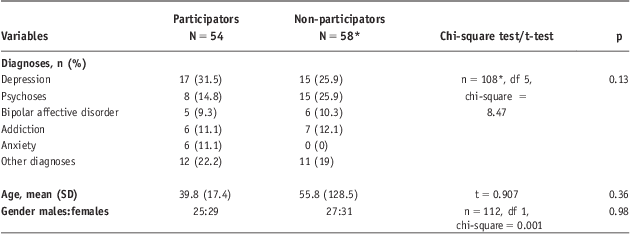
During the data collection period, 112 patients who were discharged from psychiatric observation and intensive in-patient care fulfilled the inclusion criteria for the study. Fifty-four (48%) of these patients consented to participate in the study, 29 (54%) females and 25 (46%) males. There were no significant differences with respect to age at admission, gender or diagnostic groups between patients who consented to participate and those who declined to do so (Table 1).
Two-sample comparisons on chi-square-tests and t-test: participators vs non-participators
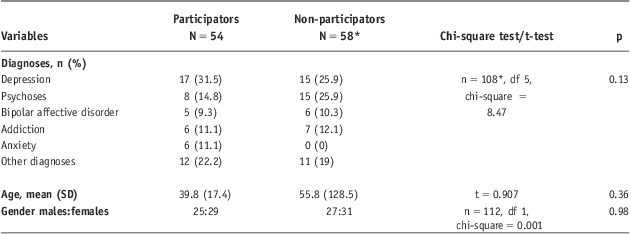
*Four patients in the group of non-participators were lacking information about diagnoses
Among the participants, age ranged from 19 to 82 years. About half of the participants were living alone, 22 (76%) of the females and 9 (36%) of the males. The education levels of the patients were as follows: primary education 13 (24%) secondary education 31 (57%) and university education 10 (19%). Eighteen (33%) of the patients were in employment and 5 (9%) were students. The remaining patients were unemployed or unable to work due to sickness or because they were pensioners. Forty-nine patients (91%) were of Swedish nationality.
Thirty-nine (72%) patients were admitted voluntarily and the remaining patients were treated involuntarily for acute psychiatric reasons. The majority of patients (n = 44, 81%), were admitted to the psychiatric observation and intensive in-patient care from the psychiatric emergency department, some patients (n = 7, 13%), came from other psychiatric units and a few (n = 2, 4%), came directly from home. The most prevalent diagnosis was depression, (n = 17, 31%), followed by psychosis (n = 8, 15%) and addiction (n = 6, 11%). Other reasons for admission were bipolar affective disorder, anxiety, aggressive behaviour, contemplation of suicide, suicide attempts or self-injury behaviour. Eighteen (33%) of the patients were admitted to a psychiatric unit for the first time. Twenty-four (44%) of the patients were not aware of their diagnosis.
Measurement
The instrument Quality in Psychiatric Care – In-Patient (QPC-IP)
Data on patients’ ratings of quality of care were collected using the QPC-IP instrument, which is designed to measure quality of care from the patient's perspective (Schröder et al. Reference Schröder, Wilde Larsson and Ahlström2007). The instrument was developed from a phenomenographic interview study with in- and out-patients (Schröder et al. Reference Schröder, Ahlström and Wilde Larsson2006). It has been psychometrically tested showing that it is psychometrically adequate (Schröder et al. Reference Schröder, Wilde Larsson, Ahlström and Lundqvist2010).
The QPC-IP consists of 30 items designed to measure 6 dimensions: Encounter (8 items; e.g. ‘the staff treated me with warmth and consideration’), Participation (8 items; e.g. ‘I was involved in deciding about my care’), Discharge (4 items; e.g. ‘I was offered a follow-up after discharge’), Support (4 items; e.g. ‘the staff helped me to understand that feelings of guilt and shame must never prevent me from seeking care’), Secluded Environment (3 items; e.g. ‘I had access to a place that was private where I could withdraw when I wanted to be left in peace and quiet’) and Secure Environment (3 items; e.g. ‘I was secure together with my fellow patients’).
Each item is related to the statement ‘I experienced that…’. A four-point Likert-type scale was used, extending from 1 (totally disagree) to 4 (totally agree). In the case of all items there was also the possibility of answering ‘Not applicable’. The instrument also contained a number of background questions about demography and general clinical characteristics, and an open question inviting any other views on quality of care.
Administrative research protocol
An administrative research protocol developed for this study by the researchers (TB & AS) included information about admission, reasons for admission and psychiatric diagnosis according to ICD-10 criteria. Notes were made in the protocol about care provided during treatment; e.g. having a somatic consultation, seeing a doctor, having prescription of medication, having support talk, suicide-risk assessment, incidence of compulsory treatments and also information about discharge.
Statistical analysis
Data were analysed using SPSS for Windows version 17. Non-parametric tests (chi-square tests) were used for categorical data. Data were dichotomized into patients perceiving the quality of care as either high or low in the six dimensions. High quality was defined as patients having a mean score higher than 2.5 which is the centre of the rating scale (Schröder et al. Reference Schröder, Wilde Larsson, Ahlström and Lundqvist2010). Two-sample independent t-tests were used for parametric data. The significance level was set at p < 0.05 in all analyses.
Results
Clinical characteristics
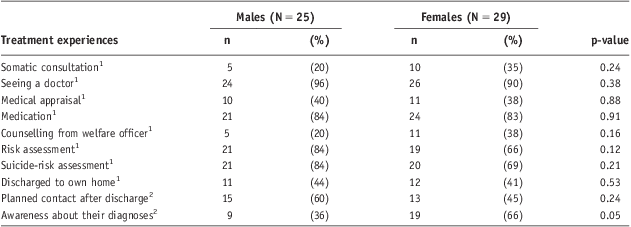
Treatment and care given during the stay at the psychiatric observation and intensive in-patient care units are illustrated divided by gender in Table 2. No significant differences were found by gender.
Number of patients with each treatment experience, divided by gender with results of chi-square tests
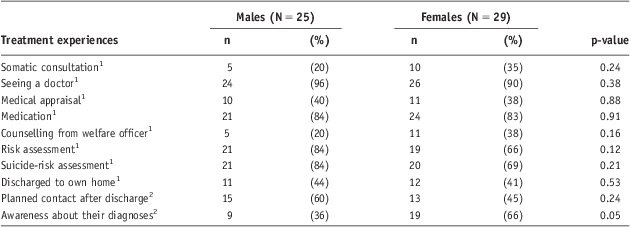
1Data from the administrative research protocol
2Data from the QPC-IP
Patients’ ratings of the quality of care
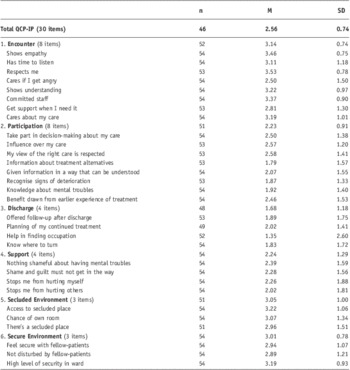
Patients rated the overall quality of care as high, with a mean value for the QPC-IP total score of 2.56. The six dimensions of the QCP-IP that mirror important aspects of the quality of psychiatric care varied between 1.35 and 3.53 for the total sample. Highest ratings were found regarding the dimension Encounter, in particular on the item ‘the staff respect my ability and show empathy’. Lowest ratings were found concerning the dimension Discharge, especially on the items referring to ‘opportunity to receive help to find an occupation’ and ‘received information about where to go if they needed help following discharge’ (Table 3).
Mean and standard deviations for the total QCP-IP score, each dimension of the QCP-IP and for each item

When patients were dichotomized into two groups depending on the mean value for each dimension of the QPC-IP, a total of 23 out of 46 (50%) patients with complete data were classified as perceiving the quality of care as high. The lowest (< 2.5) rating of quality of care was most common in the dimension Participation (n = 26), followed by Discharge (n = 21), Support (n = 20), Secure Environment (n = 14), Secluded Environment (n = 12) and Encounter (n = 9) dimensions.
Demographic factors
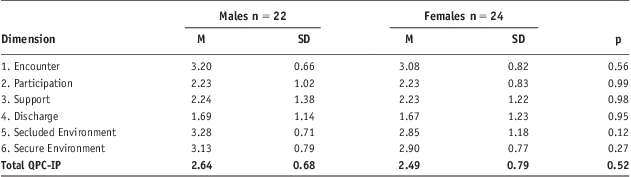
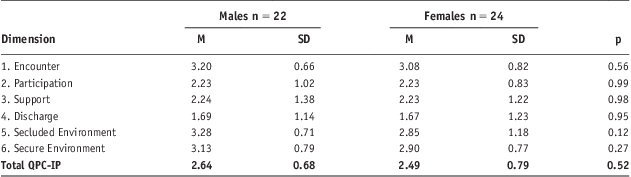
Independent t-tests showed no significant differences between males and females in their mean ratings on dimensions of quality of care (Table 4); neither were any significant differences found due to educational level, nationality, occupational status or age group in any of the QPC-IP dimensions. However, males living alone rated the quality of care significantly lower (p = 0.03) in the dimension Discharge in comparison with males living with a partner.
Dimensions of QPC-IP (mean and standard deviation) by gender of patients in psychiatric care; p-value for independent t-test
Treatment interventions and experiences
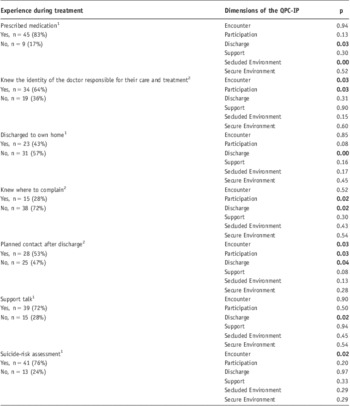
Patients received different treatment interventions during their stay in the psychiatric observation and intensive in-patient care. However, none of the patients in the study group experienced any coercive measure. In order to explore the patients’ ratings of quality of care in relation to treatment interventions, patients were divided into groups (i.e. received or not received each intervention). Thereafter, a t-test was computed to compare the groups’ mean-ratings of quality of care per dimension of the QPC-IP. Results showed that patients who received a prescription of medication, had a planned contact after treatment, were discharged to their homes, knew the identity of the doctor responsible for their care and treatment, knew where to complain or had a supportive talk, rated significantly higher quality of care. One exception was for patients who received suicide-risk assessments, since those rated significantly lower quality of care regarding the encounter with staff. For detailed information see Table 5.
Experiences during treatment in relation to satisfaction with quality of care per dimension of the QPC- IP; p-value for t-test

1Data from the administrative research protocol
2Data from the QPC-IP
Discussion
In this sample of patients treated in psychiatric observation and intensive in-patient care we found that patients’ experiences during care considerably influenced their judgments of the quality of care. Only half of the patients rated the quality of care as high in this study. An interesting finding is that patients’ in our observation and intensive psychiatric care units rated the quality of care lower than those in other in-patient care studies (Greenwood et al. Reference Greenwood, Key, Burns, Bristow and Sedgwick1999; Schröder et al. Reference Schröder, Wilde Larsson, Ahlström and Lundqvist2010). Some previous studies have found diagnosis to be associated with lower level of satisfaction or quality of care, especially the diagnosis of schizophrenia or other psychosis (Lebow, Reference Lebow1982; Perreault et al. Reference Perreault, Rogers, Leichner and Sabourin1996), whilst in other studies no such relationship has emerged (Greenwood et al. Reference Greenwood, Key, Burns, Bristow and Sedgwick1999; Lebow, Reference Lebow1983). However, in our study we found no differences in the ratings of quality of care between diagnostic groups.
The patients rated the quality highest in the dimension Encounter. However, the dimension Discharge received the lowest ratings. This seems to differ from other studies using the QPC-IP instrument (Schröder et al. Reference Schröder, Wilde Larsson and Ahlström2007, Reference Schröder, Wilde Larsson, Ahlström and Lundqvist2010) and in other psychiatric in-patient studies (Bjørngaard et al. Reference Bjørngaard, Ruud, Garrat and Hatling2007; Siponen & Välimäki, Reference Siponen and Välimäki2003) where patients often rated lowest quality in items regarding participation and information. Another study emphasised the importance of knowing where to turn or the worth of being offered a follow up after discharge (Schröder et al. Reference Schröder, Ahlström and Wilde Larsson2006). Therefore staff should focus on patients needs in discharge planning and offer an out-patient appointment to prevent re-hospitalisation (Nelson el al. 2000). Nelson et al. (Reference Nelson, Maruish and Axler2000) found that patients who are discharged without an out-patient follow up were twice as likely to be re-hospitalised then those who made at least one out-patient appointment in the same year. However, it appears that we need an overall quality improvement in this area with patients receiving more information about their discharge and being offered a follow up appointment. Quality improvement calls for several related actions, for example, developing guidelines, improving clinical practice and changing the processes of care if necessary (Grol, Reference Grol1996).
As seen in this study and others, demographic factors such as habitation, educational level, nationality, occupational status, gender or age group have only a minor impact on patients’ general ratings of quality of care (Cleary et al. Reference Cleary, Edgeman-Levitan, McMullen and Delbanco1992; Hiidenhovi et al. Reference Hiidenhovi, Nojonen and Laippala2002; Thapinta et al. Reference Thapinta, Anders, Wiwatkunupakan, Kitsumban and Vadtanapong2004). The only impact identified was that males who lived alone rated items regarding discharge significantly higher than those who lived together with a partner.
It is surprising that 44% of the patients lack awareness of their own diagnosis, particularly males. This is an interesting finding since patients have the right to information irrespective of gender (Swedish Code of Statutes, (SFS) 1982:763). Earlier research has shown that patients wish to have information and knowledge about their diagnosis (Schröder et al. Reference Schröder, Ahlström and Wilde Larsson2006) and an admission may be made with the aim of making a diagnosis (Sederer & Summergrad, Reference Sederer and Summergrad1993). It may be that the patients in this study had been given this information, but one must bear in mind that patients’ mental illness may limit their ability to comprehend the information (Kilkku et al. Reference Kilkku, Munnukka and Lehtinen2003). For this reason, information should be adapted to the patients’ conditions (Perreault et al. Reference Perreault, Rogers, Leichner and Sabourin1996), and it should also be adequate, as is emphasised in the literature (Johansson et al. Reference Johansson, Oléni and Fridlund2002).
The results of this study verify the importance of patients knowing who their doctor is and also knowing where to complain after treatment; patients who had this knowledge rated their quality of care as high significantly more often. However, it is surprising that patients who had a suicide-risk assessment, rated lower quality regarding encounters with staff. It is important in the psychiatric care to ask about and document patients’ suicidal thoughts and acts (Hirschfeld & Russell, Reference Hirschfeld and Russell1997), but one most bear in mind the patients’ vulnerability and the disadvantageous position they are in. It also seems surprising that not all patients in this study received a suicide-risk assessment. Hirschfeld & Russell (Reference Hirschfeld and Russell1997) found that physicians may be afraid to ask patients about suicide, because such questions can encourage suicidal thoughts and acts. However, it is not known why not all patients in this study were given a suicide-risk assessment.
One of the most interesting results is that it was the circumstances around the treatment episode rather than the actual content of care that was crucial in how patient rated the quality of care: having a prescription of medication, being discharged to their own home, having planned contact after treatment, knowing where to complain and having a support talk.
Strengths and limitations
This study has strengths and limitations. Our sample is small due to a low response rate, which limits the statistical power to detect differences between groups and to generalise the findings. However, a low response rate seems to be typical for studies regarding quality of care within psychiatric in-patient care (Hansson, Reference Hansson1989; Schröder et al. Reference Schröder, Wilde Larsson, Ahlström and Lundqvist2010) and satisfaction in psychiatric intensive care (Wykes & Carroll, Reference Wykes and Carroll1993). And yet, those who respond contribute important information.
Since the patients included in the study did not significantly differ from those who declined participation regarding diagnostic group, sex or age, the sample can be regarded as representative for the population treated in the psychiatric observation and intensive in-patient units. However, most of the patients were admitted voluntarily and the most common diagnosis was depression, which contrasts with other studies in intensive in-patient care (cf. Pereira et al. Reference Pereira, Sarsam, Bhui and Paton2005; Wynaden et al. Reference Wynaden, McGowan, Chapman, Castle, Lau and Headford and Finn2001). This has implications for confidence in the generalisation of these results.
Clinical implications
Our results show the benefit of listening to severely ill patients and their experiences of being treated in psychiatric observation and intensive in-patient care in order to improve the quality of care. The use of the QPC-IP instrument, constructed from the patients’ perspective, gives valuable information for quality improvement in the psychiatric observation and intensive in-patient care, for care staff and decision-makers, in the planning and improvements of the care. There are no extraordinary skills required of the clinician for the patient to feel that the care is of high quality. Patients ask for clear information, participation in their own care, prescription of medication as well as the assurance that they will have a follow-up contact after discharge. In other words, what they require is a professional attitude, by which all staff show that they look after the patients’ interests.
Future research should seek to involve more patients and to ensure that those who have experienced coercive measures also participate.