Introduction
The nature of tinnitus is heterogeneous and is described as ringing, buzzing, clicking, hissing, roaring, humming or pulsing.Reference Baguley, McFerran and Hall1 The impact varies considerably in severity, ranging from mild to very bothersome.Reference Gopinath, McMahon, Rochtchina, Karpa and Mitchell2,Reference Bhatt, Lin and Bhattacharyya3 Severe, persistent tinnitus commonly involves comorbidities such as sleep disturbance, anxiety or depression, which may substantially affect the patients’ quality of life.Reference Nondahl, Cruickshanks, Dalton, Klein, Klein and Schubert4–Reference Pattyn, Van Den Eede, Vanneste, Cassiers, Veltman and Van De Heyning7 Curative treatment for tinnitus is not available at present,Reference McFerran, Stockdale, Holme, Large and Baguley8 and current treatment approaches involve counselling and sound therapy.Reference Cima, Mazurek, Haider, Kikidis, Lapira and Norena9
Understanding the prevalence of a condition in a defined population is important for the improvement of health and prevention of that condition.Reference Møller, Møller, Langguth, De Ridder and Kleinjung10 Tinnitus is a frequent symptom in the developed world, though methodological issues mean that epidemiological studies report a wide range of prevalence in adults extending from 5.1 to 42.7 per cent.Reference McCormack, Edmondson-Jones, Somerset and Hall11 The reported prevalence of tinnitus is strongly influenced by the wording and context of the question asked,Reference McCormack, Edmondson-Jones, Somerset and Hall11 and populations outside the USA and Europe are under-represented in the literature. A body of literature regarding the prevalence of tinnitus in China exists but is only available in Chinese and thus has hitherto been inaccessible to English-speaking researchers. This study results from a collaboration between Chinese and English tinnitus researchers seeking to bridge that gap.
The aim of the present study was to identify reports, the majority of which were in Chinese, of the prevalence of tinnitus in China and to present these findings in a review format. Given the variety of published prevalence estimates in China, we assessed and collated published prevalence estimates of tinnitus and tinnitus severity creating a narrative synthesis of the data. The variability between prevalence estimates was investigated in order to determine any barriers to data synthesis and to identify reasons for heterogeneity.
Materials and methods
Eligibility criteria
We included studies reporting human participants in mainland China. All studies were required to report the prevalence of tinnitus. Publications in the Chinese simplified language were collected. Case-control studies, case reports, review papers and Chinese medicine treatment studies were excluded.
Search strategy
A total of three Chinese electronic databases (CNKI, VIP, WANFANG)Reference Xia, Wright and Adams12 and four English electronic databases (PubMed, Medline, PsychINFO and Web of Science) were searched on 6 December 2019. A search strategy was carefully specified to capture all potentially eligible records relating to tinnitus prevalence. The Chinese literature was searched using Chinese keywords which were translated into English, and the search strategy was ‘tinnitus AND (epidemiology OR epidemiology OR population OR incidence)’. The English language electronic databases were searched using a strategy that consisted of a combination of MeSH terms and relevant text words including: prevalence, tinnitus and China. A detailed search strategy is given in Table 1 in the supplementary material, available on The Journal of Laryngology & Otology website.
Summary of total cases of tinnitus in female and male populations from 11 studies

Study selection and data extraction
Titles and abstracts of the search results were screened using an iterative approach by two native Chinese speaking researchers (D Zhang and Q Xu), and non-relevant records were excluded. Any disagreements on texts for inclusion were reviewed by an independent researcher (DM Baguley) with a translated abstract. Full texts for those eligible for full-text screening were then retrieved and screened independently by two researchers (D Zhang and Q Xu). An additional researcher was consulted to resolve any disagreements (DM Baguley). A data extraction form was created using Microsoft Excel® spread sheet software and piloted using two records before finalising for full data extraction. The final data items included for data extraction were: author, year of study, publication categories, sample size, age, gender, recruitment or publication source, study design method, inclusion and exclusion criteria, study period, location, question or definition of tinnitus or severity, prevalence data, and accompanying symptoms (e.g. positive otological pathology or hearing loss).
Results
Search results
After the Chinese electronic research databases were searched, a total of 2181 articles were detected in 3 databases. According to the topic, abstract and full-text screening, 22 articles were selected for inclusion. A search of English language databases found a total of 1184 articles in 4 databases. Following the topic, abstract and full-text screening, one additional article was selected for inclusion. Therefore, a total of 23 studies were included in the review.Reference Huang, Yu, Liu, Gao, Yang and Gu13–Reference Liu, Wang, Hong and Zhongshan35
Study characteristics
The main purpose of the majority of the studies (18 of 23) was to assess the prevalence of tinnitus. The epidemiology of hearing loss, the association between tinnitus and noise, or obstructive sleep apnoea hypopnea syndrome, or systemic diseases such as hypertension and diabetes were investigated by five other studies. Most of the studies were from economically developed regions (Beijing, Jiangsu and Guangdong)Reference Zhuo, Wang, Piao, Ma, Zhai and He36 or populous provinces (Sichuan, Shaanxi, Henan and Liaoning), followed by Ningxia and Xinjiang, which are located in the western region of China. However, there are no data on the prevalence of tinnitus in other regions of China. Study characteristics of the included studies are detailed in Table 2 in the supplementary material, available on The Journal of Laryngology & Otology website.
Prevalence of tinnitus reported for different age groups

Prevalence
In order to comprehensively understand the current situation of tinnitus prevalence in mainland China, as many studies as possible were collected on the prevalence of tinnitus. In these surveys, the prevalence of total tinnitus ranged from 4.3 to 51.33 per cent. The prevalence of tinnitus also ranged from 4.3 to 51.33 per cent in 11 studies which used the definition ‘tinnitus lasted for more than five minutes’. The prevalence ranged from 7.8 to 34 per cent after excluding 5 studies with ear or systemic diseases.Reference Liu, Pei, Gong, Guo and An17,Reference Liang, Qu, Quan, Yang and Yu21,Reference Chen32,Reference Liu, Li, Zhang, Lu and Yang33,Reference Liu, Wang, Hong and Zhongshan35 The prevalence of tinnitus ranged from 7.8 to 30.4 per cent in 9 studies of the general population of all age groups.Reference Zhu14,Reference Xu16,Reference He, Shang, Cheng and Zhao23–Reference Lu, Tan, Hou, Wu and Tang28,Reference Yang, Cai, Guo, Xiong, Sun and Huang34
Gender
After 2 studiesReference Liu, Li, Zhang, Lu and Yang33,Reference Liu, Wang, Hong and Zhongshan35 from hospital populations were excluded, 14 of the 23 publications reported prevalence of tinnitus in female and male populations separately (Figure 1).Reference Zhu14–Reference Xu16,Reference Zhang and Li19,Reference Li, Qiu, Qiu, Xu, Chen and Wang20,Reference Li, Tang and Yu22–Reference Lu, Tan, Hou, Wu and Tang28,Reference Ding31,Reference Yang, Cai, Guo, Xiong, Sun and Huang34
Reported gender differences in the prevalence of tinnitus in China from 14 studies. *Studies that reported only percentages.

The prevalence of tinnitus for females ranged from 5.4 to 34.5 per cent and from 3.2 to 29.9 per cent for males. Significant differences by gender in tinnitus prevalence were observed in seven studies. Six of these studies showed that the prevalence of females was higher than males and only one study reported the opposite result. While 3 of these only reported prevalence in percentages, 11 presented the number of tinnitus cases in the population studied.Reference Zhu14–Reference Xu16,Reference Zhang and Li19,Reference Li, Tang and Yu22–Reference Lu, Yang, Lu and Tang27,Reference Ding31 By pooling these numbers together, the overall prevalence in each gender was calculated: for females it was 15.25 per cent and for males it was 13.66 per cent (Table 1). From these results, an independent samples t-test showed that there was no significant effect of gender on tinnitus prevalence (p = 0.58).
The reported prevalence of tinnitus is much lower in studies of teenagers (females: 5.38 to 6.10 per cent; males: 3.23 to 3.50 per cent)Reference Zhang and Li19,Reference Li, Qiu, Qiu, Xu, Chen and Wang20 and young adult populations (females: 8.44 per cent; males: 8.18 per cent)Reference Ding31 than the other studies that involved adults or the population in general. The reported prevalence is also much higher in the study of elderly populations (females: 29.06 to 29.92 per cent; males 28.31 to 29.28 per cent).Reference Xu, Bu, Xing, Zhou, Liu and Wang15,Reference Li, Tang and Yu22
Age
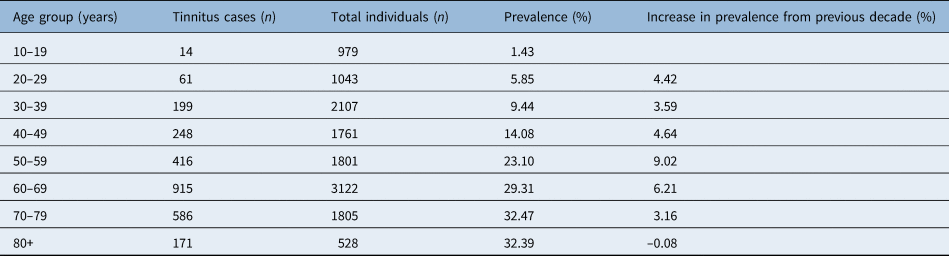
The prevalence of tinnitus in different age groups was presented in 15 studiesReference Huang, Yu, Liu, Gao, Yang and Gu13–Reference Xu16,Reference Li, Tang and Yu22–Reference Lu, Yang, Lu and Tang27,Reference Liu, Liu, Ding, Yang, Zhu and Zhai29,Reference Ding31,Reference Liu, Li, Zhang, Lu and Yang33–Reference Liu, Wang, Hong and Zhongshan35 (in Table 3 in the supplementary material, available on The Journal of Laryngology & Otology website). Six of these used the same or similar age ranges in their reports,Reference Huang, Yu, Liu, Gao, Yang and Gu13,Reference Xu16,Reference Li, Tang and Yu22,Reference Hong, Liu and Liu25,Reference Hong, Liu and Liu26 (one with transient tinnitus excludedReference Yang, Cai, Guo, Xiong, Sun and Huang34). The data from five studiesReference Huang, Yu, Liu, Gao, Yang and Gu13,Reference Xu16,Reference Li, Tang and Yu22,Reference Hong, Liu and Liu25,Reference Hong, Liu and Liu26 were pooled to evaluate the variation in different age groups (Table 2).
Severity classification across different studies

The combined data show a trend of increase in tinnitus prevalence with age in China (Figure 2). The highest increase in prevalence from the previous decade in age occurs during the fifth and sixth decades. The prevalence seems to plateau at around 32 per cent. In one of the included studies,Reference Yang, Cai, Guo, Xiong, Sun and Huang34 the percentage of prevalence in different age groups is reported without the actual number of cases and the group sizes given, so their result is plotted separately. In this particular study, the trend of increasing prevalence with age is clear, but the prevalence recorded is much lower (Figure 2).
Prevalence of tinnitus in China reported by age.

Definitions of tinnitus and tinnitus severity
Definitions of tinnitus
There was a wide variation in the definition of tinnitus used (detailed in Table 4 in the supplementary material, available on The Journal of Laryngology & Otology website). Most studies used the definition or diagnosis of ‘tinnitus or sound perceived in the ear or skull that is non-pulsatile, distinguishable from external sounds and lasts for five minutes or more’ (11 of 23). Four of the 12 studies had the same question in their questionnaire: ‘In the past 12 months or 1 year, have you been bothered by ringing, roaring, or buzzing in your ears or head that lasts for five minutes or more?’ In 1 study,Reference Chen32 tinnitus was defined as ‘lasting for more than 1 minute’ and anotherReference Hong, Liu and Liu26 used the definition ‘continuous tinnitus: lasts for 5 minutes or more, and transient tinnitus: lasts less than 5 minutes’. There were no clear definitions of tinnitus, or references to definitions in the other 10 studies.
Reported tinnitus prevalence in different patient groups

Severity of tinnitus
The severity of tinnitus was reported in seven studies, with one studyReference Li, Tang and Yu22 merely reporting ‘intolerable tinnitus’ at 11.30 per cent (66 out of 584). There were seven defined severity classifications being used across the other six publicationsReference Zhu14,Reference Xu16,Reference Zhang and Li19,Reference He, Shang, Cheng and Zhao23,Reference Lu, Tan, Hou, Wu and Tang28,Reference Han, Ma, Wu, Lin, Jing and Yu30 ; two studiesReference Zhu14,Reference Lu, Tan, Hou, Wu and Tang28 shared the same definition and one studyReference Lu, Tan, Hou, Wu and Tang28 applied an additional classification using a visual analogue scale.
In order to provide an overall evaluation of severity, the different classifications were converted into a unified broad classification that was reported by two of the studies (Table 3).Reference Zhu14,Reference Lu, Tan, Hou, Wu and Tang28 There were 6580 tinnitus cases classified in 6 studies; 4573 reported mild tinnitus (69.50 per cent), 1512 reported moderate tinnitus (22.98 per cent) and 561 reported severe tinnitus (7.52 per cent).
Lateralisation
There were nine studies that looked at the lateralisation of reported tinnitusReference Zhu14–Reference Xu16,Reference Zhang and Li19,Reference Li, Tang and Yu22,Reference He, Shang, Cheng and Zhao23,Reference Hong, Liu and Liu25,Reference Lu, Tan, Hou, Wu and Tang28,Reference Ding31 . All but oneReference Zhu14 showed a high prevalence of bilateral tinnitus (Figure 3). The data from the nine studies were pooled to evaluate lateralisation in the tinnitus population. Overall, there were 7632 reported tinnitus cases, of which 4084 presented with bilateral tinnitus (53.51 per cent), 1744 presented with left ear tinnitus (22.85 per cent) and 1804 with right ear tinnitus (23.64 per cent).
Reported lateralisation of tinnitus from 10 studies.

Risk factors and comorbidities
There were 18 studies that reported on the statistical analysis of the risk factors related to tinnitusReference Zhu14–Reference Xu16,Reference Zhang and Li19,Reference Li, Qiu, Qiu, Xu, Chen and Wang20,Reference Li, Tang and Yu22–Reference Lu, Tan, Hou, Wu and Tang28,Reference Han, Ma, Wu, Lin, Jing and Yu30–Reference Liu, Wang, Hong and Zhongshan35 (detailed in Table 5 in the supplementary material, available on The Journal of Laryngology & Otology website). Gender and age have been described above. Five of the 18 studies reported that hearing loss was related to tinnitus,Reference Xu16,Reference Han, Ma, Wu, Lin, Jing and Yu30,Reference Liu, Li, Zhang, Lu and Yang33–Reference Liu, Wang, Hong and Zhongshan35 3 of the 18 studies reported otological comorbidity was related to tinnitusReference Xu16,Reference Zhang and Li19,Reference Yang, Cai, Guo, Xiong, Sun and Huang34 and 3 of the 18 studies reported that noise exposure was related to tinnitus.Reference Xu16,Reference Zhang and Li19,Reference Lu, Yang, Lu and Tang27 The prevalence difference for tinnitus between urban and rural areas was shown in four studiesReference Xu, Bu, Xing, Zhou, Liu and Wang15,Reference Xu16,Reference Yin, Ma, Liu and Wang24,Reference Yang, Cai, Guo, Xiong, Sun and Huang34 ; two of the four studies showed that the prevalence of tinnitus was higher in urban than in the rural areas,Reference Yin, Ma, Liu and Wang24,Reference Yang, Cai, Guo, Xiong, Sun and Huang34 but the other two studies showed higher prevalence in the rural than in the urban areas.Reference Xu, Bu, Xing, Zhou, Liu and Wang15,Reference Xu16 Three studies reported that hypertension and diabetes were associated with tinnitus.Reference Hong, Liu and Liu25,Reference Chen32,Reference Yang, Cai, Guo, Xiong, Sun and Huang34 Two studies reported that heavy physical labour was associated with tinnitus,Reference Zhu14,Reference He, Shang, Cheng and Zhao23 and two studies reported that poor sleep was associated with tinnitus.Reference Zhang and Li19,Reference Lu, Yang, Lu and Tang27 There were also individual reports of operator (factory) work, education, being overweight, hyperlipidaemia and computer use time being related to tinnitus.
In comparison to the general population, the prevalence of tinnitus is significantly higher in those with systemic diseasesReference Liang, Qu, Quan, Yang and Yu21,Reference Liu, Li, Zhang, Lu and Yang33,Reference Liu, Wang, Hong and Zhongshan35 and otological comorbidityReference Liu, Pei, Gong, Guo and An17 (Table 4). A Mann–Whitney U test was conducted to compare the prevalence of tinnitus in the general population and those with a comorbidity. There was a significant effect of comorbid disorder on tinnitus prevalence (Mann–Whitney U test (n1 = 4; n2 = 19) = 13.00, z = –2.02, p = .043), such that tinnitus prevalence was significantly higher in those with a comorbid systemic disease.
Hearing loss in tinnitus cases was reported in five studies; three of them were from general populationsReference Huang, Yu, Liu, Gao, Yang and Gu13,Reference Zhu14,Reference He, Shang, Cheng and Zhao23 and two were from hospital ENT and chronic kidney disease clinics.Reference Liu, Pei, Gong, Guo and An17,Reference Liang, Qu, Quan, Yang and Yu21 When the general population studies were combined, it showed that 42.20 per cent (2825 of 6695) of tinnitus cases had hearing loss, and the combined clinical studies showed that 61.33 per cent (295 of 481) of ENT and chronic kidney disease patients who had tinnitus also had a hearing loss.
Diagnoses of otological conditions accompanying tinnitus were reported in 2 large community studies which had a total of 38 120 participants when combined.Reference Zhu14,Reference He, Shang, Cheng and Zhao23 Altogether, there were 5261 tinnitus cases identified and 50.66 per cent (2665 of 5261) of these had additional aetiology (Figure 4).
Graph shows otological conditions within 5261 cases of tinnitus from two Chinese population studies.

Discussion
This study outlined the sample collection, survey methods, definition, and data of tinnitus prevalence and severity in 23 Chinese studies and discussed how this literature reports the prevalence of tinnitus by age and gender.
The wide variability of methods, index questions and sample characteristics in the studies analysed prevents the ability to combine data and perform meta-analysis. The factors discussed in the following section are of note.
Study populations from different age groups
In 9 studies of similar general populations including all ages, the prevalence of tinnitus ranged from 7.8 to 30.4 per cent, consistent with the variability of global prevalence of tinnitus reported by McCormack et al (2016),Reference McCormack, Edmondson-Jones, Somerset and Hall11 which estimates the prevalence to be from 5.1 to 42.7 per cent. When data were extracted from the 4 studies in which populations were elderly,Reference Huang, Yu, Liu, Gao, Yang and Gu13,Reference Xu, Bu, Xing, Zhou, Liu and Wang15,Reference Li, Tang and Yu22,Reference Han, Ma, Wu, Lin, Jing and Yu30 it showed that the prevalence of tinnitus was 28.7 to 51.3 per cent, which was significantly higher than the prevalence in the general population. The prevalence of tinnitus from 3 studies of middle-school student populations,Reference Gao, Huang, Yang, Liu, Chang and Chen18–Reference Li, Qiu, Qiu, Xu, Chen and Wang20 which ranged from 4.3 to 13.4 per cent, was lower than the prevalence of the general population. There is a trend for prevalence of tinnitus to increase with age from the combined data and the highest increase in prevalence from previous decade in age occurs during the fifth and sixth decades.
Tinnitus prevalence and systemic diseases or otological comorbidity
In China, the prevalence of tinnitus is substantially higher in those with systemic diseasesReference Liang, Qu, Quan, Yang and Yu21,Reference Liu, Li, Zhang, Lu and Yang33,Reference Liu, Wang, Hong and Zhongshan35 than in the general population. However, a recent study on the epidemiology of tinnitus in the UK showed that cardiovascular comorbidities, including hypertension, were not associated with the risk of being diagnosed with tinnitus, and analysis of those diagnosed with diabetes mellitus showed a decreased adjusted odds ratio of 0.85.Reference Stohler, Reinau, Jick, Bodmer and Meier37 Another study from populations of Asian Americans showed hypertension or diabetes mellitus were not associated with tinnitus prevalence.Reference Choi, Yu, Voelker, Doherty, Oghalai and Fisher38 The sample size in the 3 studies of patients with systemic diseasesReference Liang, Qu, Quan, Yang and Yu21,Reference Liu, Li, Zhang, Lu and Yang33,Reference Liu, Wang, Hong and Zhongshan35 ranged from 115 to 255, and the prevalence ranged from 38.6 per cent to 51.6 per cent.
Otological comorbidity was associated with a higher risk of being diagnosed with tinnitus.Reference Stohler, Reinau, Jick, Bodmer and Meier37,Reference Baguley, Andersson, McKenna and McFerran39 When the general population studies were combined, it showed that 42.2 per cent of tinnitus patients had hearing loss, while the combined clinical studies showed that 61.3 per cent of ENT and chronic kidney disease patients who had tinnitus also had hearing loss. Hearing assessments in five studies were made by pure tone audiometry, tuning fork tests or whispered words.Reference Huang, Yu, Liu, Gao, Yang and Gu13,Reference Zhu14,Reference Liu, Pei, Gong, Guo and An17,Reference Liang, Qu, Quan, Yang and Yu21,Reference He, Shang, Cheng and Zhao23 Pure tone audiometry was used to evaluate hearing loss in two studies.Reference Liu, Pei, Gong, Guo and An17,Reference Liang, Qu, Quan, Yang and Yu21 Tuning fork tests or whispered words were used in one studyReference Huang, Yu, Liu, Gao, Yang and Gu13 but hearing loss criteria were unclear in these cases.
Definition of tinnitus and severity
Nearly half of the studies (11 of 23) used the definition ‘tinnitus lasts for five minutes or more’. This is consistent with the most common type of definition identified in global data by McCormack et al.Reference McCormack, Edmondson-Jones, Somerset and Hall11 There are different definitions, no clear definitions of tinnitus or no references in the other 12 studies. Although seven studies reported the severity of tinnitus, the methods used to evaluate tinnitus severity in the research studies reviewed varied widely. Therefore, it was not feasible to combine data and perform meta-analysis. The formulation of standard Chinese questions to define tinnitus and tinnitus severity would be beneficial for future epidemiological research.
The stated purpose of most studies was to explore the risk factors for tinnitus. In terms of gender, six studies showed that the prevalence in women was higher than in men, and one study showed that prevalence in men was higher than in women, unlike the report of McCormack et al.,Reference McCormack, Edmondson-Jones, Somerset and Hall11 which reports a higher prevalence of tinnitus in males than in females.Reference McCormack, Edmondson-Jones, Somerset and Hall11 In addition, other risk factors like hearing loss, otological disease, noise exposure, poor sleep and general conditions are associated with tinnitus.Reference Baguley, Andersson, McKenna and McFerran39 Four studies have reported the differences in tinnitus prevalence between urban and rural areas. Many influencing factors, such as education, economy and medical conditions may affect the prevalence of tinnitus between urban and rural areas. The present data are equivocal regarding differences in prevalence between urban and rural populations.
Limitations
In terms of the publication dates of the identified studies, these were mainly concentrated in the 15 years between 2003 and 2018, and there are 10 studies between 2017 and 2018, accounting for nearly half of the published literature. This indicates that research interest in tinnitus has grown in recent years in China. However, the studies only investigated the tinnitus epidemiological situation in 9 regions, and the total sample size was n = 72 361, which does not represent the national situation in China. If the regional scope and sample size were expanded in future surveys, the data would be more reliable and other insights might be gleaned. Additionally, the prevalence of tinnitus in Hong Kong, Macau and Taiwan was not within the scope of the present study because the medical system, lifestyle and literature publication methods of these regions were considered to be substantially different to those in mainland China.
Conclusion
In this study, the prevalence of tinnitus in mainland China was seen to be consistent with global data. This study reports that the prevalence of tinnitus increases with increasing age but was not statistically different by gender. Otological comorbidity, hearing loss, noise exposure and poor sleep are associated with the risk of developing tinnitus. With increasing awareness of the prevalence of tinnitus in China, the development of epidemiological standards is a priority, as are studies with larger numbers and greater geographical reach.
Supplementary material
The supplementary material for this article can be found at https://doi.org/10.1017/S002221512000256X.
Acknowledgements
David Baguley and Charlotte Caimino are supported by the UK National Institute for Health Research. Their views are their own and do not reflect those of the National Institute for Health Research nor the UK Department of Health and Social Care. This article presents independent research funded by the National Institute for Health Research Nottingham Biomedical Research Centre, International education training funding from School of International Education at Nanjing Medical University and Jiangsu Province Youth Medical Talents Plan Program (grant number: QNRC2016679 to Zhang Dawei).
Competing interests
None declared