INTRODUCTION
Porpita porpita (Linnaeus, Reference Linnaeus1758), commonly known as the blue button, is a colonial anthoathecate Hydrozoa belonging to the family Porpitidae Goldfuss, 1818. The species was established by Linnaeus (Reference Linnaeus1758) as Medusa porpita. Various nominal species under the genus Porpita Lamarck, 1801 have been proposed, but all are now considered synonyms of a single circumglobal species, Porpita porpita (Calder, Reference Calder1988; Schuchert, Reference Schuchert2013).
Porpita has an imperceptible sting for humans (Gershwin et al., Reference Gershwin, Zeidler and Davie2010). Recently the species has been found to contain bioactive compounds having antimicrobial effect (Fredrick & Ravichandran, Reference Fredrick and Ravichandran2010).
Although P. porpita is a well-known species, efforts made for previous records from Pakistan, failed. Studies comprising hydrozoans of Pakistan include: Haque (Reference Haque1977); Moazzam & Moazzam (Reference Moazzam and Moazzam2006); and Ali-Khan & Shehnaz (Reference Ali-Khan and Shehnaz2001a, Reference Ali-Khan and Shehnazb). The first two provide hydroid records, while the remaining report on Siphonophora of the region, none of them reported P. porpita. In an intertidal faunal study (Kazmi & Naushaba, Reference Kazmi and Naushaba2004) at Clifton, Karachi, blue buttons are documented (as ‘porpitas’). It is concluded that specimens have been sighted at shores in the past; however they may be overlooked or not considered taxonomically.
MATERIALS AND METHODS
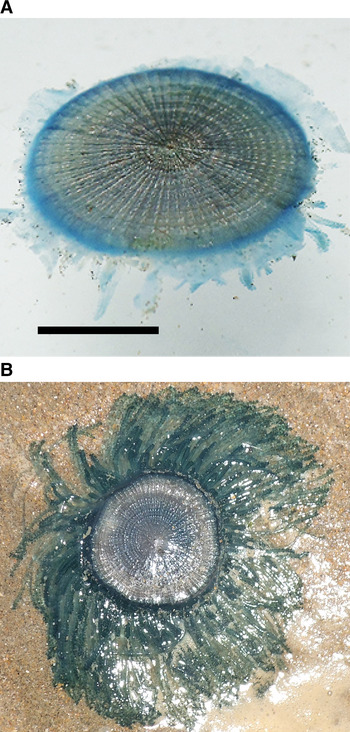
During monsoon, on 30 July 2013 (summer) six specimens of Porpita porpita (Linnaeus, Reference Linnaeus1758) (Figure 1A) were collected on the shore of Clifton (24°48′59″N 67°02′04″E). They were observed stranded along with several specimens of Physalia. However, one specimen (Figure 1B) was found on 28 November 2012 at Manora (24°47′25″N 66°58′47″E). These are two localities on the Karachi coast of Pakistan. All material (MZD/CN-12) was collected by hand, photographed and preserved in 4% formaldehyde solution. The specimens were housed in the Museum of Zoology Department (MZD) Jamia Millia Government Degree College Malir, Karachi, Pakistan.
Porpita porpita (Linnaeus, Reference Linnaeus1758) from the Karachi coast of Pakistan: (A) specimen from Clifton (photographed in Petri dish). Scale bar = 25 mm; (B) stranded specimen at Manora.

RESULTS
SYSTEMATICS
Class HYDROZOA Owen, 1843
Order ANTHOATHECATA Cornelius, 1992
Suborder CAPITATA Kühn, 1913
Family PORPITIDAE Goldfuss, 1818
Genus Porpita Lamarck, 1801
Porpita porpita (Linnaeus, Reference Linnaeus1758)
(Figure 1 A, B)
MATERIAL EXAMINED
MZD/CN-12, disc width 22–25 mm; 1 specimen, Manora, 28 November 2012; 6 specimens, Clifton, 30 July 2013.
DESCRIPTION
The animal is a round, floating hydroid colony having a large, gas-filled flat disc provided with a prominent central pore and numerous minute pores or stigmata in rows radiating from the centre, giving a specific pattern to the upper surface. The lower side of the disc has a small, central gastrozooid with a terminal mouth and is surrounded by many gonozooids, and dactylozooids towards periphery. Tentacles are present only on dactylozooids. These tentacles are short, capitate and are arranged in three longitudinal rows, distally on each dactylozooid. A sail is absent. For a recent comprehensive re-description of the species see Schuchert (Reference Schuchert2010).
DISCUSSION
Many researchers have pointed out the co-occurrence of P. porpita on the shore with other pelagic forms. Kirkendale & Calder (Reference Kirkendale and Calder2003) mentioned that, on the east coast of Guam (West Pacific), the species was usually carried to the shore by strong winds in association with Janthina, Physalia and Glaucus. Fisner et al. (Reference Fisner, Maÿal, Medeiros and de Freitas2008) observed the species stranded at the shore of Pernambuco (north-east Brazil) together with Physalia. Noble (Reference Noble1963) noticed an interesting relationship between P. porpita and a fish, Carangoides malabaricus (= Caranx malabaricus Bloch & Schneider, 1801). The fish searched for shelter under this colonial hydrozoan and in captivity, was in distress when separated from Porpita.
Porpita porpita is a pleustonic, open ocean species distributed in tropical and temperate seas; the type locality is the Indian Ocean (as ‘Habitat in India’ by Linnaeus, Reference Linnaeus1758: 659; see also Calder, Reference Calder1988; Kirkendale & Calder, Reference Kirkendale and Calder2003). It has been reported from various localities in the Atlantic and Indo-Pacific Oceans, and the Mediterranean Sea (Chun, Reference Chun1897; Moser, Reference Moser1925; Totton, Reference Totton1954; Brinckmann-Voss, Reference Brinckmann-Voss1970; Daniel, Reference Daniel1979; Bouillon, Reference Bouillon1984; Pagès et al., Reference Pagès, Gili and Bouillon1992; Medel & López-González, Reference Medel and Lopéz-González1996; Schuchert, Reference Schuchert1996; Zhang, Reference Zhang1999; Wirtz & Debelius, Reference Wirtz and Debelius2003; Bouillon et al., Reference Bouillon, Medel, Pagès, Gili, Boero and Gravili2004; Kubota, Reference Kubota2004; Kubota & Tanase, Reference Kubota and Tanase2007; Fisner et al., Reference Fisner, Maÿal, Medeiros and de Freitas2008; Gravili et al., Reference Gravili, Boero and Licandro2008). A few recent records from eastern Arabian Sea (west coast of India) include Apte et al. (Reference Apte, Bhave, Pitale, Nagale and Prasade2012) and a report by CMFRI (2010).
Very recently, P. porpita has been reported in large numbers along the coastline of the Sea of Japan, in the northern region (Kubota & Tanase, Reference Kubota and Tanase2007 as P. pacifica). The sudden northward drift (observed also for other species, such as Eugymnanthea japonica Yamada, 1950, Eutima japonica Uchida, 1925 and Nemopilema nomurai (Kishinouye, 1922) increase this species around Japan, perhaps due to higher water temperature resulting from global warming (Oiso et al., Reference Oiso, Fukai, Ishii, Ohgushi and Kubota2005). Edwards & Richardson (Reference Edwards and Richardson2004) and Richardson & Schoeman (Reference Richardson and Schoeman2004) have discovered a northward shift of plankton species by global warming, predicting a change in the spatial distribution of pelagic production. Therefore, further studies will clarify the ecological role of P. porpita in the success of fish recruitment through the competition with fish predating on their prey (i.e. zooplanktonic crustacea), and probable feeding also on fish larvae and eggs.
ACKNOWLEDGEMENTS
We are deeply indebted to Dr Dale R. Calder (Royal Ontario Museum, Toronto, Canada) for critically evaluating the previous versions of the manuscript. Thanks to Mrs Qaseem Tahera and Ms Razia Naushaba (MRCRC University of Karachi) for helpful comments on the present status of Porpita in Pakistan.