





Introduction
Turkey has been one of the leading cases of democratic backsliding and has experienced some of the most significant autocratization between 2013 and 2023 (Nord et al. Reference Nord, Lundstedt, Altman, Angiolillo, Borella, Fernandez, Gastaldi, Good God, Natsika and Lindberg2024; Papada et al. Reference Papada, Altman, Angiolillo, Gastaldi, Köhler, Lundstedt, Natsika, Nord, Sato, Wiebrecht and Lindberg2023). The most critical episode in this decade occurred between 2016 and 2018, beginning with the failed coup attempt on July 15, 2016. While the failed coup attempt of July 15 was not a successful case of regime overthrow, it marked a visible rupture in Turkey’s political trajectory and provided the ruling elite with the justification to initiate a sweeping reconfiguration of state institutions. In this respect, the Turkish case echoes Bermeo’s (Reference Bermeo2016) observation that dramatic coups are increasingly giving way to subtler, legalistic forms of democratic erosion, particularly what she calls “executive aggrandizement,” where elected executives deliberately weaken checks and balances under a veneer of legality. The post-coup period in Turkey was governed under a state of emergency, during which thirty-seven decree-laws (Kanun Hükmünde Kararnameler; KHKs) were issued, enabling the executive to bypass normal legislative procedures and concentrate power in the presidency. This two-year period of emergency rule culminated in the transition from a parliamentary to an autocratic hyper-presidential system.
As argued elsewhere, the decree-law regime facilitated the transfer and personalization of sovereignty under President Recep Tayyip Erdoğan (Salmanoğ Reference Salmanoğ2026a). Building on that constitutional interpretation, this article contributes to the literature on autocratization by focusing on a crucial but underexplored question: how is executive aggrandizement institutionally implemented? While scholars have increasingly recognized executive aggrandizement as a key mechanism of democratic backsliding, characterized by the expansion of executive authority and the hollowing out of checks and balances (Bermeo Reference Bermeo2016; Haggard and Kaufman Reference Haggard and Kaufman2021; Levitsky and Ziblatt Reference Levitsky and Ziblatt2018), there is limited research on the legal and administrative instruments through which this process unfolds (Ginsburg and Huq Reference Ginsburg and Huq2018; Scheppele Reference Scheppele2018; Varol Reference Varol2015). One such instrument is the state of emergency, which has become a common pathway for democratic erosion (Lührmann and Rooney Reference Lührmann and Rooney2021). This article builds on that insight by analyzing how emergency powers, in the form of decree-laws, were used in Turkey not just as temporary security tools, but as mechanisms of permanent institutional transformation.
Drawing on qualitative content analysis of all thirty-seven decree-laws issued during the state of emergency, this study examines the institutional logic and political effects of these legal instruments. The analysis reveals that decree-laws functioned as tools of structural transformation, enabling the government to bypass judicial and parliamentary oversight, marginalize dissent, distort electoral and bureaucratic norms, and ultimately transfer power to the presidency.
It is important to clarify that this study does not claim that KHKs issued between 2016 and 2018 were the sole or deterministic cause of autocratization in Turkey. Rather, it examines how these instruments were strategically utilized to facilitate and accelerate the institutionalization of autocratic executive power. The analysis shows how KHKs offered a highly efficient and legally sanctioned mechanism for implementing autocratic consolidation.
To interpret these developments, the article draws on three interrelated theoretical frameworks: populism; competitive authoritarianism; and neo-patrimonialism, which together illuminate the stages and strategies of executive empowerment. It identifies three phases of autocratization: (1) the shifting of power through marginalization and ideological polarization; (2) the entrenchment of power through the distortion of political competition and electoral integrity; and (3) the transfer of power to a single individual by dismantling bureaucratic constraints and institutionalizing personal rule.
Theoretical framework
Bermeo (Reference Bermeo2016) argues that executive aggrandizement as contemporary democratic erosion rarely occurs through overt regime change, such as military coups, but instead through more incremental and legalistic means. To explain how decree-laws institutionalized executive aggrandizement, this article combines three analytical frameworks: populism; competitive authoritarianism; and neo-patrimonialism. Each captures a distinct mechanism and stage through which executive authority was concentrated following the failed 2016 coup attempt.
Populism, conceptualized as a “thin-centered ideology” that divides society between the virtuous people and the corrupt elite (Mudde and Kaltwasser Reference Mudde and Kaltwasser2017), helps illuminate the government’s efforts to delegitimize dissent and justify the restructuring of state institutions through moral binaries. In the Turkish context, a growing body of scholarship has examined the populist character of President Erdoğan’s political strategy. Scholars have highlighted how Erdoğan constructs a dichotomy between the “pure people” and “corrupt elites,” presenting himself as the embodiment of national will while undermining opposition actors and institutions (Aytaç and Elçi Reference Aytaç, Elçi and Stockemer2019; Dinçşahin Reference Dinçşahin2012; Elçi Reference Elçi2019). Others have situated Erdoğan’s populism in comparative perspective (Aytaç and Öniş Reference Aytaç and Öniş2014), or connected it to Turkey’s broader authoritarian trajectory (Castaldo Reference Castaldo2018; Taşkın Reference Taşkın and Tezcür2020). Building on these insights, this article focuses on how populist logic was not only articulated discursively but also institutionalized through decree-laws, transforming the ideological divisions between “friend–enemy” and “pure people–corrupt elites” into concrete legal categories with real political consequences.
Competitive authoritarianism provides the second lens. In this model, formal democratic institutions, such as elections and legislatures, exist but are routinely manipulated to favor incumbents (Levitsky and Way Reference Levitsky and Way2002, Reference Levitsky and Way2010, Reference Levitsky and Way2020). Although some criticize the use of this framework in Turkey (e.g. Arslantaş and Kaiser Reference Arslantaş and Kaiser2023), other scholars of Turkish politics have increasingly adopted this framework to describe the country’s post-2010 regime trajectory. Esen and Gümüşçü (Reference Esen and Gümüşçü2016) argue that Turkey transitioned from electoral democracy to competitive authoritarianism, citing the growing imbalance between ruling and opposition parties. Özbudun (Reference Özbudun2015) and Somer (Reference Somer2016) analyze the judiciary’s instrumentalization and the degradation of democratic norms, while Castaldo (Reference Castaldo2018) ties these dynamics to Erdoğan’s populist authoritarianism. Based on this body of literature, this study uses the competitive authoritarianism framework to identify specific mechanisms through which decree-laws undermined electoral integrity, distorted political competition, and restricted opposition access to legislative procedures.
The third framework, neo-patrimonialism, explains the personalization of state authority under the guise of formal institutions. Originally developed by Max Weber in 1921 (see Weber Reference Weber1978) and later extended by Eisenstadt (Reference Eisenstadt1973) and Erdmann and Engel (Reference Erdmann and Engel2006), neo-patrimonialism refers to systems where legal–rational bureaucracy coexists with informal networks of loyalty, clientelism, and personalized control. In Turkey, several scholars have examined how the Justice and Development Party (Adalet ve Kalkınma Partisi; AKP) increasingly blurred the boundary between state and party, replacing meritocratic governance with loyalty-based appointments and consolidating resource control in the presidency (Bektas Reference Bektas2025; Cengiz Reference Cengiz2020). Uğur-Çınar (Reference Uğur-Çınar2017) and Coşar and Yeğenoğlu (Reference Coşar and Yeğenoğlu2011) explore how patrimonial logics also shape gender and family policy, while Kanadıkırık (Reference Kanadıkırık2019) compares Turkey’s patrimonial legacy with Russia’s. This article applies the concept of neo-patrimonialism to show how bureaucratic procedures were dismantled and authority was centralized in the figure of the President, with decree-laws used to bypass hierarchies, override ministries, and appoint loyalists across key institutions.
These three frameworks are not treated as competing regime typologies but as heuristic tools that capture different phases of Turkey’s institutional transformation. Populism explains the ideological justification through securitization for executive dominance, competitive authoritarianism highlights the strategic manipulation of democratic institutions, and neo-patrimonialism reveals how formal governance structures were reengineered for personalized rule. This multi-framework approach builds on and extends prior scholarship that Turkey’s regime transformation cannot be fully grasped through a single lens and instead requires a composite theoretical approach that captures the regime’s ideological, institutional, and structural complexity (Salmanoğ Reference Salmanoğ and Kubicek2025).
By integrating these approaches, the article shifts attention from regime outcomes to the legal–institutional mechanisms through which executive aggrandizement is enacted. It demonstrates how decree-laws can restructure state institutions and embed autocratic power under legal cover.
Methodology
Executive decrees as instruments of power
The role of executive decree-making has been widely debated in the comparative politics literature, particularly in studies of presidentialism and executive–legislative relations (Carey and Shugart Reference Carey and Shugart1998; Negretto Reference Negretto2004; Palanza Reference Palanza2019). These studies often focus on formal authority, institutional design, and the legal frameworks that allow executives to bypass legislatures. While useful for understanding variation in institutional setups, this literature generally treats decree-making as a technical or procedural feature of governance rather than a mechanism of political transformation.
In Turkey, decree-laws represent the highest form of executive decree-making authority prior to the 2018 constitutional amendments, after which they were replaced by presidential decrees. First introduced in 1971, decree-laws have always reflected the tension between executive efficiency and democratic oversight. Despite their inherently political nature, most studies of decree-laws in Turkey have emerged from constitutional law, with a focus on executive authority, delegation, and judicial review. Early works such as Teziç (Reference Teziç1972) examined legislative delegation, while Tan (Reference Tan1995) critiqued the overuse of decree authority and the weakness of parliamentary control. Gözler (Reference Gözler2000) provided a detailed conceptual and procedural analysis of the KHK mechanism, framing it within the Turkish constitutional tradition.
Following the declaration of the state of emergency in July 2016, a wave of scholarship addressed the emergency decree-laws (Olağanüstü Hal Kanun Hükmünde Kararnameleri; OHAL-KHKs), with particular attention to their scope, oversight, and implications for the rule of law. The Venice Commission (2016) expressed serious concerns about human rights violations and urged that such decrees be strictly limited to issues directly related to the emergency itself. Legal scholars such as Can and Şimşek-Aktaş (Reference Can and Şimşek-Aktaş2017) criticized the Constitutional Court for refusing to review OHAL-KHKs, calling this refusal a constitutional abdication. Aslan (Reference Aslan2019) traced the broader judicial shift toward reinforcing executive dominance. Tuncel and Demirhan (Reference Tuncel and Demirhan2018) explored the administrative and institutional consequences of emergency decrees, while Akça et al. (Reference Akça, Algül, Dinçer, Keleşoğlu and Özden2018) systematically classified the content of thirty-seven decree-laws and twelve presidential decrees, though their study offered only limited interpretation of the political logic behind them.
This study departs from these primarily legal–constitutional approaches. While those studies have provided valuable assessments of legality, judicial control, and procedural conformity, they often treat decree-laws as exceptional legal instruments or abuses of formal authority. By contrast, this study treats the KHKs not merely as legal acts, but as strategic political tools used to restructure the state and institutionalize executive aggrandizement. In doing so, this study builds on a small but growing body of literature that treats decree authority as a mechanism of autocratization, particularly in periods of emergency. This analysis treats KHKs as more than reactive measures or temporary tools. They are understood here as constitutive instruments of authoritarian statecraft, legal in form, but political in purpose.
Research design and analytical strategy
This study employs qualitative content analysis of all thirty-seven decree-laws issued between July 2016 and July 2018: thirty-two OHAL-KHKs containing 1,217 articles and five ordinary decree-laws (Olağan Kanun Hükmünde Kararnameler; O-KHKs) comprising 566 articles, enacted during the transition to the presidential system. OHAL-KHKs derive directly from constitutional emergency authority, whereas O-KHKs are based on parliamentary delegation within an enabling law (Gözler Reference Gözler2000). The primary unit of analysis is the individual article (madde), as each article constitutes a distinct legal intervention.
The full texts were retrieved from the Official Gazette. They were analyzed using a latent content analysis approach (Bengtsson Reference Bengtsson2016), which considers both the explicit legal content of decree provisions and the underlying political logic embedded within the texts. Article-level coding allows the analysis to capture fine-grained institutional changes, which are subsequently aggregated to the decree-law level to identify each decree’s dominant political–institutional functions.
A deductive coding strategy was applied, informed by the three theoretical frameworks introduced earlier. The analysis classifies provisions along two dimensions. First, decree-laws are distinguished according to their formal–legal classification, separating OHAL-KHKs issued under the state of emergency from O-KHKs enacted under parliamentary delegation. Second, provisions are classified according to their thematic–analytic focus, that is, the type of legal intervention they enact (e.g. purges, appointments, institutional subordination, or authority transfers), and are linked to distinct mechanisms of executive aggrandizement (see Figure 1). This two-dimensional classification enables a direct bridge between theory and legal text.
Typological and theoretical classification of decree-laws (Kanun Hükmünde Kararnameler; KHKs) (2016–2018). The figure distinguishes decree-laws by their formal–legal regime (emergency decree-laws [Olağanüstü Hal Kanun Hükmünde Kararnameleri; OHAL-KHKs] vs. ordinary decree-laws [Olağan Kanun Hükmünde Kararnameler; O-KHKs]) and maps their substantive legal interventions onto three analytically distinct stages of autocratization.
Source: The figure was prepared by the author

Coding proceeded in three stages. First, all articles were assigned a preliminary code corresponding to one of the three autocratization stages and their mechanisms. Second, borderline cases were reviewed through coding memos to ensure consistent application of inclusion and exclusion rules. Third, article-level codes were aggregated to the decree-law level to identify the mechanisms enacted by each decree. Decrees were allowed to carry multiple codes, reflecting the expectation that they often combined populist, competitive–authoritarian, and neo-patrimonial interventions. Treating these mechanisms as analytically co-present enables the model to capture overlap and sequencing. Empirically, many OHAL-KHKs combine populist and competitive–authoritarian elements, whereas O-KHKs are predominantly associated with neo-patrimonial consolidation.
Each decree was examined for provisions reflecting one or more of the following logics:
-
(a) Populist power shifting: including ideological purges, the targeting of civil society through selective rewards and punishments, and the delegitimization of military elites;
-
(b) Competitive authoritarian entrenchment: including manipulation of electoral and local governance rules, distortion of the political playing field through media and financial controls, and the weakening of political pluralism;
-
(c) Neo-patrimonial consolidation: including the dissolution of institutional autonomy, centralization of appointment authority, and the personalization of executive power.
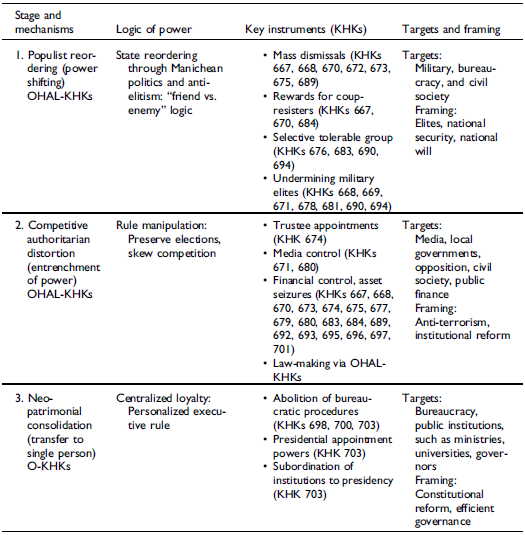
These codes are organized into a three-stage model of autocratization, summarized in Table 1, which links decree-law mechanisms to sequential phases of executive power concentration.
A three-stage model of autocratization via decree-laws (Kanun Hükmünde Kararnameler; KHKs) in Turkey (2016–2018)

Table 1 Long description
A table detailing a three-stage model of autocratization in Turkey from 2016 to 2018. The table has four columns: Stage and mechanisms, Logic of power, Key instruments (KHKs), and Targets and framing. It includes three rows for each stage: Populist reordering (power shifting), Competitive authoritarian distortion (entrenchment of power), and Neo-patrimonial consolidation (transfer to a single person). Each row describes the logic of power, key instruments, and targets and framing for that stage. The table lists specific KHKs and their targets, such as military, bureaucracy, civil society, media, and public finance.
Note: This table outlines the sequencing and logic of decree-law usage during Turkey’s post-coup autocratization process. It links each stage to corresponding legal mechanisms, political targets, and discursive frames. OHAL-KHKs, emergency decree-laws (Olağanüstü Hal Kanun Hükmünde Kararnameleri); O-KHKs, ordinary decree-laws (Olağan Kanun Hükmünde Kararnameler).
To ensure internal consistency and replicability, coding proceeded iteratively. An initial pilot on a subset of decrees refined category boundaries and inclusion rules, followed by a second review of ambiguous and multi-mechanism articles to guarantee consistent treatment across the corpus. Supplementary Appendix A provides the codebook; Supplementary Appendix B presents worked examples; Supplementary Appendix C reports decree-level coding summaries; Supplementary Appendix D offers additional illustrative article-level examples; and Supplementary Appendix E lists the analyzed corpus. Together, these materials document the coding logic and enable transparency and replication. Although later developments are occasionally referenced to illustrate the durability of decree-based changes, the empirical analysis is strictly limited to decree-laws issued between 2016 and 2018.
Power-shifting regulations: the populist logic of state reordering
The first dimension of institutional transformation enacted through the KHKs reflects a populist logic: the reordering of state and society along moral and ideological binaries. Specifically, the decree-laws operationalized Manichean politics by dividing the political field into “friends” and “enemies” through the punishment of perceived opponents, the rewarding of loyalists, and the selective toleration of ideologically non-oppositional groups. They also reflected populist anti-elitism by targeting the military as a historically autonomous elite and legitimizing its restructuring under the guise of restoring civilian control after the 2016 coup attempt. Together, these measures dismantled existing hierarchies and repopulated state institutions with ideologically aligned actors.
Manichean politics
Concretization of the “enemy”
The OHAL-KHKs enabled the government to concretize the abstract “enemy” evoked in populist discourse by institutionalizing punitive actions against individuals and organizations. Bypassing judicial procedures, the executive issued direct verdicts based on association rather than legal conviction.
KHK 667 (Article 2) authorized the closure of hundreds of institutions accused of affiliation with the Fethullahist Terrorist Organization (FETÖ),Footnote 1 and transferred their assets to the state. This marked the beginning of a mechanism in which association alone sufficed to justify purges. Subsequent decrees, including KHKs 668, 670, and 675, extended this logic to the civil service, education sector, and armed forces.
KHK 670 (Article 2) listed individuals dismissed from the military and police without trial. The same decree canceled their passports, revoked licenses and benefits, and enabled sharing of personal data, including that of spouses (Article 3). KHK 673 (Article 10) expanded this further by allowing the cancellation of spouses’ passports, applying collective punishment without legal process.
The definition of the enemy widened with KHK 672 (Article 2), which permitted dismissals based on National Security Council classifications. KHK 689 (Article 5) amended earlier decrees to include affiliation with “other terrorist organizations,” eliminating the previous focus on FETÖ. This enabled the targeting of broader opposition groups, including Academics for Peace,Footnote 2 who were dismissed allegedly for having links to the Kurdistan Workers’ Party (Partiya Karkerên Kurdistanê; PKK), despite having no connection to the coup or Gülenist networks. This situation led to hundreds of academics being imprisoned and losing their jobs; some of them were forced to leave the country because they were unable to carry out their research.
Through this process, KHKs legally enacted the populist logic of Manichean politics, transforming ideological opposition into institutional exclusion. By using executive authority to define and punish the “enemy,” the regime bypassed judicial safeguards, expanded repression beyond the coup’s perpetrators, and consolidated power through moral–political binaries.
Rewarding the “friend”
The other side of Manichean politics is the institutional rewarding of those deemed “friends” of the regime. While the KHKs were used to purge and punish perceived enemies, they also served to materially and symbolically reward loyalty, reinforcing a binary political order rooted in moral alignment rather than legal status or institutional merit.
A striking example appears in KHK 667 (Article 7), which grants pensions and compensation to civilians injured or killed during the coup attempt, or subsequent acts of terrorism. While nominally based on Law No. 3713 on Anti-Terrorism and Law No. 2330 on Cash Compensation and Pensions, the decree authorizes the executive to determine compensation amounts independently of those laws’ original formulas. Civilians injured in the events were entitled to compensation ranging from 115 to 170 times the highest civil servant salary, depending on the severity of injury (KHK 667, Article 7), while debts related to their health and pension insurance were canceled (KHK 670, Article 10).
The scope of these rewards is further expanded in KHK 670 (Article 9), which allows compensation for individuals who may not meet legal criteria for pension eligibility but are found to have contributed to “mitigating or eliminating” the coup attempt. These decisions are delegated to provincial governors and the Cash Compensation Commission of the Ministry of Interior, embedding significant discretionary power into the system. In addition to financial benefits, family members of these individuals may be appointed directly to public service positions, bypassing standard recruitment channels.
KHK 684 (Article 1) later amends Law No. 3713 to allow the payment of compensation to those who were injured but not classified as disabled, expanding the set of beneficiaries even further.
Taken together, these provisions demonstrate how KHKs not only punished the disloyal but institutionalized a system of executive patronage, rewarding ideological alignment and service to the regime. This disparity reinforces the populist moral order, in which the state operates according to a binary logic of loyalty and treachery, and in which the “friend” is elevated not through institutional norms but through political alignment.
The tolerable group
Beyond the binary categories of “friend” and “enemy,” the KHK regime institutionalized a third category: the tolerable group, actors not fully incorporated into the ruling coalition but not designated as enemies. This group includes individuals and sectors not actively aligned with the regime but not openly oppositional either. The defining principle of this category is clear: if one does not support the government, one must refrain from opposing it. This logic creates an atmosphere in which passivity and silence are politically rewarded, while dissent, even in latent form, is treated as a threat.
The tolerable group is codified through a range of legal amendments that condition access to public employment and professional advancement on ideological neutrality or silent compliance. For instance, KHK 676 amends Law No. 657 on Civil Servants to require security investigations during recruitment (Article 74) and introduces new grounds for dismissal, including aiding or propagating for terrorist organizations (Article 75).Footnote 3 These vague and expansive criteria undermine the principle of tenure and transform civil servants, traditionally protected from political interference, into subjects of ideological vetting. Even individuals with no intention of cooperating with the regime are effectively compelled to self-censor and depoliticize to maintain employment.
This logic extends into other sectors. In education, KHK 690 (Article 65) prevents the recognition of diplomas from foreign institutions affiliated with organizations deemed security threats. KHK 683 (Article 4) prohibits associate professorship appointments for applicants with such affiliations, while KHK 694 (Article 19) requires individuals seeking to operate or work in student dormitories to obtain a certificate from the Ministry of National Education confirming they have no ties to outlawed groups.
The creation of this gray zone of tolerable subjects serves two strategic functions. First, it recognizes that not everyone can or will become an active supporter of the regime. Second, and more importantly, it prioritizes the silencing of dissent over the cultivation of loyalty. The tolerable group is not incentivized to praise the government, but is disciplined into conformity through the threat of exclusion. The legal framework thus promotes a mode of governance in which quietism becomes a survival strategy, and active resistance is rendered too costly for most to pursue.
Anti-elitism
Civilian control over the military
A key pillar of the AKP’s post-coup transformation was reasserting civilian control over the military, Turkey’s most autonomous institutions for a long time. The KHKs provided legal instruments to restructure the chain of command, curtail the authority of the Chief of General Staff (Genelkurmay Başkanı; GKB), and dismantle mechanisms shielding the military from executive oversight.
KHK 681 (Article 3) amended Law No. 211 to insert civilian superiors into the chain of command, symbolically aligning the military with civilian authority. The structural core of this shift came via KHK 669 (Article 33), which removed the Force Commands from the GKB’s jurisdiction, placing them under the Ministry of National Defense and directly subordinating them to the President and Prime Minister (office abolished after July 2018, with executive authority transferred to the President) (Article 36). GKB appointment procedures were also altered to weaken internal continuity (KHK 671, Article 8). For instance, in 2023 Metin Gürak was appointed as the 31st Chief of General Staff; for the first time the Chief was not a force commander but the commander of the Second Army of Turkey.
Judicial and organizational autonomy was further eroded. Military courts were transferred to the Ministry of National Defense (KHK 668, Article 4),Footnote 4 and the Supreme Military Council’s composition shifted from military-led to civilian-dominated, with its convening and secretarial powers moved to civilian authorities (KHKs 668, 669). KHK 671 (Article 9) even removed the word “peace” from the GKB’s formal command definition, later softened in Parliament,Footnote 5 but still emblematic of reduced institutional stature.
Military education and healthcare systems under the GKB were dismantled. KHK 669 abolished military academies and high schools (Article 104), replacing them with a National Defense University under civilian leadership (Article 5), and transferred military health institutions to the Ministry of Health (Article 106). Command over military special forces, officer promotions, and administrative powers up to the rank of colonel were also reassigned to civilian ministries (KHKs 678, 681).
These reforms went far beyond emergency responses. They constituted a structural reordering of civil–military relations, subordinating the armed forces to executive ministries and eliminating the military as an independent power center within the Turkish state. Importantly, these changes to the military command structure and institutional oversight mechanisms were not reversed after the formal termination of the state of emergency in July 2018. The reconfigured chain of command, expanded civilian executive authority over promotions and appointments, and the subordination of military institutions to presidential control were incorporated into the post-2018 presidential system and preserved through subsequent presidential decrees (see Salmanoğ Reference Salmanoğ2026b).
Balancing the military with the police
Alongside restructuring the military hierarchy, the AKP sought to rebalance the state’s coercive apparatus by weakening the armed forces and empowering civilian-controlled police units. These reforms diluted the military’s monopoly over violence and built a parallel security infrastructure loyal to the executive.
A key step was the removal of the Gendarmerie and Coast Guard from the Turkish Armed Forces. Under KHK 668 (Articles 5–6), the Gendarmerie lost its military status and was placed fully under the Ministry of Interior. The Coast Guard, already under Interior Ministry control in peacetime, had its exceptional transfer to naval command made contingent on Council of Ministers (abolished following the transition to the presidential system and its all authority transferred to the President) approval, bypassing the General Staff (KHK 668, Article 23). These changes transferred substantial operational capacity from the military to executive authority.
Simultaneously, the national police force was strengthened. The bekçi (night watchman) system, defunct since the 1990s, was revived through KHK 690 (Article 26), initially adding 7,000 guards under Interior Ministry control. Although nominally auxiliary, they extended the state’s surveillance into daily life.Footnote 6
More significantly, KHK 694 (Article 13) elevated the Police Special Operations Unit from a directorate to a presidency and expanded its mandate. This elite force, instrumental in urban counterterrorism and deeply loyal to the regime, was rearmed with heavy guns and reinforced with 32,012 new personnel (KHK 694, Lists 1–2). As Minister of Interior Efkan Ala remarked, this rearmament reversed demilitarization efforts from the February 28 process, asserting police supremacy to deter future military coups (Cumhuriyet 2016).
Through these legal instruments, the AKP restructured coercive authority, shifting power from the historically autonomous military to civilian-led forces aligned with the presidency. The OHAL-KHKs enabled this transformation swiftly and unilaterally, consolidating executive control over the state’s repressive capacity.
Entrenchment of power: the competitive authoritarian logic of rule manipulation
While the previous section examined how decree-laws were used to reorder the political field and institutions through populist exclusion, this section focuses on how they served to entrench executive power by manipulating formal institutions of democratic competition. Drawing on the framework of competitive authoritarianism, this analysis shows how the AKP government used OHAL-KHKs not merely to suppress opposition, but to tilt the political playing field, weaken electoral safeguards, and limit avenues for horizontal or legal accountability. These mechanisms enabled the regime to maintain the appearance of democratic procedures while hollowing out their substance, converting the state of emergency into a framework for authoritarian durability under democratic guise.
Undermining electoral integrity
Local governments play a crucial role in party organization, the distribution of municipal resources, and the construction of clientelist networks. These networks are central to maintaining electoral strength, particularly at the grassroots level (Joppien Reference Joppien2018). In response to electoral losses in Kurdish-majority regions, the government introduced a major intervention through KHK 674, which fundamentally altered the governance of municipalities and weakened local democratic representation.
KHK 674 (Article 38) amended Articles 45 and 57 of Law No. 5393 on Municipalities, authorizing the Minister of Interior or appointed governors to suspend and replace elected mayors, deputy mayors, or council members who are under investigation or prosecution for terrorism-related charges. Crucially, this measure bypasses traditional judicial safeguards and circumvents electoral succession procedures. The power to suspend is vested in the Minister of Interior, a political office-holder, and does not require a finalized judicial verdict, only the initiation of an investigation or prosecution.
Moreover, KHK 674 removes the municipal council’s authority to elect a replacement when a mayor is removed. Instead, the central government appoints an external “trustee” (kayyım), thereby eliminating the possibility of opposition-majority councils maintaining democratic continuity.
KHK 674 (Articles 38–39) further expands central authority over local service provision. Whereas previous law required judicial authorization for gubernatorial intervention in municipal operations, the amended framework permits direct intervention if governors determine that municipal activity poses a risk to counterterrorism efforts. These provisions authorize the confiscation of municipal assets, suspension of personnel, and unilateral reassignment of service authority, substantially reducing local institutional autonomy.
The following discussion briefly contextualizes how these newly established legal powers were subsequently applied in practice. While the empirical implementation of trusteeships extends beyond the coded decree corpus, it illustrates the institutional implications of the legal changes introduced by KHK 674.
Since the enactment of the decree, the practice of appointing trustees has been extensively and strategically deployed across multiple election cycles. While originally concentrated in Kurdish-majority municipalities, by 2024, the policy had expanded to include Republican People’s Party (Cumhuriyet Halk Partisi; CHP)-run municipalities in western Turkey, signaling a broadening of executive intervention into opposition-held local governments more generally. Authorities have continued the pattern of allowing candidates with alleged links to terrorism to participate in elections, only to disqualify them after their electoral success, undermining both voter confidence and democratic competition.
By March 2025, trustees had been appointed to at least 155 municipalities (Çelik Reference Çelik2024; Independent Türkçe 2025). Recent negotiations between the pro-Kurdish Peoples’ Equality and Democracy Party (DEM Party) and the government over potential PKK disarmament have reopened debate on the policy’s legal basis and future. Regardless of possible reform, the trajectory thus far shows how emergency powers have been institutionalized in local governance, enabling the executive to override electoral outcomes through formally legal mechanisms.
Distortion of the political playing field
In competitive authoritarian regimes, incumbents manipulate the institutional environment to tilt electoral competition in their favor, while maintaining the formal appearance of democratic procedures. Rather than eliminating elections outright, such regimes rely on tools that distort the playing field, namely unequal access to media, selective control over financial and legal resources, and the erosion of institutional oversight, to consolidate power without overtly abandoning electoral legitimacy.
In Turkey, the OHAL-KHKs served as key instruments in this process. Under the guise of emergency governance, they enabled the AKP to restructure media regulation, centralize financial control, and bypass legislative constraints in ways that entrenched executive dominance. This section examines how the legal framework of the state of emergency was used to reshape the conditions of political competition and institutionalize advantages for the ruling party, while constraining the capacity of opposition forces to compete on equal terms.
Control over media
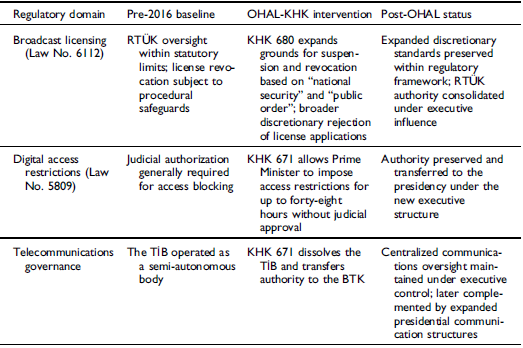
In competitive authoritarian regimes, the control of mass media is a critical mechanism for distorting electoral competition. While the AKP had already consolidated significant influence over mainstream media prior to the 2016 coup attempt, the post-coup OHAL-KHKs extended this control by providing the legal foundation for expanded censorship, licensing restrictions, and direct surveillance (see Table 2).
Media and network regulations

Table 2 Long description
A table comparing media and network regulations across three different time periods: Pre-2016 baseline, OHAL-KHK intervention, and Post-OHAL status. The table has four columns: Regulatory domain, Pre-2016 baseline, OHAL-KHK intervention, and Post-OHAL status. It includes three rows for different regulatory domains: Broadcast licensing, Digital access restrictions, and Telecommunications governance. Each row details the changes and interventions in these domains over the specified periods. For Broadcast licensing, the table shows the shift from RTÜK oversight to KHK 680 expanding grounds for suspension and revocation, and finally to expanded discretionary standards under RTÜK authority. For Digital access restrictions, it details the move from judicial authorization to KHK 671 allowing the Prime Minister to impose restrictions, and then to the authority being transferred to the presidency. For Telecommunications governance, it describes the transition from the TiB operating as a semi-autonomous body to KHK 671 dissolving the TiB and transferring authority to the BTK, culminating in centralized communications oversight under executive control.
Note: The table presents selected illustrative examples of media and network regulatory changes introduced through emergency decree-laws (Olağanüstü Hal Kanun Hükmünde Kararnameleri; OHAL-KHKs) and traces their institutional status after the formal termination of the state of emergency in July 2018. It focuses on structural reallocations of regulatory and oversight authority rather than the full range of media-related provisions enacted during the emergency period. RTÜK, Radio and Television Supreme Council (Radyo ve Televizyon Üst Kurulu); TİB, Presidency of Telecommunications and Communications (Telekomünikasyon İletişim Başkanlığı); BTK, Information and Communication Technologies Authority (Bilgi Teknolojileri ve İletişim Kurumu).
KHK 680 amended Law No. 6112 on broadcasting services, expanding the government’s ability to censor media on the grounds of national security. It introduced new penalties, including temporary suspension and license revocation, for violating broadcasting restrictions during exceptional periods (Article 17). The same decree extended restrictions into “normal times,” by authorizing the Radio and Television Supreme Council (Radyo ve Televizyon Üst Kurulu; RTÜK), dominated by pro-government appointees, to reject license applications based on vague criteria such as “national security” or “public order” (Article 19). These provisions allow the state to penalize critical media, deny licenses to potential opposition voices, and enforce ideological compliance.
KHK 671 further entrenched government control over digital communications by dissolving the Presidency of Telecommunications and Communications (Telekomünikasyon İletişim Başkanlığı; TİB) and transferring its authority to the Information and Communication Technologies Authority (Bilgi Teknolojileri ve İletişim Kurumu; BTK). This restructuring was accompanied by amendments to Law No. 5809 on Electronic Communications, granting the Prime Ministry, later the President, sweeping powers to act without judicial approval during emergencies. Under Articles 20, 24, and 25, the Prime Minister could implement security measures, including restrictions on access to digital platforms, for up to forty-eight hours without a judge’s ruling.
These powers have since been used repeatedly to disrupt access to social media by the President, especially during politically or socially sensitive events. For instance:
-
• Following the February 2020 airstrike in Idlib that killed thirty-three Turkish soldiers, Internet access was disrupted for over sixteen hours (BBC News Türkçe 2020).
-
• Bandwidth throttling was applied during the 2022 Taksim bombing (NetBlocks 2022) and again following the 2023 earthquakes, each time lasting over twelve hours (NetBlocks 2023).
These post-2018 instances are cited for illustrative purposes to demonstrate the durability of the legal authority introduced during OHAL and do not form part of the coded decree-law corpus analyzed in this study. While framed as emergency responses, such disruptions function as preemptive censorship tools, allowing the government to suppress critical narratives, limit public mobilization, and reinforce information asymmetry in favor of the ruling bloc.
Although introduced under emergency conditions, these regulatory expansions were not reversed following the termination of OHAL in July 2018. Instead, key elements of discretionary licensing authority, digital access control, and centralized communications oversight were absorbed into the institutional architecture of the presidential system. Subsequent presidential decrees further consolidated executive coordination over media and information governance, including through the expansion of the Presidency of Communications (İletişim Başkanlığı) (Salmanoğ Reference Salmanoğ2026b).
Control over financial resources
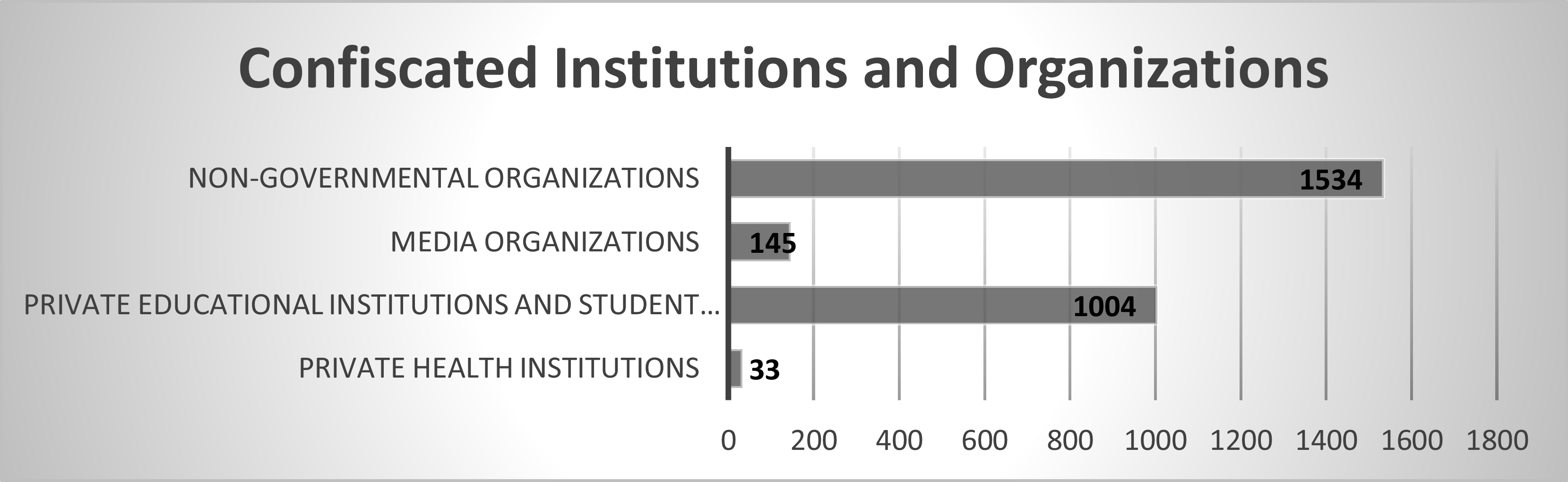
Financial control has been central to the AKP’s consolidation of power. Through OHAL-KHKs, the government not only eliminated opposition-linked wealth by closing institutions and organizations and confiscating their assets (see Figure 2), but also concentrated control over public financial resources in the presidency, creating new economic instruments shielded from oversight.
Confiscated institutions and organizations by type. The figure aggregates institutional closures and confiscations listed in the annexes of decree-laws (Kanun Hükmünde Kararnameler; KHK) Nos. 667, 668, 673, 675, 677, 679, 683, 689, 692, 693, 695, 697, and 701. Counts reflect the number of institutions explicitly enumerated in decree annexes and categorized by institutional type (non-governmental organizations, media organizations, private educational institutions and dormitories, and private health institutions). The data are based on decree-level listings rather than independent verification of institutional status.
Source: The figure was prepared by the author

KHKs 667, 668, and 670 authorized the liquidation of institutions allegedly affiliated with terrorist organizations, transferring their assets to the General Directorate of Foundations and the Treasury. KHK 674 (Article 19) extended this to private companies via the Savings Deposit Insurance Fund. As of July 2016, these measures facilitated the confiscation of over $32 billion in assets (Yildiz and Spencer Reference Yıldız and Spencer2020), effectively dismantling rival economic bases and enriching the state without transparent mechanisms.
The regime also used decree-laws to consolidate control over state resources and to circumvent institutional checks on executive spending. The creation of the Turkey Wealth Fund (TWF) through Law No. 6741 institutionalized a parallel financial structure directly controlled by the President and exempt from parliamentary or judicial oversight. KHK 680 (Articles 77, 82) transferred licenses for games of chance and horse racing to the TWF, which were then granted to Demirören Holding, a pro-government conglomerate. KHK 684 (Article 9) enabled further asset transfers from state-owned enterprises into the fund, deepening the executive’s unchecked fiscal power.
Some regulatory bodies were also dissolved to enhance ministerial control. KHK 696 (Articles 73, 81) abolished the Sugar Authority and the Tobacco and Alcohol Market Regulatory Authority, transferring their powers to ministries under political control. In the defense sector, KHK 696 created the Military Factory and Shipyard Management Corporation (Article 29) and placed the Defense Industries Undersecretariat directly under the President (Article 61). Demir (Reference Demir2020), the former head of the Undersecretariat, praises this change and describes it as a turning point, given that the defense industry is now directly affiliated with the President, the highest executive authority. KHK 696 also restructured the Turkish Armed Forces Foundation, placing the President at the head of its Board of Trustees (Article 65).
Together, these decrees restructured some of Turkey’s political economy, removing resources from independent or oppositional control and consolidating them under the presidency. In doing so, they transformed financial governance into a domain of executive patronage and strategic dominance, reinforcing authoritarian consolidation under legal cover.
OHAL-KHK as a law-making power
The government’s most far-reaching use of the state of emergency was to convert OHAL-KHKs into a substitute for law-making, enabling the executive to legislate unilaterally across nearly all policy areas. Although Article 121 of the then-Constitution allows the Council of Ministers to issue decree-laws during states of emergency, this power was originally intended to address temporary, emergency-related issues. In practice, however, the government used it to introduce permanent legal changes far beyond the boundaries of emergency governance.
Under earlier precedent, the Constitutional Court had reviewed and occasionally annulled OHAL-KHKs that exceeded their scope (Gözler Reference Gözler2000). Yet following the 2016 coup attempt, the Constitutional Court (E.2016/166 K.2016/159, November 4, 2016) adopted a non-interventionist stance, citing Article 148, which prohibits judicial review of legislation enacted by Parliament based on OHAL-KHKs. This interpretation effectively shielded the decrees from oversight and removed all domestic remedies for affected individuals.
To manage the expected wave of appeals, the government created the State of Emergency Inquiry Commission via KHK 685, assigning it jurisdiction over dismissals and sanctions issued under the decrees (Articles 2–3). However, its members were mostly government appointees, and its scope was limited to employment-related grievances, leaving the broader legislative use of OHAL-KHKs beyond review.
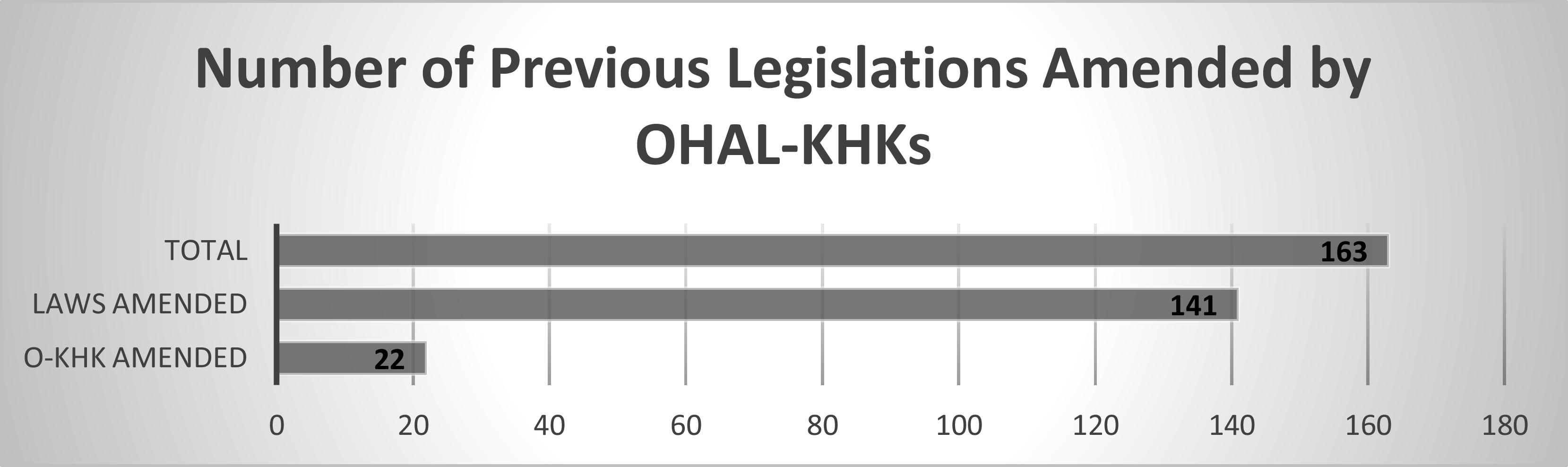
Between 2016 and 2018, the government issued thirty-two OHAL-KHKs, which amended at least one article of 163 existing pieces of legislation, including 141 laws and twenty-two ordinary decree-laws. Although formally justified as counterterrorism measures, the OHAL-KHKs extended far beyond security administration. In addition to securitization, civil–military restructuring, and interventions in local governance and media, they amended a wide range of statutes, often through seemingly technical provisions, in domains normally regulated by ordinary legislation.
For example, KHK 678 (Article 35) amended Law No. 6356 to expand the Council of Ministers’ authority to postpone strikes for up to sixty days on broad grounds such as public health, national security, urban transportation, or financial stability, thereby extending emergency law-making into labor relations and economic governance. Similarly, KHK 687 (Article 2) amended the Highway Traffic Law (No. 2918) by introducing mandatory winter tires and empowering the executive to adjust penalties. The inclusion of routine transportation regulation in an emergency decree illustrates how OHAL authority normalized exceptional law-making within everyday administrative governance. Figure 3 illustrates the scale of these interventions.
Number of legal provisions amended by emergency decree-laws (Olağanüstü Hal Kanun Hükmünde Kararnameler; OHAL-KHKs). The figure reports the number of distinct legislative instruments amended by the thirty-two OHAL-KHKs issued between July 2016 and July 2018, based on the full texts published in the Official Gazette. “Laws amended” refers to statutory laws (kanun), while “O-KHK amended” refers to previously issued ordinary decree-laws (Olağan Kanun Hükmünde Kararnameler) amended by OHAL-KHKs. The total reflects the aggregate number of unique legislative acts modified during the emergency period.
Source: The figure was prepared by the author

The permanent legal provisions that run counter to the nature of the OHAL-KHKs reveal that they serve as an instrument of authoritarian legalism, allowing the executive to bypass Parliament and entrench power through unreviewable legislative activity.
Transfer of power to the single person: the neo-patrimonial logic of presidential reconfiguration
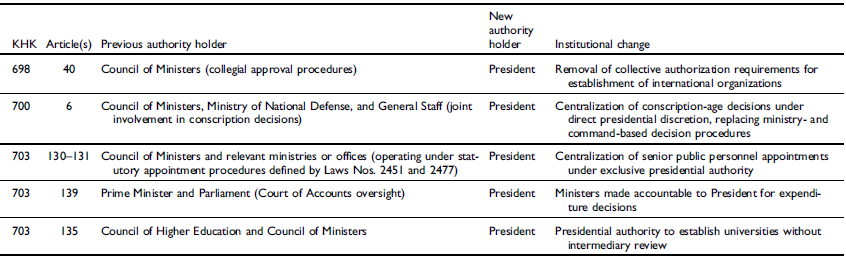
While earlier OHAL-KHKs enabled the government to suppress dissent and manipulate political competition, O-KHKs issued during the transition to the presidential system marked a decisive shift toward personalized rule. These decrees laid the institutional foundations for a new political order based on the authority of a single person after the constitutional amendment was approved but before it came into force. Through a series of O-KHKs, especially Nos. 698, 700, and 703 (see Table 3), the government dismantled core features of the parliamentary and bureaucratic state, replacing them with a structure that prioritizes direct executive command, centralized discretion, and personal loyalty.
Selected authority transfers under transitional ordinary decree-laws (Olağan Kanun Hükmünde Kararnameler; O-KHKs)

Table 3 Long description
A table detailing selected authority transfers under transitional decree-laws. The table has five rows and five columns. Column headers are KHK, Article(s), Previous authority holder, New authority holder, and Institutional change. Row 1: KHK 698 40, Previous authority holder Council of Ministers (collegial approval procedures), New authority holder President, Institutional change Removal of collective authorization requirements for establishment of international organizations. Row 2: KHK 700 6, Previous authority holder Council of Ministers, Ministry of National Defense, and General Staff (joint involvement in conscription decisions), New authority holder President, Institutional change Centralization of conscription-age decisions under direct presidential discretion, replacing ministry- and command-based decision procedures. Row 3: KHK 703 130-131, Previous authority holder Council of Ministers and relevant ministries or offices (operating under statutory appointment procedures defined by Laws Nos. 2451 and 2477), New authority holder President, Institutional change Centralization of senior public personnel appointments under exclusive presidential authority. Row 4: KHK 703 139, Previous authority holder Prime Minister and Parliament (Court of Accounts oversight), New authority holder President, Institutional change Ministers made accountable to President for expenditure decisions. Row 5: KHK 703 135, Previous authority holder Council of Higher Education and Council of Ministers, New authority holder President, Institutional change Presidential authority to establish universities without intermediary review.
Note: The table presents selected illustrative examples of authority transfers introduced by O-KHK Nos. 698, 700, and 703 during the shift from the parliamentary to the presidential system. It focuses on concrete reallocations of decision-making and oversight powers from collective or parliamentary bodies to the presidency. The examples are not exhaustive but highlight key institutional changes underpinning the personalization of executive authority.
This section analyzes these changes through the lens of neo-patrimonialism, showing how the presidency was recast as the central node of power, no longer constrained by law-bound institutional intermediaries, but sustained by a logic of personalized control.
Elimination of bureaucratic processes
One of the defining features of the O-KHKs issued during the regime transition is the systematic erosion of modern bureaucratic principles in favor of direct presidential authority. Modern bureaucracies operate through specialized offices arranged in a hierarchical structure, where each level is accountable to those above but cannot substitute for those below, ensuring both oversight and functional differentiation within legally defined boundaries (Weber Reference Weber1978, 957–958). By contrast, the O-KHKs centralize power in the presidency, allowing the President to bypass ministers, override institutional procedures, and directly command decisions previously made through collective or expert deliberation.
The presidential system, which was adopted with the 2017 constitutional amendments and came into effect immediately after the state of emergency, was made ready for implementation with KHKs 698, 700, and 703. These decrees transferred all functions of the Council of Ministers to the President, replacing every legal reference to the former with the latter. However, beyond this formal substitution, the decrees went further by collapsing the internal structure of bureaucratic governance and allowing the President to exercise the powers of subordinate offices.
For instance, KHK 698 (Article 40) amends Article 1 of Law No. 3335, which had required the approval of the Council of Ministers, based on proposals from the Ministries of Interior and Foreign Affairs, for the establishment of international organizations by natural or legal persons. This multi-step review process ensured inter-ministerial coordination and expert input. The amendment removes all procedural safeguards, granting the President unilateral authority to approve such organizations without consultation or oversight.
Similarly, KHK 700 (Article 6) amends Article 2 of Law No. 1111 on Military Service, which had required decisions about the conscription age to involve the Ministry of National Defense and the General Staff. The revised article allows the President to make such decisions directly, bypassing both the ministry and military command. These examples illustrate how the President not only inherits the authority of the Council of Ministers but also absorbs the responsibilities of individual ministers and agencies, nullifying the principle of delegated, specialized decision-making.
Across KHKs 698, 700, and 703, the pattern is consistent: bureaucratic procedures are dismantled, and decisions once subject to institutional review and professional norms are transferred to a single executive office. This consolidation reflects a shift from legal–rational governance to neo-patrimonial rule, where authority flows from the leader rather than through procedurally defined offices. By collapsing hierarchical differentiation and bypassing bureaucratic expertise, the O-KHKs demonstrate how executive aggrandizement is operationalized within the broader process of autocratization.
Loyalty to the President’s personality
In Weber’s classical formulation, modern bureaucracies are defined by impersonal norms, legal rationality, and functional specialization, while patrimonial rule is marked by personal loyalty to a ruler (Weber Reference Weber1978). The O-KHKs issued during the transition to the presidential system reflect a deliberate shift toward the latter. Through legal restructuring, these decrees detach institutions and high-level appointments from impersonal authority structures and instead tie them to the President’s person. This shift operates at two interconnected levels: the reorientation of public institutions and the centralization of bureaucratic appointments.
Loyalty of public institutions
In the parliamentary system, public institutions, though under executive control, derived their foundational authority from parliamentary legislation. The transition to the presidential system reversed this hierarchy. KHK 703 (Article 232) repealed all existing laws that regulated ministries and public institutions, enabling the President to re-establish them through presidential decrees. This legal rupture transformed the source of institutional authority from Parliament to the President, binding their loyalty to the individual executive rather than to a broader legislative mandate.
The O-KHKs also integrated semi-autonomous institutions into ministries, dissolving their independence. For example, the Higher Education Credit and Hostels Institution and the General Directorate of Sports were absorbed into the Ministry of Youth and Sports (KHK 703, Articles 11–12). Other specialized bodies, such as the Cyber Security Board, Biosecurity Board, and State Subsidy Monitoring Board, were dissolved to be reconstituted through presidential appointments (Articles 205–207). This reorganization centralizes administrative authority under a single office, transforming governance structures into extensions of presidential command.
Loyalty is further institutionalized in fiscal oversight. KHK 703 (Article 139) amends Law No. 6085 on the Court of Accounts, making ministers accountable not to Parliament but to the President for expenditure decisions. Meanwhile, KHK 703 (Article 213) amends Law No. 5018, granting the President exclusive control over public financial oversight. Even in higher education, KHK 703 (Article 135) grants the President full authority to establish universities and their sub-units, removing prior requirements for planning input or Council of Higher Education recommendations.
These structural changes detach public institutions from the logic of procedural accountability and realign their missions toward serving presidential authority. In doing so, they replace institutional autonomy with personalized allegiance, reinforcing a neo-patrimonial logic of governance.
Loyalty of senior bureaucrats
The O-KHKs also reconfigure the personnel architecture of the state. KHK 703 (Articles 130–131) repeals Law Nos. 2451 and 2477, which had previously defined procedures for appointing senior officials. With these repeals, the power to appoint high-ranking public servants, such as undersecretaries, ambassadors, board chairs, and ministry inspectors, is now exclusively in the hands of the President.
This personalization of appointments extends to key oversight bodies. The President now appoints board members of the Human Rights and Equality Institution, the Press Advertisement Institution, the Information and Communication Technologies Authority, and the Public Procurement Authority (KHK 703, Articles 149, 162, 170, 171). The State Personnel Presidency, previously responsible for managing personnel principles, was abolished (Provisional Article 3), and amendments to Law No. 657 grant the President sole authority to appoint and determine the terms of all civil servants (Articles 172–176, 182).
Even the territorial state apparatus is reoriented toward personal loyalty. Under KHK 703 (Article 138), provincial governors, who previously represented both the state and individual ministries, are now directly accountable to the President. In higher education, all Council of Higher Education members and public university rectors are appointed directly by the President. For foundation universities, rectors are appointed upon the board’s recommendation, but still at the President’s discretion (Article 135).
These changes recast the state bureaucracy as an apparatus whose continued functioning depends on loyalty to the President, rather than competence, legal norms, or parliamentary mandates. They eliminate procedural insulation and blur the boundaries between public service and personal allegiance, replacing the logic of merit-based bureaucracy with a system of vertically integrated, personalized rule.
Conclusion: legal instruments of executive aggrandizement in autocratization
This study examined how decree-laws facilitated executive aggrandizement during Turkey’s autocratization (2016–2018). Rather than temporary emergency measures, they functioned as instruments of autocratic restructuring across the bureaucracy, military, media, and electoral governance. Drawing on the three analytical frameworks of populism, competitive authoritarianism, and neo-patrimonialism, the article showed that decree-laws enabled the government to reorder the political field, distort political competition, and personalize state authority. OHAL-KHKs institutionalized populist and competitive–authoritarian mechanisms by redefining political enemies, weakening electoral competition, and consolidating control over local government, media, and financial resources. O-KHKs completed this process by dismantling bureaucratic procedures, centralizing decision-making, and embedding personal loyalty to the presidency.
Although KHKs were not the sole cause of Turkey’s autocratization, they provided a legally sanctioned mechanism for executive aggrandizement, enabling the government to bypass political and judicial oversight while restructuring the state under claims of legality and national security. The article contributes to the democratic backsliding literature by showing how ostensibly temporary legal instruments can produce durable institutional change. It thus shifts attention from repression and electoral manipulation to the legal architecture of autocratization, through which regimes consolidate power by repurposing rather than dismantling existing institutions.
Future research can build on this framework by comparing similar uses of emergency decrees or executive orders in other hybrid regimes. The Turkish case underscores the need to scrutinize not only what autocratic leaders do, but how they do it, especially through mechanisms that retain a veneer of legality. In an age where autocratization increasingly unfolds behind the façade of law, understanding the institutional pathways of executive aggrandizement remains a critical task for scholars of autocratization and democratic decline.
Acknowledgments
The author would like to thank Levent Tezcan, Thomas Faist, and Mustafa Şen for their valuable feedback during the development of this research.
Competing interests
The author declares no competing interests.
Supplementary material
To view supplementary material for this article, please visit https://doi.org/10.1017/npt.2026.10097



 Open access

