The Order of the Immaculate Conception (Conceptionist) was the first order of nuns established in America, with the founding of Mexico City's Púrisima Concepción convent in 1540. By 1636, a total of ten Conceptionist cloisters had sprung up in Mexico City (8) and Puebla (2). No other contemplative order of nuns in the region boasted as many convents. Their profession ceremonies, in which young women offered themselves to Christ in spiritual marriage, were a musical treat for Novohispanic society, as people filled the convent churches to catch a glimpse of these occasions.Footnote 1 The earliest instructions for the ceremony in New Spain are in a small printed booklet from circa 1650 entitled Orden que se ha de guardar con la que entra en religión, y modo con que se ha de vestir el hábito a las religiosas de la regla de la Purísima Concepción. . . .Footnote 2 Treated as evidence of initiation prayers by some historians of Novohispanic convent culture, this booklet is considered in this article as a source of a richly musical ceremony that initiated a musical life for women in New Spain.Footnote 3 In addition to the chants specified in Orden que se ha de guardar, some extant convent profession villancicos demonstrate that paraliturgical polyphony also played a part in the celebration of a new nun.
Expensive dowries required from women to profess in a convent could exclude some women from becoming nuns.Footnote 4 The well-known European tradition of cloistering women in convents and waiving dowries in exchange for musically inclined nuns’ performances in the liturgies set a precedent for a similar practice in the New World.Footnote 5 The details of the dowry waiver process and its implications for music making in the most important of Novohispanic women's religious institutions have been little understood, however. The recent scholarship on Novohispanic cathedral and mission repertory has left much room to investigate women's music in New Spain.Footnote 6 Convents, of course, had important ties to cathedral musicians, as will be shown by the dowry waiver process through which women musicians became nuns free of charge.
This article examines the bureaucratic procedures that legally bound some women to a lifetime of musical performance in cloistered convents. It provides a glimpse into the long-fragmented history of women's music making in two important urban centers of New Spain: Mexico City and Puebla. The profession ceremony and its attendant works of art reveal how the public and private devotional aspects of convent life contributed to a “resounding city.” This notion of a sonic metropolis, put forward by Geoffrey Baker, acknowledges the early modern Latin American city as a hierarchical enterprise ruled by elites that manipulated the—literal and metaphorical—sounds and silences of the urban soundscape.Footnote 7 The nuns whose voices have thus far been silenced by music history contributed to this enterprise, in which they too were complicit in the silencing of others.
Profession Music and its Ties to Wealth and Soundscape
María de San Juan (d. 1634), a black slave owned by Mexico City's Jesús María convent, so desired to become a nun that she dreamed about her own profession ceremony, in which she heard trumpet music and envisioned decorative banners adorning the convent church on her initiation day.Footnote 8 Upon sharing this with Mother Marina de la Cruz, María was assured by her that “it was not a dream … and all of this is prepared in heaven for when you take your vows.”Footnote 9 Denied of her desire to become a nun on account of her race, María's account is but one example of the ways in which profession was a process of both initiation and exclusion: only white women of Spanish descent could become nuns, or brides of Christ as they were called.Footnote 10
María's dreaming of trumpets suggests music was a prominent feature within professions. In reality it was. The “best” music in Novohispanic cities could be heard in Conceptionist convent churches during these ceremonies, as the chronicler José Manuel de Castro Santa Anna noted in 1752 regarding a profession ceremony at the Jesús María convent: “The music was of the finest quality, since the most skilled in this art were brought together [for the event].”Footnote 11 Santa Anna said that the nun's wealthy family merited excellent music for their daughter's profession, thus connecting certain sounds with particular social classes. Could he have been referring to the convent choir, or might performers have been hired from the cathedral music chapel?Footnote 12 The details of what elite citizens considered fine music and musicians are elusive. Any number of musicians could be deployed within the sphere of the profession rituals.
In addition to the expensive dowry, among the fees one Cristóbal Ramírez incurred for his sister's convent initiation were five pesos for indigenous performers to play shawms and drums.Footnote 13 By contrast, Ramírez paid the archbishop of Mexico City—the highest-ranking cleric in America—twelve pesos for presiding. The expenses were listed on an invoice for some 650 pesos used for fine linens, decorations, food, fireworks, licensing fees, and various other costs for his sister's reception into the novitiate.Footnote 14 These costs were still no match for those spent on a secular wedding, particularly its dowry.Footnote 15 Piety aside, becoming a nun at least ensured that woman would not marry below their social rank.Footnote 16
The moment of transition from the worldly to the sacred was marked by the ceremonial stripping of a woman's secular garments and her donning of a white veil and habit inside the church's lower choir. The novitiate, a yearlong test period, preceded the final taking of vows of obedience, poverty, chastity, and enclosure. These spectacles of elite religiosity drew crowds of urban onlookers to the streets and into the convent churches to accompany the invited guests and families of new nuns and to be entertained by the pageantry. By 1805, one Antonio Gómez was thoroughly annoyed with the festivities and complained to the department of state in Madrid, noting that both the taking of the habit for the start of the novitiate and the final profession ceremonies frequently ended with receptions, excessive feasting, music concerts, and dances in the convent parlors.Footnote 17 The nuns even accepted cash gratuities for providing refreshments and performing music for guests.Footnote 18
Music was thus part of the overall “nuptial displays for the brides of Christ.”Footnote 19 In addition, profession villancicos commissioned by families praised certain women on the day of their mystical marriage to Christ through the invocation of their names set to polyphony—usually reserved for venerating saints, Christ, and the Virgin Mary. Villancicos were the preeminent sacred songs of the Spanish Catholic world, an early modern form of mass communication, according to Baker, akin to the comedia or even like a sermon in music.Footnote 20 Their texts were in the vernacular, and they could be performed with multiple voices, choirs, and instruments in the Office and Mass and for various indoor and outdoor devotional events throughout the liturgical year.Footnote 21 The music sources in the Jesús Sanchez Garza Collection contains a large collection of villancicos performed by women from Puebla's Santísima Trinidad convent, which include two seventeenth-century examples of this villancico subgenre for professions.Footnote 22
Perhaps as a testament to their exclusivity, very few profession villancicos scores survive in the archival record. Aside from the two Santísima Trinidad sources, there are some four extant villancicos composed by Gaspar Fernández (ca. 1570–ca. 1629), the early seventeenth-century chapel master at Puebla Cathedral.Footnote 23 The latter examples survive in a deteriorated manuscript preserved at Oaxaca Cathedral. To date, these are the only Novohispanic sources of their kind. Evidence suggests that cathedral musicians might have performed the villancicos at the convents, but if the professing nun was a musician, she too could have sung a line from her piece.Footnote 24
The exact moment in which the villancicos were performed is unclear. Even extant Spanish sources are of little assistance in this matter. A collection of villancicos for Cistercian nuns from Ávila includes one profession piece, but the ritual book for this order, as with the Conceptionist ritual, does not indicate when the profession piece would have been sung, supporting the case that they were sung outside the prescribed ceremony.Footnote 25 In Valencia, however, the profession villancicos could have been sung during the Mass, according to Andrea Bombi, either after the epistle or around communion.Footnote 26 As demonstrated below, regarding the villancico Albricias zagalas (CSG.010), communion affiliated with the profession ceremony was a key component of the mystical marriage, steeped in erotic symbolism for the professing nun. But the pleasure of consuming the Eucharistic Lamb of God as a bride of Christ also meant a commitment to a life of sacrifice.
Following the Lambs and Martyrs: Profession as Sacrifice
The convent was at once a paradise, filled with beautiful buildings, gardens, art, music, and female fellowship, just as it was a place of prayer, fasting, and separation from the world. Martin de Vallarta's 1728 guidebook for nuns followed the long tradition of considering monasticism as the ascetic desert.Footnote 27 Other church leaders presented the profession process in alternate terms of self-denial, as a sacrificial rite with benefits, for example. In a sermon for the profession of Genara de Santa Teresa at Mexico City's Encarnación convent, Dionisio Casado personified the woman professing, having exclaimed on her behalf,
And you, great God see me here … as a victim going on its own to the place of sacrifice; but before I carry out this sacrifice, allow me to give myself the joy of testifying that I go because I want to, because my heart desires you, and that the sacrifice that I will make is not…being forced upon me.Footnote 28
A woman's free will to profess was essential. Ossorio cautioned that “the victim who is not free is not acceptable to God.”Footnote 29 What inspired a zeal for self-sacrifice required of nuns? Or was it simply fabricated by superiors?
The male authors of Conceptionist biographies reinforced Vallarta's instruction above that prayer was paramount in fostering such desires. Sor Barbara Josepha de San Francisco, a widow who professed in Puebla's Santísima Trinidad convent alongside her daughter in 1699, performed the Ignatian spiritual exercises just before her profession, and she came out “as if starving to sacrifice all of herself to God in holocaust.”Footnote 30 Fulfilling the vows constituted the sacrifice, which linked cloistered nuns to female saints who sacrificed their body for God in martyrdom.Footnote 31 Art assisted nuns in identifying with the sacrifice of Christ and martyrs, which male superiors expected of them.Footnote 32
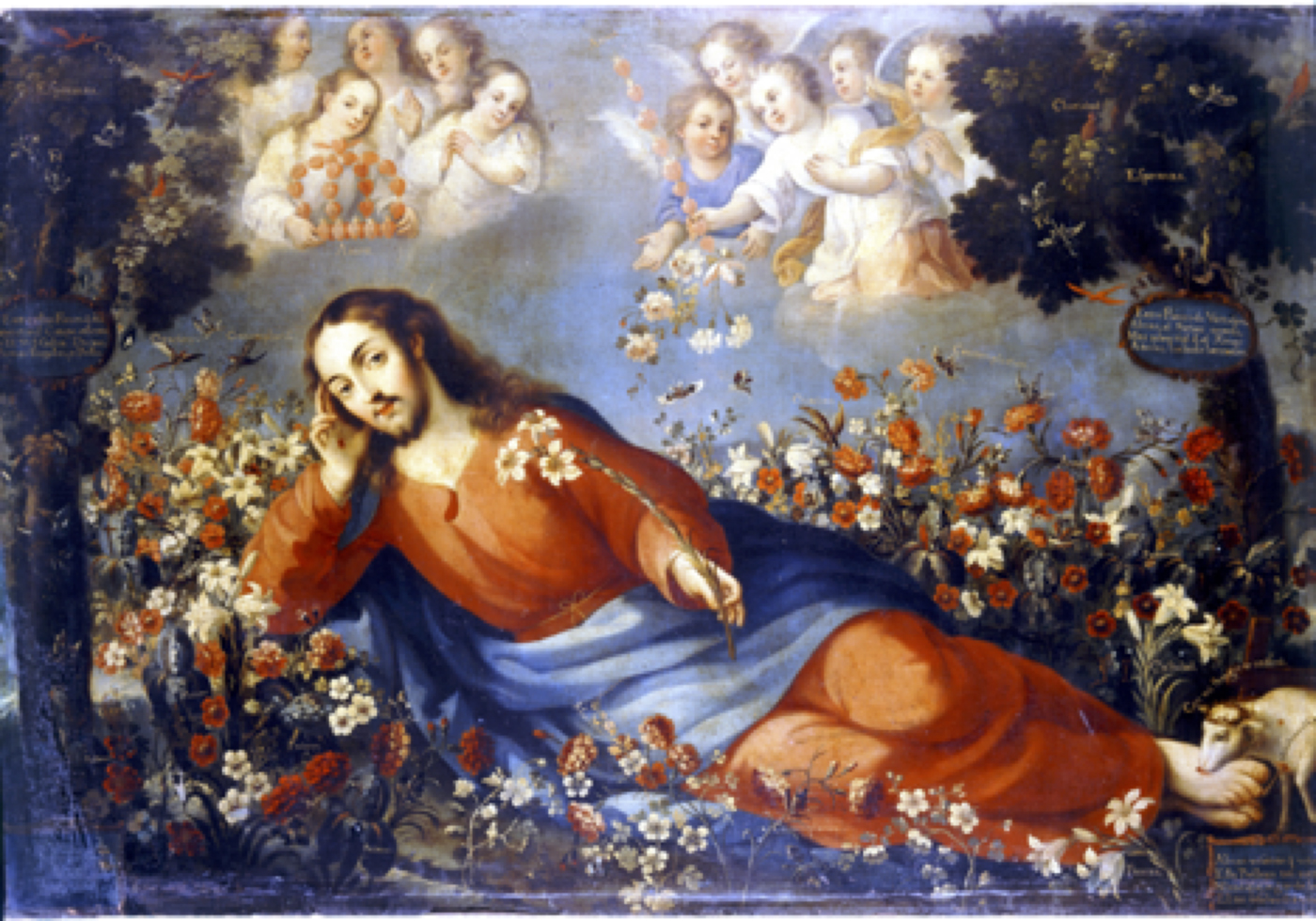
For example, images of Christ, the nuns’ bridegroom, could motivate his brides to remain in the idyllic sacrificial life that would ensure them his real presence in heaven. One particularly famous work of visual art that reproduced the image of Christ as a sacrificial lamb is José de Ibarra's Cristo en el jardín de las delicias (see Figure 1).Footnote 33
José de Ibarra, Cristo en el jardín de las delicias, ca. 1728. Image in public domain. Preserved in the Museo Nacional del Virreinato, Tepotzotlán, and reproduced with permission from INAH.
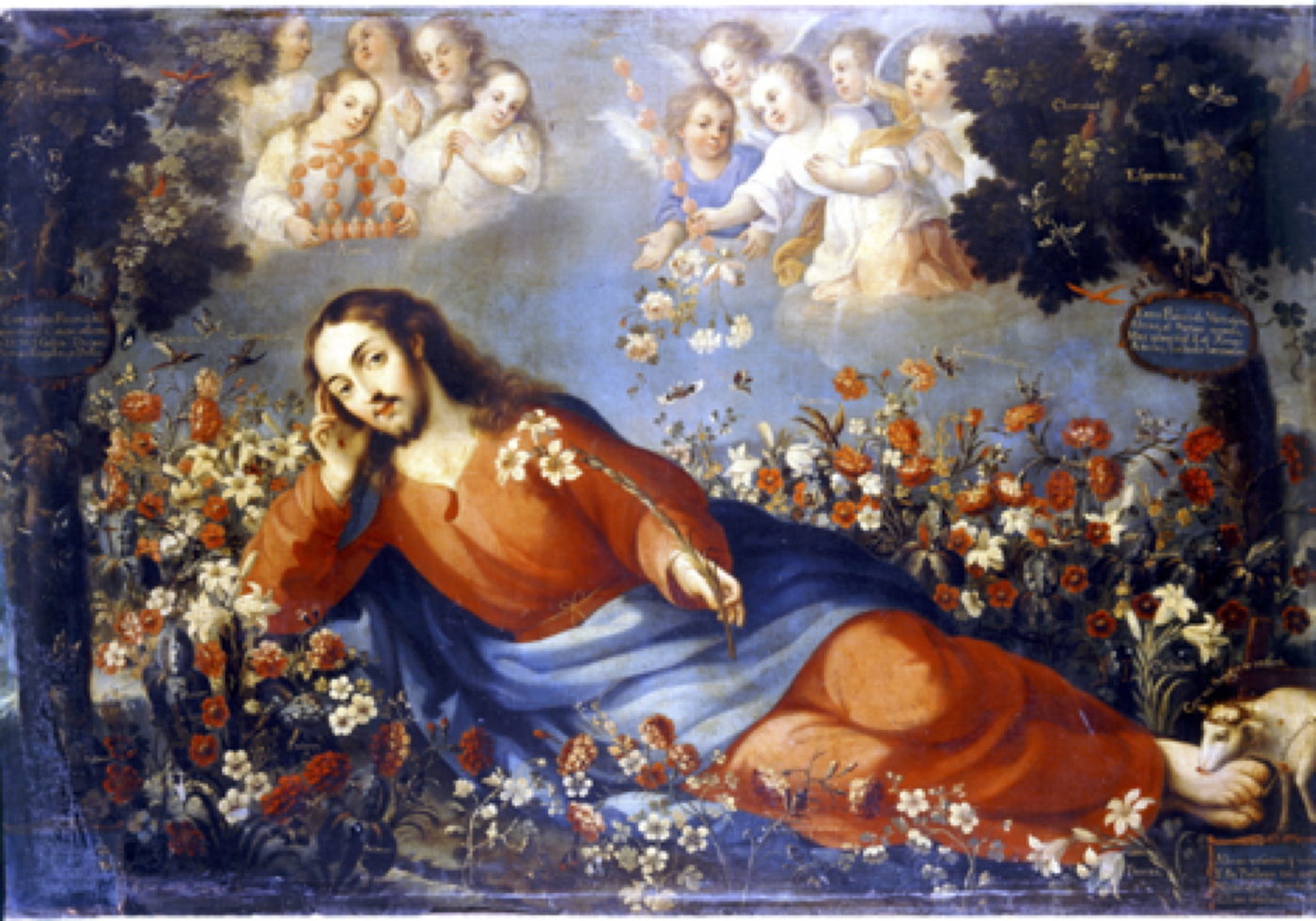
In the painting, Jesus reclines in a bed of various flowers. He holds a lily in his left hand, symbolizing his mother Mary's virginity, and the cluster of three flowers on one stem are a tribute to the Trinity.Footnote 34 A closer look at his face reveals that Jesus's forehead is healed from the crown of thorn lacerations. Yet this is a post-Crucifixion rendering because it depicts the wound on his right hand. But there are two images of Christ in this portrait: the obvious one just described and the one represented by the lamb at the far right of the painting. The lamb tends to Jesus's foot, wounded just like the hand. Crucially, the lamb wears a crown of thorns, appropriately sized for its small head. By licking the wound and wearing the crown of thorns, Christ the sacrificial lamb gives his human counterpart a more aesthetically appealing look for his convent brides to contemplate on their sacrificial path.
The dualities of convent life—paradisiacal garden and ascetic desert, joy and sacrifice—seem counterintuitive, but as Lavrin illustrates, women's allure to the convent was nurtured by Novohispanic society.Footnote 35 Aspirants, who from a young age might have been taught in the convents, or who observed their own female relatives take up the veil, would have a chance to try out this privileged martyrdom through the novitiate, “so that with discreet deliberation they sampled if this life and rule was agreeable for them to partake in.”Footnote 36
Obedience, Dowries, and the Conceptionist Novitiate
The novitiate immediately required women to give up their free will once they had employed it to enter the convent. From then on, they would become obedient to their teacher (novice mistress), the abbess, and ultimately to the Conceptionist rule.Footnote 37 Obedience took precedence even over prayer: novices were expected to sleep and eat when told to do so rather than fasting or praying late at night out of their own desire.Footnote 38 Women over forty were excluded from entering the novitiate and could not become nuns, arguably because church leaders were suspicious about older women's willingness to suppress their free will.Footnote 39
The Conceptionist rule approved by Pope Julius II in 1511 stated that candidates age twelve and older were eligible for the novitiate, a minimum that the reforms of the Council of Trent (1545–1563) raised to fifteen.Footnote 40 It closed the gap between the time in which the novitiate was completed and the time when an adolescent reached sixteen, the minimum age at which final profession could take place. Acceptance into the novitiate required final approval from the bishop and a majority vote from the nuns at the convent where the aspiring nun would take the habit. This was preceded by a series of steps, which certified that the candidate met the minimum requirements of “pure” Spanish descent and having received the sacrament of Baptism.
In addition, women requiring dowry waivers for their musical abilities were examined by cathedral musicians to prove their musical competence. The Archivo General de la Nación (AGN) in Mexico City preserves fragments of the process in manuscripts dating from the 1670s through the 1850s.Footnote 41 Conceptionist convents were not the only cloisters to accept women with music dowry waivers, but the majority of the accounts at AGN originated from convents of this order, and they contain wordy, generic titles that can be roughly translated as “Proceedings performed for Mariana de San José y Machuca so that she can be received as a choir and black veil nun in the Convent of the Concepción, with the title of Musician.”Footnote 42
Mariana's dossier is extraordinarily complete, containing all correspondence from the moment the nuns at the Purísima Concepción convent requested permission to accept her as a novice in 1694 until her profession a year later. Women declared competent to earn the “dowry corresponding to the title of musician”Footnote 43 were legally bound and obligated to perform music, unless hindered by severe illness.
The first item in the packet of correspondence is the candidate's baptismal record,Footnote 44 followed by the nuns’ description of Mariana,
We have been presented with a musician who is very skilled, and she sings with a good voice with much training, which is an advantage because she can start singing without being taught. … She is the legitimate daughter of the accountant Agustin Fernandez Machuca, deceased, and Doña Ysabel de Salazar, his legitimate wife, who is so poor that she is sustained through alms, and to receive the status of nun, to which her virtue inclines her, she has taught [Mariana] music.Footnote 45
This letter follows a general pattern seen in many profession records, whereby the nuns expressed the reason for their musical needs, the presence of a musician qualified to fill a role, and the family's financial distress. It attests to purposeful music training so that Mariana could profess in a convent.Footnote 46
Archbishop Francisco Aguiar y Seixas granted permission on November 10 for the cathedral chapel masters, José de Agurto y Loaysa (ca. 1625–1695) and Antonio de Salazar (ca. 1650–1715), to audition Mariana in the convent parlor on November 15. In other accounts, the musical examinations occurred in the choir, which, like the parlor, also had a grate to separate the men and women. The chapel masters brought along music for Mariana to perform, and the nuns also provided music for her. On the same day, the vicar general recorded that Mariana “sang and accompanied with the said musicians, and she sang a different text on her own while playing the harp with much skill, and her voice is very sonorous.”Footnote 47 His comments drew upon a common vocabulary used to describe musicians’ skills, and his testimony duplicates the chapel masters’ notarized evaluations, dated two days later on November 17. Loaysa reported that her voice was clear and high (clara y alta), in addition to being sonorous and of good use for the liturgies, while also commenting on her facility with the harp, “with which she can help the rest of the members who remain in the choir.”Footnote 48 Salazar signed off on a similar statement, without mentioning the type of music used and without listing the competencies they sought from her.
Despite their lack of musical specificity, these proceedings convey a concern for securing skilled musicians and attest to the collaboration between convent and cathedral musicians for that purpose. The legal jargon suggests a type of seventeenth-century process of human resources management administered by the archdiocese, in which women became convent music employees, essentially.Footnote 49
Judging by their greater detail, other portions of the proceedings, such as the investigation into Mariana's family life, imply that pure lineage and Spanish identity trumped musical skills. The priest Ambrozio Fernandez de Leon and Juan de Arvo, a longtime acquaintance of Mariana's family, validated Mariana's background by affirming the following:
[Her parents] procreated the aforementioned as a legitimate daughter, and, as such, they raised her, fed her, always called her daughter, and she has always called them mother and father in their house and in public, and [I know] that [her parents] are Spanish old Christians, pure from all bad lineage of the Moors, Jews, and those punished by the inquisition or other tribunal. … Mariana de San José is a virtuous person of good life and customs, and she has no impediments that will hinder her receipt of the blessed habit, which she seeks in the convent.”Footnote 50
The Spanish brought Old World fears and prejudices to the New World that affected citizens at every level of the social hierarchy.Footnote 51 Arvo's testament proved that Mariana was free of undesirable ancestry, as it was thought impossible to have the qualities of a bride of Christ without this evidence. Central to these statements is Mariana's pure bloodline.Footnote 52 Only true Spanish Christian parents, it was believed, could bequeath genealogically the good nature required of convent aspirants.Footnote 53
The final step of the process involved a personal interview on November 19, in which Mariana was asked her name, the names of her parents, her age (she was 17 at the time), and, most importantly, whether she sought to enter of her own free will without being forced or pressured: she responded that it was indeed by her own desire.Footnote 54 After these proceedings, the archbishop reviewed the material before the nuns voted on Mariana's acceptance.Footnote 55 She would then be inducted with a short ceremony performed for all candidates to begin her novitiate.
The sound of pealing bells announced the start of the ritual for novices taking the white Conceptionist habit—the same as a fully professed nun, but with a white veil instead of a black veil. They continued to ring until the aspiring novice and her family gathered in the convent church and the nuns gathered in their lower choir in the back of the church with lit candles in their hands. The aspirant would enter the church and kneel at the foot of the altar, holding a candle. After the opening prayers, the priest blessed the white habit, which sat on a table before the altar, said a prayer, and sprinkled the novice and habit with holy water. The priest then asked the candidate if she was entering the convent of her own free will, whether she had any debts, and whether she was married; after answering the questions adequately, she kissed his hand and was escorted by her family to the door connecting the church to the nuns’ choir where she was received in this cloistered space to be dressed in the white habit.Footnote 56
Music played an important role in consecrating this moment when a woman left the secular world. In the Conceptionist ritual book preserved at the motherhouse in Toledo, Spain, novices were received as the nuns chanted Conceptio tua, a Vespers antiphon for the feast of the Immaculate Conception.Footnote 57 In the Novohispanic ritual, the novice entered to Veni sponsa Christi and the psalm Beati qui habitant in domo tua Domine sung in the eighth tone.Footnote 58 The novice ceremony continued with a prayer and the invocation of the Holy Spirit through the singing of Veni Creator Spiritus.Footnote 59
The Solemn Profession Ceremony
One year after the nuns requested permission for Mariana Machuca's novitiate at the Purísima Concepción with a music dowry waiver, the nuns requested Mariana's full profession.Footnote 60 The archbishop approved the petition on December 11, 1695, and asked the nuns to take a final vote on Mariana's candidacy.Footnote 61 There followed some spiritual matters for the candidate during this transitional period. Antonio Arbiol y Díez's La religiosa instruida, a guidebook for all female religious and novices, instructed that on the last days before the solemn profession, the novice must not receive any visitors but rather remain in isolated meditation and prayer.Footnote 62 As mentioned above, Sor Barbara Josepha performed the Ignatian Spiritual Exercises prior to her profession. Torres would have his readers believe that these exercises prepared her for an event as awe-inspiring as the eclipse of celestial bodies. He reported that, “Barbara the moon aligned with the divine sun of justice on the joyous day of her religious profession.”Footnote 63
This language of union is also evident in the poetics of the anonymous profession villancico, Albricias zagalas (CSG.010). The opening of the estribillo (refrain) reads,

The call for pastoral characters to observe a holy event is particularly common in Christmas villancicos where Christ is often described as dwelling among shepherds and farm animals at his Nativity.Footnote 64 In Albricias zagalas, Christ also humbles himself by uniting with Paula, but this text is set to music that is anything but humble. The manuscript is incomplete with parts only remaining for choir I tiple, tenor, and bass; the low voice parts lack text underlay. The designation of choir I and eleven voices (a11) in the manuscript margins suggest a polychoral setting with possibly three choirs. Such a large-scale work ensured that the guests of the professing woman's family would be impressed. It would affirm the status of the families, who often invited high-ranking civic officials and clergy to these events. For this audience, Paula's rising to the status of fully professed nun was paramount.
The solemn profession began after Mass with the priest chanting the antiphon from the Common of Virgins, “Prudent virgins, prepare your lamps, behold your spouse is coming, leave [the world] to follow his way” (Prudentes Virgines aptate vestras lampades, ecce sponsus venit, excite obviam ei), at the choir grate. It continued until the nuns gathered close to the grate with lit candles to begin the blessing of the black veil. After completion of the prayers over the veil, the priest sang, “Come daughter, hear me, I will teach you to fear the Lord” (Veni filia, audi me, timorem Domini docebo te), calling the candidate up to the grate; she responded by singing, “And now I follow you and, with my whole heart, I fear you and I long to see your face, Lord, do not turn me away, but do with me according to the gentleness of your mercy” (Et nun sequor, & in toto corde timeam te, & quaeram faciem tuam videre Domine, ne confundas me, sed fac mecum juxta mansuetudinem misericordiae tuae). The priest asked her if she accepted the four vows, and after responding affirmatively, the novice professed in the hands of the reverend mother, at which point the singers chanted the litany of the saints. More prayers followed at the litany's conclusion, and meanwhile, the novice was taken to the back wall of the choir to be called three times by the priest standing at the grate chanting, “Come, bride of Christ, receive the crown which the Lord has prepared for you for all eternity” (Veni Sponsa Christi, accipe coronam, quam tibi Dominus praeparavit in aeternum); each call was to grow louder in volume.
After the first call, the novice responded, from the Feast for the Virgin Martyr Agnes: “For I have with me the angel of the Lord to keep my body” (Mecum enim habeo custodem corporis mei Angelum Domini); after the second, from the Common of Virgins: “The kingdom of the world, and all the beauty of the age I despise for the love of our Lord Jesus Christ, who I have seen, whom I loved, in whom I believed, whom I worshipped” (Regnum mundi, & omnem ornatum saeculi contempsi propter amorem Domini nostri Jesu Christi, quem vidi, quem amavi, in quem credidi, quem dilexi); and finally, from the Feast for the Virgin Martyr Agatha: “I am the servant of Christ, therefore I appear to have a servile character” (Ancilla Christi sum, ideo me ostendo servilem habere personam). The overall responsorial character of the ceremony would give women with decent singing voices, and certainly those entering with music dowries for voice, ample opportunity to demonstrate their skills.
After the Veni Sponsa Christi dialogue, the choir sang Veni Creator Spiritus. Meanwhile, the celebrant replaced the white veil on the novice's head with a black veil. After another blessing, the singers stopped singing the Veni Creator Spiritus, and the newly professed nun (professa) sang the antiphon, “He put the sign on my face, that I may receive no other lover” (Posuit signum in faciem meam, ut nullum praeter eum amatorem admittam), in response to the veiling. The priest then married her to Christ by saying (diciendo), “I marry you to Jesus Christ son of the almighty Father who will keep you unharmed” (Desponso te Jesu-Christo summi Patris Filio, qui te illaesam custodiat), and the professa responded by singing, “I am espoused to him, whom the angels serve, whose beauty the sun and the moon admire” (Ipsi sum desponsata, cui Angeli serviunt, cujus pulchritudeinem Sol & Luna mirantur). The priest then placed a ring on her finger, a crown of flowers on her head, and a palm frond in her hand. These actions were each followed by prayers, and when these were completed, the professa sang, “The Lord has dressed me in gold and adorned me with a great pendant” (Induit me Dominus cyclade auro texta, & immensis monilibus ornavit me).
Following these chants that narrated the action performed, the choir resumed the Veni Creator Spiritus. When the hymn was completed, the professa and/or the choir sang another antiphon from the Feast for Agnes: “Behold, now I see that which I have desired, Now I possess that which I have longed for. Rejoice with me and congratulate me, because along with all of these things I received a shining seat, and I am joined in heaven to that mind, whom I loved with complete devotion while on earth” (Ecce quod concupivi jam video, quod speravi jam teneo, congaudete mecum, & congratulamini, quia cum his omnibus lucidas sedes accepi, & illi mente sum juncta in caelis, quem in terries posita tota devotione dilexi). The Te Deum followed closing prayers before the nuns retreated to the refectory, singing devotional songs on the way for a small celebration. At this moment, the profession villancicos would have been more than appropriate.
Professions: Record-Keeping and Commemorations
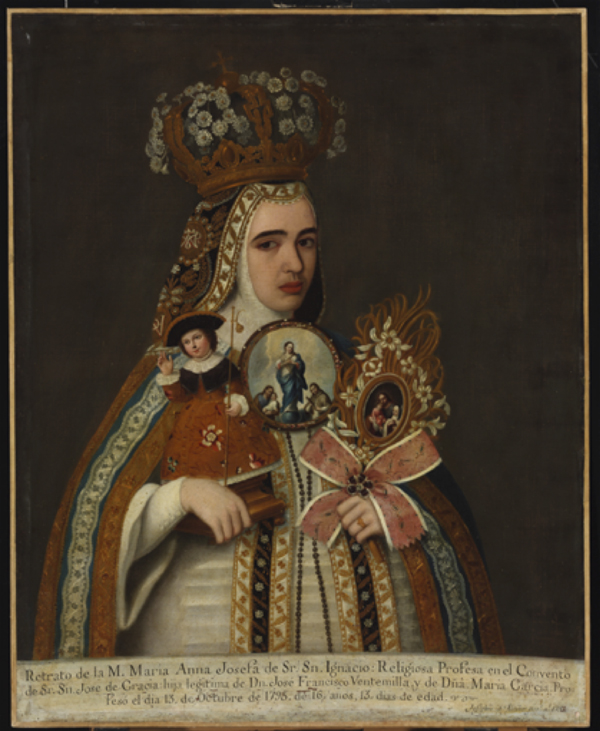
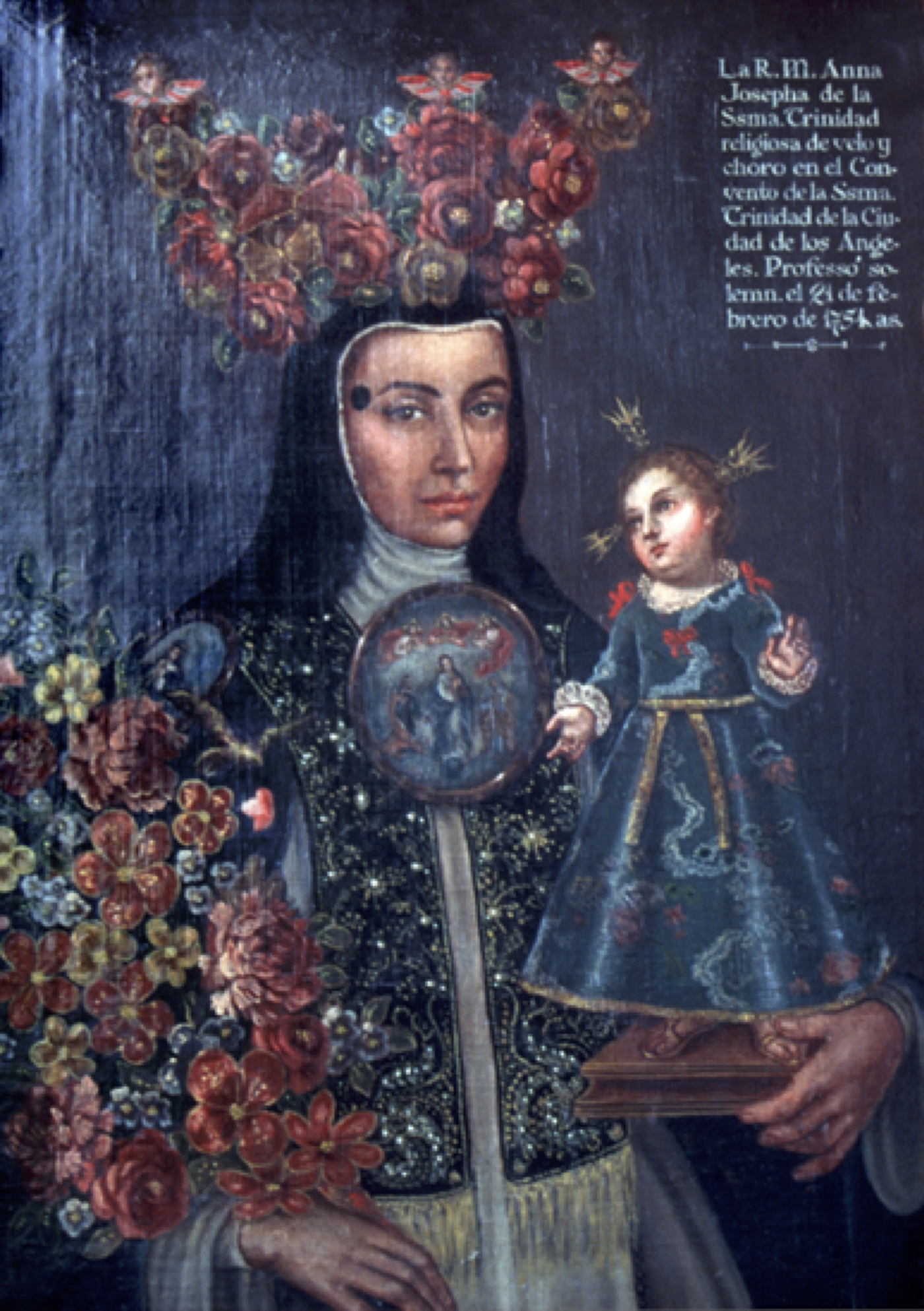
Women who professed had to have witnesses attest to their solemn profession, and these accounts are also found in AGN, confirming that the profession had been observed through the cratícula, an opening in the lower choir wall where nuns received communion.Footnote 65 In addition, the nuns wrote their vows into a profession book for record keeping. Profession portraits, or crowned-nun portraits, preserved the vision of the bedecked nun and also provided an artistic record of the profession. The name “crowned-nun portrait” refers to the long monastic tradition of placing a crown of flowers atop a nun's head during the profession ceremony.Footnote 66 Along with the veil, the ring, the palm frond, and the statue of the Christ Child, captured in the images, many of the paintings have a small biographical note indicating the name of the sitter, the convent where she professed, and the date of profession, sometimes also mentioning her family background.
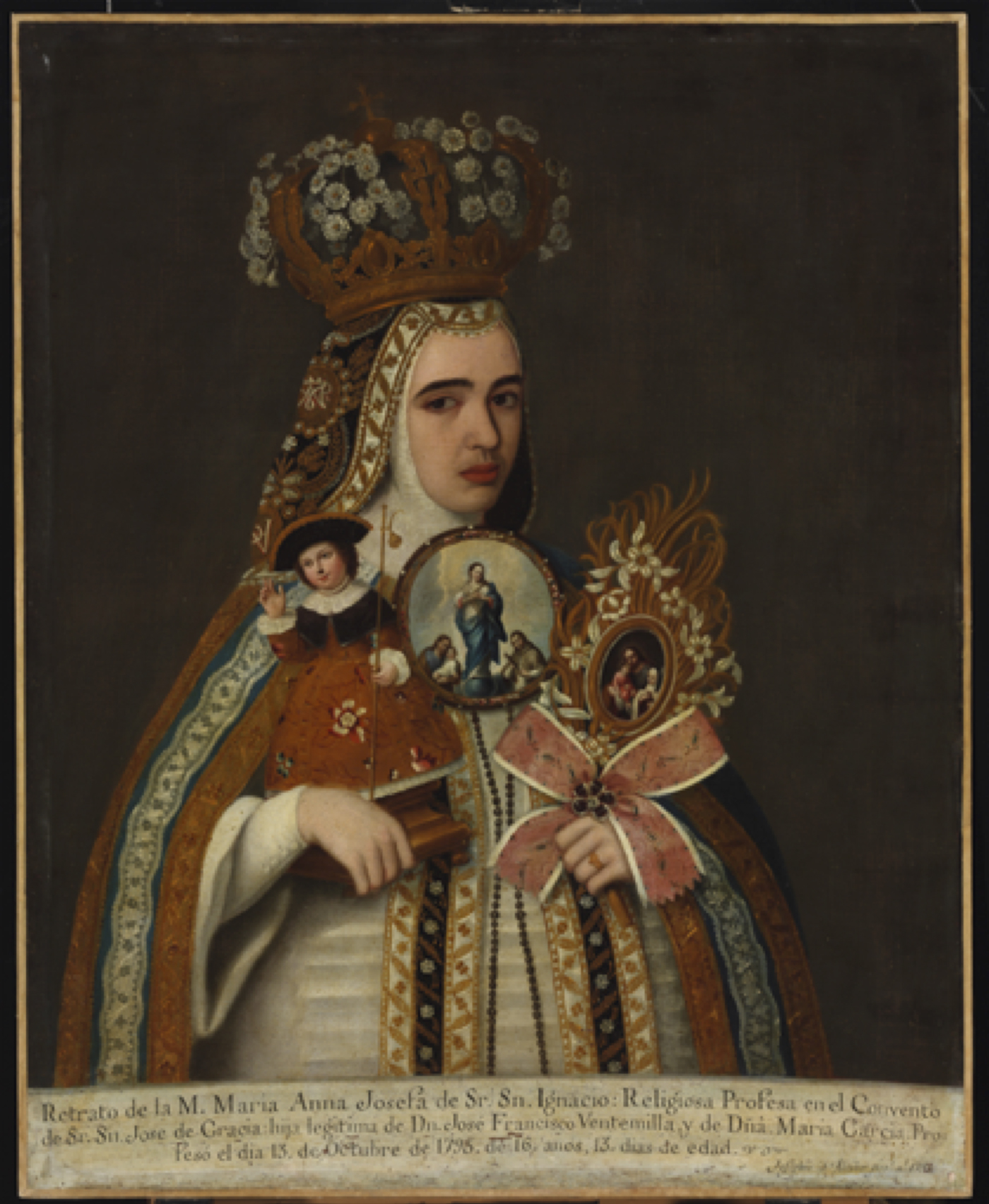
Figure 2 illustrates one of the most elaborate of these portraits. Except for the fact that the note on the bottom says the woman depicted professed at the San José de Gracia convent in Mexico City, one can hardly tell that this is a Conceptionist nun, owing to the highly ornamented habit. One would expect a simple white habit with a blue cape cloaking the shoulders and a black head veil. The white and blue mimicked the dress worn by the Virgin Mary in all of her depictions as the Immaculate Conception, the Conceptionist Order's namesake and patron. The profession portraits also depict a large circular pendant on the chest and shoulder, called an escudo, a work of art within a work of art that commonly displayed the Immaculate Conception or any other saint or personal devotion.Footnote 67
Alcíbar, Portrait of Sor M. María Ana Josefa de San Ignacio, 1793. Image in public domain. Reproduced with permission from Museum of Fine Arts, Budapest.
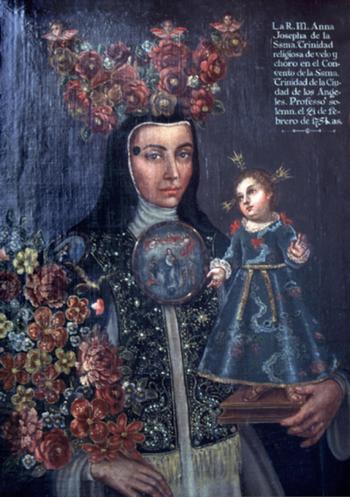
The shoulder escudo is more apparent on the right shoulder of Sor Ana Josefa de la Santísima Trinidad, just above the flower-decorated palm frond (see Figure 3). She professed in Puebla's Santísima Trinidad convent in 1754. Her portrait is unique among profession portraits in that it depicts her with a large artificial black beauty mark on her right temple. Known as a chiceador, it was a feature in the portraiture of elite Spanish and Novohispanic women.Footnote 68 The transactions that took place from the initial commissioning of the art works to their actual painting and final delivery remain a mystery. What is clear is that the crowned-nun portraits were outward demonstrations of family prestige, commemorating a milestone that was significant not just for the nun but also for her family.Footnote 69
Anonymous, Sor Ana Josefa de la Santísima Trinidad. Image in public domain. Preserved in Archivo Fotográfico Manuel Toussaint and reproduced with permission from INAH. Photograph provided by James Córdova.
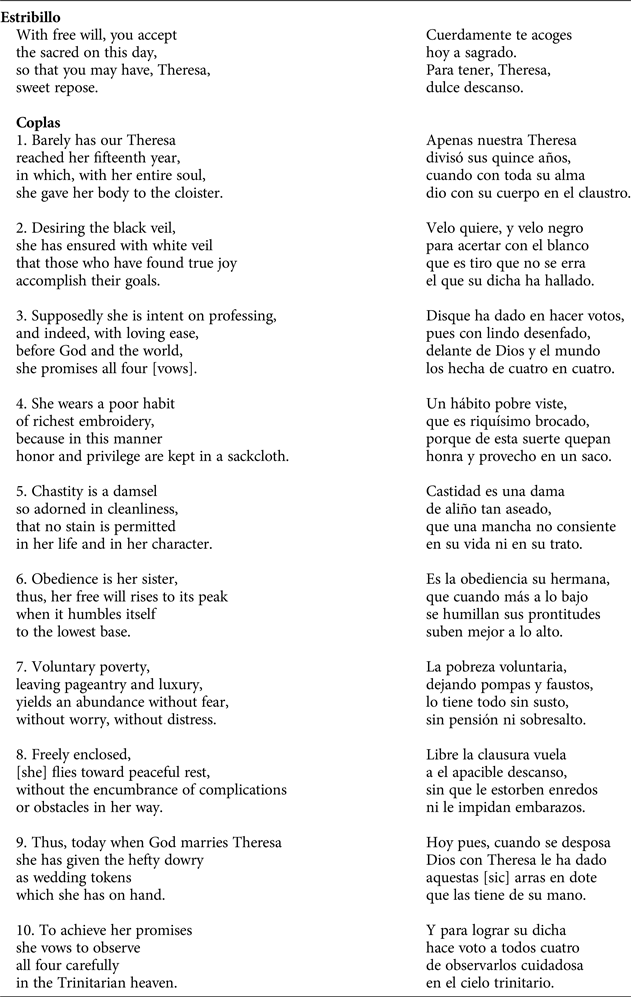
The profession villancico could be considered a sonic analogue for such paintings. In addition to Albricias zagalas, discussed earlier, the Santísima Trinidad convent in Puebla possessed a second profession villancico, titled Chansoneta a4 a la profesión de Theresica la chiquita (CSG.134), composed in 1667 by Juan de Baeza (fl. 1662–1677). In standard villancico form, the piece consists of an estribillo (refrain) and various coplas (verses). The professa Theresa is named three times in the piece, within the estribillo and in coplas 1 and 9 (see Appendix, Table 1).
Her name is laced within traditional villancico metered poetry. Even more personal is the title page referring to her likely petite features through use of the diminutive for the name Theresa (Theresica) followed by her nickname “the little one” (la chiquita). The name of the Santísima Trinidad, the convent where she professed, is revealed allegorically in copla 10, in which we are informed that Theresa will keep her vows in the Trinitarian heaven (cielo trinitario).
The coplas follow a chronological poetic narrative that outlines specific profession topics. The first two coplas describe her age at the start of her novitiate and aspiration for the black veil of a fully professed nun. The next two coplas illustrate her desire to take the four vows and to don the black veil of fully initiated nuns. They set the scene for what follows: four coplas each dedicated to particular vows. In addition, the rhetoric of duality that is typical in convent devotional texts appears in various coplas: black/white in copla 2, poor/rich in 4 and 7, peak/base in 6, and freedom/enclosure in 8 (recall rise/descend in Albricias zagalas above). The coplas, as in most villancicos, are set syllabically in homophonic texture (see Appendix, Example 1). They are in duple meter.
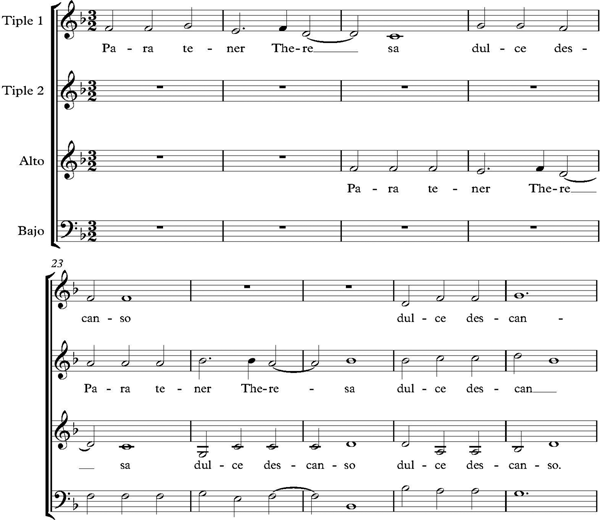
Another standard compositional procedure is to differentiate the estribillo's music from that of the coplas. For Theresica, the estribillo is in triple meter with both imitative and homophonic textures employed. When Theresa's name is mentioned, for example, the highest voice (tiple 1) provides the first utterance that is then imitated by the alto in measure 21 and by tiple 2 at measure 23. Her name is also emphasized and drawn out sonically with whole notes (see Appendix, Example 2).
This type of music and the ritual itself drew into the convent church the rich and the poor alike to listen and watch, although sometimes the poorest were drawn by force. Cristóbal Ramírez's list of expenses for his sister's profession is once again illustrative, as it also documents the purchase of a dress costing eight pesos for a young black woman (mulatilla) named Antonia.Footnote 70 Servants, like Antonia and María de San Juan at the Jesús María convent, introduced earlier, were often donated to the convents to cook for and clean after the nuns. Their attendance to menial labor allowed for the nuns to practice and perform music for the liturgies.
The nuns’ choir loft was often allegorized as heaven, and the nuns could be described as angels during devoutly sung liturgies in nuns’ biographies and devotional literature. Similarly, nuns living under perfect observation of the four vows transformed the entire cloister into a paradise—a Garden of Eden or garden of delights, as in Ibarra's painting. Heaven was a common metaphor assigned to places where good deeds took place. These metaphors, the nun's reaction to the servant's dream about professing, and the dowry bequests tell of a society obsessed with the afterlife, whose heavenly foretaste was available to certain types of people. Thus, heaven itself must have been different for different classes and races. It was where those who lived as the brides of Christ on earth reunited with their bridegroom when they died.Footnote 71 The nuns, however, did not have to wait to go to heaven in order to consummate their marriage metaphorically on the day that they professed.
Consummating the Marriage with the Lamb of God
“And who is the groom?” asked Fr. Ossorio rhetorically to Sor Josepha María in his profession sermon; “A lamb,” he answered.Footnote 72 The very sacrificial creature that nuns followed by entering the convent was also their groom. Sor Barbara Josepha, for example, “considered that in these spiritual nuptials, the souls celebrate with Christ … the consummation of their chaste, pure marriage, joining in solemn sacrifice of their vows, the immaculate lamb.”Footnote 73 Immediately following her profession ceremony at the Santísima Trinidad, Sor Barbara had a vision:
I saw myself inside the tabernacle beside my Lord, standing as if I had just professed, with a very white habit; the cape appeared to be of a fine blue cloth, adorned with gold and silver embroidery in the shape of stars; I could see the veil on my head was elaborated with diamonds and emeralds; the stole was garnished similarly; and the crown and palm [were made] of gold. … In my right hand I had a beautiful Baby Jesus richly dressed wearing the ring on his finger that I placed. … I observed this with much attention, and my Lord made me understand [in such a way] that it appeared I heard [this come out of] his Blessed mouth; ‘You are my wife and in this way that I have you pictured with me, you must remain all your life.’Footnote 74
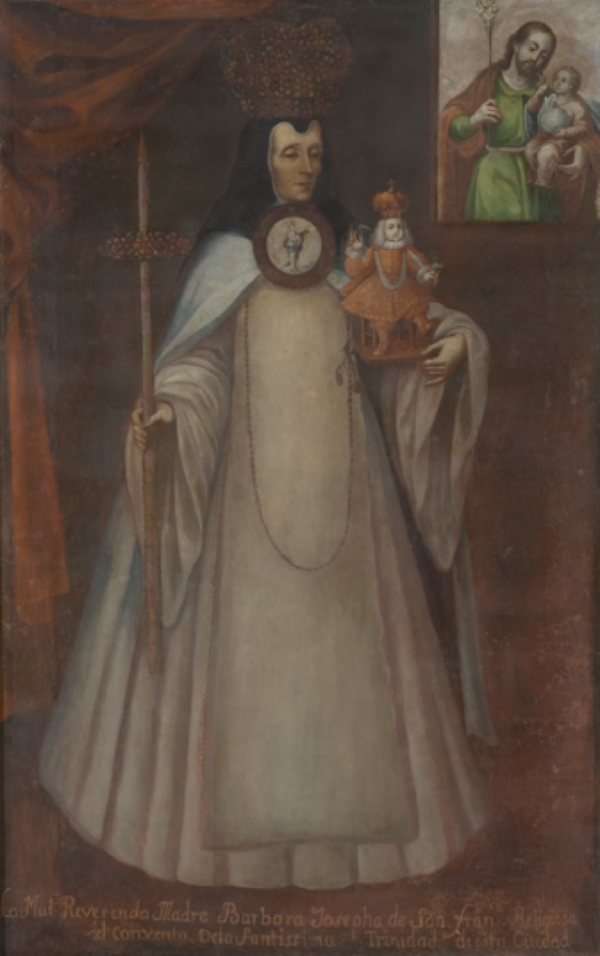
Sor Barbara's biographer practically described a profession portrait, and this vision may have inspired the creation of Barbara's own portrait seen in Figure 4. An anonymous artist painted her with closed eyes indicating that it is a posthumous rendering. The insertion of her patron St. Joseph in the top right corner is unique (recall that her full name is Barbara Josepha). Barbara mirrors Joseph iconographically, putting forth the message that she too was a chaste parent to Christ. According to Rogelio Ruiz Gomar, posing with a Christ Child statue after profession symbolized the fact that a nun's “only role as ‘mother’ would be to [Jesus].”Footnote 75 These portraits, however, conflict with the notion that a profession celebrated the marriage between a nun and Christ. “The portrayal of an infant groom seems to have been intended to de-eroticize the conjugal union of Christ and bride, imbuing it with an innocent, nonsexual character.”Footnote 76 On the contrary, profession music eroticized the relationship.
Anonymous, Sor Bárbara Josefa de San Francisco. Image in public domain. Reproduced with permission from Museo de Historia Mexicana, Monterrey.

Ossorio's and Barbara's rhetoric about marrying the Lamb of God, present in the Eucharist and stored in the tabernacle, made clear the intimacy with which nuns might approach their marriage with Christ through communion on their solemn profession day. This language is consistent with the erotic tones in the writing of late-medieval religious women with respect to Eucharistic devotion. However, these earlier instances typically were not associated with profession.Footnote 77
The copla to Albricias zagalas was more explicit. This profession villancico proclaimed,

Paula's villancico reveals the personal devotion to Christ through the Eucharist that was possible after profession. Devotional language suggesting sexual relations with Christ would seem inappropriate for religious men or any secular citizen.
Profession villancicos were not used to invoke a saint's intercession or to praise God or the Virgin Mary within or outside the liturgies. They did, however, honor women who, by means of their personal relationship with Christ, could intercede on behalf of patrons, relatives, and other individuals excluded from professing. The villancicos alluded to devotion. That specific women's names were set to polyphony, similar to the musical texture for devotional pieces, was no small gesture. No profession villancicos for male clergy have come to light.Footnote 79 The profession ceremony for nuns provided the opportunity for this exclusive gendered art that could just as well sound like a devotional piece to the urban crowds gathered for the event who were heralded by pealing bells often rung by the convent servants. Ironically, the servants contributed most directly to the urban soundscape by calling the faithful to these special events and to the daily convent liturgies that were enhanced by the voices and instruments of some very fortunate Novohispanic women.
Appendix
Juan de Baeza, Chansoneta A4 a la profesión de Theresica la chiquita, 1667

Juan de Baeza, Chansoneta a4 a la profesión de Theresica la chiquita, Copla 1

Juan de Baeza, Chansoneta a4 a la profesión de Theresica la chiquita, mm. 19–27

Abbreviations
- ACM
Archivo de la Casa Madre Concepcionista, Toledo, Spain
- AHSS
Archivo Histórico de la Secretaría de Salud, Mexico City
- BNAH
Biblioteca Nacional de Antropología e Historia
- BNM
Biblioteca Nacional de España, Madrid, Spain
- BNMFR
Biblioteca Nacional de México Fondo Reservado, Mexico City
- CSG
CENIDIM Colección Jesús Sanchéz Garza
- CENIDIM
Centro de Nacional de Investigación, Documentación e Información Musical Carlos Chávez, Mexico City
- NYPL
New York Public Library
- PAL FAXCT
Biblioteca Palafoxiana, Puebla, Mexico