The coronavirus disease (COVID-19) pandemic led to an unprecedented crisis with close to 289 million cases worldwide with more than 5.4 million deaths by the end of the year 2021. 1 The crisis has impacted the world in multiple domains and not just in the health care realm. Most universities have a curriculum hinged on conventional teaching strategies with minimal utilization of online resources. Educational strategies utilizing the Internet have been termed e-learning. Reference Vaona, Banzi and Kwag2 Medical education has evolved significantly over the past decade and more so during the COVID-19 pandemic where e-learning has become the norm. E-learning also facilitates asynchronous learning where the learner dictates the pace and consumption of the educational content. Emergency medicine (EM) residency programs have utilized online and asynchronous learning strategies in the West for the past 2 decades. Reference Mallin, Schlein and Doctor3 The COVID-19 pandemic has precipitated the need for such strategies to supplement the traditional teaching/learning methods in academic programs. Reference Bozkurt and Sharma4 EM residency programs in India are only a little over a decade old and there are no studies reviewing the utilization of online teaching/learning strategies to date. With this study, we tried to evaluate the use of e-learning during the COVID-19 pandemic from EM residency programs in India. This study also assessed the feedback from students and faculty to better understand how to optimally utilize the e-learning strategies and consider integration into the formal EM postgraduate curriculum.
Methods
This is a multicenter national survey conducted by an Indian Emergency Medicine Department after approval from the Institutional Research Board/Institutional Ethics Committee (Registration No. ECR/146/Inst/KA/2013/RR-19) (DHRRegistration No. EC/NEW/INST/2019/374) IEC: 396/2020.
The survey was validated by 3 international subject experts and underwent multiple reviews by the research team. The final survey was converted into Google Forms for dissemination via email during the COVID-19 pandemic to all medical colleges in India with a National Medical Commission (NMC) approved EM residency program (N = 44) as of 2021–2022. Only EM residency programs in medical colleges were included in the study to ensure homogeneity in the scope of practice and environment, during the pandemic. Eight weeks were given to complete the questionnaire, with 3 reminders provided within this period. We had collected responses from residents and faculty members from EM departments in medical colleges across India during the COVID-19 pandemic. Participation in this study was voluntary and only after the volunteers provided consent. To avoid the duplication of forms, they could only log in through their mail ID, and the questionnaire could only be filled out one time. The data collected from various responses were exported into Excel format and analyzed. Results were expressed as mean and standard deviations for continuous parametric data; the median for non-parametric variables, and proportion confidence interval ± for the categorical variables. The perception of faculty and residents toward the e-learning process was assessed using the 5-point Likert scale where 1 is “strongly disagree” and 5 is “strongly agree.”
Results
Among the medical colleges with the NMC approved EM residency programs (N = 44) as of 2020–2021, 12.5% of residents and 41.6% of faculty had responded to the survey during the COVID-19 pandemic. A total of 94 participants completed the survey, among whom 58.5% were faculty members (n = 55), and the rest were residents. There was a significant rise in the number of regular online classes attended by the residents during the COVID-19 pandemic (Table 1). Most of these classes attended by the residents were part of the university curriculum.
Percentage of online classes annually attended by residents

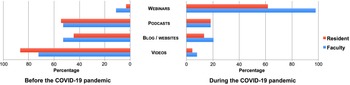
The residents use a variety of online resources for learning, the most common being videos (86.6%), podcasts (54.5%), and blogs/websites (44.5%). Before the pandemic, the online resources used by faculty were almost like the residents. There had been a significant increase in webinars and various online platforms used for the e-learning process during the pandemic (Figure 1). Zoom and Microsoft Teams were the common web-based platform used for the webinars.
Comparison of frequency of various online platforms used by residents and faculty before and during the COVID-19 pandemic.

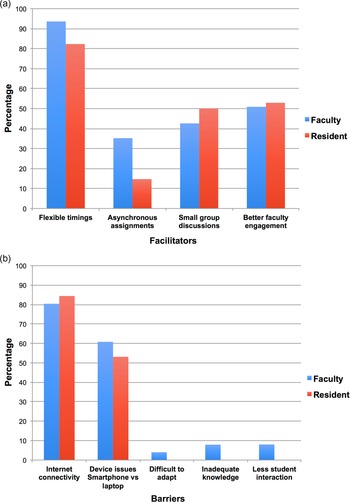
The main facilitators for e-learning, according to residents, were flexible timings (79.4%), better faculty engagement (52.9%), and improved small group discussions (50%). In contrast, among faculty, 93% felt that flexible timings facilitated the online classes. The faculty also perceived that faculty engagement (50%), small group discussions (42%), and asynchronous assignments (35.2%) had a positive impact (Figure 2a). The significant barriers to the use of online education encountered by both the students (84%) and faculty (76%) were Internet connectivity and integration with devices such as smartphones and laptops (see Figure 2b).
Comparison of frequency of various (a) facilitators and (b) barriers that affect the E-learning system among the faculty and residents.

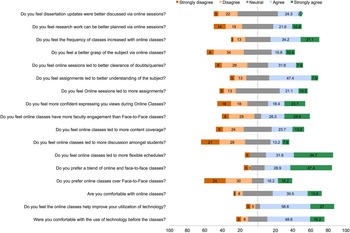
The degree of a resident’s experience on online teaching was measured using questions listed in Figure 3, using a 5-point Likert-scale-based statement ranging from “strongly disagree” to “strongly agree.” Although most residents (55.3%) were comfortable with e-learning even before the pandemic, their opinions regarding the online environment for learning compared to face-to-face classes are divided. Our study group assessed that e-learning had enabled them to increase their knowledge (83.8%) on utilization of the technology. E-learning was considered less effective, and only a few residents (32.4%) preferred online teaching over face-to-face classes (54%). E-learning is most effective when combined with traditional classes (76.3%). Only 21.1% of the residents had chosen more discussion and class interactivity as an advantage of e-learning during the COVID-19 pandemic. Residents believe that faculty engagement and assignments (55.2%) are higher during online sessions and thus result in a better understanding of the subject (55.3%). Almost one-third of residents felt that using an online platform to plan research work was a terrible idea. However, 27% believed that an online session would better debate thesis updates (see Figure 3).
Five-point Likert scale feedback results from Residents’ perspective towards e-learning process.

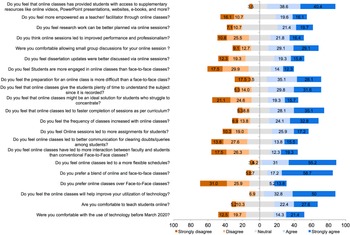
The degree of faculty experience in online teaching was measured using questions listed in Figure 4 using a 5-point Likert-scale-based statement ranging from “strongly disagree” to “strongly agree.” Only 35% of the faculty were comfortable with the online class before the COVID-19 pandemic. However, only 18% preferred online classes, even though 86% felt it led to more flexible schedules; 44% of faculty members felt that interaction in online classes is less than in traditional classes, and nearly 40% felt that the online platform does not translate into better interaction for answering residents’ queries. However, most faculty members (57%) felt that the frequency of online discussions had risen, culminating in more assigned tasks for residents; 46% of faculty considered that online sessions might not be the best option for residents who strive to stay focused. Almost 35% of faculty members believed that dissertation updates, and 41% of participants did feel that the research study could have been better structured via online sessions. Indeed 35% of faculty believed that such e-learning would aid them to be teachers/facilitators. Approximately 80% felt that online classes had provided students with access to supplementary resources like online videos, e-books, and more.
Five-point Likert scale feedback results from the various perception of faculty towards the e-learning process.

Discussion
Emergency medicine residency programs in India are only over a decade old, with the first residency program, Doctor of Medicine (MD) EM in medical colleges, approved by the erstwhile Medical Council of India (MCI) initiated in 2009. The National Board of Examination (NBE) accredited residency program in EM, conferring the Diplomate of National Board (DNB) degree was initiated later in 2013. To avoid heterogeneity in the study population based on the scope of practice and the resources/infrastructure, which are highly variable in the private health care sector in India, we have targeted residency programs in medical colleges only. E-learning, when compared to conventional learning strategies, has shown only a small positive effect in the past. Reference Vaona, Banzi and Kwag2 Literature is scarce on the e-learning revolution in India. The potential for e-learning and its impact on the advancement of health training and education is not entirely known. Reference Jorge, Lüders, Malunga and Neuhann5 It has been concluded in studies that e-learning contributes to learner-centric, active learning by promoting self-directed learning. Reference Ozuah6 A significant change in learning in current times is the strategy of focusing on the learner rather than the educator. Adopting a virtual learning environment may facilitate collaborative learning, effectively distribute learning materials, facilitate discussion, and maintain log activity and assessment without constraints. The student satisfaction on using such e-learning tools studied earlier showed a positive impact. Reference Seluakumaran, Jusof, Ismail and Husain7 The incorporation of an interactive e-learning module has already been attempted earlier in a rural medical college in India and was moderately effective but well received by students. The study finally suggested a blended approach integrating e-learning with the traditional learning modalities. Gaikwad et al. did a pilot study more than half a decade back, and the significant advances in technology need to be considered prior to generalizing the results to the present day. Reference Gaikwad and Tankhiwale8 The growth of technology and the widespread use of smartphones and tablets have facilitated better interaction and online learning for medical and nursing domains. However, there is a need for organizational guidance for optimal utilization according to Lall et al. Reference Lall, Rees and Law9 There was a significant rise in the number of regular online classes attended by the residents during the COVID-19 pandemic period compared to pre-COVID-19 pandemic period (see Table 1). Most of these online classes attended by the residents during the COVID-19 pandemic period were part of the university curriculum and were recorded and used asynchronously (see Table 1). The past 5 decades have seen rapid technology assimilation in health professional education. The various forms of digital education vary from simulation to Internet-based interactive discussions. Reference Triola, Huwendiek, Levinson and Cook10 Web-based learning is not a homogeneous domain, and the comprehensive definition keeps increasing with the advancement of technology. Reference Cook and West11 E-learning in medical education not only improves student engagement but also increases efficiency and effectiveness of faculty according to a review that focused on resource-limited settings from multiple countries. Reference Frehywot, Vovides and Talib12 Appropriate development of the institutional protocol for e-learning in health sciences education is one of the most pivotal steps for optimal output. Reference Young, Bailey and Guptill13
There are multiple studies on the utilization of online strategies for medical education in emergency medicine residency programs. Reference Young, Bailey and Guptill13,Reference Ashton and Bhati14 Toohey et al. succinctly described 10 tips for educating a millennial in EM residency programs and reiterated optimal use of technology. Reference Toohey, Wray and Wiechmann15 With its vast and diverse population, a lower-middle-income country like India is a giant in information and communication technology development and has been integrating technology seamlessly into the education sector. It is also important to note that the conventional classes and bedside are not a landmark for social development but rather a more important learning strategy that supplements e-learning. However, with the rapid development in technology and quality Internet access, the utilization of online resources such as videos, podcasts, blogs, and online courses has been an integral part of EM residents’ learning strategy. The idea of asynchronous Free Open-Access Medical (FOAM) education in EM residency programs in India is on the rise along with simulation-based learning. The survey revealed that the Indian EM residents utilized a variety of online resources before and during the COVID-19 pandemic, the most common being videos (86.6%), podcasts (54.5%), and blogs/websites (44.5%). Social media platforms like Twitter were also used. There was an increasing use of webinars as e-learning resources for learning during the COVID-19 pandemic. Simple online platforms, such as websites and blogs, assist in providing basic information and offer opportunities to host videos for demonstrating essential skills, such as clinical procedures and communication. In addition to user-friendly social media tools like Twitter and YouTube, numerous platforms and learning management systems (LMS) are available for online learning, Reference Pilli16–Reference McLaughlin and Brame19 most of which have proven to be effective educational tools in medical education. Reference Sutherland and Jalali20
As noted by faculty and residents, the major facilitators were the flexible timings for teaching/learning offered by the virtual platforms, especially during the pandemic period. Better engagement and small group discussions were facilitated in e-learning environments. The residents noted that asynchronous learning was augmented by integrating Ee-learning strategies in the curriculum. The pandemic has forced the stakeholders to explore different avenues and converge in the e-learning realm.
The significant barrier noted according to this national survey was Internet connectivity issues. Devices used for e-learning also posed challenges. The overt dependence on smartphones and the challenges of using laptop applications on phones led to unnecessary troubleshooting. The lack of understanding of the potential of the device being used and applications without proper synchrony across multiple devices was specifically mentioned as challenging by residents and faculty. The faculty also felt the need to define good teaching practices using e-learning.
During the COVID-19 pandemic, discussions and interaction were the significant advantages of e-learning felt by the residents. E-learning methods are less favored if they are not interactive. Reference Cook and Steinert21 Gamification in which “game design elements are used in non-game contexts” is one of the promising methods that can boost interaction during online sessions. Student response systems like polls, quizzes, and breakout rooms are the strategies used in gamification. Reference Hamari, Koivisto and Sarsa22–Reference Muir, Tirlea, Elphinstone and Huynh24 E-learning leads to more content coverage than traditional classes with more faculty involvement, and the residents could express their views during these sessions. Residents are free to ask and clear their queries anonymously, encouraging further participation in a live lecture due to the less intimidating online environment. Even though online sessions lead to more assignments and a better understanding of the subject, residents do not grasp the subject better via this strategy. Another major disadvantage of E-learning is the lack of interaction with patients. During the pandemic, many countries had canceled clinical clerkships. Learning from actual patients in a clinical setting is essential for medical education and cannot be wholly replaced by e-learning. To some extent, virtual patients could be a solution that can simulate real-life clinical scenarios, allowing the resident to prepare for an actual patient encounter.
There are various comments about online teaching among faculty, primarily favoring online sessions where it could be a virtuous substitute for face-to-face classes, especially during the crisis of the COVID-19 pandemic. Online classes have come as a consecration for solving and reducing the academic gap during the pandemic. Reference Chandwani, Singh and Singh25 These sessions would enable residents to gain knowledge without going anywhere, and incorporating this innovation into the curriculum may lead to an effective outcome, especially during the pandemic. However, technical glitches may lead to discontinuity in the topic discussed during the online session. Online education may get wider acceptance amongst academicians once the digital culture develops in all institutions. The development of dynamic online sessions will be challenging for most faculty and institutes, where proper training, infrastructure, and technical support may be required to make it a successful venture.
Evidence has proven that online learning is not like reading a newspaper, where one can begin and end whenever they choose; instead, it is a planned program to accomplish a specific goal. The aim is to use the right tool, learner, dose, time, and route. Reference Cook26 A recent survey on pulmonology trainees found that even though they were involved in COVID-19 patient care, the overall training toward skill acquisition was deficient and that modifications in educational models will be required in current and future health care crises, both global and local. Reference Kalchiem-Dekel, Schwalk and Patel27 At this point, one may explore the possibility of an overhaul in the educational delivery system wherein early clinical exposure and training are mandated. The bulk of the didactic training occurs online and particularly for programs such as EM, where departments work on a shift basis around the clock, 24 hours a day, 7 days a week, and 365 days a year. Southworth et al. reported during the first wave of the pandemic how experiences in changing educational practices would affect the response in educational and academic delivery during a second wave or any other disaster that prevents in-person training. Reference Southworth and COVID28 Hall et al. shared 12 tips on supporting competency-based medical education during the COVID-19 pandemic, including innovation, repeated assessment, maximizing existing clinical teaching experiences, collaborative learning, and post-pandemic catch-up. Reference Hall, Nousiainen and Campisi29 All these factors call for a revamp in the educational system with a focus on synchronous and asynchronous teaching/learning methods with predefined good teaching/learning practices. A blended approach with a curriculum incorporating traditional and e-learning strategies may lead to a better end-user experience for all stakeholders.
Limitation
The smaller sample size is one of the major limitations of the study. The survey was carried out during the COVID-19 pandemic, and that has impacted the response rate of the survey. Although the investigators attempted to gather more data, the number of respondents contributing over the 12 weeks immediately after the first wave in India has impacted the sample size.
Conclusion
This cross-sectional survey reveals a significant positive shift of medical education from the conventional teaching strategies toward the virtual realm and explosive growth in the e-learning strategies. All stakeholders (learners and educators) need to better understand e-learning and adapt to the needs, which are mandatory for optimal outcomes. The survey also highlights some of the facilitators and barriers to e-learning in Indian EM residency programs. The survey and the subsequent review have revealed several advantages for e-learning; however, it does not replace traditional bedside clinical teaching/learning and thus suggests a blended approach moving ahead. Although this study provides a snapshot of the use of e-learning during the COVID-19 pandemic in Indian EM residency programs, it was not designed to evaluate the efficacy of the same. Nonetheless, with evidence that e-learning has become more common, it is critical to assess its efficacy compared to traditional methods and consider innovative hybrid/blended strategies to embrace the best of both worlds for optimal outcomes.
Supplementary material
To view supplementary material for this article, please visit https://doi.org/10.1017/dmp.2023.146
Acknowledgments
We would like to express our deepest appreciation to everyone in the Department of Emergency Medicine, Kasturba Medical College, Manipal, for their constant support during this project. We would also like to thank all emergency physicians in India who actively participated in this study during the COVID-19 pandemic.
Author contributions
VK: study concept and design; acquisition of the data; analysis and interpretation of the data; drafting of the manuscript; critical revision of the manuscript for important intellectual content; statistical expertise; administrative, technical, or material support; and study supervision; SAK: study concept and design, acquisition of the data, analysis and interpretation of the data, drafting of the manuscript, critical revision of the manuscript for important intellectual content, and statistical expertise; VG: study design, acquisition of the data, drafting of the manuscript, and critical revision of the manuscript for important intellectual content; SSN: acquisition of the data; drafting of the manuscript; and administrative, technical, or material support; FMS: drafting of the manuscript and administrative, technical, or material support; VK: acquisition of the data and administrative, technical, or material support; and JMB: study concept and design and administrative, technical, or material support.
Funding statement
The authors received no specific funding for this work.
Competing interests
The authors declare no conflicts of interest.
Ethical standards
Kasturba Medical College and Kasturba Hospital Institutional Ethics Committee approved the study on July 15, 2020, with Registration No. ECR/146/Inst/KA/2013/RR-19 (DHR Registration No. EC/NEW/INST/2019/374), IEC: 396/2020.