1 Introduction
The etymological understanding of Present-day English (PDE) bread by various generations of English philologists has been influenced, to a considerable extent, by Otto Jespersen's (Reference Jespersen1938: §78) comment on the lexical impact of Old Norse on English: ‘An Englishman cannot thrive or be ill or die without Scandinavian words; they are to the language what bread and eggs are to the daily fare.’ The general sense of the quotation is indisputable: Norse-derived terms have had a very significant impact on English non-technical vocabulary, including grammatical terms such as they (cp. Old Icelandic [OIc] þeir ‘they’), till (cp. OIc til ‘to’) and though (cp. OIc þó ‘yet, though’ < *þauh).Footnote 2 However, the terms that Jespersen has chosen to make his point are somewhat problematic. Even though Jespersen does not give any explanation about his use of italics to single out specific terms, the reader is probably invited to think that the italicized terms have been influenced in one way or another by Old Norse. The list includes terms at various points in an imaginary scale of certainty about Norse derivation. PDE egg, whose phonological structure clearly identifies it as Norse-derived because it exhibits the effects of Holtzmann's Law (cp. OIc egg ‘egg’, Old English (OE) ǣg ‘egg’) should be placed at one end of the continuum, while PDE bread should be at the other end because nothing in its phonological or morphological structure is suggestive of Norse derivation. In fact, there are some factors that point towards its native origin (see Pons-Sanz Reference Pons-Sanz, Askedal and Nielsen2015: 204–10):
-
1. the existence of cognates in other West Germanic languages (cp. Old Frisian [OFris.] brād, Old Saxon [OS] brōd, Old High German [OHG] brōt; cp. as well Crimean Gothic [Crim. Go.] broe);
-
2. the fact that the term is already attested, as part of the compound OE bēobrēad ‘honeycomb with honey’, in texts where Norse influence on food terms seems unlikely: a text copied in ninth-century Canterbury, albeit of Mercian origin (viz. PsGlA (Kuhn) 18.10, 118.103, cp. Latin [L] favus ‘honeycomb’; see Hofstetter Reference Hofstetter1987: no. 223), and King Alfred's translation of Boethius's De Consolatione Philosophiae (BoHead 23).Footnote 3
Yet, we could argue that the term might be a Norse-derived semantic loan (cp. Johannesson Reference Johannesson and McConchie2006: 69). This would lead us to think that OE brēad, which is attested with the meaning ‘piece, morsel of bread’, acquired the new meaning ‘bread, food prepared by moistening, kneading, and baking meal or flour, generally with the addition of yeast or leaven’, which was more frequently expressed by OE hlāf, because of the influence of its Viking Age Norse cognate (cp. OIc brauð ‘bread’; see the Dictionary of Old English [DOE] 2007: s.v. brēad; and the Oxford English Dictionary [OED] 1989: s.v. bread, n., senses 1 and 2a). The apparent semantic change undergone by OE brēad could have been the main reason for the semantic narrowing exhibited by the reflex of OE hlāf: while OE hlāf could mean both ‘bread’, as a food substance, and ‘a portion of bread baked in one mass; one of the portions, of uniform size and shape, into which a batch of bread is divided’ (OED 1989: s.v. loaf, n.1, sense 2a), PDE loaf is much more commonly used with the second meaning (see below, section 4). In this respect, we should not forget that two of the lausavísur by the eleventh-century Icelandic skald Sneglu-Halli already present a similar distribution of the lexico-semantic field between OIc brauð and hleifr (cp. OE hlāf): in Lv 3 (l. 4) we find OIc brauð meaning ‘bread’ and Lv 1 (l. 8) records the compound OIc rúghleifr ‘rye-loaf’, where OIc hleifr has the meaning that the OED (1989: s.v. loaf, n.1) gives for PDE loaf under 2a.Footnote 4
It is only by exploring the lexico-semantic field of bread in Old and early Middle English texts and, in particular, the rivalry between OE brēad / Middle English (ME) brēd and OE hlāf / ME lōf that we can shed further light on the processes of semantic change outlined above and establish to what extent Norse-influence should be invoked to account for some of those changes. As the sections below show, while the evidence from the etymological connections of the two terms cannot offer conclusive results, bringing into the discussion data from other West Germanic languages proves very helpful for two reasons:
-
1. We only have limited sources for Old English lexical practices and, therefore, comparable additional data are welcome.
-
2. It is well-known that Old Saxon and Old High German were much less influenced by Old Norse than Old English; accordingly, these languages can be treated, to some extent, as testing grounds for the identification of native processes of semantic change.
2 The original meaning of the terms
The etymology of OE hlāf and brēad is sometimes brought into the discussion in order to establish their meaning. However, the ultimate origin of their etyma (viz. Proto-Germanic [PGmc] *hlaiƀa- and *ƀrauđa-, respectively) is fairly problematic and hence cannot be taken as a sure guide to their meaning. The etymology of PGmc *hlaiƀa- (> Go. hlaifs, OIc hleifr, OE hlāf, OFris. hlēf, OHG hleib, leip) remains obscure, as attempts to associate it with Greek [Gr.] κλίβανος ‘oven, furnace’, which might be a loanword from an unidentified language (see von Grienberger Reference Grienberger1900: 114; Kluge Reference Kluge and Seebold2011: s.v. Laib), are not necessarily accurate (Schrader 1917–29: I.164; de Vries Reference de Vries1961: s.v. hleifr; Lehmann Reference Lehmann1986: s.v. hlaifs; Bammesberger Reference Bammesberger1990: 52; Orel Reference Orel2003: s.v. xlaiƀaz; Bjorvand & Lindeman Reference Bjorvand and Lindeman2007: s.v. leiv; Kroonen Reference Kroonen2013: s.v. *hlaiba-). OE brēad and its cognates have received three main etymological explanations, which associate them with the concepts of brewing and breaking, as well as the production of grain (cp. Liberman & Mitchell Reference Liberman and Mitchell1993: 59–62; Kluge Reference Kluge and Seebold2011: s.v. Brot):
1. Nowadays, the terms are most frequently derived from PGmc *ƀrauđa-, a to-stem (< Proto-Indo-European [PIE] *bhrouh1 -to-) based on a root with an original meaning ‘to whirl, seethe’ that also gave rise to OE brēowan ‘to brew’ and its cognates (e.g. OFris. briouwa ‘to brew’ and OS gibreuwan ‘to brew’; < PGmc *brewwan- ‘to brew’ < PIE bhreuh1 - ‘to boil, brew’). This root could also be associated with L defrutum ‘grape juice boiled down into a syrup’ (< PIE *bhru(h1 )-to- ‘boiled’). It is likely, therefore, that these terms are also related to PGmc *ƀrennan- (> Go. brinnan ‘to burn’, OE beornan ‘to burn’ and OIc brinna / brenna ‘to burn’). A connection with OE beorma ‘ferment’ (cp. Middle Low German barme ‘ferment’) and L fermentum ‘ferment, yeast’ is also possible, albeit less clear (cp. Falk Reference Falk1925: 117–18; Schrader 1917–29: I.164; Pokorny Reference Pokorny1959: I.144–5; de Vries Reference de Vries1961: s.v. brauð; Holthausen Reference Holthausen1974: s.v. bread; Etymologisches Wörterbuch des Althochdeutschen [EWA] 1988–: s.v. brôt; Pfeifer Reference Pfeifer1989: s.v. Brot; Bammesberger Reference Bammesberger1990: 79; Schrijver Reference Schrijver1991: 252–6; Orel Reference Orel2003: s.v. ƀrauđan; Boutkan & Siebinga Reference Boutkan and Siebinga2005: s.v. breda; Bjorvand & Lindeman Reference Bjorvand and Lindeman2007: s.v. brød; de Vaan Reference de Vaan2008: s.vv. dēfrutum and fermentum; Kroonen Reference Kroonen2013: s.v. *brauda-).
Lehmann (Reference Lehmann1986: s.v. hlaifs) records two suggestions regarding the distribution of the Proto-Germanic lexico-semantic field that have been put forward on the basis of this etymological explanation:
1a. According to Schrader (1917–29: I.166; cp. EWA 1988–: s.v. brȏt, Kluge Reference Kluge and Seebold2011: s.v. Laib; Yanushkevich Reference Yanushkevich2010: 101), PGmc *hlaiƀa- might have been the common term to refer to unleavened bread,Footnote 5 while PGmc *ƀrauđa- might have been the term of choice when referring to the (more modern) leavened bread, i.e. bread made with fermentation (cp. ‘to brew’). As noted by Kluge (Reference Kluge and Seebold2011: s.v. Brot), the problem faced by this interpretation (and the derivation of the terms from a root meaning ‘to brew’ more generally) is that the extant records do not record such a distinction (cp. OHG derbbrōt ‘unleavened bread’, which can render L azymus ‘unleavened (bread)’; cp. OE ðeorf ‘unleavened’; see further below in this section and section 3). Kluge also finds it difficult to make sense of OE bēobrēad ‘honeycomb with honey’ and its equivalents in other Germanic languages (OHG bīabrōt and OS bībrōd) in connection with this interpretation.Footnote 6 However, we could account for these terms in two different ways: (i) the structure of the honeycomb might have looked similar to that found inside some leavened bread / cakes; (ii) the head of the compound might be a reminder that honey can also ferment because of the yeasts it includes (see Dyce Reference Dyce1931), and this is something that the Anglo-Saxons would have been familiar with because of its relevance to mead production (Banham Reference Banham2004: 42).Footnote 7
1b. Dieffenbacher (Reference Dieffenbacher1907: I.95) points out instead that PGmc *hlaiƀa- is likely to have referred to the baked product and PGmc *ƀrauđa- probably meant ‘dough’. This interpretation is, again, difficult to substantiate, although the connection of PGmc *ƀrauđa- with the basics of applying fire to something might argue against it.
2. Some scholars prefer to associate OE brēad and its cognates with a root referring to the concept of breaking: for instance, the OED (1989: s.v. bread, n.) rejects the previous explanation on the basis that it identifies ‘piece, bit, fragment’ as the original meanings of the terms and prefers to associate them instead with PGmc *ƀrauđoz- and L frustum ‘piece, fragment’ (< PIE *bhrus-to-; de Vaan Reference de Vaan2008: s.v. frustum). Although this dictionary rejects the connection of these terms with OE brēotan and its cognates (< PGmc *ƀreutan-) on phonological grounds, it records Sievers's (no reference given) argument in favour of bringing them together with German [G] Brosam ‘crumb’ (cp. OHG brōsama ‘crumb’ and OS brōsma ‘crumb’ < PGmc *ƀrauđsmon- < PIE bhrous(s)men-; cp. OE brȳsan ‘to bruise, crush’ and brosnian ‘to crumble, decay’). Wood (Reference Wood1910: 73) associates the terms not only with OHG brōsama but also with the hapax legomenon OE brēað ‘brittle’. The EWA (1988–: s.v. brōsama) explains that one cannot reject the possibility that PIE *bhrous- might be related to PIE *bhroud- / *bhrout- and this root with a final dental could indeed have given rise to the terms under consideration (pace Feist Reference Feist1939: s.v. broe and Kluge Reference Kluge and Seebold2011: s.v. Brot).Footnote 8 Kluge (Reference Kluge and Seebold2011: s.v. Brot) suggests that, in the light of this etymological explanation, OE bēobrēad and equivalent compounds would have referred to a delicacy, a tit-bit. Yet, the association of brēad and its cognates with the concept of breaking seems erroneous because, other than in Old English (see below, section 3), these terms do not tend to mean ‘piece, fragment’.
3. Much less common is the attempt to associate the nouns under consideration with OE brucan ‘to brook, use, enjoy’ and its cognates Go. brūkian, OFris. brūka, OS brūkan, OHG brūhhan (> G brauchen; < PGmc *ƀrūkan-), on the basis of its connection with L frumentum ‘fruit of plants, corn, grain’ (cp. L frui ‘to enjoy the produce of’; < PIE *bhruHg-ie/o- ‘to use’; de Vaan Reference de Vaan2008: s.v. fruor, fruī). Despite the clear connection between the terms under consideration and grain, and the fact that they are also recorded with the meanings ‘food’ or ‘nourishment’ more generally (see below, sections 3 and 4; cp. PDE beebread, on which see above, fn. 7), it is difficult to associate them with this Proto-Germanic root from a phonological perspective.
While the etymology of OE brēad and hlāf and their cognates remains disputed, what is clearer is that *hlaiƀa- was probably the main term to refer to bread as a food substance in Proto-Germanic. This is suggested by various complexes across the Germanic languages which encapsulate the centrality of bread as ‘the mainstay of existence’ in (early) medieval times (Duby Reference Duby1968: 79; cp. Hagen Reference Hagen1992: 11–13; Banham Reference Banham2004: 16–24).Footnote 9 In Gothic we find the derivative gahlaiba ‘messmate, comrade, companion’, which presents companionship in terms of food sharing,Footnote 10 whereas in Old English there are three compounds that indicate social status in terms of whether one provides or receives food: OE hlāford ‘lord’ (< OE hlāf ‘bread’ + OE weard ‘guardian, keeper’), OE hlǣfdige ‘lady’ (< OE hlāf ‘bread’, with i-umlaut possibly caused by the presence of PGmc */-ij-/ in the second element, + OE *dīge ‘kneader’ < PGmc *đig- ‘to form of clay, to knead’, cp. OE dāh ‘dough’) and OE hlāfǣta ‘servant’ (< OE hlāf ‘bread’ + OE ǣta ‘eater’; OED 1989: s.v. lord, n.; OED 2000–: s.v. lady, n.; Bammesberger Reference Bammesberger2002; Brink Reference Brink2008).Footnote 11 Pelteret (Reference Pelteret1995: 292) explains that
[t]hese words must date from early in the Anglo-Saxon settlement, when social and economic conditions dictated that the main social unit be an extended household whose dominant activity was the production of food.
Perhaps we should compare OE hlāford with the compound (in dative singular) wita(n)da-halaiban ‘(for him) who looks after bread, bread-protector’,Footnote 12 recorded in the Tune runic inscription (Norway, c.400; see de Vries Reference de Vries1961: s.v. witadahalaiban; Krause Reference Krause1966: no. 72; Grønvik Reference Grønvik1981: 91; Brink Reference Brink2008: 24–5).Footnote 13
Similarly, Go. hlaifs is the preferred term by Wulfila, a near-contemporary of the Tune rune-carver, to refer to bread in his translation of the Greek Bible. He uses it in the following contexts:Footnote 14
-
1. As a term for both unleavened and leavened bread: see, for instance, John 13.18, where we are told about the bread that Christ and his disciples consumed in the Last Supper (it took place around or during Passover, when unleavened bread had to be eaten); and Mark 8.16 and 8.17, where Christ and his disciples talk about bread after he has warned them against the ‘leaven’ of the Pharisees and Sadducees.Footnote 15
-
2. As both a countable and a mass noun: the term refers to loaves of bread (e.g. John 6.9, 6.11, 6.13 and 6.26); and bread as a food substance, be it literally (e.g. John 6.5, 6.7, 6.23, 6.31 and 6.32) or metaphorically, in connection with the spiritual nourishment provided by God from heaven and through Christ (e.g. Matthew 6.11; John 6.32, 6.33, 6.34, 6.35, 6.41, 6.48, 6.50 and 6.58).
-
3. As a term for a fragment of bread: Wulfila chooses Go. hlaifs to translate Gr. ψωμíον ‘morsel, crumb’ in John 13.26, 13.27 and 13.30, where we are told about the sop that Christ offered Judas before revealing to him that he knew that he would betray him later on.Footnote 16
3 Common use of the terms in Old English
The Old English textual records similarly suggest that OE hlāf was the main term to refer to bread as a food substance,Footnote 17 as it is this noun rather than OE brēad that collocates with terms indicating both leavened and unleavened bread (see A Thesaurus of Old English [TOE] 2000: 04.01.02.01.07.03.01):
-
1. Unleavened bread: OE ðeorf is the main adjective meaning ‘unleavened’ and, therefore, it is the term chosen most frequently to render L azymus ‘unleavened’, whether used literally in connection with bread (particularly in relation to the Jewish feast of Unleavened Bread; e.g. MkGl (Li) 26.17, AntGl 4 (Kindschi) 843 and ClGl 1 (Stryker) 308), or metaphorically referring to lack of corruption and purity (e.g. DurRitGl 1 (Thomp-Lind) 25.10, HyGl 2 (Milfull) 70.4 and HyGl 3 (Gneuss) 70.4). The adjective collocates a number of times with OE hlāf to render L azymus (panis), either as a direct translation (e.g. Exod 12.8, 12.39, 34.18; Lev 8.2; Josh 5.11; ByrM 1 (Baker/Lapidge) 3.1.71 and 3.1.100) or as a reference to the Latin phrase (e.g. ÆCHom II 15 150.14, 151.27, 158.262 and 158.270, which rely on Exodus 12–13). Furthermore, OE hlāf also refers to the unleavened wafers used in the sacrament of the Eucharist: think, for instance, about the compounds OE oflǣthlāf ‘bread used for the sacrament’ (with OE oflǣte, the term that commonly refers to such wafers, as its determinant; GDPref and 4 (C) 57.343.15) and OE hlāfgang ‘partaking of the Eucharist’ (e.g. LawGrið 27; see also above, fn. 9).
-
2. Leavened bread: there are many terms in Old English referring to leavened (bread) or to the leaven used to make bread rise, and, again, we sometimes find them with OE hlāf: e.g. OE gehæfen ‘leavened’ (AntGl 4 (Kindschi) 842, where ‘gehafen hlaf’ renders L fermentacius ‘leavened bread’), OE beorma ‘leaven’ (MtGl (Ru) 16.12, where ‘beorma hlafa’ renders L fermento pauium, recte panum) and OE dærst ‘leaven’ (MtGl (Li) 16.12, where L fermento panum is rendered as ‘dærstum ðara hlafa’).
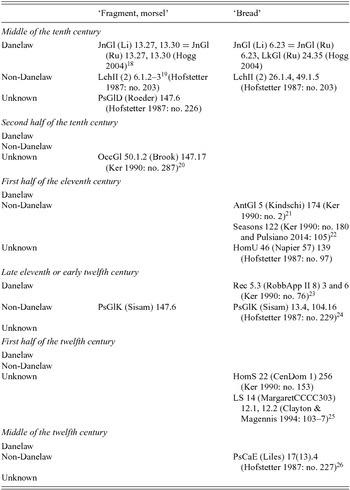
The uses of OE brēad are rather more restricted, in terms of numbers and chronological spread. Table 1 represents the chronological and dialectal distribution of all the occurrences of the two main meanings of the term in Old English texts: viz. ‘fragment, morsel’ and ‘bread’. Please note that the chronology and dialect given here for each attestation refer to the date and location of the text as it has reached us (i.e. the date and origin of the manuscript in most cases), and not necessarily to the composition of the text itself, although, as far the extant evidence suggests, there do not seem to be significant disparities in these respects for our purposes.
Chronological and dialectal distribution of the attestations of OE (-)brēad (except OE bēobrēad)

The data recorded in table 1 show a number of interesting points with regard to the use of OE brēad:
1. Even though the first attestations of the term are rather late (middle of the tenth century), we see that the two meanings of the noun, viz. ‘fragment, morsel’ and ‘bread’ are present from the beginning. In fact, the attestations of the term with the meaning ‘fragment, morsel’ are not particularly dominant, even in the earliest texts. The OED (1989: s.v. bread, n.) suggests that the attestation of the term in JnGl (Li) 6.23 = JnGl (Ru) 6.23 should actually be associated with the meaning ‘fragment, morsel’ not ‘bread’ because the context seems to refer to ‘broken bread’. However, there is no direct mention of this in the text, of course, other than the fact that this is a reference to John 6.11, where we are told that Christ distributed five loaves of bread and two fish amongst a multitude of followers by Tiberias (cp. ‘hlaf’ in Jn (WSCp) 6.23). A better case could be argued for LkGl (Ru) 24.35, where ‘on bretinge breodes’ renders L in fratione panis ‘in the breaking of the bread’; yet, interestingly, the closely related Lindisfarne glosses do not make any specific reference to fragments either, using OE hlāf in the equivalent context (viz. LkGl (Li) 24.35). Thus, it is difficult to accept fully the OED’s comment that in the Northumbrian glosses ‘bréad was not yet identified with panis’. In any case, we see that in Bald's Leechbook, which was copied on its manuscript in the second or third quarter of the tenth century from an exemplar likely to date from c.900 (Nokes Reference Nokes2004: 54), OE brēad is identified with L panis and means ‘bread’. This does not render evident that ‘fragment, morsel’ might have been the original meaning of the term, as suggested, for instance, by the OED (1989: s.v. bread, n.). Thus, instead of an example of pars pro toto in the semantic development of this term (cp. the northern dialect use of piece in British English to mean ‘bread’ and Slovenian ‘kruh ‘bread’ but literally ‘a piece, something broken off’; OED 1989: s.v. bread, n.), the Old English texts might record a case of totum pro parte (cp. G Brot ‘bread; slice of bread’ and Go. hlaifs meaning ‘fragment’; see above, section 2).
The significance of the meaning ‘bread’ for OE brēad already in its earliest attestations tallies with the use of its cognate OS brōd in the ninth-century poem Heliand (lines 1066, 2844, 2851 and 4633).Footnote 27 While in line 2844 it means ‘loaf’ (‘girstin brod fibi’, ‘five loaves made with barley’), in its other three occurrences it means ‘bread’. We might want to compare OS brōd in line 1066, which refers to the Devil's temptation of Christ in the wilderness (Matthew 4.3 and Luke 4.3), with OE hlāf, for instance, in Mt (WSCp) 4.3, Lk (WSCp) 4.3, MtGl (Li) 4.3 = MtGl (Ru) 4.3, LkGl (Li) 4.3 = LkGl (Ru) 4.3, Sat 671, and ÆCHom I 11 266.13, 267.47 and 272.169. The use of OS brōd in the Heliand agrees as well with what we find in the ninth-century Old High German poem Evengelienbuch by Otfrid von Weissenburgh: OHG brōt means both ‘loaf’ (‘finf girstînu brôt’; III.6.28) and ‘bread’, as is the case when it renders L panem in Matthew 7.9 (II.22.32).Footnote 28
2. From the eleventh century onwards OE brēad shows evidence of significant integration into the lexico-semantic field of bread:
-
(a) It is recorded in compounds for which there are no equivalents with OE hlāf: OE symbelbrēad ‘feast-bread’ (Seasons 122) and picgbrēad (AntGl 5 (Kindschi) 174). We cannot say that the use of OE brēad in the poem Seasons for Fasting responds to alliterative needs, because it is OE symbel rather than the head of the compound that alliterates; therefore, OE hlāf could have easily been used here as well. The presence of OE brēad in the other compound is even more interesting: OE picgbrēad renders L glans ‘acorn’,Footnote 29 which suggests that OE brēad is used here metonymically to refer to ‘food’ more generally.
-
(b) The fact that OE brēad could refer to ‘food’ more generally paved the way for its use to render L panem in the Lord's Prayer, where bread is to be understood as ‘a metaphor for all that is necessary for human nourishment’ (Brown Reference Brown2000: 605).Footnote 30 Thus, as noted above, fn. 26, we find the double gloss ‘breod ł hlaf’ in this context in the twelfth-century Canterbury Psalter (PsCaE (Liles)). This is particularly significant because the language in prayers tends to be rather conservative (think about the use of archaic forms, such as the second-person pronoun ‘thou’ and the verb form ‘art’, in the version of the Lord's Prayer still used by some Christian denominations nowadays; see further Kohnen Reference Kohnen, Jucker and Taavitsainen2010 and Reference Kohnen and Kytö2012). The usage of (a reflex of) OE brēad in the Lord's Prayer can frequently be seen in the early Middle English period (see below, section 4).
3. OE brēad meaning ‘bread’ is recorded in some texts that originate from the Danelaw and include a significant number of Norse-derived terms: the Northumbrian glosses to the Lindisfarne and Rushworth Gospels, and the will, probably from around Bury St Edmunds, referred to as Rec 5.3 (RobApp II 8) (see Pons-Sanz Reference Pons-Sanz2013: 134 and 144). Yet, this meaning is also recorded in other texts without a clear connection with the areas settled by the Scandinavian newcomers already from its attestation in Bald's Leechbook. Therefore, the evidence in favour of suggesting that OE brēad might have developed the meaning ‘bread’ because of Norse influence does not seem to be particularly compelling. As shown below, the dialectal distribution of ME brēd does not argue either in favour of identifying any Norse influence on the meaning of the term. The fact that its Old Saxon and Old High German cognates are also recorded with the same meaning in the ninth century similarly points towards a more generalized use of the term and not necessarily a semantic loan.Footnote 31
4 Use of the terms in early Middle English
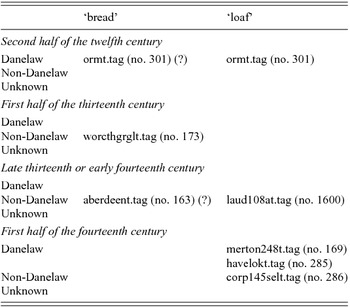
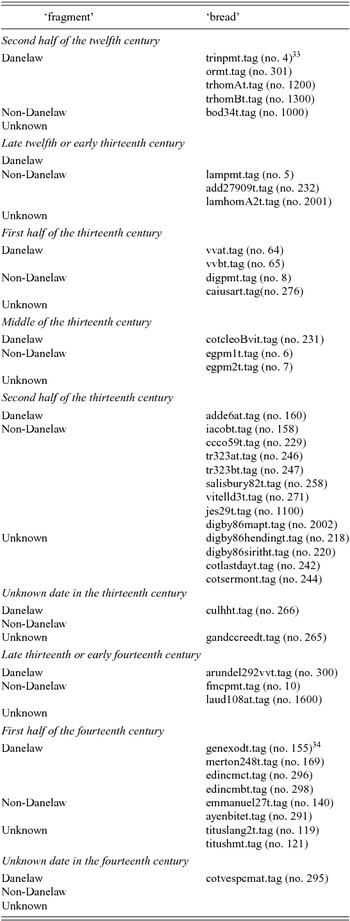
While OE hlāf is clearly the main term to refer to ‘bread’ during the Old English period, the situation in the early Middle English period is very different, as indicated by tables 2 and 3. They present the distribution of the uses of ME lōf and brēd, respectively, in terms of chronology and association with the Scandinavianized areas on the basis of the documents included in A Linguistic Atlas of Early Middle English (LAEME).Footnote 32
Chronological and dialectal distribution of the attestations of ME lōf in the LAEME corpus

Chronological and dialectal distribution of the attestations of ME brēd in the LAEME corpus

The documents included in LAEME do not necessarily reproduce whole texts and, therefore, do not present us with the whole picture; moreover, we need to take into account that some of the documents included in table 3 are various versions of the same text: for instance, digpmt.tag (no. 8), egpm1t.tag (no. 6), egpm2t.tag (no. 7), fmcpmt.tag (no. 10), jes29t.tag (no. 1100), lampmt.tag (no. 5) and trinpmt.tag (no. 4) include overlapping fragments of Poema Morale. Therefore, the figures for the attestation of the two terms are somewhat skewed. In spite of these issues, we can see some important changes in the lexico-semantic field, in terms of both the main term to express the meaning ‘bread’ and the semantic space covered by each term:
1. At a glance, it is obvious that ME brēd is attested much more widely than ME lōf and has already become the main term to refer to ‘bread’. From very early on we find it in contexts that had previously been dominated by OE hlāf, whether it refers to bread per se (e.g. ormt.tag (no. 301); cp. Johnannesson Reference Johannesson and McConchie2006: 70–1); or bread as metonymic for food or nourishment more generally (cp. the Middle English Dictionary [MED] 1952–2001: s.v. brēd, n.1, sense 4.a), as in references to the Lord's Prayer (arundel292vvt.tag (no. 300), ayenbitet.tag (no. 291), cotcleoBvit.tag (no. 231), culhht.tag (no. 266), gandccreedt.tag (no. 265), lamhomA2t.tag (no. 2001), merton248t.tag (no. 169), salisbury82t.tag (no. 258) and trhomAt.tag (no. 1200)), or to ‘heavenly bread’, the ‘bread of life’ and the bread used in the Eucharist (add27909t.tag (no. 232), ccco59t.tag (no. 229), emmanuel27t.tag (no. 140) and trhomBt.tag (no. 1300)). Thus, besides the Lord's Prayer, it is not difficult to find direct correspondences between Old and Middle English texts where OE hlāf has been replaced by ME brēd:
-
(a) In vvbt.tag (no. 65) ME brēd renders L panes in ‘Fuerunt mihi lacrimae meae panes die ac nocte’ (‘my tears have been my bread day and night’, as translated by the Douay-Rheims version of the Bible; Psalms 41.4), while the Old English versions have the plural hlāfas as the direct equivalent for L panes (PsGlA (Kuhn) 41.3, PsGlB (Brenner) 41.4, PsGlC (Wildhagen) 41.4, PsGlD (Roeder) 41.4, PsGlF (Kimmens) 41.4, PsGlG (Rosier) 41.4, PsGlH (Campbell) 41.4, PsGlI (Lindelöf) 41.4, PsGlJ (Oess) 41.4, PsGlK (Sisam) 41.4). It might have been the plurality of the noun (and hence its use as a countable noun) that steered the glossator of PsGlK (Sisam) away from the use of OE brēad in this context, while he was happy to use it elsewhere (see table 1); in vvbt.tag (no. 65) the seemingly singular form <bred> is recorded instead.
-
(b) We can compare Ælfric's rendering of Genesis 3.19 with the text given in the piece Louerd asse þu ard on god, as recorded in the thirteenth-century manuscript Cambridge, Trinity College, MS B.14.39 (fols. 36r–42r): ‘On geswincum þu leofast and on swate þu etst þinne hlaf on eorðan’ (ÆLS (Ash Wed) 16) vs ‘Wid suore & wid suinke þi breit þu salt biyeten’ (tr323at.tag (no. 246)).Footnote 35
2. In our corpus, ME lōf is only clearly attested with the meaning ‘bread’ in one document, worcthgrglt.tag (no. 173), which actually represents Old English usage in the sense that it includes a copy of Ælfric's Grammar and Glossary. ME lōf here appears as a gloss for L panis in various grammatical explanations on gender and tense (cp. ÆGram 55.7, 165.7 and 293.2). The situation in ormt.tag (no. 301), the Ormulum, is somewhat more complicated and this is the reason for the presence of the question marks in table 2. In his study on the make-up of the lexico-semantic field of bread in the text, Johannesson (Reference Johannesson and McConchie2006: 69) explains that
laf [‘unit of production, loaf’] and kechell [< OE coecil ‘little cake’] stand in a unit-of relationship to bræd [‘bread as a substance’], and *crumme [< OE cruma ‘crumb’] stands in a meronymic relationship to the other three.
It is clear that in some contexts of the text not included in LAEME ME lōf means ‘loaf’: in line 11788 it appears in a context referring to Christ's temptation in the wilderness by the Devil (‘Off staness makenn lafess’; cp. L panes in Matthew 4.3);Footnote 36 and in line 15511 we find a reference to Christ's feeding his followers with ‘fife barrliʓ lafess’. Yet, the meaning of the term in lines 1470, 1474, 1478, 1480, 1492, 1565, 1578 and 1602 is not as obvious. When explaining some of these lines, Johannesson (Reference Johannesson and McConchie2006: 74–5) gives both ‘bread’ and ‘loaf’ as translations of ME lōf:

We should note that the type A bread is no longer called bulltedd bræd, but is referred to as laf þatt iss wiþþ elesæw. / All smeredd wel. ˥ nesshedd (H1470f.), «a loaf that is smeared well with oil and made soft». It is only the fact that it is the first of the bread sacrifices to be given a Christian interpretation, as well as the insistence on oil and softness, that allows us to identify it with the bulltedd bræd of type A.
Moreover, although the glossary at the end of Holt's (Reference Holt1878) edition gives ‘loaf’ as the only meaning for ME lōf in the text, the MED (1952–2001: s.v. lōf, n.2, sense 1.c) cites lines 1480–1 (‘ʓiff þatt tu willt makenn laf / Þu þresshesst tine shæfess’) amongst the examples where the term should be interpreted as meaning ‘bread’; yet, Johannesson (Reference Johannesson and McConchie2006: 75) tells us that these lines introduce a ‘digression . . . on the making of a loaf’. The meaning of the term depends, to some extent, on the use of the indefinite article in the text: if Orm were consistent in his use of ME an as an indefinite article, the MED’s interpretation would seem more appropriate because we might have expected the article to be present if ME lōf meant ‘loaf’. However, the presence or absence of ME an in this context cannot be taken as indicative of the meaning of the term. Firstly, on the basis of the structure of the noun phrases where it occurs and its inflexional pattern, Palmatier (Reference Palmatier1969: 113) argues that ME an in the text still acts as a numeral and not as an article, as is the case with ME þe. Secondly, even if ME an were to act as an indefinite article in the text, its use in early Middle English was far from fully established (Mustanoja Reference Mustanoja1960: 231 and 259–72). Given Orm's concern about (obsession with?) the metrical structure of his work,Footnote 37 it would have been fairly easy for him to omit it in order to stick to his syllabic count (see Fulk Reference Fulk2012: 94). The range of meanings of ME lōf in the Ormulum, then, has to remain unclear.
The meaning of ME lōf in a stanza included in aberdeent.tag (no. 163; fol. 368v of Aberdeen, University Library, MS 154; see James Reference James1932: 51) is equally problematic:
Wane þe niþi(n)g his deyd me buriieth him cove
comez þe yunge strupling and wocth is loue
he drinket of his god ale an het of his lowe
an singez for his soule giuele goue.
‘When the wretched man is dead, he is buried in a pit; the youngster comes and woos his lover; he drinks from his good ale and eats from his lōf, and sings nonsense for his soul’.
It is difficult to establish whether ME lōf here means ‘loaf of bread’, ‘bread’ or ‘food’ more generally; the latter is the meaning that the MED (1952–2001: s.v. lōf, n.2, sense 1d) attributes to the term, while Hargreaves (Reference Hargreaves1969: 146) prefers ‘bread’.Footnote 38
In any case, even if these two problematic texts are included amongst those where ME lōf means ‘bread’, we see a clear predominance of the meaning ‘loaf’ for this term and, therefore, a change in its semantic space. This state of affairs anticipates the situation in Present-day English: the OED (1989: s.v. loaf, n.1, sense 1) marks the meaning ‘bread’ for PDE loaf as obsolete except in dialectal usage.
3. The change in the semantic space covered by OE brēad and its Middle English reflex is even more dramatic, as none of the texts in our corpus records it with the meaning ‘morsel, fragment’. The situation in our corpus is fully in keeping with what we find elsewhere in Middle English because the MED (1952–2001: s.v. brēd, n.1) does not record this meaning for ME brēd; similarly, the OED (1989: s.v. bread, n., sense 1) associates this meaning only with the Old English period. In the corpus we find that other terms are used to express the meaning ‘morsel, fragment (of bread or food more generally)’. As we would expect, most of them go back to the Old English period:
-
• ME crome (cp. OE cruma ‘crumb’): e.g. ayenbitet.tag (no. 291), caiusart.tag (no. 276), laud108at.tag (no. 1600) and ormt.tag (no. 301)
-
• ME morsel (cp. morsel, ultimately related to L mordere ‘to bite’): e.g. ayenbitet.tag (no. 291)
-
• ME shrēde (cp. OE scrēade ‘shred, cutting, scrap’ and scrēadian ‘to shred, peel, prune, cut off’): e.g. havelokt.tag (no. 285)
-
• ME snōde (cp. OE snǣd ‘piece, slice’ and snīðan ‘to cut’): e.g. ayenbitet.tag (no. 291)
-
• ME stiche (cp. OE stycce ‘piece, portion, bit, fragment’): e.g. digpmt.tag (no. 8), egpm1t.tag (no. 6), egpm2t.tag (no. 7), fmcpmt.tag (no. 10), and jes29t.tag (no. 1100), lampmt.tag (no. 5) and trinpmt.tag (no. 4).
5 Conclusion
This article has analysed in detail the uses of OE hlāf and brēad in Old and early Middle English and, in doing so, has argued against traditional views on the meaning of OE brēad. The article has established that, while OE hlāf is indeed the preferred term to refer to ‘bread’ in Old English texts, OE brēad is also recorded with that meaning from its earliest attestations. In fact, the earliest records of the term do not provide significant evidence in defence of considering that ‘fragment, morsel’ was its original meaning. This evidence, the dialectal distribution of the texts where OE brēad means ‘bread’ or ‘food’ and the use of its cognates in other West Germanic languages suggest that it is very unlikely that this noun represents a Norse-derived semantic loan. Instead, Jespersen's quotation seems to reflect the Victorian infatuation with the Vikings and their influence on Britain's cultural heritage (see Wawn Reference Wawn2000). Given the difficulty in identifying Norse-derived terms in English, particularly when there is no clear phonological or morphological evidence in favour of their Norse origin, it is fundamental to consider the extant data very carefully in order to gain a better understanding of the make-up of the vocabulary of medieval English and not to reproduce information that might owe more to ideology than philology.