




No CrossRef data available.
Article contents
- Abstract
- IntroductionI am grateful to Ulbe Bosma, Marcel van der Linden, and especially Femme Gaastra, who provided valuable feedback on a previous version of this article. I also wish to thank Jan Luiten van Zanden (supervisor) and Christiaan J. Van Bochove (who conducted the research) for showing me a research report from 2002 about employee arrangements in Asia.
- 1. Labor needs and recruitment in Europe and Asia
- 1.1 European Staff to Asia
- 1.2 Local staff in the Netherlands
- 1.3 Local staff overseas: free labor
- Seamen
- Soldiers
- 1.4 Unfree labor overseas
- 2. Working conditions, career, and labor relationships
- Conclusion
A Multinational and its Labor Force: The Dutch East India Company, 1595–1795
Published online by Cambridge University Press: 25 February 2005
Article contents
- Abstract
- IntroductionI am grateful to Ulbe Bosma, Marcel van der Linden, and especially Femme Gaastra, who provided valuable feedback on a previous version of this article. I also wish to thank Jan Luiten van Zanden (supervisor) and Christiaan J. Van Bochove (who conducted the research) for showing me a research report from 2002 about employee arrangements in Asia.
- 1. Labor needs and recruitment in Europe and Asia
- 1.1 European Staff to Asia
- 1.2 Local staff in the Netherlands
- 1.3 Local staff overseas: free labor
- Seamen
- Soldiers
- 1.4 Unfree labor overseas
- 2. Working conditions, career, and labor relationships
- Conclusion
Abstract
This essay focuses on the emergence of an international labor market connecting Europe with southern Africa and south and southeast Asia, showing the intertwining of commercialization and proletarianization in the institution that created and coordinated perhaps the most important international labor market connecting Europe to the Far East.
Information
- Type
- Research Article
- Information
- Copyright
- © 2004 The International Labor and Working-Class History Society
Introduction1 I am grateful to Ulbe Bosma, Marcel van der Linden, and especially Femme Gaastra, who provided valuable feedback on a previous version of this article. I also wish to thank Jan Luiten van Zanden (supervisor) and Christiaan J. Van Bochove (who conducted the research) for showing me a research report from 2002 about employee arrangements in Asia.
I am grateful to Ulbe Bosma, Marcel van der Linden, and especially Femme Gaastra, who provided valuable feedback on a previous version of this article. I also wish to thank Jan Luiten van Zanden (supervisor) and Christiaan J. Van Bochove (who conducted the research) for showing me a research report from 2002 about employee arrangements in Asia.
The VOC (Verenigde Oost-Indische Compagnie) was a major multinational in every sense of the word at a time when such companies were very rare indeed.2
An excellent reference to countless aspects of this operation, including archive files and bibliographies, appears in over 250 VOC sites accessible via the website www.londoh.com.
Sidney Pollard, The Genesis of Modern Management: A Study of the Industrial Revolution in Great Britain (London, 1965), 9; Robert C. Davis, Shipbuilders of the Venetian Arsenal: Workers and Workplace in the Preindustrial City (Baltimore, 1991).
Comparing the VOC (and its predecessors from 1595 until the company's official establishment in 1602) with the other European trading companies confirms that the Dutch firm was exceptionally large. In the sixteenth century the Portuguese dominated, but by the early seventeenth century the Netherlands had more operations in Asia than all other European nations combined. Although the gap narrowed in the eighteenth century, the Dutch preponderance continued until around 1750. Even thereafter, however, the VOC remained larger than any of its competitors. By the 1780s the English East India Company did send out as many ships as the VOC, but the (brief) surge in French shipping trade with Asia was truly remarkable during that period. This was possible only once the monopoly of the Compagnie des Indes was discontinued after 1770. The absence of the other competitors (the Portuguese, the Danish, the Swedish, the Southern Dutch, and the Prussians) from this article may appear surprising. Except for the Portuguese, though, who remained the largest presence until 1630, all these other initiatives, however interesting they were as such, were of little importance, especially as sources of employment. Altogether, the VOC transported more persons from Europe to South Africa and Asia than did the ships from all other European nations combined before 1800.4
Bruijn and Gaastra, 178–184. Since then the following additional publications have appeared about Dutch-Portuguese: Ernst van Veen, “De Portugees-Nederlandse concurrentie op de vaart naar Indië: 1596–1640,” Tijdschrift voor Zeegeschiedenis 22 [2003] 3–16, and Dutch-English competition: P. Marshall, “The Place of the Seven Years War (1756–1763) in the changing balance between Britain and the Netherlands in Asia” TVZ 20 (2001), 15–23. On Prussia, see D. de Graaf, “De Koninklijke Compagnie. De Pruisische Aziatische Compagnie von Emden nach China: 1751–1765” TVZ 20 (2001), 143–162.
The VOC was exceptional not only because of its size. Historians greatly appreciate the relative wealth of papers remaining about this company: an estimated 25 million pages of historical records, stored on over four kilometers of shelf space.5
The TANAP program (Towards a New Age of Partnership. A Dutch-Asia-South African Heritage Programme) activities are important in this respect. The website for this programme provides the following information: at present the archives cover 1.33 kilometers of shelf space in the National Archives of the Netherlands (The Hague), 2.5 kilometers are kept at the National Archives of Indonesia (Jakarta) under less satisfactory conditions, 322 meters are in the Cape Town Archives Repository, 310 meters are at the National Archives of Sri Lanka (Colombo), and smaller but nonetheless interesting collections are at the Tamil Nadu Archives (Chennai, India) and the Oriental and India Office Collections of the British Library (London) and elsewhere. Worldwide, all these papers are considered so important that they appear in their entirety on a provisional list of the UNESCO's Memory of the World Register.
Alex van Stipriaan and Ellen Bal, “De VOC is een geloof: Kanttekeningen bij een populair Nederlands imago,” Manon van der Heijden and Paul van de Laar, eds., Rotterdammers en de VOC. Handelscompagnie, stad en burgers: 1600–1800 (Amsterdam, 2002), 213–243. For responses see Marion Peters, In steen geschreven. Leven en sterven van VOC-dienaren op de kust van Coromandel in India (Amsterdam, 2002), 27–28; and Femme S. Gaastra, The Dutch East India Company: Expansion and Decline (Zutphen, 2003), 11–12.
Obviously not all—but a considerable share nonetheless—concern the role of the VOC as an employer, which is all the more reason to explore this remarkable company and its significance with respect to labor history.7
This article is based only on secondary sources: no new archival research has been conducted.
1. Labor needs and recruitment in Europe and Asia
The first letter of the abbreviation of VOC was very meaningful.8
The V in VOC stands for the Dutch word verenigd (united). On the history of the VOC, see Gaastra, 2003: a translation as well as an edited version of previous Dutch editions.
Els van Eyck van Heslinga, Van compagnie naar koopvaardij. De scheepvaartverbindingen van de Bataafse Republiek met de koloniën in Azië 1795–1806 (Amsterdam, 1988).
Throughout its lengthy existence, the VOC recruited labor in four different ways. The largest number of workers was hired at one of the six Dutch offices and subsequently dispatched to Asia.10
In addition to the sample data in Table 1, the non-European workers are likely to have been in far better health than the European ones, as will be explained below. Turnover was therefore probably lower among the Asian workers than among the European ones.
See Herman Ketting, Leven, werk en rebellie aan boord van Oost-Indiëvaarders (1595–1650) (Amsterdam, 2002), 219, for the seventeenth and Femme Gaastra, “Sware continuerende lasten en groten ommeslagh. Kosten en oorlogsvoering van de Verenigde Oost-Indische Compagnie” in Gerrit Knaap and Ger Teitler, eds., De Verenigde Oost-Indische Compagnie tussen oorlog en diplomatie (Leiden, 2002), 99–100, and Ibid. 2003, 164, for the eighteenth centuries.
Below these categories of workers are discussed at various points. I have not provided a systematic review of those employed indirectly, both for lack of sources and especially because the VOC did not set their terms of employment.
1.1 European Staff to Asia
The data are fairly accurate concerning the number of people who boarded over 4,700 ships bound for the East Indies between 1595 and 1795: nearly one million persons took ship from Europe in those two centuries, which averages 5,000 a year. We also know that over a third of a million people took ship in Asia on voyages back to the Republic, with the majority reaching Europe. Still, these figures do not reveal the total number of recruits by the VOC. After all, we do not know how many men—and nearly all the workers concerned in this article were men—were fortunate enough to return to Europe or had the courage to sign on for a second or third voyage. They knew that they were among the lucky few who survived the adventure. Besides industrious quantitative historians today,
Estimates of the number of workers directly employed by the VOCTable 1. Key: Row 1: Based on the numbers reported for 1790 (Gaastra, 2003, 163), the other figures are estimates according to the activity on the wharves (Bruijn, Gaaastra, and Schöffer, 1987, 52). See also Van Gelder and Wagenaar, 1988 and Gawronski, 1996, 43–45, 113. Rows 2 and 3: Gaastra 2003, 80–88; Bruijn and Lucassen, 1980, 135 (1687/1688). Row 4: Gaastra 1980a, 201; Gaastra 1980b, 443; Gaastra, 2003, 80–88, less the numbers indicated in the next rows in a few cases; where these figures deviate from Lequin, 1982, Appendix 4, I have used the latter, as they are more detailed. Row 5: my additions (rounded). Row 6: Gaastra, 1980a, 208; Gaastra, 1980b, 443; calculated for the eighteenth century based on Lequin, 1982, Appendix 4. Row 7: see the text and tables 3 and 4 below (these figures are higher than the ones in Lequin 1982, Appendix 4; Generale Missiven XI, 66, 726. Row 8: see the text and Table 5 below (Gaastra, 1980s, 208, Gaastra, 1980b, 443, Lequin, 1982, Appendix 4). Row 9: Raben, 1996, 86 (1,594 company slaves in Batavia alone in 1632); Vink, 2003, 166–167 for 1687/1688 and for other rough estimates see text below, based on which I assume that the figures in the eighteenth century were somewhat but not substantially higher than at the end of the seventeenth century (Van der Brug, 1994, 35, 152); with the ca. 2,000 slaves of the perkeniers (recruited from former officers of the Compagnie) on the Moluccas added in all cases. Row 10: rough estimate for Asians in 1625. Row 11: my additions.

contemporaries, definitely by the eighteenth century, were well aware of the risks of servingwith the VOC. This bad reputation resounds in the Malthusian saying: “Holland, indeed, has been called the grave of Germany,” which derives from older German authors. Around the same time that Thomas Malthus wrote, the well-known German playwright Heinrich von Kleist wrote about the East Indies: “and from there, as you know, only one out of three men returns.”14
Jan Lucassen, “The Netherlands, the Dutch, and Long-Distance Migration in the Late Sixteenth to Early Nineteenth Centuries” in Nicholas Canny, ed., Europeans on the Move. Studies on European Migration 1500–1800 (Oxford, 1994), 159; Roelof van Gelder, Het Oost-Indisch avontuur. Duitsers in dienst van de VOC (1600–1800) (Nijmegen, 1997), 49; Ibid. 2003, 490, fn.4. Regarding the cause, especially the spread of malaria after 1733 due to digging fish ponds, see P.H. van der Brug, Malaria en malaise. De VOC in Batavia in de achttiende eeuw (Amsterdam, 1994).
For a long time the prevailing opinion was that few men would be insane enough to sign on again with the VOC, but the actual data indicate otherwise. Reviewing the Delft chamber's shipping wage logs from the eighteenth century enables an estimate of the numbers who sailed on more than one voyage. Determining this information requires more detailed examination of the numbers that returned. The return rates for recruits from Delft were 30.2 percent for the soldiers and 60.5 percent for the sailors, respectively. The lower survival rates for the soldiers were attributable to the far less stringent selection of soldiers and their extended stays in barracks in Asia, where they were exposed to all kinds of diseases, as will be discussed below.15
K.L. Van Schouwenburg, “Het personeel op de schepen van de Kamer Delft van de VOC in de tweede helft van de achttiende eeuw” TVZ 8 (1989) 179–186; “Het personeel op de schepen van de Kamer Delft van de VOC in de eerste helft van de achttiende eeuw” TVZ 7 (1988) 76–93. According to van Schouwenburg's calculations, in the period from 1700 to 1794, 614 of the 2,035 soldiers from Delft returned, whereas 5,050 of the 8,340 seamen from Delft returned. Altogether, 4,711 Delft residents did not return, according to the ships' wage logs. See also Van der Brug, 1994, 186–188; Van der Heijden, 2002, 181.
The vast differences between persons from Delft and those from elsewhere, as noted by K.L. van Schouwenburg, may be attributable to their superior prospects for advancement on board, since many of the officers came from Delft
Seamen and soldiers on outbound and return journeys of the VOCTable 2. Key: Column 2: total in Bruijn, Gaastra, Schöffer, 1987, 170; distribution according to Bruijn and Lucassen, 1980, 80 (respective percentages 11.11, 40.03, 21.84, and 27.02). Column 3: percentages for the Netherlands equivalent to the ones for Delft in the eighteenth century (Van Schouwenburg, 1988 and 1989), which in Column 4 yields 140,000 returning foreigners; the difference between soldiers and sailors here is analogous to the one for the Netherlands (Bonke, 1999, 192–193). Column 4: my figures based on the percentages in Column 3.

as well.17
Jan Kees Beers and Cees Bakker, Westfriezen naar de Oost. De kamers der VOC te Hoorn en Enkhuizen en hun recruteringsgebied, 1700–1800 (Hoorn, 1990), 60; Perry Moree, “Gezagvoerders op VOC-schepen van de kamer Rotterdam in de achttiende eeuw,” in Manon van der Heijden and Paul van de Laar, eds., Rotterdammers en de VOC. Handelscompagnie, stad en burgers (1600–1800) (Amsterdam, 2002), 136–160.
I am grateful to Femme Gaastra for these useful suggestions.
As ships' wage logs for ship's crews are released, research will become easier in this field. See the Internet site http://voc.mindbus.nl/, which will be at the National Archive in The Hague in the future.
The high mortality rate among the VOC crewmembers may appear surprising, since most were young men. Being at sea was not the primary risk, although it was certainly a considerable one. About seven percent did not survive the outbound journey as far as the Cape of Good Hope, and another half of this share died along the rest of the route. Those were the deaths on board, not counting the cases where ships were wrecked, seized, or sold, or failed to reach the Cape for some other reason. Altogether, eighty to eighty-five percent of those embarking in the Republic reached their destination. But arrival at their destination did not mean the crewmembers were out of danger. In fact, the death toll was highest during the days and weeks immediately following arrival in Asia. Nearly 95,000 employees of the VOC died at the hospital in Batavia between 1725 and 1786, for example, an average of over 1,500 a year during a period when about 6,000 Europeans arrived each year. The return trip was less dangerous than the outbound journey, as ninety percent survived.20
J.R. Bruijn, F.S. Gaastra, and I. Schöffer, Dutch-Asiatic Shipping in the 17th and 18th Centuries (The Hague, three volumes, I [1987], II [1979], III [1979]), 161–172; Frank Lequin, “A New Approach to the History of the Dutch Expansion in Asia: the Personnel of the Dutch East India Company in the XVIIIth Century” Journal of European Economic History 8 (1979), 435; Ingrid Dillo, De nadagen van de verenigde Oostindische Compagnie 1783–1795. Schepen en zeevarenden (Amsterdam, 1992), 99–102.
Lequin, 1979, 435. British survival rates later improved considerably. See Van der Brug, 1994, 188; Philip D. Curtin, Death by Migration: Europe's Encounter With the Tropical World in the Nineteenth Century (Cambridge, 1989).
Van Schouwenburg has examined in what measure those who returned signed on for a second journey. Based on a small sample, he demonstrates that among the higher-ranking crewmembers, i.e. those who earned at least fourteen guilders a month (no more than ten percent of all those on board) half of those who returned (and this group had a survival rate of seventy-five percent) sailed for the Indies again within the year.22
Van Schouwenburg, 1988, 89–90 (the sample is for 1729 and concerns thirty-three persons).
Van Schouwenburg, 1988, 86 and Id., 1989, 183.
This rough estimate of the duplicates is based on the following assumptions: Ten percent of all those on board were officers. Of the sixty-five percent who returned, half signed on again, which yielded ca. 30,000 persons; of the remaining ca. 200,000 seamen, half returned, and one-third of that group signed on for another journey, which would be another 30,000 persons. Allowing for a few returning soldiers and persons making three or more voyages might amount to 75,000 persons altogether.
This immense need for workers soon depleted the supply on the Dutch labor market, not so much in numerical terms as because of the major objections among many inhabitants—especially among those in the maritime districts—to employment as an ordinary soldier or sailor. Which factors are likely to have encouraged proletarians nevertheless to sign on or, conversely, to have discouraged them from signing on with the VOC? Wages were low (108 guilders a year around 1650), although food and lodging were included. Overall, earnings matched those of an unskilled laborer ashore (206 guilders around that period) or of a seaman with the navy.25
Ketting, 2002, 59–61.
Ketting, 2002, 52–54 reaches this conclusion about the years 1630–1650. On later periods, see Manon van der Heijden, “Achterblijvers. Rotterdamse vrouwen en de VOC (1602–1750)” in van der Heijden and van de Laar, eds., Rotterdammers en de VOC, 181–212, and Danielle van den Heuvel, “Bij uijtlandigheijt van haar man. Echtgenotes van VOC-zeelieden, aangemonsterd voor de kamer Enkhuizen (1700–1750)” (MA Thesis, Free University of Amsterdam, 2003). Wives of officers were better off, as evidenced by letters of one: Perry Moree, ed., Kikkertje lief. Brieven van Aagje Luijtsen geschreven tussen 1776 en 1780 aan haar man Harmanus Kikkert stuurman in dienst van de VOC (Texel, 2002).
Ketting has recently demonstrated that in the late sixteenth century nearly all those on board came from the seaside districts (especially from the towns there). The activities of the Compagnie increased so much, as did the need for soldiers, that the tight labor market of the Republic soon became insufficient in the course of the seventeenth century. While the absolute number of crewmembers from Holland or Zeeland did not diminish, their relative share did. During the 1640s the area of recruitment expanded to include Flanders and Brabant in the South and Northwest Germany and Denmark in the North. Later on, Norway and inland Germany were added, thereby expanding the VOC labor recruitment pool to include nearly all of Western Europe.27
J.R. Bruijn and Jan Lucassen, eds., Op de schepen der Oost-Indische Compagnie. Vijf artikelen van J. de Hullu (Groningen, 1980); Jan Kees Beers and Cees Bakker, Westfriezen naar de Oost. De kamers der VOC te Hoorn en Enkhuizen en hun recruteringsgebied, 1700–1800 (Hoorn, 1990); Ketting, 2002, 41–51.
Examples of both appear in van Gelder 1997 (German edition: Das ostindische Abenteuer. Deutsche in Diensten der Vereinigten Ostindischen Kompanie der Niederlande (VOC), 1600–1800 [Hamburg, 2004]), and van Gelder, Naporra's omweg. Het leven van een VOC-matroos (1731–1793) (Amsterdam, 2003). Even Germans who left the service with sufficient savings often had trouble adjusting and were sometimes unable to, as the local elite refused to tolerate ostentatious conduct on the part of a local resident who had left in search of his fortune and returned as one of the nouveau riche.
The international labor market that emerged in the Republic was not the work of the VOC alone and was not even exclusively attributable to the shipping trade in general.29
Karel Davids, “Maritime Labour in the Netherlands, 1570–1870,” in Paul van Royen, Jaap Bruijn, and Jan Lucassen (eds), “‘Those Emblems of Hell’? European Sailors and the Maritime Labour Market, 1570–1870” (St. John's, Newfoundland, 1997), 41–71, features an interesting account of the seamen in the Netherlands.
Lucassen, 1994, 165–169, 183; Lucassen, “Mobilization of labour in early modern Europe,” in Maarten Prak, ed., Early Modern Capitalism. Economic and social change in Europe, 1400–1800 (London, 2001), 167; Bruijn and Wels, 2003.
This pattern of recruiting labor primarily through free immigration was fairly unique in early modern Europe.31
Lucassen, 2001. For maritime labor see Lucassen, “The International Maritime Labour Market (Sixteenth-Nineteenth Centuries),” in van Royen, Bruijn, and Lucassen, eds., “Those Emblems of Hell?”.
1.2 Local staff in the Netherlands
In this article about global labor history, we will not dwell extensively on the VOC staff employed ashore at the different chambers.32
Gaastra, 2003, 163.
Deurlo, A.J., “Bijltjes en klouwers. Een bijdrage tot de geschiedenis der Amsterdamse scheepsbouw, in het bijzonder in de tweede helft van de achttiende eeuw,” in Economisch– en Sociaal–Historisch Jaarboek 34 (1971), 8.
B.E. van Bruggen, “Schepen, ontwerp en bouw,” in: Maritieme Geschiedenis der Nederlanden 3 (Bussum, 1977), 57; Roelof van Gelder and Lodewijk Wagenaar, Sporen van de Compagnie. De VOC in Nederland (Amsterdam, 1988); extensive details about Amsterdam in the eighteenth century appear in Jerzy Gawronski, De Equipagie van de Hollandia en de Amsterdam. VOC-bedrijvigheid in 18 de-eeuws Amsterdam (Amsterdam, 1996), 43–130.
Deurlo, 1971.
1.3 Local staff overseas: free labor
A comprehensive list of the VOC staff overseas is impossible to provide at this time, except for the workers recruited in Europe (see the many question marks and estimates in Table 1). Europeans who survived the outbound journey and the first critical weeks following their arrival usually served at one of the many VOC sites from the Cape to Japan or on a ship in between. After all, Europeans who signed on with the VOC did so for at least three years.
This did not, however, fill the needs of the VOC, neither ashore or at sea, although European personnel was preferred and was in some cases cheaper.36
F.S. Gaastra, “De VOC in Azië tot 1680,” in Algemene Geschiedenis der Nederlanden 7 (Bussum, 1980A), 207; Remco Raben, Batavia and Colombo: The Ethnic and Spatial Order of Two Colonial Cities 1600–1800 (PhD Thesis, Leiden, 1996).
In its quest for local staff, the Compagnie drew a different distinction between Europeans and Asians than we might expect: the “Europeans” in Table 1 included Asian-born descendants of Compagnie employees who were of European or mixed European-Asian heritage. Around 1700, Asian-born “Europeans” are believed to have accounted for one sixth of all persons employed there, i.e. about 2,500 persons. In 1786 on Ceylon, which had a fairly large “European” community, fully two thirds of the civil servants were from the East Indies and Ceylon, as were half the soldiers.37
F.S. Gaastra, “De VOC in Azië 1680–1795,” in Algemene Geschiedenis der Nederlanden 9 (Bussum 1980B), 445, according to Van Goor, 1978, 16 and 173, fn. 78. The author is not entirely clear. He writes “In 1786 243 ‘Landskinderen' were figuring amongst the 306 servants in the civil ranks. Amongst the 4,435 compagnieservants including the soldiers, 816 were born in the country. The number of 3,039 soldiers consisted of 1,192 Muslims and sepoys, 264 ‘Landskinderen' and 1,583 Europeans”; Raben, 1996; Ulbe Bosma and Remco Raben, De oude Indische wereld 1500–1920 (Amsterdam, 2003).
Pieter van Dam, Beschryvinge van de Oostindische Compagnie 7 vols. (Nijhoff, 1927–1954), vol.1 (1927) 605: (“ . . . [those who] married indigenous women and have consequently deprived themselves of the opportunity to return or be sent back to the Netherlands”).
The Asian and African employees ashore are difficult to quantify. As apparent from Table 1, the figures fluctuated so much, e.g. between 1687/88 and 1700, that their accuracy is questionable. Europeans almost seem to have been included in some figures but not in others. At any rate the numbers were modest, especially when divided among the dozens of sites where the Compagnie operated. Nor were the Asian seamen very numerous, although they did increase toward the end of the eighteenth century. In Batavia (now Jakarta) many artisans were probably Chinese; in the shipbuilding yards alone, hundreds of Chinese ship's carpenters were employed in the eighteenth century. Despite the high wages they demanded, they were hired for lack of Europeans.39
Van der Brug, 1994, 152; Els Jacobs “VOC-scheepvaart binnen Azië. De Lokhorst als lokaas, of hoe het standaardwerk Dutch-Asiatic Shipping een Aziatisch complement kan krijgen,” in Leo Akveld, ed., In het kielzog. Maritiem-historische studies aangeboden aan Jaap R. Bruijn bij zijn vertrek als hoogleraar zeegeschiedenis aan de Universiteit Leiden (Amsterdam, 2003), 177, 187.
C.R. Boxer, The Dutch Seaborne Empire 1600–1800 (Harmondsworth, 1973), 239–249, 258–259; Johan Talens, Een feodale samenleving in koloniaal vaarwater. Staatsvorming, koloniale expansie en economische onderontwikkeling in Banten, West-Java (1600–1750) (Hilversum, 1999), 212–217, summarizes the debate well and applies it to West Java; on East Java, see Gerrit J. Knaap, Shallow Waters, Rising Tide: Shipping and Trade in Java around 1775 (Leiden, 1996), 163–207. Ibid., 155 for the relationship between coin circulation and wage payments; Talens, 1999, 227–232.
Seamen
Before describing Asian seamen with the VOC, we should consider that the shipping industry was already vast before the Dutch and even before the Portuguese entered the scene. Far from disappearing afterwards, the trade appears to have increased. Presumably, the Europeans took over the broad network with larger ships, while the Asians set up a more intricate network of smaller ships with their own crews. In 1774–1777, for example, the VOC accounted for only fifty-one percent of the shipping volume at fifteen Javanese ports. Javanese and Chinese operated most of the other half. These 8,000 Asian captains probably employed 65,000 to 70,000 men, including eighty-five percent Javanese, who worked as fishermen for part of the year as well. The labor market for Asian seamen was therefore substantial.41
Knaap, 1996, 48, 69; Jacobs, 2003, 185, 191; and Ravi Ahuja, “The Origins of Colonial Labour Policy in late Eighteenth-Century Madras,” International Review of Social History 44 (1999), 159–195.
In the seventeenth century Asian seamen were rarely reported as working for the VOC, except for the crews on the hongi expeditions, which will be reviewed in the discussion about the Asian soldiers. For the voyage from Batavia to Cochin in 1669, 134 Ambonese and other Indonesian seamen were recruited, despite the objection that indigenous seamen were unreliable. If they did not like a situation, they simply abandoned ship.42
Van Dam, II-2 (1932) 299. Generale missiven van gouverneurs-generaal en raden aan Heren XVII der Verenigde Oostindische Compagnie, ed., W.Ph. Coolhaas et al.: Rijks geschiedkundige publicatiën, grote serie 104, 112, 125, 134, 150, 159, 164, 193, 205, and 235, 10 vols., (The Hague, 1960–1995), III, 463–464.
Van Dam, II-2 (1932) 114; Ibid. III (1943) 325. Generale Missiven IV, 690, VI, 242, 627; VII, 160.
In the eighteenth century, the rising mortality rate among the Europeans led to such a severe shortage of sailors and soldiers that Asians were accepted as crew members for the return voyages. At least this is suggested by the prohibition that was apparently deemed necessary 1715.44
The following primarily according to J.R. Bruijn, “De personeelbehoefte van de VOC overzee en aan boord, bezien in Aziatisch en Nederlands perspectief,” Bijdragen en Mededelingen betreffende de Geschiedenis der Nederlanden 91 (1976), 229–230; Dillo, 1992, 104–112, 161–165; Raben, 1996, 100.
Generale Missiven XI, 66, 167, 307, 514, 726, 774.
Asian seamen employed by the VOC, 1784–1793Dillo, 1992, 105, 162, based on resolutions of Governor General and Council. Frank Lequin, “Het personeel van de Verenigde Oost-Indische Compagnie in Azië in de achttiende eeuw, meer in het bijzonder in de vestiging Bengalen” (2 vols., PhD Thesis, Leiden, 1982), 409, yields far lower figures based on general muster-roll of the company personnel until 1789, although Dillo appears more detailed and consequently more reliable in this respect (see also Van der Brug, 1994, 152), although she may also be underestimating the figures, see the critical remarks of Els Jacobs, Koopman in Azië. De handel van de Verenigde Oost-Indische Compagnie in de 18de eeuw (Zutphen, 2000), 277, fn. 8, and Jacobs, 2003, 190–191. On the return fleet see Table 4.

In the long run, Asians became indispensable on the returning vessels. In 1781 the VOC decided to take non-Europeans on board at all five ports from where ships departed directly for Europe: free Christians in Coromandel, Muslims in Bengal, Muslims on Ceylon as well, Macao Portuguese in China, and Javanese and Chinese in Batavia. On board the return fleet of 1792 at the Cape were 233 lascars, 101 Javanese, and 504 Chinese seamen, in addition to 579 European ones, which meant that a majority of fifty-eight percent was not from Europe! The number of Asians appears to have increased steadily to an average of twenty-five in the late 1780s and thirty to forty in the final years of the Compagnie. These data suggest that around 1790, when about fifteen large ships departed from Asia each year, at least 1,000 Asian seamen were en route between the Netherlands and Asia in one direction or the other. This is indeed a minimum, as it is very likely that Asians also sailed on the many smaller vessels.
Asian seamen per ship between Asia and Europe, 1784–1794Based on four ships headed homeward in 1789 and two ships in 1791 (Bruijn, Gaastra, and Schöffer, III 1979, 522–566) and reconstructed according to Bruijn, 1976, 230, for 1792, assuming that each ship headed homeward averaged seventy seamen to the Cape (Ibid., for 1792 based on nine ships, for which the numbers of seamen are known); also based on one outbound ship in 1784, three ships in 1785, one ship in 1790, six ships 1791, and three ships in 1793 (Bruijn, Gaastra and Schöffer II, 1979, 707–760) and based on three ships in Dillo, 1972, 164, for 1794. Large ships weighing at least 880 tons have been counted according to their country of origin, while the Pinken, Fluiten, and Hoekers with their far smaller crews have been excluded. See also Hans Bonke, De zeven reizen van de Jonge Lieve. De Biografie van een VOC-schip, 1760–1781 (Nijmegen, 1999), 60, and on lascars on English ships, Rozina Visram, Asians in Britain: 400 Years of History (London, 2002), 14–33.

Soldiers
While the demand for Asian seamen was strongest in the eighteenth century, the need for soldiers arose far earlier. Regardless of how many soldiers the Compagnie tried to lure in Europe, territorial expansion in Asia forced the VOC to recruit additional soldiers on site. Forced was indeed the key word, as the VOC was suspicious of these Asian soldiers and feared they would copy tricks from the Europeans to use against them when the time came.48
Van Dam, III (1943) 325; Raben, 1996; Gerrit Knaap and Ger Teitler, eds., De Verenigde Oost-Indische Compagnie tussen oorlog en diplomatie (Leiden, 2002).
Gaastra, 2003, 87. On the reserve troop system, see Remco Raben, “Het Aziatisch legioen. Huurlingen, bondgenoten en reservisten in het geweer voor de Verenigde Oost-Indische Compagnie,” in Knaap and Teitler, 2002, 192–198. See also Talens, 1999.
Despite countless examples of recruitment of Asian soldiers, starting with the Japanese in 1612, few statistical conclusions can be reached at this time. These would require a complete account of all available material, as has been compiled for the European seamen and is well under way for the Asian seamen. In a fundamental article about this issue, Remco Raben notes that the VOC records do not enable scholars to infer how many Asian soldiers worked for the VOC. In his view, though, there must have been hundreds of thousands.50
Raben, 2002, 182, 185; Raben, 1996.
Gaastra, 1980A, 202; Dirk Kolff, Naukar, Rajput and Sepoy: The ethnohistory of the labour market in Hindustan, 1450–1850 (Cambridge, 1990), 4–6, 152.
Origin of soldiers deployed directly by the VOC on CeylonVan Dam, II-2 (1932) 350; J. van Goor, Jan Kompenie as Schoolmaster. Dutch Education in Ceylon 1690–1795 (PhD Diss., Utrecht, 1978), 17, 162–164 (glossary), 173 fn.78, 85 (but different figures for 1765 in Raben, 1996, 147); Raben, 2002, 199–200 (1794: out of fifty companies, twenty-four companies were “easterners and sepoys,” two companies “lascars”). A company comprised 60 to 100 men (Talens, 1999, 96).

On Java, the hub of the VOC in Asia, many indigenous troops were employed directly by the VOC as well.53
Many examples also appear in Raben, 1996 and 2002.
Van, Dam I-1 (1927) 605–606 (nearly 19,000 rijksdaalders [2.50 guilder coins] were spent on wages for 652 persons, with an additional 60,000 rijksdaalders for an unspecified number, yielding a total of ca. 2,500, suggesting that each company comprised approximately 150 soldiers). On the Ambonese, see Raben, 2002, 188–191.
The biggest difference between soldiers recruited individually or as army units concerned the terms of employment. While the VOC bore sole responsibility for remuneration of the individually recruited soldiers, it shared this task with the aristocratic or sovereign commander for those recruited as army units. The contract that the Compagnie signed with the Sultan of Ternate in the late 1770s for 300 soldiers to be stationed on Sulawesi stipulated that the sultan would receive eight guilders a years for each soldier, and that the Compagnie would provide them with food and uniforms.55
Jacobs, 2000, 30.
Wherever the VOC had territorial sovereignty, it was in a position to recruit soldiers directly. These soldiers would be paid in cash, in kind or through the provision of farmland, as happened around Batavia and on Ceylon from 1678 onward in lieu of direct payment.56
Van Dam, II-2, 343; Van Goor, 1978, 13; Raben, 1996, 142–147; Generale Missiven IV, 394; VII, 308, 310, XI 181, 281–282, 426, 688.
However many Asian soldiers may have worked for the VOC, other potentates surpassed the importance of the VOC in the course of the eighteenth century. Sepoys were recruited by the French and British rivals in far greater numbers. In Bengal the EIC had 25,000 sepoys in 1768 and 40,000 in 1784. Contemporary Indian sovereigns successfully modernized their armies as well at the time.57
Raben, 2002, 203; In addition, Van der Brug, 1994, 188, reveals that mortality rates were far lower in British India than in the Netherlands Indies.
1.4 Unfree labor overseas
As is the case with the Asian soldiers, the quantitative history of the unfree workers of the VOC has yet to be written, although the doctoral thesis of Remco Raben and the recent article by Markus Vink are a good start.58
Raben, 1996, esp. 119–132; Markus Vink, “‘The World's Oldest Trade’: Dutch Slavery and Slave Trade in the Indian Ocean in the Seventeenth Century,” Journal of World History 14, No.2 (2003), 131–177; Van Stipriaan and Bal, 2002, 232–236).
As a trading company, the VOC did not aim primarily to organize production of colonial products and therefore had little interest in controlling unfree workers directly in most cases. The Banka tin mines, for example, had long been run by Chinese combines. There were, however, significant exceptions. In some places, such as on the Banda Isles in the Moluccas, on the Cape and on the northeast coast of Java and under certain conditions elsewhere, substantial unfree labor existed under the VOC administration.59
Jacobs, 2000, 25; G.J. Knaap, Kruidnagelen en Christenen. De Verenigde Oost-Indische Compagnie en de bevolking van Ambon 1656–1696 (Dordrecht, 1987), 138–160.
The small Banda Isles were the only place in the world where mace and nutmeg could be obtained until the early nineteenth century. In 1621 virtually all inhabitants were massacred or driven out by the VOC, which subsequently established a plantation settlement, where the seventy plantations (perken), each tended by about twenty-five slaves brought in from elsewhere, were entrusted to retired officers of the Compagnie (perkeniers). The VOC protected its monopoly by joining forces with rulers of the northern Moluccas to check whether any nutmeg trees (of which the fruits provided mace and muscat) were secretly grown outside Banda. Any such trees found were destroyed. Illegal cultivation of cloves outside Ambon was controlled in the same vein through the hongi–voyages, organized as labor services one month a year. Because the VOC was directly involved in all aspects of production, including the supply of slaves, this unfree labor appears in Table 1 as well, although one might argue that they in fact worked for the perkeniers and only indirectly for the VOC.
On the Cape slaves were used first of all on the farms that provisioned the ships that replenished their supplies half way between Asia and Europe. Here, too, the VOC owned hardly any slaves and left this arrangement up to the former servicemen or settlers who had come directly from Europe for this purpose. Approximately 60,000 slaves were brought in (originally mostly from India, Indonesia, and Madagascar, with only a few from black Africa60
On the stereotyping of slaves, see Robert Ross, Status and Respectability in the Cape Colony, 1750–1870: A Tragedy of Manners (Cambridge, 1999), 34–37.)
Ibid., 6.
Pieter van Duin and Robert Ross, The economy of the Cape Colony in the eighteenth century (Leiden, 1987), 9–12, 83- 112–125, Ross, 1999, 6–7.
In an effort to obtain much-needed wood, the VOC took over the logging industry on Northeast Java in the last quarter of the seventeenth century, instead of waiting for what it considered to be overpriced supplies from local rulers. It later arranged its own supply of other products as well, such as rice.63
Luc Nagtegaal, Riding the Dutch tiger. The Dutch east Indies Company and the northeast coast of Java, 1680–1743 (Leiden, 1996), 193–227.
At the large VOC settlements, such as those in Batavia and Colombo, slaves were put to work mainly as servants, artisans, and unskilled workers (coolies) or farmers. Each year the VOC purchased hundreds of slaves in Batavia from Asian dealers to have them perform duties for which they were unable to recruit Europeans. In 1694 on the small island of Onrust, 215 Compagnie slaves (including 133 men, 63 women, and 19 children) worked on the wharf, as well as 953 others (including 360 women and girls) elsewhere in the city. They worked under their own foremen (who were also slaves and were known as mandadors or mandurs, as were the supervisors of indigenous seamen). In addition, there were 383 forced laborers, known as chain gang workers, whose duties included dredging the city canals. Finally, also in 1694, the VOC hired another 579 slaves (known as coolies) from civilians. The justification for all these unfree workers—over 2,100 altogether—was, as reported by Van Dam, the high cost of free labor. He even complained about the cost of the leased slaves.64
Van Dam III, 201–208, 219–222; Marijke Barend-Van Haeften, Oost-Indië gespiegeld. Nicolaas de Graaff, een schrijvend chirurgijn in dienst van de VOC (Zutphen, 1992), 159–165; Raben 1996, 119–132.
The VOC also used slave labor at some of its industries, such as in the gunpowder mills in Batavia, on Ceylon, in Bengal, and in a few other places where slaves used niter (saltpeter or potassium nitrate) to produce gunpowder, as well as in the gold mines on Sumatra. Others besides the Compagnie used slave labor. As was the case on the Cape, these other parties owned far more slaves than the Compagnie did. In the mid-eighteenth century, Batavia, a city with 20,000 inhabitants inside and 100,000 inhabitants outside its walls at the time, had 30,000 slaves, including 13,000 inside its walls. The Compagnie owned only 1,850 of them. The rest were equally divided between Arab, Indian, and Indonesian owners on the one hand and European and Chinese owners on the other hand. In 1779 the total number for Batavia and Ommelanden had even risen to over 40,000, an all-time maximum.65
Van der Brug, 1994, 33–34. For extensive information about the number of slaves in Batavia and Colombo, see Raben, 1996, esp. 84–105.
Overall, direct use of slaves by the VOC (i.e. slaves owned or rented by the Company) was rather modest compared with the total number of staff, although slaves still accounted for thirty-five to forty percent of the staff recruited in Asia. As Vink has demonstrated, the VOC did far more to perpetuate and expand slavery than the size of its work force would suggest. While Compagnie slaves numbered in the thousands, the slaves owned by private parties from whom the Compagnie purchased its monopoly products totalled tens of thousands in the eighteenth century, especially on the Cape, as well as on Banda and elsewhere on the Moluccas. These private parties came from various backgrounds: on the Cape they were of European and on Banda of mixed European-Asian heritage, in Batavia European slave owners were in the minority, and elsewhere most slave owners pertained to the local Asian elite. After all, slavery was widespread in the areas where the VOC operated. The VOC neither invented (although it may have in fact done so on the Cape) nor abolished the practice but is far more likely to have caused unfree labor to increase than to decline. This is eminently clear for Banda, the Cape and northeast Java and may be assumed to hold true for Batavia as well, although it is less obvious for Ambon.66
Knaap, 1987, 124–137; Talens, 1999, 139 for convict labor.
Jacobs, 2000, 98, 130, 175, 211. On the other hand, slaves could be freed and might even pursue a career, see Raben 1996, and Bosma and Raven, 2003, 55–59.
Examining the slave shipments provides the clearest indicator of the significance of slavery in the VOC-controlled area. While most VOC ships transported entirely different cargo, Vink estimates that at the end of the seventeenth century the total annual slave trade amounted to at least 3,730 to 6,430 people, with slightly more men than women. Until around 1660, they came mainly from South Asia, later on somewhat more from Southeast Asia (predominantly by Makassarese and Balinese traders), and toward the end of that century, Madagascar became an important source of supply. Vink infers that “the volume of the total Dutch Indian Ocean slave trade was therefore fifteen to thirty percent of the Atlantic slave trade, slightly smaller than the trans-Saharan slave trade, and one-and-a-half to three times the size of the Swahili and Red Sea coast and the Dutch West India Company slave trades.”68
Vink, 2003, 168.
2. Working conditions, career, and labor relationships
Generalizing about the universal working conditions and career opportunities of the VOC workers as a whole is difficult. This would require a complete catalog of all the different working conditions, from shipyard workers in Amsterdam to slaves on the Moluccas, from scribes in Middelburg to soldiers in Bengal. Many of these conditions were commonplace: thousands of shipbuilding carpenters and office clerks were employed in the Republic outside the VOC, hundreds of thousands if not more soldiers were stationed in Asia, and slaves on that continent are sure to have numbered in the millions. The VOC stood out for its effort, with due regard for profit and loss on its trade, to exert a central influence on the working conditions of all its tens of thousands of workers. This applied the most to the operations and labor relationships aboard its ships, which were meticulously regulated.
Asians were exceptional amid the countless seamen from all over the world. Although as we have noted their presence dates back to the mid-seventeenth century, their number rose to at least 2,000 by the second half of the eighteenth century and to 2,500 by the end of the century. At first the VOC recruited mainly Indians, although later on Chinese recruited in Indonesia dominated, especially on the long voyages. Indonesians appear to have been the smallest group. All these Asians sailed primarily between India, Ceylon, Indonesia, and China, although several reached Amsterdam toward the end of the VOC. A wide gap separated these people from the Europeans.69
The following is based primarily on Dillo, 1992, 104–112 and 161–165.
While Asians alone were a diverse group, to say nothing of Asians and Europeans together, the Europeans themselves were far from homogenous. We will therefore overlook the separate category of the passengers, and similarly attribute no special significance to the artisans. Instead, we will cover the majority on board: sailors and soldiers. In the 1630s the VOC began its ongoing effort to recruit large numbers of soldiers. From this point onward, the soldiers were at odds with the sailors. According to Ketting, these differences became especially pronounced after 1650. A probable exacerbating factor was that the soldiers were recruited increasingly from inland areas, unlike the seamen, who continued to be recruited mainly from the coastal regions.70
Van Gelder, 1997, 152; Ketting, 2002, 219, 231–232; Cf. however Bruijn and Lucassen, 1985, 110, where the animosity between soldiers was referred to as “the old passion” by 1639.
On board the ship, seamen were divided by the steward (the bottelier: the petty officer responsible for distributing food and drink) into so-called “bins” (bakken) of seven men each. Rations were distributed according to these units, and eating utensils and cups were shared by the group. Bins usually comprised men with similar or related responsibilities. Soldiers and petty officers were therefore usually assigned to separate bins. Officers dined after the common folk had finished in the cabin. Assigning a name to each bin is likely to have promoted cohesion.71
Ketting, 2002, 140–144; Van Gelder, 1997, 158; Bruijn and Lucassen, 1985, 116–117.
Ketting 2002, 137–140; Van Gelder, 2003, discusses the friendships of a sailor called Naporra in detail.
Until well into the eighteenth century, the VOC had no fixed provisions for advancement. Nor was formal training provided, except to navigating officers, surgeons, sick visitors, and presumably bookkeepers. The only hope of advancement among the lower-ranking staff was therefore through experience on board. With the exception of the captain, everybody on board may have started at the bottom. Most petty officers probably started as ordinary sailors. What were the prospects for advancement?
Keeping the ship in good working order required dividing all duties and responsibilities very specifically, if only to prevent hundreds of people from getting in each other's way all the time in such a small space. Still, seamen could switch duties, simply because deaths and accidents kept leaving vacancies that needed to be filled.73
The following estimates are based on Van Schouwenburg, 1988 and 1989.
On the outbound journey, some of the thirty to thirty-five officers whose monthly wages were fourteen guilders or more would have to be replaced by lower-ranking men. On the return voyage, the likelihood of advancement was greater still, since only two thirds of the Dutch officers actually returned. Even though ships made their return voyages with fewer crewmembers and officers, at least one third of the officers on the return journey probably made the outbound journey as an ordinary sailor. Of course this system had a cumulative effect for officers who signed on for a second or even a third voyage. Ordinary seamen who returned to the Netherlands and were interested in sailing on another voyage undoubtedly stood a good chance of being promoted. Protection from one's superiors was a definite prerequisite, and those who came from the same place as the officers enjoyed a distinct advantage. As a result, Germans and other foreigners suffered a disadvantage, as Van Gelder has noted. Germans tended to have a bad reputation, the VOC preferred to fill the highest ranks with Dutchmen, Germans had a poor or nonexistent command of Dutch and to make matters worse were usually Lutheran or Catholic, whereas the VOC favored Calvinism.74
Van Gelder, 1997, 56–70, 184–189; Bonke, 1999, 66–80; Van Gelder, 2003, 146, 220, 226. On the general status of foreigners in the Netherlands, see Jan Lucassen and Rinus Penninx, Newcomers: Immigrants and their Descendents in the Netherlands 1550–1995 (Amsterdam, 1997).
I am grateful to Femme Gaastra, who shared these examples with me.
The remarks about working conditions for all VOC staff members ashore in Asia, Africa, or Europe also apply to labor relationships: again, I will focus on sailors and soldiers on board. The following lines, however, concern the other VOC personnel.
First I will discuss those working ashore in the Republic. Gawronski has demonstrated that although over one thousand people were employed on the Amsterdam wharf, duties were highly decentralized. As soon as the 1,100 workers and 180 staff members crossed the only bridge to the wharf on the artificial island of Oostenburg, 312 days a year, the masses drifted off into different directions. One example concerns the ship's carpenters, who used wood and ironwork from other divisions to build ship frames. The master ship's carpenters received assistance from the two master journeymen, as well as from “commanders” (commandeurs)—thirteen in 1743, including one woman. These commanders received annual wages of 500 guilders, nearly double those of a good artisan at the time. The commanders in the carpenter's yard with its three shipbuilding berths were supervising the actual ship's carpenters. In addition, there were separate groups of drillers and panel builders (for the interior panelling), each with their own commander. Altogether, there were 350 skilled workers. The commander and his assistant in charge of the 150 woodchip gatherers were also indispensable, as they coordinated the supply and disposal of timber.
The relatively favorable position of the VOC carpenters is apparent from their wages of 300 guilders a year—slightly less than their peers at other wharves, but then they had steady employment—and from the fact that they could not be dismissed without due cause. If the work diminished, they received very decent severance pay and old-age provisions.76
Gawronski, 1996, 81–85, 117; Gawronski, “Vals plat en de VOC. Opgravingen op Oostenburg, Amsterdam,” in Leo Akveld, ed., In het kielzog. Maritiem-historische studies aangeboden aan Jaap R. Bruijn bij zijn vertrek als hoogleraar zeegeschiedenis aan de Universiteit Leiden (Amsterdam, 2003), 163–173, 173.
Deurlo, 1971, 11–18; Richard W. Unger, Dutch Shipbuilding before 1800: Ships and Guilds (Assen, 1978), 95.
Whenever social turmoil arose, the Amsterdam ship's carpenters, including those of the VOC, were a prominent pro-Orangist force and opposed the urban regents as such. They took this stand in 1748, as well as in 1787 and in 1813. On 20 December 1787 they marched through the city in large groups rigidly segregated by specialization, numbering 4,000 altogether.78
Deurlo 1971, 28, 54–65.
The workers in Asia were not automatically equivalent to the work force in Europe or to the crews on the ships. The abundance of slaves in the Batavia shipyards was not the only difference. Even though we know very little about the Asian shore work force, we should not presume that they were unable to protect their own interests when confronted with supremely powerful foreigners. The wonderful study by Ravi Ahuja about the successful organization of the indigenous crew of the ships that sailed back and forth between the East Indiamen on the roadstead and the Madras harbor provides convincing evidence of the contrary.79
Ahuja 1999.
See above e.g. the uprising on the northeast coast of Java in 1741 and also Raben, 1996, 100, 126, 217, 245; Vink, 2003, 168–175; Gaastra, 2003, 94.
Organizations of seamen during the shipping era have already been covered extensively in the historiography with important implications for labor history. Herman Ketting has based his exemplary study about the men who sailed on the VOC ships in the first half of the seventeenth century on these organizations. Many authors have questioned in what measure seamen were comparable to other workers. As large numbers of seamen were necessary and moreover had to work together in close quarters well before the Industrial Revolution—at least this is what has been presumed, most recently by Rediker and Linebaugh81
Ketting, 2002, 1–8 (he refers to Marcus Rediker, Between the Devil and the Deep Blue Sea: Merchant Seamen, Pirates, and the Anglo-American Maritime World, 1700–1750 (Cambridge, 1989), but not yet to Peter Linebaugh and Marcus Rediker, The Many-Headed Hydra: Sailors, Slaves, Commoners, and the Hidden History of the Revolutionary Atlantic (London, 2000); Marcel van der Linden, “Labour History as the History of Multitudes,” Labour/Le Travail 52 (Fall 2003), 235–243, and “Notes from an Outsider,” in van Royen, Bruijn, and Lucassen, eds., “Those Emblems of Hell?”.
Gaastra, 1997, 39; Ketting, 2002, 7; the intrinsically sensible objections of Heide Gerstenberger, “Men Apart: the Concept of ‘Total Institution' and the Analysis of Seafaring,” International Journal of Maritime History VIII, No.1 (June 1996), 173–182, to overly automatic application to the shipping industry of the “total institution” concept does not seem applicable to the VOC.
The early rise of class consciousness is subject to two critical reservations. The Spanish historian Pablo E. Pérez-Mallaína has observed that merchant navy seamen in the Middle Ages and later received a share in the proceeds of the voyage and were therefore coparticipants rather than wage workers. Accordingly, they operated alongside rather than under the captain, which is manifested in part by their frequent recourse to the court in the event of wage disputes. Even assuming that they became true proletarians in increasing measure from the seventeenth century onward, they did not necessarily acquire a sense of class consciousness. Rodger argues that class consciousness was nonexistent in the Georgian navy, simply because such awareness did not yet exist ashore either. Other scholars (e.g. Weibust, inspired by Homans) argue that sailors managed to cope with the countless frustrations by rituals, rather than by protest.83
Pablo E. Pérez-Mallaína, Spain's Men of the Sea: Daily Life on the Indies Fleets in the Sixteenth Century (Baltimore, 1998); regarding the VOC, Van Gelder, 1997, 153–157 and Ibid. 2003, 266–274, 298 appears implicitly to support the “rituals” approach.
Marcus Rediker and Peter Linebaugh express an entirely different view. Following the run-up in the mid-seventeenth century, they mention countless forms of resistance during the eighteenth century that culminated toward the end of that century in a strong sense of class consciousness among seamen, albeit in a very specific setting. In the Atlantic region, they noted a “multiethnic class,” “not yet racialized,” which included all insurgents, from rebellious slaves to textile workers in England, associated through constant migrations and of course through the travelling proletarians par excellence: seamen. Their manifestations of protest, which according to Linebaugh and Rediker included not only mutiny but even piracy, have therefore received special consideration.
Ketting has also wondered to what extent the labor relationships of the seamen with the VOC were more comparable to the ones on Spanish ships in the sixteenth century, as described by Pérez-Mallaína than they were to the ones on eighteenth-century ships, as interpreted by Linebaugh and Rediker. He observes that the dichotomy deepened on board and writes of an “opposition culture” there but denies that a sense of class existed.84
Ketting, 2002, 266–267; moreover, seamen stopped petitioning the VOC after ca. 1630: apparently they lost all hope that such action would be effective.
Ketting attributes the undeniable dichotomy between the common folk and the officers to various factors.85
Ketting, 2002, 103, 168–175 and 72, respectively.
Van Gelder, 2003, 277.
The VOC prohibited the traditional baptism at sea and other “rituals of rebellion” (term from Max Gluckman) and replaced them with celebrations to be initiated exclusively by the those in charge of the ship. Rather than the carnivalesque conduct that might victimize superiors as well, additional food and drink was distributed. The soldiers did not willingly forego these privileges, although the days were over in which the “most respective” on board were “lawlesse and witlesse” for three days in the words of an English seaman of 1615. Around 1640 the berths were replaced with hammocks, thereby greatly improving the visibility of the lower decks and facilitating supervision of the seamen by their superiors.
Ketting has analyzed the courts convened aboard ships to determine whether conflicts and conflict management reflected what he refers to as the rising polarization on board.87
Ketting, 2002, 204–225.
Ibid., 245–251.
Ibid., 211–214 has observed that those on board the VOC ships closely resembled those who sailed on Spanish ships in the sixteenth century in this respect (see Pérez-Mallaína, 1998, 217), while Rediker does not even mention theft; Van Gelder, 2003, 221, 230–231, 274–275.
The statistical foundation for this account is still flimsy: Bruijn and Van Eyck van Heslinga, 1980, mention forty-five mutinies in their blurb text and list the ship and year for thirty-six of them in their book. Twelve occurred before 1650. Ketting 2002, 256, mentions thirteen for that period, including seven that the preceding authors overlooked! Altogether, over fifty mutinies are therefore documented. Combining all the data yields eight unidentified ones; Roeper and Van Gelder 2002, 63–67. Sometimes the seamen ashore rebelled as well, e.g. in 1738, 1740, and 1743 in Amsterdam (Van Gelder 2003, 407). On individual acts of vengeance, see Ketting 2002, 265–266, and, as for 1756, see Van Gelder 2003, 407–408. On Spain, see Pérez-Mallaína 1998, 214.
According to the data available, at least 250 Europeans were involved, which was very low compared to the total number on board the ships. These actions were concentrated in the periods 1611–1616 (on at least four ships), 1628–1640 (on at least fourteen ships), 1652–1654 (on at least five ships), and 1782–1790 (on at least six ships). Why acts of collective resistance occurred at twelve to eighteen-month intervals during these specific periods and far less frequently at other times remains unclear. In some but not all cases they seemed associated with periods of war. No rising trend or learning effect is apparent over the long term. I attribute this primarily to the high turnover rate. In addition, nearly all experienced seamen started at the bottom of the hierarchy and worked their way up to petty officers. An army of inexperienced, heterogeneous seamen was thus up against experienced, homogeneous officers. Ketting does not believe that these collective actions reveal class consciousness, considering the emphasis on enforcing old privileges. I am struck by how often petty officers and even officers became involved in the disputes to get even with those of a similar rank. Moreover, while the actions in the first half of the seventeenth century were rather violent, this was even more the case for the ones in the second half of the eighteenth century. Five of the actions in the eighteenth century involved Asians.91
J.R. Bruijn and E. Van Eyck van Heslinga, in Muiterij. Oproer en berechting op schepen van de VOC (Haarlem, 1980), report the following ships with rebellious Asians: Robo 1705, Rambang 1722, Slot ter Hoge 1783 (slaves), Java 1783 (Chinese seamen), Haasje 1790 (slaves). For a detailed description, see the essay by K. Van der Tempel in Ibid., 123–147; Vibeke Roeper and Roelof van Gelder, In dienst van de Compagnie. Leven bij de VOC in honderd getuigenissen (1602–1799) (Amsterdam, 2002), 245–247.
Conclusion
This account of recent literature on the VOC, an organization that has had one and a half to two million in its direct employ altogether and was consequently the largest multinational of the early-modern period, gives rise to a few conclusions relevant for devising a global labor history.
While the extent to which proletarianization increased in Europe, Africa, and Asia between 1600 and 1800 remains unclear, the establishment of an international labor market by the VOC is indisputable in my view. The debate on proletarianization has been revived since scholars such as Bas van Bavel presented justified assertions that the extent of proletarianization during the late Middle Ages and the early modern period was far greater than hitherto assumed. His conclusions are valid only for the Netherlands at this time, but the fact that nearly sixty percent of the people in the inland farming regions were proletarianized is food for thought.92
Bas van Bavel, “Land, lease and agriculture: the transition of the rural economy in the Dutch river area from the fourteenth to the sixteenth century,” Past and Present 172 (2001).
Undeniably, however, the Dutch labor market and its demand for seamen and within that market in turn the demand for VOC staff was international in the seventeenth and eighteenth centuries. The VOC certainly boosted international labor migration within Europe. Whether the same held true for its sites overseas is less obvious. It was certainly the case in Batavia, on the Cape and perhaps on the Moluccas and Ceylon as well. At all other sites, however, the VOC was but one of several operators. Indian and Chinese merchants and entrepreneurs and their demand for labor, regardless of the actions of the VOC, were probably of far greater significance, especially in India. Moreover, the European and Asian segments of the labor market set up by the VOC were hardly integrated with one another. The Asian labor market did become better integrated: not only did Chinese continue to come to South and Southeast Asia, but the exchange of both free and unfree workers probably intensified between South and Southeast Asia, as well as between these areas and South and Southeast Africa.
The labor relationships were less straightforward. At this time we can go no further than to ascertain that the information available does not confirm the conclusions of Linebaugh and Rediker regarding the radicalized labor relationships in the Atlantic, and that the approach of Pérez-Mallaína appears more worthwhile. On our quest for answers, we will need to explore labor relationships in the period 1650–1795 at least as thoroughly as Ketting has done for the preceding period. Especially the labor relationships in Asia that directly or indirectly concerned the VOC, ranging from slaves in Batavia, Ceylon and South Africa, serfs on the Moluccas under local rulers, Chinese combines on Banka, soldiers under their own commanders, and sugar mills leased to Chinese to the firm's own staff merit separate, detailed studies. A veritable el dorado awaits global labor historians!

Estimates of the number of workers directly employed by the VOCTable 1. Key: Row 1: Based on the numbers reported for 1790 (Gaastra, 2003, 163), the other figures are estimates according to the activity on the wharves (Bruijn, Gaaastra, and Schöffer, 1987, 52). See also Van Gelder and Wagenaar, 1988 and Gawronski, 1996, 43–45, 113. Rows 2 and 3: Gaastra 2003, 80–88; Bruijn and Lucassen, 1980, 135 (1687/1688). Row 4: Gaastra 1980a, 201; Gaastra 1980b, 443; Gaastra, 2003, 80–88, less the numbers indicated in the next rows in a few cases; where these figures deviate from Lequin, 1982, Appendix 4, I have used the latter, as they are more detailed. Row 5: my additions (rounded). Row 6: Gaastra, 1980a, 208; Gaastra, 1980b, 443; calculated for the eighteenth century based on Lequin, 1982, Appendix 4. Row 7: see the text and tables 3 and 4 below (these figures are higher than the ones in Lequin 1982, Appendix 4; Generale Missiven XI, 66, 726. Row 8: see the text and Table 5 below (Gaastra, 1980s, 208, Gaastra, 1980b, 443, Lequin, 1982, Appendix 4). Row 9: Raben, 1996, 86 (1,594 company slaves in Batavia alone in 1632); Vink, 2003, 166–167 for 1687/1688 and for other rough estimates see text below, based on which I assume that the figures in the eighteenth century were somewhat but not substantially higher than at the end of the seventeenth century (Van der Brug, 1994, 35, 152); with the ca. 2,000 slaves of the perkeniers (recruited from former officers of the Compagnie) on the Moluccas added in all cases. Row 10: rough estimate for Asians in 1625. Row 11: my additions.
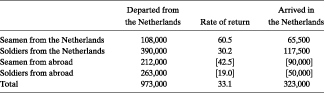
Seamen and soldiers on outbound and return journeys of the VOCTable 2. Key: Column 2: total in Bruijn, Gaastra, Schöffer, 1987, 170; distribution according to Bruijn and Lucassen, 1980, 80 (respective percentages 11.11, 40.03, 21.84, and 27.02). Column 3: percentages for the Netherlands equivalent to the ones for Delft in the eighteenth century (Van Schouwenburg, 1988 and 1989), which in Column 4 yields 140,000 returning foreigners; the difference between soldiers and sailors here is analogous to the one for the Netherlands (Bonke, 1999, 192–193). Column 4: my figures based on the percentages in Column 3.
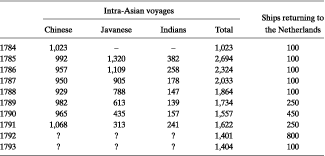
Asian seamen employed by the VOC, 1784–1793Dillo, 1992, 105, 162, based on resolutions of Governor General and Council. Frank Lequin, “Het personeel van de Verenigde Oost-Indische Compagnie in Azië in de achttiende eeuw, meer in het bijzonder in de vestiging Bengalen” (2 vols., PhD Thesis, Leiden, 1982), 409, yields far lower figures based on general muster-roll of the company personnel until 1789, although Dillo appears more detailed and consequently more reliable in this respect (see also Van der Brug, 1994, 152), although she may also be underestimating the figures, see the critical remarks of Els Jacobs, Koopman in Azië. De handel van de Verenigde Oost-Indische Compagnie in de 18de eeuw (Zutphen, 2000), 277, fn. 8, and Jacobs, 2003, 190–191. On the return fleet see Table 4.
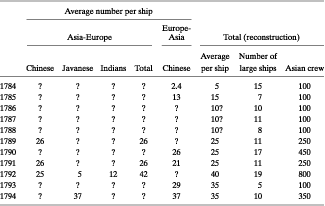
Asian seamen per ship between Asia and Europe, 1784–1794Based on four ships headed homeward in 1789 and two ships in 1791 (Bruijn, Gaastra, and Schöffer, III 1979, 522–566) and reconstructed according to Bruijn, 1976, 230, for 1792, assuming that each ship headed homeward averaged seventy seamen to the Cape (Ibid., for 1792 based on nine ships, for which the numbers of seamen are known); also based on one outbound ship in 1784, three ships in 1785, one ship in 1790, six ships 1791, and three ships in 1793 (Bruijn, Gaastra and Schöffer II, 1979, 707–760) and based on three ships in Dillo, 1972, 164, for 1794. Large ships weighing at least 880 tons have been counted according to their country of origin, while the Pinken, Fluiten, and Hoekers with their far smaller crews have been excluded. See also Hans Bonke, De zeven reizen van de Jonge Lieve. De Biografie van een VOC-schip, 1760–1781 (Nijmegen, 1999), 60, and on lascars on English ships, Rozina Visram, Asians in Britain: 400 Years of History (London, 2002), 14–33.
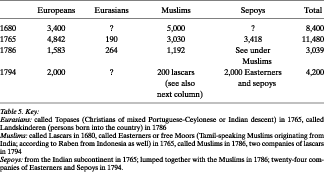
Origin of soldiers deployed directly by the VOC on CeylonVan Dam, II-2 (1932) 350; J. van Goor, Jan Kompenie as Schoolmaster. Dutch Education in Ceylon 1690–1795 (PhD Diss., Utrecht, 1978), 17, 162–164 (glossary), 173 fn.78, 85 (but different figures for 1765 in Raben, 1996, 147); Raben, 2002, 199–200 (1794: out of fifty companies, twenty-four companies were “easterners and sepoys,” two companies “lascars”). A company comprised 60 to 100 men (Talens, 1999, 96).
 You have
Access
- 29
- Cited by