Clostridium difficile infection is among the most common cause of healthcare-associated infection (HAI).Reference Lessa, Mu and Bamberg 1 In the United States, national surveillance of C. difficile infection (CDI) began in 2009. Many states mandate reporting of all healthcare associated cases of CDI as defined by the Society of Healthcare Epidemiology of America (SHEA).Reference Cohen, Gerding and Johnson 2
Approximately 13%–20% of patients with CDI will experience a recurrence between 2 and 8 weeks after the initial infection, the vast majority of these (>80%) are relapses.Reference Kamboj, Khosa, Kaltsas, Babady, Son and Sepkowitz 3 For the purposes of surveillance, any subsequent episode of CDI that occurs >8 weeks after the index episode is considered a reinfection. Application of genotyping techniques have revealed that more than half of reinfections are actually relapses due to the original infecting strain.Reference Kamboj, Khosa, Kaltsas, Babady, Son and Sepkowitz 3 It has been recognized that mixed infections with toxigenic strains of C. difficile occur in 8.7%–13% of all episodes.Reference Behroozian, Chludzinski and Lo 4 , Reference van den Berg, Ameen, Furusawa, Claas, van der Vorm and Kuijper 5 However, the biologic and epidemiologic significance of coexisting toxigenic strains in CDI is not completely understood.
In this report, we examine the contribution of mixed infection among recurrent episodes of CDI. The coexistence of multiple infecting strains in the index and subsequent episode of CDI was assessed by performing multilocus sequence typing (MLST) on multiple representative colonies of toxigenic C. difficile from the same stool sample.
METHODS
Memorial Sloan-Kettering Cancer Center (MSKCC) is a 470-bed tertiary care cancer center in New York City with 22,689 admissions and ~140,000 patient days annually. Between January 2012 and September 2013, patients with >1 episode of CDI that occurred at least 8 weeks apart, according to the reinfection definition of the National Healthcare Safety Network (NHSN), were identified using an internal infection control database. For patients with >1 recurrence (ie, ≥3 episodes), the interval between the most recent episodes was examined, and the patient was included if the episodes were ≥8 weeks apart. All stool samples positive by C. difficile polymerase chain reaction (PCR) during this time period were stored at −80°C within 24 hours of collection.
MLST was performed as previously described.Reference Griffiths, Fawley and Kachrimanidou 6 From each sample, 5 single colonies were confirmed to be C. difficile by PRO DISC (Remel, Lenexa, KS), and toxin production was confirmed by a commercial enzyme immunoassay for toxin B (Premier Toxins A&B Meridian Bioscience, Cincinnati, OH) prior to MLST typing.
The MSKCC Institutional Review Board reviewed the study and granted a Health Insurance Portability and Accountability Act (HIPAA) waiver of authorization.
RESULTS
During the 21-month study period, 55 patients were identified with 120 CDI events that occurred >8 weeks apart. In total, 10 episodes from 3 patients were excluded due to absent or insufficient growth (ie, <5 colonies). Isolates retrieved from 110 CDI episodes that occurred in 52 patients were included in the final analysis.
The mean age of the 52 patients was 53.3 years (median, 59 years; range, 3–81 years); 27 patients were female (52%). Among these the patients, 50 of 52 (96%) had underlying cancer and 54% had solid tumors. A total of 13 patients had received stem cell transplant (allogenic SCT, 10; autologous SCT, 3).
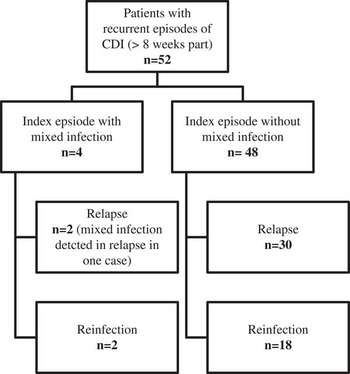
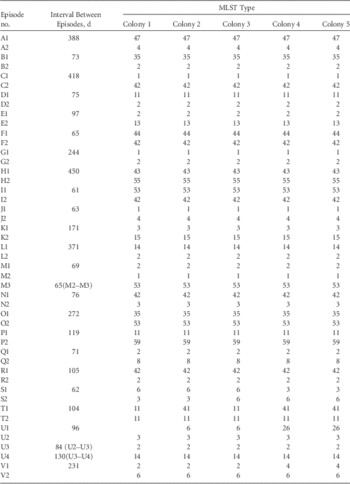
Based on MLST typing of isolates from 52 patients with recurrent CDI, 32 (62%) relapses (same strain) and 20 reinfections (different strains) were identified (Figure 1). For the first episode, mixed infection with 2 genetically distinct strains was detected in 4 of 52 cases (7.7%). These 4 patients experienced 6 subsequent episodes (episodes S–V in Table 1), and 2 relapses were identified. A single relapse (T2) occurred due to a single strain, and both original coinfecting strains were present in the stool sample of the other patient (S2) in all tested samples. In the remaining 2 patients with mixed initial infection, 4 subsequent episodes (U2, U3, U4, and V2) were due to completely distinct single strains, suggesting reinfection.
Schematic depicting results based on multiple colonies MLST among index episodes from 52 patients and discordant recurrent events.

Multilocus Sequence Typing (MLST) Profile of Toxigenic Clostridium difficile Strains: Strain Types From 5 Isolated ColoniesFootnote a

a Each patient is represented by a letter (A–V); episodes from the same patient are numbered in chronological order (1–4). Strain types from index episode with mixed infection are shown as patients S–V (n=4), and discordant recurrent events are shown as patients A–R (n=18).
Multiple-colony typing was also performed in 19 recurrent episodes from 18 patients where discordance was observed between the index strain and recurrent strains by single-colony MLST (episodes A–R in Table 1). No mixed infections were detected among these. Based on our data, single-colony typing could potentially misclassify 2 of 32 (6%) relapses as reinfections due to the presence of mixed infection during the index episode.
DISCUSSION
Mixed infection due to toxigenic C. difficile strains can have several epidemiologic and clinical implications. Analysis based on a single colony is the most common, timely, and cost-effective approach for genotyping. Although they are informative, transmission events originating from mixed infections can remain undetected using this approach, and relapses may potentially be misclassified as new infections. Currently, understanding of the contribution of mixed infection to either of these situations is limited.
In our study, we sought to determine the frequency of relapse in recurrent discordant episodes of CDI that occur >8 weeks apart. Using multicolony MLST typing, mixed infection was detected in 7.7% of initial episodes among our cohort. Relapse attributed to mixed infection that could be missed by examining single colonies occurred in 2 of 25 (9%) patients (Table 1).
Multiple previous studies have examined the occurrence of mixed infection due to toxigenic C. difficile, but its epidemiologic consequences have seldom been investigated. O’Neil et alReference O’Neill, Beaman and Riley 7 explored the possibility of relapse caused by mixed infection utilizing restriction endonuclease analysis (REA); 10 colonies for every sample were tested and no mixed infections were detected. Eyre et alReference Eyre, Walker and Griffiths 8 examined multiple stool samples obtained on the same day from 109 patients and isolated different ST types in 2 samples. Other studies using ribotyping have detected mixed infection in 8.7% of single, nonrecurrent, CDI cases.Reference van den Berg, Ameen, Furusawa, Claas, van der Vorm and Kuijper 5
In a recent study, Behroozian et alReference Behroozian, Chludzinski and Lo 4 analyzed 95 colonies per sample using polymerase chain reaction (PCR) ribotyping . Mixed infections with >1 toxigenic ribotype were detected in 13 of 102 (13%) cases. High-resolution genotyping methods have also been applied to investigate the role of mixed infection in transmission of C. difficile. Donor and recipient cases that were closely linked in space but revealed different strain types by single-colony MLST were further examined. With the application of whole-genome sequencing (WGS), 2 of 26 cases (8%) showed evidence of mixed infection, and in 1 instance, transmission was missed due to coexistence of strains in the donor.Reference Eyre, Cule, Griffiths, Crook, Peto and Walker 9
Our study approach has several limitations. The relative population of coinfecting strains varies; therefore, the analysis of 5 colonies per sample may not have been sufficient to provide a high enough resolution to detect the presence of less abundant strains. We used a typing method with low discriminatory power. In spite of this method, the frequency of mixed infection in our study is comparable to what has previously been reported by examining large number of colonies and with the application of higher-resolution genotyping methods. Finally, our study reports on the findings from recurrent episodes of CDI among cancer patients, and the results may not be entirely representative of other patient populations.
In summary, mixed infection due to C. difficile occurs in ~8% of initial CDI episodes. Relapse attributed to mixed infection is not a common occurrence. Nevertheless, the possibility of mixed infection should be considered when conducting a comprehensive epidemiologic analysis to avoid missing transmission links between cases and to ensure that recurrent episodes are accurately categorized.
ACKNOWLEDGMENTS
Financial support: This study was supported by National Institutes of Health/National Institute of Allergy and Infectious Diseases career development award to M.K. (K23 AI083880) and by the MSK Cancer Center Support Grant/Core Grant (no. P30 CA008748).
Potential conflicts of interest: All authors report no conflicts of interest relevant to this article.