INTRODUCTION
Aurelia aurita (Linnaeus, 1758) is a cosmopolitan scyphomedusa living successfully in a wide range of different habitats such as the cold waters of the western Swedish Fjords (Rasmussen, Reference Rasmussen1973, Hernroth & Gröndhal, Reference Hernroth and Gröndahl1983) or the Jellyfish lake of Palau (Hamner et al., Reference Hamner, Gilmer and Hamner1982; Dawson & Martin, Reference Dawson and Martin2001), wherever substrata suitable for polyp settlement are present (Miyake et al., Reference Miyake, Iwao and Kakinuma1997; Lucas, Reference Lucas2001). Also salinity is not a constraint for A. aurita found both at high (38 psu) (Papathanassiou et al., Reference Papathanassiou, Panayotidis and Anagnostaki1987), and very low salinity areas (<10 psu) (Russell, Reference Russell1970). Finally, this species was recorded in both eutrophic and polluted sites (Lucas, Reference Lucas2001).
In the northern Adriatic Sea, the presence of Aurelia was documented from February to June (Del Negro et al., Reference Del Negro, Kokelj, Tubaro and Della Loggia1992; ARPA OSMER-FVG, 2007). In July 2007 a bloom of this species was reported for Varano lagoon (Apulia), where the jellyfish density reached about 50 specimens for cubic meter of water (ANSA, 2007).
During blooms, the impact of A. aurita on planktonic communities may be significant (Boero et al., Reference Boero, Bouillon, Gravili, Miglietta, Parson and Piraino2008) and in several areas the decrease of mesozooplankton abundance was attributed to medusa predation (Lindahal & Hernroth, Reference Lindahl and Hernroth1983; Schneider & Behrends, Reference Schneider and Behrends1994, Reference Schneider and Behrends1998; Lucas et al., Reference Lucas, Hirst and Williams1997). Commercial fishing may be damaged by Aurelia swarms that clog fishing nets (Ki et al., 2008), but also fish stocks may be affected by high density of this jellyfish both directly, by predation on fish larvae, and indirectly, competing with fish larvae for food resources (Purcell & Arai, Reference Purcell and Arai2001).
Although several studies on the medusoid phase of Aurelia have been conducted, little is known about its benthic polyps. Watanabe & Ishii (Reference Watanabe and Ishii2001) observed the annual variations in the number of Aurelia polyps on settling plates placed in Tokyo Bay, and Miyake et al. (Reference Miyake, Terazaki and Kakinuma2002) studied colony structure, density and strobilation of A. aurita polyps attached on floating piers in Kagoshima Bay. In situ experiments trying to record the polyp density were held in the Gullmar Fjord (Hernoth & Gröndahl, 1983, 1985; Gröndahl, Reference Gröndahl1988). In this area, polyp density decreased significantly during October–November due to predation by the nudibranch Coryphella verrucosa.
Polyps of A. aurita are able to settle on several substrata, such as bare rock, shells, ascidians, polychaete tubes, macroalgae and artificial substrata (glass, ceramic or plastic) (Lucas, Reference Lucas2001; Miyake et al., Reference Miyake, Terazaki and Kakinuma2002). They show a low feeding selectivity (Tsikon-Lukanina et al., Reference Tsikon-Lukanina, Reznichenko and Lukasheva1995) and can survive long periods of starvation (Hiromi et al., Reference Hiromi, Yamamoto, Koyama and Kadota1995).
Temperature decrease is one of the main factors promoting strobilation, however, several studies demonstrated the importance of iodide since strobilation does not occur in artificial seawater lacking this compound (Spangenberg, Reference Spangenberg1967; Berking et al., Reference Berking, Czech, Gerharz, Herrmann, Hoffmann, Raifer, Sekul, Siefker, Sommerei and Vedder2005). Ephyra development in Aurelia spp. was described by several authors (Uchida & Nagao, Reference Uchida and Nagao1963; Russell, Reference Russell1970) while the kinetics of the strobilation was studied by Kroiher et al. (Reference Kroiher, Siefker and Berking2000).
Most of the previous studies reported that strobilation generally occurs during late winter or early spring (see Lucas, Reference Lucas2001 for a detailed survey), but the number of produced strobilae or the number of released ephyrae per strobila changes in relation to environmental factors. Particularly the number of discs shown by strobilae is correlated with food availability; in fact, polyps accumulate the resources necessary to strobilate during periods of high food density (Thiel, Reference Thiel1962; Spangenberg, Reference Spangenberg1968). In several localities, such as the Gullmar Fjord, strobilation may occur also twice a year if the food level is high.
Although in the Mediterranean Sea Aurelia is one of the most common Scyphomedusae, studies about its annual cycle are completely lacking. The goal of this work is the description of the seasonal cycle of a natural population of A. aurita settled on a wreck sunk off the Conero Promontory (Ancona, northern Adriatic Sea).
MATERIALS AND METHODS
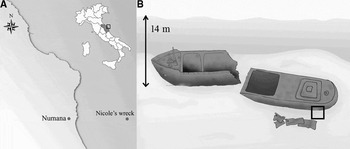
Observations and sampling of Aurelia polyps were conducted monthly, from July 2006 to May 2008, by SCUBA diving on the iron wreck of the ‘Nicole’ motorship located at 14 m depth, about 2 miles off Numana, along the Conero Promontory (Ancona, Italy) (Figure 1A & B).
(A) Map of the Conero Promontory, Ancona, Adriatic Sea; (B) the ‘Nicole’ wreck. The hull is located at 12 m and is broken into two parts. The inset shows the portion of the stern with the highest number of scyphopolyps, where monitoring has been conducted.

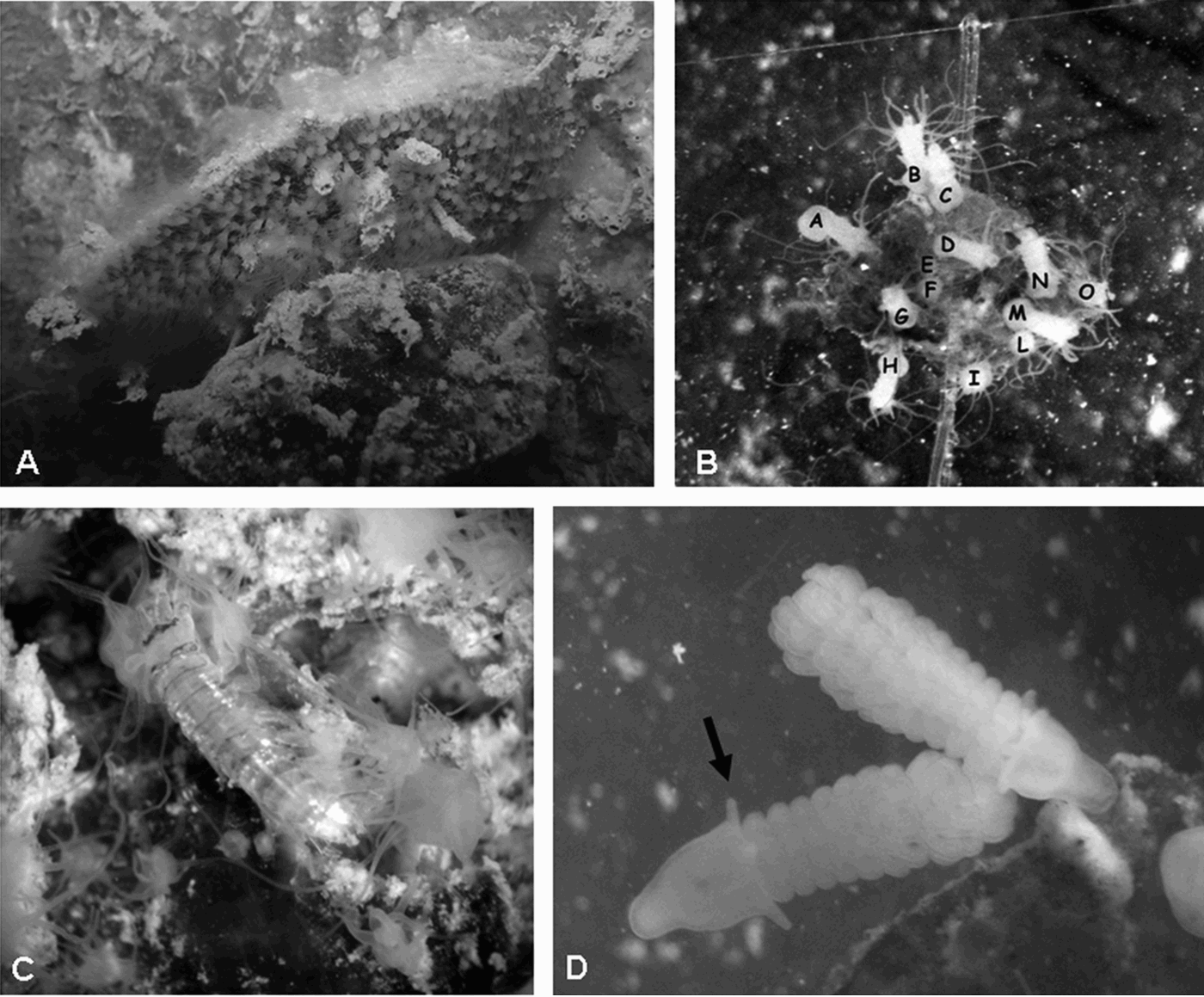
In the field, polyps were found attached directly to the wreck or growing on secondary substrata represented by Mytilus galloprovincialis and Ostrea spp. (Figure 2A). Underwater pictures of five mussel-free areas, 8 × 8 cm2, were randomly taken in each sampling using a digital camera. Later a grid of 64 cm2 was overlapped to the pictures to determine polyp density (number of polyps/cm2). During the strobilation phase, strobilae were easily distinguished from polyps for their brown colour and elongated shape. The monthly mean of superficial water temperatures in the studied period were obtained from the National Tidegauge Network website (http://www.mareografico.it).
(A) Scyphopolyps of Aurelia aurita settled on the lower side of an oyster attached to the hull; (B) portion of shell with 13 polyps marked by a letter in order to follow strobilation and determine the number of released discs per strobila; (C) several polyps eating the same amphipod; (D) polydisc stage of two strobilae; note the formation of new tentacles before the medusa detachment (arrow).

In order to study the strobilation process, on September 2006, some oyster shells covered by scyphopolyps were placed in an aquarium filled with seawater and kept in a thermostatic chamber at the same temperature of the sea (22°C). Temperature was periodically regulated to keep the animals in the same conditions recorded in their natural environment. Polyps were fed with an excess of nauplii of Artemia salina at 24-hour intervals. The water was changed daily. A shell portion with 13 polyps attached was kept in a separate bowl and a letter was assigned to each polyp, making each one recognizable, in order to follow their growth singularly (Figure 2B). When the 13 marked polyps began to strobilate, the number of released ephyrae per day was determined.
Some ephyrae were reared in aquarium and fed as polyps.
RESULTS
Polyps settled mainly on the shady parts of the wreck, generally hanging upside down, being particularly abundant on the lower part of the stern, at a depth ranging between 10 and 12 m.
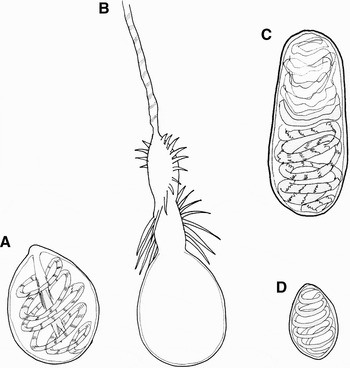
Polyps of A. aurita are white, 0.7–1 mm from the base to the oral region, with 10–15 tentacles, generally 13. Three kinds of nematocysts were identified as already reported by Spangenberg (Reference Spangenberg1964) and Calder (Reference Calder1971, Reference Calder1983): (i) a-isorhizas 6.5–7 × 4 µm; (ii) heterotrichous microbasic euryteles 10–11.25 × 7.5 µm very abundant in tentacles and scattered on body and stolons; and (iii) polyspiras 13.75–15 × 6.25 distributed in a dense ring around the mouth (Figure 3).
Nematocysts of Aurelia aurita scyphopolyps. (A–B) Heterotrichous microbasic euryteles; (A) undischarged capsule; (B) discharged capsule; (C) undischarged polyspiras; (D) a-isorhizas.

Bivalves hosting scyphopolyps were also covered by other sessile organisms, as small calcisponges or hydroids (Bougainvillia muscus, Tubularia indivisa and Eudendrium glomeratum during winter and Eudendrium racemosum in summer). A rich vagile fauna, represented mainly by amphipods, was also present. Polyps actively eat the amphipod Monocorophium acherusicum (Figure 2C) and also juveniles of mussels.
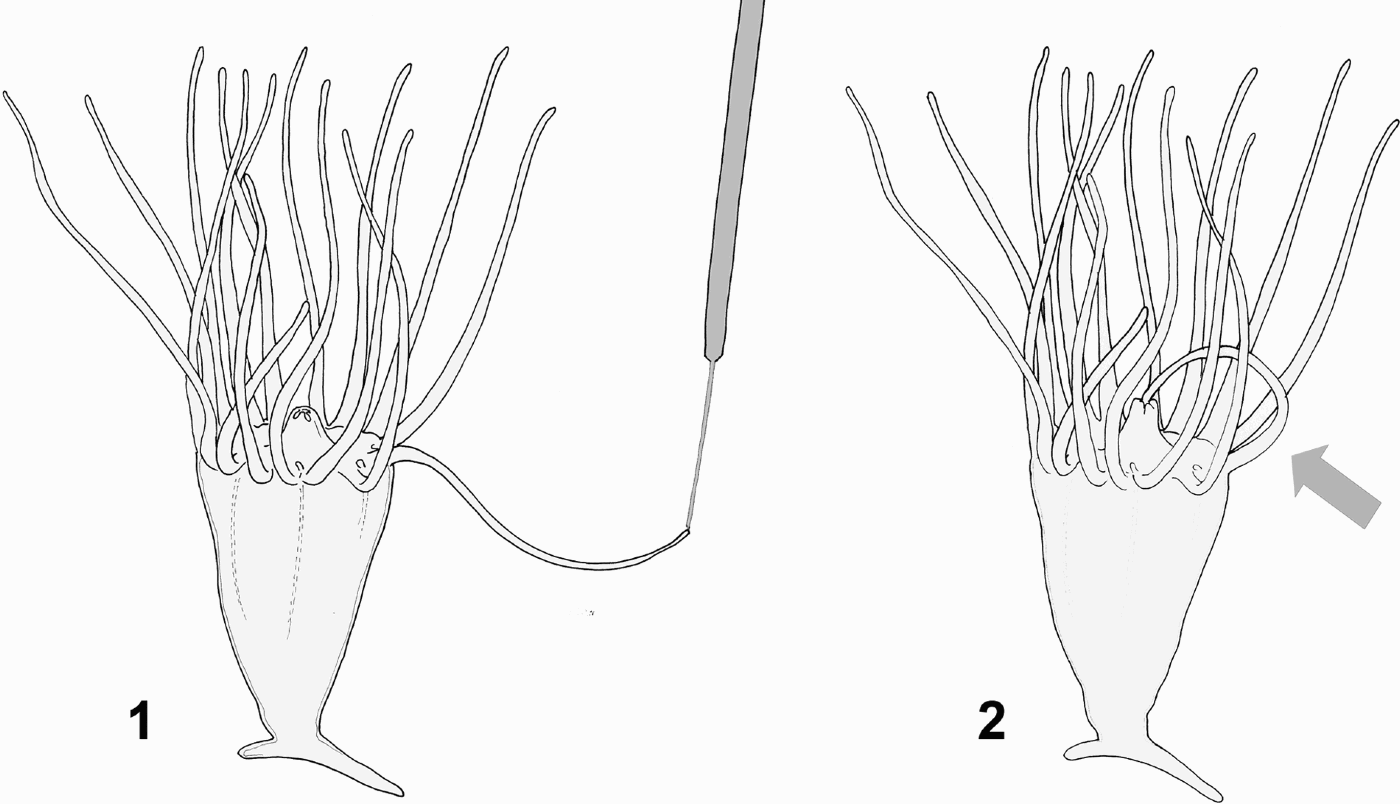
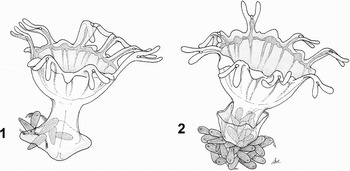
Under laboratory conditions, when a tentacle tip of a polyp was touched by a mounted needle, the tentacle was immediately bent towards the oral side, the mouth was wide opened and the tentacle introduced inside the coelenteron and maintained for a few seconds in this position (Figure 4). We have observed the same behaviour in polyps of Stylocoronella riedlii (unpublished) and Blanquet & Wetzel (Reference Blanquet and Wetzel1975) reported a drawing showing a feeding polyp of Chrysaora quinquecirrha with a tentacle introduced inside the mouth, but the behaviour was not described in the text.
Polyp behaviour. When a tentacle tip is touched by a mounted needle (1), the tentacle immediately bends towards the mouth, it is introduced inside the coelenteron and maintained for a few seconds in this position (2).

In aquarium, polyps began to strobilate when the temperature was kept lower than 15°C while ephyra release occurred 11 days later. Almost 100% of the reared scyphistomae became strobilae but the process was not simultaneous for all individuals.
Both in reared and collected strobilae, the maximal number of ephyrae produced were 13. Generally only one ephyra at a time was released, but detachment of groups of 2–3 ephyrae was sometimes observed. In reared strobilae (Figure 2B) the number of released ephyrae was higher in the first days and gradually decreased in the following days (4 ephyrae in the first day of releasing, up to 3 in the following three days and just 1 in the fifth day). At the sixth day all the ephyrae were set free and we never observed other strobilating phases. The aboral portion of strobilae was able to give rise to new tentacles before medusa detachment (Figure 2D). Once polyps released the ephyrae, they were able to begin to bud and complete tentacle development.
Newly released ephyrae were deprived of tentacles and caught nauplii aided by the sticky ectoderm of the manubrium. Slowly, the medusae engulfed the preys and, by contraction of the bell, pushed the food along the gastric column (Figure 5). When the reared ephyrae developed marginal tentacles, they were able to catch preys by tentacles and the ability to collect prey through the manubrium was not observed anymore.
Ephyra behaviour. (1) Ephyra with reverted umbrella; nauplii are caught by the sticky ectoderm of the manubrium and concentrated around the mouth area; (2) the medusa engulfs preys and by contraction of the bell, pushes the food along the gastric column.

Annual cycle
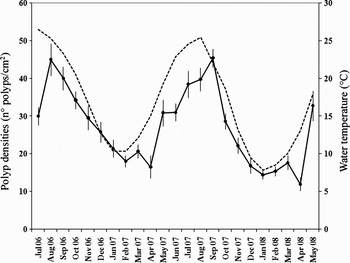
Scyphopolyps of A. aurita have been steadily monitored on the stern of the ‘Nicole’ throughout the considered period and the trend of their density was subjected to intra-annual variations (Figure 6). Polyp density increased during spring–summer reaching maxima in August 2006 and September 2007 with values higher than 45 polyps/cm2, and decreased from October reaching the minima between February and April of the following year, with values ranging between 12 and 20 polyps/cm2. The annual trend of polyp density is strongly correlated to sea temperatures (r = 0.87; N = 48) ranging from 8–10°C in winter and 26.5°C in summer (July 2006).
Trend of scyphopolyp densities (number of polyps/cm2) ±SE (solid line) in relation to sea temperatures (dashed line) from July 2006 to May 2008.

In both years, strobilation occurred between the end of November and the beginning of December when temperature was lower than 15°C and ceased in February. The photographic analysis showed that polyps did not strobilate contemporaneously: in 2006, for example, the maximal percentage of strobilae in December was 19%, while in January was 28%. The density varied from 5 to 6 strobilae/cm2 while the not strobilating polyps showed density values ranging from 20 to 15/cm2 in December and January respectively. Therefore, the maximum estimated density of strobilae per square metre was 60000 and considering that the maximum number of released ephyrae was 13, we can calculate that up to 780000 ephyrae/m2 could be liberated. If in the natural environment all polyps became strobilae as observed in reared specimens, the maximum density of strobilae per square metre should become 200,000 and the highest number of liberated ephyrae should be 2,600,000/m2.
DISCUSSION
This is the first description of the seasonal cycle of the polyps of A. aurita in the Mediterranean Sea. Our data generally agree with those obtained for other populations living in temperate waters.
The observed scyphopolyp densities, ranging from 12 and 45 polyps/cm2, match with those recorded in the Gullmar Fjord (Hernroth & Gröndhal, Reference Hernroth and Gröndahl1983) where the density of polyps, settled on artificial substrata, varied between 6 and 40/cm2. Under experimental conditions, the maximum density of polyps settled on a glass slide was 60/cm2 (Gröndahl Reference Gröndahl1988, Reference Gröndahl1989), while Miyake et al. (Reference Miyake, Terazaki and Kakinuma2002) found values of 88 individuals/cm2 on several substrata in Kagoshima Bay. According to observations conducted on other populations (Watanabe & Ishii, Reference Watanabe and Ishii2001), the Adriatic scyphopolyps hung from the inclined portions of the wreck to avoid sedimentation.
Scyphopolyps were steadily observed on the wreck of the ‘Nicole’ throughout the considered period, but their density was subjected to seasonal changes. Lowest values of polyp density coincided with the minimum of temperature while the maximum number of polyps/cm2 was recorded from August to September at the end of the summer temperature increase. The strobilation occurred when the water temperature was lower than 15°C as confirmed also by reared polyps. During strobilation, budding stopped completely. Temperature reduction seems to be the most relevant parameter triggering the strobilation in several localities of the world, although also the food supply plays a role in this process (Lucas, Reference Lucas2001).
The winter reduction of the polyp density is probably due to a direct relationship between water temperature and rate of asexual budding. Keen & Gong (Reference Keen and Gong1989) noticed that budding rate increased with feeding frequency, but Kakinuma (Reference Kakinuma1975) observed that high temperatures (25°C) promoted polyp budding. On the other hand, the spring–summer increase in polyp density could be related to the settling of planulae produced by the spring sexual reproduction of medusae. Moreover, the autumn–winter decrease can also be influenced by a possible competition with the hydroids Tubularia, Eudendrium and Clytia, whose density drastically increases during autumn. Other studies carried out on populations of scyphopolyps of Aurelia (Thiel, Reference Thiel1962; Hernroth & Gröndhal, Reference Hernroth and Gröndahl1985) indicated that nudibranch predation can be an important factor affecting the polyp density. On the wreck of the ‘Nicole’, during autumn, several specimens of the eolid Cuthona sp. were observed, but our observations suggest that this species feeds on the hydroid Tubularia indivisa without impact on Aurelia polyps.
The two ways of asexual reproduction of Aurelia—polyp budding and medusa strobilation—are mutually exclusive and occur in a different period of the annual cycle, due to opposite dependence from the seawater temperature. The autumn temperature decrease reduces the budding rate allowing the polyps to store energy for the strobilation that occurs in the coolest period of the year.
Miyake et al. (Reference Miyake, Terazaki and Kakinuma2002) noticed a preferential settlement of A. aurita planulae on artificial substrata. It is intriguing that in the Conero Promontory the species was recorded only on the wreck while it was completely lacking from the close rocky cliff. Iron structures often select a peculiar fauna different from that living on close natural rocky substrata. In the Marine Protected Area of the Portofino Promontory (Ligurian Sea) the iron chains anchoring the buoys delimiting the border of the MPA, are completely covered by the rare hydroid Coryne eximia that has never been recorded on the close rocky wall (Puce et al., Reference Puce, Bavestrello, Azzini and Cerrano2003). The same hydroid has been observed on the chains anchoring the signalling buoys of the ‘Nicole’ wreck while a different unidentified species of Coryniidae lives on the costal rocky substrate (unpublished data). In the Adriatic Sea underwater anthropogenic structures were demonstrated to be very important in increasing the biodiversity of benthic organisms living on hard substrata. On the iron wreck of the drilling Platform ‘Paguro’ 54 species of benthic organisms sometimes never observed in the area, were recorded (Ponti et al., Reference Ponti, Abbiati and Ceccherelli2002). In this basin artificial structures not only provide novel habitats for the colonization of marine organisms but play also an important, largely unexplored role in facilitating invasions of allochthonous species (Bulleri & Airoldi, Reference Bulleri and Airoldi2005).
It is possible to hypothesize that the increase of underwater structures of anthropogenic origin could be related to increases in jellyfish biomass (Miyake et al., Reference Miyake, Terazaki and Kakinuma2002). This fact could be particularly relevant in the northern Adriatic Sea where a high number of platforms for gas drilling are present, moreover our estimations (780,000–2,600,000 ephyrae released/m2) indicate that a high number of medusae can be released from a limited surface colonized by polyps. Although interest in the gelatinous zooplankton has risen in the last years (Purcell et al., Reference Purcell, Graham and Dumont2001; Purcell, Reference Purcell2005), the possible impact of these medusae on the planktonic community is not clear, but blooms of Aurelia spp. have recently been observed in many coastal areas worldwide, causing significant economic damages (Mills, Reference Mills2001) through the predation of fish eggs and larvae or by clogging of fishing nets.
The Adriatic Sea, for its morphological characteristics and for the heavy human impact should be considered as an ideal ‘natural laboratory’ to clarify the effects of anthropogenic modifications of the marine environment on the ecology of the gelatinous zooplankton (Boero et al., Reference Boero, Bouillon, Gravili, Miglietta, Parson and Piraino2008). In order to understand the jellyfish impact it is necessary to take in consideration not only the evident planktonic phase but also the cryptic benthic polyps (Boero et al., Reference Boero, Belmonte, Fanelli, Piraino and Rubino1996), representing the potentiality of medusa release, expressed with variable intensity due to the unpredictable environmental factors.