How does violence during civil war shape the relationship between citizens and the state? In particular, how does wartime violence affect citizens' demand for state-provided security, and their willingness to comply with state security providers? Most states struggle to recover from civil war, and from the rejection of state authority that rebellion implies. Citizens who demand state-provided security in the post-conflict period should be more willing to pay taxes, obey the law, and co-operate in the provision of security and other public goods (for example, by reporting crimes to the police) (Braithwaite and Levi Reference Braithwaite and Levi2003; Levi Reference Levi1989; Levi, Sacks and Tyler Reference Levi, Sacks and Tyler2009). This, in turn, should improve the state's ability to provide security in the first place (Tyler Reference Tyler2006).
Recent studies have documented the surprisingly positive effects of wartime violence on altruism (Voors et al. Reference Voors2012), empathy (Hartman and Morse Reference Hartman and Morse2020), civic culture (Bellows and Miguel Reference Bellows and Miguel2006), collective action (Gilligan, Pasquale and Samii Reference Gilligan, Pasquale and Samii2014) and political participation (Blattman Reference Blattman2009; De Luca and Verpoorten Reference De Luca and Verpoorten2015). Scholars have also shown that exposure to terrorism increases citizens' support for right-wing parties (Balcells and Torrats-Espinosa Reference Balcells and Torrats-Espinosa2018) and their willingness to tolerate state repression (Hou and Quek Reference Hou and Quek2019). These studies have taught us much about the effects of wartime violence on citizens' attitudes and behaviors (Davenport et al. Reference Davenport2019). But few have addressed the more basic dynamics of demand and compliance that lie at the heart of the citizen/state relationship.
These dynamics are especially salient in post-conflict societies, where states typically compete for citizens' loyalties with multiple alternative providers of security and other public goods. Examples are myriad: warlords in Afghanistan (Blair and Kalmanovitz Reference Blair and Kalmanovitz2016), clan houses in East Timor (Hohe Reference Hohe2003), kamajors in Sierra Leone (Ero Reference Ero, Cawthra and Luckham2003), etc. While state and non-state authorities sometimes develop symbiotic relationships (Baldwin Reference Baldwin2015), their coexistence often heightens the risk of local violence during transitions to national peace (Sisk and Risley Reference Sisk and Risley2005). Non-state authorities often have ‘no reason to support increased administrative intrusiveness by central authorities’ (Leander Reference Leander, Guzzini and Jung2002, 9), and some reject the state's claim to sovereignty altogether. Civil war may shape citizens' preferences over these potentially competing authorities in ways that scholars are only beginning to explore.
In this study I posit and test a Hobbesian explanation of the effects of wartime violence on citizen/state relations. In Hobbes's famous formulation, civil war generates demand for durable centralized power that cannot be satisfied by temporary or localized alternatives, since only a sovereign state – a Leviathan – can provide protection against the threat of future conflict. States are preferable to these alternatives because they are relatively (1) strong, (2) permanent and (3) capable of monopolizing the use of force. Recognizing the state's comparative advantages, rational, self-interested citizens covenant under sovereign rule. These ideas remain immensely influential for both the theory and practice of peacebuilding (Autesserre Reference Autesserre2010; Call Reference Call, Call and Wyeth2008; Doyle and Sambanis Reference Doyle and Sambanis2006; Fukuyama Reference Fukuyama2004). Yet they are rarely (if ever) subjected to systematic empirical examination.
I test the observable implications of this Hobbesian theory in Liberia, a country still recovering from 14 years of civil war. Liberia is an ideal test case for at least four reasons. First, non-state security providers are viable alternatives to the state in many Liberian communities: they adjudicate disputes, restitute victims of crime and more generally preserve order at the local level (Lubkemann, Isser and Banks Reference Lubkemann, Isser, Banks and Isser2011). Secondly and related, Liberian citizens are deeply divided in their preferences regarding state and non-state security providers. Thirdly, while the Liberian state is weak, most Liberians believe it is strong enough to prevent a recurrence of civil war (Vinck, Pham and Kreutzer Reference Vinck, Pham and Kreutzer2011) – a crucial scope condition for Hobbes's argument, as I discuss below. Finally, at the time my data were collected, Liberia was home to both sub- and supra-national alternatives to the state, in the form of chiefs and other non-state authorities on the one hand and the UN on the other. This allows me to test nuances of Hobbesian theory that would be inaccessible in settings where citizens have only local (or no) alternatives to the state.
I test the theory by combining two original surveys with information on the locations of battles and incidents of violence against civilians from the Armed Conflict Location and Event Dataset (ACLED) and the Uppsala Conflict Data Program (UCDP) Georeferenced Event Dataset. Consistent with Hobbes, I show that Liberians who were more severely victimized during the civil war are more likely to rely on the state for security almost a decade later, and less likely to rely on non-state alternatives. They are no more likely to rely on the UN. Though counterintuitive, this latter finding is consistent with other recent research in Liberia (Smith-Höhn Reference Smith-Höhn2010; Vinck, Pham and Kreutzer Reference Vinck, Pham and Kreutzer2011), and with Hobbesian claims about the limits of ‘temporary’ sovereigns. While isolating the mechanism(s) that link wartime violence to demand for the state is a challenge (Bullock, Green and Ha Reference Bullock, Green and Ha2010), I also show that Liberians who were more severely victimized express greater fear of civil war recurrence in the post-conflict period. This is the mechanism that Hobbes believed would motivate citizens to covenant under sovereign rule.
While my results are correlational, much of the violence that occurred during the Liberian civil war was indiscriminate conditional on ethnicity and, to a lesser extent, wealth, which should facilitate causal inference. I also take multiple steps to mitigate any remaining biases arising from non-random exposure to wartime violence. I operationalize exposure in multiple ways and exploit variation in exposure both within and across communities. I show that my correlations hold across different Liberian counties that witnessed different levels of violence perpetrated by different armed groups. I also show that the correlations are unlikely to be artifacts of support for the ruling party in the post-conflict period, or of differential state service provision in the communities most severely affected by the conflict. To address ecological inference problems arising from the dynamics of wartime displacement, I show that my results hold when I subset to respondents who were born in the same community where they were surveyed, and, as a more stringent test, when I subset to respondents who were never displaced at all.
This study contributes to multiple bodies of research. First, it extends research on the determinants of citizens' attitudes towards the state (Braithwaite and Levi Reference Braithwaite and Levi2003; Levi Reference Levi1989; Levi, Sacks and Tyler Reference Levi, Sacks and Tyler2009; Tyler Reference Tyler2006), as well as studies on the effects of wartime violence on citizens' social and political dispositions (see Bauer et al. Reference Bauer2016 for a review). The former literature has explored many explanations of citizens' attitudes towards the state, but has generally overlooked the role of wartime violence; the latter literature has tested the effects of wartime violence on many outcomes, but has generally overlooked citizens' attitudes towards the state. This study creates a theoretical and empirical bridge between these two otherwise disconnected bodies of research.
Secondly, this study contributes to research on the role of non-state actors as providers of security and other public goods, and on the relative merits of ‘bottom-up’ and ‘top-down’ approaches to peacebuilding. Scholars debate whether state and non-state authorities should be viewed as complements (Baldwin Reference Baldwin2015; Biberman Reference Biberman2018; Logan Reference Logan2013; Raleigh and Kishi Reference Raleigh and Kishi2020; Van der Windt et al. Reference Van der Windt2019) or substitutes (Bodea and LeBas Reference Bodea and LeBas2016; Boege, Brown and Clements Reference Boege, Brown and Clements2009; Henn Reference Henn2018), and whether peacebuilding is more successful when it focuses on state (Fukuyama Reference Fukuyama2004) or non-state security providers (Autesserre Reference Autesserre2010). My results suggest that wartime violence creates demand for a Leviathan capable of sustaining order from the top down, and for state security providers over non-state substitutes. This finding is especially relevant in Africa, given the prevalence of both non-state authorities and civil wars on the continent.
Finally, while this study does not seek to break new ground in its interpretation of Hobbes, it does contribute to the (vast) literature on Leviathan in political philosophy by testing one of the core empirical claims undergirding Hobbesian theory. As Ellis (Reference Ellis and Shapiro2010, 486) observes, while Hobbes is ‘not simply producing an explanatory or predictive theory of human political action’, he nonetheless makes numerous claims about ‘likely human behavior’. Evaluating Hobbes's arguments thus requires examining not just the normative basis for citizens' demand for state-provided security, but the empirical basis as well.Footnote 1 My study helps fill gaps in the theoretical literature while also highlighting nuances of Hobbes's account that are often lost in empirical studies.
Theoretical Framework
The Puzzle of Demand for Corrupt, Biased States in Post-Conflict Countries
Civil war shapes citizens' attitudes and behaviors in profound and lasting ways. Yet despite a recent proliferation of research, few studies have explored the effects of wartime violence on citizens' relationships with the state itself. The existing evidence is thin and contradictory, but generally suggests that, if anything, wartime violence should damage citizen/state relations. De Juan and Pierskalla (Reference De Juan and Pierskalla2016, 71), for example, argue that ‘observing civil war violence and the state's inability to end it exerts negative effects on people's trust in the state’. They find support for their argument in Nepal. Similarly, Carreras (Reference Carreras2013, 90) argues that violence diminishes ‘system support’ by revealing the government's inability to punish perpetrators and ensure victims' safety. They find support for this argument in Latin America. The adverse effects of wartime violence on perceptions of the state may be transmitted intergenerationally, from victims to their children and even grandchildren (Lupu and Peisakhin Reference Lupu and Peisakhin2017; Rozenas, Schutte and Zhukov Reference Rozenas, Schutte and Zhukov2017; Wang Reference Wang2019). Adverse effects may be further compounded by the corruption and bias that are often endemic to states recovering from civil war (Levi, Sacks and Tyler Reference Levi, Sacks and Tyler2009; Tyler Reference Tyler2006).
Yet in many post-conflict settings, citizens do demand state authority, and do endorse the state's right to command them, despite widespread misconduct on the part of state officials (Bakke et al. Reference Bakke2013; Sacks and Larizza Reference Sacks and Larizza2012). This appears to be especially true in Africa, the site of many of the world's most brutal civil wars. Recent data from the Afrobarometer survey suggests that most Africans support the government's right to ‘make people pay taxes’, despite low trust in tax authorities (Isbell Reference Isbell2017). Most Africans also say they would report to the police first if they were victims of a crime (though many crimes go unreported), and most believe the police have a right to ‘make people obey the law’, even though the police are almost universally perceived as the most corrupt of all state institutions (Wambua Reference Wambua2015).
More striking, these two beliefs – that the police are corrupt, and that they have a right to make people obey the law – have tended to increase in parallel over time (Wambua Reference Wambua2015). More striking still, the countries where citizens express the strongest support for the state's right to command them are in many cases the same ones that have experienced the most extreme wartime violence in recent years (Sierra Leone, Cote d'Ivoire, Burundi, Mali, Liberia, etc.). While non-state (‘traditional’) authorities remain popular, the vast majority of Afrobarometer respondents believe the state should be responsible for collecting taxes, providing services like education and health care, and ‘maintaining law and order’, despite pervasive perceptions of state corruption and bias (Logan Reference Logan2013, 360). How can this paradox be explained?
A Hobbesian Solution
I propose and test a Hobbesian solution to this puzzle. Hobbes famously argues in Leviathan that centralized power, whatever its defects, is preferable to the ‘dissolute condition of masterlesse men’ and the horrors of civil war (Hobbes Reference Hobbes2010, 106, 112). This dissolute condition persists as long as people live without a ‘common Power’ to ‘tye their hands from rapine, and revenge’ (77, 112). Hobbes argues that only a sovereign state – a Leviathan – is capable of wielding this sort of power, and therefore of assuaging citizens' ‘continuall feare, and danger of violent death’ (78). While the state may delegate responsibility for some aspects of governance to non-state authorities, it remains sovereign within its borders: ‘where there is already erected a Soveraign Power, there can be no other Representative of the same people, but onely to certain particular ends, by the Soveraign limited’ (109, 113). Hobbesian theory thus aims to provide a ‘clear, unambiguous and indisputable answer’ to the jurisdictional questions that inevitably arise in the presence of multiple potential providers of security and other public goods (Ryan Reference Ryan and Sorell1996, 210).
In Hobbes's account, states have at least three key comparative advantages relative to other forms of social and political organization: they are (1) stronger, (2) more permanent and (3) more capable of monopolizing the use of force. These comparative advantages lead Hobbes to reject localized alternatives to centralized power: the ‘joyning together of a small number of men’ will not suffice, he argues, since ‘in small numbers, small additions on the one side or the other’ create renewed threats (Hobbes Reference Hobbes2010, 103). More subtly, he also rejects temporary alternatives to the state, arguing that while these may help secure peace ‘for a limited time’, ultimately they must be supplanted by permanent centralized authorities (103). Hobbesian theory thus predicts that if given the choice between a centralized state and localized non-state alternatives,Footnote 2 citizens should prefer the former. Hobbesian theory also predicts that if given the choice between two centralized authorities, one temporary and one permanent, citizens should prefer the latter.
Hobbes's arguments are grounded in a richly complex theory of human psychology (Gert Reference Gert1967; Ryan Reference Ryan and Sorell1996). Ultimately, however, Hobbes believed it was fear and ‘foresight of their own preservation’ that would motivate rational, self-interested citizens to covenant under sovereign rule (Hobbes Reference Hobbes2010, 85, 121, 193). From a Hobbesian perspective, demand for a corrupt or biased state is no puzzle at all, at least not in the aftermath of conflict, since ‘the greatest, that in any forme of Government can possibly happen to the people…is scarce sensible, in respect of the miseries, and horrible calamities, that accompany a Civill Warre’ (112). The normative implications of Leviathan thus hinge on empirical observations about fear, rationality and the pursuit of self-interest. Indeed, Nagel (Reference Nagel1959, 69) goes so far as to argue that ‘genuine moral obligation plays no part in Leviathan at all’, and that ‘what Hobbes calls moral obligation is based exclusively on considerations of rational self-interest’.Footnote 3
These ideas continue to pervade the literature on peacebuilding after civil war. Doyle and Sambanis (Reference Doyle and Sambanis2006, 28–9), for example, argue that ‘sustainable peace needs state authority as a starting point’, and that ‘Hobbes's Leviathan – state sovereignty, or authority – fills that role’. Call (Reference Call, Call and Wyeth2008, 365) argues that while ‘alternative sources of authority and service delivery’ may promote stability, ‘peace is likely to prove unsustainable’ without a ‘minimally effective and legitimate state’. Fukuyama (Reference Fukuyama2004, 120–1) goes further, arguing that ‘states and states alone’ can ‘aggregate and purposefully deploy legitimate power’; rather than delegate authority to a ‘motley collection’ of non-state actors, ‘we have no choice but to turn back to the sovereign nation-state’. Citizens are often believed to share these perceptions: as Goldsmith (Reference Goldsmith2002, 9) argues, wartime violence creates ‘strong grassroots demand for better state-provided security’ that ‘cannot and will not be satisfied by non-state providers’. Policy makers also tend to conceptualize peacebuilding as a ‘Hobbesian challenge’, and to prioritize extending state authority in ‘Hobbesian environments’ (Autesserre Reference Autesserre2010, 42, 67, 69).
Scope of Hobbes's Argument
Importantly, the Hobbesian covenant between state and citizen is only ever conditional: ‘the Obligation of Subjects to the Soveraign, is understood to last as long, and no longer, than the power lasteth, by which he is able to protect them’ (Hobbes Reference Hobbes2010, 134). This theoretical argument has important empirical implications. Since the covenant is contingent on protection, exposure to wartime violence should increase demand for state-provided security only in settings where civil war results in the emergence of new centralized authorities, rather than the persistence of the same ones that already demonstrated their inability or unwillingness to protect citizens – for example, cases where the incumbent retains power after the end of a civil war.
This scope condition is not as restrictive as it may seem. While many civil wars end in decisive military victories or a gradual cessation of hostilities with no accompanying peace agreement (Kreutz Reference Kreutz2010), many others result in governments that bear little structural or political resemblance to the regimes that preceded them. This was the case, for example, in Guatemala, Sierra Leone, Burundi, Nepal and Liberia, the focus of this study. Even in countries where civil war ends with a decisive military victory on the part of the government – Greece, Sri Lanka, Indonesia – Hobbes's argument may still apply to citizens who were victimized primarily or exclusively by rebel groups (though these citizens may in some cases blame the state for failing to protect them). In the discussion I explore the implications of Hobbes's account for the recurrence of local violence after a return to national peace.
Nor should the scope of Hobbesian theory be limited to states that are strong, permanent and capable of monopolizing force in some absolute sense. States must be strong enough to provide protection, but more important, they must be stronger, more permanent and more capable of monopolizing force than their localized or temporary competitors. Many states recovering from civil war meet this scope condition, though of course there are exceptions – Afghanistan, for example, where some warlords are more powerful and legitimate than the state itself (Blair and Kalmanovitz Reference Blair and Kalmanovitz2016). Nor should the theory be limited to states that provide security and administer justice fairly and transparently. As discussed above, Hobbesian citizens should demand sovereign rule for their own good, despite acts of ‘Iniquity’ on the sovereign's part (Hobbes Reference Hobbes2010, 108).
Hypotheses
Hobbesian theory thus generates several empirical predictions for me to test. Exposure to wartime violence should (1) increase citizens' demand for state-provided security and their willingness to comply with state security providers and (2) decrease their demand for, and compliance with, non-state alternatives. This should be especially true in cases where the state has not delegated jurisdiction to some other actor: while state and non-state authorities may sometimes co-operate in the coproduction of security and other public goods, the sovereign is endowed with a supreme ‘Right of Judicature’ that Hobbes expected citizens to respect (Hobbes Reference Hobbes2010, 109, 113). Wartime violence should also (3) increase citizens' demand for permanent over temporary security providers and (4) increase citizens' fear of a return to civil war – the mechanism motivating citizens to covenant under sovereign rule.
‘Wartime violence’ is admittedly a broad term. Armed groups adopt distinct repertoires of violence during civil war, and citizens are victimized in disparate ways (Gutiérrez-Sanín and Wood Reference Gutiérrez-Sanín and Wood2017). It is not obvious, either intuitively or from Hobbes, which of these sources of variation should be most salient in shaping attitudes and behaviors towards the state.Footnote 4 It seems clear, however, that the more (5) intensely and (6) directly citizens are victimized, the more they should demand state-provided security. I define intensity as the number of acts of violence to which citizens are subjected, and directness as the extent to which citizens experience or witness violence themselves. Direct victims are physically present when violence occurs, and are often targets of it. Indirect victims do not themselves experience or witness violence, but are friends or relatives of direct victims who do. Intuitively, experiencing or witnessing multiple acts of violence firsthand should be more likely to induce fear, and more likely to generate demand for state security provision.
Setting
Patterns of Violence During the Liberian Civil War
I test these Hobbesian predictions in Liberia, focusing on three counties that together capture much of the variation in the nature and intensity of violence during the civil wars that ravaged the country from 1989 to 2003 – Nimba, Grand Gedeh and Lofa. Nimba was the ‘epicentre of opposition’ to the dictatorship of Samuel K. Doe, who seized power in a coup d'etat in 1980 (Ellis Reference Ellis2006, 113). The county was the site of recurring violence during Doe's regime, directed in particular at young men from the Gio and Mano tribes. Nimba is also where the first Liberian civil war began in 1989, when Charles Taylor's National Patriotic Front of Liberia (NPFL) invaded from neighboring Cote d'Ivoire. Nimba's Gio and Mano residents later became some of Taylor's most loyal recruits.
If Nimba was the epicenter of opposition to Doe, Grand Gedeh and Lofa were epicenters of loyalty. Grand Gedeh is the ancestral home of the Krahn tribe, of which Doe was a member and from which he drew much of his support. When Taylor seized power in 1990, he targeted Grand Gedeh as ‘enemy territory’ (Ellis Reference Ellis2006, 114). The county was relatively peaceful under Doe, but became increasingly violent under Taylor. In Lofa as well, violence escalated throughout the conflict as rival factions jockeyed for control. Doe had allied with Lofa's Mandingo residents, who the NPFL slaughtered en masse. In response, Mandingo exiles and Doe loyalists in Guinea and Sierra Leone mobilized against Taylor's government, eventually seizing Lofa from the NPFL.
Violence during the Liberian civil wars was often indiscriminate conditional only on ethnicity and, to a lesser extent, wealth. The NPFL sometimes used a language test to distinguish Gios or Manos from members of other tribes, but in many places – Grand Gedeh, for example – they assumed all civilians were enemies and killed them indiscriminately (Outram Reference Outram1997, 360). Doe's forces similarly ‘exacted collective punishments on the population’, moving from village to village ‘shooting at the inhabitants indiscriminately’ and ‘carrying out scorched earth policies’ (Duyvesteyn Reference Duyvesteyn2005, 27). Even in Nimba, an NPFL stronghold, Taylor was ‘unable to control his fighters’ (Outram Reference Outram1997, 182), and violence ‘rapidly spread out of control’ (167). By the mid-1990s, much of the violence was ‘general and undirected’ (367). Cannibalism, mutilation, mass killings and other atrocities were commonplace.
Unlike in some other civil wars, Liberian armed groups typically did not attempt to establish mechanisms of governance in the territories they controlled (Arjona Reference Arjona2016, 32). Instead, many Liberians took recourse in traditional or ‘customary’ institutions (Sawyer Reference Sawyer2005). The influence of these institutions had waned over the twentieth century, but they experienced a ‘distinct revival’ as a result of the civil war (Ellis Reference Ellis2006, 270). Similar dynamics have been observed in other conflict settings, where non-state authorities with roots in custom and tradition often provide local order amidst national upheaval (Isser Reference Isser2011). Examples abound, including régulos in Mozambique, ulamas in Indonesia, arbakai in Iraq and dozos in Cote d'Ivoire. I discuss the nature of Liberia's non-state authorities in further detail below.
Taylor was driven into exile in 2003. That same year a Comprehensive Peace Agreement was signed, a UN peacekeeping operation (UNMIL) was deployed and a transitional administration was installed, to be supplanted in 2005 by a democratically elected government under President Ellen Johnson Sirleaf. UNMIL worked with Sirleaf to purge state security institutions of war criminals, recruit and train a new generation of police officers and soldiers, and introduce new oversight and accountability mechanisms. While corruption, incompetence and resource constraints continue to hobble the army and police, efforts to reform them are generally viewed as a (qualified) success (Friedman and MacAulay Reference Friedman and MacAulay2014). By 2010, the year this study begins, the Liberian state was fundamentally different from the one that brutalized civilians during the conflict. UNMIL continued to assist the government until 2018, but the mission explicitly encouraged citizens to view its presence as temporary, and to rely on the state as a more permanent security provider (Blair Reference Blair2019).
Tensions Between State and Non-state Authorities in Liberia
Like many other African countries, Liberia is home to a variety of non-state authorities that provide security, justice and other public goods in the shadow of the state. Traditional or customary authorities constitute the ‘most relevant justice institutions for the vast majority of the country's population’, especially in rural areas (Isser, Lubkemann and N'Tow Reference Isser, Lubkemann and N'Tow2009, 23) – a dynamic that became even more pronounced in the wake of the civil war. The customary sector comprises a hierarchy of chiefs with paramount chiefs at the top, followed by clan chiefs, town chiefs and, in larger towns and cities, quarter chiefs. Customary jurisdictions are codified in Liberian law, though chiefs routinely transgress legal limits on their authority, even in criminal cases over which the state claims both original and ultimate jurisdiction (Lubkemann, Isser and Banks Reference Lubkemann, Isser, Banks and Isser2011).
Operating alongside the chiefs is a network of sodalities known as ‘secret societies’. Secret societies are not recognized under Liberian law, but nonetheless remain the ‘most important political institution’ in many rural Liberian communities (Ellis Reference Ellis1995, 188). Secret society elders serve as intermediaries between the living and the ancestors; as such, they provide a form of order that many Liberians believe cannot be replicated through other institutions. Like chiefs, secret societies routinely intervene when crimes are committed or conflicts arise. In many instances they are ‘expected to be the first – and often ultimate – authorities to deal with disputes’, even in cases that involve ‘significant crimes that technically should be referred to the formal court system’ (Lubkemann, Isser, and Banks Reference Lubkemann, Isser, Banks and Isser2011, 213).
After 2003, UNMIL also provided security through patrols, public works projects and interventions to resolve impending or ongoing disputes. By the time my data were collected, Liberians had already experienced eight years of peacekeeping under UNMIL, and most had interacted with UNMIL personnel in some capacity, even in the most rural communities (Blair Reference Blair2019). UNMIL also disseminated information about its activities through UNMIL Radio, which at the time was the only radio station capable of reaching all Liberians nationwide. Despite UNMIL's (relative) novelty, most Liberians had enough information to form preferences about its role as a security provider. Most credited the mission with helping to prevent a recurrence of civil war, and most approved of the mission's continued presence in the country (Mvukiyehe and Samii Reference Mvukiyehe and Samii2010).
As in other African settings, the paradox of demand for a corrupt and biased state is evident in Liberia. As I show in Appendix A, 56 per cent of respondents in my survey sample prefer to rely on the state to resolve the most serious incidents of crime and violence, compared to just 32 per cent who prefer to rely on non-state authorities (such as chiefs), and just 12 per cent who prefer to rely on UNMIL. This is especially remarkable given that respondents are also much more likely to describe the state as corrupt and biased against particular ethnic or religious groups: 61 per cent of respondents in my sample describe the state as corrupt, compared to just 30 per cent who describe non-state authorities as corrupt, and just 15 per cent who describe UNMIL as corrupt. While only a minority of respondents (33 per cent) describe the state as biased, even smaller minorities describe non-state authorities or UNMIL as biased as well (11 per cent and 9 per cent, respectively).Footnote 5
Nor are these patterns unique to the counties in my sample. In a nationally representative survey from 2011, a majority of Liberians expressed a preference for the police and courts to intervene in all but the pettiest of disputes (Vinck, Pham and Kreutzer Reference Vinck, Pham and Kreutzer2011). Another report from the same period notes Liberians' ‘pronounced preference for state agencies to provide for security’, despite being aware of state misconduct (Smith-Höhn Reference Smith-Höhn2010, 95, 135). But this preference is far from universal, and Liberians remain deeply divided over the appropriate role of state and non-state security providers in their communities (Lubkemann, Isser and Banks Reference Lubkemann, Isser, Banks and Isser2011). Importantly, while the Liberian state is weak, most Liberians believe it is strong enough to prevent civil war from recurring (Vinck, Pham and Kreutzer Reference Vinck, Pham and Kreutzer2011) – a crucial scope condition for Hobbesian theory, as noted above. I discuss generalizablity to settings where this condition does not hold in the conclusion.
Data
My analysis relies on two original surveys covering 242 rural towns and villages across Lofa, Nimba and Grand Gedeh counties. Data were collected between November 2010 and January 2011. One survey was administered to a random sample of twenty citizens per community, selected using the random walk method described in Appendix B. The second was administered to four purposively selected local leaders – typically a town chief, women's group leader, youth group leader and minority group leader. These positions exist in almost all Liberian communities, and represent distinct cross sections of the Liberian populace. While the communities in my sample are not representative of Liberia, in Appendix C I use a nationally representative survey conducted at the same time to show that they are similar to the average Liberian community along a variety of characteristics, including age, religion, educational attainment and exposure to crime (Vinck, Pham and Kreutzer Reference Vinck, Pham and Kreutzer2011)
Measurement
Measuring Exposure to Wartime Violence
Citizen survey respondents were asked about fourteen types of direct and indirect victimization during the Liberian civil wars.Footnote 6 I construct fourteen indicators for respondents who were victimized in each of these ways, then combine these indicators into standardized additive indices for direct exposure (witnessing or being victimized by wartime violence), indirect exposure (being related to someone who was a victim), and direct and indirect exposure together. Following my theoretical framework, these indices distinguish between more and less intense and more and less direct exposure to wartime violence, allowing me to test whether respondents who experienced or witnessed multiple acts of violence firsthand are more likely to demand state security provision. As a more exploratory exercise, in Appendix D I test the effects of exposure among combatants, victims and witnesses of sexual violence, and witnesses of lethal and non-lethal violence specifically.
I combine the survey with ACLED data on the number of violent events – defined as battles and incidents of violence against civilians – in each community in my sample over the final 6 years of civil war in Liberia.Footnote 7 Since the distribution of violent events in ACLED is highly skewed, I also code indicators for any violent event to ensure that my results are not artifacts of outliers. Since many violent events occurred near – but not within – the communities in my sample, I also calculate the distance from each community to the site of the nearest violent event, measured in units of 10 km and reverse coded such that larger values indicate closer proximity. In Appendix E I instead calculate the number of fatalities associated with violent events in each community, and in Appendix F I disaggregate violent events by perpetrator, though both of these measures are noisy and prone to missingness. Finally, since violent event datasets are inevitably susceptible to measurement error, especially at such a low level of aggregation, in Appendix G I replicate my analyses using UCDP data to ensure that my results are not artifacts of particular coding rules or data sources.
Measuring Demand for State Authority
Demand for state security provision should manifest in both attitudes and behaviors. Citizens who demand state-provided security should prefer the protection that police forces and other state security institutions offer, and should rely on these institutions to intervene when crimes are committed or violence occurs. To operationalize attitudinal demand for the state, respondents were first read three hypothetical scenarios of crime and violence – a murder, an incident of mob violence and an ethnic riot resulting in fatalities – and asked which authority they would prefer to provide protection and ‘resolve the situation’. Options included state authorities (police, military and other ‘government people’), non-state authorities (chiefs and other traditional leaders) and the UN.
Importantly, while the incidents described in the hypothetical scenarios all pose a high risk of escalation, none was so severe as to preclude reliance on non-state authorities, as I show in Appendix A. Equally important, all three incidents fall unambiguously under the original and ultimate jurisdiction of the state, and Liberian law requires that citizens rely on state rather than non-state authorities to resolve them. The hypothetical scenarios are thus designed to offer contemporary analogues to the jurisdictional questions that preoccupied Hobbes in his account of law making and enforcement under sovereign rule (Ryan Reference Ryan and Sorell1996). I code each respondent's preferred security provider in each hypothetical scenario,Footnote 8 as well as their modal preference across the three hypothetical scenarios.Footnote 9
To operationalize behavioral demand for the state, respondents were also asked whether they were the victim of four types of crimes in the past year – burglary, armed robbery, simple assault or aggravated assault – and, if so, whether they reported the crime to the police. Again, these crimes all fall unambiguously under state rather than non-state jurisdiction. (Unfortunately I did not ask respondents whether they reported these crimes to non-state authorities or UNMIL.) Local leaders were also asked whether any crimes in their communities had been reported to the police or paramount chief in the previous year. As noted above, paramount chiefs are one of the most important non-state authorities in Liberia, occupying a position in the customary hierarchy above clan, town and quarter chiefs. I interpret reporting to the police as a measure of behavioral demand for the state, and reporting to paramount chiefs as a measure of behavioral demand for non-state alternatives.
Triangulation
Each of these measures complements and compensates for the limitations of the others. The survey generates detailed, highly granular data on exposure to wartime violence at the individual level, but relies on respondents' memories, and so may be susceptible to non-random recall. While it is not obvious why recall of events that occurred years in the past would be correlated with demand for the state in the present – which it would have to be to bias my results – my use of ACLED allows me to address this limitation. ACLED draws on media and non-governmental organization (NGO) reports, and so avoids biases induced by spotty memories. But ACLED is also less granular than the survey, and may be susceptible to non-random missingness caused by uneven NGO and press coverage. My goal is triangulation. There is no reason to expect bias induced by missingness in ACLED to have the same magnitude or even the same direction as bias induced by recall in the survey. By combining the two measures, I am able to mitigate the limitations of each on its own.
I measure demand for state security providers by surveying both residents and local leaders, and by combining attitudinal responses to hypothetical scenarios with behavioral responses to actual crimes. Hypothetical scenarios are stylized, but are applicable to all respondents, regardless of whether or not they ever experienced similar incidents firsthand. Actual incidents are more realistic, but are only directly applicable to victims of crime. Both of these measures are potentially susceptible to social desirability bias, though again, it is not obvious why social desirability today would be correlated with events that occurred years in the past. Nonetheless, as an additional proxy I use the survey of local leaders to measure reporting of crimes that randomly selected residents may not have heard of, or may have been reluctant to talk about. Again, none of these proxies is flawless. If my results are consistent across multiple measurement strategies, this should provide some reassurance that they are not artifacts of the limitations of any particular method.
Estimation
I use three survey-based measures of exposure to wartime violence at the individual level: (1) an aggregate index of victimization, and disaggregated indices of (2) direct and (3) indirect victimization. I also have three ACLED-based measures at the community level: (1) the number of violent events in each community, (2) a dummy for any violent event in each community and (3) the proximity of each community to the site of the nearest violent event. When testing the relationship between demand for the state and individual-level wartime violence, I fit a weighted least squares regression given by
 $$y_{ic} = {\rm \alpha} + {\rm \beta }\nu _{ic} + \sum\limits_{\,j = 1}^J X_{icj}\theta _j + {\rm \gamma }_c + {\epsilon} _{ic}$$
where y ic denotes demand by individual i in community c, ν ic denotes individual-level wartime violence, X icj indexes J individual-level controls (described below), and γc denotes a vector of community fixed effects. Observations are weighted by the inverse probability of sampling. Standard errors are clustered by community.Footnote 10
When testing the relationship between demand and wartime violence at the community level, I instead estimate
 $$y_{icd} = {\rm \alpha} + {\rm \beta }V_{cd} + \sum\limits_{\,j = 1}^J X_{icdj}\theta _j + {\rm \delta }_d + {\epsilon} _{icd}$$
where y icd denotes demand by individual i in community c in district d, V cd denotes community-level wartime violence, δd denotes a vector of district fixed effects, and all other parameters are defined as in Equation 1.Footnote 11
Inference
If citizens who were more severely affected by wartime violence differ from those who were not in ways that correlate with their attitudes towards state authority today, then my results will be biased. As discussed above, much violence during the Liberian civil war was indiscriminate conditional on ethnicity and, to a lesser extent, wealth. This should facilitate causal inference. Nonetheless, I take multiple steps to mitigate any remaining bias and rule out alternative explanations. First, I measure exposure to wartime violence in multiple ways using multiple sources of data, and exploit variation in exposure both across and within communities, using community fixed effects when possible to eliminate all observed and unobserved sources of community-level confounding in the cross-section.
Secondly, I control for the most important individual-level determinants of victimization during the civil war. Since young men were the most common victims (and perpetrators) of wartime violence, I control for age and gender. Since armed groups organized along ethnic lines and targeted particular ethnic groups, I include fixed effects for all of Liberia's eighteen tribes. Since armed groups also targeted civilians with assets worth looting, I control for employment and private property ownership before the civil war began as proxies for wealth. And since attitudes towards the state may depend in part on citizens' ties to non-state sources of power, I include dummies indicating whether respondents were local leaders during the conflict, or were related to one. Thirdly and related, in Appendix H I show that my results are similar when I separately analyze subsamples of residents from Lofa, Nimba and Grand Gedeh counties, which, as discussed earlier, have distinct ethnic compositions and witnessed disparate forms and levels of violence during the civil wars, perpetrated by different actors.
Fourthly, I address the possibility that demand for the state is an artifact of support for President Sirleaf and her Unity Party (UP). Liberians who opposed Taylor may have been more likely to participate in the conflict, or to be victims of it. If Taylor opponents subsequently became Sirleaf supporters, then what appears to be a correlation between wartime violence and demand for the state may mask a more mechanical association between opposition to Taylor and support for Sirleaf and the UP. To address this possibility, in Appendix I I show that respondents who were more severely affected by wartime violence are more likely to support any political party in the post-conflict period – a result consistent with research documenting greater political engagement among victims of conflict (Blattman Reference Blattman2009; De Luca and Verpoorten Reference De Luca and Verpoorten2015) – but are no more likely to support the UP than they are to support the opposition Congress for Democratic Change.
Fifthly, I address ecological inference problems arising from the fact that most Liberians were displaced at some point during the civil wars. If respondents migrated to the communities where they were surveyed after the conflict ended, then they would not have been affected by the violent events that ACLED records in their communities. (Ecological inference is only a problem for my results that rely on ACLED, since these are the only results for which the dependent and independent variables are operationalized at different levels of analysis.) This is a relatively minor concern, as 72 per cent of respondents in my sample were born in the same community where they were surveyed. Nonetheless, in Appendix J I show that my results hold when I restrict my sample to this latter subset of respondents. More subtly, respondents may have fled the communities where they were surveyed before the conflict began, then returned after the conflict ended but before the survey was conducted, in which case they again would not have been affected by violent events that occurred there. As an even more stringent test, in Appendix K I show that my results hold when I subset to the 16 per cent of respondents who were never displaced.
Sixthly, it is possible that Liberians who were more severely victimized by wartime violence are also more likely to seek health care from government hospitals and clinics in the post-conflict period, and that this experience – rather than the experience of victimization per se – explains their increased demand for the state. Unfortunately I do not have data to test this possibility directly. But there are reasons to believe it is unlikely to bias my results. While many victims express a desire for better health care in Liberia, especially for mental health, most are unable to access it (Johnson et al. Reference Johnson2008). Moreover, most hospitals and clinics in Liberia are run by NGOs, not the government. In any event, to the extent that victims prefer government over NGO health care, that preference is itself consistent with Hobbesian theory. Seeking government health care is arguably indicative of the same demand for the state that Hobbes predicts.
Finally and relatedly, it is possible that the Liberian government provided more services to communities that were more severely affected by wartime violence, which in turn created demand for additional services. Again, this is only a problem when using ACLED: when using the survey, differential state service provision at the community level is absorbed by community fixed effects. In Appendix L I attempt to disentangle demand for the state from state service provision, focusing on security. Intuitively, if the state provides more security to communities that were more severely affected by wartime violence, then residents of those communities should have easier access to state security providers – in particular, the police. I show that this is not the case. While citizens who were more severely affected are more likely to know the location of the nearest police station, they are no more likely to live close to one.Footnote 12 These results suggest that the state is no more likely to provide security to communities that were more severely affected by the civil war, but that residents of these communities are nonetheless more likely to seek information about where and how to access state security providers, which is itself a potential indicator of demand for state security provision.
Results
Wartime Violence and Demand for State Authority
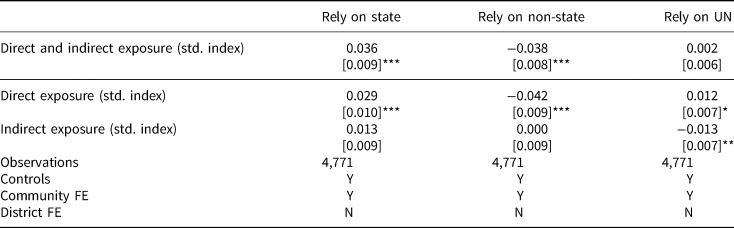
Table 1 reports the correlation between individual-level exposure to wartime violence and respondents' demand for state-provided security across three hypothetical scenarios of crime and violence. The top panel reports my results using a standardized additive index that aggregates all forms of direct and indirect exposure to wartime violence in the survey. The bottom panel disaggregates this index into direct and indirect exposure. Both specifications include individual-level controls and community fixed effects, following Equation 1 above. Observations are weighted by the inverse probability of sampling, and standard errors are clustered by community.
Individual-level exposure to wartime violence and reliance on state in hypothetical criminal cases

Notes: coefficients from OLS regressions. Observations are weighted by the inverse probability of sampling. Standard errors, clustered by community, are in brackets. *** p < 0.01, ** p < 0.05, * p < 0.1
From the top panel of Table 1, a one-standard-deviation increase in exposure to wartime violence predicts a 3.6-percentage-point increase in respondents' preference to rely on the state to resolve hypothetical scenarios of crime and violence, and a corresponding 3.8-percentage-point decrease in their preference to rely on non-state authorities. From the bottom panel, this correlation is driven by direct rather than indirect exposure. These results are consistent with the Hobbesian intuition that wartime violence induces a substitution towards state security providers and away from non-state alternatives, and that the size of this effect increases with the intensity and directness of exposure at the individual level.
To put the magnitude of these correlations into perspective, the predicted probability of relying on state security providers is 0.52 among respondents who reported the least severe exposure to wartime violence (that is, those who scored a 0 on my index before standardization). Among those who reported the most severe exposure (that is, those who scored a 14 on my index), the predicted probability of relying on the state is 0.67 – an increase of 15 percentage points, or roughly 29 per cent. Conversely, the predicted probability of relying on non-state authorities is 0.35 among respondents who reported the least severe exposure to wartime violence, compared to 0.19 among those who reported the most severe exposure – a decrease of 16 percentage points, or 46 per cent. Respondents who reported the most severe exposure are about half as likely to prefer non-state security providers as those who reported the least severe exposure. This is a substantively large and highly statistically significant effect.
Perhaps more surprisingly, my index of direct and indirect exposure does not appear to predict reliance on UNMIL (top panel). While reliance on UNMIL is weakly positively correlated with direct exposure (bottom panel), this is offset by the weakly negative correlation with indirect exposure. Although counterintuitive, these results also conform to Hobbesian expectations. UNMIL had a temporary mandate, and its periodic renewal was subject not just to the will of the UN Security Council, but also to the continued consent of the Liberian government. The temporary nature of UNMIL's mandate may help explain victims' preference for state security provision. As I show in Appendix M, however, while victims of wartime violence are no more likely to prefer relying on UNMIL either in absolute terms or relative to the state, they are more likely to prefer relying on UNMIL over non-state authorities. This suggests that wartime violence induces a substitution towards centralized power and away from localized non-state alternatives, even if the latter are potentially more permanent than the former.
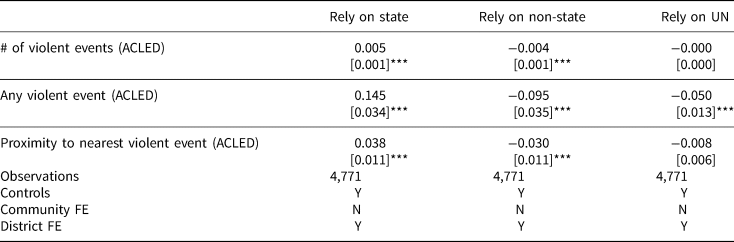
Table 2 tests the correlation between demand for state-provided security and community-level exposure to wartime violence in ACLED. I operationalize exposure as the number of violent events in each community (top panel), an indicator for any violent event in each community (middle panel), and an estimate for each community's proximity to the site of the nearest violent event (bottom panel). My results are again consistent with Hobbesian theory. The predicted probability of relying on the state in communities in which ACLED records no violent events is 0.56, compared to 0.70 in communities in which ACLED records at least one violent event – an increase of 14 percentage points, or roughly 25 per cent. Conversely, in communities in which ACLED records no violent events, the predicted probability of relying on non-state authorities is 0.31, compared to 0.21 in communities in which ACLED records at least one violent event – a decrease of 10 percentage points, or roughly 32 per cent. As in Table 1, with one exception, wartime violence in ACLED is not a statistically significant predictor of reliance on UNMIL. (Respondents living in communities with at least one violent event were 5 percentage points less likely to prefer relying on UNMIL, but this negative correlation is sensitive to specification.) Again, as I show in Appendix M, while wartime violence in ACLED does not predict demand for UNMIL in an absolute sense, in most specifications it does predict demand for UNMIL over non-state authorities.
Community-level exposure to wartime violence and reliance on state in hypothetical criminal cases

Notes: coefficients from OLS regressions. Observations are weighted by the inverse probability of sampling. Standard errors, clustered by community, are in brackets. *** p < 0.01, ** p < 0.05, * p < 0.1
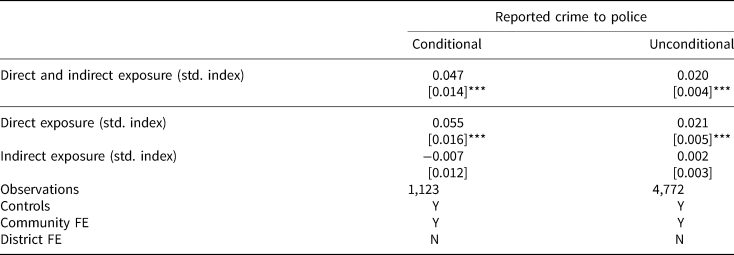
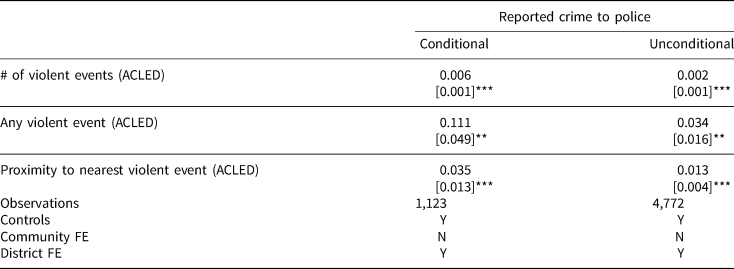
Tables 1 and 2 use hypothetical scenarios to measure attitudinal demand for state security provision. As a behavioral complement, Tables 3 and 4 use respondents' decisions to report actual crimes to the police. The first column in each table reports results conditional on crime victimization: respondents who were victims of crime and reported to the police are coded as 1, those who were victims but did not report are coded as 0, and those who were not victims are coded as missing. This specification requires conditioning on a post-treatment variable, which may induce bias. The second column in each table therefore reports unconditional correlations instead. This specification avoids post-treatment bias but is more ambiguous to interpret, since it conflates respondents who were victims of crime but did not report with those who were not victims. (Both are coded as 0.)
Individual-level exposure to wartime violence and reliance on state in actual criminal cases

Notes: coefficients from OLS regressions. Column 1 reports estimates conditional on being a victim of crime; Column 2 reports unconditional estimates. Observations are weighted by the inverse probability of sampling. Standard errors, clustered by community, are in brackets. *** p < 0.01, ** p < 0.05, * p < 0.1
Community-level exposure to wartime violence and reliance on state in actual criminal cases

Notes: coefficients from OLS regressions. Column 1 reports estimates conditional on being a victim of crime; Column 2 reports unconditional estimates. Observations are weighted by the inverse probability of sampling. Standard errors, clustered by community, are in brackets. *** p < 0.01, ** p < 0.05, * p < 0.1
My results are substantively similar regardless of specification, and are again consistent with Hobbesian theory. From Table 3, a one-standard-deviation increase in direct and indirect exposure to wartime violence predicts a 2-percentage-point increase in the probability of reporting to the police among all respondents, and a 4.7-percentage-point increase among victims of crime (top panel). These correlations are again driven by direct rather than indirect exposure (bottom panel). The predicted probability of reporting a crime to the police is less than 0.01 among respondents who reported the least severe exposure to wartime violence. Among respondents who reported the most severe exposure, it is over 0.09, a twentyfold increase. From Table 4, my results are similar when I use ACLED instead. Taken together, these results suggest that Liberian victims' increased demand for state-provided security is not passive, aspirational or purely attitudinal. Behaviorally as well, respondents who were more severely affected by violence during the civil war are more likely to seek redress from the state in actual criminal cases. These results also suggest that victims do not view the Liberian state as too weak to provide protection when actual crimes occur.
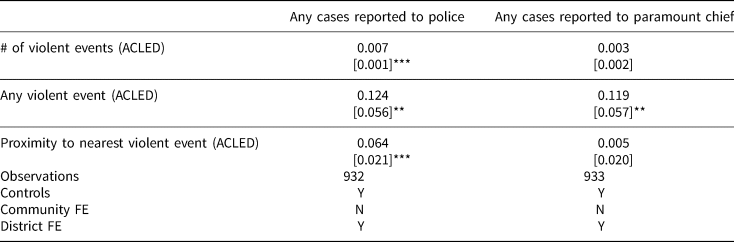
Finally, in Table 5 I use the local leaders survey to test whether communities that were more severely affected by wartime violence are also more likely to report criminal cases to the police (Column 1) or the paramount chief (Column 2), one of the most powerful non-state authorities in Liberia. Because I did not ask local leaders about their own histories of wartime victimization, I am limited to ACLED data for these analyses. Nonetheless, my results are again consistent with Hobbesian theory. Communities that witnessed more violence during the civil wars are more likely to report criminal cases to the police almost a decade later. Communities with at least one violent event are more likely to report criminal cases to the paramount chief as well, but this result is sensitive to specification.
Community-level exposure to wartime violence and reliance on state in actual criminal cases using local leaders survey

Notes: coefficients from OLS regressions. Observations are weighted by the inverse probability of sampling. Standard errors, clustered by community, are in brackets. *** p < 0.01, ** p < 0.05, * p < 0.1
Wartime Violence and Fear of Civil War Recurrence
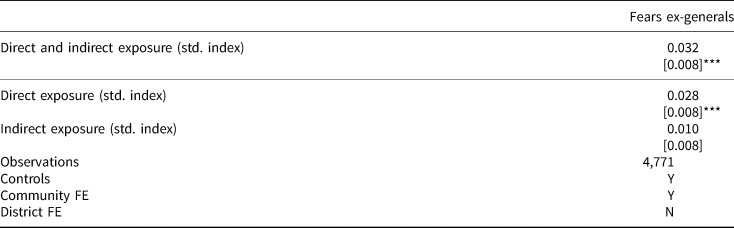
Hobbes posited fear of a return to civil war as the mechanism that would motivate rational, self-interested individuals to demand state authority. He believed this fear would persist even after the sovereign was established, and dedicated much of Leviathan to persuading readers to ‘keep their eyes on the object of that fear’ (Ryan Reference Ryan and Sorell1996, 225). Hobbesian theory therefore predicts a positive correlation between exposure to wartime violence and fear of civil war recurrence, even in the post-conflict period, and even where a state has already been (re-)established. My survey allows me to test this prediction. To operationalize fear of civil war recurrence, respondents were asked if they believe generals or other ‘big men’ from the conflict still wish to cause upheaval in Liberia today. I code a dummy indicating affirmative responses to this question.
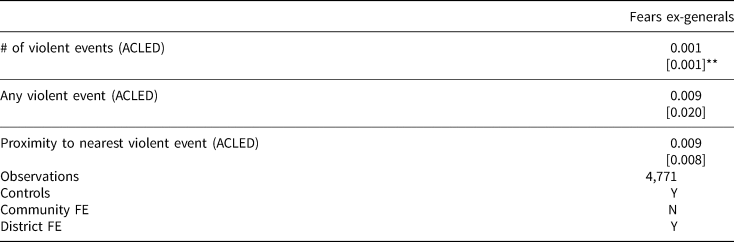
Tables 6 and 7 report the correlation between fear of civil war recurrence and exposure to wartime violence at the individual and community levels, respectively. The results in Table 6 show that respondents who were more severely victimized during the civil wars are more likely to express fear of generals and other ‘big men’. These correlations are again driven primarily by direct rather than indirect victimization. To put the correlations into perspective, 14.5 per cent of respondents who reported the least severe exposure to wartime violence fear a recurrence of civil war, compared to 28 per cent who reported the most severe exposure. In other words, fear of civil war recurrence is almost twice as likely among respondents who witnessed or experienced the worst violence during the civil war. My results using ACLED data in Table 7 are consistent with Hobbesian theory as well, though the coefficients are less precisely estimated.
Individual-level exposure to wartime violence and fear of civil war recurrence

Notes: coefficients from OLS regressions. Observations are weighted by the inverse probability of sampling. Standard errors, clustered by community, are in brackets. *** p < 0.01, ** p < 0.05, * p < 0.1
Community-level exposure to wartime violence and fear of civil war recurrence

Notes: coefficients from OLS regressions. Observations are weighted by the inverse probability of sampling. Standard errors, clustered by community, are in brackets. *** p < 0.01, ** p < 0.05, * p < 0.1
Given the challenges of isolating mechanisms even in experimental and quasi-experimental studies (Bullock, Green and Ha Reference Bullock, Green and Ha2010), these correlations should be interpreted with some caution. They do not prove that fear of civil war recurrence is the only (or even the primary) mechanism linking wartime violence to demand for the state.Footnote 13 For example, wartime violence may increase political engagement and efficacy (Blattman Reference Blattman2009; De Luca and Verpoorten Reference De Luca and Verpoorten2015), which may in turn heighten demand for state security provision. I cannot rule out this or other possibilities. These caveats notwithstanding, my results are generally consistent with the mechanism that Hobbes proposed.
Discussion and Conclusion
This study tests the empirical implications of a Hobbesian theory of citizen/state relations after civil war. In Hobbes's account, the state is preferable to available alternatives due to its relative (1) strength, (2) permanence and (3) capacity to monopolize the use of force. Using data from Liberia, I show that citizens who were more severely affected by wartime violence express greater demand for the state as a purveyor of security almost a decade later, both in absolute terms and relative to both local (for example, chiefs) and international (for example, UN) alternatives. These correlations are especially pronounced among those who witnessed or experienced wartime violence firsthand, and are consistent with the Hobbesian expectation that wartime violence generates demand for centralized over localized authorities, and for permanent over temporary ones. Liberians who were more severely victimized also tend to be more fearful of threats to peace in the post-conflict period. This resonates with Hobbes's emphasis on fear as the mechanism motivating citizens to covenant under sovereign rule (though other mechanisms are of course possible).
Hobbes believed this covenant was conditional on continued protection. While Liberia has been generally stable since the end of the civil war, it has witnessed sporadic incidents of collective violence, some of which have threatened to escalate (Blair, Blattman and Hartman Reference Blair, Blattman and Hartman2017). Were these incidents sufficiently serious to rupture the social contract between Liberians and the state? Hobbes does not provide a clear prediction on this point. Hobbesian agents have the right to protect themselves when the state fails to do so: ‘the right men have by Nature to protect themselves, when none else can protect them, can by no Covenant be relinquished’ (Hobbes Reference Hobbes2010, 134). It is this aspect of Hobbes's theory that most disturbed his contemporaries, and that has provoked some of the most heated debate among scholars (see Steinberger Reference Steinberger2002 for a review and an especially elegant solution to the problem of Hobbesian resistance). But it is not clear how serious the failure to protect would have to be to absolve citizens of their obligations.
While Hobbes does not offer an unambiguous theoretical answer to this question, I explore it empirically in Appendix O by testing the relationship between demand for state-provided security and community-level collective violence in the post-conflict period. My results suggest that if anything, peacetime collective violence only reinforces reliance on the state over non-state alternatives. Residents of communities that experienced at least one incident of peacetime collective violence are 8 percentage points more likely to prefer relying on state authorities in hypothetical scenarios of crime and violence, and 5.9 percentage points less likely to prefer relying on non-state alternatives. They are also 3 percentage points more likely to rely on the state in actual criminal cases. It may be that collective violence in the post-conflict period simply was not severe enough to erode Liberians' confidence in the peace process, or in the government's ability to sustain it. Indeed, in a 2011 survey, only 5 per cent of respondents said the government had failed to ‘have peace in Liberia’ (Vinck, Pham and Kreutzer Reference Vinck, Pham and Kreutzer2011).
How generalizable are my results likely to be? While I cannot answer this question definitively, data from the Afrobarometer survey suggest that Liberians are not unique in their endorsement of state rule despite bias and corruption on the part of state authorities. As discussed earlier, most Africans support the government's right to collect taxes and enforce the law, and most prefer to rely on the police and courts to adjudicate criminal cases, even (and perhaps especially) in countries that have recently emerged from civil war. While these patterns are only descriptive, they suggest that a Hobbesian logic may operate outside of Liberia as well. Nor is the scope of my findings limited to states that are strong, permanent and capable of monopolizing force in some absolute sense. The more relevant question is whether the state is strong, permanent and capable relative to the available alternatives.
The nature and identity of these alternatives inevitably varies across settings. In Liberia, the disorder of the civil war catalyzed the re-emergence of traditional and customary mechanisms of governance at the local level. In other settings, gangs, vigilante groups and insurgents themselves are the most viable alternatives to the state. It is possible that citizens might be less likely to demand state-provided security in settings where rebel groups (rather than traditional leaders) provide local order amidst national upheaval. But as long as the state is stronger, more permanent and more capable of monopolizing violence than these alternatives, a Hobbesian logic should apply. Liberia meets this scope condition, as do many (though not all) countries in Africa and beyond.
Perhaps the most important scope conditions for my findings, and for Hobbes's account more generally, are the sweeping structural and political reforms that distinguish the Liberian state of the post-conflict period from the one that brutalized civilians during the conflict itself. My results are less likely to generalize to settings where predatory incumbent regimes maintain control after civil war termination, and are especially unlikely to hold among victims of these regimes. But as discussed earlier, this scope condition is not as restrictive as it may seem. Transitions to peace often precipitate convulsive political and institutional change, which may in turn create opportunities for states to repair damaged relations with the civilians over whom they claim the right to rule.
This has important implications for the practice of peacebuilding in countries recovering from civil war. Scholars and practitioners continue to debate the relative merits of ‘bottom-up’ and ‘top-down’ approaches to peacebuilding. Proponents of bottom-up approaches advocate focusing less on rebuilding states and more on supporting civil society organizations and other non-state actors (Autesserre Reference Autesserre2010). Proponents of ‘top-down’ approaches argue that statebuilding is the most urgent priority for peace (Fukuyama Reference Fukuyama2004). While my goal is not to adjudicate between these perspectives, my results nonetheless suggest that victims of wartime violence are likely to demand a Hobbesian Leviathan capable of providing protection from the top down. Policies designed to strengthen the state are likely to resonate with this demand, even in settings where observers are reasonably skeptical about whether citizens affected by wartime violence will ever seek protection from the state again.
Acknowledgements
For valuable comments I thank Pablo Kalmanovitz, Benjamin Morse, Kevin Russell, Peter van der Windt, Jonathan Weigel, participants in the Stanford University Comparative Politics Seminar and two anonymous reviewers. Matthew Siakor, Jr., Yuequan Guo and Colombine Peze-Heidseck provided excellent research assistance.
Data availability statement
Replication data for this paper can be found in Harvard Dataverse at: https://doi.org/10.7910/DVN/YKVN5D
Supplementary material
Online appendices are available at https://doi.org/10.1017/S0007123420000885
Financial support
This research was supported by the National Science Foundation, the MacMillan Center for International and Area Studies at Yale University, Humanity United and a Vanguard Charitable Trust.
Ethical standards
This research was conducted in accordance with protocols approved by the Institutional Review Boards of Yale University and Columbia University.