




No CrossRef data available.
Article contents
- Abstract
- EXISTING EVIDENCE ON THE ELECTORAL EFFECT OF HOUSE MEMBERS' VOTING
- LEGISLATIVE VOTING AND ELECTORAL MARGINS
- Model, Data, and Measurement for Analysis of Electoral Margins
- Results on Electoral Margins
- LEGISLATIVE VOTING AND THE PROBABILITY OF REELECTION BY DISTRICT SAFETY
- CONCLUSION
- References
Out of Step, Out of Office: Electoral Accountability and House Members' Voting
Published online by Cambridge University Press: 03 March 2004
Article contents
- Abstract
- EXISTING EVIDENCE ON THE ELECTORAL EFFECT OF HOUSE MEMBERS' VOTING
- LEGISLATIVE VOTING AND ELECTORAL MARGINS
- Model, Data, and Measurement for Analysis of Electoral Margins
- Results on Electoral Margins
- LEGISLATIVE VOTING AND THE PROBABILITY OF REELECTION BY DISTRICT SAFETY
- CONCLUSION
- References
Abstract
Does a typical House member need to worry about the electoral ramifications of his roll-call decisions? We investigate the relationship between incumbents' electoral performance and roll-call support for their party—controlling for district ideology, challenger quality, and campaign spending, among other factors—through a series of tests of the 1956–1996 elections. The tests produce three key findings indicating that members are indeed accountable for their legislative voting. First, in each election, an incumbent receives a lower vote share the more he supports his party. Second, this effect is comparable in size to that of other widely recognized electoral determinants. Third, a member's probability of retaining office decreases as he offers increased support for his party, and this relationship holds for not only marginal, but also safe members.
Information
- Type
- Research Article
- Information
- Copyright
- © 2002 by the American Political Science Association
You can only go so far in Texas…there's nothing more useless [to the Democrats] than a dead liberal.
Spoken by Representative (and future President) Lyndon B. Johnson to Jim Rowe, a White House assistant under Franklin D. Roosevelt, when Rowe asked Johnson to vote for an administration proposal on civil rights (Dallek 1991, 168–9)
A fundamental issue of American politics, as well as democratic theory, is whether the public holds elected officials accountable for their policy decisions. The founders of the United States clearly desired such accountability, and for no institution more so than the House of Representatives. As Madison ([1788] 1987, 323–4) argued in Federalist 52, “As it is essential to liberty that the government in general should have a common interest with the people, so it is particularly essential that the branch of it under consideration [the House of Representatives] should have an immediate dependence on, and intimate sympathy with, the people.” He continued by surmising, “Frequent elections are unquestionably the only policy by which this dependence sympathy can be effectively secured.”
Of course, frequent House elections achieve Madison's desired common interest only to the extent that electoral outcomes depend upon officials' policy decisions, and research in political science calls into question whether in fact voters hold members accountable for their policy choices. Perhaps most indicative of a lack of accountability is the plethora of studies that suggest that individual voters are fairly ignorant about members' policy actions (e.g., Campbell et al. 1960; Converse 1964; Delli Carpini and Keeter 1991; Miller and Stokes 1962; Smith 1989). Moreover, as Downs (1957) argued nearly half a century ago, such ignorance is rational for the typical citizen, who has little incentive to expend effort to gather political information given the extremely low probability that he is pivotal in an election. Thus the typical representative might be able to vote on legislative matters as she pleases without fearing that she could lose reelection.
In contrast to this body of work, research on congressional behavior suggests that House members believe that roll-call voting affects their probability of reelection, causing them to consider constituent ideology in deciding upon roll-call positions. This concern with the electoral effect of legislative voting is a standard component of theories of Congress1
For example, see Arnold (1990), Fiorina (1974), and Mayhew (1974a).
See Clausen (1973), Kingdon (1981), and Sullivan et al. (1993) among others. Collie (1985) provides an excellent review of this literature.
I've found out this much. When you are voting right, you build up points on a cumulative basis. You lose them on a geometric basis; you can lose all your points on one vote.
Studies that focus explicitly on electoral results do not resolve whether a typical member should be concerned with the potential electoral ramifications of legislative voting. Several studies find no evidence of an electoral impact (e.g., Gaines and Nokken 1999), while those uncovering one have generally focused on members' vote shares for specific elections (e.g., Jacobson 1996) or samples of legislators (e.g., Ansolabehere, Stewart and Snyder 2001). Notably, even the positive evidence does not establish that a member who has won with at least 60% of the two-party vote, a criterion applying to the majority of incumbents between 1956 and 1996, need fear that roll-call voting could affect his probability of defeat. Results on vote shares and seat loss are not in general equivalent, and moreover, the existing evidence suggests that a large shift in a member's voting, such as from a perfectly moderate record to one at his party extreme, decreases his two-party vote share by less than 10 percentage points.
In the following, we conduct three tests on the elections of 1956–1996 to analyze whether in fact House members should be concerned with the electoral impact of legislative voting. In each of the tests, we estimate the effect of an incumbent's increased support for the extreme of his party. The first test employs a standard model from previous work to assess whether such legislative voting had a significant effect on members' vote shares in each election. The second test then pools across the elections, estimating how the average impact of legislative voting compares to that of other factors, such as challenger quality and campaign spending. The third test proceeds to examine directly the relationship between members' voting and their probability of reelection. To incorporate that this probability may differ between “safe” members who have previously won with at least 60% of the vote and the remaining “marginal” members, the test distinguishes between them. In addition, it accounts for the fact that a member's safety may depend upon his prior voting record.
EXISTING EVIDENCE ON THE ELECTORAL EFFECT OF HOUSE MEMBERS' VOTING
Almost every existing study that finds an electoral effect of legislative voting focuses on a small set of elections. These include the studies by Schoenberger (1969) for 1964, Erikson (1971) for Republicans in the 1950s–1960s, Bernstein (1989) for 1978 and 1980, Johannes and McAdams (1981) for 1978, Erikson and Wright (1993) for 1990, and Brady et al. (1996) and Jacobson (1996) for 1994.3
In related work, Wright (1978) and Erikson and Wright (1989, 1997) show that members' publicly stated campaign positions affected their electoral margins in 1966, 1982, and 1994, respectively.
The two exceptions are Johannes and McAdams (1981) and Brady et al. (1996). In the former, the authors construct a measure of ideological discrepancy that allows any member, regardless of partisan affiliation, to be out of step with district ideology in either a conservative or a liberal direction. In the latter, the authors analyze the relationship between incumbents' presidential support and their probability of reelection.
This research provides a critical basis for considering the importance of legislative voting in affecting electoral outcomes but, as a whole, does not establish that members' actual probability of seat loss is affected by their roll-call decisions, particularly for so-called safe members. In general, results on electoral margins are not equivalent to results on seat loss because, among other reasons, members behave differently if they are minimizing their probability of defeat rather than seeking the largest number of votes.5
Even ignoring this nonequivalence, however, the existing results do not imply a conclusive impact. For example, Erikson and Wright (1993) find that a Democrat who shifted from perfectly moderate to perfectly liberal voting decreased his two-party vote share by only 5 percentage points in 1990, and Bernstein (1989) estimates that among Democratic incumbents who lost in 1980, only those receiving at least 46% of the vote could have conceivably altered the outcome by moderating their roll-call voting. Given such findings, one might conclude that a typical incumbent need not fear that roll-call voting could ever cost him reelection, and Bernstein explicitly makes this claim. After reviewing the existing evidence, he surmises that “members can generally afford to vote for what they think is right without expecting that their votes will cost them a seat in Congress … ” (Bernstein 1989, 100). The other cited studies on electoral margins do not offer such a bold claim, but neither do they establish a systematic relationship between members' voting and their probability of retaining office.Even the contention that legislative voting systematically affects electoral margins is put into question by work that analyzes elections across several decades. For example, political economics research on members' ideological “shirking” from 1960 through 1990 has produced inconsistent findings. In studies that estimate shirking as the absolute difference between interest-group voting scores and the predicted values from these scores regressed on constituency characteristics, some evidence has suggested that shirking is correlated with electoral defeat (e.g., Wright 1993), while other evidence has suggested that the factors are uncorrelated (e.g., Goff and Grier 1993). One possible reason for the discrepancy is that these studies equate shirking with noise that could result from omitted variables; to the extent that the constituency characteristics included in a particular analysis do not fully capture district preferences, shirking is overestimated and the effects of it underestimated.6
For other problems with the two-stage residual approach, see Bender and Lott (1996).
Other research that examines elections over time, but that does not characterize itself as studying shirking, also produces inconclusive results as to whether legislative voting systematically affects elections. Gaines and Nokken (1999) analyze all midterm elections between 1958 and 1994 and find that in almost every year, an incumbent's roll-call support for the president did not significantly affect his probability of reelection. Brady, Canes-Wrone and Cogan (2000) find more evidence of an impact, showing that for the 1954–1994 elections, winning incumbents tended to have more moderate voting records than losing incumbents. This difference, however, is significant for only about one-third of the elections.The most compelling evidence of an electoral effect over time comes from Ansolabehere, Snyder and Stewart (2001) and Erikson and Wright (2000). Ansolabehere, Snyder and Stewart pool the elections of 1952–1974 and 1976–1996 to compare candidates' voting records in races in which a sitting incumbent was defeated and find that a candidate's vote share was lower the more she supported the extreme of her party. The key limitation of the analysis is that it does not examine the roll-call voting of members who are never unseated, and therefore, as the authors acknowledge, it remains possible that most House races are not affected by legislative voting. Erikson and Wright do examine all incumbents for the elections of 1976–1996 and similarly find that voting with the ideological extreme of one's party decreases one's vote share. Their analysis does not, however, control for standard electoral determinants such as challenger quality and campaign spending, and thus it remains possible that the effect of legislative voting would disappear once such controls were added to the analysis.7
Notably, most of the other cited analyses also do not control for these electoral determinants.
In sum, the literature is far from conclusive that legislative voting systematically affects House electoral outcomes. It offers some evidence that roll-call voting, particularly voting with the extreme of one's party, affects electoral margins, but this relationship has not been established across time and members. Moreover, even the existing support does not show that legislative voting affects the probability of reelection, particularly for safe members. What is needed, therefore, is a study that examines the relationship between vote shares and roll-call decisions across elections for all districts and that explicitly analyzes the effect of the decisions on the probability of winning for safe as well as marginal members.
LEGISLATIVE VOTING AND ELECTORAL MARGINS
Building on previous research, we estimate the electoral impact of legislative voting by analyzing the effect of voting with the extreme of one's party, a phenomenon we refer to as roll-call ideological extremity. We hypothesize that controlling for district ideology, Democrats lose electoral support by voting more liberally and Republicans by voting more conservatively. Thus for two Democratic (Republican) incumbents from districts with identical voter preferences, the Democrat (Republican) with the more liberal (conservative) voting record should have a lower electoral vote share, holding all else equal. We refer to this prediction as the Roll-Call Ideological Extremity Hypothesis.
While much of the previously discussed work on electoral margins details the theoretical framework underlying the Roll-Call Ideological Extremity Hypothesis (in particular, see Erikson 1971), we briefly review the logic here. Arguably the most critical assumption is that the Republican and Democratic candidates of each district diverge ideologically, with the Democrat being more liberal than the Republican. Evidence of such divergence is provided by Ansolabehere, Snyder and Stewart (2001), and other studies justify this phenomenon by describing the long-run career benefits a member may obtain from voting with his or her party (e.g., Aldrich 1995; Cox and McCubbins 1993; Rohde 1991; Snyder and Groseclose 2000). Thus even on roll-calls for which a member's electoral incentive is to vote against her party, she can have long-term career incentives to vote with it.
Applying Downsian (1957) logic to this stylized fact of ideological divergence between the Republican and the Democratic candidates in a district, ideological moderation should increase an incumbent's vote share. Given Downs' assumptions that voters can order the candidates on an ideological spectrum, that voters have positions on the spectrum, and that electoral choices depend upon candidates' positions, either candidate can increase her vote share by moderating towards the other. Thus if voters' assessment of the incumbent's ideology is not independent of her legislative voting, her electoral margin is higher the less she votes with the ideological extreme of her party.8
The directional theory of issue voting (Rabinowitz and MacDonald 1989) suggests that a candidate may increase his vote share by moving toward his party extreme. While we base our theoretical prediction on Downsian logic, our empirical analysis allows for this alternative hypothesis (and in fact tests for it). Moreover, we are careful to use two-tailed significance tests in evaluating the Roll-Call Ideological Extremity Hypothesis given the alternative prediction of the directional theory.
Notably, while this framework assumes that voters select candidates on the basis of ideology, the Roll-Call Ideological Extremity Hypothesis does not require voters to be fully informed about all details of an incumbent's legislative record. The literature identifies several mechanisms by which roll-call voting should affect constituents' assessments of an incumbent's ideology absent their complete knowledge of his or her record.9
Even Downs (1957, 80) explicitly states that his framework assumes that voters “may be completely unaware of certain actions being carried out by the government, or of alternatives the government could have undertaken, or of both.”
Among others, see Kuklinski, Metlay and Kay (1982) and Lupia (1994) for evidence of citizen cue-taking from elites.
Jacobson and Kernell (1983) identify a related mechanism, arguing that a high-quality challenger is more likely to enter the electoral race if an incumbent has voted out of step with district preferences. This mechanism still presumes that there exists some relationship between an incumbent's voting record and voters' assessment of the incumbent; otherwise, potential challengers' decisions on whether to enter the race would not be based on the incumbent's record.
Complementing these mechanisms is the “running tally” or “on-line” cognitive model of voters' evaluations of candidates. In this cognitive model, voters update their judgment of a candidate with each new piece of information received and, when they produce an overall evaluation, retrieve the tally without reviewing the contents upon which it has been formed. See, for example, Lodge, McGraw and Stroh (1989).
Model, Data, and Measurement for Analysis of Electoral Margins
To test the Roll-Call Ideological Extremity Hypothesis, we employ an econometric model that is similar to those adopted in previous studies of the relationship between legislative voting and electoral margins. In particular, we regress each incumbent's vote share on a measure of roll-call ideological extremity, controlling for a range of factors.13
Snyder (1996b) formally derives the conditions under which a linear factor structure can be employed to analyze aggregated voting data, and Snyder (1996a) employs such a model.
where the variables in brackets are naturally included only in tests that pool across elections. Because the Roll-Call Ideological Extremity Hypothesis does not imply asymmetric effects across parties, we analyze Democratic and Republican incumbents jointly, with the parties in a given year separated by the factor In Party. The substantive results still hold, however, if the effect of roll-call ideological extremity or the entire model is estimated separately for each party.14
When we estimate the effect of roll-call ideological extremity separately by party, but the remainder of the model jointly, the null that the coefficients for the two parties are equivalent cannot be rejected. Specifically, for the time series as a whole, the coefficient on Roll-Call Ideological Extremity for Democrats is 0.067 (with a standard error of 0.006) and the analogous coefficient for Republicans is 0.055 (with a standard error of 0.008). The difference between these two coefficients, 0.012, is not significant at conventional levels (F = 1.13, p > 0.2). Estimating only the elections for which we have data on candidates' spending, we again cannot reject the null that the two coefficients are identical (F = 2.41, p > 0.1).
The main difference when uncontested elections are included is that if separate coefficients are estimated for Democratic and Republican incumbents, the magnitude of the difference between Democrats and Republicans becomes relatively large, with roll-call ideological extremity having approximately three times the impact on the former than the latter. (Each coefficient remains significant, however.) Consistent with this result, Democrats held 82% of uncontested seats during the time period of our analysis.
The measurement of each variable in the model is as follows.
Incumbent's Vote Share. As is common in studies of electoral margins (e.g., Jacobson 1996), the dependent variable equals the incumbent's percentage of the two-party vote.16
The independents Dale Alford (AR), John Moakley (MA), Thomas Foglietta (PA), and Bernie Sanders (VT) have been coded as Democrats since each caucused with this party.
Roll-Call Ideological Extremity. We base our measure of legislative voting on Americans for Democratic Action (ADA) scores, which reflect the proportion of liberal positions taken by a member in a given year on votes selected by the Americans for Democratic Action. These votes generally encompass the key policy issues of a session. For example, the scores include the major tax and budget votes of the 1980s and 1990s, the abortion and school prayer votes of the 1970s and 1980s, and the Civil Rights votes of the 1960s. The ADA ratings are widely known among members and often publicized in their districts. Therefore, to the extent that legislative voting affects members' electoral fate, the scores should have this effect. The specific measure that we adopt provides a consistent ranking of ideological extremity across the parties and is based on a member's ADA score in the year prior to the election if the member is Democratic and 100 minus this score if the member is Republican. Thus for a Democrat, a higher value indicates a more liberal member, while for a Republican, it reflects a more conservative one.17
We are aware of the limitations of pooling interest group scores over time (Groseclose, Levitt and Snyder 1999), but the available corrections constrain the way in which members' scores can change over time, and we do not want to eliminate the possibility that a member could vote moderately for a number of sessions and then more extremely in a particular session. Still, we have analyzed our model with the Groseclose, Levitt and Snyder adjusted scores, and our substantive results hold.
In conducting this analysis, we used the average of each member's first- and second-dimension DW-NOMINATE scores.
Presidential Vote. Following Erikson and Wright (1989, 1993, 1997) and Brady et al. (1996), among others, we use the presidential vote to control for district ideology. Specifically, Presidential Vote equals the average proportion of the two-party vote received by the presidential candidate of the incumbent's party in the two most recent elections in his or her district, with each combination of presidential elections normalized around its mean. Thus for Democratic incumbents, the variable is based on the vote for the Democratic presidential candidate, and for Republican incumbents, on the vote for the Republican presidential candidate. We average across the two most recent elections and normalize each of these averages, to mitigate the impact of factors that may be specific to individual presidential races.
Challenger Quality. Research suggests that an incumbent's vote share is lower when she faces a challenger who has previously won an elected position (e.g. Jacobson and Kernell 1983). We therefore control for challenger quality with a variable that equals 1 if the challenger has held elective office and 0 otherwise.
ln(Challenger Spending) − ln(Incumbent Spending). A great deal of work has examined the electoral effects of candidates' spending, and while the findings vary, the literature as a whole suggests that a candidate's spending increases his vote share. As in some previous research (e.g., Erikson and Wright 1993), we control for this effect with a variable reflecting the difference between challenger and incumbent spending, taking the natural log of each. Our data are from Federal Elections Commission (FEC) Reports. Because these reports were not edited by the FEC until 1980, we include the control for spending only in the 1980 through 1996 elections.19
As Souraf (1992, 248, note 10) writes, “Since the Federal Election Commission did not begin to operate at full power until the 1978 elections, complete data on congressional campaign finance are not available before that election. Even then, the FEC never had the resources to edit and reconcile the data for the receipts and spending of congressional candidates in 1978; one must use a final preliminary report and its data. Worse than that, FEC data for 1976 are sketchy and for 1974 one has to rely on the much smaller volume of data that Common Cause assembled.”
Freshman. This dummy variable equals 1 if the House term was the incumbent's first and 0 otherwise. Research suggests that there exists an incumbency advantage due to, among other factors, members' capacity to bring home pork and perform constituency service (Mayhew 1974a). Because freshmen generally have less political clout than more senior members, for example, less influential committee assignments (Munger 1988), freshmen should have a lower incumbency advantage and thus a lower average vote share.
ΔPersonal Income (coded by In Party), Presidential Popularity (coded by In Party), Midterm Loss (coded by In Party), and In Party. We include several factors that vary over time20
We have also conducted the analysis with a set of election indicators. However, because the controls for presidential popularity, midterm loss, and the macroeconomy already account for a good deal of inter temporal variation, multicollinearity prevents including a full set of election effects. For example, in the 1980–1996 test, only five election effects can be included without creating perfect multicollinearity among some of the controls. The results are substantively similar with the effects.
Other rationales include the macroeconomy and presidential popularity, which are controlled for directly.
We include each of these factors as a single term that is coded by affiliation with the in party rather than without this coding but with interaction terms according to affiliation with the in party because the latter approach would create a high degree of multicollinearity.22
Our approach is akin to that of Jacobson (2000).
An additional control variable with which we have conducted the analysis is the incumbent's prior vote, and the results from this analysis are substantively similar to those presented. Disagreement exists in the literature over whether to include lagged vote share as an explanatory variable of current vote share. For example, in the previous studies of roll-call voting cited, some do not control for lagged vote (e.g., Ansolabehere, Snyder and Stewart 2001; Eriskon and Wright 2000) while others do (e.g., Jacobson 1996). Our main rationale for not including the variable derives from Ansolabehere, Snyder and Stewart's (2000), which shows that it does a poor job of measuring the normal vote, which is the traditional reason for including lagged vote. We therefore do not include the variable in our analysis.
Results on Electoral Margins
We first analyze Eq. (1) for each election of 1956 through 1996.24
We conducted all analyses regarding electoral margins with STATA version 6.0.
We have also analyzed an alternative specification that excludes any observation for which redistricting occurred in the previous 2 years or since the most recent presidential election and that bases Presidential Vote only on this most recent presidential election. The results are substantively similar to those presented.
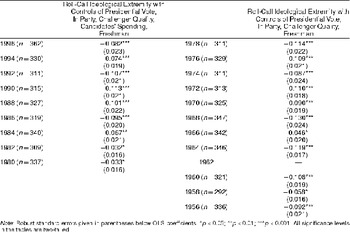
Table 1 presents the central results. In particular, the table describes the parameter estimates on the key variable Roll-Call Ideological Extremity, reporting White's robust standard errors because the Cook and Weisberg (1983) test rejects the null of homoskedasticity in almost every election. We have chosen to make the parameter estimates on the control variables and the regression diagnostics available upon request to conserve space, particularly because these findings largely replicate those presented subsequently (and more succinctly) for the pooled-election analyses.

As Table 1 shows, the results of the individual-election analysis strongly support the Roll-Call Ideological Extremity Hypothesis. In all of the elections, an incumbent receives a significantly lower electoral margin the more he votes with the extreme of his party holding constant the range of control variables listed in the table. Thus comparing two Republican members who have identical district ideologies, who are running against the same quality of challenger, who are not freshmen, and who face the same distribution of spending between themselves and their challengers, the member with the more conservative voting record obtains a lower vote share. Similarly, the results suggest that between two otherwise equivalent Democratic incumbents, the one with the more liberal voting record will receive the lower vote share. In each year, this effect is statistically significant at the conventional level of p = 0.05 (two-tailed).26
These results, in supporting the Roll-Call Ideological Extremity Hypothesis, also support the Downsian logic of elections over the directional theory of issue voting, which allows that candidates may increase their electoral margins by voting more extremely.
To interpret the size of this effect, we consider a 25-point shift in a member's ADA score toward the extreme of his party, a shift that approximates one standard deviation of the data, or 3 to 4 high-profile votes.27
The standard deviation in members' ADA scores equals 24.43 points.
Analyzing our model without controlling for challenger quality or campaign spending, a 25-point shift in roll-call extremity is estimated to decrease a member's vote share by 1.5 to 4 percentage points. Another reason that our estimate is arguably conservative is that we have excluded uncontested elections, which many previous studies include (e.g., Brady, Canes-Wrone and Cogan 2000; Erikson and Wright 2000). Analyzing our model with contested elections, a standard deviation increase in roll-call extremity is estimated to decrease a member's vote share by 2 to 7 percentage points.
Given the consistent significance of the relationship between roll-call decisions and vote margins, we proceed to estimate the average impact of this relationship. Pooling the data, we control not only for factors that vary only within an election but also ones that vary across time, as specified in Eq. (1). Because the control for candidate spending exists only for 1980–1996, we conduct two tests. The first examines these later years with the control, and the second all years without it.
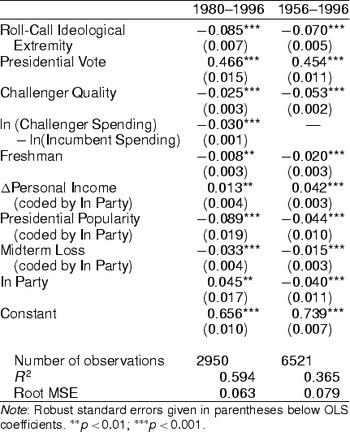
Table 2 presents the results. As with the individual-election analysis, the Cook and Weisberg (1983) test suggests evidence of heteroskedasticity, and White's robust standard errors are therefore reported.29
Specifically, χ2(9) = 36.77 (p < 0.05) for the 1980–1996 sample and χ2(8) = 168.03 (p < 0.05) for the 1956–1996 sample. We have also tested for autocorrelation and found that it is not significant. The lack of significant autocorrelation is not terribly surprising since open seats are excluded; in fact, less than 10% of the observations are in a district that has an uninterrupted time series. The DW statistic (calculated as if each observation may be correlated with the most recent previous election in which an incumbent ran in that district) equals 1.89 for the 1980–1996 sample and 1.90 for the 1956–1996 sample.

Moreover, this effect has a magnitude comparable to that of other commonly recognized electoral determinants. To interpret the average impact of ideologically extreme voting, we again focus on a 25-point shift in a member's ADA score toward the extreme of his party, which, as mentioned previously, approximates a standard deviation. The coefficients for each sample indicate that such a shift would decrease a member's vote share by approximately 2 percentage points. In comparison, the 1980–1996 results suggest that an incumbent's vote share is lower by 2.5 percentage points when she faces a high-quality challenger, by 1 percentage point if the ratio between the challenger's and the incumbent's spending increases by 25 percentage points, and by 1 percentage point if she is a freshman. Even the coefficient on the midterm loss phenomenon has a comparable impact; off-year elections are estimated to lower the vote share of members of the president's party by 3 percentage points. The 1956–1996 coefficients are similar, with a high-quality challenger lowering a member's vote share by approximately 5 percentage points, a freshman receiving a lower vote share of 2 percentage points, and off-year elections lowering the vote shares of members of the president's party by 2 percentage points.
As these results suggest, the effects of the control variables are generally consistent with our expectations. The coefficients on challenger quality, presidential vote, candidates' spending, freshmen, personal income, and the midterm loss phenomenon all have the predicted signs with statistical significance (p < 0.05, two-tailed). The only control variable that has an unexpected effect is presidential popularity, and even though the factor was included merely to prevent overestimating any impact of legislative voting, we still investigated why the variable did not have the same effect as in the study by Tufte (1975). Employing Tufte's specification, which regresses seat change across the parties (rather than individual members' vote shares) on presidential popularity and personal income, we found presidential popularity to have the predicted impact, suggesting our finding derives from differences across the specifications. Specifically, the Tufte effect does not hold once the control for spending is added or if the dependent variable represents vote share rather than seat loss; our subsequent analysis on the probability of reelection demonstrates this variation in the impact.
Before moving on to this analysis, however, we first summarize the key findings in Tables 1 and 2. The results are important because previous work had left open the possibility that legislative voting affects members' electoral margins only for particular elections. By establishing a consistent effect in every year, we have foreclosed this possibility. Moreover, we have shown that the magnitude of the effect is not insubstantial but rather comparable to that of other widely recognized electoral determinants such as campaign spending, challenger quality, and the midterm loss phenomenon.
LEGISLATIVE VOTING AND THE PROBABILITY OF REELECTION BY DISTRICT SAFETY
The previous section still leaves open whether most members should be concerned that legislative voting might affect their probability of defeat. On the one hand, a majority of incumbents win by the so-called safe margin of at least 60% of the two-party vote, and the findings indicate that a shift from perfectly moderate to perfectly extreme voting alters a member's vote share by only 4 percentage points. On the other hand, the findings indicate that safety itself is likely to be dependent upon members' prior legislative records, and this relationship would suggest that even safe members might need to fear the electoral ramifications of legislative voting. For example, the results on electoral margins would lead us to expect that between two otherwise similar incumbents, the one with the more moderate record should be likelier to win by a safe margin, yet if that member were subsequently to shift toward her party's extreme, then her probability of winning reelection could significantly decrease. In fact, to the extent that a member is safe due to the moderation of her prior voting, a change toward more ideologically extreme voting could have as large of an effect as for a marginal member, whose lack of safety may derive from having voted ideologically extremely.
To assess whether members should indeed fear that roll-call voting might affect their prospects for reelection, we conduct a final test that estimates the relationship between legislative voting and the probability of reelection directly. In the test, we account for the possibility that safe members may not need to be concerned with the electoral ramifications of legislative voting even if marginal members do. Moreover, we incorporate that safety itself may depend upon members' prior voting records.
Model and Data for Analysis of the Probability of Reelection
The model that we employ is an endogenous switching regime regression, which has been utilized previously in political science (e.g., Kiewiet and McCubbins 1988; McCarty and Poole 1995). The model has similarities to the instrumental variables approach that has long been used to analyze congressional elections (e.g., Ferejohn and Calvert 1984) and consists of two equations. In the first-stage equation the binary indicator Safety, which equals 1 if the incumbent won at least 60% of the two-party vote in the previous election and equals 0 otherwise, is regressed via probit analysis on determinants of the previous election.30
We use the cutpoint of 60% rather than the other, often employed cutpoint of 55% (e.g., Mayhew 1974b) to bias against a finding that safe members face a higher probability of electoral defeat from ideologically extreme voting. We have conducted the analysis with this alternative cutpoint and found substantively similar results.
The regime-switching specification of the second-stage equation is important because if we estimated a single coefficient for roll-call voting, the effect could be significant (in magnitude and standard error) even if the impact for safe members were negligible. Our specification allows that the effect may be negligible for these members. The first-stage equation is also important; it is necessary from an econometric standpoint because if the factors influencing safety are correlated with those determining the probability of reelection, then modeling safety as exogenous could bias the results in favor of finding a significant effect of roll-call voting (see Maddala 1983, 283–4). By modeling safety as endogenous, we avoid this problem.31
We have, however, estimated a one-equation probit model of the probability of winning regressed on roll-call ideological extremity, the control variables, and a control for the incumbent's vote share last year and found a significant effect of roll-call ideological extremity. These results are presented in Table A1 (Appendix).
Equations (2) and (3) formally state the model.
where Pr[Safetyit = 1]** equals the predicted values from
and where the Control Variables include Presidential Vote, Challenger Quality, ln (Challenger Spending)-ln (Incumbent Spending), ΔPersonal Income (coded by In Party), Presidential Popularity (coded by In Party), Midterm Loss (coded by In Party), and In Party.
Because we are interested in capturing the degree to which prior legislative voting affects safety, we include only members who in election t have a voting record in the Congress preceding election t − 1, a sample that includes only nonfreshmen. Notably, this exclusion biases against finding that legislative voting significantly affects the probability of reelection; because freshmen tend to have a lower ability to bring home pork, perform constituency service, and otherwise serve their district in nonvoting capacities (Munger 1988), any effect of roll-call voting should be greater for these members. The control variable Freshman is thus not included in Eq. (2), but the lag is still included in Eq. (3) because sophomore members running in election t ran as freshmen in election t − 1.
The model is identified by this necessary exclusion of Freshman from Eq. (2) and, more generally, the fact that all other variables in Eq. (3) are lags of the regressors in Eq. (2). Thus for a given observation, Incumbent Won is predicted by right-hand-side components distinct from those predicting Safety. For example, if an incumbent faces a high-quality challenger in election t but did not face one in election t − 1, the value of Challenger Qualityt equals 1, while Challenger Qualityt−1 equals 0.32
We do not include in Eq. (3) the determinants of election t because of the intertemporal inconsistency that would result from doing so.
Our predictions for Eqs. (2) and (3) are similar to those we made regarding electoral margins. In terms of the incumbent's estimated safety, we predict that, holding district ideology constant, a member's likelihood of holding a safe seat will decrease as she shifts her voting toward the extreme of her party. In terms of the probability of reelection, we predict a negative effect of Roll-Call Ideological Extremity, expecting this effect to be significant for not only marginal but also safe members. We do not predict whether the impact should be greater for safe or marginal members because, as explained above, a significant relationship between safety and roll call voting would indicate that the impact could be similar for each type of member.
Results on the Probability of Reelection
We estimate the two-equation system by maximum likelihood and, following our previous tests, employ robust standard errors.33
We used the package TSP 4.5 to maximize the likelihood function, which Kimhi (1999) defines.

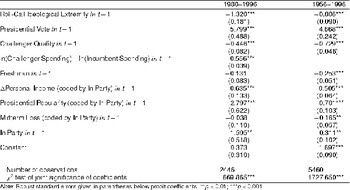
Most importantly for our purposes, the results indicate that a member is significantly more likely to be designated safe the more moderate is his legislative voting holding other factors equal. Interpreting the probit coefficients at the means of the independent variables, we focus as before on a 25-point shift in an incumbent's ADA score toward the extreme of his party, a shift that approximates a standard deviation.34
The standard deviation in members' ADA scores is 24.96 points. This standard deviation is close but not identical to that of the data in Table 2 since the current analysis excludes freshmen running in election t.
The control variables generally have the same effect on safety as they did on marginal changes in vote share. The most notable difference is in the 1980–1996 sample: the coefficients on Midterm Loss and Freshman are no longer significant at p = 0.05 (two-tailed) in this sample. These effects are still in the expected direction, however, and that on freshman remains marginally significant (p = 0.06, one-tailed).
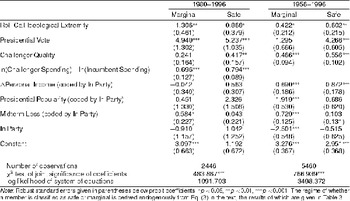
Turning to the main results, those on the probability of reelection, Table 4 presents them by the estimated regime of seat safety. In particular, the table describes the parameter estimates of each electoral determinant for a safe member versus a marginal one. The findings show that even safe members face a significantly lower probability of reelection when they increase the extent to which they vote with the extreme of their party. For both safe and marginal members and in each sample of the data, an incumbent's likelihood of retaining her seat decreases the more ideologically extreme is her voting.

These results support the long-standing findings that members view legislative voting as an important component of the electoral connection and consider constituency cues in roll-call decisions. Perhaps most notably, the results show why such legislative behavior is consistent with the fact that most incumbents win reelection by safe margins. Even safe legislators' roll-call voting affects their risk of electoral defeat. Thus members are correct in assuming that legislative votes have an impact on the probability of reelection.
Comparing the coefficients on Roll-Call Ideological Extremity across regimes, the one for marginal members is higher than that for safe members in the test with the control for campaign spending, while the reverse occurs in the other test. Neither difference, however, is statistically significant (p > 0.4 in each case). This result is consistent with the first-stage findings that safety is a function of members' prior voting records. As we argued at the outset, to the extent that safety depends upon roll-call decisions, they may have a similar impact on the probability of winning for safe and marginal members.
In terms of the magnitude of the coefficients, interpretation is less straightforward than for even a typical probit analysis because the means of the variables differ across the regimes of safety. To describe the magnitudes similarly by regime, we interpret the probit coefficients at specified parameter values, beginning with the following ones, which were chosen for their moderate values: 0.75 for roll-call ideological extremity (an ADA of 75 for a Democrat, 25 for a Republican); a difference of 0 between the district vote for the presidential candidate of the incumbent's party and the average vote for that candidate across the districts; 1 for challenger quality, midterm loss, and in party; 50% for presidential popularity; and 0 for the other variables. At these values, a member who shifts his ADA score 25 points toward the extreme of his party decreases his probability of reelection by 11% in the marginal regime of the 1980–1996 test, 9% in the safe regime of that test, and 4% in each regime of the 1956–1996 test. Altering the values such that the incumbent does not face a high-quality challenger, the magnitudes stay relatively constant, with such a shift in an incumbent's roll-call voting decreasing his probability of reelection by 9% in the marginal regime of the 1980–1996 test, 8% in the safe regime of this test, 3% in the marginal regime of the 1956–1996 test, and 2% in the remaining regime. Likewise, reducing the initial value of roll-call ideological extremity does not substantially alter the results. For example, at 0.50 (an ADA of 50 for each member) a 25-point shift in a member's ADA toward his party's extreme decreases his likelihood of reelection by 8% in each regime of the 1980–1996 test and by 3 to 4% in each regime of the 1956–1996 test.
As with the results on vote shares, the impact of roll-call voting is comparable to that for other electoral determinants. For example, at the initial parameter values of the previous paragraph, the 1980–1996 test suggests that an incumbent's probability of winning would decline by 5 to 7% if the ratio of challenger to incumbent spending increased by 25%. Similarly, each test indicates that a high-quality challenger decreases an incumbent's probability of reelection by 6 to 15%. The impact of legislative voting on the probability of reelection is thus not only statistically significant for safe as well as marginal members, but also similar to the effect of factors that are commonly recognized to be important determinants of electoral outcomes.
In general, the results on the control variables comport with our expectations. The effects of campaign spending and district ideology are consistently in the expected direction and statistically significant. Those on challenger quality also have the correct sign in each regime and sample and are significant with the exception of the marginal regime of the 1980–1996 test. In addition, the coefficients for the remaining variables that are not included as a main effect typically have the predicted sign, and they are significant only with the expected sign. Specifically, the effect of the economy is significant in each regime of the 1956–1996 test, the effect of the midterm loss is significant in the marginal regime of each test, and the effect of presidential popularity is significant in the marginal regime of the 1956–1996 test.
Overall, the results in Tables 3 and 4 are important because they show that a typical member should rationally be concerned with the electoral impact of legislative voting. Controlling for a wide range of other electoral determinants, roll-call voting has a significant effect on the probability of reelection. Notably, this effect holds for not only marginal but also safe members. These results are consistent with our finding that safety itself is a function of members' voting. That is, safe members are “safe” partially as a consequence of their roll-call decisions. Consequently, when such members change their voting pattern toward their party's extreme, they face a significantly higher probability of defeat, just as other members do.
CONCLUSION
While surveys of members have consistently found that they are concerned with the potential electoral ramifications of legislative voting, previous work had not established that this concern is necessarily rational. Surveys of the mass public have suggested that the typical voter is fairly ignorant of her representative's policy decisions, and studies of elections themselves have provided mixed results as to whether legislative voting affects electoral margins. Moreover, even the positive evidence has left open the possibility that roll-call decisions may not affect the likelihood of defeat for the majority of incumbents. The literature has thus failed to provide evidence that a typical member should believe that he is accountable to voters with regard to his roll-call decisions.
Our study presents three types of evidence to this end. First, we show that, holding district ideology constant, in every election between 1956 and 1996 an incumbent's vote share decreased the more he voted with the extreme of his party. Second, pooling across the years, we establish that the average impact of this effect is comparable to that of commonly recognized electoral determinants such as challenger quality. Third, by directly examining the probability of reelection, we demonstrate that the probability decreases significantly as an incumbent's voting support for his party increases, with this effect holding not only for marginal but also safe incumbents. The vulnerability of the safe members occurs in part because moderate voting increases the probability of holding a safe seat or, in other words, because safety itself derives from a member's roll-call positions.
Notably, while we find evidence of House members' electoral accountability for their policy actions, we certainly do not conclude that voters are highly knowledgeable about all such actions. Earlier we noted several rationales for the seemingly distinct states of the world. For example, “uninformed” voters may take cues from informed elites or, alternatively, may become informed by challengers when an incumbent votes out of step with her district. Accordingly, future work might examine how elites' and challengers' behaviors influence the degree to which legislative voting affects electoral outcomes.
Our analysis also provokes a number of other issues for future research. One question is the extent to which the effect of legislative voting varies according to the salience of the policy issue. Research on legislative behavior finds that members are more likely to enact legislation reflecting public opinion when the policy issue is salient (Canes-Wrone 2001; Hutchings 1998; Kollman 1998). In combination with our findings, this research suggests that members' legislative votes regarding relatively salient issues may have larger electoral effects than votes on less salient matters.
A second extension would be to examine whether changes in the number of marginal seats derive in part from variation in party discipline. Standard explanations for the “vanishing marginals” of the 1960s–1980s emphasize member activities other than legislative voting, such as constituency service (Fiorina 1989). Meanwhile, research has found substantial variation in the influence of parties over members' voting throughout these decades (e.g., Snyder and Groseclose 2000). The evidence presented in this paper suggests that these phenomena of party discipline and the vanishing marginals could be related.

We thank Steve Ansolabehere, Michael Bailey, Gregory Bovitz, Chappell Lawson, John Lott, Jas Sekhon, and Jim Snyder for helpful comments and Steve Ansolabehere, Gary Jacobson, and Jim Snyder for making available the data on challenger quality and candidates' spending. Any errors, however, are clearly our own.
References
Aldrich John H.
1995
Why Parties? The Origin and Transformation of Party Politics in America
Chicago
University of Chicago Press
Ansolabehere Stephen
Snyder James M. Jr.
Charles Stewart III
2000
Old Voters, New Voters, and the Personal Vote: Using Redistricting to Measure the Incumbency Advantage
American Journal of Political Science
44
January
17
34Google Scholar
Ansolabehere Stephen
Snyder James M. Jr
Charles Stewart III
2001
Candidate Positioning in U.S. House Elections
American Journal of Political Science
45
January
136 59Google Scholar
Aranson Peter H.
Hinich Melvin J.
Ordeshook Peter C.
1974
Election Goals and Strategies: Equivalent and Nonequivalent Candidate Objectives
American Political Science Review
68
March
135 52Google Scholar
Arnold R. Douglas
1990
The Logic of Congressional Action
New Haven, CT
Yale University Press
Bailey Michael
2001
Quiet Influence: The Representation of Diffuse Interests on Postwar Trade Policy
Legislative Studies Quarterly
26
February
45
80Google Scholar
Bender Bruce
Lott John R.
1996
Legislator Voting and Shirking: A Critical Review of the Literature
Public Choice
87
April
67
100Google Scholar
Bernstein Robert A.
1989
Elections, Representation and Congressional Voting Behavior: The Myth of Constituency Control
Englewood Cliffs, NJ
Prentice Hall
Brady David W.
Brandice Canes-Wrone
Cogan John F.
2000
Differences between Winning and Losing Incumbents
Change and Continuity in House Elections
David W. Brady
John F. Cogan
Morris P. Fiorina
Stanford, CA
Stanford University Press
178 92
Brady David W.
Cogan John F.
Gaines Brian
Rivers R. Douglas
1996
The Perils of Presidential Support: How the Republicans Captured the House
Political Behavior
18
December
345 68Google Scholar
Campbell Angus
Converse Philip E.
Miller Warren E.
Stokes Donald E.
1960
The American Voter
New York
Wiley
Canes-Wrone Brandice
2001
The President's Legislative Influence from Public Appeals
American Journal of Political Science
45
April
313 29Google Scholar
Clausen Aage
1973
How Congressmen Decide: A Policy Focus
New York
St. Martin's Press
Collie Melissa P.
1985
Voting Behavior in Legislatures
Handbook of Legislative Research
Gerhard Loewenberg
Samuel Patterson
Malcolm Jewell
Cambridge, MA
Harvard University Press
471
518
Converse Philip E.
The Nature of Belief Systems in Mass Publics
Ideology and Discontent
David E. Apter
New York
Free Press
206 61
Cook R. Dennis
Weisberg Sanford
1983
Diagnostics for Heteroscedasticity in Regression
Biometrika
70
April
1
10Google Scholar
Cox Gary W.
McCubbins Mathew D.
1993
Legislative Leviathan: Party Government in the House
Berkeley
University of California Press
Dallek Robert
1991
Lone Star Rising: Lyndon Johnson and His Times, 1908–1960
New York
Oxford University Press
Delli Carpini Michael X.
Scott Keeter
1991
Stability and Change in the U.S. Public's Knowledge of Politics
Public Opinion Quarterly
Winter
583
612Google Scholar
Downs Anthony
1957
An Economic Theory of Democracy
New York
Harper
Erikson Robert S.
1971
The Electoral Impact of Congressional Roll Call Voting
American Political Science Review
65
December
1018 32Google Scholar
Erikson Robert S.
1988
The Puzzle of Midterm Loss
Journal of Politics
50
November
1011 29Google Scholar
Erikson Robert S.
Wright Gerald C.
1989
Voters, Candidates and Issues in Congressional Elections
Congress Reconsidered
4th ed.
Lawrence C. Dodd
Bruce I. Oppenheimer
Washington, DC
Congressional Quarterly Press
91
116
Erikson Robert S.
Wright Gerald C.
1993
Voters, Candidates and Issues in Congressional Elections
Congress Reconsidered
5th ed.
Lawrence C. Dodd
Bruce I. Oppenheimer
Washington, DC
Congressional Quarterly Press
91
114
Erikson Robert S.
Wright Gerald C.
1997
Voters, Candidates and Issues in Congressional Elections
Congress Reconsidered
6th ed.
Lawrence C. Dodd
Bruce I. Oppenheimer
Washington, DC
Congressional Quarterly Press
132 61
Erikson Robert S.
Wright Gerald C.
2000
Representation of Constituency Ideology in Congress
Change and Continuity in House Elections
David W. Brady
John F. Cogan
John F. Ferejohn
Stanford, CA
Stanford University Press
149 77
Ferejohn John A.
Calvert Randall L.
1984
Presidential Coattails in Historical Perspective
American Journal of Political Science
28
February
127 46Google Scholar
Fiorina Morris P.
1974
Representatives, Roll Calls, and Constituencies
Lexington, MA
Lexington Books
Fiorina Morris P.
1989
Congress: Keystone of the Washington Establishment
2nd ed.
New Haven, CT
Yale University Press
Gaines Brian J.
Nokken Timothy P.
1999
The Presidential Shadow on Midterm House Elections: Presidential Support, Presidential Agendas, and Seat Loss
Typescript
University of Illinois at Urbana–Champaign
Goff Brian L.
Grier Kevin B.
1993
On the (Mis)measurement of Legislator Ideology and Shirking
Public Choice
76
June
5
19Google Scholar
Groseclose Tim
Levitt Steven D.
Snyder James M. Jr.
1999
Comparing Interest Group Scores across Time and Chambers: Adjusted ADA Scores for the U.S. Congress
American Political Science Review
93
March
33
50Google Scholar
Hutchings Vincent L.
1998
Issue Salience and Support for Civil Rights Legislation Among Southern Democrats
Legislative Studies Quarterly
23
November
521 44Google Scholar
Jacobson Gary C.
1990
The Effects of Campaign Spending in House Elections: New Evidence for Old Arguments
American Journal of Political Science
34
May
334 62Google Scholar
Jacobson Gary C.
1996
The 1994 House Elections in Perspective
Political Science Quarterly
111
Summer
203 23Google Scholar
Jacobson Gary C.
2000
Reversal of Fortune: The Transformation of U.S. House Elections in the 1990s
Change and Continuity in House Elections
David W. Brady
John F. Cogan
Morris P. Fiorina
Stanford, CA
Stanford University Press
10
38
Jacobson Gary C.
Kernell Samuel
1983
Strategy and Choice in Congressional Elections
2nd ed.
New Haven, CT
Yale University Press
Johannes John R.
McAdams John C.
1981
The Congressional Incumbency Effect: Is It Casework, Policy Compatibility, or Something Else? An Examination of the 1978 Election
American Journal of Political Science
25
August
512 42Google Scholar
Kiewiet D. Roderick
McCubbins Mathew D.
1988
Presidential Influence on Congressional Appropriations Decisions
American Journal of Political Science
32
August
713 36Google Scholar
Kimhi Ayal
1999
Estimation of an Endogenous Switching Regression Model with Discrete Dependent Variables: Monte-Carlo Analysis and Empirical Application of Three Estimators
Empirical Economics
24
2
225 41Google Scholar
Kingdon John W.
1981
Congressmen's Voting Decisions
New York
Harper & Row
Kollman Ken
1998
Outside Lobbying: Public Opinion and Interest Group Strategies
Princeton, NJ
Princeton University Press
Kramer Gerald H.
1971
Short-Term Fluctuations in U.S. Voting Behavior, 1896–1964
American Political Science Review
65
March
131 43Google Scholar
Kuklinski James H. Daniel S. Metlay
Kay W. D.
1982
Citizen Knowledge and Choices on the Complex Issue of Nuclear Energy
American Journal of Political Science
26
November
615 39Google Scholar
Lodge Milton
McGraw Kathleen M.
Stroh Patrick
1989
An Impression-Driven Model of Candidate Evaluation
American Political Science Review
83
June
399
419Google Scholar
Lott John R.
Bronars Stephen G.
1993
Time-Series Evidence on Shirking in the United States House of Representatives
Public Choice
76
June
125 49Google Scholar
Lupia Arthur
1994
Shortcuts Versus Encyclopedias: Information and Voting Behavior in California Insurance Reform Elections
American Political Science Review
88
March
63
76Google Scholar
Madalla G. S.
1983
Limited Dependent and Qualitative Variables in Econometrics
Cambridge
Cambridge University Press
Madison James
Alexander Hamilton
John Jay
1788
1987
The Federalist Papers
Isaac Kramnick
New York
Penguin Books
Matthews Donald R.
Stimson James A.
1975
Yeas and Nays: Normal Decision-Making in the U.S. House of Representatives
New York
Wiley
Mayhew David R.
1974a
Congress: The Electoral Connection
New Haven, CT
Yale University Press
Mayhew David R.
1974b
Congressional Elections: The Case of the Vanishing Marginals
Polity
6
Spring
295
317Google Scholar
McCarty Nolan M.
Poole Keith T.
1995
Veto Power and Legislation: An Empirical Analysis of Executive and Legislative Bargaining from 1961–1986
Journal of Law, Economics and Organization
11
October
282
312Google Scholar
Miller Warren E.
Stokes Donald E.
1963
Constituency Influence in Congress
American Political Science Review
57
March
45
56Google Scholar
Munger Michael C.
1988
Allocation of Desirable Committee Assignments: Extended Queues Versus Committee Expansion
American Journal of Political Science
32
May
317 44Google Scholar
Poole Keith T.
Rosenthal Howard
1991
Patterns of Congressional Voting
American Journal of Political Science
35
February
228 78Google Scholar
Rabinowitz George
MacDonald Stuart Elaine
1989
A Directional Theory of Issue Voting
American Political Science Review
83
March
93
121Google Scholar
Rohde David W.
1991
Parties and Leaders in the Postreform House
Chicago
University of Chicago Press
Schoenberger Robert A.
1969
Campaign Strategy and Party Loyalty: The Electoral Relevance of Candidate Decision-Making in the 1964 Congressional Elections
American Political Science Review
63
June
515 20Google Scholar
Smith Eric R. A. N.
1989
The Unchanging American Voter
Berkeley
University of California Press
Snyder James M. Jr.
1996a
Constituency Preferences: California Ballot Propositions, 1974–90
Legislative Studies Quarterly
21
November
463 88Google Scholar
Snyder James M. Jr.
1996b
Estimating Voter Preferences Using Partially Aggregated Voting Data
Typescript. Cambridge, MA
Snyder James M. Jr.
Groseclose Tim
2000
Estimating Party Influence in Congressional Roll Call Voting
American Journal of Political Science
44
April
193
211Google Scholar
Souraf Frank J.
1992
Inside Campaign Finance
New Haven, CT
Yale University Press
Sullivan John L.
Shaw L. Earl
McAvoy Gregory E.
Barnum David G.
1993
The Dimensions of Cue-Taking in the House of Representatives: Variation by Issue Area
Journal of Politics
55
November
975 97Google Scholar
Tufte Edward R.
1975
Determinants of the Outcomes of Midterm Congressional Elections
American Political Science Review
69
September
812 26Google Scholar
Wright Gerald C.
1978
Candidates' Policy Positions and Voting in U.S. Congressional Elections
Legislative Studies Quarterly
3
August
445 64Google Scholar
Wright Matthew B.
1993
Shirking, Political Support and Agency Costs in Political Markets
Public Choice
76
June
103 24Google Scholar
House Incumbents' Legislative Voting and Electoral Vote Share: By Election, 1956–1996
House Incumbents' Legislative Voting and Electoral Vote Share: Pooled Analysis, 1956–1996
The Effect of Legislative Voting on House Seat Safety
The Effect of Legislative Voting on the Probability of Reelection
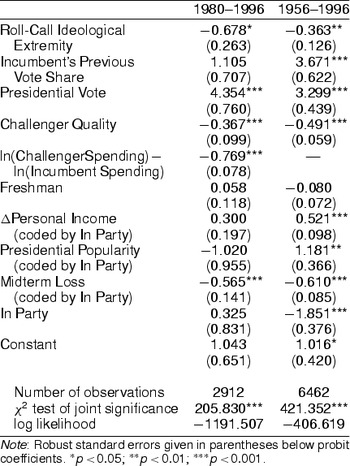
Alternative Specification of Analysis of Probability of Reelection
 You have
Access
- 532
- Cited by
Comments
No Comments have been published for this article.