FOCUS POINTS
• Symptoms of Tourette's Syndrome (TS) range from simple motor tics to complex behaviors resembling obsessive-compulsive disorder, which are thought to be related to changes in (partially) differential neural circuits.
• Symmetry and ordering behavior is a common symptom in TS, that appears to be at the crossroad between simple tics and obsessive-compulsive behavior.
• The induction of symmetry behavior in TS is related to activation in both the motor circuitry as well as the limbic circuitry.
• We hypothesize that limbic involvement represents the emotional value of asymmetry to TS patients and motor activity represents an urge to move or tic.
Introduction
Tourette's syndrome (TS) is a neurodevelopmental disorder characterized by the presence of both motor and phonic tics. Expression of tics can vary in complexity, ranging from simple motor tics to complex repetitive behaviors, such as touching objects or repeating sentences.Reference Cath, Hedderly and Ludolph1 Repetitive complex behaviors appear in about 65% of TS patientsReference Worbe, Mallet and Golmard2 and closely resemble the symptoms of obsessive-compulsive disorder (OCD), a disorder that is genetically associated with TS.Reference Pauls, Towbin, Leckman, Zahner and Cohen3 In OCD, repetitive intrusive thoughts (obsessions) provoke anxiety, which can be neutralized by carrying out ritualistic behaviors (compulsions), such as cleaning, checking, or ordering, often aimed at reduction of anxiety caused by the obsessions. Obsessive-compulsive (OC) behavior in TS tends to differ phenomenologically from pure OCD. Counting, touching, symmetry behavior, and “just right” feelings are more commonly found in TS than other OC behaviors; they appear to be more egosyntonic and are often preceded by sensory premonitory urges instead of anxious repetitive thoughts.Reference Robertson4, Reference Cath, Spinhoven and van Woerkom5 Whereas premonitory urges can be diminished by performing tics, a “just not right feeling” may be resolved by performing an OC behavior. Recently, symmetry behavior, counting, and just right feelings in TS patients were classified as “tic-like” repetitive behaviors, in contrast to checking and washing compulsions.Reference Worbe, Mallet and Golmard2 As such, symmetry behavior seems to be at the crossroad between motor tics and more complex OC behavior. Recently, the existence of an OC spectrum has been proposed with TS at the frontal-striatal end and anxiety disorders at the limbic end of the spectrum. OC behavior was suggested to occupy a place in the middle of the spectrum, with a contribution of both limbic and frontal-striatal brain circuits.Reference Mataix-Cols and van den Heuvel6 Previous structural and functional neuroimaging studies have reported an association between OC behavior in TS patients and prefrontal cognitive circuitry,Reference Bloch, Leckman, Zhu and Peterson7–Reference Pourfar, Feigin and Tang9 and also limbic circuitry.Reference Pourfar, Feigin and Tang9, Reference Braun, Randolph and Stoetter10
Distinct symptom dimensions in TS, such as simple tics and complex OC behaviors, may have specific as well as common neural correlates, similar to recent investigations of OCD.Reference Mataix-Cols, Wooderson and Lawrence11, Reference van den Heuvel, Remijnse and Mataix-Cols12 Clinically, symmetry behavior in TS patients was shown to be more often tic-like, as opposed to for example washing or checking rituals.Reference Worbe, Mallet and Golmard2 However, there are no previous reports on the neural correlates of symmetry behavior in TS. Symmetry and ordering symptoms can be specifically investigated by using a symptom provocation paradigm with positron emission tomography (PET) or functional magnetic resonance imaging (fMRI) scanning (e.g.,Reference Mataix-Cols, Wooderson and Lawrence11, Reference van den Heuvel, Veltman and Groenewegen13). The current study aimed to investigate the neural correlates of OC behavior in TS by provoking Tourette-specific OC symptoms, i.e., symmetry and ordering, during H215O PET. We chose to perform H215O PET scans rather than fMRI, because PET is less susceptible to signal loss in the orbitofrontal cortex (OFC) and PET is particularly suitable for studying events that last several minutes, as is common in provocation experiments.
We hypothesized that symmetry behavior in TS involves both frontal-striatal circuitry and limbic areas.
Methods
Subjects
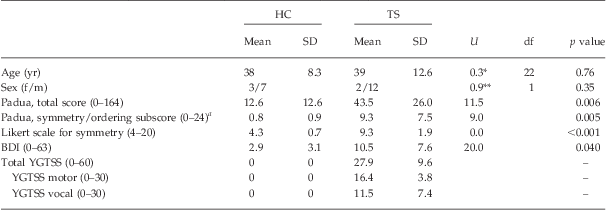
TS patients (19) were screened for inclusion; 3 patients withdrew consent before scanning, 2 two patients were excluded due to excessive head movement. Medication-free patients with TS (14) and symmetry behavior remained (12 men, 2 women, aged 39 ± 13 years) and 10 healthy control subjects (7 men, 3 women, aged 38 ± 8 years) were included. Subjects were right-handed and were off psychotropic medication for three weeks or more. Patients with a major medical illness or a major comorbid psychiatric illness were excluded. Comorbid anxiety disorders or depressive symptoms were allowed, as long as they did not interfere with the ability to comply with the study protocol. The diagnosis of TS and tic severity were assessed during a clinical interview and with the Yale Global Tic Severity Scale (YGTSSReference Leckman, Riddle and Hardin14). Comorbidity was established with the Structural Clinical Interview for DSM-IV (SCID-I15). Current depressive symptoms were measured with the Beck Depression Inventory (BDIReference Beck, Ward, Mendelson, Mock and Erbaugh16). The Padua Inventory–Revised (Padua-IR) was used to assess overall OCD symptomsReference van Oppen, Hoekstra and Emmelkamp17 and to assess specific symmetry/ordering behavior (items: 11, 13, 17, 21, 24, and 33. See Table 1 for a description of these items). Symmetry/ordering behavior was also assessed with a 4 item questionnaire, scored on a 5-point Likert scale. All included TS patients experienced symmetry/ordering symptoms as part of the overall general clinical picture, but other obsessive-compulsive behaviors could also be present.
Patient characteristics
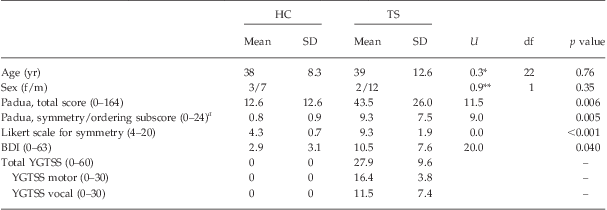
Mann–Whitney U tests were performed unless indicated otherwise.
*Independent sample T-test, t value, **Chi-square.
HC = healthy controls, TS = Tourette's syndrome patients.
YGTSS = Yale Global Tic Severity Scale, BDI = Beck Depression Inventory.
aThe following Padua items were used to construct a symmetry/ordering subscore: “I feel obliged to follow a particular order in dressing, undressing and washing myself”; “Before going to sleep I have to do certain things in a certain order”; “Before going to bed I have to hang up or fold my clothes in a special way”; “I feel I have to repeat certain numbers for no reason”; “I sometimes start counting objects for no reason”; “I feel I have to remember unimportant numbers.”
Subjects were recruited from the outpatient clinic of Psychiatry of GGZ in Geest, the Netherlands, and the Dutch Tourette Syndrome Association. Healthy controls (HC) were recruited by advertisement. All subjects gave written informed consent. The protocol was approved by the Medical Ethical Committee of the VU University Medical Center, Amsterdam, the Netherlands.
Symptom provocation paradigm
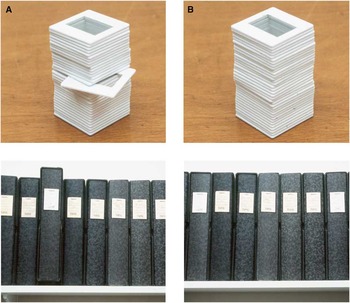
Visual stimuli were presented to each subject to provoke symmetry/ordering obsessions during PET data acquisition. A scanning session consisted of 8 randomly ordered H215O PET scans with 4 scans in the baseline condition (pictures with symmetrically ordered objects) and 4 scans in the active condition (pictures with asymmetrically ordered objects, see Figure 1). Stimuli were based on patients’ and experts’ opinions of symmetry-behavior–provoking situations and were tested in TS patients who did not participate in the study. Twenty seconds after injection of H215O, 11 pictures from the same condition were presented sequentially on a high-resolution screen. Each picture was visible for 3 s, followed by a 1 s blank screen. After each scan, subjects could rest for 8 min, while subjective distress was rated on a 100-point analogue scale using the question: “How distressed do you feel at this moment?” and symmetry compulsivity (symmetry scores) was rated by asking “How strong is the urge to rearrange the objects in the pictures?” In total, 44 active and 44 baseline pictures were shown to each subject.
Visual stimuli used for provocation of symmetry behavior. A: Active condition, example of asymmetry pictures, B: Baseline condition, example of symmetry pictures.

Image acquisition and reconstruction
PET scans were acquired on an ECAT EXACT HR+ scanner (CTI/Siemens, Knoxville, TN). Prior to each scanning session, a canula was inserted into the left antecubital vein. First, a 10-min transmission scan was performed in 2D mode for the purpose of attenuation correction of the subsequent emission scans, which were acquired in 3D mode. For each emission scan, 10–15 mL saline containing 450 MBq of H215O was administered as a bolus injection using an infusion pump. Data acquisition lasted 90 sec (20 sec before, 44 sec during, and 26 sec after stimulus presentation). The interval between successive H215O injections was 8 min to allow for radioactive decay. Subjects were instructed to lie still during scanning, and their heads were immobilized using a custom-made headband. Head motion was monitored and manually corrected between each emission scan. All frames of the dynamic water PET studies were first summed over 0–90 sec to obtain the average tracer uptake image during the wash-in phase. These summed water PET images represent regional cerebral blood flow (rCBF) distribution. To correct for task-related motion artifacts, data were reconstructed using an image registration methodReference van den Heuvel, Boellaard, Veltman, Mesina and Lammertsma18 with ordered subset expectation maximization (OSEM) applying four iterations with 16 subsets.Reference Mesina, Boellaard and van den Heuvel19
Statistical analysis
Behavioral data were analyzed using a standard statistical package (SPSS 15). When data did not meet assumptions for parametric testing, nonparametric tests were used. Reconstructed PET images were analyzed with Statistical Parametric Mapping 2 (SPM2) using a voxel-based whole brain approach (Wellcome Trust Centre for Neuroimaging at University College London, London, UK). For each subject, all 8 scans were reoriented to the anterior-posterior commissure (AC-PC) line, realigned, normalized to standard anatomical Montreal Neurological Institute (MNI), space and smoothed with a 10-mm Gaussian filter, resulting in an overall Full Width Half Maximum (FWHM) of 12 mm. Results are reported at p < 0.001 uncorrected with an extent threshold of 10 voxels, which was shown to produce an adequate balance between type I and type II error rates. More lenient thresholding protects against type II errors when exploring complex and possibly subtle cognitive or affective phenomena.Reference Lieberman and Cunningham20 Differences between scans during active versus neutral baseline stimuli (effect of condition) were assessed using repeated measures ANOVA, with proportional scaling set to 50. Main effects of group by condition (effect of condition in TS versus effect of condition in HC) were masked by the main effect of condition within the same model (at p < 0.001) to restrict the search for voxels to those related to symmetry provocation. For both the patient and control group, a separate model was used to assess correlations between symmetry scores and rCBF during symptom provocation by adding the symmetry scores as a regressor to the model. Peak voxel activity, in the clusters found to be significantly related to the symmetry score, was then extracted from SPM and correlated with the symmetry scores in SPSS to compute the magnitude of the correlations, using Spearman's ρ.
Findings
Patient characteristics are summarized in Table 1. In the TS group, 1 patient was diagnosed with comorbid panic disorder, 1 with comorbid dysthymic disorder, 1 with comorbid OCD (with aggressive, symmetry, and checking symptoms), and 1 patient with comorbid OCD (with symmetry and checking symptoms) and depression. Two patients were medication naïve, 9 had received a prior trial of antipsychotic medication, 7 had used antidepressant medication, and 1 patient had used methylphenidate in the past. One TS patient used antipsychotic medication up to 3 weeks prior to inclusion; the other participants were off medication for 6 weeks or more. Compared to controls, TS patients had significantly higher scores on the Padua-IR and the symmetry/ordering subscale of the Padua, as well as higher scores for the Likert scale of symmetry behavior, indicating the presence of symmetry and ordering behavior in this group (see Table 1). BDI scores were higher in TS (10.5 ± 7.6) than in controls (2.9 ± 3.1). BDI scores between 10 and 18 indicate mild depressive symptoms. Mean total tic severity in the TS group was 27.9 ± 9.6, indicating moderate symptom severity, with motor subscores of 16.4 ± 3.8 and vocal subscores of 11.5 ± 7.4. None of the HC experienced tics.
Behavioral data
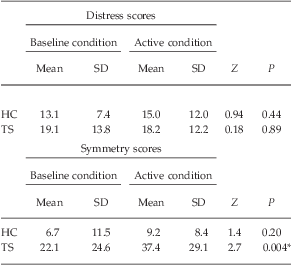
Mean distress and symmetry scores for both groups and both conditions (symmetry and asymmetry scans) are displayed in Table 2. Distress scores were not significantly different between the baseline and active condition for either group (Wilcoxon Signed Ranks Test: TS Z = 0.18, p = 0.89; HC Z = 0.94, p = 0.44). Distress scores did not differ significantly between groups at baseline (mean ± SD TS: 19.1 ± 13.8 vs. HC: 13.1 ± 7.4; Mann–Whitney U = 53.0, p = 0.34) or during the active condition (mean ± SD TS: 18.2 ± 12.2 vs. HC: 15.0 ± 12.0; Mann–Whitney U = 60.0, p = 0.59).
Behavioral results
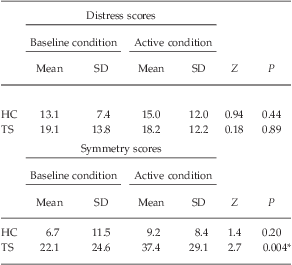
Mean (+SD) distress and symmetry scores (0–100) during baseline (symmetry) and active (asymmetry) condition.
Wilcoxon signed rank tests were performed for mean scores during baseline versus active scans.
HC = healthy controls (N = 10), TS = Tourette's syndrome patients (N=14), SD = standard deviation.
*Significant at p < 0.05.
In contrast, the TS group showed a significant increase in symmetry scores from baseline to active condition (Wilcoxon Signed Ranks Test: Z = 2.7, p = 0.004), but HC did not (Z = 1.4, p = 0.20). Symmetry scores were higher in TS compared with HC during the active condition (mean ± SD TS: 37.4 ± 29.1 vs. HC: 9.2 ± 8.4; Mann–Whitney U = 35.0, p = 0.042) and at trend level during the baseline condition (mean ± SD TS: 22.1 ± 24.6 vs. HC: 6.7 ± 11.5; Mann–Whitney U = 42.0, p = 0.11).
PET data
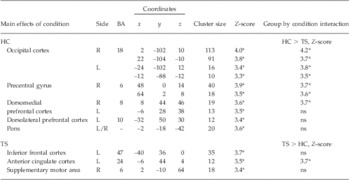
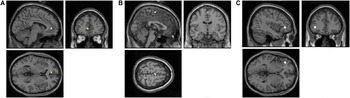
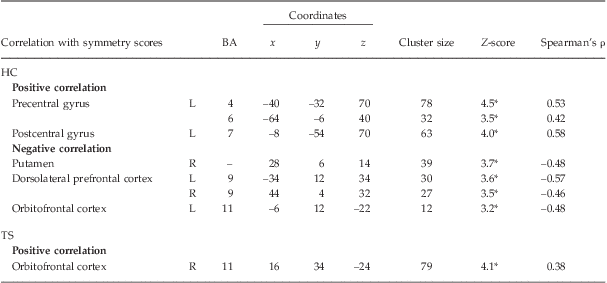
The main effects of condition (regions with increased rCBF during the active condition compared with the baseline condition) are displayed in Table 3. Provocation of symmetry behavior in the TS group resulted in increased rCBF in the left inferior frontal gyrus (IFG), the left anterior cingulate cortex (ACC), and the right supplementary motor area (SMA) (see Figure 2). HC showed provocation-related activation in the bilateral occipital cortex, the right primary motor cortex, the pons, the bilateral dorsomedial prefrontal cortex (dmPFC), and the left dorsolateral prefrontal cortex (dlPFC). The main effect of group by condition (main effect of condition in TS versus main effect of condition in HC) showed a significantly larger increase in rCBF in the ACC in TS compared with HC and a significantly larger increase in rCBF in the occipital cortex, motor cortex, and dmPFC in HC compared with TS. To control for possible confounding effects of depression or comorbid OCD, the analysis was repeated excluding three TS patients (1 patient with a BDI score above 20 and 2 patients with mild OCD, of which one also had a BDI score above 20). Similar results were obtained after exclusion of these subjects (data not shown). The results of the correlations between rCBF and symmetry scores are listed in Table 4. In the TS group, activation in the right medial OFC correlated positively with the symmetry scores during the active scans (Spearman's ρ = 0.38). In HC, symmetry scores correlated positively with activation in the left primary motor (Spearman's ρ = 0.53 and 0.42) and somatosensory (Spearman's ρ = 0.58) cortices, and correlated negatively with activation in the bilateral dlPFC (left: Spearman's ρ = –0.57, right: Spearman's ρ = –0.46) and left OFC (Spearman's ρ = –0.48).
Main effect of condition and group x condition interaction effects

HC = Healthy controls, N = 10; TS = Tourette's syndrome patients, N = 14. BA = Brodmann's area. L = left hemisphere, R = right hemisphere. x, y, z = MNI coordinates. *p < 0.001, ns = non significant.
Main effect of condition = areas with increased rCBF during symmetry provocation compared with the baseline condition.
Group by condition interaction = main effect of condition in HC versus TS, masked with main effect of condition at p < 0.001.
Main effect of task (asymmetry > symmetry) in the Tourette's syndrome patients group (N = 14) at p < 0.001 uncorrected with an extent threshold of 10 voxels. A: Left anterior cingulate cortex, Brodmann area 24 (x, y, z = –6, 44, 4), B: right supplementary motor area, Brodmann area 6 (x, y, z = 2, –10, 64), C: left inferior frontal gyrus, Brodmann area 47 (x, y, z = –40, 36, 0).

Correlations between regional cerebral blood flow during symmetry provocation and symmetry scores
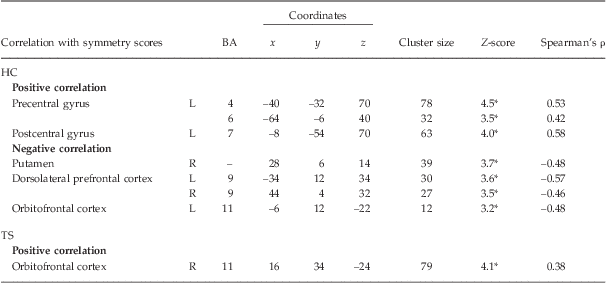
Brain areas showing correlations between regional cerebral blood flow during the active condition and symmetry scores were assessed in SPM. The value of the peak voxel was then extracted from SPM and correlated with symmetry scores in SPSS to compute the strength of the correlation indicated as Spearman's ρ.
*p < 0.001 uncorrected. HC = healthy controls, N = 10; TS = Tourette's syndrome patients, N = 14. BA = Brodmann's area, L = left hemisphere, R = right hemisphere; x, y, z = MNI coordinates.
Discussion
In this study we investigated the neural correlates of symmetry/ordering behavior in patients with TS using a H215O PET paradigm during symptom provocation. The urge to perform symmetry behavior was successfully induced, which was reflected in increased symmetry scores during the active condition compared with the baseline condition. No increase in distress was reported following symptom provocation. Upon symptom provocation, the TS group showed increased rCBF in the left ventral ACC, the left IFG, and the right SMA. Furthermore, a positive correlation was found between rCBF in the right OFC and symmetry scores. These data support our hypothesis that symmetry behavior in TS involves both frontal-striatal and limbic circuits.
Neural substrate of symmetry behavior in TS
The frontal-striatal circuits consist of several cortico-striatal-thalamo-cortical (CSTC) loops that integrate and modulate the flow of information from the neocortex, by projecting through the basal ganglia and thalamus, then back to the cortex.Reference Alexander, DeLong and Strick21 Distinct loops are involved in sensorimotor, cognitive, and limbic functions, while interconnections at various levels have been suggested to play a role in the integration of these functions.Reference Haber22 Dysfunctions in discrete loops may be linked to simple motor tics (motor loops), complex tics (cognitive loops), and OC behavior (limbic loops).Reference Mink23 A recent structural MRI study provided empirical support for this model, demonstrating that simple tics were associated with decreased thickness in the (pre)motor cortex, complex tics were associated with prefrontal and parietal changes, and OC behavior in TS was associated with decreased thickness in the ACC and altered hippocampus morphology.Reference Worbe, Gerardin and Hartmann24 ACC activity was found to be increased during suppression of ticsReference Peterson, Skudlarski and Anderson25 and during suppression of eye blinking in TS patients, but not in healthy controls,Reference Mazzone, Yu and Blair26 suggesting that inhibitory ACC activity is necessary to control tic behavior. However, increased ACC activity was also reported preceding ticsReference Bohlhalter, Goldfine and Matteson27 and during tic performance.Reference Stern, Silbersweig and Chee28, Reference Kawohl, Bruhl, Krowatschek, Ketteler and Herwig29 Since the ventral region of the ACC is involved in evaluating emotional value or salience of stimuli and generating an affective response,Reference Phillips, Drevets, Rauch and Lane30 ACC activity following symmetry provocation could be interpreted as the result of increased emotional salience of these stimuli in TS patients compared with controls. Medial OFC activity correlated positively with symmetry scores in TS and correlated negatively with symmetry scores in HC. In a previous resting state PET study of TS, OFC metabolism was associated with OC behavior and the occurrence of echo phenomena,Reference Braun, Randolph and Stoetter10 which is in concordance with our results, showing an association between OFC activity and the urge to perform symmetry behavior in TS patients. Activity in the medial OFC is thought to be related to the evaluation of reward, leading to continuation of the behavior and has been coupled to the subjective experience of “rightness,”Reference Elliott, Dolan and Frith31 which resembles the “just-right perceptions” related to symmetry behavior.
The IFG and SMA are involved in action planning and reprogramming, and have been implicated in previous studies of TS. Increased left IFG activity has been found during tics,Reference Bohlhalter, Goldfine and Matteson27, Reference Stern, Silbersweig and Chee28 whereas SMA activity was more prominently found preceding tics.Reference Bohlhalter, Goldfine and Matteson27, Reference Hampson, Tokoglu, King, Constable and Leckman32 Neubert etal.Reference Neubert, Mars, Buch, Olivier and Rushworth33 showed that the IFG can either facilitate a planned motor action or inhibit a movement that was already initiated when a competitive new motor action needs to be performed. Low frequency transcranial magnetic stimulation at the SMA, which temporarily depresses its excitability, resulted in a decrease of symptoms in both OCD and TS.Reference Mantovani, Lisanby and Pieraccini34 Also, decreased SMA activity was found during successful tic suppression.Reference Peterson, Skudlarski and Anderson25 Furthermore, electrical stimulation of the SMA can result in an urge to perform a movement or the anticipation of a movement.Reference Fried, Katz and McCarthy35 Coupled with increased activity of the SMA preceding tics, these findings may suggest that aberrant SMA activity in TS represents the urge to perform tics,Reference Hampson, Tokoglu, King, Constable and Leckman32 which is in line with the facilitating properties of the SMA to execute new movements.Reference Mars, Klein and Neubert36 We could thus speculate that increased rCBF in ACC, SMA, and IFG in the TS group represents a combination of attention capture of a salient stimulus, an urge to move (either to perform a tic or to perform compulsive behavior), and an inhibitory response to prevent this unwanted action tendency.
Our findings suggest involvement of both motor and limbic circuitry in OC behavior in TS. Disordered integration between the limbic and motor circuitry in TS has been postulated by several authors, but to date only one experimental study has been published supporting this hypothesis. Jeffries etal.Reference Jeffries, Schooler and Schoenbach37 used fluorodeoxyglucose (FDG) PET scans to compute correlations of metabolic activity between limbic and motor CSTC circuitry. In the TS group, a positive correlation was found between activation in the SMA and ventral striatum; this correlation was reversed in healthy volunteers. These data suggest an abnormally increased coupling of limbic and motor functioning in TS.Reference Jeffries, Schooler and Schoenbach37 From this perspective, we propose that, in TS patients, activation of limbic structures enhances activation of sensorimotor circuits, resulting in an urge to perform tics. Further studies are needed to investigate this hypothesis.
Symmetry behavior in healthy individuals
Symmetry scores in HC increased only nonsignificantly after symptom provocation, and symmetry scores were lower than in the TS group. Increased rCBF following asymmetry stimuli was found in the visual cortex, motor areas, dmPFC, and dlPFC. Symmetry scores correlated positively with activation in the primary somatosensory and motor cortices and negatively with activation in the bilateral dlPFC and OFC. These results show some similarity with earlier symptom provocation paradigms with different stimuli. Increased activation of visual regions was found in HC versus OCD patients in all three OCD-related symptom provocation experiments (washing, checking, and hoarding) by Mataix-Cols etal.,Reference Mataix-Cols, Wooderson and Lawrence11 and may therefore be a nonspecific reaction in HC that directs their attention to the visual details of the picture instead of their emotional salience. Increased dorsal prefrontal activation together with activation of the caudate nucleus was found in HC during a contamination obsession provocation experiment in our group using the same H215O PET design.Reference van den Heuvel, Veltman and Groenewegen13 Dorsal prefrontal cortical activity is assumed to represent higher order cognitive control, which has been hypothesized to fail in OCD.Reference Mataix-Cols and van den Heuvel6, Reference Remijnse, van den Heuvel and Veltman38 Increased dorsal prefrontal activity upon provocation combined with a negative correlation between symmetry ratings and dlPFC activity may therefore reflect successful control of symmetry behavior by the HC group.
Involvement of motor areas during symmetry provocation in controls is in accordance with results of a structural MRI study performed by our group in OCD patients, which demonstrated decreased primary motor cortex volume associated with symmetry/ordering severity in OCD patients.Reference van den Heuvel, Remijnse and Mataix-Cols12
Limitations
As a result of the sample size, the present study has limited power. Therefore we avoided overly stringent statistical thresholds to reduce type II errors. This implies, however that the study should be considered exploratory, and results should be interpreted with caution because they need to be replicated. Moreover, there was a large variability in the measures of clinical characteristics, indicating considerable variation in the clinical phenotype of the TS patients included. Although PET imaging is less susceptible to creating artifacts in the OFC, the spatial resolution of PET is not as good as MRI. Therefore, activation in small areas (e.g., the subthalamic nucleus, which is a part of the IFG-SMA pathway) may not have been detected. Another limitation is that the symmetry pictures that served as a baseline condition may not have been perceived as neutral by the TS group, which was reflected in a trend to higher symmetry scores at baseline in the TS group compared with the HC group. Even though this could have decreased the power of the experiment, it is unlikely that it led to false positive findings. Furthermore, we did not conduct a formal validation process for the pictures. The increase in symmetry ratings after provocation, however, suggests validity of the provocation paradigm. Although no significant differences were found on demographic characteristics between the two groups, the TS group included relatively more males than the control group, which may have influenced the results. Little is known about the neural correlates of symmetry behavior in OCD. It would be interesting to compare TS patients with and without symmetry behavior with OCD patients with and without symmetry behavior to study similarities and differences between the subtypes within and across the two disorders.
Conclusions
This is, to our knowledge, the first report on the functional neural correlates of symmetry behavior in TS. Our findings support the involvement of both limbic and motor areas. We hypothesize that limbic activity in TS patients reflects the emotional value of the asymmetrical stimuli and that SMA involvement points to an urge to move.
Acknowledgments
We thank Prof. Dr. R. van Dyck for his aid in supervising the project. We thank G. Luurtsema, J. M. P. A. Eyndhoven, and P. L. B. Ophemert for their contribution to H215O production, and B. G. Hoving, S. C. M. van Balen, R. H. A. Koopmans, and A. M. de Wildt for their assistance during scanning sessions. This work was supported by the Dutch Organization for Scientific Research (NWO), ZonMW 940-37-018 (to OvdH) and ZonMW 920-03-542 (to FdV).