Introduction
Cement and concrete are by far the most manufactured materials in the world. With global production of 20 billion tons per year (approximately 1 m3/capita/year), concrete is produced at a rate ten times greater than all other construction materials combined. Reference Ulm1 Unfortunately, this ubiquitous use comes with a heavy environmental impact; cement and concrete are responsible for 5–10% of the world’s total carbon dioxide emissions. Reference Van Ruijven, Van Vuuren, Boskaljon, Neelis, Saygin and Patel2,Reference Pour-Ghaz3 This carbon impact is expected to increase by 13% by 2020, mainly driven by the high demand for infrastructure in developing countries. Reference Van Ruijven, Van Vuuren, Boskaljon, Neelis, Saygin and Patel2 China used more cement from 2013 to 2015 than the United States used in the entire 20th century.
Despite this environmental burden, the compositions and manufacturing process for producing cement have seen limited changes since the introduction of ordinary portland cement in the 19th century—cement still primarily relies on calcium silicate clinkers (the powder that forms a cement paste upon contact with water). Reference Taylor4 This lack of innovation, which has resulted in a relative increase of the carbon impact of cement over the years as other industries are becoming more environmentally friendly, is mainly caused by (1) the low cost and ease of use of the material (concrete is about 100× cheaper than an equivalent weight quantity of steel), which impedes the emergence of alternative greener but more expensive materials; (2) the existence of decades of Edisonian “trial-and-error” optimization, thereby limiting the possibility of significant further improvements relying on empirical approaches; and (3) construction safety regulations, which render the introduction of new building materials with unproven long-term performance to be challenging.
Despite these drawbacks, no credible alternatives to concrete are on the horizon or likely to arise in the foreseeable future, so improving the properties and processes for existing concrete compositions is the only realistic option to reduce environmental impact. Reference Wray5 Due to the huge quantity of concrete produced, even small improvements would result in a major impact: for example, decreasing the carbon impact of concrete by 10% would be equivalent to removing all of the CO2 emissions associated with steel production. Reference Wray5 This situation calls for a systematic, rational optimization of concrete formulations, within the constraints of price, processability, and performance.
Recently, concrete nanoengineering Reference Ulm1,Reference Sanchez and Sobolev6 has emerged as an idea that may lead to the next step change in cement and concrete technology. Although poorly defined, this term comprises various experimental, numerical, and theoretical approaches to characterize how the nanoscale structure of concrete can be tuned to design concretes with tailored macroscopic properties, or with lower carbon impact. In this article, we review recent advances in the modeling and topological optimization of concrete. This approach was inspired by the topological optimization of glasses, which led to the discovery of Corning Gorilla Glass, a scratch- and damage-resistant glass used in more than 4.5 billion smartphone and tablet screens today. Reference Mauro, Ellison and Pye7,Reference Mauro, Tandia, Vargheese, Mauro and Smedskjaer8 Here, we summarize how such an approach was used to enhance concrete’s hardness, fracture toughness, and resistance to creep.
Nanostructure of the binding phase of concrete
A multiscale material
Concrete, which comprises aggregates and hydrated cement, is a complex multiscale and multiphase material. Reference Taylor4 Nevertheless, most of its properties are controlled by its “glue,” the calcium–silicate–hydrate phase (CaO-SiO2-H2O, or CSH following cement notation), which holds the different phases together. Reference Taylor4 CSH itself is a multiscale phase, consisting of a gel made of polydisperse grains of ∼5 nm size. Reference Jennings9,Reference Ioannidou, Krakowiak, Bauchy, Hoover, Masoero, Yip, Ulm, Levitz, Pellenq and Del Gado10 Within each grain, CSH takes the form of a layered calcium silicate atomic network that is poorly crystalline and of variable stoichiometry, with a Ca/Si molar ratio between ∼1.0 and ∼2.0. Reference Scrivener, Juilland and Monteiro11 In the following, we focus on the atomic-scale topological optimization of CSH, keeping in mind that its gel-like microstructure provides an additional degree of freedom to optimize concrete. Reference Ioannidou, Krakowiak, Bauchy, Hoover, Masoero, Yip, Ulm, Levitz, Pellenq and Del Gado10
Atomistic modeling of CSH phases
Due to the heterogeneity of the CSH phase that naturally forms upon the hydration of cement, its nanostructure is usually “invisible” to experiments. In fact, the atomic structure of CSH is still a matter of debate. Reference Scrivener, Juilland and Monteiro11 As such, simulations offer an attractive alternative to “nanoengineered” concrete. Pellenq et al. Reference Pellenq, Kushima, Shahsavari, Van Vliet, Buehler, Yip and Ulm12,Reference Abdolhosseini Qomi, Krakowiak, Bauchy, Stewart, Shahsavari, Jagannathan, Brommer, Baronnet, Buehler, Yip, Ulm, Van Vliet and Pellenq13 adopted the model that is used in this study. This model has been shown to predict realistic compositions, structure, mechanical, dynamical, and thermal properties for CSH. Reference Abdolhosseini Qomi, Krakowiak, Bauchy, Stewart, Shahsavari, Jagannathan, Brommer, Baronnet, Buehler, Yip, Ulm, Van Vliet and Pellenq13–Reference Bauchy, Wang, Yu, Wang, Anoop Krishnan, Ulm and Pellenq17 The details of the methodology used for the preparation of the models, as well as multiple validations with respect to experimental data can be found in Reference Reference Abdolhosseini Qomi, Krakowiak, Bauchy, Stewart, Shahsavari, Jagannathan, Brommer, Baronnet, Buehler, Yip, Ulm, Van Vliet and Pellenq13 and other reports. Reference Abdolhosseini Qomi, Bauchy, Ulm and Pellenq14–Reference Qomi, Bauchy, Ulm, Pellenq, Sobolev and Shah23
A partially disordered material
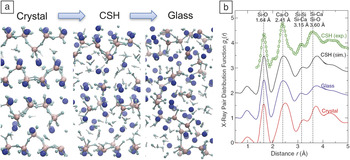
Figure 1a shows a snapshot of the atomic structure of CSH, compared to those of a tobermorite crystal (11 Å polymorph) and an artificial CSH glass. Reference Bauchy, Abdolhosseini Qomi, Ulm and Pellenq19,Reference Bauchy, Abdolhosseini Qomi, Pellenq and Ulm21,Reference Hamid24 Tobermorite is a CSH mineral with the chemical formula Ca5Si6O16(OH)2•4H2O or Ca5Si6(O,OH)18•5H2O. Clearly, CSH features a partially disordered structure, which contains defects while retaining some degree of order reminiscent of that of a tobermorite crystal. Figure 1b shows the computed x-ray pair distribution function (PDF) of simulated CSH (with Ca/Si = 1.6), revealing good agreement with the PDF of a synthetic monophasic CSH phase. Reference Skinner, Chae, Benmore, Wenk and Monteiro25–Reference Soyer-Uzun, Chae, Benmore, Wenk and Monteiro27 The PDF of CSH, while showing some similarities with that of the crystal (with consistent peaks at a distance larger than 3 Å), is largely similar to that of a glass, in particular, the shift of the Ca-O peak around 2.4 Å. This denotes that the short-range atomic structure of CSH is similar to that of a glass. This further supports the idea of applying glass physics tools to concrete (e.g., topological constraint theory). Reference Abdolhosseini Qomi, Bauchy, Pellenq and Ulm18
(a) Snapshots of the atomic configurations of a tobermorite crystal, calcium–silicate–hydrate (CSH), and a CSH glass. Reference Bauchy, Abdolhosseini Qomi, Ulm and Pellenq19,Reference Hamid24 (b) Computed x-ray pair distribution function of CSH, compared with those of the tobermorite crystal and CSH glass, and with experimental data for artificial CSH. Reference Bauchy, Abdolhosseini Qomi, Ulm and Pellenq19,Reference Skinner, Chae, Benmore, Wenk and Monteiro25

Structure–mechanical–property relationships
Need for simplification
CSH shares many similarities with typical industrial glasses, namely, a noncrystalline atomic structure and a silicate backbone. In addition, the cement and glass industries share common challenges, including enhancing mechanical properties. Reference Mauro28 In both cases, this requires an understanding of composition–structure–property relationships. However, this constitutes a permanent challenge in the case of disordered networks, as they feature various fine structural details at different scales. Topological constraint theory offers a powerful framework to tackle this issue by capturing the important atomic topology, while leaving aside less relevant structural details that do not significantly impact macroscopic properties. Reference Mauro29,Reference Bauchy30 In effect, topological constraint theory considers complex atomic networks as conventional mechanical trusses, made of joints (the atoms) interconnected to each other through constraints (the chemical bonds). This simplification is key to developing analytical composition–property models, as described in the Introductory article and further discussed in this article.
Topology and rigidity of CSH
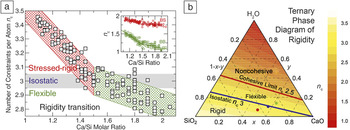
Rather than relying on unproven guesses, the atomic topology of CSH can be assessed from atomistic simulations, following a well-established methodology. Reference Bauchy, Micoulaut, Celino, Le Roux, Boero and Massobrio31–Reference Bauchy42 This is based on the idea that topological constraints prevent relative motion between atoms, where large relative motion is indicative of the absence of any underlying constraints. As shown in Figure 2a, the computed number of constraints per atom (n c) in CSH decreases with increasing Ca/Si molar ratio, effectively separating a stressed-rigid domain (n c > 3, Si-rich) from a flexible one (n c < 3, Ca-rich). Reference Bauchy, Qomi, Bichara, Ulm and Pellenq22 Specifically, CSH shows a rigidity transition at approximately Ca/Si = 1.5 (inset of Figure 2a), which corresponds to structural and mechanical transitions. CSH is found to be largely crystalline and transversely isotropic at low Ca/Si, and fairly amorphous and isotropic at high Ca/Si. Reference Abdolhosseini Qomi, Krakowiak, Bauchy, Stewart, Shahsavari, Jagannathan, Brommer, Baronnet, Buehler, Yip, Ulm, Van Vliet and Pellenq13 As shown in Figure 2b, these results were extrapolated to establish the ternary rigidity phase diagram of CSH. Reference Bauchy, Qomi, Bichara, Ulm and Pellenq22
(a) Number of constraints per atom n c in calcium–silicate–hydrate (CSH) as a function of the Ca/Si molar ratio. The inset shows the contributions of the radial (bond-stretching, BS) and angular (bond-bending, BB) constraints. Reference Bauchy, Qomi, Bichara, Ulm and Pellenq22 (b) Predicted rigidity phase diagram of CSH. Reference Bauchy, Qomi, Bichara, Ulm and Pellenq22

Composition–hardness relationship in CSH
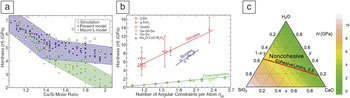
Knowledge of the rigidity of CSH can be used as a basis for composition–property models. In particular, hardness (H), which characterizes the resistance to permanent deformation upon indentation, is an important mechanical property, both for concrete and industrial glasses. Reference Bauchy, Qomi, Bichara, Ulm and Pellenq22,Reference Smedskjaer, Bauchy, Mauro, Rzoska and Bockowski43 As initially proposed by Smedskjaer, Mauro, and Yue, Reference Smedskjaer, Mauro and Yue44 atomic networks require a critical number of constraints to be cohesive, after which each additional constraint contributes to increasing hardness. As shown in Figure 3a, Reference Oliver and Pharr45,Reference Swiler, Varshneya and Callahan46 the hardness of CSH was found to be better predicted by an alternative model, assuming that H increases linearly with the number of bond-bending (BB) constraints per atom (n BB). Reference Bauchy, Qomi, Bichara, Ulm and Pellenq22 This arises from the fact that, upon indentation, atomic networks rearrange by following lowest energy paths, that is, those that preferentially involve breakings or reformations of the weakest constraints (i.e., the angular BB constraints herein). Figure 3b demonstrates the linear correlation between H and atom n BB applying to various families of materials. These results were used to analytically predict the compositional dependence of the hardness of CSH, as shown in the hardness ternary diagram in Figure 3c.
(a) Computed hardness of calcium–silicate–hydrate (CSH) compared with the values predicted by Mauro’s and Bauchy’s models. Reference Bauchy, Qomi, Bichara, Ulm and Pellenq22,Reference Smedskjaer, Mauro and Yue44 (b) Experimental values of the hardness of CSH, glassy silica, quartz, soda-lime-borates, Ge-Se, and Ge-Sb-Se glasses as a function of the number of angular constraints per atom. Reference Abdolhosseini Qomi, Krakowiak, Bauchy, Stewart, Shahsavari, Jagannathan, Brommer, Baronnet, Buehler, Yip, Ulm, Van Vliet and Pellenq13,Reference Bauchy, Qomi, Bichara, Ulm and Pellenq22,Reference Smedskjaer, Mauro and Yue44–Reference Swiler, Varshneya and Callahan46,Reference Guin, Rouxel, Sanglebœuf, Melscoët and Lucas54 (c) Predicted hardness ternary diagram of CSH. Reference Bauchy, Qomi, Bichara, Ulm and Pellenq22

Identifying ultratough materials
Despite all past efforts, glass and infrastructures still fail. Reference Wang, Yu, Lee and Bauchy47–Reference Yu, Wang, Lee and Bauchy50 Enhancing the fracture toughness (K Ic), the resistance to fracture of materials, remains a “grand challenge” in materials science. Reference Mauro28 Unfortunately, the compositional dependence of toughness is even less understood than that of hardness.
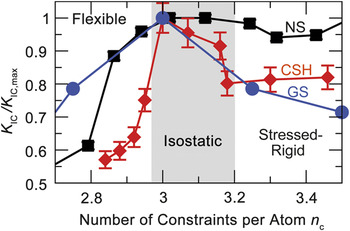
We recently introduced a new methodology to compute the toughness of atomic networks, which relies on a thermodynamic integration of the stress–strain curve of a prenotched sample placed under tension. Reference Bauchy, Laubie, Qomi, Hoover, Ulm and Pellenq15 Figure 4 shows the computed normalized values of K Ic for CSH, which feature a maximum inside a window located near the isostatic composition (n c = 3). Reference Bauchy, Laubie, Qomi, Hoover, Ulm and Pellenq15,Reference Bauchy, Wang, Wang, Yu, Qomi, Smedskjaer, Bichara, Ulm and Pellenq51 We note that such a window appears analogous to the “Boolchand intermediate phase” observed in many chalcogenide glasses. Reference Boolchand, Georgiev and Goodman52,Reference Mantisi, Bauchy and Micoulaut53 As shown in Figure 4, the maximum of K Ic for isostatic systems appears to be a general feature, also observed in sodium silicate (NS) and Ge-Se glasses (GS)—note that the plotted values of K Ic are normalized here to facilitate the comparison between each family of materials. Reference Bauchy, Wang, Wang, Yu, Qomi, Smedskjaer, Bichara, Ulm and Pellenq51,Reference Guin, Rouxel, Sanglebœuf, Melscoët and Lucas54,Reference Bauchy55 This anomalous behavior was explained by the fact that flexible networks feature the ability to resist fracture through ductile deformations, thanks to the presence of low-energy (floppy) modes of deformation in the atomic network, but have low surface energies. In contrast, stressed-rigid networks break in a brittle way due to internal eigenstress, but have higher surface energies. Eventually, isostatic systems, which are simultaneously free of eigenstress and floppy modes, feature the best compromise between surface energy and ductility. Reference Bauchy, Wang, Wang, Yu, Qomi, Smedskjaer, Bichara, Ulm and Pellenq51 As such, topological constraint theory offers a powerful framework to predict optimal compositions featuring maximum fracture toughness.
Computed normalized fracture toughness of calcium–silicate–hydrate (CSH) with respect to n c, compared to those of densified sodium silicate (NS) and Ge-Se glasses (GS). Reference Bauchy, Wang, Wang, Yu, Qomi, Smedskjaer, Bichara, Ulm and Pellenq51,Reference Guin, Rouxel, Sanglebœuf, Melscoët and Lucas54,Reference Bauchy55

Toward nonaging materials
As in the case of glasses, cement and concrete “age” over time. In particular, creep is one of the main limitations of cementitious materials. Reference Bažant, Hubler and Yu56 However, the role of atomic structure in controlling the propensity of materials for aging remains poorly understood.
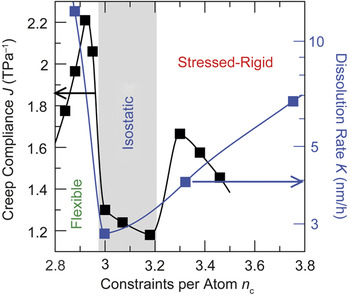
When subjected to a constant load, CSH shows logarithmic creep, whose propensity is captured by the creep compliance (J). Reference Bauchy, Masoero, Ulm and Pellenq57,Reference Masoero, Bauchy, Del Gado, Manzano, Pellenq, Ulm and Yip58 Figure 5 shows the computed creep compliance of CSH with respect to the number of constraints per atom. It is remarkable that compositions near the isostatic threshold feature the lowest propensity for creep. Reference Bauchy, Wang, Yu, Wang, Anoop Krishnan, Ulm and Pellenq17,Reference Pignatelli, Kumar, Alizadeh, Le Pape, Yann, Bauchy and Sant59 Again, this suggests that the isostatic compositional window (3 < n c < 3.2) is analogous to a Boolchand intermediate phase, as such isostatic glasses have been shown to feature weak relaxation over time. Reference Chen, Boolchand and Georgiev60 As shown in Figure 5, the minimum of J is correlated to a minimum of the dissolution rate of CSH, which suggests that the creep of CSH occurs through a dissolution–precipitation mechanism. Reference Pignatelli, Kumar, Alizadeh, Le Pape, Yann, Bauchy and Sant59
Computed creep compliance of calcium–silicate–hydrate (CSH) (left axis) with respect to n c, compared with its dissolution rate at pH 13 (right axis). Reference Pignatelli, Kumar, Alizadeh, Le Pape, Yann, Bauchy and Sant59

Summary
The examples described in this article highlight how topological constraint theory can be used as a rational tool to design new cementitious materials. For such disordered systems with no fixed stoichiometry, the virtually infinite number of possible compositions renders traditional trial-and-error approaches inefficient. In contrast, the topological nanoengineering approach can efficiently target promising regions in the compositional space and, as such, has the potential to dramatically accelerate the discovery of novel cementitious materials with tailored properties. It is expected that rigidity concepts could be used in the future to optimize topology-controlled properties, including transport properties, Reference Bauchy and Micoulaut36,Reference Bauchy and Micoulaut61,Reference Bauchy, Guillot, Micoulaut and Sator62 reactivity and dissolution, Reference Pignatelli, Kumar, Alizadeh, Le Pape, Yann, Bauchy and Sant59,Reference Pignatelli, Kumar, Bauchy and Sant63 resistance to irradiation, Reference Pignatelli, Kumar, Field, Wang, Yu, Le Pape, Bauchy and Sant64,Reference Wang, Yu, Pignatelli, Sant and Bauchy65 relaxation, Reference Bauchy, Wang, Yu, Wang, Anoop Krishnan, Ulm and Pellenq17,Reference Yu, Wang, Zhang, Wang, Sant and Bauchy66,Reference Wang, Wang, Bechgaard, Mauro, Rzoska, Bockowski, Smedskjaer and Bauchy67 or ion exchange strengthening. Reference Wang and Bauchy68,Reference Wang, Wang, Krishnan, Yu, Smedskjaer, Mauro, Sant and Bauchy69
Acknowledgments
This review is based upon work supported by the National Science Foundation under Grant No. 1562066. The author gratefully acknowledges M.J.A. Qomi, C. Bichara, F.-J. Ulm, and R.J.-M. Pellenq, who have largely contributed to the study presented herein.

Mathieu Bauchy is an assistant professor in the Department of Civil and Environmental Engineering at the University of California, Los Angeles. He obtained his PhD degree in physics from the Université Pierre et Marie Curie, France, in 2012, and joined the Massachusetts Institute of Technology from 2012 to 2014 as a postdoctoral associate. His research interests include industrial glasses and concrete’s structure, mechanical properties, relaxation, reactivity, and resistance to irradiation using multiscale simulation techniques. Bauchy can be reached by phone at 310-825-9991 or by email at bauchy@ucla.edu.