1. Introduction
Contemporary biologists often seek to discover mechanisms. Many such discoveries were major achievements in twentieth-century biology, such as the mechanism of Mendelian heredity (Morgan et al. Reference Morgan, Sturtevant, Muller and Bridges1915; Darden Reference Darden1991), the numerous mechanisms of cellular metabolism (Bechtel Reference Bechtel2006), and the mechanisms of DNA replication, protein synthesis, and gene expression in molecular biology (Watson et al. Reference Watson, Hopkins, Roberts, Steitz and Weiner1988). Until recently philosophers of biology have paid scant attention to the nature of mechanisms and the numerous benefits of discovering mechanistic theories. Happily this lacuna in the philosophical literature is now being filled and, within the last decade, a plethora of papers and a few books on biological mechanisms have appeared. This new work has been called “the new mechanistic philosophy” (Skipper and Millstein Reference Skipper and Millstein2005).
This work on mechanisms in biology originated (primarily) not as a response to past work in philosophy of science but from consideration of the work of biologists themselves, especially in molecular biology and neurobiology (Machamer, Darden, and Craver Reference Machamer, Darden and Craver2000) and biochemistry and cell biology (Bechtel and Richardson Reference Bechtel and Richardson1993; Bechtel Reference Bechtel2006). Nonetheless, it serves to illuminate many traditional topics in philosophy of science. The following list shows the richness of the recent work and points interested readers to relevant sources. Biologists rarely appeal to laws in giving explanations; much more often they describe the operation of mechanisms to explain a phenomenon (Thagard Reference Thagard1998; Machamer et al. Reference Machamer, Darden and Craver2000; Glennan Reference Glennan2002; Bechtel and Abrahamsen Reference Bechtel and Abrahamsen2005; Craver Reference Craver2007). The relation of this new work on mechanisms in biology to prior work on causation (e.g., Salmon Reference Salmon1984) is a lively topic being addressed (Glennan Reference Glennan1996; Machamer et al. Reference Machamer, Darden and Craver2000; Woodward Reference Woodward2002; Bogen Reference Bogen2004, Reference Bogen2005, Reference Bogen2008; Craver Reference Craver2007, Chapter 3; and Craver and Bechtel Reference Craver and Bechtel2007). Craver (Reference Craver, Machamer and Silberstein2002b) showed the role that descriptions of mechanisms play in the structure of some biological theories. He showed that functional roles could be understood in mechanistic terms (Craver Reference Craver2001). Emphasis on mechanisms showed new varieties of nonreductive, interfield relations in genetics and neuroscience. Darden (Reference Darden2006, Chapter 4) discussed relations between Mendelian genetic, cytological, and molecular biological mechanisms in a temporal series of hereditary mechanisms. Craver (Reference Craver2005), in contrast, discussed multilevel constraints in a hierarchical mechanistic theory of memory in neuroscience. Much guidance for reasoning in discovery results from the goal to discover a mechanism. Reasoning in mechanism discovery is the topic of Bechtel and Richardson Reference Bechtel and Richardson1993, Thagard Reference Thagard1999, Reference Thagard2003, Bechtel and Abrahamsen Reference Bechtel and Abrahamsen2005, and Darden Reference Darden2006, Chapter 12. Experimental and modeling strategies for investigating mechanisms are the topics in Craver Reference Craver2002a, Glennan Reference Glennan2005, and Darden Reference Darden, Hull and Ruse2007.
Given this flurry of philosophical activity, it is a good time to reconsider the characterization of mechanisms that Peter Machamer, Carl Craver, and I (known as the “MDC view”) proposed in 2000 in our “Thinking about Mechanisms.” Each of us has further developed this view, while others have criticized the MDC characterization. Furthermore, new ideas by others need to be integrated with the MDC account. This article begins this work. Topics here include the perspectival aspect of the MDC characterization of mechanisms (and ways of mitigating rampant perspectivalism); refinements in claims about the nature of entities and activities; challenges and responses to claims about regularity, productive continuity, and the organizational aspects of a mechanism; and issues about representations of mechanisms in models, schemas, and sketches.
2. Thinking Again about the MDC Characterization of Mechanisms
A mechanism is sought to explain how a phenomenon is produced (Machamer et al. Reference Machamer, Darden and Craver2000) or how some task is carried out (Bechtel and Richardson Reference Bechtel and Richardson1993) or how the mechanism as a whole behaves (Glennan Reference Glennan1996). Our team of Machamer, Darden, and Craver characterized mechanisms in the following way: “Mechanisms are entities and activities organized such that they are productive of regular changes from start or set-up to finish or termination conditions” (Machamer et al. Reference Machamer, Darden and Craver2000, 3).
Although sometimes construed as such, the MDC characterization of mechanisms was not presented as a definition to provide necessary and sufficient conditions for the term's usage in all cases. Instead it was a characterization aimed at capturing the way biologists use the term, as informed by our detailed examination of cases from molecular biology and neurobiology, and also informed by philosophical reflection on requirements for productive changes.
When biologists identify mechanisms, there is an inherent perspectival aspect as to what is picked out of interest from all the goings on in the world (cf. Kauffman Reference Kauffman, Buck and Cohen1971). First, the choice of phenomenon is relative to the scientist's interests. Identifying a puzzling phenomenon is the first step in an investigation of a mechanism. The individuation and characterization of phenomena are open to revision in the light of empirical inquiry. Relations between identifying a phenomenon and finding the mechanism(s) that produces it are reciprocal. If, for example, two mechanisms are found instead of one, the phenomenon may be more appropriately divided into two phenomena (or maybe not, if one mechanism is a backup that operates if the first fails to produce the same phenomenon). Craver (Reference Craver2007, 123–124) refers to such recharacterizations of the phenomena as “lumping” or “splitting,” by analogy with the activities of taxonomists who lump and split groups in devising classifications.
To some extent and in some cases, the choice of beginning, ending, topping-off, and bottoming-out points in the description of a mechanism may also be related to the interests of the investigator. In an ongoing series or cycles of mechanisms, with nested levels of mechanisms, exactly where investigators choose to focus may well be influenced by their interests, as well as their available model experimental systems and techniques. However, various factors mitigate rampant perspectivalism, that is, completely arbitrary choices in individuating phenomena and mechanisms.
One factor constraining choice of perspective is that some mechanisms operate only within natural boundaries, such as the nuclear membrane. Boundaries protect the mechanism's components from buffeting and dissipation. Biologists do not arbitrarily choose such locations; instead, they discover that being inside or outside such boundaries makes a difference.
Some bottoming-out and topping-off points are not arbitrary. In order to operate, some mechanisms require entities of a given shape and size (and other properties) as the working entities (Darden Reference Darden2006, Chapter 4) of that mechanism. For example, the mechanism of DNA replication has a natural beginning point of one double helix and a natural ending point of two helices. An intact DNA double helix is a requirement for the mechanism of DNA replication to operate. Specific kinds of activities require entities having specific kinds of properties. Hydrogen bonding, for example, requires polarized molecules exhibiting asymmetric charges; entities smaller than molecules cannot be recruited as working entities to carry out that activity. Neutral molecules in the cellular milieu will not participate. The polarly charged bases in the DNA double helix must be exposed in order to participate in the replication mechanism. The complex and multipart DNA polymerase enzymes are the working entities that aid the splitting of old hydrogen bonds and the formation of new ones between the two newly forming helices.
Often biologists engage in much investigative work to discover the level at which a given mechanism operates. Geneticists worked to find the operative level for genetic linkage, ruling out the coupling of paired alleles and the reduplication of germ cells and ruling in chromosomal mechanisms (Darden Reference Darden1991). Genes are linked because they ride along on chromosomes in meiotic mechanisms. In immunology, the working entities in clonal selection were at first hypothesized to be self-replicating protein molecules but were later found to be self-reproducing immune cells (Darden Reference Darden2006, Chapter 8). These two examples show that biologists do not always discover working entities in mechanisms by going to a smaller size level; sometimes the operative units are intermediate or larger than at first hypothesized: not genes but chromosomes, not molecules but cells.
General features of entities (whether working or not) aid in identifying the working entities of a mechanism. The goal here is not to define an entity by giving necessary and sufficient conditions. Rather, the goal is to provide strategies that may serve as useful guides for finding entities. An entity may have a spatiotemporal location. An entity may have a clear boundary, such as a membrane bounding it. An entity may be composed of chemically bonded subparts that are not similarly bonded to the parts of other entities. It may be composed of specific chemicals that differ from chemicals in the surroundings. It may be stable over some period of time, as are chromosomes, or it may be rapidly synthesized and degraded, as are some messenger RNAs. It may have a developmental history; that is, it may be formed during embryological development. It may have an evolutionary history; that is, it may be a descendant in a lineage and have homologous relations to other biological entities.
In addition to these general features of entities, working entities in mechanisms have additional features. A working entity acts in a mechanism. It may move from one place to another. It may have one or more localized active sites. For example, the centromeres of chromosomes are active sites that attach to the spindles during the mechanisms of meiosis. Alternatively, the active sites may be distributed throughout the entity, for example, the slightly charged bases along the entire double helix that are the active sites in DNA replication. A working entity may have activity-enabling properties or it may bear activity signatures that indicate an activity operated on it previously (Darden Reference Darden2006, Chapter 3).
Working entities in a given mechanism may be and often are different sizes. For example, ions, macromolecules, and cell organelles are all working entities in the mechanism of protein synthesis. Because working entities in a given mechanism may be of different sizes, mechanism levels may not correspond tidily to size levels. Of course, all biological entities are composed of smaller parts; however, most subcomponents do not change during the activities of the working entities of which they are parts. For example, atomic nuclei are merely stable subcomponents of working entities in biological mechanisms. Atomic nuclei are not working entities or active sites in the DNA replication mechanism. They are parts of the structure, providing stability, but buried away behind electrons. In other conditions, nuclei of atoms can become working entities (e.g., in nuclear fission mechanisms when atoms are split). But such an activity during DNA replication would completely disrupt that biological mechanism.
The linear and three-dimensional structures of biological entities often hold clues to the activities in which they can engage. The double helical structure of DNA is a famous example, immediately suggesting a copying mechanism. The concept of an activity has traditionally received less attention by philosophers than the concept of an entity and is sometimes viewed as more problematic. Breaking with the more usual entity, property, interaction ontology, Machamer et al. (Reference Machamer, Darden and Craver2000) stressed that mechanisms are composed of both entities (with their properties) and activities. Activities are producers of change; they are constitutive of the transformations that yield new states of affairs (Bogen Reference Bogen2008). As Machamer (Reference Machamer2004) stressed, activities are often referred to by verbs or verb forms (e.g., participles, gerunds). Molecules bond, helices unwind, ion channels open, chromosomes pair and separate.
An important feature of activities is that they come in types that have been discovered as science has changed. Over the centuries, scientists discovered new types of activities and their ways of operating. Once they are discovered and their mode of operating is well understood, types of activities become part of the “store” or “library” of mechanism parts available for new discovery episodes (Darden Reference Darden, Jantke and Shinohara2001). Machamer et al. (Reference Machamer, Darden and Craver2000) named four types of activities that we had identified as operating in molecular and neurobiological mechanisms: geometrico-mechanical, electrochemical, energetic, and electromagnetic. Those names are in need of refinement. “Electrochemical” should be called merely “chemical bonding.” (“Electrochemistry” historically referred to the relations between electricity and living things; today it more often refers to chemical changes produced by electric currents.) “Energetic” may not be the best term for the activity of diffusion, such as in osmosis, or for other kinds of activities that result in establishing thermodynamic equilibrium or cases of active transport.
Marcel Weber (Reference Weber2005, Chapter 2) endorsed the importance of mechanisms in biology. He discussed the example of the mechanism of action potentials in neurotransmission. He identified entities, such as Na+ channels, but he curiously separated activities into “active” and “passive” categories. The Na+ channel, he claimed, after changing conformation, “passively” allows Na+ ions to pass through it. Perhaps there is a useful distinction to be made between active and passive transport, but, as Machamer et al. (Reference Machamer, Darden and Craver2000) noted, the Na+ channel protein has numerous “active” activities, such as attracting, repelling, opening, closing, and rotating. Calling these “passive” is at best curious; however, his discussion does point to the need for further analysis of the relative roles of passive diffusion and active transport as activities in cellular mechanisms.
After identifying various other biological entities and their activities, Weber (Reference Weber2005, 32) puzzlingly found osmosis problematic because he could not identify a single kind of entity with that activity. However, he too readily retreated to the need for physical laws to explain the phenomenon (see Bogen Reference Bogen2005 for a critique). Furthermore, he equated MDC's view of activities with Nancy Cartwright's (Reference Cartwright1989) view of capacities (Weber does note that this interpretation may be problematic; see Weber Reference Weber2005, 299, note 17). However, MDC's view does not require that each activity be associated with a single entity or produced by a single activity-enabling property (= a capacity?). The capacities perspective is more entity-property-centered than our view. Furthermore, Machamer et al. (Reference Machamer, Darden and Craver2000, 14) explicitly discussed diffusion across a membrane as a kind of activity.
Machamer said more about activities and their relations to entities:
Entities, most often, are the things that act. This may be taken to imply that there is no activity without an entity. However, this is not to say that activities belong to entities in the same way structural properties belong to entities: running does not belong to Lisa in the same way that her nose does. It is to say that activities are how entities express themselves. … Some philosophers want to treat activities as dispositions or propensities. … It is not clear that all activities are necessarily the activity of some entity, or less strongly, that one always can or needs to identify an entity to which an activity belongs. It is unclear to me that forces, fields, or energy are entities … or that the process or activities of equilibrating or reaching stasis need entities in order to be understood. (Machamer Reference Machamer2004, 30)
Furthermore, activities can sometimes be identified independently of the specific entities that engage in them. For example, the melting temperature of the DNA helix indicated that it contained weak hydrogen bonds, even before the specific bases exhibiting those bonds had been identified. More generally, activities may sometimes be investigated to find their order, rate, and duration, more or less independently of the entities that engage in those activities.
Jim Tabery (Reference Tabery2004) contrasted Machamer et al.'s (Reference Machamer, Darden and Craver2000) claims about activities and Glennan's (Reference Glennan1996, Reference Glennan2002) views on interactions in our different characterizations of mechanisms. Tabery suggested that the two concepts—activities and interactions—should be synthesized. His own view stressed the importance of “dynamicity” and “interactivity.” These concepts, he said, draw on “the property changes that occur between entities of a mechanism emphasized in Glennan's analysis.” Furthermore, “they also point to the fact that the production of these property changes is a dynamic process,” as Machamer et al. emphasized (Tabery Reference Tabery2004, 12). Tabery helpfully pointed out the dynamic aspect of activities. But activities can be carried out by one entity, by two entities interacting, or by a more generalized process not easily attributed to the capacity of or change in the property of a single entity (e.g., osmosis). Machamer replied to Tabery's talk of interaction by saying: “Here, and in Machamer et al. (Reference Machamer, Darden and Craver2000), it may have been unclear that activity is meant to include activities that are mutually effective and affected. There is no dispute about interaction if the ‘action' part is taken to refer to activities (so they’ll be interactivities), and not as is usually done to refer to relations that exist among static states” (Machamer Reference Machamer2004, 37, note 4).
3. Regularity, Productivity, and Organization
In addition to talk of “phenomena,” “entities,” and “activities,” the MDC characterization of mechanism included the phrase “regular changes.” Bogen (Reference Bogen2005) suggested omitting “regular.” He pointed to instances of irregularly operating and stochastic mechanisms. A mechanism, he claimed, might operate just once or might operate successfully more than once, but at irregular intervals. What is important is the productivity, not the regularity. Machamer (Reference Machamer2004) embraced Bogen's suggestion. However, even if it is not constitutive of what it is to be a mechanism, most molecular biological mechanisms operate with some degree of regularity. They usually work in the same way under the same conditions. The regularity is exhibited in the typical way that the mechanism runs from start to finish. Molecular biological textbooks are filled with diagrams of mechanism schemas that have very wide scope domains of applicability. Furthermore, as Bogen conceded, regularity is important to biologists’ ability to investigate mechanisms. Craver's (Reference Craver2002a) discussion of experimental strategies for investigating mechanisms shows the importance of the use of regularly operating mechanisms in experimentation.
Nonetheless, Bogen (Reference Bogen2008) correctly stressed that the most important aspect of mechanisms is their productivity. An activity produces a change. A world with no productive activities would be a completely static one. Others have called for a definition of production (see, e.g., Woodward Reference Woodward2002; Psillos Reference Psillos2004). Finding necessary and sufficient conditions for recognizing the many diverse kinds of production is difficult and not required for their scientific discovery (Bogen Reference Bogen2008). As Machamer suggested in Machamer et al. (Reference Machamer, Darden and Craver2000), human beings directly experience many kinds of activities, such as collision, pushing, pulling, and rotating—the activities in mechanisms often discussed in the seventeenth century. Scientists have since discovered many kinds of activities not directly detectable by human senses, such as attraction and repulsion, hydrophobicity and hydrophilicity, and movements across membranes to achieve equilibrium. Science students must be trained to understand how these activities work so that, with education, they can “see” how mechanisms employing them operate. (On mental simulations of mechanisms operating, see Bechtel and Abrahamsen Reference Bechtel and Abrahamsen2005.) Understanding how an activity (even one far removed from sense experience) works makes an appeal to that activity in a proposed mechanism intelligible.
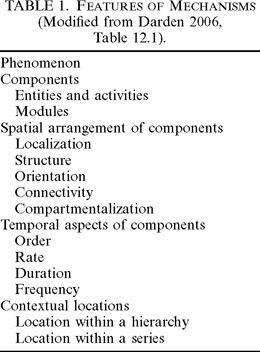
In addition to regularity and productivity, mechanisms exhibit special organizational features. Some general features of a mechanism, based on cases from molecular biology, are listed in Table 1. An adequate description of a mechanism in that field includes these features; hence, the search for them may guide the discovery of mechanisms. The first feature is “phenomenon” because, as discussed previously, the first step in the search for a mechanism is to identify a puzzling phenomenon of interest. Next are componency features. The mechanism's component entities and activities, sometimes further organized into modules, are sought. These components have spatial and temporal organization. Spatial organization includes location, internal structure, orientation, connectivity, and sometimes compartmentalization. Furthermore, mechanisms have temporal organization. The stages of the mechanism occur in a particular order, and they take certain amounts of time (duration). Some stages occur at a certain rate or repeat with a given frequency. In addition to the componency, spatial, and temporal features of a specific mechanism, that mechanism may be situated in wider contexts—in a hierarchy of mechanism levels (Craver Reference Craver2007, Chapter 5) and in a temporal series of mechanisms (Darden Reference Darden2006, Chapter 4). Mechanisms of spatial memory may be characterized at the membrane, synapse (intercellular), brain region, and organismal behavior levels. A temporal series of mechanisms spanning generations is the wider context for the mechanisms of heredity. These features of mechanisms (listed in Table 1) can play roles in the search for mechanisms, and then they become parts of an adequate description of a mechanism. This detailed characterization of mechanisms supplies constraints and guidance for reasoning in their discovery in some biological fields. Knowledge of these features of the desired product shapes the process of its discovery.

| Phenomenon |
| Components |
| Entities and activities |
| Modules |
| Spatial arrangement of components |
| Localization |
| Structure |
| Orientation |
| Connectivity |
| Compartmentalization |
| Temporal aspects of components |
| Order |
| Rate |
| Duration |
| Frequency |
| Contextual locations |
| Location within a hierarchy |
| Location within a series |
4. Representations of Mechanisms
A mechanism schema is a truncated abstract description of a mechanism that can be filled with more specific descriptions of component entities and activities. An example is James Watson's (Reference Watson1965) diagram of his version of the central dogma of molecular biology:

This is a schematic representation (with a high degree of abstraction) of the mechanism of protein synthesis. A less schematic description of a mechanism shows, with more or less detail, how the mechanism operates to produce the phenomenon in a productively continuous way and satisfies the componency, spatial, temporal, and contextual constraints. A goal in mechanism discovery is to find a description of a mechanism that produces the phenomenon, and for which there is empirical evidence for its various componency and organizational features. A mechanism schema can be instantiated to yield such an adequate description of a mechanism.
In contrast, a mechanism sketch cannot (yet) be instantiated. Components are (as yet) unknown. Sketches may have black boxes for missing components whose function is not yet known. They may also have gray boxes, whose functional role (Craver Reference Craver2001) is known or conjectured; however, which specific entities and activities carry out that function in the mechanism are (as yet) unknown. The goal in mechanism discovery is to transform black boxes (components and their functions unknown) to gray boxes (component functions specified) to glass boxes (components supported by good evidence), to use Hanson's (Reference Hanson1963) metaphor. A schema consists of glass boxes; one can look inside and see all the relevant parts.
Glennan (Reference Glennan2005) criticized MDC's schema/sketch distinction, saying that articulation of a mechanistic model is a continuous process. For a period of time, during discovery, that is right. However, biologists come to believe that they have sufficiently identified the components of mechanism schemas after some period of work and amassing of good evidence so as to claim that they know “how actually” the mechanism operates. Schemas then become textbook knowledge and are no longer the source for research projects; incomplete sketches indicate where fruitful work may be directed to produce new discoveries. So the distinction is important for indicating where current problems lie and where research needs to be directed.
As Glennan (Reference Glennan2005) and Bechtel and Abrahamsen (Reference Bechtel and Abrahamsen2005) noted, the term “model” may be used to describe a representation of a mechanism that illustrates its parts, operations, and organization. The term “model” in this sense refers to what philosophers call a “mechanistic theoretical model.” “Model” as they use it may refer to any of the three terms discussed above: a mechanism “schema,” an “instantiation” of a mechanism schema, or a “sketch.” (For more on mechanisms and models, see Darden Reference Darden, Hull and Ruse2007.)
5. Directions for Future Work
Despite all the work completed thus far to characterize mechanisms in biology, much remains to be done. Philosophers of molecular biology need to situate molecular biological mechanisms, such as DNA replication, into a wider hierarchical context. Looking down, we see that some macromolecules are referred to as “molecular machines” (Morange Reference Morange, Rheinberger and Chadarevian2006). How do they play the role of entities in higher level, containing mechanisms? Looking upward, how are such mechanisms to be situated in larger “systems” (a term used in many diverse ways in biology)?
The work so far has concentrated on biological mechanisms in molecular, cellular, and neurobiology. Characterizations for natural selection as a mechanism (Skipper and Millstein Reference Skipper and Millstein2005) or the mechanisms operating within ecosystems have yet to be proposed. There is much yet to understand about relations between normal mechanisms and diseased mechanisms as well as methods for the experimental and computational discovery of treatments and drugs based on what is known about the normal and diseased mechanisms. These issues span such diverse fields as human medicine, veterinary medicine, environmental crises, and agriculture.
Now that this mechanistic research program is well under way in philosophy of biology, questions arise about extending it to other fields, such as economics, other social sciences, and science education (Russ Reference Russ2006). Furthermore, to what extent does this mechanistic perspective apply to understanding chemical mechanisms or to information-processing mechanisms in cognitive neuroscience? How does a mechanistic view relate to the older nonmechanistic analyses of laws, theories, and explanations in those fields? What new issues arise in those fields about experimental and conceptual methods for discovering mechanisms? William Bechtel's and Jeff Ramsey's papers in this issue address some of these topics.