INTRODUCTION
Intensity modulated radiation therapy (IMRT) has been described as ‘a revolution in the treatment of cancer’.Reference Mundt and Roeske1 Nowadays, the technological evolution of the three-dimensional (3D) conformal radiotherapy continues to advance. The volumetric modulated arc therapy (VMAT) technique is one further step in that evolution. VMAT consists of the use of arcs (coplanar or non-coplanar) with a continual conformation of the beam shape with a multileaf collimator (MLC) and variation in dose rate and gantry rotation speed.Reference Otto2 New treatment techniques are required in order to be able to scale the dose without increasing toxicity.Reference Palma, Emily and James3–Reference Johnston, Clifford, Bromley, Back, Oliver and Eade5 IMRT techniques require high position and MLC speed accuracy. On the other hand, VMAT is more technically demanding because of the continuous dose rate variation and simultaneous movement of the gantry.Reference Oliver, Gagne, Bush, Zavgorodni, Ansbacher and Beckham6 Another uncertainty to consider is the accuracy of the dose calculation algorithms used in treatment planning systems (TPS). Different calculation algorithms have been widely verified for conventional IMRT, both sliding window and step-and-shoot, using homogeneous or heterogeneous density phantoms,Reference Davidson, Ibbott, Prado, Dong, Liao and Followill7–Reference Schiefera, Fogliata and Nicolini12 as well as through the use of Monte Carlo techniques.Reference Ma, Pawlicki and Jiang13–Reference Jones, Das, Jones and Monte15
The correct handling of the heterogeneities by the TPS for the dose calculation is essential for current radiation therapy treatments. The analytical anisotropic algorithm (AAA),Reference Ulmer and Harder16, Reference Ulmer and Harder17 is an algorithm based on the superposition-convolution model, improving dose calculation in the presence of patient heterogeneities (fat, bone, muscle, lung, etc.), in comparison with other algorithms, such as pencil beam algorithm.Reference Ahnesjö, Saxner and Trepp18 However, dosimetric verifications inside a patient are not easy to perform. For this purpose anthropomorphic phantomsReference Yoon, Lee, Shin, Lee, Park and Cho19–Reference Ann Van, Laura and Jukka23 which present anthropomorphic shape with heterogeneities can be used. The use of such a phantom with a system of adequate dosimeters, such as the thermoluminiscent dosimeters (TLD) becomes a powerful tool for studying the accuracy of the dose calculation algorithm in realistic clinical situations. Thus, the objective of this work is to study dose calculation accuracy of the AAA algorithm used by the Eclipse TPS (Varian Medical Systems) for the VMAT technique using the anthropomorphic phantom RANDO© (The Phantom Laboratory) Man with realistic electronic densities.
Although other authors have addressed the validation of the AAA algorithm,Reference Davidson, Ibbott, Followill and Popple9, Reference Schiefera, Fogliata and Nicolini12, Reference Sterpin, Tomsej, Vynckie, De Smedt and Reynaert14, Reference Dunscombe, McGhee and Lederer21, Reference Ibbott, Molineu and Followill22, Reference Oliver, Isabelle, Karl, Sergie, Will and Wayne24–Reference Han, Mourtada, Kisling, Mikell, Followill and Howell27 our approach with the VMAT technique is valuable because, as far as we know, no previous study with this technique has been done using an anthropomorphic phantom.
MATERIAL AND METHODS
Detectors
The TLD dosimeters used were Harshaw XD-100 (Thermo Fisher Scientific Inc.) extremity (EXT-RAD) model, which consisted of LiF:Mg,Ti chips (3·2×3·2 mm2 surface and 0·38 mm thickness, 100 mg.cm−2). The chip was hermetically bonded to a substrate to which a unique barcode label was attached for identification purposes (see Figure 1).
Thermoluminiscent dosimeter EXT-RAD TLD-100. TLD, thermoluminiscent dosimeter.

Individual sensitivity factors were associated with each detector. The detector dose response was almost linear until 200 cGy, beyond this point they presented a supralinearity of about 10%. The energy dependence was below 5%, within the range of the X-ray energies used in the work.
Dosimeter calibration
Two sets of 50 dosimeters were supplied. In all, 10 dosimeters among each set were randomly selected to perform the dose calibration. One TLD after another was irradiated at 10 cm depth between PTW-RW3 plastic slabs (density=1,045 g/cm3) and SSD 100 cm. The radiation field was a 10×10 cm2. The total dose to the dosimeters was 1 Gy, calculated by the TPS and checked by an ionisation chamber PTW 30013 (PTW Freiburg) in the same set-up.
In order to ensure that no accidental irradiation of the TLDs occurred during transportation, a group of ten TLDs were intentionally not irradiated, and subsequently used for background dose assignment purposes to the rest of the set.
Phantom
The anthropomorphic phantom RANDO© Man was used (see Figure 2), which is constructed with a natural human skeleton and covered by material equivalent to soft tissue. The RANDO© phantom Man does not have internal organs, but it presents a real bone structure and coverage with human body form with a density similar to water. The phantom RANDO© Man was cut up into slices of 2·5 cm thickness. This phantom does not present specific cavities for the dosimeter model used in this work, therefore the dosimeters were taped onto the slices of the phantom, and covered with a thin layer of black plastic film. This layer eliminates potential over-responses owing to artificial fluorescent light tubes and prevents soiling or damaging the active area of the TLD when handled, which could alter the glow curve reading.
(a and b) Phantom Rando© Man.
Phantom scanner
The TLDs were placed in approximate positions related to the PTVs and organs at risk (OARs) (prostate, bladder, node chains, rectum, femoral heads and small bowel) before the phantom was scanned. In this way, it is possible to accurately identify the position of the TLD inside the phantom. Owing to its finite size, a volume of interest was delineated on each slice in which the TLDs were seen and the average dose calculated on this volume.
Radiopaque marks were applied externally to the phantom in order to locate the centre of the computed tomography (CT) and to align the phantom in the treatment room. The CT scan was performed using a Siemens Somatom Open Sensation CT (Siemens AG) with our usual technique for the pelvis: 120 kV, 190 mAs, 2-mm slice and 0·9 pitch. CT data were transferred to TPS for planning purposes.
A group of six TLDs were used to evaluate the dose received during the CT scan. These dosimeters were distributed in the phantom and a new CT scan, with the same technical characteristics as before, was performed for them. The average dose of these TLDs was used to subtract the extra dose recorded in the rest of the TLDs during the initial phantom scan.
Treatment planning
In the TPS the anatomical structures of interest were contoured by a radiation oncologist, using the phantom’s skeletal anatomy as a reference point. The anatomical structures defined were: planning target volume corresponding to the prostate (PTV-T), planning target volume corresponding to the pelvic nodes (PTV-N), bladder, rectum, intestinal package and femoral heads.
Two clinical cases were used for this study: (1) a low-risk prostate case, where only one PTV-T was delineated and (2) a high risk prostate case, where two PTVs were delineated, that is, a PTV-N and a PTV-T.
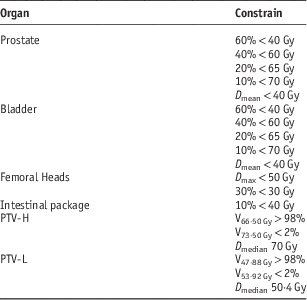
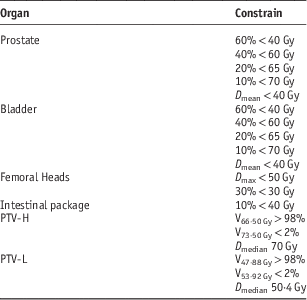
A VMAT plan for each case was optimised in accordance with our department protocols (see Table 1),Reference Salinas, Serna and Iglesias28 delivering 28 fractions to a total of 7,000 cGy in the PTV-T (250 cGy/fraction) and 5,040 cGy in the PTV-N (180 cGy/fraction). Dose was prescribed to the median PTV dose, requiring >98% of the PTV volume should receive at least 95% of the prescribed dose, and no >2% of the PTV volume should exceed 107% of the prescribed dose. The constraints for the OARs are shown in Table 1.
Department volumetric modulated arc therapy constrains set.
Abbreviation: PTV, planning target volume.
However, owing to the TLD supralinearity being above 200 cGy, the planning was performed by doubling the number of sessions and dividing the fraction dose by half, that is, PTV-T to 125 cGy/fraction and PTV-N to 90 cGy/fraction. By doing so, we ensured that TLD radiation dose was well below the supralinearity threshold, while maintaining the total planned dose, as per protocol.
Both treatment plans consisted of a single VMAT field, 6 MV X-rays, full rotation 358°, and 30° of collimator rotation, in order to minimise the tongue and groove effect.Reference Otto2, Reference Oliver, Isabelle, Karl, Sergie, Will and Wayne24, Reference Clivio, Fogliata and Franzetti-Pellanda29 The plan was optimised by the TPS Eclipse v10·0, and the dose distribution was calculated using the AAA algorithm and 2·5 mm dose grid size.
Even though VMAT dose distributions are highly homogeneous, the dose is not the same in all the TLD points chip. That is the reason why the dose provided by the TPS for the TLD is considered as the average for the TLD volume.
The TLD dose given by the calibration laboratory was modified by (1) by subtracting the average dose of the CT scan and (2) taking into account daily linac output, measured by an ionisation chamber.
For each plan two irradiations were performed, using two different TLD sets, in order to obtain more dose points for evaluation. For each case, the phantom was CT scanned with the TLD inside and the VMAT plan copied and recalculated from the first plan.
TLD measures are considered as our gold standard and the agreement between the doses calculated by the TPS were analysed.
VMAT plan quality assurance
Before each VMAT treatment, a plan specific quality control (QC) protocol was performed.Reference Serna, Puchades and Mata30 This QC consisted of four tests: (1) ionisation chamber array Seven29 (PTW Freiburg) in conjunction with the Octavius phantom, (2) portal dosimetry, (3) absolute dose measurement using an ionisation chamber PTW 30016 and the phantom QUASAR and (4) an alternative calculation program DIAMOND.Reference Mata Colodro, Serna Berná and Puchades Puchades31 The plans passed the QC and were deemed clinically acceptable.
Before clinical use a set of tests following ESTROReference Mijnheer, Olszewska and Fiorino32 and AAPMReference Ezzell, Burmeister and Dogan33 protocols test were done in order to verify the accuracy of the beam modelling for 3D and VMAT plans.
Phantom irradiation
The irradiations were carried out in a VARIAN iX (Varian Medical Systems), equipped with a MLC Millennium-120, which presents a central set of 80 leaves (40 leaves/side) with a size in isocenter of 5 mm and the remaining 40 leaves (20 leaves/side) with a size in isocenter of 10 mm. All of the plans were delivered by setting the maximum dose rate to 600 MU/minute, in order to minimise the treatment time.
Since the irradiation of the phantom and the calibration dosimeters were carried out on different days, we took into consideration the accelerator output measured by the daily verification system QUICK-CHECK. If the output measured deviated by >1% then the measurement was repeated by an ionisation chamber in a water phantom in order to obtain the output of the day.
For each plan the phantom was centred on the radiopaque marks and irradiated as a real patient resulting in a total of four sets of irradiated TLDs.
Dosimeter reading
The reading of the dosimeters was done in the Centro Nacional de Dosimetría, Spain, which is an accredited dosimetry calibration laboratory (ADCL). The reading of thermoluminescent dosimeters was carried out in a Harshaw 6600 TLD reader (Thermo Fisher Scientific Inc.). Optimum heating cycle parameters were determined as follows: preheat temperature, 160°C; preheat time, 9 seconds; temperature rate, 12°C/second; maximum temperature, 300°C; acquire time, 30 seconds; anneal temperature, 300°C; and anneal time, 33 seconds. The dosimeters were then kept at room temperature for 2 hours followed by heating at 80°C for 18 hours. As stated by the ADCL the uncertainty of the readings is 1%.
RESULTS
TLD calibration dispersion
The standard deviation of the calibration factor was 2·0% for the first TLD set and 1·8% for the second, nevertheless, a calibration factor was given for each set.
VMAT planning and treatment
A total of 354 and 374 MU were delivered for the low risk and high risk cases, respectively, corresponding with the adjusted MU for supralinearity.
Dose–volume histogram curves for both the low and the high risk treatment planning are shown in Figures 3a and 3b. In addition, in Figures 4a and 4b, the dose distribution corresponding with the high risk plan is shown. In the transversal plane, Figure 4a, the positions of four TLDs are indicated.
(a and b) Dose–volume histogram curves for the low risk (left) and the high risk (right) treatments. Yellow line: right femoral head, green line: left femoral head, blue line: bladder, brown line: rectum, red lines: planning target volumes.
(a and b) Dose distribution, in colorwash, for the high risk prostate treatment planning. Isodoses for the prostate hazard ratio treatment. TLD, thermoluminiscent dosimeter.
The average dose of the TLDs dedicated to measure the CT scan dose was 1·69±0·08 cGy, and subtracted from all the measured doses.
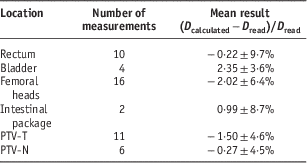
A total of 49 TLD dose values were obtained, 25 for the low risk case and 24 for the high risk case. PTV-T dose was measured in 11 different points and the PTV-N dose was measured in 6 points. Rectum dose was measured in 10 points, bladder in 4 points and femoral heads in 16 points and intestinal package in 2 points. In Figure 5, the complete set of measurements is presented as a function of the relative difference with the calculated dose. More than 77% of the measurements are below 3·5% error, and only 6% are >6·5% error, none exceeded 7·5% error. The average difference between the measured dose and that calculated by the TPS was below 2·5%.
Absolute deviation for the measurements.
Regarding the high dose low gradient region, corresponding with the PTVs, the average difference was −1·5±4·6% (1 SD) for the PTV-T and −0·3±4·5% for the PTV-N. The average OARs dose error was below 2·5% for all of them, rectum −0·2±9·7%, bladder 2·4±3·6%, femoral heads −2·0±6·4% and intestinal package 1·0±8·7%. These results are shown in Table 2
Number of measurements for each location and mean result in percentage.
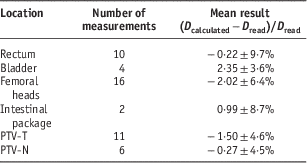
Abbreviations: PTV-T, planning target volume corresponding to the prostate; PTV-N, planning target volume corresponding to the pelvic nodes.
.
DISCUSSION
Our results are in accordance with the acceptance criteria proposed by Fraass et al.Reference Fraass, Doppke and Hunt25 in the AAPM TG53 on QC for beams of radiation ranged between 5 and 7% for inhomogeneous phantom. The standard deviation of the OARs was significantly higher than that corresponding to the PTVs. A plausible explanation is that the TLDs have a size of about 3 mm and are located in regions of high dose gradients. The region where the rectum, bladder and femoral heads are located has a dose gradient of about 3%/mm. In particular, the rectum, with the highest standard deviation value, is usually the most difficult organ to comply with the dose constraints; hence, the modulation in that area and the resulting dose gradient are higher. In addition, it must be taken into account that small variations of the TLD position have a great impact on its dose measurement or calculation.
Although the analysis done in this work was focused on the prostate, it is equally applicable to the rest of pathologies involved in the pelvis or abdominal area.
Comparing our results with the AAPM acceptance protocol,Reference Serna, Puchades and Mata30 only one measurement reached the 7% limit of acceptance. Our results show differences in the same range as those found by similar studies, performed with different measurement systems for IMRT techniques.Reference Schiefera, Fogliata and Nicolini12, Reference Mijnheer, Olszewska and Fiorino32–Reference Al-Hallaq, Reft and Roeske34 For instance, Kinhikar et al.Reference Kinhikar, Upreti, Tambe and Despande26 made a study of the AAA with IMRT technique in plastic phantom and using different detectors. They found a good agreement between measured and calculated doses, and in particular a difference of <5% for the TLDs.
This work has some limitations. First, our results depend on the accuracy with which clinical radiation beams have been modelled in the TPS. So any particular institution must ensure that their basic dosimetric data have enough quality and the MLC is accurately modelled. Nevertheless, this study offers high value to the institution, giving confidence in implementing the AAA for the dose calculation and VMAT technique; and second, we do not have access to the new Varian’s algorithm Accuros XB, which is claimed to be more accurate than the AAA, especially for heterogeneities.Reference Fogliata, Nicollini, Clivio, Vanetti and Cozzi35–Reference Kathirvel, Subramanian and Clivio41 However, as this work is focused in the pelvis region, where the heterogeneities are less relevant than in other locations, such as thorax, we expect little differences when using these two algorithms.
CONCLUSIONS
The use of TLD in conjunction with anthropomorphic phantoms is a useful tool to verify the accuracy of the dose calculation algorithm implemented in the TPS in realistic anatomical cases. We conclude that the AAA algorithm provides reliable dose calculation for the treatment with VMAT in the anatomy of the pelvis.
Acknowledgements
The authors are grateful for the collaboration of the M. D. A. Iglesias, who contoured the structures of this work. The authors also thank PhD J. Perez-Calatayud for providing the phantom RANDO© Man on loan.
Conflicts of Interest
None.
Ethical Standards
No animals were used in this study. The manuscript does not contain clinical studies or patient data.