Founded as a penal settlement in 1788 with no special monetary arrangements, the colony of New South Wales had neither bank nor mint until 1817 and 1855 respectively and, unlike the American colonies, no government paper issues. From its earliest days, the colony had a high proportion of free colonists (67 per cent in 1800,Footnote 1 mainly ex-convicts) who were engaged in carrying out economic transactions beyond the prison system based on the general principles of the transplanted English law. The remoteness of the colony called for self reliance and a high degree of autonomous decision making. These attributes make New South Wales an important case study and reference point for the establishment of a monetary system from first principles, making its monetary history of more than local interest.
The current view of New South Wales's early monetary history is based on Butlin's pioneering work (Butlin Reference Butlin1953), formulated over half a century ago and largely unquestioned by subsequent authors (for example, Hainsworth Reference Hainsworth1972, pp. 58–62; Holder Reference Holder1970, pp. 4–10; Steven Reference Steven, Broadbent and Hughes1992, pp. 55–6; Kercher Reference Kercher1996, p. 136). However, the present investigation, originating from a review of the New South Wales material as a case study for Heinsohn and Steiger's property-based theory of money (Heinsohn and Steiger Reference Heinsohn, STEIGER, Arestis and Sawyer2006),Footnote 2 suggests that it may be appropriate to re-evaluate some of Butlin's conclusions and to offer a revised and more comprehensive account of the early history of bills, notes and money. This includes, for the first time, a comprehensive and quantitative review of currency-related court cases,Footnote 3 which were not considered by Butlin, together with a critical document related to the Commercial Society, only discovered after Butlin's work (Hainsworth Reference Hainsworth1972, p. 60; Reference Hainsworth1968, pp. 56–7).
In brief, Butlin (Reference Butlin1953, p. 18) concluded that private notes emerged as a coin substitute and became the basis of an inferior ‘currency’ discounted against ‘sterling’ (British Treasury bills and specie) due to the lower creditworthiness of private individuals compared to the British Treasury and later due to pressure to pay for imports (Butlin Reference Butlin1953, pp. 66–7, 100). Repeated government attempts to outlaw ‘currency’ had been futile because there were never sufficient banknotes, English coins and cheques to replace private notes until the 1830s (Butlin Reference Butlin1953, p. 67). In particular, Macquarie's landmark 1816 reform to outlaw ‘currency’ had been unsuccessful (Butlin Reference Butlin1953, p. 67) and the founding of Australia's first bank, the Bank of New South Wales, a relatively unimportant event (Butlin Reference Butlin1953, pp. 122, 138).
In contrast, we will argue in Section I that not all private notes were discounted, consistent with their role as an integral part of a payment system based on mutual claims documented in book accounts and denominated in English pounds sterling. Notes emerged not simply as a coin substitute but performed advanced payment functions (akin to a modern cheque) like their usage in early modern England. We also provide an explanation of why exotic instruments like notes payable in wheat and copper coin emerged, a point left unexplained in the literature. Section II shows that ‘currency’ emerged only from about 1809/10 and was foremost an abstract monetary standard, a money of account, to be distinguished from Butlin's view of ‘currency’ as a physical thing of only local validity (like a commodity or private note) (Butlin Reference Butlin1953, p. 67). The pound currency / pound sterling exchange rate was set by merchants when issuing and redeeming their notes. Small merchant notes were also the first occurrence of money and created to pay wage labourers. This explains the easy acceptability of notes, a fact Butlin (Reference Butlin1953, p. 90) found difficult to understand. While rates partly reflected pressures to pay for imports, rates were also strongly influenced by exchange rates set in civil court judgments. In response to court judgments, merchants successfully combined to fix the exchange rate for considerable periods of time, a fact previously not recognised. Exchange rate fixing caused disruptions to prices and wage payments and triggered Governor Macquarie's 1816 reform, outlined in Section III. Section IV argues that Macquarie's reforms were a success. While private notes continued to exist, the monetary standard in New South Wales returned to English pound sterling until 1821. We argue that the Bank of New South Wales was important and the cornerstone to that reform. The concluding Section V seeks to place the New South Wales material in the wider context of a more general debate about the origins of money. The timeframe selected for this account is 1788–1822, a period commencing with the formation of the colony and ending with the introduction of the dollar standard.
I
The monetary system from 1788 until about 1809/10 was characterised by a system of mutual obligations that heavily utilised book accounts, bills and notes. Remaining balances and judgment debts were settled with British government debt, copper coin and commodities. Within this system, private promissory notes became the dominant means of payment in early New South Wales (Chalmers Reference Chalmers1893, p. 242; Kercher Reference Kercher1996, pp. 96, 131).
Like in the British North American colonies (see, for example, Michener and Wright Reference Michener and WRIGHT2006, pp. 19, 22), the same money of account was used to convert extremely varied means of payment (coins, wheat, livestock, swine flesh, promissory notes) into a single well-understood price. However, while Americans reckoned in their local accounting unit – for example, the New York pound or New York currency (Michener and Wright Reference Michener and WRIGHT2006, p. 23), which was defined in terms of specific coins usually at a fixed discount to the pound sterling – the New South Wales monetary standard was the English pound sterling. In 1800, following the importation of copper coin for ‘the want of small money’.Footnote 4 Governor King had prescribed inflated English pound sterling values for foreign (for example, the Spanish silver dollars at 5s sterling) and English coins (for example, the English shilling at £0/1/1 sterling) in New South Wales. The English copper penny of one oz. was issued at double the English value (£0/0/2) in payment of government expenses and received back in payment of taxes like market dues. This was a radical departure from other colonies. For example, while one English shilling could discharge a debt of £0/1/0 sterling in England, £0/1/9 currency in New York, £0/1/4 currency in Connecticut and £0/1/1 currency in Lower Canada, the same coin discharged a debt of £0/1/1 sterling in New South Wales (see, for example, Michener and Wright Reference Michener and WRIGHT2006, p. 36; Neufeld Reference Neufeld1964, pp. 24–7). With the exception of Chalmers (Reference Chalmers1893, p. 243), who thought King's proclamation was ‘extraordinary’, few authors have noted this anomaly.
With the pound sterling as the accounting unit, book accounts, as in the American colonies (Michener and Wright Reference Michener and WRIGHT2006, p. 20), were widely used and kept between private individuals and between merchants and their customers. Such accounts enabled mutual balances to be offset periodically and most transactions to be effected without coin. Even the final payment of an account balance was typically avoided by writing out a promissory note. For example, the merchant G. Blaxcell settled his 1810 account for ‘Money transactions’ with the grazier Elizabeth Macarthur using a promissory note.Footnote 5
Merchant accounts were accessed by drawing bills on the merchant. For example, the 1803/4 account of Captain Piper with prominent Sydney merchant Simeon LordFootnote 6 shows, amongst account entries for paper, tea, socks, soap and tooth powder, entries for orders in favour of several people. Piper, the drawer, would have created orders (i.e. bills) on Simeon Lord, the drawee, in favour of various payees. Presentment would have created the debit entries in Piper's account with Lord, which extinguished the bills.
Even so-called ‘barter’ transactions (for example, the ‘barter’ of imported goods for wheat by the government storeFootnote 7) usually involved goods with prices (Butlin Reference Butlin1953, p. 25, confirmed by Kercher Reference Kercher1996, p. 143), which means that they were in substance a concurrent sale on book account and not an exchange. A similar result was found for the American colonies (Michener and Wright Reference Michener and WRIGHT2006, pp. 21, 23).
The use of these accounts indicates that notes did not simply fill the gap left by an inadequate supply of coin as so often suggested (for example, Butlin Reference Butlin1953, p. 18; Steven Reference Steven, Broadbent and Hughes1992, p. 55), but rather they emerged as part of a relatively sophisticated payment system which was based on mutual obligations (similar to the use of bills and notes in early modern England) (Kerridge Reference Kerridge1988, p. 40), and far superior to conducting transactions solely with coins.
This interpretation is consistent with the fact that the most important coin in local circulation was copper coin, which was not always accepted in payments.Footnote 8 Unlike store receipts, however, copper coin could not be consolidated into bills on the British Treasury and as a consequence little was exported (Butlin Reference Butlin1953, p. 39). Despite these drawbacks, examples of advertisements indicate that the copper coin retained its proclaimed pound sterling value as it continued to rank in line with store receipts, paymaster's bills and Spanish dollars at 5s.Footnote 9
In this environment, it became the role of the importers to periodically force the final settlement of balances because they required pound sterling funds on London to pay the masters of ships before their departure.Footnote 10 The two most important funding sources were government debt in the form of (a) store receiptsFootnote 11 for the delivery of grain, animal food and meat into the government store, which in turn provided rations for the convict population; and (b) paymaster's notes, which were issued as salary payments to military officers. Store receipts were consolidated into bills on the British Treasury and paymaster's notes into bills on the regimental agents in London.Footnote 12 Unlike in England where final settlement required specie (Kerridge Reference Kerridge1988, p. 40), government debt in the form of bills on London became the final settlement asset for pound sterling obligations (‘sterling settlement assets’) in New South Wales. These instruments became referred to as consolidated moneyFootnote 13 and sterling money.Footnote 14
Another situation that required the final settlement of balances was a prosecution for non-payment of a bill, note or book account. This allowed for the seizure of the debtor's goods and chattels and imprisonment until the debt was paid. Judgments before 1810 on occasion allowed payment by instalments or payments in wheat or other goods and labour, thereby explicitly recognising the scarcity of government debt. From 1810 procedures were tightened and judgments were for payment in sterling settlement assets (Kercher Reference Kercher1996, pp. 144, 197). Bills, notes and book debts therefore obtained their backing from being enforceable against the general property of the issuer.
An important shortcoming of this early system was that government debt could not be created when most needed to liquidate balances. The supply was inelastic and relied on the size of the government's food purchases and salary payments, which were fixed and did not contract or expand with the needs of trade (Hainsworth Reference Hainsworth1972, p. 84; Steven Reference Steven1965, p. 50). When the granaries were fullFootnote 15 the supply of store receipts stopped and merchants had to defer the presentment of accounts.
A further interesting and yet to be fully explained feature of the early monetary system is the proliferation of notes payable in copper coin, and commodities (contrary to English law, which required notes payable in specie: Kyd Reference Kyd1800, p. 50) by value and by weight. These appeared alongside bills and notes drawn payable in pounds sterling.Footnote 16
One plausible explanation is that drawing bills and notes in ways other than pounds sterling reduced the default risk for the issuer. Copper coin was retained in the colony and commodities were locally produced, ensuring access to these assets when needed. On some notes makers reduced the default risk even further by making the notes payable at the time of the harvest.Footnote 17
However, the complexities arising from the use of wheat as a settlement asset became obvious in the McArthur v. Thompson case (27 October 1806).Footnote 18 How was a wheat note promising to pay 55 bushels of wheat, payable on demand and received in payment in April 1805, to be interpreted when the value of wheat had risen tenfold after the Hawkesbury floods in March 1806? The court gave judgment for the plaintiff at the pre-flood valuation and treated the note as a nominal monetary obligation. As a consequence, two important regulations by Governor Bligh dated 1 November 1806 and 3 January 1807 sought to prevent future litigation of this nature. Notes were to be liquidated in money only and not in goods; bills and notes were to be ‘drawn payable in Sterling Money’. The term ‘sterling money’ referred to the foreign and English coins (including copper coin) as defined in King's 1800 currency regulation.Footnote 19
It is clear from a general order dated 17 November 1807 and the evidence given before the 1808 court martial of Lieutenant Johnston that Bligh's proclamation was not complied with.Footnote 20 The likely reason is that the option to settle obligations in goods must have been even more important at the time because Bligh had reduced the commissariat expenditure and associated store receipts from £32,351 in 1805 to a mere £3,264 in 1807 (Ritchie Reference Ritchie1988, p. xiv). While staunching the sources of wealth of what has been described as a junta of military and civil officials (ibid.), this action also forced a tenfold contraction in one of the colony's key settlement assets. Bligh, perhaps not realising the full monetary consequences of his actions, created one of the factors contributing to his deposition.
The Hawkesbury settlers’ petition to the Secretary of State dated 4 November 1808 refers to Bligh's orders, which
put a stop to … the Stroling Dealers who were generally employ'd by our Trading Officers, suppressing extortion and the Colonial Cash Notes, the Drawers of which were making a Trade of them, by chargeing from 25 to 40 p'r C't. whenever any of the Holders of such Bills presented them for Consolidation … by which many of the Officers and leading Men had inriched themselves….Footnote 21
This was used by Butlin (Reference Butlin1953, p. 67)Footnote 22 and others (Hainsworth Reference Hainsworth1972, p. 58) as evidence that private promissory notes had generally been discounted against government bills. The discount was due to the ‘recipient's estimate of the worth of the drawer’ and ‘uncertain acceptability’ of the note. All private promissory notes were ‘currency’ and inferior to ‘sterling’ (Butlin Reference Butlin1953, pp. 66–7).
The text of the settlers’ petition refers, however, to transactions between settlers and officials or dealers employed by officers. The discount is applied when notes are presented for ‘consolidation’, a term used for the consolidation of store receipts into bills on the Treasury. The settlers’ later ‘memorial’ to the Secretary of State, dated 17 February 1809, notes that officers had redeemed their notes in property ‘in some instances at one Thousand p'r cent. profit, principally obtained from His Majesty's Stores’.Footnote 23
Rather than evidence for a general discount of private notes, the issues raised by the settlers are more likely a special case where members of the ‘junta’ of civil and military officials used the government store for their own benefit. This would explain why there is little other evidence suggesting that private bills and notes were generally discounted in the period up to 1809/10. The account of Captain Piper with merchant Simeon Lord over the period of 1803–9Footnote 24 is in single-column formatFootnote 25 with bills, notes and orders listed alongside imported goods. Damages, claims and prices in the McArthur v. Thompson (1806) case all imply pounds sterling. Advertisements name ‘good bills’ alongside wheat receipts and copper coinFootnote 26 and ‘approved bills’ alongside dollars,Footnote 27 suggesting a valuation of these bills in pounds sterling. The note drawn by merchant G. Blaxcell in 1810 is for £316/1/10 in ‘Sterling Money’ and settled ‘Money transactions’ that included bills and notes of various people together with store receipts.Footnote 28 This suggests that private notes drawn payable in pounds sterling were valued at par with pound sterling bills on London in this instance.
II
The second phase of the monetary development from 1809/10 until Macquarie's currency reform in November 1816 is dominated by the emergence and complexities of a dual pound sterling / pound currency standard and the first occurrence of money in the form of small merchant notes, which were enforced in government regulations and judgments of increasing complexity.
Contrary to the original intentions of King (see Section I), a local money of account, the pound currency, was widely used in all commercial dealings of the colony alongside the pound sterling. From about the end of 1809 onwards there is clear evidence from advertisements,Footnote 29 notices of lost promissory notes,Footnote 30 private accounts,Footnote 31 official accounts,Footnote 32 government and general orders,Footnote 33 court records (see discussion below) and official market price quotationsFootnote 34 that similar to other colonies (see Section I), a local money of account, the pound currency, trading at a discount to the pound sterling, had been established in which contractual obligations and debts were entered into separately from sterling.
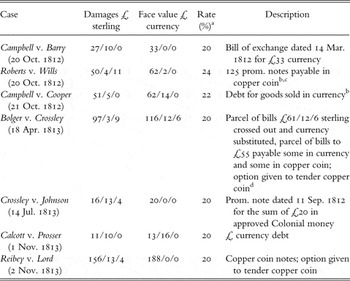
Court exchange rates in selected judgments on £ currency obligations 1812–13

aMarket exchange rate was reported at around 50% during the time of judgments; see General Hospital accounts.
bReported in Sydney Gazette 24 Oct. 1812 as 20% premium.
cThe minutes note 125 promissory notes payable in copper coin at £62/2/0 and 54 notes payable in sterling at £16/17/0. Total damages £67/1/11. One note appears to have been disallowed therefore the rate of 24% could be overstated.
dTotal damages £175/1/3 sterling of which £77/17/6 are for notes payable in sterling.
Source: State Records Authority of New South Wales, Court of Civil Jurisdiction, Minutes of Proceedings (Record series 2659), 1812–13 (5/1109–10).
It is important to emphasise that the instances of government and general orders and official market quotations in pound currency indicate that this standard became officially recognised from at least 1812. Butlin and others assumedFootnote 35 that ‘currency’ had remained outlawed (see also the discussion in Section III).
This emergence of pound currency as a money of account coincided with a relative contraction of government expenditure (Steven Reference Steven, Broadbent and Hughes1992, p. 54; Fletcher Reference Fletcher1976, p. 137), which would have made obligations denominated in pounds sterling riskier, and the emergence of small merchant notes. Copper coin became the final settlement asset for pound currency obligations at £0/0/2 currency (instead of £0/0/2 sterling). For example, a side note to the case minutes in Reibey v. Lord (1813) indicates that Lord actually delivered £106/17/0 in copper coin (amounting to a weight of about 359kg!) into the court.
The period 1812–14 provides strong evidence for merchants and traders acting as early ‘bankers’. Bearer-on-demand notes in regular small round-figure denominations (£0/1/0, £0/1/6, £0/2/0, £0/2/6, £0/5/0, £0/10/0, £1/0/0) payable in copper coin or pound currency become abundant in the manuscript sources.Footnote 36 While Butlin identified the currency note issues and the role of what he identified as shopkeepers as early bankers, he could not explain the underlying reasons as to what made their notes so easily acceptable (Butlin Reference Butlin1953, p. 90) and therefore so frequent. It is argued here that the reason is to be found in the unique position merchants had within the payment system. Merchants sold goods to producers and through their shops to labourers, but at the same time purchased commodities and government debt (store receipts) from producers. Instead of recording these transactions as book entries, merchants could pay in their own notes, which in turn would flow back through the purchase of merchandise.
This self-liquidating payment flow created a natural reflux that stabilised the value of small notes, supported if needed by the practice of some storekeepers to only accept their own notes. It is very clear from the sources that these notes were viewed as superior to others as merchants had ‘merchandize … to pay their notes with’.Footnote 37 Commodities and merchandise (supported by the general property of the merchant) became the underlying property basis of merchant notes.
It appears that wage payments were driving the demand for small merchant notes. An editorial in the Sydney Gazette on 6 March 1813 stressed the great benefits of paying wages in notes, as labourers could avoid being paid in ‘property’ (like tea, sugar and tobacco) at inflated prices. Producers thus needed to purchase notes from merchants to pay wages.
It can be argued that merchant note issues are also the underlying reason why pound currency as a local money of account could appear and be maintained. Merchant note issues and redemptions constantly created pound currency valuations of commodities, British government debt and (often imported) merchandise, thus setting prices and the exchange rate.Footnote 38 The exchange rate between pound currency and pound sterling in March 1812 was 25 per cent premiumFootnote 39 (£125 currency for £100 sterling) and increased to 50 per cent in October 1812.Footnote 40 Contemporary sources stress that the premium over sterling was not an issue related to the creditworthiness of the note issuers, the public being always able to ‘exercise the power of rejecting any [notes] that were considered doubtful’.Footnote 41 Any interference with the issuer's property, for example through mortgage, immediately impacted on the acceptability of notes.Footnote 42 Rather than a lack of creditworthiness, the sterling appreciation reflected the result of excessive importations caused by competition between merchants.Footnote 43 Thus merchants outbid each other when buying the scarce supply of British government debt with their notes, which resulted in floating exchange rates.
This was in stark contrast to the American colonies. Here the currency/sterling exchange rate was at least nominally fixed by the rating of the local currency unit in terms of specie. While exchange rates still fluctuated, in colonies that had not over-issued government paper (for example, New York or Pennsylvania), the average level of exchange rates largely followed these ratings (Michener and Wright Reference Michener and WRIGHT2006, pp. 26–9). As the local monetary standard in New South Wales was the pound sterling, the currency/sterling exchange rate depended entirely on the actions of merchants and debt-recovery actions of the court.
Merchant notes also perhaps represent the origin and earliest form of ‘money’ in New South Wales. This interpretation follows from Heinsohn and Steiger's definition of money as a claim over property that is created in a credit contract or repurchase operation (for example, the open-market purchase and repurchase of assets) (Heinsohn and Steiger Reference Heinsohn, STEIGER, Arestis and Sawyer2006, pp. 497–8). Merchants undertook the repurchase operations in the form of a crude ‘open-market’ purchase and subsequent sale of goods. This money is not simply a debt (like an ordinary bill or note) but a note that is issued by a net-creditor, frequently created and redeemed on the basis of valuable assets ensuring its stability and currency. The interest for this provision of liquidity to producers would have been included in the prices.
Governor Macquarie, shortly after his arrival in 1810, began to regulate the issue of small notes. Firstly, he proposed the establishment of a government bank to the Colonial Office (rejected in 1811).Footnote 44 Secondly, a proclamation dated 30 June 1810 provided that all promissory notes payable to bearer on demand below or equal to £5 had to be on printed forms and drawn (consistent with Bligh's 1807 proclamation) payable in ‘a certain Sum Sterling’.Footnote 45 But the proclamation was moderated by legislation following an important appeal case reported in the Sydney Gazette on 23 May 1812 (seemingly misinterpreted by Butlin as litigation over copper coin bills: Butlin Reference Butlin1953, p. 79). According to the issuer of the notes, the proclamation forced makers of small notes (in this case 2s. 6d. to 20s., the total value of the notes exceeded £75) to draw these payable in sterling (rather than copper coin or currency) even though notes were issued at pound currency valuations, at the time at 25 per cent premium to pound sterling. The original civil court judgment to the full sterling value therefore created an unjustified loss to the issuer.
While the High Court of Appeal (represented by Macquarie) confirmed the original judgment, new legislation introduced on 22 May 1812Footnote 46 permitted the negotiation of promissory notes payable in copper coin and limited the liability of the drawer to the payment in copper coin regardless of the amount (recognising that copper coin was not deemed legal tender above £5). The consequences of this proclamation were far reaching as it seemingly protected issuers from the requirement to redeem notes payable in copper coin (or currency) with sterling settlement assets, greatly reducing the default risk of the issuer and also officially endorsing pound currency as a money of account.
However, only six months later the Court of Civil Jurisdiction (under judge advocate Ellis Bent) removed the privilege to redeem copper coin notes in actual copper coin. Instead the court awarded damages on pound currency obligations in pounds sterling at 20 per cent premium.Footnote 47 A review of the case minutes shows that the relevant cases are Campbell v. Berry (1812), Roberts v. Wills (1812) and Campbell v. Cooper (1812); see Table 1. The exchange rate applied by the court was significantly lower than the current market rate of 50 per cent premium.Footnote 48 The court-imposed rate of 20 per cent was maintained until November 1813 (see Table 1; there are cases where Bent allowed the discharge in copper coin) irrespective of changes to the market rate. Damages on notes payable in sterling continued to be to the full sterling amount.
With the market exchange rate at 75 per cent in February 1813 and dropping to 50 per cent until October 1813,Footnote 49 all past and future small note issuers became exposed to a potential loss through court action. Bent's October 1812 judgments thus had significant economic implications, a fact not previously recognised.
In October 1813, 17 Sydney traders founded the Commercial Society of Sydney to ‘establish a better and more permanent Currency’. The meeting resolved for individual members to issue promissory notes payable on demand in pound currency (denominations £0/2/6, £0/5/0, £0/10/0) with an implied option for redemption in pounds sterling at 25 per cent premium (later known as 25 per cent notes) (reproduced in Hainsworth Reference Hainsworth1968, pp. 56–7). Another important agreement was ‘not to receive in payment the bills of any individuals who had not been admitted into their society’ (Wentworth Reference Wentworth1819, p. 210).
The note issue is reported to have commenced in October 1813 with the purchase of government bills.Footnote 50 While Hainsworth downplayed the activities of the Commercial Society as not harmful (Hainsworth Reference Hainsworth1972, p. 61), the evidence given in McKenna v. Lord (1814) indicates that the note issue had a significant and disruptive impact. The volume of the note issue is reported to have been considerable and the market exchange rate became fixed at 25 per cent premium as a result.Footnote 51 Evidence given by witnesses in McKenna v. Lord (1814) shows that the 25 per cent note issue not only affected exchange rates. Shopkeepers reduced their (currency) prices and attempts were made to reduce the price of labour. Old notes were only accepted in payment at the previous rate of 50 per cent and old notes payable in copper coin were refused. There is evidence for a competing 50 per cent note issue occurring about the same time (see Table 2 and advertisement for 50 per cent notes by G. Blaxcell in the Sydney Gazette, 6 November 1813), which was no longer competitive.
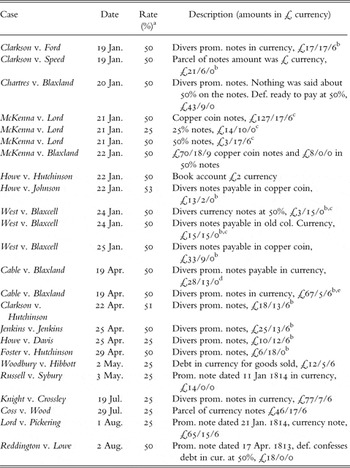
Court exchange rates in selected judgments on £ currency obligations 1814

a Market exchange rate reported at 25%; see General Hospital accounts.
b Minutes state payable to bearer on demand. cSame case. dCase no. 257. eCase no. 258.
Source: State Records Authority of New South Wales, Court of Civil Jurisdiction, Minutes. of Proceedings (Record series 2659), 1814 (5/1110-1).
Macquarie responded with drastic measures. Meetings exceeding six persons on trade matters were prohibitedFootnote 52 and a further proclamation dated 11 December 1813Footnote 53 outlawed future notes implying an exchange rate.
However, surprisingly and contrary to Macquarie's efforts, an analysis of court minutes from January to August 1814 (Table 2) shows that Bent's court directly supported the 25 per cent scheme. The court changed the long-held practice of applying a fixed exchange rate of 20 per cent to all currency obligations and began to make judgments favouring the 25 per cent scheme. Older note issues, like notes payable in copper coin and the competing 50 per cent notes, were assessed at 50 per cent premium (Kercher Reference Kercher1996, p. 137, only noted court acceptance of the 25 per cent rate), while 25 per cent notes or more recent pound currency book debt were assessed at 25 per cent premium. Bent's chosen exchange rates clearly supported, if not endorsed, the activities of the Commercial Society that Macquarie had sought to outlaw.
The 25 per cent scheme is reported to have collapsed around the second quarter of 1815 after an opulent trader demanded the redemption of a large sum.Footnote 54 The General Hospital accounts show that the scheme had stabilised the exchange rate for over 18 months, which is a remarkable achievement. As a result of the collapse, the exchange rate moved to 50 per cent premium, members of the Commercial Society reportedly repurchased their now depreciated 25 per cent notes at a great profit and a new 50 per cent scheme was devised in November 1815.Footnote 55 This scheme provided for redemption into pounds sterling at 50 per cent under the condition that a minimum of £15 in notes from a single issuer were presented,Footnote 56 making the new 50 per cent notes for all intents and purposes irredeemable.Footnote 57 The new 50 per cent scheme also had disastrous consequences for employers and wage earners, resulting in layoffs as ‘employers had none but the old currency to pay them with’.Footnote 58
III
Macquarie initiated his major currency reform in November 1816. General interpretation of this reform has to date not considered Bent's currency-related court cases (outlined in Section II above). In the following, the events leading up to the reforms are reconstructed within the context of Bent's judgments, showing that these are critical for the understanding of events.
From August 1814 until the arrival of the new deputy judge advocate Wylde in October 1816 the court system hardly functioned, in part due to Ellis Bent's worsening illness and subsequent death (Currey Reference Currey1968, p. 85). Wylde noted that the majority of pending law suits were actions on ‘Currency Notes’ issued contrary to colonial orders ‘not only of old but of very recent date’.Footnote 59 The most recent currency proclamation was Macquarie's December 1813 order outlawing notes with implied exchange rates. The success of the 25 per cent note issue, Bent's supporting judgments in 1814 and the new 50 per cent scheme in 1815 suggest that the cases referred to involved notes payable in currency with implied exchange rates (and not simply private notes as commonly assumed).Footnote 60 The court faced a dilemma. If it considered the notes illegal, plaintiffs who had received the notes ‘on a bona fide consideration’Footnote 61 would suffer.
Macquarie and Wylde untangled this complicated legal situation by initiating a major currency reform conducted in four steps. Firstly, previous currency regulations were rescinded (proclamation 23 November 1816Footnote 62) to allow judgments on notes issued contrary to colonial orders. Secondly, from the date of this proclamation, only notes drawn payable in pounds sterling ‘in direct and certain words’ were permitted. A subsequent proclamation dated 25 November 1816Footnote 63 established the pound sterling as the money of account, and on 29 November 1816 a meeting of ‘the Magistrates, Gentlemen, Settlers, and Merchants’ changed the rate and scale of prices on all contracts, agreements and dealings from pound currency to pound sterling based on a premium over sterling of 50 per cent.Footnote 64 The third step was the revaluation of copper coin to its English value of 1d. sterling (general order dated 7 December 1816Footnote 65). This finally ended King's practice of issuing copper coin at double its English sterling value and destroyed the pound currency settlement asset.
The fourth and concluding step was to establish the Bank of New South Wales, contrary to colonial orders. It is not entirely clear what insight drove Macquarie to take this final step (Holder Reference Holder1970, p. 6). However, it appears from the failed 1810 proclamation that simply declaring the pound sterling as the money of account would not stop merchants from issuing small notes (drawn payable in sterling) at a discount. The problem was not just the chosen money of account but how to keep a private note issue in New South Wales at par with pound sterling bills on London. We know today that the proven method of achieving this is the discount operation of a well-capitalised note-issuing bank (Stadermann Reference Stadermann2002, pp. 28–9, 40). It is therefore argued that Macquarie's underlying objective for establishing a colonial bank was to stabilise the exchange rate.
The Commercial Society provided the blueprint for the bank's ownership structure as a bank of merchants. Robert Jenkins, the former vice president of the Commercial Society, was one of the founders and later became a founding director of the Bank (Hainsworth Reference Hainsworth1972, pp. 61–2).
The Bank of New South Wales began operation on 8 April 1817 under a charter of limited liability (Holder Reference Holder1970, p.18). Individuals now drew bills and notes for the purpose of discounting rather than using them directly in payment. The bank's reserves were sterling settlement assets like bills on the British Treasury and store receipts, which were accepted as deposits or exchanged for banknotes without charge or reduction. Notes of private individuals (payable in sterling) were not accepted as cash for deposits, because if recognised as cash, the bank ‘would become virtually guarantor for them’ (Holder Reference Holder1970, p.17). Promissory notes issued by the bank were in small denominations of £0/2/6, £0/5/0, £0/10/0, £1/0/0 and £5/0/0, payable in sterlingFootnote 66 and received in payment of import duties (Bigge Reference Bigge1823, p. 65).
Macquarie retrospectively justified his actions in a dispatch to Bathurst on 29 March 1817.Footnote 67 This dispatch has commonly been interpreted to imply that Macquarie had wrongfully accused Bent of deliberately disregarding the 1810 proclamation by giving judgments on currency notes, because Macquarie himself had ‘condoned currency’ (Butlin Reference Butlin1953, p.108; Currey Reference Currey1968, p. 84) by issuing treasury orders payable in pound currency.
Without the context of the civil court cases the dispatch can indeed give this impression. Macquarie made an explicit reference only to his 30 June 1810 proclamation and was silent on his 1812 copper coin note proclamation. However, the content of his dispatch refers most clearly to the issue of notes payable in pound currency with an implied exchange rate. He noted:
A issues his Currency Notes for a sum expressed payable, say at 25 per Cent. Discount … As soon as these Notes get into a very general circulation, enquiry begins to be made about the Validity of the Issuer, and alarm being excited the holders hasten to demand payment …. The course of redress by Law having been … much obstructed and by various Circumstances rendered almost unattainable for some Years past … the Creditors retire, and determine rather to meet the first loss, than to seek recovery of the whole by an Appeal to the Courts of Justice … [The holder] prefers negotiating the Notes … at an increased Discount, amounting not unfrequently to the various sums of 50, 75, and even 100 Per Cent. When the depreciation has thus attained its lowest level, then A, by his private Agent, purchases up the Notes …. He makes, at the expense of the Public, a profit equal to 50 or 75 P'r Cent.Footnote 68
Macquarie's references to 25 per cent notes, the fact that redress by law had been unattainable and that individuals had profited from the depreciation of their notes all relate to events in 1814–16 associated with 25 per cent and 50 per cent notes. Macquarie then noted that since Bent's death he had learned that Bent had allowed actions ‘on illegally drawn Notes’ defeating ‘my [June 1810] Proclamation and subsequent Orders’.Footnote 69 The 1814 judgments (see Section II) supporting the 25 per cent note issue suggest that some of Macquarie's criticism of Bent's conduct was justified. A similar conclusion was reached by Kercher based on judgments on wheat notes (Kercher Reference Kercher1996, p. 135).
IV
Butlin's view of the 1816 reforms was negative. Macquarie's argument that a bank was needed to abolish currency was inaccurate. Currency had not been abolished because evidence for promissory notes continued and the bank's notes were unimportant relative to other note issues. Repeated government attempts to outlaw ‘currency’ were futile because there were never sufficient English coins, banknotes and cheques until the 1830s (Butlin Reference Butlin1953, pp. 67–8, 91, 113, 122).
However, the available evidence does not support Butlin's assessment. Firstly, while there is no doubt that promissory notes continued to be issued, there is no evidence based on the reviewed primary and secondary sources that pound currency and associated exchange rate fluctuations continued to exist. Commissioner Bigge, reviewing the colony between 1819 and 1821, noted that the paper currency consisted ‘of bank notes and bills of individuals’ (Bigge Reference Bigge1823, p. 66). There are, as in previous years, references to notes in the Sydney Gazette (e.g. 3 May 1817, 19 April 1817, 9 August 1817, 20 December 1817, 25 July 1818, 27 March 1819, 10 June 1820). While some of these notes specify payment in property, notes specifying amounts are payable in pounds or pounds sterling consistent with the 23 November 1816 proclamation. That the nature of promissory notes had changed is also confirmed by Bigge, who noted that convicts were only paid in paper money with ‘fluctuating value’ until December 1816, the date of Macquarie's proclamation (Bigge Reference Bigge1822, p.75). Butlin himself showed that references to copper coin notes only continued until Macquarie's December 1816 proclamation (Butlin Reference Butlin1953, p. 98). A review, to our knowledge carried out for the first time, of samples of case files of the Governor's CourtFootnote 70 (set-up to deal specifically with small promissory note cases) for the period of 1818–20 (as there are no case files for 1817) uncovered six surviving notes. One note specified payment in dollars, four notes specified payment in pounds, shillings and pence and one note specified sterling. Each court summons is signed by judge advocate Wylde himself. No reference is made to pound currency.
A dual sterling/currency standard reappeared in 1822 after Macquarie's departure, with the introduction of the dollar standard. However, this time the exchange rate depended on the fluctuating valuation of the Spanish silver dollar in pounds sterling, while goods were priced at a fixed rate of £0/5/0 currency (Butlin Reference Butlin1953, pp. 153–7). In Butlin's own words ‘the dual system of reckoning in “sterling” and “currency” was given a new lease of life’ (Reference Butlin1953, p. 149, emphasis added). Similarly, Holder noted that the directors of the Bank of New South Wales thought that the Government had reverted ‘to the old “sterling–currency” duality’ (Reference Holder1970, p.62, emphasis added). Both statements suggest that there was no dual standard during 1817–21.
Secondly, Butlin's identification of other note issues does not prove the unimportance of the bank. The structure of the bank as a limited liability corporation allowed the unprecedented pooling of sterling settlement assets as bank capital creating a buffer against import-related withdrawals. The bank deposit accounts provided a superior ability to offset balances, further economising the use of settlement assets. The discounting of bills and notes at an interest rate of 10 per cent above the market rate of 8 per cent (Butlin Reference Butlin1953, p. 126) would have safeguarded the scarcity of the bank's notes and deposits, keeping the notes at par with bills on London while providing liquidity when needed and setting the benchmark for other note issues. This reasoning is consistent with Bigge's positive assessment of the bank (Bigge Reference Bigge1823, p. 65) and its importance to the merchant community (Hainsworth Reference Hainsworth1968, p. 59). The advantage of banking to the merchant community has also been noted for the American Colonies, where the formation of specie reserve banks as an alternative to government paper issues following the Federal Constitution appeared to have supported the merchant communities by securing ‘a larger, deeper reservoir of specie reserves’ allowing merchants to ‘smooth their temporary shortfalls and surpluses of specie via short-term bank borrowing and lending’ (Grubb Reference Grubb2006, p. 70).
It is therefore more plausible than not to assume that Macquarie's reforms were successful. It was never Macquarie's intention to outlaw all promissory notes (all of which Butlin Reference Butlin1953, p. 67, considered simply as currency, a physical ‘thing’) but to abolish pound currency as a money of account. Only the structure of a bank could ensure a private note issue at par with pound sterling assets.
V
Economists have been in a certain disaccord about the nature and origins of money (Ingham Reference Ingham2004, pp. 3–10) and ‘colonial monies’ have been used since Adam Smith to justify particular views of what money is and how it originated (Smith Reference Smith1776, book I, chapter IV, p. 127, and the critique by Innes Reference Innes1913, p. 378). What then are the implications from the New South Wales evidence in this context?
It is clear that private instruments and not barter or state instruments have driven the monetisation of New South Wales. The origin of money in this colony is to be seen in small notes issued by merchants and later banknotes. This money was backed by the issuer's property, frequently enforced by the civil court. The New South Wales case supports Heinsohn and Steiger's property theory of money, which argues for a private origin of money as a claim over property (Heinsohn and Steiger Reference Heinsohn, STEIGER, Arestis and Sawyer2006, p. 497; see also Decker Reference Decker2010, pp. 161–9).
The New South Wales evidence also shows that even though government expenses were very high (with 30–50 per cent of the population receiving government rations: Fletcher Reference Fletcher1976, pp. 83, 236), government debt was too scarce and inelastic to supply sufficient means of payment. As a result, government debt was used to settle final balances only and notes payable in commodities emerged to avoid the settlement in government debt altogether. The government also lost control over the money of account and only a private note issuing bank stabilised the exchange rate. This represents an important case against a view of money as ‘state money’ (issued in payment of government expenses and received back through taxes) in a colonial context argued by Chartalists (Wray Reference Wray1998, pp. 54–61; see also Decker Reference Decker2010, pp. 157–61). The importance of private note issues for an elastic supply of payment instruments is also paralleled in the early monetary history of the United States. Here banknotes and deposits took the place of relatively inelastic government notes after the adoption of the Federal Constitution in 1789, which prohibited government note issues. This greatly increased the elasticity of the money supply, the speed of monetisation and promoted economic development (Rousseau Reference Rousseau2006, pp. 109, 115, 122).
The high importance of private instruments relative to coin and the frequent use of book debts in early New South Wales may also provide a much needed reference point for the assessment of the role of credit in ancient Greece and Rome, which is to this date controversial. The New South Wales evidence supports authors who have suggested that transferable instruments, bank deposits and book debts may have played a much stronger role in ancient economies than previously assumed (Harris Reference Harris and Harris2008; Cohen Reference Cohen and Harris2008).
Final settlement requires an asset that is not a liability of the same debtor. In New South Wales, assets used for final settlement were British government debt, (token) copper coin and commodities like wheat. Perhaps one of the surprises is the importance and special role that these assets played in the New South Wales economy. Different settlement assets (British government debt and copper coin respectively) underpinned separate monetary standards (pound sterling / pound currency). The degree of supply elasticity of settlement assets strongly impacted on how monetary affairs were structured. Settlement in wheat became critical to reduce the default risk of note issuers. It is therefore argued that settlement assets should be explicitly recognised as a new and separate economic category alongside money and money of account.Footnote 71