Generation and negotiations
This article concerns generation and food morality, drawing on video recordings of inter-generational dinnertime encounters. Bourdieu (Reference Bourdieu1977/1991, Reference Bourdieu2003) sees age and generation as social categories, rather than as biological or developmental features. What we may gloss as “children” therefore refers to a social category (Bourdieu Reference Bourdieu2003), or what poststructuralists would call a subject position (e.g. Hollway Reference Hollway, Henriques, Hollway, Urwin, Venn and Walkerdine1984), partly constituted through local discourses, rather than through a fixed developmental identity. Similarly, what could be called “social age” is constructed through the positioning of subjects within discourses on childhood and adulthood (James, Jenks, & Prout Reference James, Jenks and Prout1998; Forsberg Reference Forsberg2007), particularly in the ways that subjects position themselves in everyday interactions (Goffman Reference Goffman1981; Davies & Harré Reference Davies and Harré1990; Aronsson Reference Aronsson1998; Bourdieu Reference Bourdieu2003). In his detailed accounts of taste and gift exchanges, Bourdieu (Reference Bourdieu2003) did not analyze issues related to age and childhood. We would, however, argue that affect and taste are intimately linked to ways of positioning oneself dialogically in social discourse (Davies & Harré Reference Davies and Harré1990; Aronsson Reference Aronsson1998), and more specifically in terms of what we here call generational positions, that is, ways in which someone is positioned or positions himself/herself as a child or as an adult. In the area of food morality, this may also involve cases where someone is seen as “childish” or uncivilized by his or her elders.
This does not mean, however, that children are seen as passive objects of socialization. In line with sociology of childhood (e.g. James et al. Reference James, Jenks and Prout1998), children are studied as agents who partly shape their own lives, for example, through positioning themselves in strategic ways. This article documents how children are, at least to some extent, able to oppose the food ideologies that parents set up and try to invoke in children at dinnertime. For instance, treating a child as immature may position that child as having a younger social age than that of his/her biological age. But this also works the other way around. A child may position himself or herself as someone with a more advanced social age, thereby transcending any prefixed positions. In the following sections, we argue and document that the very same child may at times position himself as a “child” and sometimes as an “adult”.
In contemporary society, the everyday life of middle-class families in Sweden and other Western cultures is to a great extent characterized by negotiations. Sociologists, like Giddens (Reference Giddens1992) and Beck (Reference Beck1997), have argued that families are increasingly “democratic” in that kinship relations and obligations are negotiable. Individuals today are not only free to choose partners, they may also finish the relationships at any time. Even though parent-child relationships are less open for negotiation, they are based on the same democratic principles:
In a democratic family, the authority of parents should be based upon an implicit contract. The parent in effect says to the child: “If you were an adult, and knew what I know, you would agree that what I ask you to do is legitimate.” (Giddens Reference Giddens1999:63)
Until recently, there has been more theorizing than documentation of family life negotiations. But there is a growing body of evidence of intergenerational negotiations. For instance, contemporary middle-class parents and children in Sweden, Italy, Israel, and the US negotiate cleaning practices (Fasulo, Loyd, & Padiglione Reference Fasulo, Loyd and Padiglione2007; Aronsson & Cekaite Reference Aronsson and Cekaite2011), bedtime procedures (Sirota Reference Sirota2006; Aronsson & Cekaite Reference Aronsson and Cekaite2011), homework (Forsberg Reference Forsberg2007; Wingard & Forsberg Reference Wingard and Forsberg2009), computer gaming time (Aarsand & Aronsson Reference Aarsand and Aronsson2009), and dinner protocol (Ochs et al. Reference Ochs, Pontecorvo and Fasulo1996; Blum-Kulka Reference Blum-Kulka1997; de Geer Reference de Geer2004). However, negotiations do not necessarily guarantee “democratic” participation. In contrast to Giddens (Reference Giddens1992), we would argue that parent-child relations are in many ways unequal, and that family negotiations are not necessarily democratic. In this article, we document everyday negotiations at family dinners, exploring ways that food morality is involved in intergenerational encounters.
Food morality and generational positions
Family dinners are permeated with notions of morality, and they are thus privileged sites for analyzing intergenerational negotiations. As discussed by Ochs & Shohet (Reference Ochs and Shohet2006), family dinners are important arenas for parents' and children's cajoling, begging, probing, praising, and bargaining. In this article, we show in detail how the give and take of an everyday dinner is negotiated in a Swedish middle-class family, and in what ways such negotiations are linked to generational positions and affective alignments.
Western societies celebrate family dinner as an important nexus for family cohesion (de Vault Reference de Vault1991; Ochs et al. Reference Ochs, Pontecorvo and Fasulo1996; Grieshaber Reference Grieshaber1997; Simmel Reference Simmel, Frisby and Feathersonte1997; Kendall Reference Kendall2008). Eating a cooked meal at home is linked to intimacy, and ways of constructing a “proper” family (Douglas Reference Douglas1972; Bugge & Almås Reference Bugge and Almås2005). Family dinners therefore become symbols for the family itself and rituals where the “family” is articulated through the members' investment in shared time, and through the mothers' investment in the cooking (de Vault Reference de Vault1991). Family dinners involve an economy of gift exchange (Mauss Reference Mauss1925/2002) in that parents are expected to supply their children with food, and children are expected to finish their food. Eating the food and showing gratitude are symbolic compensations for the gifts received.
Family dining is simultaneously an important site for transmitting cultural norms and for exercising power relations (Pan, Perlmann, & Snow Reference Pan, Perlmann, Snow, Menn and Ratner2000), and table manners are prominent issues in parents' comments on children at dinner (Grieshaber Reference Grieshaber1997; Tulviste, Mizera, de Geer, & Tryggvason Reference Tulviste, Mizera, de Geer and Tryggvason2002). In a study of Australian parents and six-year-olds, Grieshaber (Reference Grieshaber1997) found that every family had different sets of rules about table manners, but all were closely related to moral ideologies about purity and order (cf. Douglas Reference Douglas1972). The parents constantly reminded their children about the family rules while the children questioned these rules and, consequently, parental authority. In a study of seven- to eight-year-old children in the Nordic countries, Thorsted & Sellerberg (Reference Thorsted and Sellerberg2006) found similar patterns of control, in which parents often upheld local norms of what to eat by offering their children restricted choices. Moreover, children and parents often entertained different food projects—different goals and ideas about what to eat—where children often saw themselves as relatively powerless. The children would negotiate with parents about what to eat, but they had to take an “adult perspective” on food aligning themselves with the parents in order to be successful in food negotiations.
In their pioneer work on family dinner conversations in Italy and the US, Ochs, Pontecorvo, & Fasulo (Reference Ochs, Pontecorvo and Fasulo1996) presented detailed analyses of the ways in which family dinners involve socializing practices that both express and shape food morality and dinner comportment of individual family members. In their analyses, they draw on Bourdieu's (Reference Bourdieu2003) discussion of taste, illuminating how food morality is either construed in terms of rewards and punishment, and the invocation of nutrition and material goods (taste of necessity) or as a matter of pleasure and talk on shared pleasure (taste of luxury). Moreover, their study shows how food morality is selectively displayed and regulated in different cultures. Parents in their two sites celebrated the taste of necessity, in which they emphasized the importance of finishing one's food and of not throwing away food. At large though, the US meal tended to become pedagogical exercises in delayed gratification (first food, then rewards such as dessert or sweets), partly displayed in emic expressions such as a “happy plate.” In contrast, the Italian conversations invoked shared pleasure, in that adults and children would generally have similar food, and there was no generational divide in terms of talk on sweets or other rewards for finishing “proper” food.
In a study of moral discourse genres at dinner among Estonian, Finnish, and Swedish families, Tulviste and colleagues (2002) found that, intergenerational discussions about table manners and food morality were more common than discussions of general moral rules. In general, family dinners among the families in the present study were similarly saturated with food morality. Food morality was to a great extent connected to generational order, and explicit directives about what to eat and how to behave at dinner were particularly directed to younger children (up to ten years of age).
There are four features of food morality that we documented in our data (in terms of parents' monitoring), and that have earlier been found in the literature. First, parents often monitor children's table manners and bodily comportment by commenting on transgressions of local rules and encouraging their children to sit properly. Children are expected to remain at the table until everyone had finished eating, not to play with the food or at the table, to eat from their plates and not directly from jars or pots, and not to walk around eating. These rules are in line with food morality as discussed by Simmel (Reference Simmel, Frisby and Feathersonte1997), in which food regimentation in middle-class families involves eating with knives and forks, not fingers, and behaving like civilized, disciplined human bodies, not like animals.
Second, food morality is closely connected to implicit procedural or sequential rules, such as “first x, then y.” A central concern for many parents is that children are to finish what they have started: to finish drinking or eating up before getting more, and to finish dinner before getting dessert (cf. Ochs et al. Reference Ochs, Pontecorvo and Fasulo1996).
Third, food morality means that the children are not supposed to express disgust or revulsion. In her study of Swedish mealtime conversations, de Geer (Reference de Geer2004) has documented that parents tend to correct children when expressing disgust. Wiggins (Reference Wiggins2004) has similarly documented a dispreference for negative food evaluations. In the families studied here, parents similarly disaligned with children's negative assessments of food by making revulsion sounds, sulking, or through food avoidance.
Fourth, food morality at dinnertime concerns the “bad five” (Kline Reference Kline2005), including soft drinks, confectionaries, and fast food. Various types of sweets restrictions are found in the socialization practices of many Swedish middle-class parents who encourage their children to abstain from sweets during weekdays and to only eat it on Saturdays, which is ritualized into the habit of so-called lördagsgodis ‘Saturday sweets,’ a phenomenon that started in the 1960s and that seems to have had positive effects on Swedish children's dental health (Johansson Reference Johansson2008). Among middle-class Swedish families, it has become something of a moral duty to gently monitor children's eating, for example, to regulate the intake of sweets and to monitor children's eating in such a way that they do not overeat (cf. Johansson Reference Johansson2008).
Our work extends prior work on family dinner conversations (Ochs & Taylor Reference Ochs, Taylor, Hall and Bucholtz1995; Ochs et al. Reference Ochs, Pontecorvo and Fasulo1996; Blum Kulka Reference Blum-Kulka1997; Grieshaber Reference Grieshaber1997; Aukrust & Snow Reference Aukrust and Snow1998; de Geer Reference de Geer2004; Wiggins Reference Wiggins2004), demonstrating and specifying ways in which taste is linked to both generational positions and to generational alignments, that is, ways in which family members display alignments within their own generation (parental alignments or sibling alignments) versus alignments that transcend generational boundaries, in other words, cross-generational alignments. More specifically, we extend prior work in documenting ways in which affective stances are talked into being through everyday family events, where, for instance, “sulking” and “distaste” are reformulated into “tired” and “sad”. Thus we show how children and parents construct family and childhood in negotiations about food and table manners. These analyses simultaneously problematize the notion of a “child,” demonstrating that category membership is not just a matter of generational cohort, but also an issue related to the ways in which children choose to position themselves or are positioned as children by siblings and parents when negotiating norms on food morality in everyday life.
Data and procedure
The present data are parts of a larger video ethnography of middle-class family life in Sweden that has documented the ways in which dual-earner parents are expected to juggle diverse and at times conflicting demands in everyday life. The study involves sixteen middle-class parents (eight families), including their twenty-five children of two to sixteen years of age; each family features at least one child who is between eight and ten years of age, and who has one or two siblings. However, the main analytical units are different types of everyday negotiations, linked to family routines and practices, such as bedtime storytelling, computer gaming, homework practices, and, in the present study, dinner conversations.
Video recordings, tracking and analytical units
Two research team members made video-based observations in each family during the course of a week; in total for up to twenty-five hours, documenting mornings, afternoons, and evenings, including dinner preparation and dinnertime events. A third member tracked family members' distinct activities every ten minutes, documenting the use of household spaces and artifacts, and the simultaneous and sequential activities of family members at particular points in time. A number of ethnographic methods were used, including interviews. But video recordings constitute the main method, particularly for the present study, as they make it possible to undertake repeated viewings and detailed analyses of the family members' own orientations to each other (Ochs et al. Reference Ochs, Graesch, Mittmann, Bradbury, Repetti, Pitt-Catsouphes, Kossek and Sweet2006).
Family dinners
All family-life episodes have been classified in terms of so-called activity logs, which indicate type of activities and their distribution over time and family space: for example, breakfast, dinner, chatting, homework, household work, or watching television (on tracking, activity logs, and other ethno-archeological methods, see Ochs et al. Reference Ochs, Graesch, Mittmann, Bradbury, Repetti, Pitt-Catsouphes, Kossek and Sweet2006). On the basis of these logs and repeated viewings of the videos, it has been possible to identify events involving generational positions and positionings, that is, the target units of our present study. We visited each family during three evenings: two weekday nights and a Sunday night. In the majority of cases, the entire household had dinner together (sixteen out of twenty-four observed evenings). The dinners lasted between approximately twenty and forty minutes.
Transcriptions and translation
The videotaped interactions were transcribed in Swedish (see the appendix for transcription conventions) and all analyses were based on watching the videotapes and on reading the original Swedish transcriptions. These originals were translated into English in the form of relatively literal translations (sticking close to the word order and lexical choices of the original Swedish conversations). For the sake of anonymity, all names have been fictionalized.
Analyses of generational positions
The overall goal of the present study is not to study fixed positions but rather to study positionings, that is, the ways in which participants sequentially position themselves with respect to generational stances. As discussed in Aronsson (Reference Aronsson1998) and Stivers (Reference Stivers2008), changes in positions—such as affective upgradings or downgradings, alignments and disalignments—provide rich sites for identifying and analyzing identities-in-interaction. In the present context, generational positions primarily have to do with what the participants themselves (parents and/or siblings) apparently see as “childish” (e.g. uncivilized) versus what is seen as “mature” and adult food practices.
In line with the ethnographic approach of language socialization paradigms (e.g. Goodwin Reference Goodwin1990; Schieffelin Reference Schieffelin1990; Ochs Reference Ochs1993), combined with transcription conventions and inspired by conversation analysis (e.g. Heritage Reference Heritage1984; Sacks Reference Sacks1992), we have primarily focused on the ways in which the participants themselves present themselves (e.g. how parents praise, support, and reprimand their children at dinner, revealing what they see as proper and improper behavior). Generational positions were thus primarily analyzed in terms of the participants' own initiatives and uptake. On a parenthetical note, there were no cases where the parents assumed child-like positions in relation to food morality as discussed above (e.g. breaking rules by playing with the food, expressing distaste, or craving for sweets first or sweets alone).
Analyses of generational alignments
Interactional turns in family dinner episodes were also coded in terms of intergenerational alignments. In our analyses, we have systematically looked for instances where the participants can be seen to align or disalign across generations. But on an underlying level, in line with language socialization paradigms or work informed by discursive psychology (Goodwin & Goodwin Reference Goodwin, Goodwin, Duranti and Goodwin1992; Capps & Ochs Reference Capps and Ochs1995; Potter Reference Potter1996; Aronsson Reference Aronsson1998; Wiggins Reference Wiggins2004), alignments and disalignments can ultimately be seen not as dichotomies but as phenomena that are arranged along a continuum. As in other recent work on affective stances and alignments (Goodwin & Goodwin Reference Goodwin, Goodwin, Duranti and Goodwin1992, Reference Goodwin, Goodwin and Duranti2001; Capps & Ochs Reference Capps and Ochs1995; Gordon Reference Gordon2003; M. Goodwin Reference Goodwin2006; C. Goodwin Reference Goodwin2007; Kendall Reference Kendall2008; Stivers Reference Stivers2008), the participants' affective uptake (alignments/disalignments) were analyzed in terms of both verbal and nonverbal moves, for example, prosody, gesture, and posture.
Generational positionings and family negotiations: A micro drama
We present in detail below one single dinner where parents and children negotiated about sweets and food morality. In many ways, this particular dinner was quite similar to other dinners among the families in our data. The reason for focusing on this dinner is that it provides clear illustrative data or how food morality is explicitly contested and discussed by both parents and children, that is, by members of both generations.
In Sweden, as in many of the US families studied in Ochs et al. (Reference Ochs, Pontecorvo and Fasulo1996), sweets are recurrently served as rewards for finishing “proper” food. Although these parents often served sweet desserts, many parents had procedural rules for when to eat sweets and desserts. Some families would have desserts on weekdays, but sweet food and drinks were generally restricted to weekends. In the present case, dinner negotiations were quite extended, making it possible to document and analyze in detail the complex emotion work (cf. Hochschild Reference Hochschild1983/2003), in which both parents and children engaged within this type of negotiation, and not the least ways in which affective stances were linked to generational positions in relation to food morality; where the children would position themselves along a generational continuum, ranging from the positions of a young (irresponsible child), entirely oriented to the taste of freedom (Bourdieu Reference Bourdieu2003) to the responsible caretaker position of an elder sibling, acting as a co-parent, educating a younger sibling about the hazards of poor food morality.
In the following excerpts, we document in detail ways in which the elder brother assumed various generational positions: from that of a young playmate to that of a caretaker. It is a case study documentation of one single family dinner, featuring Mother, Father, and two sons: ten-year-old Filip and his younger brother, Emil, five years old. As discussed above, this dinner was selected because it yields rich data on generational positions and affective alignments and disalignments. During the dinner negotiations, both parents and Filip invest much time and involvement, drawing on a range of verbal and nonverbal resources (such as voice quality variation, tempo, mimicry, posture, gestures, and locomotion) in order to make the youngest boy finish his “proper” food so that he would be entitled to start on his sweets. All together, the negotiations lasted almost thirty minutes from the point when everyone else had finished to the moment when Emil was also done.
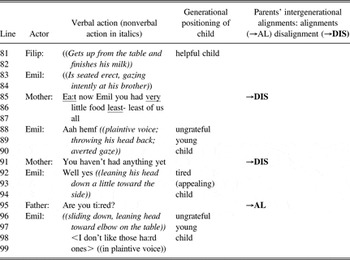
The first extract, presented in Table 1, illuminates the affective stances with respect to intergenerational positions and alignments. Dinnertime performance involves both verbal, nonverbal, and bodily comportment. Nonverbal elements, for instance, included gesture, motion, posture, mimicry as well as prosody, pauses, and tempo. This means that the participants drew on multimodal resources when shaping their ways of “doing a helpful (responsible) child” versus younger child.
Generational positions and alignments.

Kaplan (Reference Kaplan2000) discusses preadolescent children's ways of assisting or not assisting at family food events, differentiating between helpful kids, not so helpful, and unhelpful kids. In an intergenerational context, the unhelpful kid could also be interpreted as a “childish” child, someone who sulks, protests, or disrupts dinnertime routines in various ways, eliciting various types of care or control moves from copresent parents or elder siblings.
At the outset of this episode, the parents and the eldest son Filip have just finished eating. Filip has gotten up from the table, setting about to rinse his plate and to put it into the dishwasher. Later he rejoins the others at the table. Mother is trying to make little brother Emil finish his plate.
In line 81, ten-year-old Filip clearly positions himself as a helpful child in that he efficiently and neatly clears his part of the table, rinses his plate, and stacks it into the dishwasher, without any kind of prompting (line 106; not given here). His comportment is not extraordinary within our Swedish data; many other school-age children undertake similar actions without adult monitoring. He positions himself as a responsible ten-year-old; he is up to Swedish standards in terms of dinnertime manners.
In contrast, his little brother Emil, who is about half Filip's age, acts his age. He has not yet finished his food, and he complains about food, displaying distaste, throwing his head back in an angry protest (lines 88–90), and producing a cry of disgust through an inarticulate revulsion sound (cf. Goffman Reference Goffman1981). But Mother initially does not display any pity in response to his displayed disgust. Instead, she disaligns, reminding him that he has not eaten anything yet (line 91). As in the work of de Geer (Reference de Geer2004) and Wiggins (Reference Wiggins2004), there is parental dispreference for negative food assessments.
Emil provides minimal responses to Mother's complaint, but responds by letting his head fall a little toward the side (lines 92–94). Father apparently orients to this head tilt, when he then asks in a concerned way “Are you tired?” (line 95), displaying both pity and concern. What might have been interpreted merely as a display of distaste was instead read as “being tired” (or perhaps ill).
At this point, Emil lets himself and his head slide down a bit more toward the table, leaning his head heavily in his left hand, displaying the posture of someone who is indeed quite tired. Apparently, he responds to Father's display of pity or concern, perceiving it as a kind of moral support, an alignment, legitimating that he can now let go, revealing the full extent of his great fatigue. If a display of “being tired” is part of his local identity-in-interaction (cf. Aronsson Reference Aronsson1998), he now displays an upgraded or aggravated version of being tired. Similar fine adjustments to adults' social responses to tired postures can be found in a study of teacher-student interactions in a first grade classroom (Cekaite Reference Cekaite2009).
In multiparty interactions, alignments with others are core building blocks in the architecture of social life (Goodwin & Goodwin Reference Goodwin, Goodwin, Duranti and Goodwin1992). In this brief opening episode, Emil is partly successful in that both parents are aligning with him in different ways, indirectly validating his status as someone who is to be pitied and someone who has worthy mealtime projects (in this case, resting). Indirectly, his initial display of “distaste” (lines 88–90) was not legitimized by his mother (line 91), whereas his display of being “tired” (lines 92–94) was authorized and legitimized through Father's concerned response. In terms of the language socialization practices of this specific family, being “tired” is apparently preferred to complaining, sulking, or displaying distaste for proper food.
Much of the emotion work that is occuring is taking place in a nonverbal mode or through bodily action, and at times multimodally (cf. M. Goodwin Reference Goodwin2006). For instance, some of the local identity work is displayed through a plaintive voice (line 88) or in postural displays, as when Emil throws his head back or averts his gaze (in sheer distaste as in lines 88–90), or when he successively lets himself slide down into a reclining posture, lying down with his head on the table (lines 92–94, 96–97). Similarly, his haltingly slow speech (lines 98–99) indicates his great fatigue. Note that the parents' uptake to their children's affective stances are often selective and predictable affairs. Both mother and father display alignments in very orderly ways: they disalign with Emil when he positions himself as a child (complaining about the food and forgetting or refusing to eat; lines 85–87, 91). In contrast, Father displays empathy as an uptake to Emil's display of fatigue (line 95).
During this dinner conversation, there are several other similar sequences (not given here). Both parents responded negatively when Emil whined or complained about the food. In contrast, they were quite supportive when he displayed fatigue.
Big brother and caretaker positions
The next episode documents ways in which the big brother, Filip, assumes adult generational positions, positioning himself as an adult, a caretaker, or co-parent. In a series of distinct moves, he engages himself in the parental project of making little brother Emil finish his food, successively aligning with his parents' acts of teasing, persuading, and distracting the little boy.
(1)

Filip first aligns with Father in gently teasing little Emil (line 260). Then, he tries to provide arguments for eating proper food (lines 269–71). Finally, he engages in so-called edutainment in that he joins his mother in making his little brother count each bite in English.
Father and Filip then indirectly challenge Emil when they successively ask if he would be able to eat apple pie or sweets (lines 259, 260). Their joint challenges can be seen as a form of mild teasing or as (indirect) threats, based on the implicit norm of finishing “real” food before dessert or other sweets. If Emil “cannot take” any more food, he is not entitled to take any sweets either. Within Swedish food morality as in US dinnertime socialization (Ochs et al. Reference Ochs, Pontecorvo and Fasulo1996), the notion of “real food first” is quite a strong principle. In any case, Emil responds that he cannot take any more food, but can take sweets.
Filip sounds somewhat concerned when finding out that his little brother will only eat sweets. Like a good caretaker, he points out to Emil that it is not quite good for his stomach (lines 271–72). In his argumentation, he indirectly aligns with his parents, displaying a cross-generational alignment—but a generational disalignment—in trying to make his little brother eat dispreferred proper food before embarking on sweets or dessert. Thus he positions himself as an adult, a co-parent as it were, helping out in teaching his little brother food morality. Much of this work goes on collaboratively, as joint cross-generational alignments, as when Filip somewhat later assists his Mother in her edutainment of Emil, making him eat by counting in English (lines 285–86).
Filip here consistently positions himself as sort of an adult. Conversely, his little brother positions himself as an ungrateful little child, complaining, “but now I can't take any more” (line 252), pronouncing “can't” slowly as if he hardly has the forces to finish his sentence. Emil displays his distaste multimodally: verbally, nonverbally, and through his posture, that is, visually or nonvocally. He thus quite eloquently positions himself as someone who just cannot take any more. When Mother disaligns, pointing out that he has not eaten “anything,” so that he cannot be full, Emil claims that he just cannot take “any more food” (line 255). In the emotionally charged language of extreme case formulation (ECF; Pomerantz Reference Pomerantz1986; Edwards Reference Edwards2000), both parties thus talk about not taking “anything.” Emil then mitigates his opposition to the local moral order by moving toward a more reclining position, and by talking in a slow and tired way (lines 252 and 255). As in lines 88–89 in Table 1, he displays “being tired.” Mother then aligns by caressing his head, and Father addresses him in a soft voice, “Can't you not take any more Emil?” (line 257), format tying (Goodwin Reference Goodwin1990), that is, partly repeating Emil's prior complaint. Along with shared smiles, supportive back channeling, and collaborative sentence-building, such repetitions are important conversational features of alignment (Gordon Reference Gordon2003).
Big brother's shifting alignments
At large, the elder sibling has assumed a bridge position in the family, assisting his parents in arguing with and in comforting little brother Emil. In extract 2 (below), Filip still acts like a co-parent (but this will change in extract 3).
In line with the logic of food morality—first food, then sweets—Father has offered big brother Filip a choice between two different types of sweets (nut cream and mint cream) that he is hiding in his hands, asking, “Which hand Filip?” Thus Father has turned the reward part of dinner into a (guessing) game. Meanwhile, Emil has been seated erect watching intently, following every move.
(2)

Smiling endearingly with a sideward glance (line 298), Emil takes a chance that he will get away with snatching sweets that were intended for his big brother. However, Father immediately protests in a laughing voice (line 299), snatching back the sweets, thereby disaligning with Emil. At this point, Emil protests “What about me?” (line 301), and Father provides an account in accordance with the local food protocol: Filip has finished his food (line 302), and is thus (morally) entitled to the sweets reward, according to the food morality principle of “first good—then rewards.” Then Father hands the sweets to Filip who in his turn hands it over to this little brother, asking, “Do you want one of these?” (line 307), thereby aligning with Emil and disaligning with Father.
At this point, Emils starts to cry silently, hiding his face in his hands, leaning down. He is averting the gazes of other family members, doing “literal face work” (see Goffman Reference Goffman1961) in that his face is not seen (lines 308–9). Father then talks to him reassuringly, telling him that there is more, which he will get upon finishing eating, and that he, of course, bought sweets for both boys (lines 310, 313–14, 320–21). Big brother Filip again tries to comfort him by offering him his sweets by handing it to him (line 316). Again, there is a parent–big brother alignment—that is, a cross-generational alignment—this time in the comforting of little Emil.
Evidently, Emil's crying is not just a response to not getting the sweets. If so, he might have become happy again, once his big brother offered him his own sweets (see lines 306, 316). Instead, he first did not respond at all to his brother's first offer, and the second time around, he shook his head, crying silently as a response to big brother's offer of sweets. He does not grab the sweets; instead he continues to cry, hiding his face in both hands, that is, doing a kind of “literal” face work. Apparently, getting the sweets is also a matter of pride; Emil primarily wants a piece of sweets to which he is, in fact, entitled; he does not accept being the object of charity. On a speculative note, Emil wants to be acknowledged as the rightful possessor of the sweets, not just to be the receiver of charitable gifts. Honor, and not just material goods, is part of the give and take of family life (cf. Schieffelin Reference Schieffelin1990; Bourdieu Reference Bourdieu1977/1991; Mauss Reference Mauss1925/2002).
An alternative explanation could be that he is afraid that he will not be able to keep his brother's sweets because his parents will not allow it. Initially, Father's gesture of snatching back the sweets suggests that he might not condone any premature eating of sweets. But Father does not protest when big brother makes his two offers, which means that Emil need not worry that these parents would take back the sweets offered by big brother.
Eventually, Emil calms down somewhat after his attack of silent crying. At this point, Emil is not yet entitled to the sweets but big brother Filip teasingly points out that it is really yummy (line 323).
(3)

At this point in the dinner, Filip does not align any longer with his parents' project of comforting his little brother. Instead, he amuses himself by challenging Emil in a teasing way, pointing out that the nut cream is “really yummy.” In any case, Father orients to Filip's teasing, and tells him to stop (“No cut that out!”; line 324).
Meanwhile, both parents engage in mitigation strategies where they comfort Emil by cutting down the size of the task of finishing dinner: Father suggests that Emil should take “five more big bites” (line 343), reducing a big task to a somewhat smaller one, and Mother mitigates her demands by another diminutive strategy, referring to the food as “wee wee” (line 344). Minimizing an imposition is one of many face work strategies within the canonical face work typology of Brown & Levinson (Reference Brown and Levinson1987). Collaboratively, both parents orient to the size of Emil's task, rhetorically reducing the amount (of eating proper food) required.
It is important to note that Filip now does not align with his parents in their minimization or comforting tasks. When Emil says that he does not like mint (the taste of his sweets; line 335), Filip sees a chance to appropriate one more piece (lines 342, 346), and Father is somewhat perturbed by what he apparently sees as teasing on Filip's part. In any case, he seems to categorize Filip's offer as teasing, blurting out “What! Cut it out Filip” (line 347). Filip then stops the teasing, but he continues to direct his attention toward the sweets by telling the other family members how he will protect it from flies by using the flyswatter (lines 348–50). Thus he indirectly reminds his parents of his interest in the sweets, while simultaneously being helpful, assisting in the joint project of making Emil finish his meal (distracting him so that eating is made easier). The flyswatter activity is now turned into a playful activity that is part of the project of making Emil finish his food. Filip realigns with his parents in supporting their food morality project of finishing one's proper food.
Sibling alignments and carnivalesque generational positions
As discussed by Bakhtin (Reference Bakhtin1984), marginalized groups exploit carnivals as a way of distancing themselves from authorities, a way of letting off steam as it were. Toward the termination of the family dinner, the two boys let go by playing with the food (breaking one of the ground rules of local food morality), by subversively chatting away, engaging in scatological joking about poop-type sweets, and using their nut cream bags as subversive weapons. Moreover, they employ taboo words and frolick in talk and actions, invoking “gross” things, as Emil expresses it in his sotto vocce comments on their playing with poop (line 606 below). The episode commences when Emil is finally entitled to his sweets, as he has now finished his “proper” food.
(4)
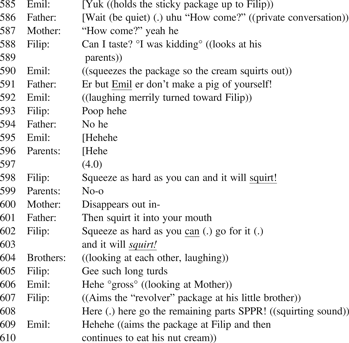
After extended negotiations, Emil is ultimately entitled to his sweets. As a man of honor (cf. Bourdieu Reference Bourdieu1977/1991), he is now seated erect with his head upright, facing the other family members. His business of eating is somewhat messy and not without difficulties, and Father (lines 591, 601) tries to monitor some of his eating, so that he will get access to his sweets without cutting himself or making too much of a mess. None of the parental directives make him loose his high spirits though. He is now displaying pleasure, beaming and smiling all through most of the messy business of unwrapping the sweets and eating it, licking the bag and trying to suck in the very last drop of nut cream.
During this final (and triumphant) episode, his big brother does not assist the parents, that is, aligning with them as sort of a co-parent, as on prior occasions. In contrast, he indirectly aligns with the pig-like behavior of his little brother, playing with the food. When Father complains “Er but Emil er don't make a pig of yourself” (line 591), Filip in fact invites more pig-like behavior when he blurts out “poop hehe” (line 593), thereby aligning with Emil, escalating pig-like playing. Filip subversively takes up the word “poop.” aligning with a prior reference by Emils' to the idea that the nut cream bag is “farting” (line 550; not excerpted). Moreover, he initiates a carnivalesque type of joking about squirting it all out (lines 598 and 607–8). This initiative produces much joint laughter, which escalates when Filip exclaims “Gee such long turds” (line 605) and when he creatively uses the sweets package as a revolver (with poop ammunition; line 607), playfully aiming it at his little brother. By now, the playing has advanced into a play fight, where the two parties squirt “poop” at each other with loaded weapons. Thus, Filip has initiated a nonverbal scatological improvisation.
At this point, the elder sibling does not behave as a co-parent any longer. In this carnivalesque phase of the dinner, Filip positions himself as a “pig” (cf. Father's criticism of Emil, line 591), or perhaps as a young child—a same-age play mate of Emil—rather than as a big brother who is twice Emil's age. Through their “gross” joking, the two brothers free themselves of authority and demands from superiors (cf. Bakhtin Reference Bakhtin1984).
The parents watched the boys' subversive joking for a little while, but Father ultimately intervened (line 623; not excerpted here, exerting parental authority), bringing both boys back to order. Emil then finishes his sweets, destroying his weapon, and Filip similarly crumples up his “weapon” and throws it into a bowl on the table, marking that the war of poop is over. He then realigns with his parents. For quite a while, though, he had aligned with his little brother in joint subversive playing, positioning himself as another child, rather than as the parents' ally.
In this interaction, Emil presents himself as a grateful co-player, who is frolicking in talk and actions that invoke what is “gross” (e.g. his sotto vocce comments on their playing with poop; line 606), with a sideward glance at Mother. Thus family alignments have changed from cross-generational alignments—for example, when Filip assisted his parents in comforting his little brother or making him eat—to sibling alignments, that is, generational alignments when the two bothers position themselves as subversive minors, challenging the authority of their elders (and the local protocol about proper talk at dinner time).
Generational positions at a family dinner
Ochs & Taylor (Reference Ochs, Taylor, Hall and Bucholtz1995) have discussed how family dinners are rich sites for invoking family hierarchies. The conversations discussed here illuminate ways in which children and parents negotiate what are proper and improper affective stances at dinner. These stances similarly form hierarchies, where the parents show that some stances, such as disgust, are illegitimate from the point of view of local food morality. As in some prior work (de Geer Reference de Geer2004; Wiggins Reference Wiggins2004; Orrell-Valente et al. Reference Orrell-Valente, Hill, Brechwald, Doge, Pettit and Bates2007), negative evaluations of food are clearly dispreferred. As documented in the present recordings, the parents recurrently engage in reshaping some of the children's dinnertime affects, rewarding alternative affective stances (e.g. being tired), rather than disgust or distaste for food.
What is notable is that some affective stances are also coupled to generational positions. The youngest child in the family displays affective stances of disgust and unrestrained exuberance that his parents do not. Yet his big brother shifts alignments, at times aligning with his little brother in carnivalesque play, and at times with his parents, positioning himself as a sort of caretaker, endorsing and reinforcing local food morality, and urging his brother to eat what is good for his stomach, rather than what he primarily desires. During the course of a family dinner, desires are thus shaped and reshaped as parts of family-life negotiations.
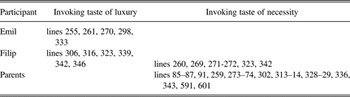
The parents' food talk discussed here resembles that of middle-class American (Ochs et al. Reference Ochs, Pontecorvo and Fasulo1996) and Australian parents (Grieshaber Reference Grieshaber1997): they primarily orient to food as necessity, engaging in time-consuming negotiations with their children about the importance of finishing proper food. We have extended prior work in pointing to ways in which such negotiations involve generational positions and emotion work. Different ways of relating to food morality are not distributed at random. Instead, dinnertime socialization practices invoke distinct food moralities that follow generational positions (see Table 2).
Generational positions.

The parents and their youngest son recurrently displayed contrasting generational positions, linked to competing food moralities and affective stances. More precisely, Emil consistently invoked a fun morality and taste of luxury, whereas his parents consistently invoked the taste of necessity. In their everyday practices of socializing food morality, the parents positioned themselves in much the same way as US parents in relation to their children (Ochs et al. Reference Ochs, Pontecorvo and Fasulo1996).
What is notable is that food moralities are generation-bound affairs. Moreover, such generational positions seem to be yet one more resource for negotiating rights and obligations within family life. In between the two contrasting generational positions—food as freedom versus food as necessity (see Bourdieu Reference Bourdieu2003) —Filip at times positioned himself as an adult and at times as a child. Yet, he recurrently demonstrated that although he is capable of taking an adult perspective on food, he does not necessarily choose to do so. In the final part of this micro drama, he adopted a child perspective, positioning himself as a young child, a playmate of his brother. But note that when he did so, his parents did not align with him. Instead, they opposed his “childlike” behavior; for instance, when trying to appropriate Emil's mint chocolate or when encouraging Emil to squirt nut cream (poop) during the two brothers' final carnivalesque escalation of food play. In line with Thorsted & Sellerberg (Reference Thorsted and Sellerberg2006), this interaction shows that it could be rather risky to consistently adopt a child perspective with respect to food morality. This position may mean that the participant may end up, not only having problems in pursuing the food project at hand, but may also run the risk of being (mildly) disciplined. The parents' uptake repeatedly shows that food morality is intimately linked to local hierarchies of affective stances and taste.
In the present family-dinner activities, these local hierarchies are also linked to ways of doing generation on a micro level: ways of positioning oneself, and others, as a child or as an adult. Thus everyday life, in this case, dinner practices is a rich arena for identity work, and such identity work involves agency and constant negotiations, including intergenerational alignments and realignments.
Appendix: Transcription notations
- :
prolonged syllable
- [ ]
encloses simultaneous talk
- (.)
micropause, shorter than (0.5)
- NO
relatively high amplitude
- x
unsure transcription
- (xx)
inaudible word
- ° °
speech in a lower volume than surrounding talk (sotto vocce)
- (( ))
comments by the transcriber
- > <
quicker pace than surrounding talk
- < >
slower pace than surrounding talk
- ?
interrogative intonation
- !
rising terminal intonation
- =
latching between utterances
- Emil
emphatic stress
- hehe
laughter
- Sw
swedish
- “ “
encloses words in other register (e.g. English)
- →
target move (here: intergenerational alignments and disalignments with Emil)