Introduction: gender mainstreaming – mainstreaming heteronormativity?
Gender mainstreaming was formally endorsed by the UN member states at the fourth United Nation’s (UN) World Conference on Women in Beijing in 1995Footnote 1 as a policy strategy to promote gender equality and the advancement of women. Since 1995, gender mainstreaming has become the dominant mode for promoting gender equality for most international, regional and national organisations, both state and non-state actors, at least at the level of rhetoric.Footnote 2 Although the gender mainstreaming policy approach was officially introduced at the Beijing Conference in 1995, the concept ‘mainstreaming’ can be seen as a continuation of previously introduced concept ‘integration’.Footnote 3 What began as an approach to ‘integrate women into development’ (or Women in Development, WID) in the 1970s changed into ‘integrating a gender perspective’ or ‘mainstreaming gender’ into development (Gender and Development, GAD approach) in the 1990s.
What is significant about the Beijing Conference is that it provided an international forum on how the concepts of sex, gender, and sexuality became intelligible within the context of international development aid and programmes. In the final preparatory committee meeting of the Beijing Conference which provided the last opportunity for country delegations to signal their reservations over parts of the outcome document, a number of countries (Honduras backed up by various Catholic countries) proposed bracketing the world ‘gender’ throughout the text, which refers to using the form ‘[gender]’ whenever the word was mentioned.Footnote 4 An informal contact group of sixty states was established to devise an acceptable definition of the term and the final statement of the group clarified that gender was to be used in ‘its ordinary, accepted usage […] there was no indication that any new meaning or connotation of the term, different from accepted prior usage, was intended in the Platform for Action’.Footnote 5
This wording raises important questions about what an ‘ordinary, generally accepted usage’ actually means. Some governments (Guatemala, Holy See, Peru) made a reservation that the word gender was to be used in reference to women and men, and the biological sexual identity of male or female. Further some other countries made clear that the rights provided in the Platform for Action are restricted to the context of formal marriage between men and women (for example, Egypt, Iran, Libya). Some other country delegates (for example, Malaysia, Holy See, Peru) were concerned that the concept of gender might refer to permitting sexual rights to non-heterosexual relationships.Footnote 6 This arguably homophobic tone was apparent during the Asian Pacific preparatory meeting of the Beijing conference in Jakarta in June 1994 when the Indonesian Minister for Women’s Affairs made a statement:
I cannot accept them [lesbians] as Indonesian women. My belief is that lesbianism is not in accordance with Pancasila [Indonesia's five-point state ideology], because lesbians have forgotten their fundamental duties to be mothers, giving birth and raising children.Footnote 7
The politicised debates around sex, gender and sexuality in Beijing should not be seen as an isolated or idiosyncratic, but as a continuation of debates that took place within the UN in 1994 at the International Conference on Population and Development in Cairo, and the 1993 Word Conference on Human Rights in Vienna, and the previous conferences on Women.Footnote 8 After the Beijing conference, it has become usual practice that UN documents include a footnote:
For the purpose of this declaration and programme of action, it was understood that the term ‘gender’ refers to the two sexes, male and female, within the context of society. The term ‘gender’ does not indicate any meaning different from the above.Footnote 9
Consequently, most of the UN documents insist on two genders (male and female), and do not discuss the possibility of any other gender identities.Footnote 10 Gender equality is framed, without exception, in the context of equality between men and women – the binary which defines and constitutes analyses of gender roles.Footnote 11
It is important to note that gender experts play an important role in the production of knowledge about gender and to the conceptual limits of gender analysis. The group of ‘gender experts’ hired by government bodies and international organisations are not necessarily a homogenous group of people, but rather a mixture of international consultants, nationally and locally hired experts and sometimes expertise ‘outsourced’ to national and local NGOs.Footnote 12 To become a gender expert requires usually a university education, related work experience, proven skills to conduct gender analysis and gender advocacy, and in Aceh increasingly, knowledge of Islamic Studies and shari’a law. Gayatri Chakravorty Spivak argues that ‘metropolitan education’ has created a foreign and indigenous elite who share a class line cutting across race and North-South divide, and who speak the same language over the Subaltern voices. This language reproduces colonial subjects and distances the advocates from those whom they intent to protect.Footnote 13 A gender expert is someone who is expected to ‘know gender’ and be able to advise other people, and for example, give advice on how to integrate gender concerns to humanitarian or development assistance.
What does ‘knowing gender’ do to bodies and their desires? I suggest that further critique is required about how concepts such as ‘woman’, ‘gender’ and ‘sexuality’, contribute towards normative violence and regulation of bodies. I also argue that feminists need further address the question ‘who knows’ and ‘what relationships of work, production and exchange are concealed and revealed by acts of speaking’Footnote 14 when gender experts speak of gender relations in concrete contexts of development/humanitarian aid. This speech act can be described as a ‘dubbing culture’Footnote 15 or production of ‘voice over’Footnote 16 in which the aid contexts are translated into the cultural logic of gender mainstreaming.
In order to address these questions in this article, I focus on gender mainstreaming policies and advocacy on gender equality in the post-tsunami context in Nanggroe Aceh Darussalam, Indonesia. In my analysis, I focus on how gender mainstreaming policy documents, when drawing from the sex/gender division and binary of sexes, reproduce heteronormativity, and thus provide normative boundaries to what is promoted as livable life in Aceh.
Three governmental structures/bodies have promoted integration of gender into governance in Aceh: the Bureau for Women’s Empowerment and its district offices (est. 2000), gender ‘architectures’ of the Bureau for Rehabilitation and Reconstruction of Aceh and Nias (2005–2009), and Aceh Peace-Reintegration Board (est. 2006). In addition to these three state bodies, a loose network, called as Gender Working Group, was established in 2005 by the Governor’s instruction to co-ordinate and share information about of gender advocacy and gender initiatives in the post-tsunami context in Aceh. The group’s diverse membership from both local and international organisations is not restricted to just ‘gender experts’, but is comprised more widely of women activists. The boundaries between state and non-state, or local, national and international, are blurred, as all these structures have received outside funding for their activities and for the recruitment of additional gender experts. The link with the international funding in the Indonesian context is crucial to the existence of these bodies. At the time of the adoption of gender mainstreaming in 2000, just a couple of years after the Asian economic crisis, the percentage of foreign debt of the Indonesian state budget varied between 100 per cent in 1999 and 40 per cent in 2006 of the GDP and international contribution to the tsunami funds has been approximately 70 per cent.Footnote 17 The inter-textual analysis of this article draws from a wider range of policy documents on gender produced by the Indonesian central government, the UN and international donors since 1975.
My aim is to reflect on how the analytical category of gender, when relying on the binary of sexes, is a tool of normalisation, turning certain bodies ‘invisible’Footnote 18 and ‘unintelligible’Footnote 19 while promoting certain ways of life as normal and natural. By focusing on details, I illustrate how the image of universal heteronormativity participates in normalising other identity categories such as urban, middle-class and religion. I further demonstrate how simultaneous to the production of normativity, documents and advocacy can potentially challenge heteronormativity and norms governing heterosexuality. Drawing from postcolonial feminist and recent queer critiques, I argue that advocacy that solely focuses on gender and/or sexuality, remains blind to other forms of violence, enacted through economic and political frameworks that define ‘better’ primarily as a recovery of economy, assets and labour force. The next section aims to introduce the context in which reconstruction efforts, and efforts to define the ‘new Aceh’, are conducted.
‘Build back better’: locating the post-tsunami Aceh
“Better?” I say, in a small voice. How can he think this is better? “Better never means better for everyone”, he says. “It always means worse, for some”.Footnote 20
The epicentre of the Indian Ocean earthquakes and tsunami in December 2004 was one hundred kilometres off the coast of Nanggroe Aceh Darussalam (henceforth referred to Aceh). The earthquake and the tsunami had devastating results: lost and displaced lives, destroyed and damaged infrastructure. Eight months after the tsunami and some thirty years of conflict, the government of Indonesia and the Free Aceh Movement (GAM) signed a peace agreement on 15 August 2005 that led to a new governance law and local elections in 2006. For many, it was time to ‘build Aceh back better’. This slogan has been used by organisations involved in promotion of gender mainstreaming, and post-tsunami and post-conflict initiatives in general, and I want to analyse the meanings of each of the words in the slogan.Footnote 21
Firstly, the word to ‘build’ (membangun) in Indonesian also means ‘to develop’ and has a specific ideological genealogy. Since independence in 1947, ‘development’ has had a strong connotation of ‘nation-building’, ‘modernisation’, ‘economic growth’ and development of ‘Indonesian character/identity’.Footnote 22 Experts and technocrats plan and determine the direction of ‘development’. The process of achieving ‘the development’ is built into concepts that have aimed to convey a positive meaning, such as ‘participation’, ‘mutual cooperation’ (gotong-royong), and ‘socialisation’.Footnote 23 The role of government technocrats was particularly strong during president Suharto’s New Order period (1965–1998) and contributed to an emergence of a group of Acehnese technocrats in charge of implementing national development programmes. Acehnese ulama (religious leaders) saw the state-led programmes as a threat to the morals of the Acehnese society, whereas technocrats feared that the powerful Acehnese ulama were discouraging foreign investment in the region.Footnote 24
Central government introduced gender mainstreaming as a part of the process of moving towards ‘democratic, pluralist and decentralist government where government interacts with the population’.Footnote 25 This introduction took place at the same time as ideas of reformation and decentralisation, as well as combating corruption, collusion, and nepotism (in Indonesian referred as KKN) collided with strengthened neoliberal aspirations of bringing democracy through an open market economy and reducing the role of the state.Footnote 26 At the same time as praising the reforms, the Ministry for Women’s Empowerment listed the transition to regional autonomy, along with certain interpretations of religion and cultural values, as threats to successful gender mainstreaming. It has been argued that the decentralisation law allows revitalisation of local values and traditions, and strengthens local patriarchal values, and also consolidates local political and economic elites.Footnote 27
Secondly, the word ‘better’ seems to imply a binary position where some ways of being and living are, literally, better than others, and that some other ways of being and living are categorised as worse, unintelligible or incomprehensible.Footnote 28 To many organisations, ‘better’ is described within the context of rebuilding economy, infrastructure and revitalisation of human resources in Aceh.Footnote 29 Many organisations add that the importance of reconstruction processes is in ‘rebuilding of lost and damaged values and norms’.Footnote 30 So ‘better’ is not just evaluated from reconstructed houses, roads and bridges, but also in ideas, ideals, and norms. Thirdly, the word ‘back’, when put together with the word ‘better’, seems to suggest that the comparison of ‘now’ with the ‘past’ includes the expectation of linearity, and evolution, where the aim is to improve the past.
Finally, Benedict Anderson’s deconstruction of ‘Indonesia’ as an ‘imagined community’, an active process of performing the idea of Indonesia as a united nation, can be also used for ‘Aceh’.Footnote 31 Aceh, is often called the ‘Veranda of Mecca’, reflecting the long tradition of Islamic influence in the region.Footnote 32 The Muslim population is said to be between 90–99 per cent, although there are also Christian, Buddhist and Hindu communities, each proportionally one per cent of the total population, and communities practising animism. ‘Acehnese people’ are ethnically, culturally and linguistically a diverse group. However, in the current context the word ‘Acehnese’ is often used to refer to the groups that are considered ‘indigenous’, and it does not include the ethnic Chinese (mostly Christian), or transmigrant (mostly ethnic Javanese) population.Footnote 33 Further, post-tsunami reconstruction projects and initiatives have been criticised for being insensitive towards the long history of violence and to the divided communities that it has caused. Thus, the question remains: whose imagined community the reconstructed ‘Aceh’ is, and what are its normative limits?
Dominant gender norms in Aceh are constructed and negotiated as a continuous interplay between customs (adat), Islam, state ideology, 30 years long violent conflict and militarisation and exploitation of natural resources.Footnote 34 Since the early 1960s, the implementation of shari’a law has been part of the laws defining the status and government structures of Aceh and since 2001, all policies and local regulations are reviewed through the lens of shari’a law. It has been argued that the implementation of shari’a law would increase unity in the conflict ridden society, although it is also seen as a political commodity for political and religious elites in Jakarta and Banda Aceh.Footnote 35 Several women’s organisations are concerned that local regulations on the shari’a implementation ‘are based on framework of symbolic, literal and un-contextual interpretations of Islam’.Footnote 36 The focus on moral behaviour (for example, Muslim dress, adultery) reproduces women as representations of the strength of Islam.Footnote 37 Women are portrayed as the symbolic value of the society and they become a target of normative control. It is difficult to publicly criticise the interpretation and implementation of shari’a. Attempts to open up discussion on feminist interpretations of the Qur’an are interpreted by some religious leaders, who have a particular role in forming public opinion, as anti-Islamic, or non-Acehnese, behaviour.Footnote 38 Gender mainstreaming policies are promoted in this complex context, in which many other attempts to define norms of living a good life already exist. The aim in the following section is to provide a frame to locate the processes of norm production.
Proposing a frame to locate normativity
What counts as a person? Or what, given the contemporary order of being, can I be?Footnote 39
Judith Butler has argued that instead of being a man or a woman, it is necessary to replace the verb ‘being’ with a vocabulary of action – ‘becoming’ or ‘doing’. Gender is a way of acting the body, yet one does not become gender through a free choice, as ‘gender identity is governed by taboos, conventions and laws’Footnote 40 that operate within social practices. The aim in this article is to locate ways in which gender mainstreaming discourse and gender advocacy produce normative boundaries to bodies and desires to exist in the Acehnese context.
The distinction between sex (male/female), a matter of biology, and gender (masculine/feminine), a set of culturally and socially defined characteristics, has been central to a significant body of Gender and Development discourse, research on gender mainstreaming included, and this distinction is nowadays seen as a ‘natural’: ‘sex is a natural, biological fact, but gender is a cultural, historical and linguistic production or achievement’.Footnote 41 A common notion of gender is based on the idea of binary opposition of two sexes and exclusionary categories of man and woman are created. Based on this construct, one can only have one gender, never the other, or both.Footnote 42 Andrea Cornwall, Sonia Corrêa and Susie Jolly (2008) argue, that Gender and Development discourse has not yet managed to disrupt the effects of the gender binary and heteronormativity, and further contend that the theoretical criticism of sex/gender divide and binary of sexes is yet to gain attention amongst the Gender and Development academicians and practitioners.Footnote 43
In the Indonesian context, in addition to the sex/gender (jenis kelamin/ jender) divide which has been an important part of the feminist discourse since 1990s,Footnote 44 a third concept, kodrat (natural character) is as important. The term kodrat refers to the biological ‘facts’ or intrinsic nature of woman and man, which has also gained religious meanings as ‘God’s will’ and ‘creation of God’.Footnote 45 The concept ‘women’s nature’ is built on various localised ideals although they are portrayed as the norm and universal.Footnote 46 In the current context of public debates in Aceh, anyone using the word gender has to add that using the concept does not deny the existence of kodrat,Footnote 47 as those who are advocating for gender equality are ‘accused of being anti-Islam […] pro-secularism, Westernization, exclusive, radical, strange, naïve and denying the kodrat’. These accusations have led some organisations, instead of referring to ‘gender equality/justice’, to refer to ‘equality between men and women’ or ‘women’s empowerment’, to avoid these accusations altogether.
In my analysis I draw from Judith Butler’s critique of the feminist use of the concept pair ‘sex/gender’ and her aim to denaturalise ‘hetero-reality’ of feminism.Footnote 48 For Judith Butler, the category of women achieves its stability and coherence only in the context of the heterosexual matrix, in which bodies become comprehensible through a stable gender pairs (masculine-male, feminine-female) that are oppositional to each other and made hierarchical through compulsory practice of heterosexuality.Footnote 49 This assumption of coherence of bodies requires processes of regulation, where certain behaviours and ways of life are constituted as ‘normal’ and ‘natural’ – against which all people are measured.Footnote 50 The concept ‘normative violence’, or ‘violence of norms’, refers to violence which takes place in the formation of subjectivities. An attempt to denaturalise gender aims to make this violence visible.Footnote 51
This article uses two theoretical concepts as guidance: heteronormativity and normative heterosexuality. Heteronormativity refers to dominant social order and power that maintains heterosexuality as the norm and describes it as normal in culture, society and politics.Footnote 52 I use the concept of normative heterosexuality to acknowledge the processes of normalisation within heterosexual relations, which is said to have been overlooked in attempts (that aim) to denaturalise heterosexuality, and sometimes assumed as monolithic and unchangeable system.Footnote 53 Focus on normative heterosexuality acknowledges debates within the heteronormativity where some heterosexual practices are considered as non-normative and ‘queer’ or odd.Footnote 54 Instead of insisting a binary between normativity and non-normativity, I understand normativity as a sliding scale, and a product of continuous negotiation of norms that take place in various locations and historical moments.Footnote 55
Interconnections between postcolonial feminism and queer studiesFootnote 56 provide important insights for both academic feminism and feminist activism. Postcolonial feminists and women of colour criticise how gender is made into a universal priority for feminism.Footnote 57 Moreover I argue that the feminist analysis of heteronormativity and gender norms remains Eurocentric if other localised processes of normalisation are not considered simultaneously, such as ethnicity, religion and class, just to name a few.Footnote 58 Importantly, recent feminist queer studies’ debates seem to share a concern to universalise debates and subject position, moving towards emphasising broad-based study of lives lived outside of the conventional life narratives of family and reproduction, emphasising modes of resistance that survive between marginal subjects and dominant cultures, including neoliberal capitalism.Footnote 59 The focus is on liminal subjects, subjects that are excluded from the ‘norms that govern the recognisability of the human’.Footnote 60 Although deriving from the critique on normative sexuality, queer critique has opened up its analytical framework to other forms of exclusion – although keeping analysis of sexuality as part of the analytical framework. This I refer to as the intersectional turn of queer studies. Instead of focusing solely on questions of gender and sexuality, the focus is on broad critique of ‘multiple social antagonisms’. This approach, instead of deciding its focus in advance, analyses a wider field of normalisation in order to locate potential sites of social violence and then focuses on those hegemonic social structures by which certain subjects are rendered ‘normal’ and ‘natural’ through the production of ‘perverse’ and ‘pathological’ others.Footnote 61
Thus, the critique of heteronormativity in this article is not about setting up an agenda for universal LGBT identity politics, but rather to critically examine the attempts to stabilise and universalise subject positions. The gay and lesbian transnational movement, also active at the Beijing conference, has been much criticised for having followed in the footsteps of the white Western women’s movement in universalising its issues as a global mission. This discourse assumes, prediscursively, that homosexuals, gays, and lesbians are universal categories that exist everywhere in the world and are used to justify that mission to defend their rights as homosexuals and advance homosexuality as a group category and fixed identity.Footnote 62 I apply this critique by arguing that pre-assuming universal analytical categories does not allow sensitivity to localised processes of normalisation and it keeps some forms of violence invisible.
These pre-assumed analytical categories could also be described as ‘dubbing culture’ or ‘voice over’. These are concepts which Tom Boellstorff has introduced in his research as a ‘metaphor for conceptualizing contemporary globalizing processes’Footnote 63 between modernity, nationalism, sexuality, and gay subjectivities in the Indonesian archipelago.Footnote 64 These concepts provide an interesting metaphor for tracing the processes where norms are continuously produced. I apply ‘close reading’ method in order to locate the norm and the subversion to the norm in policy documents and images. Sara Ahmed describes this process as:
reading which works against, rather than through, a text's own construction of itself (how the text ‘asks to be read') […] The disobedient reader […] is a reader who interrupts the text with questions that demand a re-thinking of how it works, of how and why it works as it does, for whom.Footnote 65
This way of reading refers to methods that pay attention to the details (of texts, illustrations) in order to open up possibilities and produce interpretations that are breaking conventional meanings of sex, gender, and sexuality. Focusing on details allows sensitivity towards intersectionality of norms: how norms of sexuality and gender are located in the crossroads of class, social status, just to name a few.
Critical feminist scholars, according to Judith Butler, have a double task: first to show how knowledge and power constitute a way of ordering the world; and second, to follow ‘the breaking points’: moments of discontinuity, and sites where workings of power fail and subversion emerges.Footnote 66 For Butler, subversion is a political process of erosion working from inside the norm. It creates new possibilities for the expressions of enjoyable life and challenges to normative violence, heteronormative structures, and assumptions of kinship.Footnote 67 The rest of the article describes and reads closely the practices of producing gender knowledge. It analyses the normative descriptions of gender mainstreaming advocacy in the context of post-tsunami Aceh, and illustrates how subversion emerges from these norms. The next section takes a closer look at the normative ideals that are produced by policy documents and advocacy materials on gender.
Negotiations around gender in Aceh
Without exception, both the central government and Acehnese provincial government define gender equality as equality between men and women. The term ‘gender’ is used as it was at the Beijing conference in 1995, namely only in the context of heterosexual binary of men and women.Footnote 68 Working within the heteronormative framework, gender advocacy provides a space for feminist interpretations of Islam, pushing the normative boundaries that govern heterosexuality with contextual readings of the Qur’an.Footnote 69 The formal implementation of shari’a law in Acehnese governance and legislative processes means that any arguments for gender mainstreaming and gender equality, to gain any respect in public, have to be based on the interpretations of the Qur’an and the hadith. However, it is important to note that women activists and gender experts do not share one vision of what gender sensitive or human rights based shari’a implementation should be, and that they attempt to challenge the normative borders actively. The normative boundaries of public debates on gender are where the limits of the dominant and publicly expressed interpretations of Islam are located at.
The key components of promotion of gender equality are the production of ‘gender sensitive’ information for ‘gender responsive’ programme planning, and the promotion of sex-disaggregated statistics. Data is produced using indicators agreed in the Beijing Platform for Action, Millennium Development Goals, CEDAW and through sector specific gender analysis. The ‘ultimate goal [is]: the full engagement of women and men as equal partners in the social, cultural and economic development of Aceh and Nias’.Footnote 70
Production of knowledge created at different government structures is distributed to the Acehnese population by experts and consultants using community meetings (such as focus group discussions). One of the commonly used concepts is ‘socialisation’ which has a particular history in the context of Indonesia, and was commonly used by the President Suharto’s New Order regime. Government programmes and plans to ‘develop and modernize’ rural parts of Indonesia were introduced to rural populations through open community meetings. New ways to ‘conduct conduct’ include emphasis on ‘capabilities, self-reliance and mental endurance of women’.Footnote 71 This is done by emphasising community participation and the establishment of issue-based groups and committees, whose main task is to hold meetings to prepare plans and proposals to receive gender funds, and to monitor their implementation. Although the emphasis is on potentiality of ‘communities’, expert knowledge and positions (such as trained facilitators, community volunteers or civil society organisations) are required to secure the success of the process.Footnote 72
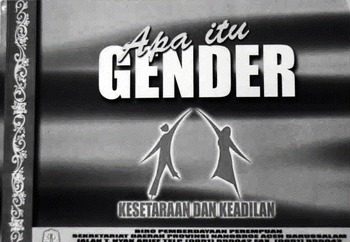
The above examples illustrate the processes of institutionalisation and normalising gender mainstreaming approaches into governance, and suggest further linkages between gender mainstreaming initiatives and neoliberal governmentality. In the following, in order to illustrate the ideals that exist in the current gender mainstreaming discourse, and the subversive reading that can challenge the notions of ‘universalism’, I will analyse the brochure ‘What Is Gender’ produced by the Bureau for Women’s Empowerment in Aceh. The material is produced to ‘socialize shari’a Islam and the concept of gender’ to government officials and Acehnese women through women’s empowerment centres. The two green figures that appear in the middle comprise the official logo used by the State Ministry for Women’s Empowerment, and the Bureau for Women’s Empowerment, in Aceh.Footnote 73
Cover of the brochure ‘This is gender’ Bureau for Women's Empowerment, NAD.

The two green stick figures can be identified as male and female figures appearing in modern Muslim dress (man’s hat, woman’s long dress and veil, and the green colour of the figures). This idealised picture not only portrays an ideal religious identity, but also an ideal character of a citizen (Acehnese/Indonesian); the dress suggests an economically stable, urban middle-class couple, and a monogamous nuclear heterosexual relationship. It reinforces the idea of uniform and uniformed citizens, an image which erases religious, social, economic, and ethnic differences.Footnote 74
One of the recurrent themes in gender mainstreaming documentation and national development plans is the emphasis on the ‘harmonious equal-partnership’ between men and women.Footnote 75 This language focusing on harmonious partnership between men and women is also part of the UN World Conference on Women discourse, and of the ‘harmonious family model’ (keluarga sakinah) promoted by Aisyiah, women’s wing of the second biggest Muslim organisation in Indonesia.Footnote 76 The declaration of Mexico, the first UN Conference on Women in 1975, stated that the family is a basic unit of society, and that men’s active participation in the family is advocated, combining home and work possibilities for both partners.Footnote 77 Similarly, since 1993, Indonesian policy documents have actively emphasised the role of both men and women ‘as citizens and human resources for development’. It is the responsibility of both men and women to ‘build a healthy prosperous and happy family along with the nurturing of children, adolescents and youth in the effort to fully develop the Indonesian character.’Footnote 78 The marriage law from 1974 defines ‘family’ and ‘household’ as the same. ‘Family’ is defined as a formal monogamous marriage of a man and a woman, ‘blessed’ with a small number of children, and husband as the head of the family.Footnote 79
The construct of the ‘family’ as father, mother, and two children, inhabits the modern official spaces where the ideal Indonesian citizenship is built.Footnote 80 What is remarkable about this construct is that the family is not considered a private sphere, but a part of the rhetoric of nation-building and religious piety aimed at producing Indonesian citizens as modern Muslims. Women and men are seen as productive and reproductive human resources and key elements in the ‘development’ process. However, the gender ideology of the New Order period (1965–1998) is described as ‘state ideology of motherhood.’Footnote 81 Krishna Sen has argued that in the early 1990s there was a shift from women as ‘wife and womb’ into women as reproductive workers.Footnote 82
The two figures in the logo are each stretching one arm upwards which can be seen in two ways. Firstly, their bodies seem to draw the profile of a house, suggesting ideals of harmonious partnership and family life. Interestingly, there are no children on this cover page or in the logo, so as to differentiate the Ministry’s logo from the logo of the National Family Planning Board which has similar two figures forming a house with two children inside. However, the back cover of the brochure shows a picture of children attending a religious ceremony, accompanied by a printed prayer for equality between boys and girls in the future. Secondly, the upwardly stretching arms suggest the idea of reaching higher and higher towards ‘development’, ‘progress’, ‘advancement’, and ‘better future’.
During the celebration of Hari Ibu in 2006, the Garuda Bird, the national symbol of the Republic of Indonesia, was used to represent the joint responsibility of women and men in the process of nation-building:
Bird GarudaFootnote 83 that carries the spirit and the soul of pancasila [five principles of the Constitution of Republic of Indonesia], cannot fly high if it only uses one of its wings, that is the male wing. Garuda Pancasila can only fly through the clouds if it’s two wings, male and female, flap together and have synergy. Let us unite power, potential and energy which we have together.Footnote 84
Garuda, the national symbol of the Republic of Indonesia.

As already mentioned, both the local and the central government bodies use internationally agreed indicators to compare the ‘quality of women’ within Indonesia, regionally and globally. The most important indicators are Gender Development Index (GDI) and Gender Empowerment Measurement (GEM). Theses indicators are criticised generally.Footnote 85 For example, the notion of political participation as formal representation of women in national politics omits other types of political participation and forms of politics, such as decision making in other governance structures, participation in civil society and community-based organisations, and the active role women play in the Qur’an reading groups interpreting Islam and their Muslim identities.Footnote 86
The ‘fact’ that women do not appear in ‘public’ (namely formal politics and formal labour market participation), is compounded by representations of ‘women’s domestication’ in the private sphere. ‘Housewife’ as a concept emerged in the vocabulary of Indonesian archipelago through Dutch colonialism, and has always been an unfamiliar concept to the majority of Indonesian people, due to their economic circumstances and the importance of female labour.Footnote 87 Furthermore, the division between the private and the public are perceived differently in many rural societies. When public and private are defined as a dichotomy between household/family and public participation (in politics or formal labour market) it ultimately refers to urban-based middle class and ignores women’s active participation in the Qur’an reading groups, farming and various other ‘family activities’, which can also be considered as ‘public affairs’.Footnote 88 Underlying the gender indicators, there is an assumption of a monogamous nuclear family model with one husband and one wife, none of which necessarily corresponds with the ways in which lives are organised around production, consumption, and reproduction.Footnote 89
According to the official state discourse, gender mainstreaming as a policy aims to ensuring the quality of the female workforce which is essential for the ‘national development’, economic growth and welfare, on which the economic welfare of families depends.Footnote 90 The focus on the labour market and economy points towards measuring people’s worth according to their ability to participate in the economic development. It further seems that focus on both women and men is highest during so called ‘reproductive years’ or on adolescents who are about to enter this ‘natural’ phase in their lives. The ideals of family seem to have a connection with the state discourse during the New Order period which focused on ‘Five Duties of Women’. These duties illustrate the importance of marriage and giving birth to children as a qualification for a membership of society. Women are generally not considered as adults until they have married.Footnote 91
To sum up, heterosexual nuclear-family and the stability of bodies and their desires is presumed and produced as the norm.Footnote 92 It also seems that gender mainstreaming documentation paints an ideal picture of women and men who are well educated, healthy, and who contribute to the national (economic) development as labour force and biological mothers and fathers in formal heterosexual monogamous families. The ideal picture of both men and women in central government’s documentation becomes integrated with the ideal of ‘Indonesian character’. However, in Aceh it includes a special focus on the ideal of Muslim citizenship, living in accordance with shari’a, leaving space for multiple voices of feminist interpretations of the Qur’an. The next section takes a closer look at the ruptures and negotiation that take place within the framework of gender advocacy or promotion of gender equality: how on one hand the documents miss certain bodies, and on the other, how a close reading of these documents provides new possibilities for reading the Acehnese society differently.
Subversion that emerges from within
In this section, I take a closer look at the subversion that emerges from within the gender mainstreaming and gender advocacy in Aceh. Gender reporting from Aceh has been criticised of ‘coca-colaisation’ or ‘cut-and paste’ policy making. Deleting the name of the region or the references to the tsunami or the conflict would make it impossible to tell the context the documents have been produced for. Further, the promotion of gender equality takes place in a complex context where international financial organisations, donor agencies, and multinational corporations while funding initiatives to promote gender equality and women’s rights, simultaneously frame ‘development’ and ‘reconstruction’ within the wider context of economic liberalisation, with a focus on improvement of workforce, and access to markets.
Remarkably, none of the government’s gender mainstreaming policy documents problematise the impacts of the liberalisation processes of creating ‘investment environment’ for foreign investments or exploitation of natural resources, that have contributed towards the violent conflict in the province. This despite the fact that Bureau for Reconstruction and Rehabilitation states in its gender equality strategy, that
a community is not a collection of equal people living in a particular geographic region. It is usually made up by individuals and groups who command different levels of power, wealth, influence and the ability to express their needs, concerns and rightsFootnote 93
and thus offers a framework to widen the analytical focus from gender to intersectionalities. However, indicators in all key gender mainstreaming documents focus on the inequalities between men and women within the given structures and systems, not on differences between women. Thus, it leaves intersectional sensitivity hanging in the air.
For example, Solidaritas Perempuan Bungoeng Jeumpa Aceh, Banda Aceh-based women’s organisation, has documented the negative impacts the Asian Development Bank’s infrastructure loan to reconstruct the cement facility of the Pt SAI-Lafarge in Lhoknga. Impacts have included worsened security situation due to presence of army and police, lack of drinkable water in the villages surrounding the cement factory, and reproductive health problems such as miscarriages for the female factory workers.
Moreover, when violence against women is primarily framed as domestic violence (kekerasan dalam rumah tangga, KDRT), it leaves other kinds of violence out of the picture, including violence that is committed by conflict parties, state apparatus (police, and judicial system), or religious norms that control especially women’s bodies and sexuality. Socialisation of the law on Islamic dress has included arrests, public humiliation (cutting hair, caning punishments after Friday prayers) by the shari’a police.
The focus on women’s rights vis-à-vis men’s rights in relation to inheritance, role in the family and public decision-making, when put into the current normative context in Aceh, can also read as an attempt to challenge the increased textual readings of the Qur’an that attempt to ‘domesticate Acehnese women’. Such reporting can also be read as an attempt to respond to the existing stereotypes of Muslim societies in the post 9/11 and ‘war on terror’ contexts.Footnote 94
An important element of the discourse on prosperous families is that the ‘household’ referring to an economic unit, and the ‘family’ referring to kinship relations, is assumed to be one and the same. Furthermore, it is assumed that people belonging to the same family, share one household. This perception ignores the prevalence of migrants and those who fled Aceh seeking political asylum or employment in Malaysia. There are purely ‘female villages’ that have emerged as a result of conflict and disappearance, killing and displacement of male members of the community.Footnote 95 The image of nuclear family also excludes and makes invisible domestic workers, mostly women and girls, who perform domestic chores in urban middle-class households.Footnote 96
Furthermore, the cover picture of the brochure ‘what is gender’ leaves out other potential interpretations of Muslim identity and all non-Muslim identities, and minority ethnic identity groups, such as the ethnic Chinese community, the biggest non-Muslim community in Aceh. Further, there is silencing of: conflict widow(ers), polygamous relationships (formal/informal); same-sex/bi-sex practices; joint family structures or single-headed households (be it women, men, or waria Footnote 97); disabled or people outside of reproduction/production; or people to whom parenthood is social rather than biological (especially in complex post-tsunami and conflict context many children are adopted by their extended family members). Further, people who are considered less-Acehnese or non-Acehnese, or otherwise suspicious due to the local conflict dynamics, are generally missing. An exception to this is the gender document of the Aceh Peace-Reintegration Board, which directly refers to discrimination of conflict victims and ‘susceptible people’, and the BRR gender equality strategy, that specifically refers to the isolation and discrimination of (tsunami) widows and widowers.
In the following section, I elaborate on how dominant concepts that frame advocacy on gender equality: sex, gender and sexuality, and notions of motherhood, are challenged. The first example is from the context of the celebration of the international women’s day (IWD) in 2007 in Aceh for which the Gender Working Group had prepared a gender analysis of the reconstruction and rehabilitation process. The analysis pointed out the missed opportunities of the past reconstruction efforts and demanding clear focus on women’s concerns, particularly ending the violence against women.Footnote 98 The report was handed over to the Governor after the long march across the town. The Association of Warias joined them along with banners ‘warias are also human beings’.Footnote 99
This request to be included into the category of ‘human’ during the IWD celebration subverts the framework of women’s day celebration and post-tsunami reconstruction efforts in several distinct ways. Firstly, it challenges the feminist practices of reading bodies through the heteronormative matrix. It also can be seen as an attempt to question the naturalness of the concept of ‘woman’ or ‘female’ solely belonging to the female bodies. Although publicly visible, waria remain unintelligible within the gender mainstreaming framework and most public policies. Waria as a group is mentioned in official documentation only in the social work regulations attempting to find ‘cures for social problems’ such as sexual transmitted diseases (particularly HIV/AIDS), and the elimination of prostitution. None of the organisations working on gender issues have included waria as a category in their gender analysis.
Finally, it raises the question of normative boundaries of the advocacy to end violence which has not given attention to the violence against the LGBT community in Aceh.Footnote 100
While insisting on segregating public spaces into same-sex spaces in order ‘to protect people’s morality’, the construction of dominant moral norms opens up potential spaces for same-sex relations. However, the likelihood of people moving publicly beyond the heterosexual norms, or support non-normativity publicly is unlikely, due to the common interpretation of homosexuality and cross-dressing as a sin. There have been cases of torture and sexual abuse of two gays in Banda Aceh by police in 2007 and openly hostile anti-gay mail has been posted on the Gender Working Group’s email list in 2008 and 2009.Footnote 101
The second example focuses on the discussions around the Hari Ibu. The dominant interpretation of the day has focused on women’s roles as wives and (biological) mothers.Footnote 102 Motherhood is seen as the kodrat, or women’s destiny or natural biological role. The discourse of ‘Ibu bangsa’ (mother of nation) highlights the responsibility of women to prepare the next generation of citizens.Footnote 103 In the Acehnese context, motherhood is valued both in nationalistic and religious discourses.Footnote 104
The ‘naturalness’ of biological motherhood within formally registered marriage is not found only the official state discourse. This same ‘naturalness’ is repeated within the wider gender advocacy, where most of the attention on health related concern is on women’s reproductive health. Significantly, biological motherhood and reproductive health are the only contexts where woman’s sexuality is discussed; sexual pleasure does not appear in any of the discussions.
The strong state discourse on motherhood, or state ibuism Footnote 105 has made some women’s activists allergic to the ceremonies that have been imposed by the state particularly during the Suharto’s 30 year long regime. The dominant gender ideology relies on the idea of motherhood as biological. Parenting is implicitly seen as biological and natural part of the kodrat – the God given natural roles for men and women. However, after the Hari Ibu in 2007, some Gender Working Group’s email list members raised their concern of the narrow understanding of the concept ‘mother’ or ‘motherhood’ and called for wider understanding of motherhood as societal phenomena.Footnote 106 Historically, within the wider Indonesian context, the meaning of motherhood has included multiple mothering, care by domestic workers, co-wives, grandparents, aunts and older siblings.Footnote 107 The narrow understanding of parenting through reproduction also omits other forms of social parenting and varied guardianship arrangements due to the impacts of the long armed conflict and the tsunami. It further ‘others’ those women who have become mothers after a rape or relationships outside marriage, or those women who for various reasons, either do not choose or cannot become biological mothers.Footnote 108
Finally, a subversive reading of the logo and the Garuda bird (figures 1 and 2), questions the naturalness of the notions on normative sexuality. We are used to seeing the stick figures representing male sex and female sex, and further, the two genders. Judith Butler’s critique of the stability of sex and gender releases the stick figures from these pre-assumptions; what appears to be male and female are simply dresses that signify the binary of male/female. Secondly, the way in which the Indonesian state has codified the representation of the Garuda bird, contrasts remarkably with how the bird is represented for example, in Balinese Hindu temple stone carvings. In the official state version, Garuda has two wings and its beak is pointed towards right. In the temple carvings, Garuda has multiple wings and the beak is directed towards front forming an yonic Footnote 109 triangle. The wings have no gender markers, and the yonic triangle can be read as representing female sexuality and non-reproductive sex organs.Footnote 110 Indonesian state has not only gendered the image of Garuda, but it has also purified its meanings from non-reproductive female sexuality and replaced it with a masculinised and militarised bird, resembling other eagle images used as national symbols.
Conclusion
This article has attempted to illustrate the ways in which advocacy on gender mainstreaming and gender equality continuously reproduce and challenge the normative ideas of human lives in Aceh. Without exception, the concept gender is constructed as a binary of two sexes and organisations differ in their perspective and sensitivity to lives that are lived outside heterosexual nuclear family.
Production of norms is a dynamic site of contestation which while producing the norm creates simultaneously potentiality for subversion that challenges the dominant interpretations. The notions of gender norms in Aceh are moulded from many directions, including the religious and political powers. Based on my reading, gender mainstreaming is not a policy approach that exists in vacuum or produces gender ideology in isolation, but rather a discourse that is integrated with religious frames and different layers of governmentality (local, national, international) and has linkages to national, international, debates on gender norms, and it’s linkages to neoliberalism, paternalism and nationalism, and theology.
What do multiple interpretations of concepts do to gender mainstreaming policies and feminist activism? This could point towards agenda that continuously keeps challenging the meanings of concepts and search for silenced and invisible lives; or towards opening up analytical frameworks to recognise the multiplicity of genders and sexualities and recognising non-normative lives in wider sense as ‘worth living’. Drawing from postcolonial feminist and recent queer critiques, I argue that advocacy that solely focuses on gender and/or sexuality, reduces human bodies and their desires to simplistic, stick figures.Footnote 111 These representations remain blind to other forms of violence, such as global economic and political frameworks that define ‘building back better’ primarily as rebuilding economy, infrastructure and revitalisation of human resources. Subaltern bodies that are not in the position to speak remain invisible.Footnote 112
Gender mainstreaming policies promoted in the context of Aceh provide a blueprint or map of how Acehnese society and culture is asked to be read. Gender policies produce a ‘voice over’ for their audience (other experts, donor agencies, beneficiaries) This process requires translation from one language and cultural order to another and in the process of ‘dubbing’, gender mainstreaming retells the story of bodies and desires with the vocabulary that is intelligible, or comprehensible to dominant understandings of gender. The dubbing or voicing over cannot not totalise the discourse, as discourse is in constant process of change and contestation. When observed carefully, however, the voice is sometimes out of sync and the viewer is reminded of the alternative cultural logics that are performed at the same time with the norm.
Stories of Acehnese resistance to central government policies are well reported by earlier studies on Aceh. Subversion of a norm is not necessarily direct action against the norm, but sometimes conforming to the norm to use the emerging space for other purposes. What may seem to be conformity may be alternatively understood as strategy to use power and turn the norm against itself in favour of other agendas.Footnote 113 In the current context, conforming subversion (playing along with heterosexual norms), provides more spaces for bodies and their desires than open resistance to the norm, or claiming non-normative identity.
Humanitarian organisations have reported cases where communities refusals to take part in gender assessments, requests to be paid for the time spent on the exercise demanding that organisations pay attention to existing economic injustices. This has been regarded by some experts as negative and as a sign of aid dependency. The refusal creates cracks in experts and researchers assumed ‘right to know’, and the assumption of communities’ already existing consent to voluntary participation. It further points towards the urgency to respond to lived experiences of political, social and economic injustices, which remain unsolved, if the analysis does not relate itself to wider economical restructuring, or ecological exploitation that is conducted, and supported by same organisations that promote women’s rights, and gender equality.
This article does not provide any solution to the question ‘what is better for Aceh’. The desire to fix and suggest alternatives too quickly might result simply ‘wishing for new tricks’, whereas sometimes showing how ‘stuck we are’ could open up new possibilities for hearing.Footnote 114 This article ends with a suggestion that feminist activism and academic practice has to continue critiquing the positions where feminism(s) are spoken from and where feminist knowledge is produced. And finally, to engage in broader critique of the processes of economic, political and social normalisation, arising from ‘micropolitics of context, subjectivity and struggle’ and ‘linked with larger, even global economic and political frameworks’,Footnote 115 including the economic paradigm that attempts to define what is ‘better’. Better is never better for everyone, as it may well remain worse – for some.