Implications
This study shows that piglet socialising and keeping intact groups during raising and at slaughter can be one way to improve the welfare of entire male pigs. However, this management routine does not affect growth rate or boar taint.
Introduction
In today's production systems, pigs raised for slaughter are mixed many times; at weaning, when entering the growing–finishing unit, during transport to the slaughter plant and during lairage. Mixing is stressful for pigs (de Groot et al., Reference de Groot, Ruiz, Scholten, Koolhaas and Boersma2001) and fighting leads to injuries such as skin lesions (Turner et al., Reference Turner, Farnworth, White, Brotherstone, Mendl, Knap, Penny and Lawrence2006) and leg problems (Rydhmer et al., Reference Rydhmer, Zamaratskaia, Andersson, Algers, Guillemet and Lundström2006). The negative consequences of mixing are probably even more severe with entire males than with castrates, as entire males fight more (Cronin et al., Reference Cronin, Dunshea, Butler, McCauly, Barnett and Hemsworth2003). Here is a strong goal conflict as castration is painful and should be avoided to improve welfare (Rault et al., Reference Rault, Lay and Marchant Forde2011). In order to create successful production systems for entire males, management routines have to be changed, creating the motive for this study. Thus, in the context of an economically, societally and environmentally more sustainable pig production, we studied a system without castration where pigs of different sexes were reared separately, and met unfamiliar pigs only once, at 2 weeks of age.
Once the dominance order is established after mixing, aggressive interactions decrease; however, after the first pigs in a pen are sent to slaughter, the frequency of aggressive interactions may increase among the remaining pigs (Rydhmer et al., Reference Rydhmer, Zamaratskaia, Andersson, Algers, Guillemet and Lundström2006; Fredriksen and Hexeberg, Reference Fredriksen and Hexeberg2009). Aggressions and other social interactions including sexual behaviour (mounting) of entire males may affect welfare during the whole growing–finishing phase (Rydhmer et al., Reference Rydhmer, Zamaratskaia, Andersson, Algers, Guillemet and Lundström2006) and it can also impair growth rate (Rydhmer et al., Reference Rydhmer, Zamaratskaia, Andersson, Algers, Guillemet and Lundström2006; Zamaratskaia et al., Reference Zamaratskaia, Andersson, Chen, Andersson, Madej and Lundström2008). According to Fredriksen et al. (Reference Fredriksen, Lium, Cathrine, Marka, Heier, Jadwiga and Nafstad2006 and Reference Fredriksen, Lium, Hexeberg, Mosveen and Nafstad2008), housing entire male pigs in intact litters in farrow-to-finish pens reduces aggressive behaviour and skin lesions, and also androstenone levels in the fat. Entire males and females reared together may, however, result in slaughter of pregnant gilts (Andersson et al., Reference Andersson, Hullberg, Malmgren, Lundström and Rydhmer1999), which is questionable for ethical reasons. By keeping the sexes separated, at least half of the pigs are not influenced by the entire males’ higher frequency of aggressive and sexual interactions. Furthermore, entire males and females have different nutritional requirements (Williams et al., Reference Williams, Cromwell, Stahly and Overfield1984; Yen et al., Reference Yen, Cole and Lewis1986) and entire males have a better feed efficiency than the other sexes (Andersson et al., Reference Andersson, Schaub, Andersson, Lundström, Thomke and Hansson1997). If reared separately, the feeding regime can be adopted for each sex and thus nutrient leakage from manure could be decreased because the full production capacity of entire males is used. Avoiding mixing and rearing sexes separately would, however, imply small groups in pens of only 3 to 5 brothers and a production system based on such small pens would be very ineffective.
Pigs’ recognition of other pigs is based on familiarity gained through rearing associations and does not involve genetic relatedness (Stookey and Gonyou, Reference Stookey and Gonyou1998). In this study, we wanted to create groups of entire males that behave as litter brothers, and keep these groups intact until slaughter. There is one occasion in a pig's life when mixing is ‘natural’ and not associated with fighting. That is at 10 to 14 days of age, when the sow leaves the isolated farrowing nest and brings her piglets to the group (Jensen and Redbo, Reference Jensen and Redbo1987). We aimed for a simple way to create groups of familiar entire males with a group size appropriate for conventional growing–finishing units. The hypotheses were:
• By letting piglets from two litters meet at 2 weeks of age (socialising piglets) and separating them into male and female groups at weaning, entire male pigs show less aggressive behaviour when moved to the growing–finishing unit, compared with entire males mixed with unfamiliar pigs.
• During the growing–finishing phase, entire males do not distinguish between brothers raised in the same litter and familiar pigs that they met from 2 weeks of age, with regard to social interactions.
• During the growing–finishing phase, entire males reared in intact groups of familiar pigs from weaning and onwards show less aggressive and other social behaviour, and less sexual behaviour, compared with mixed entire males.
• Transport and lairage of entire males in intact groups result in less skin lesions, compared with entire males that are mixed with unfamiliar pigs during transport and lairage.
• Keeping groups intact with only one slaughter occasion per pen results in less fighting during the end of the growing–finishing phase and higher average growth rate compared with mixed groups with several slaughter occasions per pen.
• Entire males reared in intact groups have lower levels of boar taint compounds in adipose tissue at slaughter, compared with mixed entire males.
Material and methods
Experimental design
A total of 96 entire male Swedish Yorkshire pigs from 24 litters were used in this study, comprising two treatments each with 48 pigs. The pigs were raised in pens with eight pigs in each, that is, six pens per treatment and in total 12 pens. The study was performed at the Swedish Livestock Research Center. The sires were randomly selected from sires available for artificial insemination.
The 24 sows were housed in farrowing pens without crates. Some cross-fostering was performed to achieve at least four vital male piglets in each litter. In total, six of the 96 pigs in this study were raised by a foster sow and the piglets were moved to the foster sow at an age of 0 to 2 days. In this article, ‘litter mates’ refer to piglets raised by the same sow. No pigs were castrated and tail-cutting was not performed. During weaning at 5 weeks of age, some piglets were moved to another unit so that each litter consisted of eight piglets. When possible, weak, very small and very large piglets were taken away, resulting in average sized and vital piglets for this study.
Two treatments were compared. In one, piglets from two litters were allowed to meet each other through an opening between the farrowing pens, from ∼2 weeks of age (12 to 15 days) until weaning. The opening was located in the piglet corner, where the sow could not enter. Piglets from two litters in adjacent pens could thus meet and visit each other's pens (Eriksson, Reference Eriksson2011). At weaning, these piglets were sorted by sex. Four male piglets from each litter (in total eight piglets) were kept in the farrowing pen until moved to the growing–finishing unit. They were raised in intact groups from weaning and onwards. In the other treatment, control pigs were raised in their litters without meeting any other piglets. At weaning, four male and four female litter mates were kept in the farrowing pen until moved to the growing–finishing unit.
At 10 weeks of age (75.0 days, s.d. 1.9 days), the male pigs were moved to the growing–finishing unit where they were raised in pens with eight pigs in each. The entire males that had known each other since 2 weeks of age and had shared the same pen since weaning were moved to the new pen in intact groups. The control pigs were mixed so that each pen included entire males from 2 to 3 litters. When the growing–finishing phase started, the pigs had an average initial live weight (LW) of 31.7 kg (s.d. 5.6 kg).
The growing–finishing unit had 12 pens. The pen had a feeding trough that was 3.95 m long, two water nipples, 6.25 m2 solid floor and a dunging area of 3.86 m2. The lying area was separated from the dunging area by a low wall with an opening of 1 m between the two surfaces. The staff monitored all pens every day and cleaned the solid floor when necessary. The pigs got straw every day (∼1 kg/pen). The feed was placed in the trough by an automatic feeder wagon. All pigs were fed the same commercial diet (12.4 MJ ME/kg, digestible CP 13.5%, dry feed) restrictedly twice a day according to the standard feeding regimen for growing–finishing pigs in Sweden (Andersson et al., Reference Andersson, Schaub, Andersson, Lundström, Thomke and Hansson1997). The daily feed allowances in MJ of ME were 16.5, 19.0, 24.1, 29.0 and 34.1 at 25, 30, 40, 50 and 60 kg LW, and thereafter to slaughter, respectively. Pigs were weighed individually at the start of the study and then fortnightly until their final weighing one day before slaughter. Feed consumption was recorded on a daily basis and feed conversion ratio was calculated pen-wise.
Slaughter was performed at an average age of 164.3 days (s.d. 6.4 days) and an average LW of 115.7 kg (s.d. 11.2 kg). The intact groups were slaughtered at four dates and the control groups at five dates. Pigs kept together with familiar pigs were slaughtered pen-wise and stayed in intact groups during transport and lairage. Control pigs were slaughtered by split marketing based on individual weight with a maximum of three slaughter occasions per pen, and these pigs were mixed with unfamiliar pigs during transport and lairage. In the control pen, 2 to 3 pigs were slaughtered on the first slaughter occasion for the pen. Before cooling, carcass weight was recorded and lean meat content was determined with the Hennessy Grading Probe (Hennessy Grading Systems, Auckland, New Zealand; Sather et al., Reference Sather, Newman, Jones, Tong, Zawadski and Colpitts1991). Testes were removed and dissected from extraneous tissue and were weighed as pairs. Samples of adipose tissue were taken from the neck region of the carcass and kept at −20°C before analysis of skatole and androstenone concentration.
Daily lean meat growth from start of the experiment to slaughter was calculated using the formula: % lean × (carcass weight − initial weight × 0.72)/days in experiment, with the value 0.72 representing a hypothetical dressing percentage at start. The income per carcass was calculated on the basis of carcass weight and estimated lean meat content, according to prices from the co-operative slaughterhouse, contract note April 2012. Prices were converted from SEK into EUR (1 SEK = 0.11 EUR).
The study was approved by the local Ethics Committee on Animal Research, Uppsala, Sweden, and ensuring compliance with EC Directive 86/609/EEC for animal experiments.
Behavioural studies
Activity and social interactions of pigs were studied by direct observations on three observation occasions per pen for pigs kept in intact groups and four occasions for control pigs: the first day of the growing–finishing phase (starting shortly after the pigs had been moved to the new pen; D1), at ∼67 kg LW (D2), at ∼109 kg LW (D3) and for the control group also after the first slaughter occasion, when 5 to 6 pigs remained in the pen (D4). The behavioural data were recorded by one observer, standing outside the pen and observations did not start until the pigs were accustomed and no longer seemed to pay attention to the observer. All observations were performed outside feeding time and were done between 0830 and 1530 h, except for the first observation occasion for which the finishing time was 1200 h. The pigs were marked with numbers (1 to 8) on their back the day before the behavioural observation.
Seventeen observation rounds were made in a consecutive order to distribute the observations of pens equally over time, and each pen was studied for a 6 min session per round. The observations consisted of two kinds of sampling and recording: instantaneous scan sampling of activity behaviours and continuous recording of frequencies of social interactions. Instantaneous scan samplings of activity behaviours were performed for 1 min at the beginning and end of each observation round. Between these scan sampling observations, frequencies of social interactions were recorded for a total of 4 min. Thus, 1 day gave 34 instantaneous scan samples and a total of 68 min of observation of social interactions per observed pen.
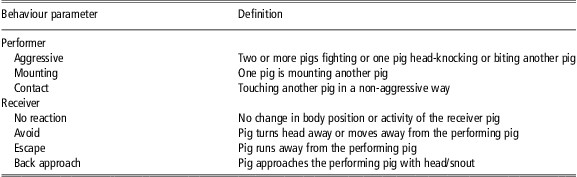
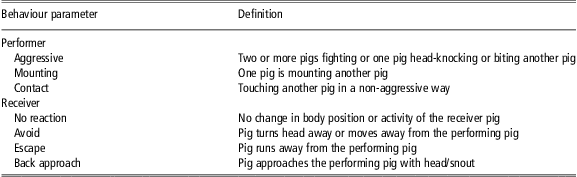
The definitions of the behaviour parameters are presented in Table 1 (activity: sleeping, resting and active) and Table 2 (social interactions: aggressive, mounting and contact). The receiver's reaction to a social interaction was recorded as no reaction, avoid, escape and back approach (Table 2). It was also recorded whether the receiver vocalised or not during the social interactions. Different social interactions were recorded as new events, regardless of whether they were performed by the same or several different pigs. A new event was recorded as soon as new pigs interacted or when the interaction stopped for 3 s or more, and then started again. When an interaction lasted longer than 4 s, it was recorded as long-lasting interaction.
Definitions of behaviour parameters used at the scan sampling

Definitions of social interactions during continuous recording
Skin lesions
All pigs were inspected by a technician for skin lesions on four or five occasions. The first inspection was performed the day before entering the growing–finishing unit and the second 2 days later. The following inspections were performed on the same occasions in which activity and social interactions were recorded. Skin lesions were recorded as deep and light bites and scratches on head, front and back of the pig. ‘Deep’ was defined as open wound, wound with large or thick crust or infected wound. ‘Light’ was defined as red skin, shallow scratch or shallow and small wound with or without crust. The number of lesions was recorded as follows: no (0 lesion); few (1 to 3 lesions); several (4 to 9 lesions); many (⩾10 lesions). These records were later translated to figures: 0, no lesions; 2, few lesions; 7, several lesions; and 12, many lesions. The sum of these figures was used in the statistical analyses. Subsequently, this sum is called ‘number of skin lesions’.
After slaughter, skin lesions were recorded by an experienced technician at cutting using a 6-point scale (0: no visible skin damage; 5: very highly damaged skin). These records from the slaughter plant were used to classify the pigs into two groups: without skin lesions (score 0) or with skin lesions (score 1 to 5).
Statistical analyses
Data were analysed with the Statistical Analysis System, version 9.2 (SAS Institute, Cary, NC, USA). The effect of treatment on performance, carcass quality, skin lesions recorded during the growing–finishing phase, testes weight, severity of skin lesions recorded at slaughter and concentrations of skatole and androstenone in fat was evaluated with Proc Mixed. The model included the fixed factor of treatment (intact v. control), and the random factors of pen and litter. Pig was the experimental unit for all these parameters, except for feed conversion ratio. For feed conversion ratio, pen was the experimental unit and no random factors were included in the model. When analysing daily weight gain, initial weight was used as a covariate (quadratic regression). The slaughter weight was used as a covariate for analysis of lean meat content (linear regression). The concentrations of skatole and androstenone in fat were log-transformed before statistical analyses in order to normalise residual distribution.
Activity behaviours were recorded as the percentage of pigs performing a particular behaviour on each observation occasion (34 scan samplings). The social behaviour was recorded as the total number of interactions performed per pen on each observation occasion (17 rounds × 4 min = 68 min) and then adjusted to frequency of interactions per pen during 60 min. Pen was the statistical unit for all behaviour analyses. Behaviour parameters did not show normal distribution of the residuals. Thus, activity behaviour data were arcsine-transformed and social interaction data were square root-transformed before statistical analysis. These parameters were evaluated within each observation occasion with Proc Mixed. The model included treatment as fixed factor. For comparisons over time (D1 to D3 for pigs in intact groups and D1 to D4 for control pigs), analogous evaluation was performed within treatment, with observation occasion as fixed factor. On the fourth occasion (D4) of the control pigs, when there were 5 to 6 pigs in the pen, the frequency of social interactions per pen during 60 min was adjusted to eight pigs, to be comparable with the frequencies recorded for eight pigs on previous occasions (D1 to D3).
The impact of treatment on skin lesions recorded at slaughter (without or with lesions) and the proportion of pigs reacting with vocalisation were tested as a logistic regression using a binomial distribution with a logit link function. These analyses were performed with Proc Genmod and the model included the effect of treatment.
Results
Performance and carcass quality
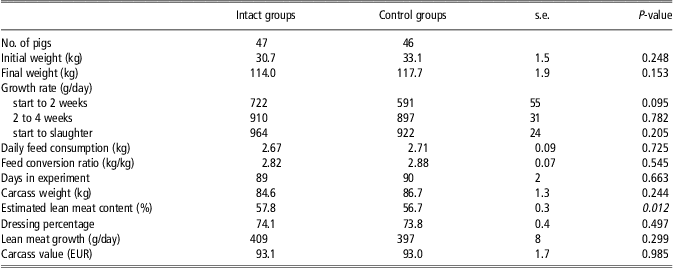
During the growing–finishing phase, one pig from an intact group and two control pigs died or had to be killed. During the first 2 weeks after moving to the growing–finishing unit, pigs in intact groups tended to have a higher growth rate than the control pigs with a difference of 131 g/day (Table 3). After this period, no significant difference in growth rate was seen between the two treatments. Overall, daily weight gain and feed conversion ratio did not differ significantly between the treatments. The week after the first slaughter occasion of the control pigs, growth rate of the remaining control pigs was at the same level as the week before (1052 g/day before and 1037 g/day after; P = 0.853; n = 28). Pigs slaughtered pen-wise and kept in intact groups had a higher variation in carcass weight than pigs slaughtered by split marketing and mixed with unfamiliar pigs during transport and lairage (coefficient of variation (CV) 11.9% v. 6.9%). This led to a higher proportion of pigs from intact groups outside the best paid interval, 23% compared with 9% for control pigs. There was an effect of treatment on estimated lean meat content; entire male pigs kept in intact groups had higher values and lower variation (CV 2.4% v. 3.7%) compared with control pigs kept in mixed groups. Average daily lean meat growth from start of the study to slaughter did not differ between the groups. No difference in economic carcass value, based on estimated lean meat content was found (Table 3).
Performance and carcass quality for entire male pigs kept in intact groups from 2 weeks after birth to slaughter or raised together with unfamiliar pigs (control)
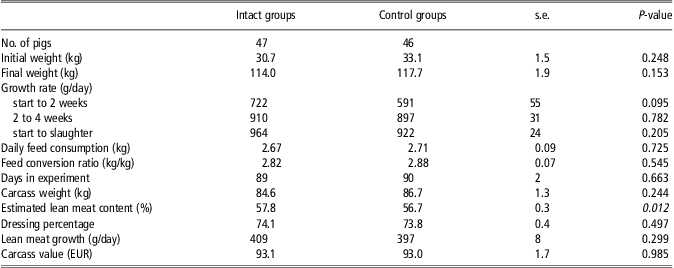
Results are presented as LS means with pooled standard error (s.e.) and significance of difference between treatments (P-value). Significant values are formatted in italics (P < 0.05).
Activity behaviour
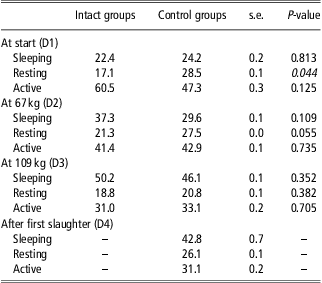
Treatment did not significantly affect the proportion of pigs sleeping on any observation occasion (Table 4). Resting was affected by treatment at D1 (at start) and D2 (∼67 kg), with a higher frequency of resting for the control. At D3 (∼109 kg), the proportion of resting control pigs had decreased to around the same level as pigs raised in intact groups. The proportion of pigs that were active did not differ significantly between the treatments at any observation occasion. When analysed over time (with observation occasion as a fixed factor), pigs in intact groups became less active when they got older (P < 0.001), whereas no age-related effect was found in control pigs (P = 0.250).
Percent of pigs performing different scan sampling activity behavioursFootnote 1 at different observation occasionsFootnote 2
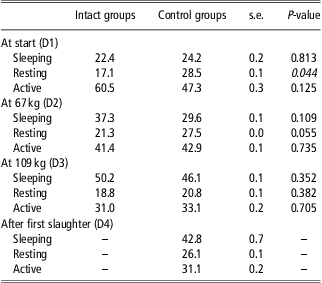
Results are presented as LS means with pooled standard error (s.e.) and significance of difference between treatments (P-value). Significant values are formatted in italics (P < 0.05).
1 See Table 1 for definitions of behaviour parameter used at the scan sampling.
2 D1, D2, D3 and D4 refer to four observation occasions.
Social interactions
Performer
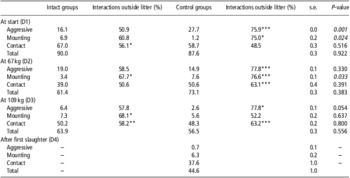
At D1 (shortly after entering the growing–finishing unit), entire male pigs in intact groups showed less aggressive behaviour, but performed more mountings than control pigs (Table 5). In addition, for control pigs, more aggressions were long lasting than for familiar pigs (17.6 v. 5.0 interactions; P < 0.001). At D2 (∼67 kg), pigs in intact groups performed less mounting behaviour than control pigs. Aggression level of control pigs had decreased in comparison with D1 and was similar to pigs raised in intact groups. At D3 (∼109 kg), pigs in intact groups tended to perform more aggressive behaviour than control pigs. In pens that were split marketed the numbers of aggressive and mounting behaviour were unaffected among the remaining pigs after the first pigs in the pen were sent to slaughter. In total for all pigs, the proportion of long-lasting interactions was 25.0% for aggressive interactions, 5.7% for sexual interactions (mounting) and 3.8% for other social interactions (contact). The proportions of long-lasting mounting and contact did not differ between treatments, whereas the proportion of long-lasting aggressive interactions was significantly higher for the control pigs (P = 0.001).
Total number of observed social interactionsFootnote 1 of performer, per pen and hour and proportion of interactions directed towards non-litter matesFootnote 2 at different observation occasionsFootnote 3

Results are presented as LS means with pooled standard error (s.e.) and significance of difference between treatments (P-value). Significant values are formatted in italics (P < 0.05).
1 See Table 2 for definitions of social interactions.
2 Significance level of difference between litter and non-litter mates is based on a χ 2-test: *P ⩽ 0.05; **P ⩽ 0.01; ***P ⩽ 0.001.
3 D1, D2, D3 and D4 refer to four observation occasions.
Receiver
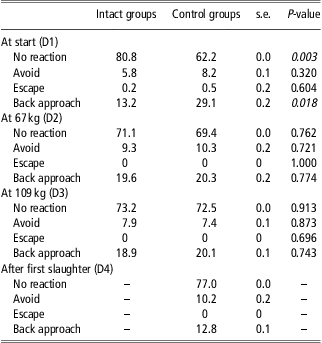
When the intact groups of familiar pigs were moved to the growing–finishing unit, the frequency of pigs that showed no reaction when exposed to a social interaction was higher compared with pigs in control groups (Table 6). At this occasion, fewer pigs in intact groups reacted with a back approach when exposed to an interaction. Thereafter, no significant differences in receiver's reaction were seen between the two treatments.
Response to social interactionsFootnote 1, expressed as percentage of total number of interactions at different observation occasionsFootnote 2
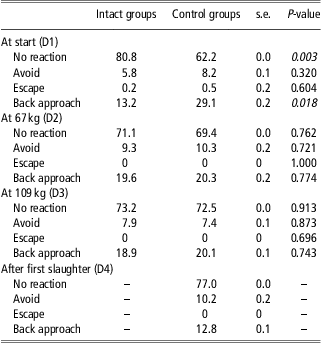
Results are presented as LS means with pooled standard error (s.e.) and significance of difference between treatments (P-value). Significant values are formatted in italics (P < 0.05).
1 See Table 2 for definitions of responses.
2 D1, D2, D3 and D4 refer to four observation occasions.
At start (D1), the proportion of interactions where the receiving pigs reacted with a vocalisation was very low, on average 0.6%, and with no significant difference between treatments (P = 0.782). At D2 and D3, proportion of interactions with vocalising increased to ∼15% but was unaffected by treatment (P = 0.482 and 0.602, respectively). At D4 (control pigs only), the proportion was 13.4%. In all interactions with vocalisations, the receiver reacted with avoidance in ∼36% of cases, with back approach in 33% of cases and with no reaction in 31% of cases. Vocalising in combination with escape occurred only in two interactions. The corresponding proportions for all interactions without vocalising was 6% for avoid, 19% for back approach, 74% for no reaction and 1% for escape.
In control groups, aggressive interactions were directed towards non-litter mates more often than towards litter mates at all occasions, whereas no significant effect of pigs’ origin was found for pigs in intact groups (Table 5). Sexual interactions were directed towards non-litter mates (two of three occasions) more often than towards litter mates for both treatments. Other social interactions (contact) were also directed towards non-litter mates (two of three occasions) more often than towards litter mates for both treatments.
Skin lesions
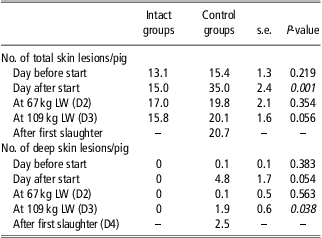
Before moving to the growing–finishing unit, skin lesions did not differ between treatments (Table 7). The day after the pigs were moved to the growing–finishing unit, pigs in intact groups had fewer skin lesions in total than the control pigs, which were mixed, 15.0 v. 35.0 (P < 0.001) with about the same difference at head (5.6 v. 13.3; P < 0.001), front (7.5 v. 13.0; P < 0.001) and back (1.9 v. 8.7; P < 0.001). They also tended to have fewer deep lesions than the mixed pigs (0 v. 4.8; P = 0.054). At the next occasion (D2), skin lesions did not differ between the two treatments. At D3, pigs in intact groups tended to have fewer skin lesions than the pigs raised in control groups (P = 0.056) and the number of deep skin lesions was significantly lower (P = 0.038). In the control groups, the frequency and the severity of skin lesions among the remaining pigs after the first slaughter occasion (D4) was at the same level as observed at the previous occasion with all pigs in the pen (i.e. D3).
Skin lesions at different observation occasionsFootnote 1
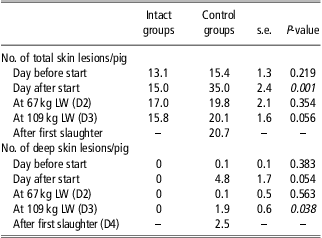
Results are presented as LS means with pooled standard error (s.e.) and significance of difference between treatments (P-value). Significant values are formatted in italics (P < 0.05).
1 D2, D3 and D4 refer to four observation occasions.
At slaughter, the occurrence of pigs without skin lesions was higher when kept in intact groups and slaughtered pen-wise (74%) compared with the control pigs that were mixed with unfamiliar pigs during raising and at slaughter (13%; P < 0.001). When comparing pigs with at least one skin lesion, the pigs in intact groups also had less severe lesions than the control pigs (mean value 1.30 v. 2.98 points; P < 0.001).
Testes weight and boar taint compounds
Testes weight and skatole and androstenone concentrations in fat did not differ between pigs raised in intact or control groups (Table 8). Of the pigs raised in intact groups (n = 47), 7 pigs had a fat skatole concentration above 0.2 μg/g and 41 had an androstenone concentration above 1 μg/g, which were used as threshold values for sensory acceptance (Walstra et al., Reference Walstra, Claudi-Magnussen, Chevillon, Von Seth, Diestre, Matthews, Homer and Bonneau1999). For control pigs (n = 46), corresponding values for skatole and androstenone were 12 and 42, respectively. All pigs with skatole values above 0.2 μg/g also had androstenone levels above the threshold value. A total of 89% of all pigs were thus above the threshold level for boar taint.
Testes weightFootnote 1 and boar taint compoundsFootnote 2 in fat of entire male pigs kept in intact groups from 2 weeks after birth to slaughter or raised together with unfamiliar pigs (control)

1 Testes weights are presented as LS means. The pooled standard error (s.e.) is 25.8.
2 Boar taint compounds are presented as back-transformed LS means with 95% confidence interval within parentheses.
Discussion
Socialising piglets has been performed in several studies (D'Eath, Reference D'Eath2005; Hessel et al., Reference Hessel, Reiners and Van den Weghe2006; Kutzer et al., Reference Kutzer, Bünger, Kjaer and Schrader2009; Fàbrega et al., Reference Fàbrega, Puigvert, Soler, Tibau and Dalmau2013), but it has not become a common practice in conventional production. The fact that entire males perform more aggressive and sexual behaviour than castrates, in combination with the ambition to stop castration, increases the relevance of early socialising in conventional pig production. We are only aware of one other study where entire males have been socialised and followed until slaughter, which is a study by Fàbrega et al. (Reference Fàbrega, Puigvert, Soler, Tibau and Dalmau2013) performed in parallel to our study, both within the EU project Q-PorkChains.
The results show that the frequency of aggressive interactions when entering the growing–finishing unit (D1) are much lower among familiar pigs (i.e. socialised) kept in intact groups than among unknown mixed pigs. This is in accordance with Kutzer et al. (Reference Kutzer, Bünger, Kjaer and Schrader2009) and Hessel et al. (Reference Hessel, Reiners and Van den Weghe2006) who compared aggressive behaviour between socialised and control piglets for 48 h after mixing at weaning. According to D'Eath (Reference D'Eath2005), socialised piglets learn social skills that enable them to rapidly form stable hierarchies. In addition to the frequency of aggressions, we also recorded the reaction of the receiver. The aggressive interactions that did occur among familiar pigs in our study seemed less severe (as compared with the interactions of control pigs), as a larger proportion of them led to no reaction of the receiver, that is, no change in body position or activity. Consequently, the number of skin lesions was more than twice as high among control pigs, as compared with pigs in intact groups and many of the control pigs had several deep skin lesions the day after mixing. According to Turner et al. (Reference Turner, Farnworth, White, Brotherstone, Mendl, Knap, Penny and Lawrence2006), lesions on the back part of the body are associated with non-reciprocal bullying. This implies that bullying is rare among pigs in intact groups at mixing, as their number of lesions on the back was, on average, only 1.9, compared with 8.7 for control pigs. Skin lesions can, however, also result from mounting (Rydhmer et al., Reference Rydhmer, Zamaratskaia, Andersson, Algers, Guillemet and Lundström2006). Mounting was more common among pigs in intact groups than among control pigs at mixing, but this mounting did not result in more lesions. At 10 weeks of age, mounting is more related to play than to sexual development (Berry and Signoret, Reference Berry and Signoret1984). It is plausible that the pigs in intact groups, which were less occupied by aggressive behaviour, had more time and energy left for mounting, compared with control pigs. They also seemed more active and although the difference in activity was not significant, the proportion of resting pigs was significantly lower in the intact groups. They probably had less need for resting as they spent less energy on fighting, which is an energy-consuming activity (Lepron et al., Reference Lepron, Bergeron, Robert, Faucitano, Bernier and Pomar2007).
Except for the newly mixed control pigs, the distribution of activities during the day observed in this study was in accordance with previous studies (Bolhuis et al., Reference Bolhuis, Schouten, Schrama and Wiegant2005; Andersson et al., Reference Andersson, Brunius, Zamaratskaia and Lundström2012); young pigs spend approximately half of the day lying down and the time increases with increasing age during the growing–finishing phase. Even so, they have plenty of time for social interactions such as nibbling, belly suckling and ear and tail manipulating. We have previously suggested that these behaviours, which are performed to a higher degree by entire males than females, reduce calmness, and thus may decrease welfare (Rydhmer et al., Reference Rydhmer, Lundström and Andersson2010). The frequency of these behaviours were, however, lower in this study than in the studies by Rydhmer et al. (Reference Rydhmer, Lundström and Andersson2010) and Andersson et al. (Reference Andersson, Brunius, Zamaratskaia and Lundström2012) and there was no difference between treatments.
Raising entire males in intact groups of familiar pigs resulted in less skin lesions (and no deep lesions) compared with mixed control pigs, both at the start and the end of the growing–finishing phase. This is in accordance with the results from entire males in farrow-to-finish pens (Fredriksen et al., Reference Fredriksen, Lium, Hexeberg, Mosveen and Nafstad2008). It should be noted that weight at slaughter was high in our study (∼115 kg), compared with the lower average weight at slaughter in, for example, United Kingdom or Ireland, where castration is normally not performed. To our surprise, the frequency of aggressive interactions tended to be higher at 109 kg (D3) in intact groups of familiar pigs than in control groups. At mixing, the difference in aggressive behaviour between treatments was reflected in skin lesions, but this was not seen at 109 kg. On the contrary, familiar pigs had significantly less skin lesions and no deep skin lesions at this occasion. Furthermore, the ratio of aggressive interactions resulting in no reaction was higher and the ratio of long-lasting aggressive interactions was lower for familiar pigs in intact groups than for control pigs at 109 kg (data not shown). Thus, we assume that the aggressive interactions observed in groups of familiar pigs at the end of the growing–finishing phase are less problematic than those observed at mixing. Compared with previous studies (Rydhmer et al., Reference Rydhmer, Lundström and Andersson2010; Andersson et al., Reference Andersson, Brunius, Zamaratskaia and Lundström2012), the frequency was rather low for both treatments. However, because of heavy body weight and limited space available in the pen at this stage, this unexpected result should not be ignored.
Fredriksen and co-workers have proposed that rearing entire males in intact litters, in farrow-to-finish pens, may reduce aggressive behaviour and delay sexual maturity (Fredriksen et al., Reference Fredriksen, Lium, Cathrine, Marka, Heier, Jadwiga and Nafstad2006 and Reference Fredriksen, Lium, Hexeberg, Mosveen and Nafstad2008). Our aim with socialising piglets was to create groups of familiar entire males that would behave as litter mates, although they were moved from the farrowing pen to a growing–finishing pen at 10 weeks of age. On the basis of the behavioural observations from the whole growing–finishing phase, we conclude that socialising piglets worked; these pigs did not fight more with pigs they had met at 2 weeks of age than with litter mates. Pigs that met for the first time at the age of 10 weeks, on the other hand, continued to perform more aggressive interactions with non-litter mates during the 3 months after mixing.
The frequency of sexual behaviour (mounting) in our study was of the same size as in previous Swedish studies (Rydhmer et al., Reference Rydhmer, Zamaratskaia, Andersson, Algers, Guillemet and Lundström2006 and Reference Rydhmer, Lundström and Andersson2010; Andersson et al., Reference Andersson, Brunius, Zamaratskaia and Lundström2012). Non-litter mates were mounted more often than litter mates in both treatments (significant at two of three occasions per treatment). In the study by Fredriksen et al. (Reference Fredriksen, Lium, Hexeberg, Mosveen and Nafstad2008), the frequency of mounting was very low both among litter mates in farrow-to-finish pens and pens with mixed pigs. In our study, the frequency of mounting was higher for the control pigs at a LW of 67 kg (D2), but at 109 kg (D3) there was no difference between treatments. The lower frequency of mounting among pigs in intact groups at 67 kg could reflect a delayed sexual maturation, in line with the hypothesis of Fredriksen et al. (Reference Fredriksen, Lium, Hexeberg, Mosveen and Nafstad2008), but although control pigs had higher testes weight at slaughter, the difference was far from significant. Likewise, androstenone levels in fat at slaughter did not differ significantly between treatments. This may or may not be in contradiction with the results presented by Fredriksen et al. (Reference Fredriksen, Lium, Hexeberg, Mosveen and Nafstad2008). The numeric difference between the groups was almost the same between the two studies (0.19 μg/g, this study; 0.18 μg/g, Fredriksen et al., Reference Fredriksen, Lium, Hexeberg, Mosveen and Nafstad2008), but Fredriksen and co-workers had many more entire males (n = 1353) in their study, and therefore much more power in the statistical analysis.
No difference between treatments in skatole levels were found neither in this study, nor in the study by Fredriksen et al. (Reference Fredriksen, Lium, Hexeberg, Mosveen and Nafstad2008). Skatole, but especially androstenone levels were alarmingly high in our study, resulting in 89% of all pigs above the threshold levels for boar taint. In a recent study at the same research station, the corresponding rate was 66% (Andersson et al., Reference Andersson, Brunius, Zamaratskaia and Lundström2012). The study by Fredriksen et al. (Reference Fredriksen, Lium, Hexeberg, Mosveen and Nafstad2008) was a field study and they found large differences between herds. In one herd, 78% to 79% of the pigs were over the threshold for boar taint, whereas only 27% to 44% of the pigs were over this threshold in the other two herds. The lower values belong to the treatment with farrow-to-finish pens.
Measured over the whole growing–finishing period, growth rate did not differ significantly, but control pigs tended to grow slower during the first 2 weeks after mixing. This is probably a consequence of the increased number of aggressive interactions and stress from being housed with unfamiliar pigs. In pigs, the dominance order is set shortly after mixing and the frequency of aggressive interactions decreases as pigs move from the first phase of intensive fighting among unfamiliar pigs to a phase of longer-term competition over feed or other resources (Fraser, 1995). During weeks 3 to 4, when the first phase was over, the increase in growth rate (compared with weeks 1 to 2) was larger for control pigs (52%) than for pigs kept in intact groups (26%). Both Kutzer et al. (Reference Kutzer, Bünger, Kjaer and Schrader2009) and Hessel et al. (Reference Hessel, Reiners and Van den Weghe2006) reported a higher growth rate for socialised pigs during the first 5 weeks after mixing (at weaning). Daily feed consumption and feed conversion ratio did not differ between treatments in our study, which is in accordance with a study on socialised entire males by Fàbrega et al. (Reference Fàbrega, Puigvert, Soler, Tibau and Dalmau2013).
Today's pricing system is based on a weight range outside which the carcass value is substantially lower, and thus pigs are slaughtered based on individual weight. Owing to variation in initial weight and growth rate, each pen is often split over three slaughter occasions in conventional production. Boyle and Björklund (Reference Boyle and Björklund2007) proposed that split marketing is a welfare problem when raising entire males and both Fredriksen and Hexeberg (Reference Fredriksen and Hexeberg2009) and Rydhmer et al. (Reference Rydhmer, Zamaratskaia, Andersson, Algers, Guillemet and Lundström2006) found that aggressive interactions among the remaining entire males increased after the fastest growing pigs had been sent to slaughter. Fredriksen and Hexeberg (Reference Fredriksen and Hexeberg2009) also observed a higher frequency of mounting. In our study, neither aggressive, nor sexual behaviour changed when the first 2 to 3 pigs in the pen were removed and the number of skin lesions as well as growth rate remained at the same level as before first slaughter. Likewise, Rydhmer et al. (Reference Rydhmer, Lundström and Andersson2010) observed no effect of split marketing on aggressive or sexual behaviour. The welfare of the remaining pigs seems not to be a strong argument against split marketing, a conclusion that we share with Conte et al. (Reference Conte, Lawlor, O'Connell and Boyle2011). However, there is a large difference in skin lesions between pigs slaughtered in intact groups and pigs mixed during transport and lairage (this study; Sather et al., Reference Sather, Jones, Squires, Schaefer, Robertson, Tong and Zawadski1995; Andersson et al., Reference Andersson, Andersson, Zamaratskaia, Rydhmer, Chen and Lundström2005; Fàbrega et al., Reference Fàbrega, Puigvert, Soler, Tibau and Dalmau2013). Keeping unfamiliar pigs separated in the van and in the slaughter plant is a technical challenge and the extra cost probably increases with decreasing group size. Fàbrega et al. (Reference Fàbrega, Puigvert, Soler, Tibau and Dalmau2013) have recently reported that socialised pigs handle split marketing better than control pigs. A larger proportion of the socialised, split marketed pigs had no skin lesions after slaughter, as compared with the split marketed control pigs.
Pen-wise slaughter, of course, increased the variation in weight at slaughter, and thereby decreased the proportion of pigs within the best paid price range. On the other hand, pigs slaughtered pen-wise in intact groups had a lower variation in lean meat content and were on average leaner than control pigs. Conte et al. (Reference Conte, Lawlor, O'Connell and Boyle2011) also found less lean meat yield in split marketed pigs. One explanation could be that with pen-wise slaughter, slow growing and inefficient pigs are slaughtered before they build up a considerable body fat. With split marketing, such pigs are the last to reach the target weight and they have time to become fat. As the carcass value was the same for both treatments and as pen-wise slaughter should decrease the amount of work during the end of the growing–finishing phase and increase animal welfare at slaughter, there are good reasons to develop routines and methods that facilitate pen-wise slaughter.
Conclusions
The following results were not in line with our hypotheses:
• Once the initial period of fighting is over, entire males reared in intact groups do not show less aggressive and other social interactions than pigs that were mixed when entering the growing–finishing unit.
• Entire males reared in intact groups do not show less sexual behaviour during the whole growing–finishing phase, and they do not have lower levels of boar taint compounds at slaughter, compared with mixed males.
• Keeping groups intact with only one slaughter occasion per pen does not lead to less fighting during the end of the growing–finishing phase and growth rate is not improved, compared with mixed groups with several slaughter occasions per pen.
The following hypotheses were found to be true:
• By mixing two litters at 2 weeks of age and separating pigs into male and female groups at weaning, entire male pigs get involved in much fewer and less severe aggressive interactions when starting the growing–finishing phase, compared with entire males mixed with unfamiliar pigs.
• Entire males do not distinguish between brothers raised in the same litter and familiar pigs that they first met at 2 weeks of age, with regard to aggressive interactions. Pigs that meet for the first time at 10 weeks of age direct more aggression towards non-littermates than towards litter mates during the whole growing–finishing phase.
• Transport and lairage of entire males in intact groups results in fewer and less severe skin lesions, compared with entire males that are mixed with unfamiliar pigs during transport and lairage.
To conclude, socialising piglets creates groups of familiar entire males in which being litter mates or not has no effect on aggressive behaviour. Furthermore, socialising piglets is a feasible way to improve welfare of entire males at the beginning of the growing–finishing phase. This positive effect is less evident during the later parts of the growing–finishing phase and socialising piglets does not improve production traits. Pen-wise slaughter leads to more pigs outside the best paid weight range, but this loss is compensated by a higher lean meat content, and thus the economic carcass value does not differ from that of split marketed pigs. Keeping pigs in intact groups at slaughter clearly improves welfare of entire male pigs with regard to skin lesions.
Acknowledgement
The authors gratefully acknowledge European Community financial participation under the Sixth Framework Programme for Research, Technological Development and Demonstration Activities, for the Integrated Project Q-PORKCHAINS FOOD-CT-2007-036245. The authors thank the staff at Lövsta for taking good care of the pigs. They also thank Rolf Grahm and Ulla Schmidt for collecting data and Lisa Eriksson for planning and performing the piglet study.