





Dusk was approaching and Jad was anxious.Footnote 1 “He said he’d be here, and now he’s not answering his phone.” Pacing around the back of his boxy green water truck, Jad attempted yet another call amid the commotion of traffic on the main road of Zahle, entering the Maʿalaqa neighborhood. “We don’t know which is his tank,” Jad continued. “And right now, all of Zahle is cut off (maʾtouʿ) from water.”
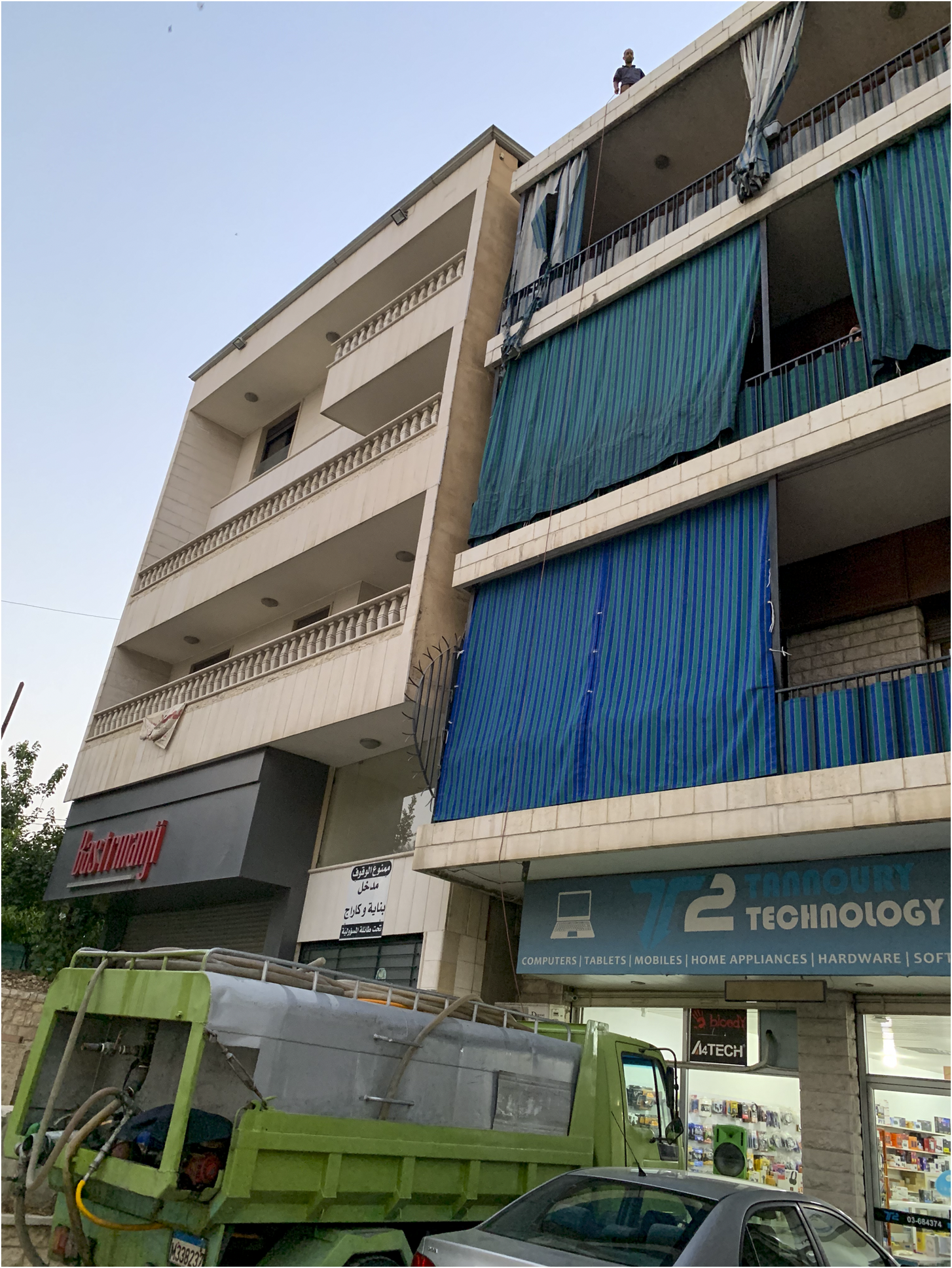
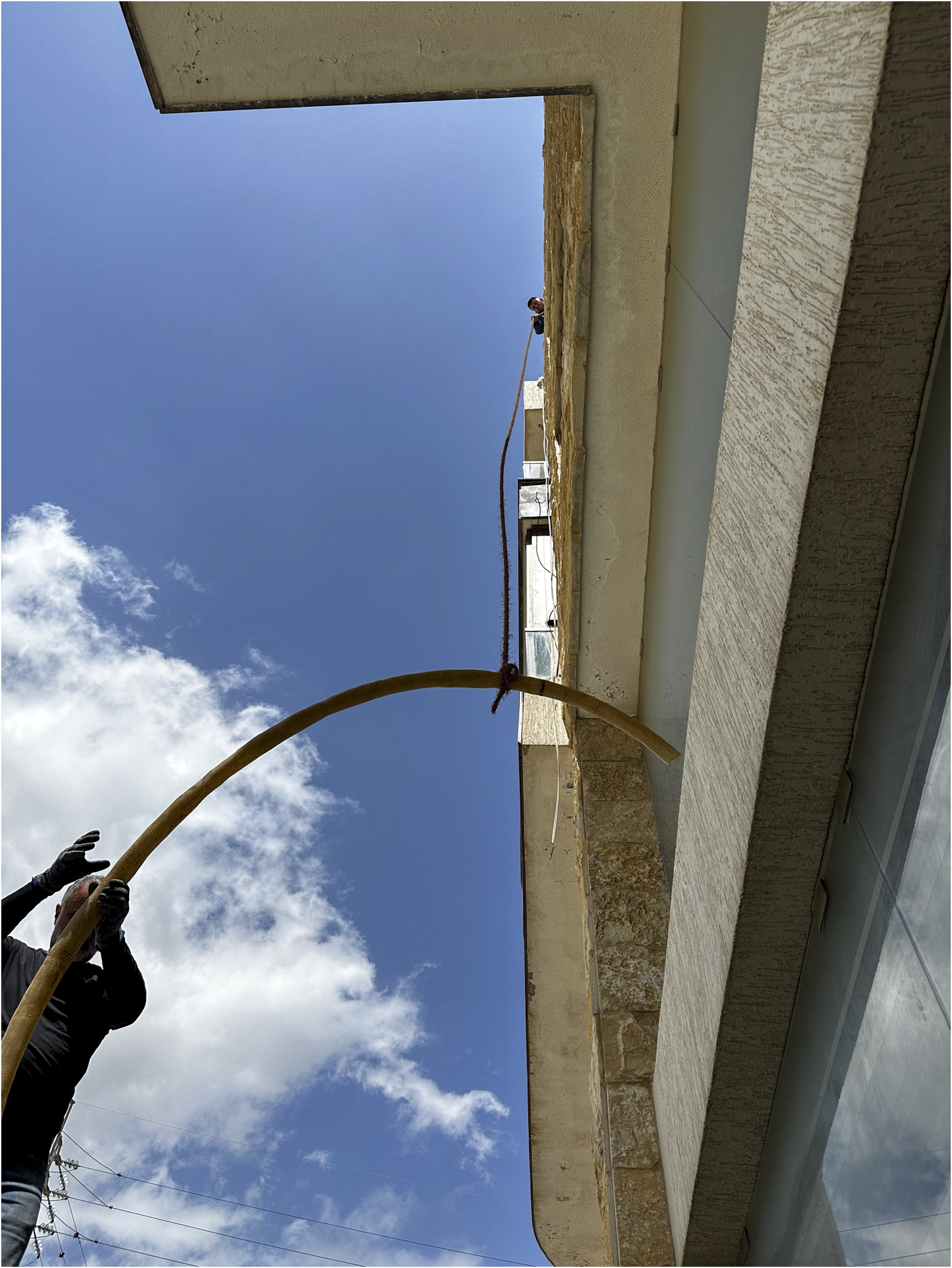
I had spotted Jad’s truck ten minutes previously on my commute home where it was parked in front of the client’s apartment building. Before I approached, I observed the truck and its crew. Jad, a five and a-half foot, bald man in his mid-forties, hopped out of the driver’s seat on his phone, answering a call for another delivery. Two taller men—Syrians, I noticed from their accents—lowered themselves from the passenger’s side, holding rope in their hands. They entered the four-story apartment building, ascended to the roof, positioned themselves above the truck, and tossed down one end of the rope. On the ground, Jad tied the rope to the truck’s hose—a hearty 3 inch diameter composite tube of rubber, plastic, and fiber weaving, 100 feet in length, feeding into the truck’s bulky body—ready for his crew to pull it up to the roof (Fig. 1). The only problem was that Jad’s crew still did not know which of the dozen or so water tanks on the roof was his client’s, who was absent from the scene.
Jad’s truck and worker above, waiting to draw up the hose. Author photograph.

With Jad pacing in frustration, I offered my timid introduction: “I’m a researcher, from America, of Lebanese heritage—originally from Zahle, yes, and also Qob Elias and Bikfaya, but from 100 years ago—now studying water in the Bekaa valley; I want to volunteer my time on a water truck, to better understand the work.” He smiled at my accent and earnestness. “Let me give you my number and you can join me on a trip. Just not today. I’m under too much pressure (daght katīr).” He repeated, “All of Zahle is cut off (maʾtouʿ) from water, and I don’t like to work in the dark.”
Jad’s descriptor of Zahle’s broken infrastructure—maʾtouʿ—is a word signifying breakdown, cut off, ruin. It was a burst central line that disabled Zahle’s water supply that June day in 2022. While the piped water distribution system underwent lengthy repair, water trucks filled Zahle’s streets, relieving the burdens of water scarcity.
Indeed, the burdens of life during my fieldwork in 2022–23 were severe. This time in Lebanon was marked by compounded crises—financial, since its 2019 hyperinflation and economic collapse; political, from corrupt sectarian impasse; and national, with refugees accounting for nearly one-third of the population, the most per capita globally.Footnote 2 Amid these ongoing suffocating circumstances, standard water distribution infrastructures remained both ineffective and insufficient for servicing all groups in demand. Wells are difficult to power due to high energy costs; aquifers run dry due to overextraction; and settlements for displaced populations are off-grid. Water trucks meet the needs produced by these conditions. They address momentary shortcomings of the water network, filling in when lines burst or wells break, and at the same time extend the reach of water to communities without the standard connections—namely, displaced Syrians living in off-grid (and presumably temporary) settlements. Among both Lebanese and displaced Syrian populations, water trucks are a curious kind of infrastructure: at once an exceptional intermediary, filling the gap when expected operations fail, and also a standard feature of humanitarian provision servicing hundreds of thousands of those displaced by conflict in Syria. Water trucks are in this way essential to addressing the needs and complexities of a cut-off life for Lebanese and Syrians alike, albeit in uneven and differentiated ways. In delivering this vital life necessity, I argue that water trucks and their drivers are essential, powerful, and yet suspect actors who variously entrench, maintain, and reconfigure the sociomaterial and political terrain in Lebanon’s Bekaa valley. Through a close analysis of water trucks, the everyday and exceptional negotiations of a cut-off life among both Lebanese and displaced Syrians can be better understood.
Categorizing Water Trucks and Infrastructure in the Middle East
Put simply, water trucks (citernāt al-mayy in Lebanon) are a means to deliver water. They are composite entities, possessing the bulky body of a service vehicle with three defining features: a large vessel to hold its cargo, a pump to deliver the water, and a hose to guide the flow. Although water trucks exist in a range of sizes and technical formations, they can be categorized by two distinct groups, depending on their target consumer: trucks that hold nonpotable water, mostly used for the domestic purposes of washing and cleaning, and trucks for potable drinking water, mostly providing humanitarian assistance.Footnote 3 Attending to these distinctions reveals water’s plurality in Lebanon and illuminates the social lives served the segregated flows of (un)potability.Footnote 4
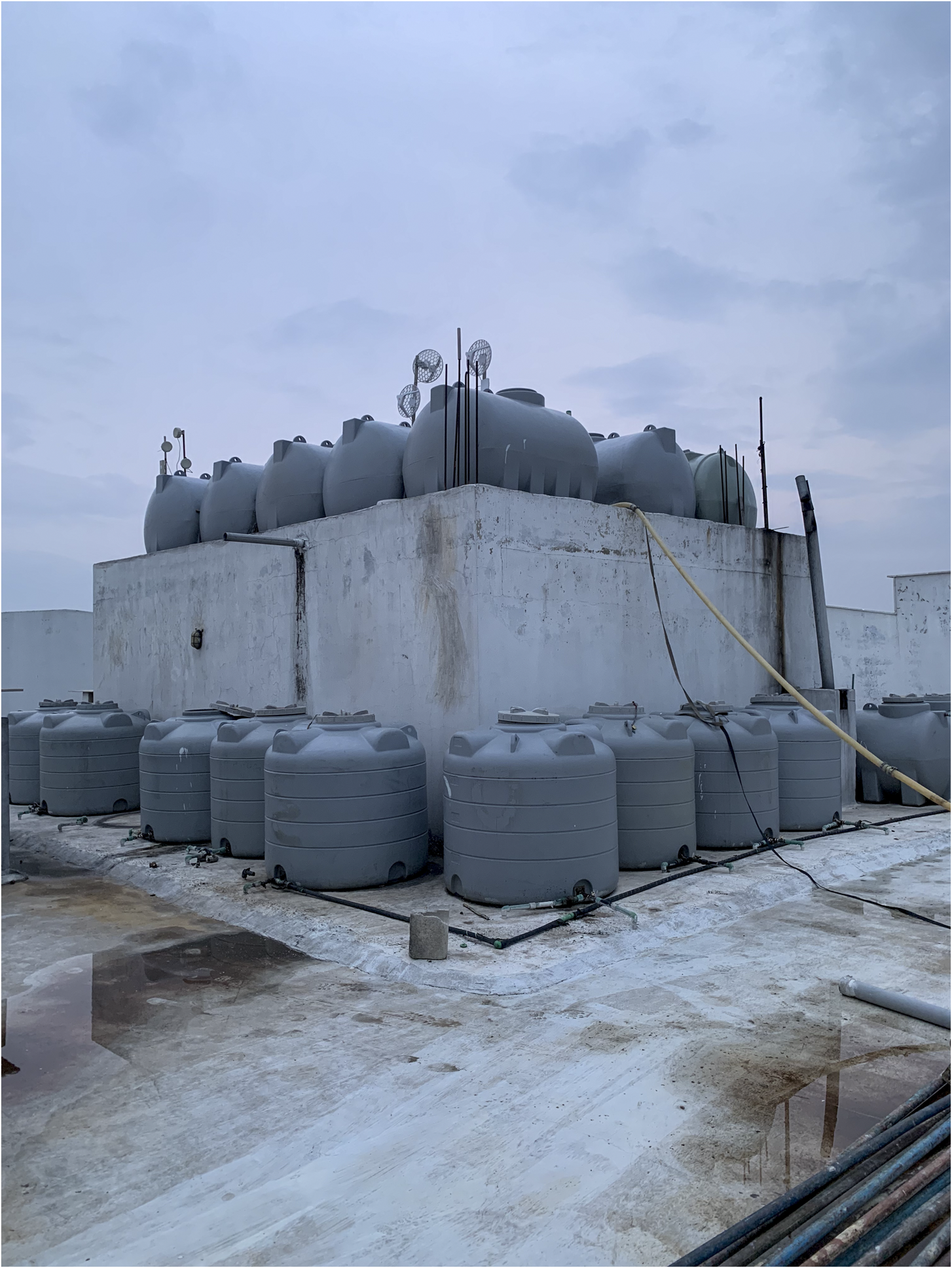
Trucks carrying nonpotable water for domestic usage target Lebanese municipalities, offering a service that addresses the shortcomings of the standard piped water distribution network. Homes in Lebanon are generally connected to a piped network, which is run by one of the four regional water establishments (RWEs). Because it is not possible to continuously pipe water directly to residents’ faucets secondary to broken infrastructure and high energy costs, this water instead is received in household 1,000-liter tanks that often are stored on residents’ roofs and ideally refilled twice weekly—a frequency that varies in less-supported regions of the country (Fig. 2).Footnote 5 Because of energy shortages, cracked piped connections, clogging, or other distribution breakdowns, water delivery may be late. When the 1,000-liter cistern runs low, residents call upon private water trucks to quench their needs. Always unregulated and without governmental oversight, these domestic water trucks operate at their own discretion, often drawing from untested sources that are likely contaminated due to widespread, increasing pollution of Lebanon’s aquifers.Footnote 6 The potentially tainted cargo of domestic water trucks situates them as a vessel navigating the border of respite and danger, relief and trepidation. This threat is kept at bay by a general social awareness of water’s plurality: the difference between its domestic and potable forms. As in other places in the Global South, everyone in Lebanon knows that water from rooftop tanks and domestic faucets is never to be consumed.Footnote 7 Potable drinking water for Lebanese is usually bottled or comes from springs or chlorinated sources—a precious product that should never be wasted.
Tanks on a roof. Note water truck hose on right side. Author photograph.

Daily water access for many displaced Syrians—and the humanitarian water trucks which service them—is different. These trucks deliver potable, tested drinking water, and due to their higher costs are primarily limited to the humanitarian sector, servicing the over 300,000 displaced Syrians living in off-grid settlements.Footnote 8 In an effort to prevent permanent residence, the Lebanese government has prohibited informal Syrian tent settlements from connecting to a piped water network or incorporating any infrastructure deemed permanent.Footnote 9 All of these Syrians’ water needs (drinking as well as cleaning, washing, etc.) are therefore met by frequent trucking for water provision and removal (desludging). These highly regulated and costly water trucks are contracted by international humanitarian organizations with field offices in the Bekaa valley. Yet although potable water trucking constitutes a significant sector in the larger economy of humanitarianism in Lebanon, dwindling funds for Syrian assistance makes trucking an unsustainable solution to a protracted crisis. With such constraints, potable water trucks become more than presumed apolitical features of humanitarian assistance. These trucks and their drivers are powerful actors, able to leverage their vital cargo to challenge authority and shape policy with significant implications.
In both of their forms, water trucks exist in a curious position: within an everyday life described as maʾtouʿ, water trucks serve as an increasingly quotidian feature of water distribution. Yet, unlike piped networks, water trucks provide a necessarily temporary solution to water’s depletion. In addition to servicing an immediate moment of need, the truck itself carries limited volume, facing eventual depletion, which always requires refilling at its source. These limitations frame unique technical and symbolic dimensions to our understanding of water trucks as infrastructure, especially as it applies to the Middle East more broadly.
Several analyses of infrastructure in the Middle East inform this paper. Some of this work explores large-scale projects—from dams to desalination plants—and the ways that infrastructures are central to the expansion and maintenance of state power, often through technopolitical expertise.Footnote 10 I diverge from these contributions to highlight the everyday and intimate workings of infrastructures that often shape the domestic realm, on a scale that nevertheless is fundamental to questions of politics.Footnote 11 Indeed, despite the hypervisibility of certain infrastructures such as transnational highways or the technopolitical operations of information technologies, Nikhil Anand and his colleagues argue that often governance “does not take place at a distance but through the intimacy and proximity of toilets, pipes, and potholed roads.”Footnote 12 In other words, distinctions between private and public, interior and exterior, and excessive and intimate are collapsed through careful attention to infrastructure.Footnote 13 And although water trucks and other small scale or “informal” infrastructures seem to exist separately from “formal” governance, the adequate functioning of formal standard infrastructures are often dependent on the otherwise overlooked informal forms.Footnote 14
My work is in conversation with literature that seeks to reconfigure unhelpful normative framings of infrastructure and government as rigidly vertical or split along analytical divisions of the formal and informal. Rather, we can imagine water trucks existing within a broader “water regime” in Lebanon that includes but necessarily exceeds standard piped networks.Footnote 15 Echoing urban political ecology scholars like Noura Wahby, this paper critiques the modernist normativity of a single-network water supply and considers the possibilities of repair to achieve this ideal.Footnote 16 Neither discrete nor permanent, infrastructures often rely on hybrid formations to maintain adequate functioning amid ever pressing decay or ruin (maʾtouʿ). Water trucks themselves are reliant on an unfolding and unruly infrastructural landscape: roads, pipes, pumps, reservoirs, electric grids, telecommunications, globalized supply chains, human bodies.Footnote 17 Yet rather than offering either temporary or permanent repair to a broken system, water trucks bring punctuated relief to the (un)expected and inevitable shortcomings of piped infrastructure. A mobile and nimble character makes water trucks a reliable stopgap for distribution failures, but added costs and uncertain water quality add trepidation to their operations. Undulating between divergent neighborhoods when punctuated moments of need arise, water trucks reflect contingent temporalities of infrastructure and spatial dimensions of situated identities and sectarianism.Footnote 18 More than investigating how residents make do in an ever-decaying infrastructural landscape, I center water trucks themselves as the protagonist. I explore how the trucks both illuminate and structure the experiences of a cut-off life for Lebanese and Syrians alike—experiences that, although decidedly uneven, hierarchical, and unequal, are nevertheless shared through a dependence on relief infrastructure such as trucking. Water trucks become revelatory actors in contemporary Lebanon, bringing into relief a series of material, labor, and political realities through their raucous, hazardous, and life-giving operations.
The paper unfolds as follows. I next provide the context for my fieldwork in Lebanon, then give an overview on the expansion of domestic water trucks in Zahle. This brings me to a consideration of the social life of water trucks, including their classed, sectarian, and gendered dimensions. Unregulated and untethered from a discrete source, domestic trucks elicit affects of fear and trepidation as much as gratitude and relief. I then discuss humanitarian water trucks that deliver drinking water to off-grid refugees and the efforts taken to ensure potability. These trucks are not simply laborers for humanitarian organizations that hire them. Even more, as essential vessels delivering necessary water to thousands of displaced Syrians, these trucks and their drivers possess coercive power that can reconfigure policy to match their interests. I close with a discussion of the possibilities and challenges of integrating water trucks with a web of infrastructures embraced as standard. These discussions are illuminated by a series of ethnographic excerpts and photographs drawn from sixteen months of fieldwork (between March 2022 and August 2023) primarily in the Zahle district of Lebanon’s Bekaa valley.
Lebanon, Zahle, and the Emergence of Water Trucks
Important social, political, and environmental conditions about Lebanon and Zahle inform this paper. First, this relatively small country holds the most refugees per capita globally. Protracted Syrian (majority Sunni) residence threatens the demographic and delicate representational balance of Lebanon’s sectarian government. Especially in Zahle, the Christian majority capital of the Bekaa valley, these dynamics have fueled nationalist rhetoric that scapegoats Syrians for many of the country’s political, economic, and environmental struggles. Although much of the Bekaa is rural and predominantly Sunni or Shiʿa, Zahle prides itself on being the largest demographically Christian city in the entire Middle East. This pride takes public form through ubiquitous icons and statues to Christian saints, and an extensive sectarian apparatus for the Lebanese Forces and Kataeb parties, who are committed to right-wing Christian nationalism.Footnote 19 The city’s residents claim a social imaginary of rugged independence, stemming from a legacy of resisting first Ottoman authorities and then Syrian occupation during the 1975–90 Lebanese war.Footnote 20 Zahle is best understood as an urban town or city: its social fabric is small enough to be legible to longtime residents, but large enough to establish economic and industrial hubs. Anthropologically, Zahle is a compelling field site, because it captures generalizable phenomena while remaining rooted in relational bonds. Today, Zahle views itself as a bulwark against what many residents refer to as the ever-encroaching Muslim masses of the Bekaa, creating demographic differences that have intensified following widespread Syrian settlement beginning in 2011.Footnote 21 Against this backdrop, Zahle is marked by exclusionary politics that blame Syrians for all of Lebanon’s problems, especially its financial disaster and general environmental degradation.
Importantly, the Bekaa valley as a borderland has for generations been marked by Syrian migrant life and residence, including long-standing kinship ties between nationalities.Footnote 22 When significant waves of displaced Syrians began entering Lebanon in 2011, Syrians drew from these preexisting land tenure connections to reside in informal tent settlements (ITSs). Citing the protracted and politically contentious presence of Palestinian refugees in Lebanon—who first entered the country during the 1948 Nakba—the Lebanese government prevented construction of formal refugee camps overseen by UNHCR. Syrians living in ITSs are prohibited from constructing elements of permanent residence: concrete cannot be poured, slabs of stone can only reach a height of 1 meter, and piped infrastructure cannot be installed. As a result, all off-grid water needs (for drinking as well as cleaning, washing, etc.) are met by frequent water trucking and desludging. This is coordinated through a wide network of humanitarian organizations largely based out of Zahle. Although Lebanon has historically been defined by its abundant water supply as an ecological prize, from its snow-peaked mountains to its lush vegetation, water scarcity concerns are increasing due to widespread pollution, governmental mismanagement, and aged and broken distribution infrastructure.Footnote 23 Such challenges have only intensified since 2019 and the collapse of Lebanon’s economy, stemming from decades of corruption and elaborate Ponzi banking schemes.Footnote 24 By summer 2023, at the tail end of my fieldwork, the Lebanese lira was 100 percent devalued to its preinflation rate, four years previously. Such unprecedented realities ushered over 85 percent of Lebanon’s population into poverty.Footnote 25 It is amid these cascading struggles that water trucks have become firmly integrated into Lebanon’s infrastructural fabric (Fig. 3).
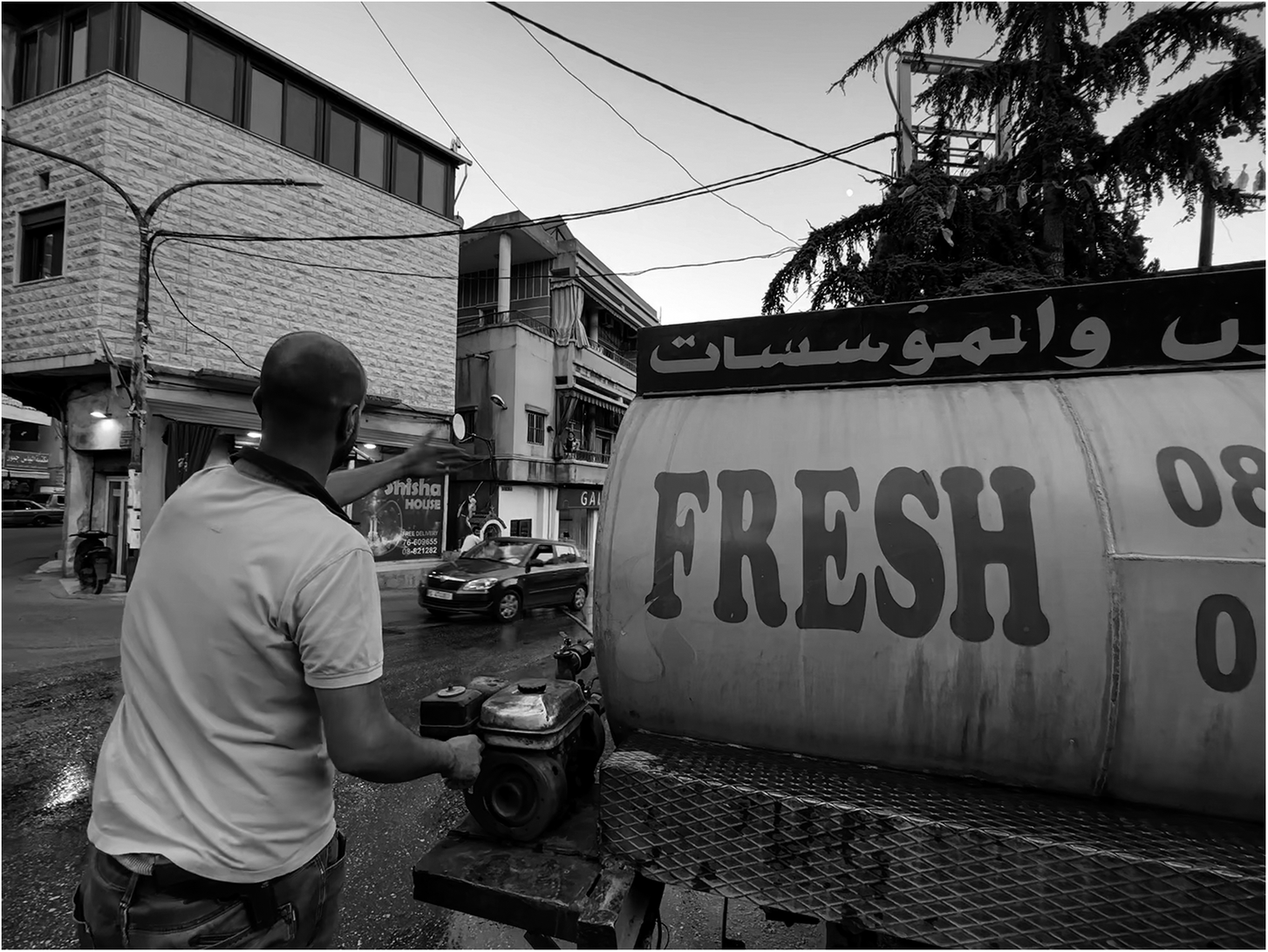
Tony directing his worker. Author photograph.

I had just begun my relaxed introduction to Michel in his shady jneyneh (garden) when his elderly mother joined us carrying a pitcher of homemade mulberry juice, made with berries from a nearby tree. This serene garden was idyllic, against a background of the commotion of engines, pumps, and shouts on the other side of Michel’s home, which doubled as a filling station and center of trucking operations. Michel was one of the first water truckers in Zahle and claims to host the longest running enterprise in the region. A Zahle native, Michel and his family also owned land in Madina Sinaiyya, an industrial neighborhood located at the foothills of the city as it bleeds into the valley’s plains. After Lebanon’s War ended in 1990, Michel and his parents built a home on this agricultural land, which was quickly urbanizing as postwar investments were made in the periurban landscape.Footnote 26 Their land, like much of the Bekaa valley, was located on a rich aquifer. Wells were dug for irrigation purposes. As the 1990s progressed, Michel realized his excess water could become a valuable business. With infrastructure remaining in disrepair following the war, water often failed to arrive at many residents’ domestic tanks. Michel recognized this need and, having an excess of water on his land, decided to begin selling this valuable resource.
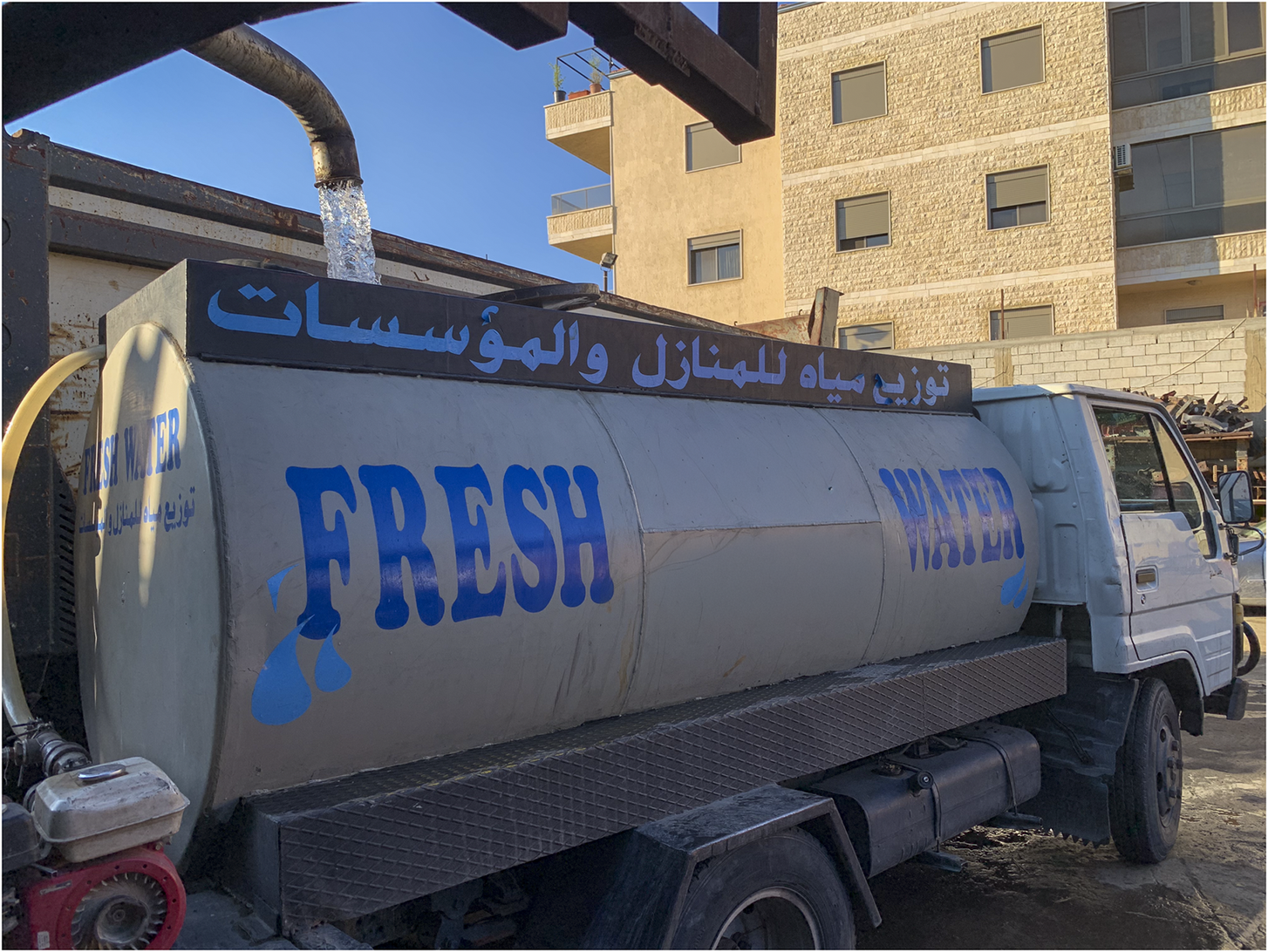
Michel’s first water truck was rudimentary, consisting of a large tank vessel with wheels, hauled by a tractor. A pump was built on the tractor’s water tank and used to fill domestic cisterns on one’s roof. This was, according to Michel, the first iteration of water trucks throughout Lebanon. Over time, the infrastructure evolved to pick-up trucks that carried filled water tanks in lieu of a single large metal vessel. The infrastructure reached its final evolution in the form of citernāt, or tanker trucks, which are currently most common among private distributors in the country (Fig. 4). Michel bought his first citern in the early 2000s—later than others in the country but one of the first in Zahle. With time he upgraded his station: he improved his well to pump more water, more consistently; he expanded the concrete driveway to allow more trucks to enter his station; and he installed a reservoir to hold water after the well was powered, to maximize the value of energy spent. His business started exclusively as a water filling station but also became a gasoline and diesel station for passersby, with underground tanks installed to hold the fuel.
Tony’s truck filling at his well and reservoir. Author photograph.

Having invested in his station’s broader infrastructure, Michel began to advertise the business, persuading others to buy trucks for water delivery. He convinced his friend George to invest in water trucks; George, in turn, suggested Tony buy a water truck as a side gig. Although George and Tony now possess their own private water sources, Michel remains the filling station for many others, including Jad. This linear expansion of water trucking—from Michel to George to Tony—highlights the relational dimensions of the work and the lack of competition amid great need. The composite and upgradable form of water trucks and their filling station also speaks to the malleable conditions of the infrastructure.
The postwar expansion of domestic trucking reflects the particular needs of the Bekaa’s residents; namely, the insufficiencies of a damaged and neglected water network requiring an auxiliary form of distribution. These deficiencies reflect broader absences, failures, and abandonment of governmental support.Footnote 27 The common refrain in Lebanon, mā fī dawleh (there is no state), does not simply describe the government’s failure to ensure rights and protections, but also the inadequate servicing of (infra)structures that facilitate everyday life. Infrastructure breakdown (as Jad would say, maʾtouʿ) is not an exception to daily life in Lebanon, but a problem around which daily life is arranged. It is also a condition that goes back to long before the 2019 crisis. In Lebanon, the quintessential feature is the absence or presence of electricity, which is only minimally provided by the state and more commonly accessed through neighborhood-level private generators (moteur).Footnote 28
Much as moteur provide a central yet technically auxiliary role of electricity provision, water trucks are increasingly functioning not as temporary providers, but instead becoming integrated with the web of provisions that constitute standard water infrastructure. Water trucks are undesirable not simply for the required coordination for water delivery, but also the redundant costs of water access, the noisy roar of the water pump, and concerns regarding water quality. And when life is maʾtouʿ, not only do informal auxiliary actors fill in the gaps when piped infrastructures fail, but the very foundation of everyday life becomes dependent on the integration and function of such informal infrastructure.Footnote 29 And as trucks are not simply metal and rubber, but depend on flesh and bone, human labor and its social textures are central to this infrastructure.Footnote 30
The Gender and Class of Water Trucks
“You have to be an ʾabaday to work on a truck,” Jad smiled, flexing his arm for emphasis. A term widespread in Lebanon and especially Zahle, with its legacy of masculine independence, ʾabaday means a strong man, virtuous and manly, daring and honorable.Footnote 31 In her study of Zahle, historian Alixa Naff writes, “An abaday is the possessor of all the heroic qualities portrayed in the legends and tales; he is primarily a warrior, but more than that, he is the social ideal as every man sees himself or aspires to be.”Footnote 32 Jad offered the term playfully, as do most men in Zahle these days. Yet the gendered dimensions of theʾabaday reveal the pride that many truckers have in their work. After all, it is not easy (Fig. 5). Perils exist at all stages of domestic water trucking. Many roofs lack proper railings, and are riddled with exposed rebar, electric wires, pipes, and other tripping hazards. The hose itself is bulky and heavy, possessing a force of its own when water courses through it. And driving the truck requires immense skill. The sheer force of its contents moves at a continuous velocity, resisting the truck as it brakes. To climb and descend Zahle’s hillside streets while managing this unruly cargo requires expertise of the driver. The liveliness of water trucks, with their energy-broaching agentive qualities, becomes a beast to be wrestled and guided by masculine ʾabaday labor.Footnote 33
Raising (or lowering) the hose. Author photograph.

The pride of operating a water truck is reflected in the drivers’ relationships with their vehicles. The very nature of the water truck—its size and noise—defines its visibility; those who own and operate the trucks are similarly made visible by the work, and make themselves visible for the sake of attracting new clients. The trucks and their drivers thereby merge together. Tony is known for his cylindrical vehicle, with blue text reading, in English, “FRESH WATER,” and in Arabic, towzīʿ al-miyāh lil-manāzil wa al-muʾsasāt (Water Distribution for Residences and Establishments). Jad is known for his larger, box-shaped green truck. George’s two trucks are unadorned, painted white, with no advertising. When I asked him how people knew about his trucks if they were plain, he told me with pride: “I have been in this business [of diesel and water distribution] for ages (min zamān), for thirty years. All of Zahle knows that I have trucks that are clean and very white (nẓīf wa abyaḍ abyaḍ). When they see a truck that is clean and tidy (mrattab), they know it is mine.” More than inert metal and tire or lively flesh and blood, Zahle’s water trucks and their drivers are entangled; they come to represent one another. They are made legible not simply by the colors of the truck or the words on the tank, but by the broader social formations of Zahle and Lebanon—those based on kinship recognition and perceived familial proximity.Footnote 34
For the drivers themselves, navigating a maʾtouʿ condition invites an entrepreneurial sensibility. The truck owners are often middle-class or aspiring middle-class Lebanese men. Importantly, “class” here involves both financial and social capital, because purchasing a truck requires both fluid funds and an established reputation, qualities unique to Lebanese citizenship and longtime residence in the area. Most water truck drivers are well connected and well known—they have often been in the business for a number of years, or are associates of others who have taught them what they know. With minimal profits and growing costs under Lebanon’s hyperinflation and fuel shortages, many truck drivers manage multiple jobs. But the market for water trucks is socially regulated in a city like Zahle—small enough for word to pass quickly, yet large enough to require a range of truckers operating together.
This middle-class, reputation-driven quality of the truck driver contrasts with his crew: often one or two Syrian men, ranging from teenaged to middle aged. Water trucks, like other infrastructures, have a co-constitutive relationship with social stratification; that is, infrastructures both reflect and structure social difference.Footnote 35 In contemporary Lebanon, this is especially true along lines of nationality. Due to the unregulated state of domestic water trucks, the informal conditions of Syrian labor, and the economic crisis extant since 2019, Syrian labor on trucks is often exploitable. Lebanese regulations prevent Syrians from formal employment outside of agriculture and manual labor. And although Syrian children are officially guaranteed education through Lebanese schooling, the quality is often poor and lasts only through primary school. Therefore, as in other landscapes marked by widespread displacement, there is an abundance of young Syrian men in Lebanon who are eager for work but have limited options.Footnote 36 Younger men can often accept lower wages, presumably lacking the familial responsibilities and debts of husbands and fathers.
Each driver has their own standard for hiring and paying their crew. Jad will usually work with men in their 30s, looking for someone more skilled and professional, whereas Tony often works with younger Syrians, between sixteen and twenty years old, who are not as financially demanding. Some drivers gather their crew from familial relations, like George, who rides with his sixteen-year-old Syrian nephew, Jihad, who also works the grounds at his filling station, reflecting the kinship ties between Lebanese and Syrians. “He’s like my son and he’s very sharp,” George tells me, slapping Jihad’s knee while driving to a delivery. Although camaraderie and trust develop between drivers and their crew, who are often joking amid stressful deliveries, many drivers avoid hiring family due to the stress and danger of the job. Ultimately ʾabaday labor remains a transactional relationship rooted in class, national, and sectarian differences.
Sectarianism and the Concerns of Mobile Infrastructure
“We’re going to a Shiʿa area next. Hizbullah,” Tony smirked, over the roar of the engine and the jostling of the truck. “You’re an American. Are you afraid? Don’t be afraid, they won’t kidnap you. I’m with you,” he continued, over my chuckles and gratitude. “Yaʿtīk al-ʿāfiyeh (God give you relief),” I replied: a playful response to his tongue-in-cheek comments.
I was squeezed between Tony and Khaled, a 16-year-old Syrian from Aleppo who’d been assisting Tony for three months now. Tony, a 33-year-old Maronite Christian, has lived his life in Zahle. Working primarily with the Lebanese Internal Security Forces, Tony spends his days stationed at Baalbek, a Shiʿa majority region in the Bekaa valley also known to have a significant Hizbullah presence. Tony’s playful comments stem from the convergence of these facts, in addition to the geographical context: traveling from the Christian-dominant city of Zahle, through mixed neighborhoods like Maʿalaqa, into majority Shiʿa regions. The fluidity of these shifts emphasizes the banal occurrence of sectarianism in its territorial valence. If a client is within reasonable distance, Tony will travel there regardless of sectarian affiliation; yet the geography of sectarianism informs his consciousness of space and potential clients.
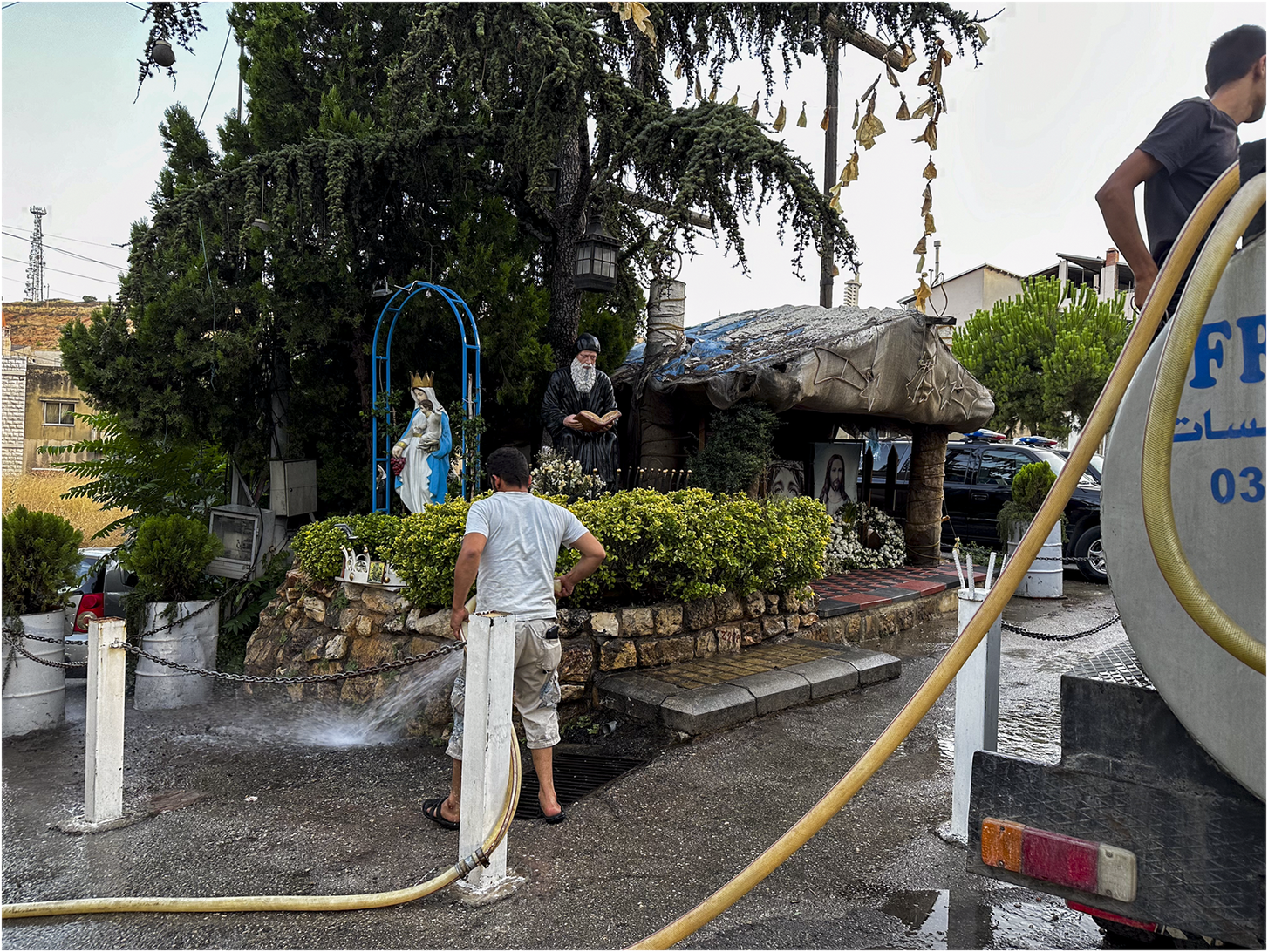
Water trucks offer insight into sectarianism, and territory and its relation to infrastructure. Although commonly understood as a descriptor of politics and social demarcation, sectarianism is a central territorial feature in Lebanon.Footnote 37 Villages, neighborhoods, and even specific streets territorially demarcate sectarian affiliations (Fig. 6). These associations are fundamentally relational and processual; they are therefore in constant negotiation, reformation, and subversion.Footnote 38 Although sectarianism is centrally a social formation, it is bolstered by and emerges from a series of material channels. Infrastructure specifically plays a key role in demarcating space along political and sectarian affiliation in Lebanon, especially for continuous services requiring protracted connections for access, such as electricity.Footnote 39 Therefore, although sectarian affiliations are ongoing and changing processes, often the forms of material infrastructure are static and immovable, or limited to the reach of cables, pipes, or other predictable circuits. Water trucks in their mobility and punctuated appearances subvert the rootedness that reifies sectarian difference. Water trucks are therefore relieved of territorial sectarian limitations even as they remain caught in its web of associations. Financial and technical constraints most dominantly define a water truck’s reach: a truck can only travel so far—burn so much petrol—and still make a profit. The size of a truck’s tank also determines the frequency with which it needs to return to a water source for refill before further distribution. Trucking is therefore constrained by the recurrent and circuital distance between the water filling station and the client.
A Zahle Resident borrowing Tony’s hose to wash the saints. Author photograph.

But, fundamentally, a water truck’s reputation is most central to its success, a factor informed by but not restricted to preferences of sect. Residents often call truck drivers they have used in the past or have been referred to. Tony’s client in the nearby Hizbullah territory is a regular, due to a continued fault in the residence’s water line and Tony’s established trust. If a driver is too busy to service a client, he will suggest an alternative colleague, expanding a client’s network of reputable trucks. Water trucks reveal the inherent porosity of social and sectarian divisions, and indeed foster connections and associations across such differences. They are active in both maintaining and subverting the sociomaterial terrain.
Crucial to navigating the social terrain is a driver’s reputation and the viability of a truck’s water source. The viability of water sources is a factor that overshadows much of the unregulated and uncertain domestic water trucking business in Lebanon. I am reminded of an interview with Joseph, an engineer for the Bekaa Water Establishment (BWE). We had just finished a two-hour tour of Zahle’s central water network before I probed his thoughts on domestic water trucks. “I’ll never call a citern,” he told me. “You never know their source. I once saw a water truck filling its tank from the Litani River.” I gasped with genuine concern, given the Litani’s infamous association with waste and pollution. “Yes. You know, on that road you can’t even walk outside because the river smells so bad. But the drivers just throw some chlorine in their tanks and it’s easy money.” With a decade’s experience at BWE, Joseph carries a calibrated consciousness of water quality. His concerns stem not only from the unregulated nature of water trucks, but the practice of their operations, as they transfer and move water from one location to virtually any other. Untethered from a discrete source and lacking regulation, water trucks exist in a shrouded zone of uncertainty—a zone that suggests disturbing possibilities.
These conditions speak to the parasitic dimensions of domestic water trucks: being not of the piped water distribution network but still located within it.Footnote 40 From this perspective, domestic water trucks benefit from the shortcomings of standard distribution, as residents grow dependent on apparently parasitic elements for the adequate function of normative infrastructure. The presence of water trucks reveals the openings created by the distribution network, that is, a home’s accessible water tank. This opening allows water trucks to provide necessary relief when water is scarce (the continuation of everyday life despite moments of temporary breakdown) even if from an unknown and potentially contaminated source. In the context of Lebanon and as mobile entities carrying uncertain cargo, water trucks weave through zones of inclusion and exclusion, formality and informality, purity and danger. As opposed to a closed piped network with defined entry and exit points, trucks uproot water from its origin, draining the liquid of its associated source. Lack of water causes fears about water quality in contemporary Lebanon; it can become a fearsome substance to be met with trepidation.
Although Joseph’s story of truckers drawing from the Litani, Lebanon’s primary and notoriously polluted river, is dramatic, most water truckers in Zahle and its vicinity obtain water from private wells. The water drawn from these typically 50-meter boreholes appears pure, or at least adequate for the domestic purposes of washing and cleaning. No domestic truck driver would endorse consuming their water, but all assume a degree of sufficient purity, in the absence of regular testing. There remains an assumption that water drawn from underground sources is clean enough, despite complaints of Lebanon’s environmental degradation, often blamed on expanded Syrian settlement since 2011.
Indeed, in the Bekaa valley, Syrian settlement has become for many Lebanese a metonym of environmental degradation. “They’re shitting in the water,” George whispered, pulling me to the corner of his filling station to peer through a chain-link fence at a modest three-building Syrian settlement adjacent to a stagnant body of irrigation water. I heard this refrain throughout my time in Lebanon—that these off-grid Syrian settlements dump their waste in nearby water paths. Humanitarian actors challenge such accusations, as they manage the sizable budgets and are responsible for surveilling the efforts to desludge the settlements’ septic tanks. Although minimal seepage from these flimsy underground tanks is inevitable given Lebanese regulations mandating that these informal settlements remain off-grid, the majority of this wastewater is trucked to nearby treatment facilities. Syrians have become principal scapegoats for Lebanon’s cascading failures, particularly environmental degradation.Footnote 41
Although monitoring desludging trucks has been challenging—certainly, there were rare cases of desludging trucks offloading their cargo in the Litani to save petrol amid Lebanon’s 2021 fuel crisis—the cause of widespread pollution stems primarily from Lebanese municipalities. According to official reports, only 8 percent of wastewater produced in Lebanese municipalities undergoes primary treatment; the rest—92 percent—is released untreated into the Mediterranean Sea, various river bodies, or trenches that seep into aquifers, polluting the waters hidden below.Footnote 42 As a result, an estimated 87 percent of groundwater 120 meters in depth is contaminated in Lebanon. Such contamination includes chemical and biological pollutants stemming from industrial and agricultural toxins, and wastewater seepage. These startling realities are facilitated by the overdrilling of boreholes, which generates porous geological formations, allowing aquifers and their contents to bleed over vast distances. According to interviews with hydrogeological experts, if wastewater is mismanaged on one side of an aquifer, it can affect groundwater multiple kilometers away. This cascading failure makes most of Bekaa’s underground water unpotable; at shallow depths, pumped water almost certainly carries damaging concentrations of contaminants.
Domestic water trucks—unregulated and mobile—reflect the concerns of Lebanon’s polluted waterways, which are narratively (although erroneously) tethered to protracted Syrian settlement. It is difficult to disentangle the growing dependence of Lebanese on water trucks from concerns about widespread refugee life. Indeed, a close examination of humanitarian water trucks servicing Syrians discloses not only ecological concerns, but the quagmire of political and financial challenges of relying on trucking to deliver potable water to thousands of settlements in the Bekaa. We turn to these questions now.
The Ambivalences of (Chlorinated) Potability
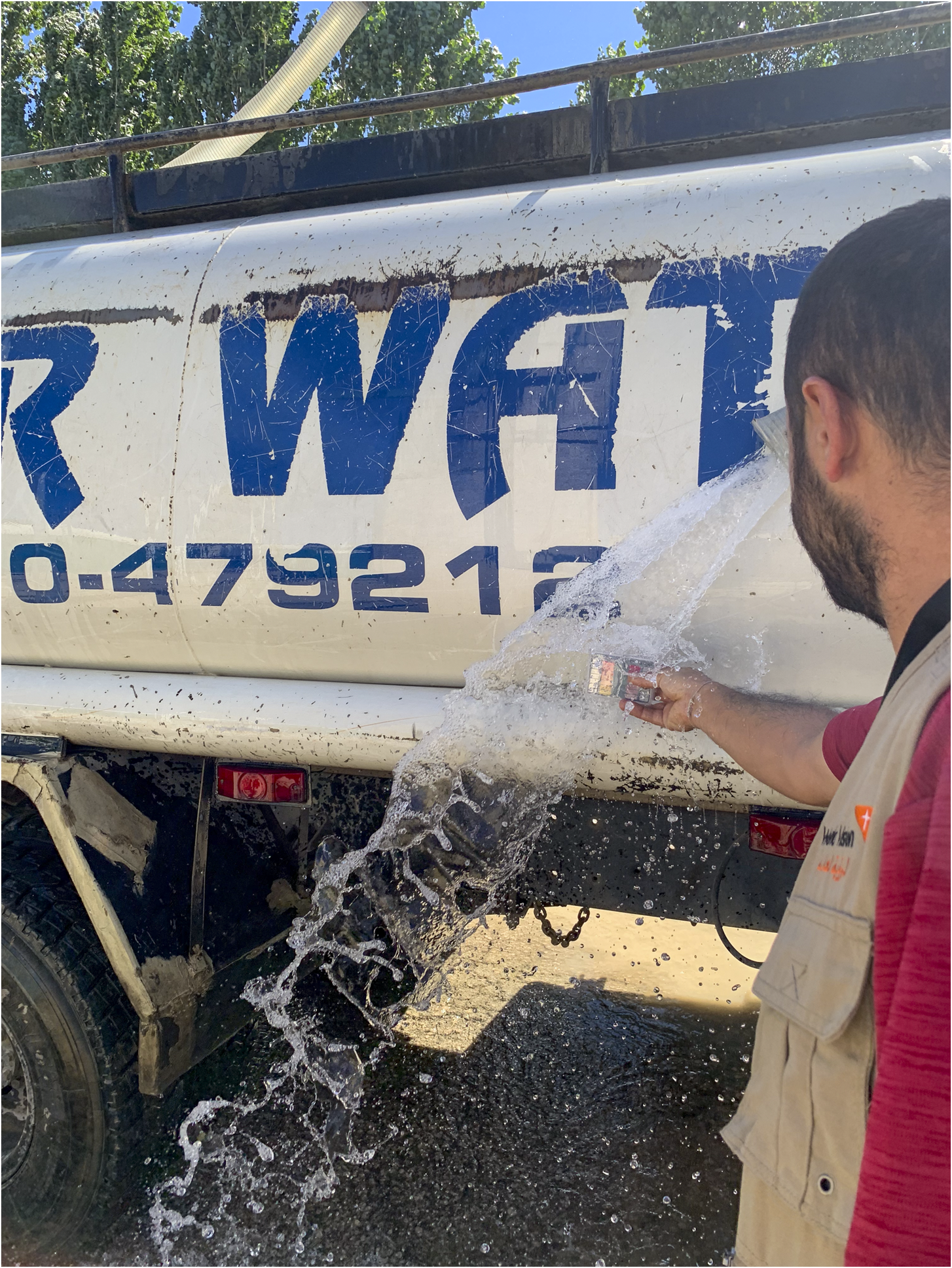
“So the chlorine is integrated in the well’s pump?” I asked Sara, a Lebanese fieldworker for World Vision, one of the primary NGOs overseeing water distribution to Syrian informal tent settlements in the Bekaa’s Zahle district. “Yes, yes,” she said, “all of the water here is automatically chlorinated.” “And the quality is very high,” joined in Ahmed, a Lebanese manager at Nasr Water, one of the major trucking companies in the Bekaa. “The pH is always in range [on] our field tests” (Fig. 7).
Humanitarian worker testing chlorine and pH of potable water. Author photograph.

Nasr Water is the most well-coordinated financed trucking company in the area. It boasts a fleet of ten trucks, a private generator to operate the well, and a sophisticated tower reservoir to efficiently fill the trucks delivering daily to thousands of nearby displaced households. The company is located on a dirt road 3 kilometers from the center of Zahle, positioned next to an agricultural field and a Syrian ITS whose residents work as crew on these trucks. On my first visit to Nasr Water, not only was Ahmed proud of the coordination he oversees, but Sara was boasting about the quality of the trucking enterprise, which World Vision, Save the Children International, and other NGOs contract with to assist displaced Syrians.
As opposed to domestic water trucking that is unregulated and therefore delivers cargo of an uncertain quality, potable water trucking is a highly regulated—and lucrative—enterprise, overseen by a network of NGOs, operating throughout Lebanon on an annual budget of roughly $35 million. The standards of water provision are established nationwide by a collection of NGO and Lebanese governmental actors. A range of NGOs are then assigned various regions to service, granted a budget based on the number of ITSs, and contract water trucks accordingly. Contracting occurs on an annual basis by listing a tender and sorting applications. Because these contracts are paid in US dollars, they are highly sought after and competitive. Because the NGOs require a certain standard of operation, not all qualify. Often, it is water truckers who have previously contracted that are selected again, because, like domestic water trucks, reputation plays a part in company selection, as do experience and overall qualifications. Within the lucrative and protracted business of humanitarian water trucking, a handful of trucking companies—such as Nasr—have developed and expanded their operations, becoming too big and efficient to fail the annual tender application.
Each household in an ITS receives at least one 1,000-liter tank. This water is refilled twice weekly by trucking, for an amount reaching 35 liters per person, per day—a quantity informed by international standards and set by the humanitarian water, sanitation, and health (WASH) working group in Lebanon.Footnote 43 Because this water must be potable grade, water truckers undergo a series of inspections to receive a contract: they must possess a number of functioning water trucks, a private, tested water source, and a crew sufficient to meet labor demands. Deliveries are logistically facilitated by a centralized database that has cataloged each ITS based on the number of households and structures. There are more than two thousand ITSs throughout the Bekaa valley. Provisions and needs are documented through this database, as are the coordinated efforts of water trucking and desludging. All water for humanitarian provision is chlorinated to ensure its consistent potability and undergoes daily field tests that ensure the cargo meets adequate measurements of chlorine and pH.
Sara continued, “Even though it’s tested and high quality, they don’t like how our water tastes, how it goes with the tea.” We were driving behind some Nasr Water trucks, from the filling station to a large settlement to observe distribution. I had just asked Sara if the chlorine impacts the flavor of water, even if it is measured within a safe level for drinking. “To them [Syrians], tea is a very sacred tradition,” she continued. “So they’ll make tea from a different source, and use our water for other purposes.” Although Sara offered “sacred” as a tongue-in-cheek (if not belittling) comment, it reveals a difference of consciousness regarding water and its plurality between humanitarian workers and their beneficiaries.Footnote 44
Potability here exists as a scientific category of humanitarian assistance—testable and verifiable—more than a marker of water’s desirability. Although chlorine is effective at eliminating harmful biological life, it adds a bitter flavor, transforming water into a secure yet ambivalent substance. Such conditions reflect fundamental humanitarian logics, because beneficiaries are cared for primarily, and at times exclusively, by the metrics of survivability (liters of daily water, quantity of calories consumed, etc.), more than a diversity of desired provisions.Footnote 45 Not only do logistical and financial constraints determine these dynamics, but politics play a key role. In a context like Lebanon, constraints of water provision have more to do with regulations imposed upon the humanitarian sector by the Lebanese government than the wishes of humanitarian workers. Indeed, it would be financially cheaper, environmentally healthier, and logistically easier for ITSs to receive piped chlorinated water from municipal lines than to rely wholly on trucking. Yet installing pipes would, according to governing authorities, breach the boundaries of impermanence, possibly integrating Syrian life in Lebanon indefinitely. Such solutions have been vehemently rejected by Lebanon’s Ministry of Energy and Water.
For on-grid piped water distribution in Lebanon, domestic and potable waters remain segregated substances. Yet according to the humanitarian logics of off-grid assistance, the exclusively potable condition collapses the plurality of water’s form in ITSs. Whereas domestic water trucks are haunted by the uncertainty of their cargo’s quality, water used in humanitarian trucking is made potable with the purifying rite of chlorine. From my interviews with Syrians in ITSs, this regulated water—purified chemically and accordingly bitter in taste—becomes for many an ambivalent resource stripped to its base utility: a substance suspended in tanks for a population suspended in displacement. Such bitterness is the reminder and result of a maʾtouʿ life in the off-grid interstices of the Bekaa’s agricultural fields. Removed from the piped networks which shape the material connections between on-grid residents, Syrians in ITSs instead live a presumably segregated life that is infrastructurally disconnected from Lebanese society. However, as Syrian life remains protracted in Lebanon, the reliance on water trucking becomes an expensive and untenable reality.
Anxieties of Humanitarian Water Trucks
In August 2022, Ralph, the Lebanon WASH coordinator, reviewed his budget. Since he had taken the position five months before, he had known that the dependence of ITS on water trucking was an unsustainable reality. Informed by his European humanitarian education and a decade of experience in the region, trucking potable water was, in his opinion, reserved for emergency situations; a tactic used in punctuated moments of need for people living in short-term displacement. Yet like many conditions in these settlements, short-term strategies became protracted solutions, if only because all other sustainable solutions—like integrating ITSs in piped infrastructures—are rejected by Lebanese officials. But in 2022 global humanitarianism was unprecedentedly burdened. Russia invaded Ukraine in February of that year; a new wave of Afghan refugees had spread the previous year. Funding for protracted crises, of which Syria was the most significant, began to dwindle. Grants carried with them eligibility restrictions to target certain world regions, and funding for Syrian assistance dropped.
When Ralph arrived in April, he saw the writing on the wall. He told his team they needed to find ways to lower costs. This meant primarily less reliance on water trucks, which were too expensive to maintain. Alternatives included installing chlorination or reverse-osmosis mechanisms in private wells for ITS, or installing community wells near the settlements. After all, Ralph told me, most ITSs were built on or near agricultural tracts and possessed irrigation wells reaching aquifers with seemingly endless supply. Yet Ralph and his team made little headway, meeting political resistance and overcome by the busyness of daily work. When he reviewed the budget sheets in August 2022, he realized the only possible solution: cut the trucked water quantity to Syrians from 35 liters per person per day to 7.5 liters.
At the monthly WASH sector meeting, Ralph and his team notified all of the water-related NGOs in Bekaa: UNICEF, World Vision, Save the Children International, Norwegian Refugee Council, Oxfam, MedAir, We World GVC, and others. It would take significant coordination to enact this updated regulation, but it was necessary based on the budget constraints. Within the next week, notice was made to all affected groups, including the water truck companies and the Syrian residents of ITSs themselves. What happened next, Ralph tells me, was unexpected.
Protests started outside NGO branch offices in Zahle. Syrians claimed that water was a right, and that it was unacceptable to have it reduced by such a significant quantity overnight. This reaction was a shock to humanitarian workers. They thought that Syrians would trust the austerity measures given the financial crises all were experiencing. As days went on, things escalated. In a northern Bekaa town, about 70 kilometers from Zahle and its NGO headquarters, it was not Syrians who protested but the Lebanese water truck companies. They used their massive vehicles as a barricade, blocking the main roads in and out of town to all humanitarian workers. The NGOs, unable to reach the ITSs in the area for weekly or daily assistance, were effectively coerced by the water truck drivers to increase the quantity of provided water, thereby increasing their work and salaries. The WASH coordinator was forced to concede, and water provision became patchy, differing in quantity based on region rather than uniformly provided in equal amounts to all, a practice that betrays standard humanitarian practice.
Amid this chaos, within the next month, cholera appeared. Likely originating in neighboring Syria, the outbreak spread due to widespread usage of contaminated private wells by the Lebanese amid energy crises. But dominant media narratives pinned the outbreak on Syrian settlements, a result of presumed contaminated life off-grid. After cholera arrived, the WASH sector was able to apply for emergency UN funding and return water provision to 35 liters. Within a few months, widespread humanitarian support controlled the outbreak. “Cholera saved us,” Ralph told me. But once the emergency funds ran dry, Ralph would return to square one: relying on expensive and unsustainable solutions to address a protracted crisis.
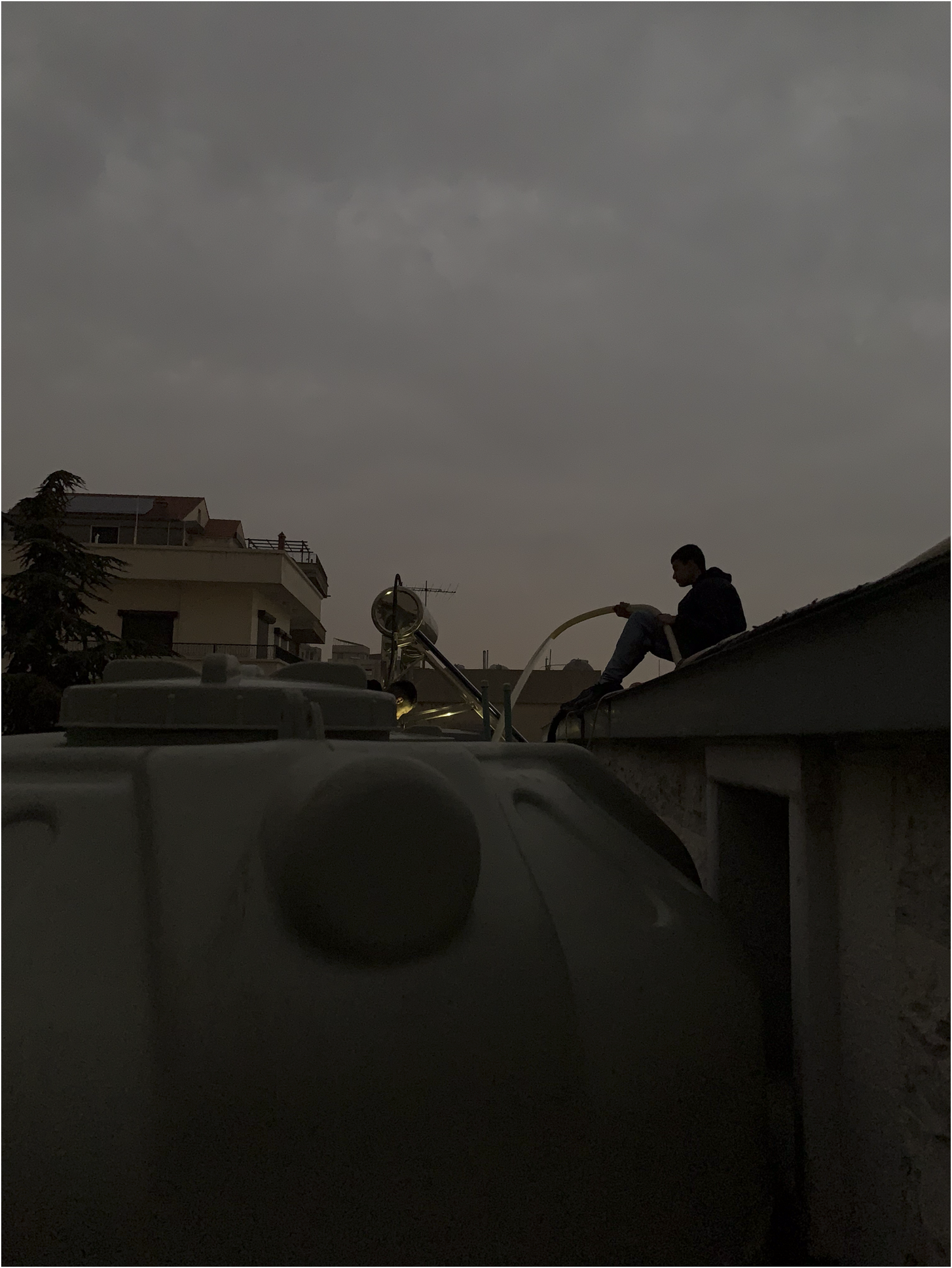
Humanitarian water trucks bring into relief the intersecting dimensions of water as a right and water as a commodity.Footnote 46 Syrians protesting the reduction of water did so based on rights; water truck drivers protested their loss of work. Yet within the cascading crescendo of crises—protracted displacement; economic hyperinflation; spread of disease—water trucks became more than mundane features of humanitarian assistance: they were central actors resisting change. Precisely because of the vital need for water trucks—as the providers of a basic essential, and therefore the arbiters of life and the possibility of death—this infrastructure carries with it active (bio)political power, an ability to challenge governing actors and reverse policy decisions set by international authorities. When the tank faces perpetual depletion, water trucks carry the capacity to both relieve and heighten the burdens of a maʾtouʿ world. Water trucks absorb and reflect the struggles and opportunities generated by life under threat (Fig. 8). From a close attention to their operations and effects we can better understand how life is maintained in a world increasingly marked by breakdown and ruin.Footnote 47
Water truck assistant at dusk, on edge of roof, hose taut. Author photograph.

A Compromised Solution
“Khalas?” I asked, as we walked into the butchery, the site of Tony’s family’s profession and a source of his supplemental income. Finished? “Ayy,” he said, moving around the desk and plopping down on a chair, before quickly reaching in his pocket for a cigarette. After a series of deliveries, the butchery became a place of respite, with Tony or his brother Maroun offering a cup of coffee to pass the time. Yet the silence of this afternoon highlighted its somber interior: the icons of Saint Charbel were chipped and dusty; the plastic chairs were cracked and stained; the desk was covered with images of Tony’s father, the famous butcher recently taken by cancer; and the buzz of a fly seeking meaty sustenance echoed. After taking a few drags of his cigarette, Tony leaned forward.
“Look habibi, my friend, do you know anyone who needs a worker outside of Lebanon (barra)? I want to leave. I have skills: I know how to drive a truck (camioun). And I work with the Internal Security Forces. And I work in the butchery. If there’s someone who can take me from here, I will work. Sorry, it’s just very hard here and I want my family to live well.”
I was still new to Tony, having only been on a few deliveries this summer of 2022. Yet his words were familiar. It felt like Zahle—indeed, all of Lebanon—was a shell of its former self after 2019. If folks hadn’t yet left, they were considering it. The economic crisis was severe, and it turned Tony’s public sector salary into pennies. Although water trucking and the butchery provided a supplemental wage, Tony desired more for his two children, still in elementary school. I promised Tony I would let him know, and shared with him how difficult migration and visas are for noncitizens.
The lives of water trucks and their drivers in Lebanon reveal a failure of normative (infra)structures to manage daily life. More than an exception, Lebanon increasingly feels like a case study in something commonplace: the systems we rely on breaking down, falling short, maʾtouʿ. The conditions are entangled in cascading effects on a range of scales: global crises strain limited humanitarian funds; underground overextraction leads to widespread contamination; refugees seek safety in a neighboring country, whose citizens flee under economic pressure.
Amid these suffocating circumstances, water trucks represent relief—even if temporary—to the burdens of a cut-off life. Although limited in their ability, they provide respite from the liminal enclosures of collapse; a collapse both experienced and subverted by the trucks’ raucous, hazardous, life-giving operations.Footnote 48 Although momentary, this relief infrastructure challenges the stucked-ness of crisis, granting enough leeway to continue on in maʾtouʿ conditions until underlying structures are repaired or another path appears.Footnote 49 As breakdown becomes the norm, water trucks become integrated as expected actors of distribution. But fuel costs and financial constraints make water trucks unviable as single sources of livelihood, leaving drivers to require a repertoire of labors. Given these limitations amid ruinous conditions, water trucks remain a compromised solution for both drivers and clients, but nevertheless provide necessary, if temporary, relief, sustaining everyday life.
Finishing our coffee in silence, Tony’s phone rang. After a few moments of chatting he jumped up, patted me on the back, and walked out the door. “Yalla,” he said, Let’s go, “another delivery.” I walked outside to the truck, hopped in the passenger seat, and we were off. The rumblings of the engine and a trickle of water marked our trail.
Acknowledgments
This paper would not exist without the water truck drivers of Zahle and the Bekaa valley, who accepted my presence and assistance on dozens of deliveries. I also thank several interlocutors in Lebanon’s water sector, including employees of the Bekaa Water Establishment and various NGOs. Early drafts of this paper were presented at the Middle East Studies Association annual conference, the Anthropological Society in Lebanon, and the Arab Political Science Network workshop, “Politics of Infrastructure in the Middle East.” I am grateful to all who provided comments, especially Samer Abboud, Jowel Choufani, May Darwich, Dhouha Djerbi, Pascal Menoret, Ahmed Morsy, and Noura Wahby. I also am indebted for the careful reading and feedback of David Nugent, Sa’ed Atshan, Peter Little, Kristin Phillips, Michael Peletz, Shreyas Sreenath, and Sasha Tycko. I am very grateful to the editors of IJMES, especially Lara Deeb, Heather Ferguson, and Ayat Agah, for their astute comments and trust in this piece, and for the generative comments of the three anonymous reviewers. Finally, I offer thanks to Emory University’s Fox Center for Humanistic Inquiry and Harvard University’s Weatherhead Center for International Affairs, which provided intellectual homes as I developed these ideas.
This work was supported by the National Science Foundation Doctoral Dissertation Research Improvement Grant (DDRIG) under grant 2049460; and a grant from the Dr. Philip M. Kayal Fund for Arab American Research.

 Open access

