Introduction
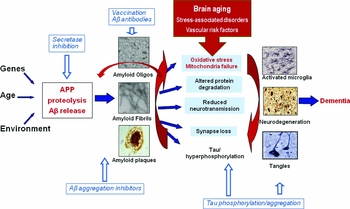
Much of the current research into treatments for Alzheimer's disease (AD) focuses on dysfunction of the amyloid cascade, which is traditionally considered to be a linear sequence of events (Figure 1). Certain events are active earlier in the disease course: for example, oxidative stress and mitochondrial failure promote altered protein degradation, reduced neurotransmission, accelerate synapse loss and tau-hyperphosphorylation. Triggers such as genetics, age and environment may affect processing of amyloid precursor protein (APP) and hence generation of beta amyloid (Aβ), which aggregates into amyloid oligomers and fibrils and finally their deposition as plaques. Each event in the amyloid cascade is an important trigger for the changes that ultimately result in AD. Some agents may be able to interfere with this cascade, providing a degree of neuroprotection from the development of this condition.
Amyloid-β cascade hypothesis and potential intervention strategies.

Oxidative stress and mitochondrial failure
Wu and colleagues used the model organism Caenorhabditis elegans to evaluate the pharmacological effects of standardized Gingko biloba leaf special extract EGb 761® on aging and to test the hypothesis that this extract augments the natural antioxidant system of C. elegans (Wu et al., Reference Wu2002). The results showed that treatment of wild-type worms with EGb 761 reduces oxidative stress and also extends median lifespan compared with controls. EGb 761 is a dry extract from Ginkgo biloba leaves (35–67:1), extraction solvent acetone 60% (w/w). The extract is adjusted to 22.0–27.0% ginkgo flavonoids and 5.0–7.0% terpene lactones, consisting of 2.8–3.4% ginkgolides A, B, and C and 2.6–3.2% bilobalide and contains less than 5 ppm ginkgolic acids.
Mitochondria are producers of reactive oxygen species (ROS), and dysfunction of the mitochondria has a central role in aging and is an early event in neurodegenerative diseases (Abdel-Kader et al., Reference Abdel-Kader2007). Aged mice (18 months old) were treated with EGb 761 for 14 days and the cortical brain cells were then investigated post-mortem for the presence of ROS using fluorescent dyes. Levels of ROS and particularly the superoxide anion radical O2− (an aggressive form of ROS formed as an unwanted by-product of mitochondrial respiration) were reduced in brain cells from EGb 761-treated mice compared with controls (placebo-treated mice). EGb 761 thus provides antioxidant effects.
A high mitochondrial membrane potential is vital for the production of adenosine triphosphate (ATP), which has an important role in intracellular energy transfer. In a study by Eckert et al. (Reference Eckert, Keil, Scherping, Hauptmann and Müller2005) in aged mice (22 months old), brain cells were isolated and subjected to oxidative stress through the application of hydrogen peroxide. Control mice exhibited a consequent reduction in membrane potential, which was followed by a reduction in production of ATP. In comparison, brain cells from mice treated with Ginkgo biloba extract EGb 761 were protected from the effects of hydrogen peroxide, which had a reduced effect on ATP production. Shi et al. (Reference Shi2010) also investigated the impact of EGb 761 on ATP production using SAMP8 mice (a senescence-accelerated strain of mouse). The hippocampi of two age groups of mice (3 weeks and 40 weeks) were isolated and the ATP content in the mitochondria was determined. In young mice, EGb 761 had no effect on basal production of ATP; however, treatment of older mice with EGb 761 resulted in a protective effect, with levels of ATP increasing.
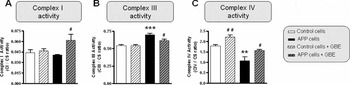
A respiratory experiment in a closed chamber investigated whether standardized Ginkgo biloba extract was able to rescue Aβ-induced defects in energy metabolism using whole cells (Rhein et al., Reference Rhein2010). In this experiment, the respiratory capacity of human neuroblastoma cells overexpressing human wild-type amyloid precursor protein (APP) and control cells (stably transfected with the empty vector) was examined under physiological conditions before and after treatment with standardized Ginkgo biloba extract for 24 hours. The oxygen concentration in the chamber decreases once mitochondria begin to consume oxygen and oxygen consumption (also called mitochondrial respiration) can be measured. When compared to control cells, APP transfected cells which chronically overproduce Aβ showed a strong reduction in respiratory capacity and coupling of the mitochondrial electron transport chain. For cells treated with Gingko biloba extract, however, a general antioxidant effect led to an increase in energy homeostasis and a reduction in ROS levels in both control and APP cells. Importantly, respiration remained improved in the Ginkgo biloba extract-treated cells even after removal of the extract, which suggests that the extract has long-term regulatory effects on mitochondria. The activities of mitochondrial enzymes that assemble the electron transport system (ETS) were also examined, with interesting results. Complex I activity was significantly increased after APP cells but not control cells were treated with Ginkgo biloba extract (Figure 2A), whereas Complex II activity was unaffected by Ginkgo biloba extract in both cell lines. Complex III activity was markedly increased in APP cells but normalized to the level of control cells after treatment with Ginkgo biloba extract (Figure 2B). Complex IV activity was decreased in APP cells but significantly increased in control and APP cells after treatment with Ginkgo biloba extract (Figure 2C). The reason for the specific effect of the drug on activity of the different mitochondrial enzymes is unclear, but it may relate to normalization of the Aβ-induced disturbance in the activity of complexes III and IV.
Modulation of mitochondrial enzyme activities by Gingko biloba extract in control and amyloid precursor protein (APP) cells. Reproduced with permission from Rhein et al., Reference Rhein2010.

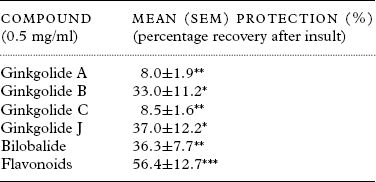
When the effects of the component compounds of Ginkgo biloba extract on membrane protection were compared, the flavonoids, bilobalide and some of the ginkgolides (B and J) had a high protective capacity (Table 1), which indicates that a combination of several compounds within the extract may contribute disproportionately for its protective effects. This is interesting, because the extract has a large effect on the mitochondrial DNA compared to levels in controls and APP-transected cells. This may indicate that activity of certain complexes is increased and is important for protective effects in terms of mitochondrial dysfunction.
Protective capacity of individual compounds of EGb 761 in brain cells (n = 6–12)
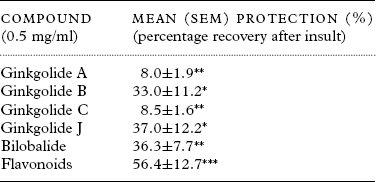
SEM = standard error mean.
*P < 0.05 versus no insult; **P < 0.01 versus no insult; ***P < 0.001 versus no insult.
Summary
A meaningful selection of data confirms that Ginkgo biloba extract has beneficial effects in terms of reducing oxidative stress and improving mitochondrial respiration, which may be useful in preventing the early stages of AD.
Conflict of interest
The author has undertaken consultancy services for Dr Willmar Schwabe GmbH & Co KG, Karlsruhe, Germany.